
The Griffith Medicine course
What you actually study, and where you will be
Griffith's MD is a 4-year (graduate entry) course taught through team-based learning in an integrated curriculum, with patient contact from Year 1 and placements in South East Queensland, northern New South Wales and rural Queensland (2027 entry). Griffith's Doctor of Medicine is a four-year graduate course taught at the Gold Coast or the Sunshine Coast, with a small rural stream in Toowoomba. Years 1 and 2 pair body-systems science, taught through lectures, practicals and team-based learning, with clinical skills, community placements and general practice sessions. Years 3 and 4 are full-time clinical training, mostly in hospitals from the Sunshine Coast to northern New South Wales, or in one rural Queensland hospital through the Longlook program.
- Degree
- MD
- Length
- 4 years (graduate entry)
- Teaching
- Integrated + Team-based learning
- Clinical contact
- Year 1
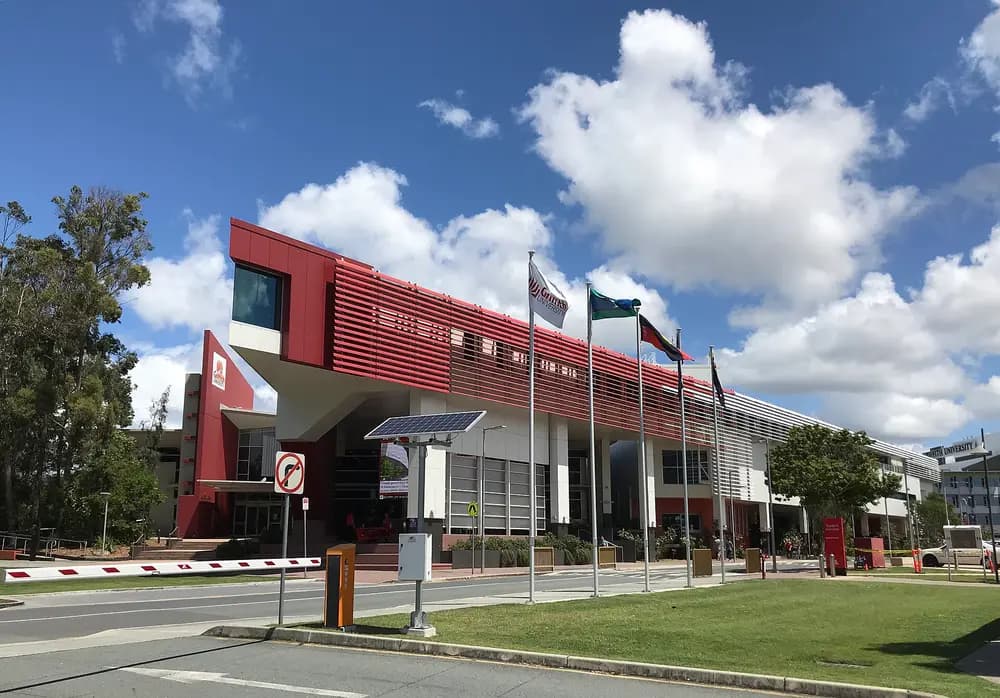
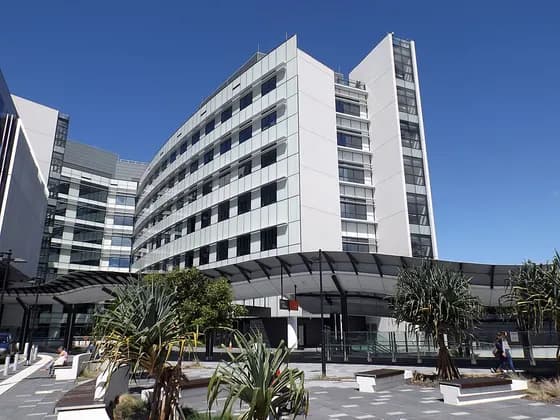


Photo: Chris Olszewski · CC BY-SA 4.0 · cropped
Photo: Shiftchange · CC0 · Photo: John Robert McPherson · CC0 · Photo: Do japan · CC BY-SA 4.0
The Griffith medicine course at a glance (2027 entry)
Griffith's Doctor of Medicine (MD) is a four-year, full-time course for graduates, run by the School of Medicine and Dentistry. Despite the name, the MD is an extended masters degree, at Level 9 of the Australian Qualifications Framework. It is accredited until 31 March 2031 by the Australian Medical Council (AMC), which checks medical courses against national standards, and approved by the Medical Board of Australia for registration. The year runs from January to December, with 40 to 43 weeks of attendance.
Most students are based at the Gold Coast campus in Southport, next to Gold Coast University Hospital, or at the Sunshine Coast Health Institute in Birtinya, beside Sunshine Coast University Hospital. A small rural stream also teaches Years 1 and 2 in Toowoomba. In 2024 the AMC found no significant difference in results between the Gold Coast and the Sunshine Coast.
Teaching is integrated: in each of the first three trimesters you study a group of body systems in science classes while learning to examine them in clinical skills sessions. Patient contact starts in Year 1, through community placements and the General Practice Longitudinal Program. Griffith has been rebuilding the course year by year. The AMC found Years 1 and 2 on the new curriculum at its September 2024 visit, with the new Year 3 due in 2025 and the new final year in 2026.
Years 3 and 4 are full-time clinical training in six-week blocks, mostly in hospitals, at sites from the Sunshine Coast to Logan, Brisbane and northern New South Wales. Alternatively, you can spend one or both years in a rural hospital through Longlook, run with Rural Medical Education Australia (RuralMedEd). After graduating you complete an internship, your first supervised year as a doctor, before general registration through the Australian Health Practitioner Regulation Agency (AHPRA).
| Degree | Doctor of Medicine (MD), an extended masters degree at AQF Level 9 |
|---|---|
| Course length | 4 years full time, 320 credit points, January to December |
| Teaching locations | Gold Coast campus, Sunshine Coast Health Institute (Birtinya), or a small Toowoomba stream |
| Class size | 208 domestic places plus up to 35 international (2027 intake) |
| Teaching style | Integrated; team-based learning in Years 1-2, then masterclasses, case-based learning and placements |
| Anatomy | Donor bodies (Gold Coast); plastinated and digital, plus Nathan wet-lab visits (Sunshine Coast) |
| First patient contact | Year 1 community placements; GP sessions from Year 1 Trimester 2 |
| Clinical years | Hospital blocks in South East Queensland and northern NSW, or rural Longlook |
| Rural option | Year-long Longlook placement in one rural hospital, Year 3, Year 4 or both |
| Research | Preparation for Research in Year 2; optional MD/PhD for 5 to 10 students |
What makes Griffith medicine different
General practice from Year 1, not just final year
Through the General Practice Longitudinal Program you are linked with a supervising GP from Year 1. You start by watching consultations, then take histories and examine patients under supervision, and you return to general practice for a six-week Year 4 rotation. The program began on the Sunshine Coast in 2019 before reaching the Gold Coast, and the AMC commended it in its 2024 assessment.
A whole year in one rural hospital
Longlook is a Longitudinal Integrated Clerkship. Instead of rotating through six-week blocks, you spend Year 3, Year 4 or both in one rural hospital, following patients through their care and meeting the year's requirements as you go. RuralMedEd runs it at eight hospitals, including Warwick, Kingaroy, Roma and Goondiwindi, with a medical educator and a nurse educator at each site.
A four-year rural stream based in Toowoomba
Ten places are for students who take the whole course rurally. Years 1 and 2 are taught at Griffith's Rural Clinical School, its base for rural training, in East Toowoomba. Years 3 and 4 are year-long placements in Darling Downs, South Burnett and South West Queensland hospitals. Students get guaranteed, subsidised housing for all four years, with rural generalists (GPs with extra hospital skills) and GPs as mentors.
A capstone trimester before the hospital years
Year 2 Trimester 2 is three capstone courses that bridge the classroom and the wards. Transition to Clinical Practice gives a masterclass each week on a different clinical field, and you also take Advanced Communication, Law and Ethics, and Preparation for Research. The AMC singled this block out for praise in 2024.
Mindfulness and reflection built into clinical skills
Year 1 communication skills are taught through what Griffith calls contemplative pedagogy: mindfulness and reflection on your own reactions, alongside history-taking practice with simulated patients. A reflective practice module runs through the clinical courses and is assessed every trimester of Years 1 and 2. The AMC commended this step-by-step program of reflection in 2024.
How Griffith teaches medicine
Each of the first three trimesters (all of Year 1 and Year 2 Trimester 1) has the same three linked courses, numbered 1 to 3. Foundations of Medicine (20 credit points) teaches the science of a group of body systems. Introduction to Clinical Practice (10 credit points) teaches history taking, examination and procedures. Community Medicine and Professional Practice (10 credit points) covers law, ethics, public health and First Peoples health. In Year 1 Trimester 2, for example, you study the gut, hormones and reproduction while learning to examine them.
The science courses use a flipped classroom: you prepare beforehand and spend class time applying it. At the centre is team-based learning (TBL). In TBL you sit a short readiness test on your own, then the same test with your team, and then apply the material to problems as a group. Lectures, lectorials (part lecture, part tutorial), practicals and small-group tutorials fill out the week.
From the Year 2 capstone, case-based learning (CBL) sessions, where a small group works through a patient case, sit alongside weekly masterclasses and placements. In Years 3 and 4 most learning happens with clinical teams. Seminars, CBL tutorials where you present cases through an online system called OSCAR, and an online lecture series on common conditions back this up. Rural students also meet for hub days of shared teaching.
Griffith Health plans interprofessional learning, learning with students of other health professions, in three stages, from what each profession does to simulated and then real team care. The MD's 2026 course profiles include compulsory interprofessional sessions in Transition to Clinical Practice and an interprofessional practice assignment in Year 4. At the Gold Coast, students also work with other professions in CLEIMS, a team simulation. In 2024 the AMC found interprofessional learning on clinical placements largely opportunistic and set a condition to make it available at every site.
The ways you will learn
| Team-based learning | Compulsory in the Foundations of Medicine courses: six sessions a trimester in Year 1 and eight in Year 2 Trimester 1. The individual and team readiness tests are worth 10% of each Year 1 Foundations course and 5% in Year 2. |
|---|---|
| Lectures and practicals | Lectures carry the core science; in Year 1 at the Gold Coast in 2026 they ran on Monday and Friday mornings. Three-hour practicals in the Griffith Health Centre include anatomy and pathology sessions using donor and digital resources. |
| Clinical skills workshops | Two-hour small-group sessions in communication, physical examination and procedures, practised on each other, simulated patients and part-task trainers (models of a body part used to practise procedures). |
| Masterclasses and case-based learning | In Year 2 Trimester 2, twelve compulsory masterclasses and five case-based learning sessions. |
A typical week on the Griffith course
The 2026 Gold Coast timetables for Year 1 Trimester 1 show what a first-year week looks like. The year group is split into six timetable groups, which Griffith calls pathways, so your workshop times depend on your group. Other locations run the same courses with slightly different session numbers: in 2026 there were nine communication skills sessions at the Gold Coast and eight at the Sunshine Coast and Toowoomba.
You need to be available from 7am to 6pm on weekdays, and some activities can fall after hours, at weekends or on public holidays. From Year 1 Trimester 2 the timetable also includes full placement days, 8am to 4.50pm: weekly on Thursdays or on some Tuesdays, depending on your group. In Year 2 Trimester 1 it sets aside Tuesdays and Thursdays. Your own dates are set in Sonia, Griffith Health's online placement system.
Each year level runs to its own calendar. In 2026, Years 3 and 4 started on 7 January, Year 2 on 19 January and Year 1 on 27 January, and every year had a week off at Easter. Years 1 and 2 sat exams in June, then had three to four weeks off until mid July. Their end-of-year exams began on 29 October for Year 2 and 5 November for Year 1, while Year 3's final exams were in late October and Year 4's in early September.
- Monday: Foundations of Medicine lectures from 9am to just before 1pm, and a one-hour Introduction to Clinical Practice lecture at 5pm.
- Tuesday and Thursday: two-hour clinical skills workshops, plus a two-hour Community Medicine and Professional Practice workshop on one of the two days.
- Wednesday: a three-hour Foundations of Medicine practical on most weeks, in the morning or afternoon.
- Friday: a Community Medicine lecture at 8am, Foundations lectures until just before 1pm, and on some weeks a three-hour afternoon tutorial.
- March to May: community placement days off campus, falling on Tuesdays to Thursdays, on dates set in Sonia.
How anatomy is taught at Griffith
Anatomy is taught within the Foundations of Medicine courses, alongside histology (tissue under the microscope) and pathology. At the Gold Coast it has a whole floor of the 10-storey Ian O'Connor Building, home of the Griffith Health Centre. The floor holds a 240-student anatomy laboratory, a 90-person histology and pathology laboratory, and an Anatomy and Pathology Learning Centre for self-study. The AMC's 2024 report also lists a surgical skills lab.
Teaching uses donor bodies and specimens from Griffith's body donation program, which runs under the Transplantation and Anatomy Act 1979 with a formal consent process. To use the laboratory you must agree to a code of conduct and its rules. In Year 2, for example, the neurology module includes practical sessions on donor and digital resources.
The Sunshine Coast site has no wet lab, the type of lab needed to work with donor bodies. Students there use plastinated specimens (real tissue preserved with plastic), models and an Anatomage table, a touchscreen for virtual dissection. They travel to the wet lab at Griffith's Nathan campus in Brisbane for scheduled sessions, and digital methods first built for the Sunshine Coast are now used at the Gold Coast too.
Anatomy is examined in practical exams. An anatomy exam is worth 15% of Foundations of Medicine 1, and Year 2 has two spotter exams, in which you identify tagged structures on specimens or images, worth 12.5% each.
When you first meet patients at Griffith
Your first patients are simulated: actors and community members trained to play patients in clinical skills sessions. Griffith Health recruits and trains them centrally. In 2024 the AMC counted over 150 at the Gold Coast and about 65 registered on the Sunshine Coast. They vary in age, culture, gender and disability, and include Aboriginal and Torres Strait Islander people and native speakers of many languages.
Real-world contact starts with a community placement in Year 1 Trimester 1, where you see how community health organisations support people and write a reflective assessment. GP sessions start in Trimester 2. The 2026 course profiles list four that trimester. In Year 2 Trimester 1 they list six at the Gold Coast or four at the Sunshine Coast, alongside bedside teaching, phlebotomy (taking blood) and more community placements.
In Year 2 Trimester 2 you work in community organisations in pairs or small groups, watching multidisciplinary teams manage chronic conditions. From Year 3 you join hospital teams of consultants, registrars (doctors training as specialists), junior doctors and interns, and you are supervised whenever you see patients. You take histories and examine patients yourself, then present them to your supervisor.
In Year 4 you take on more, from clinical reasoning to investigations, management and minor procedures, working increasingly like an intern. Experience with Aboriginal and Torres Strait Islander patients varies by site: at the Sunshine Coast, shadowing an Aboriginal Liaison Officer is built into the clinical years. The AMC found these opportunities uneven in 2024 and set Griffith a condition to offer them to every student.
Year by year at Griffith
- Year 1
Foundations: body systems, clinical skills and community
Year 1 has two trimesters of three linked courses. You work through the body from cells and blood to the heart, lungs, kidneys, gut, hormones and reproduction, while learning to take histories and examine patients. Community placements start in Trimester 1, and general practice sessions in Trimester 2.
- Foundations of Medicine 1: basic anatomy, physiology, pathology and pharmacology; blood, immunity and infection; an integration module on high blood pressure, high cholesterol and diabetes; then the heart and lungs.
- Foundations of Medicine 2: the kidneys, gut, endocrine (hormone) and reproductive systems, including how their common diseases are diagnosed and treated and how the drugs used work.
- Introduction to Clinical Practice 1 and 2: history taking, examination and procedures, starting with the heart and lungs, then the gut, endocrine and reproductive systems, with reflective practice and placements.
- Community Medicine and Professional Practice 1: the legal, ethical and professional frameworks of medicine applied to clinical cases, assessed by two written exams and an in-class oral presentation worth 40%.
- Community Medicine and Professional Practice 2: public health, screening, outbreaks and immunisation, epidemiology and biostatistics, and global health challenges including climate change.
- Year 2
Brain, movement and mind, then the capstone trimester
Trimester 1 completes the body systems and adds First Peoples health and evidence-based practice. Trimester 2 is a block of three capstone courses that prepare you for clinical work. It ends with a multiple-choice (MCQ) exam and an OSCE (Objective Structured Clinical Examination), where you rotate through timed stations, each with one task such as examining a simulated patient.
- Foundations of Medicine 3: neuroanatomy, neurophysiology and neurotrauma; musculoskeletal medicine and trauma; and the biology, psychology and common presentations of mental illness.
- Introduction to Clinical Practice 3: neurological and musculoskeletal examination and procedures, with GP sessions, bedside teaching, phlebotomy and community placements, each signed off on an in-training assessment (ITA) form.
- Community Medicine and Professional Practice 3: a First Peoples health module on colonisation and health, social and emotional wellbeing, anti-racist practice and culturally safe communication, developed and taught by the School's First Peoples staff. A second module covers critical appraisal of research.
- Transition to Clinical Practice: weekly masterclasses from ear, nose and throat (ENT), aged care and imaging to heart tracings (ECGs), emergency and trauma care, women's health, eyes, paediatrics, skin, general medicine and surgery. Case-based learning, interprofessional sessions and community placements run alongside.
- Advanced Communication, Law and Ethics: difficult clinical conversations, legal and ethical dilemmas, the arts and humanities in health care, self-care and leadership, assessed by reflective writing, an oral presentation and a communication skills exam.
- Preparation for Research: a systematic literature review (a structured search and appraisal of the studies on a question), meta-analysis, research ethics, budgeting and AI in research, ending in a written proposal and pitch.
- Year 3
Clinical Medicine Year 3: six hospital blocks
Year 3 is a single year-long course, Clinical Medicine Year 3. You are assigned to designated hospitals for the year and rotate through six six-week blocks; in 2024 the AMC reported each rotation starting with clinical skills practice. Rural Longlook students instead stay in one rural hospital, covering the same requirements across the year.
- Blocks: Medicine; Surgery; Women's Health; Children's Health; Mental Health; and Aged Care and Cancer Care.
- You learn on ward rounds, in outpatient, procedural and specialist clinics, in theatre, at multidisciplinary team meetings and community clinics, and on call with junior doctors.
- Each block has a 5% clinical assessment bundle, and passing it needs a satisfactory ITA. You also keep a reflective journal in aged and cancer care, and write a 10% case summary and reflection, which Griffith calls the LEP task, tied to outcomes including ethical, legal and professional practice.
- Exams in 2026: an MCQ paper in late May (10%), two more in late October (10% and 15%) and an end-of-year OSCE (25%).
- Year 4
Clinical Medicine Year 4: preparing for internship
Year 4 became the new curriculum's final year in 2026. Its 2026 profile, the only one published so far, has five six-week placements, then a four-week pre-internship (PRINT) block after the final exams. The AMC's December 2024 report described a different design for that year (three 12-week blocks with medical and surgical specialty blocks and a Scholarly Project block), which the 2026 profile does not follow. Griffith's current course list names the Year 4 sub-topics as emergency medicine, general practice and medical and surgical sub-specialties.
- Placements in 2026: critical care and orthopaedics, and emergency medicine, in a designated zone; general practice in a South East Queensland practice, or a rural one through ShortLook; plus a selective and an elective.
- PRINT block: prioritising tasks, documentation, discharge planning, handover and referrals, safe prescribing, recognising deteriorating patients and end-of-life care.
- Assessment in 2026: an OSCE in September (35%), two MCQ exams (10% and 20%) and workplace assessments. Written work includes a case report on ethical, professional and legal practice (10%) and an assignment Griffith calls POEM (10%), which you present in week 6 of the GP block.
- Must-complete tasks: a prescribing assessment, paediatric basic life support, National Prescribing Service online modules, an interprofessional practice assignment and a reflective journal.
- Rural Longlook: 28 weeks combining general practice, emergency, critical care, orthopaedics and a rural selective, plus an elective.
How you are assessed at Griffith
Each course is assessed separately, mixing multiple-choice and short-answer exams, practical anatomy and pathology exams, clinical skills assessments, reflective writing, and individual and group presentations. Written exams run on your own laptop or tablet through ExamSoft's Examplify software, so your device must meet its requirements.
Clinical skills are tested in OSCEs at the end of Year 2 and in Years 3 and 4. Griffith lengthened examiners' marking time from two to three minutes per station in 2023, and in 2024 began giving every student personalised OSCE feedback.
On placement you are assessed in the workplace. In a mini-CEX (mini clinical evaluation exercise) a supervisor watches you with a patient and rates you. OSCAR assesses your case presentations, and the ITA is your supervisor's report on each rotation. In Year 3 these workplace assessments make up 30% of the grade, and all must be submitted.
Progression is block by block: you must pass every course in a block to move on. If you fail one, you repeat only that course at its next offering, on leave of absence until you pass, rather than repeating the year. Most courses offer a supplementary assessment (a second attempt), but in 2026 Introduction to Clinical Practice 2 and 3 and Advanced Communication, Law and Ethics did not. A failed clinical rotation can be made up in a directed rotation at the end of the year.
Attendance counts towards passing. Clinical skills courses need at least 80% of all sessions and 70% of each module, and missing more than two TBL sessions fails a Foundations course. Arriving more than ten minutes late or leaving more than ten minutes early counts as an absence, and no warnings are given. Griffith also benchmarks its exams with other medical schools through two assessment collaborations.
Where you will actually be at Griffith
For Years 1 and 2 you stay at your teaching location, with community and GP placements around it. From Year 3 you are assigned to designated hospitals for the whole year, and in Year 4 your critical care, orthopaedic and emergency rotations are in a designated zone. Griffith says sites depend on availability and can include the Gold Coast, Sunshine Coast, Brisbane, Logan and other parts of Queensland and northern New South Wales. Interstate or overseas placements are possible by negotiation.
The main hospitals are Gold Coast University Hospital and those of the Sunshine Coast Hospital and Health Service. Some sites are shared with other universities: joint committees plan placements with Bond University at Gold Coast Health and Tweed Valley, and with the University of Queensland at QEII. Placements are unpaid, and you pay your own travel, accommodation and other placement costs.
Before placements start, you submit Fit for Professional Practice checks through Sonia in your first trimester. They include vaccinations (a new hepatitis B course can take up to five months), a police check and a Queensland Blue Card for work with children. You also need first aid and CPR certificates and online modules, including First Peoples cultural awareness training.
Rural training runs through Griffith's Rural Clinical School with RuralMedEd, a not-for-profit organisation started by rural doctors that has partnered Griffith since 2010. Year 3 Longlook is 42 weeks in one hospital, about 35 hours a week, with exams at your site or in Toowoomba and two days a month of hub teaching in Toowoomba. RuralMedEd coordinates student housing, which cost about $75 a week at many sites in 2025.
ShortLook is a six-week placement in a rural general practice or Aboriginal medical service, used for the Year 4 general practice block; the AMC counted about 65 students a year in 2024. In Years 1 and 2, LittleLook offers sponsored places at rural medical conferences, site visits and two-week summer observerships at Longlook hospitals, which draw more applicants than places.
Published sources disagree on two points. GEMSAS, the graduate-entry application system, presents Toowoomba as a new teaching location for 2027, and the course page calls it the new Toowoomba location. But a page for 2026 starters, the 2026 Year 1 course pages and Sonia already show a Toowoomba Year 1. The course page also lists only 27 placement hours in Year 1 and 35 in Year 2, against up to 1,260 in Year 3 and 1,225 in Year 4. Yet the 2026 timetables set aside full placement days in both early years.
The tertiary teaching hospital next to the main campus.
- Gold Coast University Hospital
- Gold Coast general practices
Sunshine Coast University Hospital is a tertiary teaching hospital on the same site as the Sunshine Coast Health Institute. The health service covers about 492,000 people.
- Sunshine Coast University Hospital
- Gympie Hospital
Clinical-year sites named by the AMC in 2024. QEII placements began in 2017.
- Logan Hospital
- Queen Elizabeth II Jubilee Hospital (QEII)
- Wesley Hospital
Run by the Northern NSW Local Health District, the hospital opened in 2024.
- Tweed Valley Hospital
RuralMedEd's current Year 3 and Year 4 sites. The AMC's 2024 report named six of them; Griffith's 2026 rural program flyer adds Chinchilla.
- Toowoomba Hospital
- Warwick Hospital
- Stanthorpe Hospital
- Dalby Hospital
- Kingaroy Hospital
- Goondiwindi Hospital
- Roma Hospital
- Beaudesert Hospital
- Allora Medical Practice
- Acacia Country Practice
- Goondir Health Services
- Cherbourg Regional Aboriginal and Islander Community Controlled Health Service
- Miles Medical Centre
- MyFamily Medical
- Dalby and Toowoomba medical sites
The PNG LukLuk elective in Western Province, described under electives.
- Balimo Hospital
- Morehead Hospital
Electives, selectives and options at Griffith
Your chosen placements come in Year 4. A selective is a closely supervised clinical placement where you work much like a junior intern; in 2026 it was usually local and picked from a list the School organises. An elective lets you explore an interest: you usually arrange it yourself, and it can be local, interstate or overseas.
The AMC's 2024 report listed elective options run by Griffith, such as advanced surgical and clinical anatomy, medical education, and rural research or education in Toowoomba. It said the selective and elective would become four weeks long in the new final year, but in 2026 each still ran for six weeks. Longlook students take their elective in Block 7, and it need not be rural. Their selective is a rural generalist or rural specialist placement, which can include up to ten days at another rural site.
Overseas, PNG LukLuk is a six-week elective at Balimo and Morehead Hospitals in Western Province, Papua New Guinea, planned for two students per rotation at each hospital. RuralMedEd runs it with the PNG Sustainable Development Program and Griffith. Pre-departure teaching covers malaria, tuberculosis, dengue, HIV and local culture; in the country you work in emergency, theatre, maternity and the wards under local doctors, and join health outreach to remote villages.
Intercalation and research degrees at Griffith
The research route Griffith offers alongside the MD is the MD/PhD pathway, for 5 to 10 students. After Years 1 and 2 you take two years' leave from the MD for a full-time PhD in clinical research. You then complete Years 3 and 4 while continuing the PhD part-time, six years in all. Bedside teaching continues during the PhD to ease your return, and PhD scholarships are open to you. International students on a student visa cannot take this pathway.
Fields named include neuropsychiatry, pathology, neurology, primary health care, health economics, cardiology, Indigenous health, medical education and medical ethics. You need a Distinction-level Year 1 result and must meet research degree entry rules, such as first-class or second-class (Division A) Honours, a research masters or a research record. Expressions of interest close on 1 December in Year 1, and applications on 1 June in Year 2.
Facilities and support at Griffith
Where you will learn
At the Gold Coast, practicals, many workshops and the main lectures are held in the Griffith Health Centre, next to Gold Coast University Hospital. In CLEIMS, an extended simulation in clinical skills rooms, students from several health courses manage three patients through a hospital stay and discharge home, then reflect as a group. The AMC reported Gold Coast Year 4 students doing it in 2024.
The Sunshine Coast Health Institute is shared by the Sunshine Coast Hospital and Health Service, UniSC (the University of the Sunshine Coast), TAFE Queensland and Griffith. UniSC describes simulation suites at the institute that copy the hospital's operating suite, an intensive care room, a birthing suite and an emergency resuscitation bay. In 2024 the AMC praised the Sunshine Coast simulation facilities used by Griffith's MD students.
In Toowoomba, teaching is at the Rural Clinical School, 190 Hume Street, East Toowoomba. RuralMedEd has built clinical training centres at Stanthorpe, Warwick, Kingaroy and Dalby hospitals and in Chinchilla, and owns student housing in several towns. Toowoomba-stream students live at the Swallow Court Unit Complex: up to 17 residents in individual bedrooms with a shared kitchen and living areas, a 30-minute walk from the town centre.
Support while you study
Griffith flags students at risk from attendance, marks, mid-trimester results or a return from leave, then offers near-peer tutoring, study skills workshops, wellbeing referrals or a personalised learning plan. Near-peer mentors are senior MD students employed by the School. Aboriginal and Torres Strait Islander students also have the GUMURRII Student Success Unit, which assigns a support officer to medical students and a near-peer mentor to each First Nations medical student.
On placement, Medical Student Placement Managers organise and support students at the main sites, and Clinical Sub Deans represent the School in the hospitals. The Griffith University Medicine Society (GUMS), the student society, has advocacy officers at each clinical site who help with confidential reports. The Dean also meets site managers weekly in a group called the Solution Squad to catch student problems early.
Wellbeing services are mostly university-wide, including a 24/7 mental wellbeing support line that the AMC found students trusted across sites, and Sunshine Coast students can also use UniSC services. At its 2024 visit the AMC noted the MD had lost its own student support officer, so course convenors, who also assess you, were the first point of contact. It recommended a separate support role.
Is the Griffith course right for you?
This course may suit you if
- You want general practice in your training from the start, through GP sessions in Years 1 and 2 and a GP rotation in Year 4.
- You would like to spend a year, or two, in one rural hospital following patients over time, rather than in six-week blocks.
- You learn well by preparing before class and solving problems in a team, as team-based learning asks in Years 1 and 2.
- You want a structured bridge to the wards: a capstone trimester with masterclasses, case-based learning and an OSCE before Year 3.
- You are drawn to research and might take two years out for a PhD through the MD/PhD pathway.
Things to think about
- Attendance rules are strict: more than ten minutes late counts as absent, no warnings are given, and missing more than two TBL sessions fails the course.
- Clinical-year hospitals are assigned and range from Gympie to Logan and northern New South Wales, and you pay your own placement travel and accommodation.
- Published descriptions of the final year differ: the 2026 profile, the AMC's 2024 report and Griffith's course list do not match, so check the current profile before Year 4.
- Anatomy differs by site: the Sunshine Coast has no wet lab, so donor-body sessions mean trips to Griffith's Nathan campus in Brisbane.
- At the AMC's 2024 visit there was no dedicated support officer for medical students, and some rural students reported financial strain on placement.
Griffith medicine course — frequently asked questions
Applying to Griffith?
How to get into Griffith
Entry requirements, admission tests, written application and interview, step by step.
Open the guide →Griffith entry requirements
ATAR or GPA, GAMSAT and UCAT ANZ thresholds, interview format and place types.
See the requirements →Compare Griffith with other schools
Put the teaching style, anatomy teaching and placements next to another school.
Open the comparison →Prepare for the Griffith interview
Format breakdown, school-specific sample questions and prep tips from tutors who interviewed here.
Read the guide →Where this Griffith course guide came from
This guide was written from 52 official sources — Griffith University School of Medicine and Dentistry's own course pages and programme documents, plus the Australian Medical Council or Australian Dental Council and the health services the school places students with where they publish detail — read on 2026-10-07, then checked claim by claim against those sources.
- Griffith University: Doctor of Medicine (5099) course page, domestic view, with the 2027 and 2028 course lists
- Griffith University: Doctor of Medicine (5099) course page, international view
- Griffith University: Doctor of Medicine (5099) study plan, Years 1 to 4
- Course profile 2026: Introduction to Clinical Practice 1 (8111MED)
- Course profile 2026: Community Medicine and Professional Practice 1 (8121MED)
- Course profile 2026: Foundations of Medicine 1 (8131MED)
- Course profile 2026: Introduction to Clinical Practice 2 (8112MED)
- Course profile 2026: Community Medicine and Professional Practice 2 (8122MED)
- Course profile 2026: Foundations of Medicine 2 (8132MED)
- Course profile 2026: Introduction to Clinical Practice 3 (8211MED)
- Course profile 2026: Community Medicine and Professional Practice 3 (8221MED)
- Course profile 2026: Foundations of Medicine 3 (8231MED)
- Course profile 2026: Transition to Clinical Practice (8240MED)
- Course profile 2026: Advanced Communication, Law and Ethics (8252MED)
- Course profile 2026: Preparation for Research (8262MED)
- Course profile 2026: Clinical Medicine Year 3 (8300MED, both parts)
- Course profile 2026: Clinical Medicine Year 4 (8400MED, both parts)
- Griffith course page with 2026 Gold Coast timetable: Introduction to Clinical Practice 1
- Griffith course page with 2026 Gold Coast timetable: Community Medicine and Professional Practice 1
- Griffith course page with 2026 Gold Coast timetable: Foundations of Medicine 1
- Griffith course page with 2026 Gold Coast timetable: Introduction to Clinical Practice 2
- Griffith course page with 2026 Gold Coast timetable: Introduction to Clinical Practice 3
- Griffith School of Medicine and Dentistry: Academic Calendar 2026, Medicine
- Griffith University: MD-PhD pathway, concurrent enrolment in the MD and PhD
- Griffith Rural Residential Medical Program 2026 (Toowoomba stream flyer)
- Griffith School of Medicine and Dentistry: Learning and Teaching
- Griffith School of Medicine and Dentistry: Rural Clinical School and Longlook
- Griffith University: Pathways to Medicine
- Griffith University: Doctor of Medicine next steps for students starting in 2026
- GEMSAS: Griffith University places for 2027 and teaching locations
- Griffith Discipline of Anatomy: responsibilities and facilities
- Griffith University: Griffith Health Centre clinical spaces
- Griffith Health: Interprofessional Learning framework
- Griffith University: GUMURRII Student Success Unit
- Griffith Health Placement Support Hub: Doctor of Medicine placement requirements
- Griffith Health Placement Support Hub: Sonia placement system
- Sonia: School of Medicine and Dentistry placements noticeboard
- UniSC: Sunshine Coast Health Institute
- Sunshine Coast Hospital and Health Service: hospitals and health centres
- Gold Coast Health: hospitals and health centres
- NSW Health: Tweed Valley Hospital set to open May 2024 (November 2023)
- RuralMedEd: programs for Griffith University medical students
- RuralMedEd: LongLook program
- RuralMedEd: ShortLook program
- RuralMedEd: LittleLook program
- RuralMedEd: PNG LukLuk elective
- RuralMedEd: about Rural Medical Education Australia
- Australian Medical Council: Griffith University accreditation report (site visit September 2024, report December 2024)
- Australian Medical Council: accredited medical schools list
- Australian Medical Council: Griffith extension of accreditation report (2021, accreditation history)
- Medical Board of Australia: general registration for Australian and New Zealand graduates
- Medical Board of Australia: intern training is changing from 2024
Courses are restructured between cycles. Anything here that decides your application — an anatomy offer, a placement city, a compulsory intercalated year — should be confirmed against the official page for your entry year.
Applying to Griffith?
We have helped hundreds of applicants turn their GAMSAT / UCAT ANZ, written application and interview prep into offers from Griffith and other Australian medicine schools.