
The UWA Medicine course
What you actually study, and where you will be
UWA's MD is a 4-year (graduate entry) course taught through case-based learning in an integrated curriculum, with patient contact from Year 2 and placements in Perth and rural Western Australia, from Esperance to Kununurra (2027 entry). UWA's Doctor of Medicine opens with a campus year of integrated body-systems teaching, adds one more systems term, and puts you on hospital rotations from May of Year 2. In Year 3 a quarter of the class lives in a country town with the Rural Clinical School, and Year 4 ends with Preparation for Internship. School leavers take six years through the Assured Pathway, whose third bachelor's year is MD Year 1.
- Degree
- MD
- Length
- 4 years (graduate entry)
- Teaching
- Integrated + Case-based learning
- Clinical contact
- Year 2
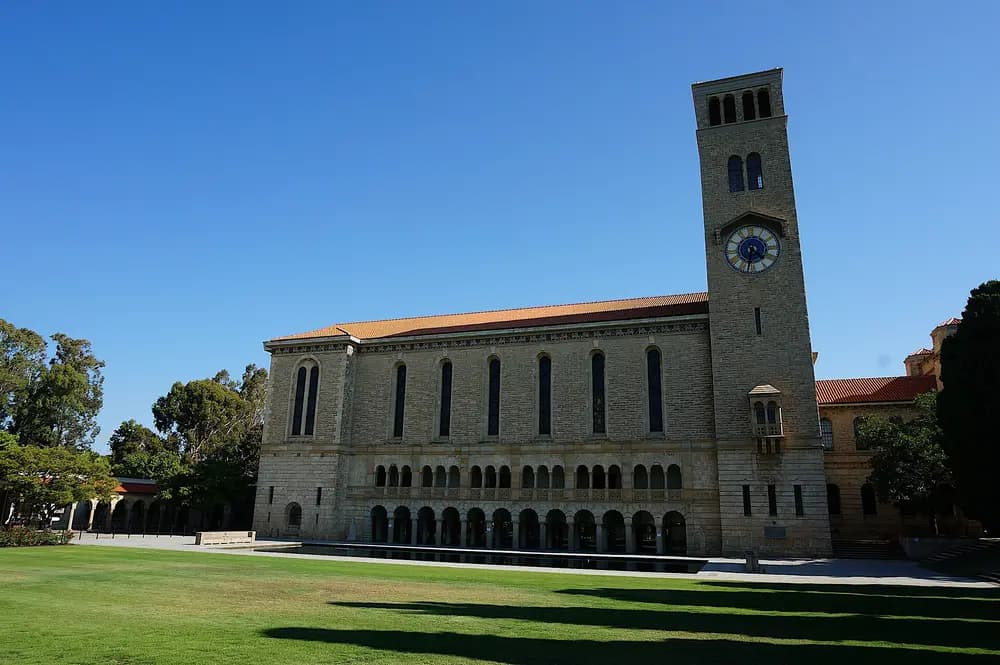
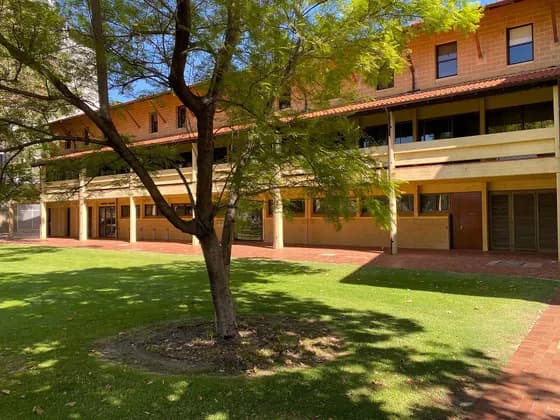


Photo: Kristina D.C. Hoeppner · CC BY-SA 3.0 · cropped
Photo: -wuppertaler · CC BY 4.0 · Photo: Nachoman-au · CC BY-SA 3.0 · Photo: Zen5iuZ · CC BY-SA 4.0
The UWA medicine course at a glance (2027 entry)
UWA's Doctor of Medicine (MD) is a four-year, full-time course run by the UWA Medical School in Perth, starting each January. In Australia the MD is an extended master's-level medical degree, and UWA's handbook classes it as a professional practice master's. It is accredited by the Australian Medical Council (AMC), which accredits medical courses. Graduates can apply for provisional registration and begin an internship, the first supervised year of work as a doctor, known as PGY1.
Graduates enter the four-year MD directly, while school leavers can take the Assured Pathway, UWA's provisional-entry route. It offers a conditional MD place from Year 12, starting with the three-year Bachelor of Biomedicine (Specialised), whose third year is MD Year 1, so the route takes six years. The course has 206 domestic and 40 international places, and up to half go to school leavers.
Year 1 teaches the body system by system on campus, and hospital rotations begin in May of Year 2. About a quarter of the class spends Year 3 with the Rural Clinical School, UWA's network of teaching sites in country towns. You keep one clinician mentor throughout, are assessed on professional behaviour in every unit, and follow a scholarly activity stream (research, service learning or coursework) in Years 3 and 4.
| Degree | MD (Doctor of Medicine), a professional practice master's degree |
|---|---|
| Course length | 4 years full time; 6 years from Year 12 via the Assured Pathway |
| Places | 206 domestic and 40 international places |
| Start and campus | January start; Crawley campus and UWA Health Campus, Nedlands |
| Teaching style | Integrated systems units with team-based and case-based learning in Year 1 |
| Clinical placements | Hospital rotations and a general practice attachment from May of Year 2 |
| Rural year | Year 3 in a Rural Clinical School town for a quarter of the class |
| Final year | Elective, rotations, a selective, then Preparation for Internship |
| Research | Scholarly activity in Years 3 and 4: research, service learning or coursework |
| Accreditation | Accredited by the AMC until 31 March 2027, with conditions |
What makes UWA medicine different
School leavers and graduates merge in MD Year 1
On the Assured Pathway, you spend your third bachelor's year alongside graduate entrants in the same Integrated Medical Systems units. Because it counts towards both degrees, the route from Year 12 takes six years rather than seven.
A year in country Western Australia
Students selected for the Rural Clinical School spend Year 3 living in one of its 15 towns, from Esperance to Kununurra. They learn from local doctors in hospitals, general practices and Aboriginal health services.
A clinician mentor from Year 1 to graduation
Every student is paired with a clinician mentor who stays with them for the whole course and gives feedback on their professional development. You meet at least once a year, twice in Year 3. UWA encourages you to choose your own: a doctor qualified for at least three years who is not a direct family member.
Scholarly activity: research, service or master's units
From Year 3 into Year 4 you follow one scholarly activity stream beside your rotations. It can be a supervised research project, clinical audit or systematic review, a project for a not-for-profit organisation, or postgraduate units worth 18 points towards a master's. Rural and Aboriginal health versions of these units make up two optional specialisations.
Shadowing the intern team you will join
Final year ends with Preparation for Internship. In its two-week Transition to Internship rotation, as the AMC described it in October 2024, you shadow an intern in your future health service on the term you will start on. A student starting in general surgery at Fiona Stanley Hospital shadows that team's intern, and students interning in country WA travel to that site.
How UWA teaches medicine
The course is organised around six themes, called PLACES, for the roles a doctor plays: professional, leader, advocate, clinician, educator and scholar. UWA's 2024 MD Guidebook splits them into 24 strands, from medical ethics and law to Aboriginal health and evidence-based practice, and every unit teaches across them. General practice academics lead the leader, advocate and scholar themes. Boola Boola Djinda, the Medical School's Aboriginal health and wellbeing team, is listed among the discipline leads in each clinical year.
Year 1 is the most structured part of the course. Case-based learning built on core conditions ties the science to patients and introduces clinical reasoning, the step-by-step thinking that takes you from symptoms to a diagnosis.
From May of Year 2 the balance flips. Formal lectures become rare, and you learn as part of clinical teams, with small-group sessions on evidence-based practice in each discipline. Which patients you meet depends on your team, so self-directed learning matters more. Core curriculum lists of presentations, conditions, procedural skills and investigations, updated in 2024, guide what to cover.
The ways you will learn
| Lectures and seminars | Lectures and seminars take the largest share of Year 1 timetabled hours. The 2024 guidebook says most lectures are recorded with audio and slides, though some are not, for cultural, clinical, intellectual property or technical reasons. |
|---|---|
| Team-based learning | You prepare before class, take a readiness test on your own and then with your team, hear the facilitator's explanation, then apply the ideas to problems as a team. |
| Labs and pathology tutorials | Labs are used mainly for anatomy, physiology and pathology. Pathology also comes through e-learning and tutorials on preserved specimens, known as bottles, and some Year 1 and 2 tutorials run in the e-learning suites, according to the 2024 guidebook. |
| Clinical skills workshops | Small groups practise communication, history taking, examination and some procedures, with each week's skills matched to the body system you are studying. From Year 2, volunteers aged 18 to 70 play patients in small-group sessions supervised by a tutoring doctor. |
| Clinical rotations and general practice | From May of Year 2 you care for patients under supervision on ward rounds, in theatre, outpatient clinics, emergency departments and community practices. General practice teaching, aligned with the Royal Australian College of General Practitioners' curriculum for medical students, runs through all three clinical years. |
A typical week on the UWA course
In Year 1 the handbook lists about 24 hours of timetabled teaching a week. That is 6 to 8 hours of lectures, 4 of seminars, 4 of online learning, and 2 each of clinical skills, team-based learning, pathology and labs. The course page puts face-to-face contact at about 20 hours, plus at least 20 hours of personal study and online modules, for the first three semesters.
A first-year student described the rhythm in a 2023 UWA article. Most mornings started with a three- to four-hour lecture block, and on Fridays clinical skills and team-based learning sessions applied the week's work to cases. Each system block began with anatomy and physiology, with lab classes, then moved to several weeks of pathology, pharmacology, microbiology and immunology.
Year 2 is busier. The handbook lists about 25 contact hours a week in its campus term, then 30 to 40 hours a week on rotations. From the fourth semester the course page also warns of some after-hours and weekend placements.
The handbook counts about 40 weeks of contact time a year, and the course page a 42-week academic year. Rural Year 3 students have seven clinical sessions, two tutorial sessions and one personal study session a week.
How anatomy is taught at UWA
Anatomy is not taught as a separate subject. It is part of the Integrated Medical Systems units of Year 1 and the first term of Year 2, which covers the musculoskeletal and neurological systems. A 2023 UWA article called anatomy and physiology the two most emphasised disciplines in each system block. Anatomy is examined in Year 1 by a 25-station OSPE (objective structured practical examination), a practical exam made up of separate stations. UWA says the first half of Year 2 uses the same kinds of assessment as Year 1.
UWA is licensed by the WA health department to accept whole-body donations, and its School of Human Sciences says these let medical students study real human bodies. At the start of each semester, a representative of each class studying anatomy reads an Act of Recognition and Gratitude to thank the donors. UWA also holds a memorial service for donors in Winthrop Hall every three years.
When you first meet patients at UWA
In Year 1 you learn communication, history taking and examination before using them on wards. The 2026 handbook also lists early clinical experiences among Year 1's teaching methods. Across the course, the 2024 guidebook describes clinical skills workshops using classmates, simulated patients and real patients, with examination of each other limited to the limbs, chest and abdomen. UWA's simulated-patient volunteers work with students from Year 2.
Your first hospital placements start in May of Year 2, when you join hospital teams. UWA asks supervisors to remember that Year 2 students are still finding their feet and to keep teaching basic. From Year 3 you take on more, and by the end of final year you are expected to have the knowledge and skills of a new intern.
UWA's patient-care protocol sets the ground rules. You always introduce yourself as a medical student and check the patient is comfortable with your involvement. If you are unsure about consent, you ask the most senior health professional available. Intimate examinations need a chaperone, and the patient's consent and the chaperone's identity must be recorded in the notes.
Year by year at UWA
- Pathway Years 1–2
Bachelor of Biomedicine (Specialised), for school leavers
If you enter from Year 12 on the Assured Pathway, you spend two years on the Bachelor of Biomedicine (Specialised) with the Integrated Medical Sciences and Clinical Practice (IMSCP) major. Core units are shared with students heading for dentistry, podiatry and medical science. You keep your MD place by completing the major and meeting a minimum selection grade point average within these two years.
- First-year core units: Form and Function (body plan, histology and physiology), The Facts of Life (cell chemistry, molecular biology and genetics), Cell Survival and Communication (metabolism and cell signalling), and Health and Society.
- Health and Society covers immunity, disease outbreaks, drug and alcohol use, mental health and the effect of history and culture on Aboriginal peoples' health.
- Second-year core units: Body Defences (microbiology and immunology), Blood and Drugs (haematology and pharmacology), Medical Sciences Research Methodologies, and Human Development and Genetics.
- Eight broadening and elective units over the two years, in areas from music and languages to extra biomedical science; a semester-long exchange is possible only in the first semester of second year.
- Year 1
Integrated Medical Systems
Graduate entrants and third-year Assured Pathway students start here together in January. The year is two 24-point units, each presenting science, clinical skills and professional practice together around core clinical conditions and presentations. Dates in this section come from the 2026 handbook: Integrated Medical Systems 1 ran from January to mid-June and Integrated Medical Systems 2 from late June to mid-November.
- Biomedical sciences: anatomy, physiology, biochemistry, genetics, immunology, haematology, microbiology, anatomical pathology and pharmacology.
- Clinical skills: communication, history taking and physical examination, introduced step by step with attention to the patient's perspective and patient-centred care.
- Health and professional topics: epidemiology and evidence-based practice, social determinants of health, global and mental health, health systems and economics, medical law and ethics, teamwork, diversity in medicine and Aboriginal health.
- Assessment: written exams at the end of each system block, case-based assessments in clinical skills and general practice, and the anatomy OSPE. There is also a single-station OSCE. An OSCE (objective structured clinical examination) is a clinical exam run as stations, each testing one task.
- Professional behaviour and attendance are barrier components of both units, and Integrated Medical Systems 2 also makes the combined end-of-semester exams a barrier. You must pass each barrier whatever your overall mark, and you must pass both units to enter Year 2.
- Year 2
The last systems term, then the wards
Year 2 was restructured in 2025. Integrated Medical Systems 3 runs from January to April and ends in barrier assessments, a progression point before clinical work. Integrated Medical Practice 1 then runs from May to November: four six-week hospital rotations, a general practice attachment alongside them, and central teaching in advanced clinical skills and clinical reasoning.
- Integrated Medical Systems 3 (AMC, October 2024): ten weeks on the musculoskeletal and neurological systems, two assessment weeks and a two-week Preparation for Clinical Placements block.
- Planned content included virtual and tabletop ward rounds and a surgical skills day on assessment before an operation and ward care afterwards. A barrier portfolio records your attendance, required online modules and procedural skills sign-off.
- A two-week break follows, when supplementary assessments (resits) are held, so you know before placements if you are progressing.
- Rotations: internal medicine, geriatrics and rheumatology, psychiatry and surgery.
- Assessment: supervisor ratings and work-based assessments on each rotation, a case report, a procedural skills logbook, end-of-year written exams and a portfolio. The six-station OSCE needs satisfactory performance in at least half the stations.
- Year 3
Perth rotations or a rural year
Most students take Integrated Medical Practice 2 in Perth: five eight-week placements, from January to early July and late July to November. About 60 students take Integrated Rural Medical Practice instead, spending the year in one Rural Clinical School town. They meet the same outcomes, plus extra skills in rural generalist practice and Aboriginal health care.
- Perth placements: internal medicine; surgery and psychiatry; general practice and ophthalmology; paediatrics and child health; and women's and infants' health.
- Year 3 surgical teaching has discipline leads in urology and orthopaedics.
- Rural students are attached to rural doctors and cover surgery, psychiatry, internal medicine, general practice, ophthalmology, paediatrics and women's health within the one year.
- Two scholarly activity units, one in each half of the year, in your chosen stream.
- Assessment: in-training assessments such as case presentations, structured clinical assessments, quizzes and workbooks, plus end-of-year written exams and a portfolio. The 10-station barrier OSCE needs satisfactory performance in at least two-thirds of stations.
- Year 4
Elective, final rotations and Preparation for Internship
Final year opens with a four-week elective. Integrated Medical Practice 3 then runs from late January to early October, first in five-week placements and then in two-, four- or six-week ones. Supervisors are asked to pitch teaching at intern level. Preparation for Internship fills mid-October to late November, and your last scholarly activity unit runs in the first half of the year.
- Placements in emergency medicine, internal medicine, surgery, rural general practice, anaesthesia, cancer and palliative care, plus a selective chosen to suit your interests. The second part adds dermatology and ENT (ear, nose and throat).
- Rural final-year students cover emergency medicine, internal medicine, surgery including ENT, anaesthetics and pain management, oncology, palliative care and rural general practice at their site.
- Assessment: in-training assessments, written exams, a 12-station barrier OSCE at the end of Integrated Medical Practice 3, a portfolio, a procedural skills log and nine required work-based assessments.
- Preparation for Internship (AMC, October 2024) has a Knowledge and Skills for Internship week, two weeks shadowing an intern and a two-week PLACES rotation. Two ward simulation sessions run during the year.
- The skills week has clinical simulations, an escape room, a prescribing exam and workshops on prescribing, ultrasound-guided cannulation, Aboriginal health and cultural safety, palliative care and conflict management, closing with a careers cafe.
- In ward simulations you work through a simulated ward alongside UWA pharmacy and social work students and nursing students from Edith Cowan University.
How you are assessed at UWA
Assessment runs unit by unit, and to progress you must pass every unit in the year. Within each unit, key components are barriers: you must reach 50%, or the standard set in the unit outline, in each one, whatever your overall mark. In the clinical years these include the written exams, the OSCE, in-training assessment (your supervisors' ratings on placement), the portfolio and professional behaviour.
Written papers use multiple-choice and extended matching questions, short answers, image-based questions and modified essay questions, where a case unfolds in stages and you cannot go back (2024 guidebook and 2020 MD Assessment Framework). Under the 2025 progress rules, written exams in every year and the Year 2 to 4 OSCEs are standard set. That means a panel of experts judges where the pass line falls.
On placement, supervisors complete work-based assessments, which the Medical School likens to the assessments used for interns, along with structured clinical assessments marked against a checklist and professionalism rating forms. You also keep a procedural skills log and an e-portfolio of tasks across the PLACES themes, completing both in final year. In the professional development program you write a case-based ethics essay.
Professional behaviour is assessed in every unit, and attendance and participation count towards it. Short leave is capped at 10 university days a year. The 2024 guidebook says attending less than 80% of the required time means you cannot pass the unit, whatever your marks.
Any teaching or clinical staff member can file a Structured Professional Assessment Note about a concern, which a coordinator reviews with you. Three or more confirmed unsatisfactory assessments in a year count as failing the professional behaviour barrier; in the elective and Preparation for Internship, one is enough. The Board of Examiners, the panel that decides progress, then usually records a fail for that year or unit.
If you narrowly fail, usually with a mark of 45 to 49%, you may be offered a supplementary assessment. You will not be if you fail two or more units in a year, fail a deferred or supplementary assessment, or are on probation. Otherwise you repeat the failed part of the course the next year on probation, and failing again while on probation normally means exclusion. A course average of 80% or more earns the degree with distinction.
Where you will actually be at UWA
Year 1 and the first term of Year 2 are on campus, at Crawley and the UWA Health Campus at the Queen Elizabeth II Medical Centre, Nedlands. From May of Year 2 you move through Perth hospitals and general practices: six-week rotations in Year 2, eight-week placements in Year 3 and two- to six-week blocks in Year 4. The AMC met UWA students at Sir Charles Gairdner, Royal Perth, Fiona Stanley, Perth Children's and St John of God Subiaco hospitals in 2019, and at King Edward Memorial in 2022.
In Year 2 you can apply to spend Year 3 with the Rural Clinical School of Western Australia (RCSWA), a division of the Medical School. It also takes students from the University of Notre Dame Australia and Curtin University. The 2026 handbook sets 60 rural Year 3 places, listed for domestic students.
You list preferred towns and are interviewed by a staff panel, and you can say whether getting your first-choice town or being placed with one or two colleagues matters more. Offers name the other students at your site, and sites are not negotiable.
RCSWA students live in their host town all year. Single students get furnished housing free. Students bringing a partner or family find their own and can claim a bursary of $6,000 plus $1,000 from Geraldton south, or $7,000 plus $1,000 from Karratha north. RCSWA pays your trip to the site and home again, and many town pages advise bringing a car. In 2026 RCSWA had 117 penultimate-year students across its 15 towns.
UWA calls the rural year longitudinal and integrated: you stay in one community and learn the disciplines side by side, rather than in separate blocks. Arrangements vary, though; Albany rotates students through hospital disciplines for two to four weeks each. Teaching in each town is led by medical coordinators, who are local doctors. You may work in the hospital and emergency department, general practices, Aboriginal community controlled health services (run by local Aboriginal communities), the Royal Flying Doctor Service and population health units.
After a rural Year 3 you can apply for RCSWA's competitive Final Year Program in Albany, Broome, Bunbury or Geraldton, where everything except the end-of-year exams happens at your site. It is self-funded: RCSWA pays travel and relocation, but you cover living costs and rent. The 2026 handbook also lists Kalgoorlie for the rural final-year units, with 2 to 8 UWA students per site. Every Perth-based final-year student has a rural general practice placement, arranged by RCSWA's Rural GP Placement team.
Medical students have classes on the UWA Health Campus here, beside two major public hospitals. UWA's paediatrics division is based at Perth Children's Hospital, and UWA emergency medicine academics work at Sir Charles Gairdner.
- UWA Health Campus
- Sir Charles Gairdner Hospital
- Perth Children's Hospital
UWA emergency medicine academics also work at Royal Perth and Fiona Stanley, and its paediatrics staff provide clinical services at King Edward Memorial. Year 4 students met the AMC at St John of God Subiaco in 2019, and Joondalup clinicians met it as UWA adjunct teachers.
- Royal Perth Hospital
- Fiona Stanley Hospital
- King Edward Memorial Hospital
- St John of God Subiaco Hospital
RCSWA's site pages list 10 penultimate-year students a year in Broome, 7 in Karratha, 6 in Port Hedland and 4 in Kununurra. Kununurra students are encouraged to see patients every day.
- Broome Hospital and Kimberley Aboriginal Medical Services
- Derby Hospital and Derby Aboriginal Health Service
- Kununurra District Hospital and Wunan Health and Well-being Centre
- Hedland Health Campus and Wirraka Maya Aboriginal Health Service, Port Hedland
- Karratha Health Campus and Mawarankarra Aboriginal Health Service, Roebourne
Site pages list 12 penultimate-year students a year each in Geraldton and Kalgoorlie and 4 in Esperance. RCSWA's headquarters is at Kalgoorlie. Carnarvon is still listed in the 2026 handbook, but RCSWA says that site is currently closed.
- Geraldton Health Campus
- St John of God Hospital, Geraldton
- Kalgoorlie Health Campus
- Bega Garnbirringu Aboriginal Medical Services, Kalgoorlie
- Esperance Health Campus
Site pages list 12 penultimate-year students a year each in Albany, Bunbury and Busselton, 6 in Manjimup, and 4 in Narrogin and Northam; Collie took its first four in 2023. Some sites lend cars for placements in nearby towns.
- Albany Health Campus
- Bunbury Regional Hospital
- Busselton Health Campus
- Collie Hospital
- Warren District Hospital, Manjimup
- Narrogin Hospital
- Northam Health Campus
Electives, selectives and options at UWA
The elective (IMED5413) is a four-week clinical or clinical research placement in Australia or overseas, taken before Year 4 proper begins. In the 2026 handbook its window ran from 10 November 2025 to 22 February 2026. The 2024 guidebook lists international, interstate, metropolitan and rural options, and RCSWA oversees rural electives in WA. The elective is graded pass or fail on a professional behaviour assessment and an elective report. If Year 3 leaves you with supplementary assessments to sit, you must withdraw from your elective and take a remediation unit instead.
Year 4 also has a selective and the two-week PLACES rotation in Preparation for Internship. There you choose a theme: the clinician theme is an Extension placement in a clinical area you choose, and other themes are assessed by a research presentation or reflective writing (AMC, October 2024).
The longest-running choice is your scholarly activity stream, which runs through Year 3 and the first half of Year 4. In the research stream you are matched with a supervisor and project: a clinical audit, a systematic review or independent research. UWA advises independent research if you plan a research master's or PhD. You write a literature review and proposal and defend it orally, report progress in a seminar, then finish with a journal-style manuscript and a poster.
Service learning matches you with a not-for-profit organisation for Years 3 and 4 to deliver a project it sets. You first learn how not-for-profits work, project management, and survey and focus-group methods, then write a project proposal and an ethics document. Coursework streams draw on public health, health professions education, Aboriginal health and research foundations, with units such as epidemiology, biostatistics, health promotion, clinical teaching and emergency medicine research design.
Two optional specialisations are built from set scholarly activity units; the word does not mean specialist training. Aboriginal Health combines Aboriginal Health Research and Ethics, a 15-place Year 3 unit taught by the Aboriginal health team, with Epidemiology I and, in Year 4, Biostatistics I. Rural Health uses rural versions of the research or service-learning units, with research supervised by Rural Clinical School staff.
The 2024 guidebook tied Rural Health to a rural Year 3, but the 2026 handbook allows either option. The same handbook rule places Aboriginal Health specialisation students in the rural Year 3 units, though the urban Year 3 unit lists Aboriginal Health Research and Ethics as an option.
Intercalation and research degrees at UWA
The routes UWA describes to an extra qualification run alongside the MD. Coursework scholarly activity units count 18 points towards a master's in public health, health professions education or Aboriginal health. In a 2023 UWA article, a final-year student described enrolling in the full Master of Public Health this way. The AMC reported in October 2024 that the newer Research Foundations stream offers a route into the Master of Clinical Science.
On the Assured Pathway, the IMSCP major does not lead to an Honours year. After graduating you can take a PhD or postgraduate study such as the Master of Infectious Diseases or the Graduate Certificate in Rural and Remote Medicine, alongside specialist training with a medical college.
Facilities and support at UWA
Where you will learn
The UWA Health Campus sits on the Queen Elizabeth II Medical Centre site in Nedlands. It shares the grounds with Sir Charles Gairdner Hospital, Perth Children's Hospital, PathWest and research institutes including the Harry Perkins Institute of Medical Research and The Kids Research Institute Australia. Its biomedical teaching laboratories include histopathology and pharmacology labs, and the e-learning suites let groups view and project live digital microscope images.
The FA Hadley pathology museum, founded in 1959, holds more than 3,500 specimens, each displayed with an anonymous clinical history, and students can visit by arrangement. The J. Robin Warren Library, named after one of UWA's two Nobel laureates and refurbished for $7 million, is open to UWA students around the clock.
The Clinical Training and Evaluation Centre (CTEC), opened in 2000 in the CTEC and Anatomy Building on Hackett Drive, runs practical surgical skills workshops for MD students. It recreates a hospital and operating theatre, with a multi-station operating theatre lab, surgical instruments and simulators. Rural Clinical School offices offer study spaces and tutorial rooms, and Geraldton's has dedicated teaching and simulation spaces.
Support while you study
Each year group has a Sub-Dean, a senior academic you can see in confidence about personal circumstances, leave, special consideration and other serious issues. Separate Sub-Deans cover the rural penultimate year and international students. On Perth placements you can use wellbeing supports similar to junior doctors', such as employee assistance counselling. The 2024 guidebook also points to the Doctors' Health Advisory Service of WA, a confidential 24-hour line for doctors and medical students.
Beside your clinician mentor, the Student MeDMentor program, run with the Western Australian Medical Students' Society and UWA's UniMentor scheme, links first-year students with senior students. Junior doctors, most of them UWA graduates, teach at mock OSCEs and procedural skills workshops and coach students who need extra help with OSCE skills, as the AMC described in October 2024.
Boola Boola Djinda (Many, Many Stars) was set up in 2025 from the Centre for Aboriginal Medical and Dental Health. From the Bilya Marlee Building at Crawley it supports Aboriginal and Torres Strait Islander students into and through medicine.
In rural towns, RCSWA's medical coordinators set learning goals with you, and the Regional Training Hubs offer career planning and rural mentors. If you are worried about meeting the course's inherent requirements, the core abilities expected of every student, the Medical School looks at ways to make teaching and assessment more accessible for you.
Is the UWA course right for you?
This course may suit you if
- You are in Year 12 and want a conditional MD place through the Assured Pathway.
- You would like to spend a year living and training in a country WA town.
- You want a clinician mentor, ideally one you choose yourself, for the whole course.
- You want your scholarly activity to count towards a master's, become a research manuscript or serve a not-for-profit organisation.
- You like science taught body system by body system, with weekly clinical skills and team-based learning.
Things to think about
- From May of Year 2 you work up to 40 hours a week on placement, with some after-hours and weekend placements. In Perth you change teams every six to eight weeks, and more often in Year 4.
- The rural year is by application and interview, sites cannot be negotiated, and a rural final year is self-funded.
- Barriers are strict: you must pass each key component, OSCEs need satisfactory performance in a set share of stations, and supplementary chances are limited.
- On the Assured Pathway, your MD place depends on completing the IMSCP major and meeting a minimum grade point average, and the major does not lead to Honours.
- Professional behaviour is formally assessed in every unit. Three confirmed unsatisfactory ratings in a year mean failing the professional behaviour barrier, and usually the year.
UWA medicine course — frequently asked questions
Applying to UWA?
How to get into UWA
Entry requirements, admission tests, written application and interview, step by step.
Open the guide →UWA entry requirements
ATAR or GPA, GAMSAT and UCAT ANZ thresholds, interview format and place types.
See the requirements →Compare UWA with other schools
Put the teaching style, anatomy teaching and placements next to another school.
Open the comparison →Prepare for the UWA interview
Format breakdown, school-specific sample questions and prep tips from tutors who interviewed here.
Read the guide →Where this UWA course guide came from
This guide was written from 82 official sources — University of Western Australia Medical School's own course pages and programme documents, plus the Australian Medical Council or Australian Dental Council and the health services the school places students with where they publish detail — read on 2026-10-08, then checked claim by claim against those sources.
- UWA: Doctor of Medicine course page
- UWA Handbook 2026: Doctor of Medicine [91850], structure and rules
- Handbook 2026: Integrated Medical Systems 1 (IMED3111)
- Handbook 2026: Integrated Medical Systems 2 (IMED3112)
- Handbook 2026: Integrated Medical Systems 3 (IMED4113)
- Handbook 2026: Integrated Medical Practice 1 (IMED4222)
- Handbook 2026: Integrated Medical Practice 2 Part A (IMED5311)
- Handbook 2026: Integrated Medical Practice 2 Part B (IMED5312)
- Handbook 2026: Integrated Rural Medical Practice 1 (RMED5311)
- Handbook 2026: Integrated Rural Medical Practice 2 (RMED5321)
- Handbook 2026: Integrated Medical Practice 3 Part 1 (IMED5411)
- Handbook 2026: Integrated Medical Practice 3 Part 2 (IMED5412)
- Handbook 2026: Integrated Rural Medical Practice 3, Part 1 (RMED5411)
- Handbook 2026: Medical Elective (IMED5413)
- Handbook 2026: Preparation for Internship (IMED5421)
- Handbook 2026: Research Unit 1 (SMED5331)
- Handbook 2026: Research Unit 2 (SMED5341)
- Handbook 2026: Research Unit 3 (SMED5411)
- Handbook 2026: Service Learning Unit 1 (SMED5332)
- Handbook 2026: Rural Specialisation, Research Unit 1 (SRUR5331)
- Handbook 2026: Aboriginal Health Research and Ethics (AHEA5801)
- UWA Handbook 2026: Bachelor of Biomedicine (Specialised) [BP056]
- UWA Handbook 2026: Integrated Medical Sciences and Clinical Practice major [MJD-IMSCP]
- Handbook 2026: Form and Function (IMED1001)
- Handbook 2026: The Facts of Life (IMED1002)
- Handbook 2026: Cell Survival and Communication (IMED1003)
- Handbook 2026: Health and Society (IMED1004)
- Handbook 2026: Body Defences (IMED2001)
- Handbook 2026: Blood and Drugs (IMED2002)
- Handbook 2026: Integrated Rural Medical Practice 3, Part 2 (RMED5421)
- Handbook 2026: Elective Remediation Unit (IMED5417)
- UWA MD Progress Rules 2025
- UWA Medical School: MD Guidebook 2024
- UWA MD Professional Behaviour Assessment procedure (effective March 2026)
- UWA Medical School protocol: Medical Student Involvement in Patient Care (February 2026)
- UWA MD Assessment Framework, version 1 (2020)
- UWA: Medical School non-standard teaching periods, 2026
- UWA current students: information for Doctor of Medicine students
- UWA Medical School: Centre for Medical Education, assessment in the MD
- UWA Medical School: mentoring programs and Simulated Patient Program
- UWA Medical School home page
- UWA Medical School: Division of General Practice
- UWA Medical School: Division of Emergency Medicine
- UWA Medical School: Division of Surgery
- UWA Medical School: Division of Paediatrics
- UWA: Boola Boola Djinda, Aboriginal Health and Wellbeing
- UWA Health Campus and Queen Elizabeth II Medical Centre
- UWA: Clinical Training and Evaluation Centre (CTEC)
- UWA: Biomedical Sciences Teaching Laboratories
- UWA: Biomedical Sciences E-Learning Suites
- UWA: FA Hadley pathology museum
- UWA School of Human Sciences: Body Donation Program
- UWA: Bachelor of Biomedicine (Specialised) course page
- UWA: Integrated Medical Sciences and Clinical Practice major page
- UWA news: From Classroom to Clinic (September 2023)
- UWA: A Day in the Life of a Medical Student (September 2023)
- Rural Clinical School of WA: medical students
- Rural Clinical School of WA: about us and history
- Rural Clinical School of WA: sites
- RCSWA site: Albany
- RCSWA site: Broome
- RCSWA site: Bunbury
- RCSWA site: Busselton
- RCSWA site: Carnarvon
- RCSWA site: Collie
- RCSWA site: Derby
- RCSWA site: Esperance
- RCSWA site: Geraldton
- RCSWA site: Kalgoorlie
- RCSWA site: Karratha
- RCSWA site: Kununurra
- RCSWA site: Manjimup (Warren Blackwood)
- RCSWA site: Narrogin
- RCSWA site: Northam
- RCSWA site: Port Hedland
- Rural Clinical School of WA: Regional Training Hubs
- Australian Medical Council: accredited medical schools
- AMC accreditation report: UWA Medical School (October 2024, published 2025)
- AMC accreditation report: UWA Medical School (2019 assessment and 2022 follow-up)
- Medical Board of Australia: interns
- Medical Board of Australia: provisional registration
- WA Health Medical Careers WA: internship, 2027 clinical year
Courses are restructured between cycles. Anything here that decides your application — an anatomy offer, a placement city, a compulsory intercalated year — should be confirmed against the official page for your entry year.
Applying to UWA?
We have helped hundreds of applicants turn their GAMSAT / UCAT ANZ, written application and interview prep into offers from UWA and other Australian medicine schools.