
The ANU Medicine course
What you actually study, and where you will be
ANU's MChD is a 4-year (graduate entry) course taught through team-based learning and case-based learning, with patient contact from Year 1 and placements in Canberra, Sydney, south-east New South Wales and Central Australia (2027 entry). ANU's Doctor of Medicine and Surgery is a four-year course for graduates, based in Canberra. Years 1 and 2 combine a weekly clinical case worked through in team-based learning, lectures, lab practicals, clinical skills on a weekly clinical day at a Canberra hospital, and your own research project. Years 3 and 4 are spent almost entirely on placement in Canberra, Sydney, rural New South Wales and the Northern Territory. About 30% of each class spends all of Year 3 in one rural town.
- Degree
- MChD
- Length
- 4 years (graduate entry)
- Teaching
- Team-based learning + Case-based learning
- Clinical contact
- Year 1
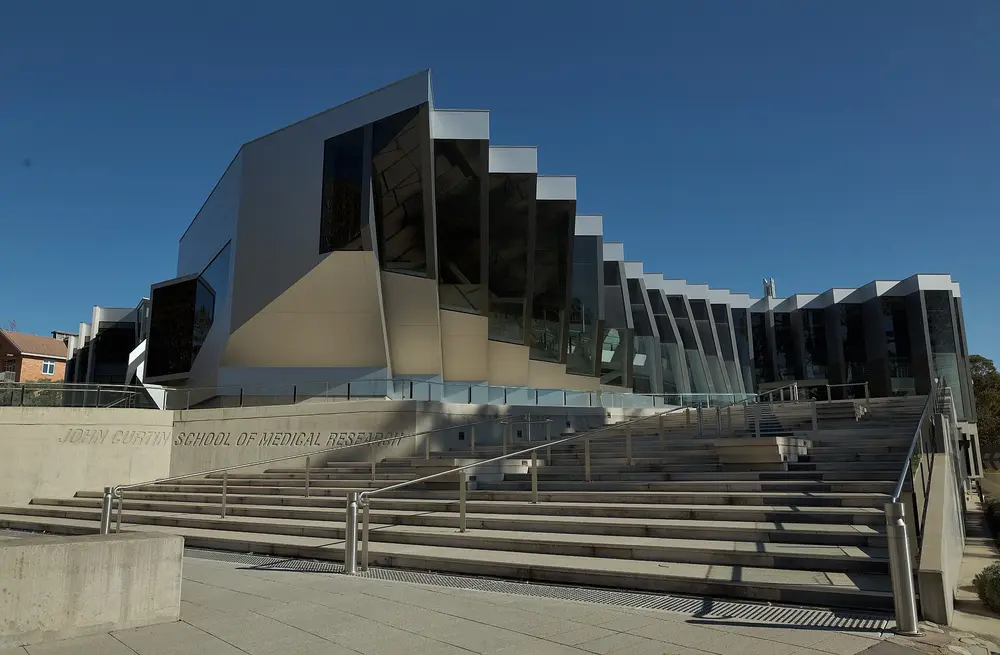
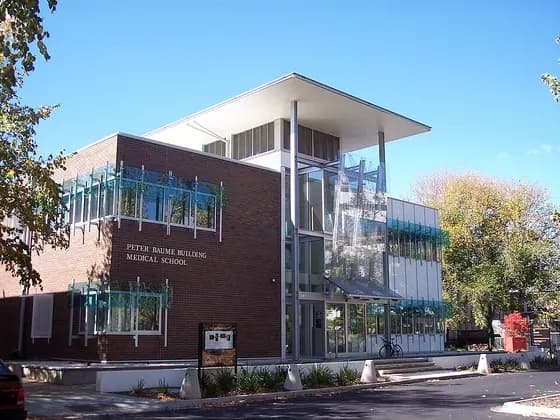

Photo: Thennicke · CC BY-SA 4.0 · cropped
Photo: Russell Thomas · CC BY-SA 3.0 · Photo: Thennicke · CC BY-SA 4.0 · Photo: Chris Olszewski · CC BY-SA 4.0
The ANU medicine course at a glance (2027 entry)
ANU's Doctor of Medicine and Surgery (MChD) is a four-year, full-time medical degree for people who already hold a bachelor's degree. It is an extended master's-level qualification at level 9 of the Australian Qualifications Framework (AQF), the same level as the Doctor of Medicine (MD) offered by many Australian medical schools. It is run by the School of Medicine and Psychology, formed in 2023 when the ANU Medical School merged with the Research School of Psychology. Year 1 starts on 25 January 2027.
The course has two phases. In Phase 1 (Years 1 and 2) you are based at ANU's Acton campus in inner Canberra and at Canberra Hospital. Each week centres on a clinical case and its team-based learning sessions: you usually prepare on your own, then work through the case with a team in class. Lectures, practicals, tutorials and a weekly clinical day at a Canberra hospital fill out the week. You also plan and begin your own research project, which you finish in Year 3.
Phase 2 (Years 3 and 4) is spent almost entirely in hospitals and general practices. You rotate through placements run by three clinical schools, the hospital-based campuses that students are attached to: Canberra, Sydney and the Rural Clinical School, with campuses in south-east New South Wales. Year 4 ends with a pre-internship block (PRINT) that prepares you for internship, the first supervised year of work as a doctor, also called postgraduate year 1 (PGY1).
Four themes run through all four years: medical sciences, clinical skills, population health, and professionalism and leadership. Four frameworks sit alongside them: Indigenous health, the social foundations of medicine, rural health and research. Rural time is built in for everyone, from a rural week in each of the first two years to placements in country towns in Year 3.
The course is accredited by the Australian Medical Council (AMC), which assesses and accredits Australian medical courses. Graduates apply to the Medical Board of Australia, through Ahpra (the Australian Health Practitioner Regulation Agency), for provisional registration, which lets them start internship. The AMC's May 2026 decision on the course is explained in the questions below.
| Degree | Doctor of Medicine and Surgery (MChD), an AQF level 9 extended master's degree |
|---|---|
| Course length | 4 years full time; Year 1 starts 25 January 2027 |
| Class size | 115 students enrolled in 2023, according to the AMC |
| Phase 1 base | Acton campus and Canberra Hospital, Canberra |
| Teaching style | Team-based learning in Years 1 and 2; case-based learning tutorials later |
| First patient contact | Year 1: volunteer and simulated patients, on weekly clinical days at a Canberra hospital |
| Clinical schools | Canberra, Sydney (Sydney Adventist Hospital) and Rural, with six NSW campuses |
| Rural time | Rural weeks in Years 1–2, then six weeks or all of Year 3 |
| Research | Compulsory supervised project: planned in Year 1, completed in Year 3 |
| Accreditation | AMC-accredited to 31 March 2028, with conditions (decision of May 2026) |
What makes ANU medicine different
A whole clinical year in one rural town
About 30% of each class joins the Rural Stream. You apply during Year 1, places are decided competitively at the end of it, and you then spend Year 3 at one campus: Bega, Cooma, Eurobodalla, Goulburn or Young/Cowra. You learn general practice, hospital and community medicine together, follow patients over time and meet other rural students for four teaching blocks of a week each.
Your own research project, planned from Year 1
Every student completes a supervised research project. You choose a topic and supervisor, write a proposal and present your work in progress at the medical student conference. The School offers research prizes and travel grants of up to $1,000.
General practice in Canberra and in the country
Outside the Rural Stream, Year 3 includes six weeks in a Canberra or Queanbeyan general practice and six weeks in a rural practice. You can apply for half-time places in practices serving refugees, Aboriginal and Torres Strait Islander people, people with drug and alcohol problems or people in custody. The School works with 150 general practitioners (GPs) in 36 practices.
An optional Indigenous Health Stream
A small group of students joins the Indigenous Health Stream, which runs alongside the normal course with the same exams. It adds a mentor, a community link, an Indigenous health research project, cultural immersion and regular meetings with ANU's Indigenous health staff. In Year 3, stream students are offered six weeks in a remote community or a regional Aboriginal medical service and get preference for Northern Territory places.
Placements at a private hospital in Sydney
Through the Sydney Clinical School, students can be placed at Sydney Adventist Hospital in Wahroonga, a private hospital with more than 700 beds, in Year 3 as well as Year 4. In Year 4, the acute care, senior medicine and surgery, women's health and PRINT placements can all be taken there.
How ANU teaches medicine
ANU calls the MChD an integrated spiral curriculum. Integrated means science and clinical practice are taught together rather than in separate halves. Spiral means topics come back each year in more depth. The four themes and four frameworks are the threads that keep returning, so population health, professionalism and Indigenous health run through the whole course rather than sitting in one subject.
In Years 1 and 2 each week is built around a clinical case, and you work through hypotheses and possible diagnoses as you go. The main format is team-based learning.
Older descriptions use a different label. The AMC's 2023 accreditation report described problem-based learning (PBL) as the core of Phase 1, with PBL tutors guiding groups. In PBL, a small group works out for itself what it needs to learn from a case. This guide follows ANU's 2026 class outlines, which describe team-based learning.
From Year 3 you learn mainly on placement. ANU stresses self-directed, hands-on learning, with set requirements for attendance, for clerking patients (taking and writing up a full history and examination) and for joining in your unit's work. Formal teaching continues through case-based learning (CBL) tutorials and clinico-pathological correlation sessions, which link a patient's illness to the disease processes behind it.
The ways you will learn
| Team-based learning sessions | The core of Years 1 and 2. Peer evaluation and reflection on your team's work count towards your professionalism assessment. |
|---|---|
| Lectures and medical science practicals | Lectures support each week's case. Practicals run in the School's laboratories; you buy your own safety glasses and suitable shoes, and lab coats are provided. |
| Clinical skills and simulation | Clinical skills are taught by medically trained tutors. You practise on volunteer patients and on simulated patients, trained role-players who follow scripted cases. The program runs across all four years, with procedural skills in every year and emergency simulations for senior students. |
| Professionalism and population health groups | Compulsory class and group sessions in Professionalism and Leadership (PAL), which covers ethics and law, and group work in Population Health, backed by required online modules. |
| Case-based learning tutorials | From Year 3, small-group tutorials in which students present real patient cases with identifying details removed. In the Year 3 child and community health block they follow a weekly topic list, from a child with a fever to a patient who is sad, worried or tired. |
| Clinical placements | In Years 3 and 4 you join hospital units, general practices and rural health services, where clinicians supervise you, give feedback and sign off your portfolio tasks. |
A typical week on the ANU course
In Years 1 and 2 ANU expects you to put in at least 40 hours a week, of which 20 to 22 hours are scheduled sessions; the rest is independent study. Attendance is compulsory at team-based learning, medical science practicals, Professionalism and Leadership classes, population health group work, clinical skills days and cultural immersion sessions. Travel between Acton and Canberra Hospital is at your own cost. A student profiled by the School in 2026 said the timetable leaves breaks between classes and some half days for work, study or rest.
In Year 3 the expectation is at least six clinical sessions of four hours a week, sometimes seven or eight, plus teaching all day on Wednesday. In the urban general practice rotation, Wednesday and Friday are both teaching days at the Canberra Hospital campus, so you are in the practice three days a week. Rural placements, including the Rural Stream, run at seven or eight sessions a week, plus Wednesday teaching, and can include after-hours work.
Year 4 keeps the minimum of six four-hour clinical sessions a week. A lecture series for the whole year group runs every Friday, with core topics early in the year, and each block adds its own workshops and tutorials.
How anatomy is taught at ANU
Anatomy is one of the sciences in the Medical Sciences theme. Practicals take place in the School's Medical Science and Anatomy Facility, which is licensed under the ACT Transplantation and Anatomy Act 1978. Its rules tell students to wear gloves when handling prosected specimens, meaning body parts already dissected by staff, and to take care when handling cadaveric specimens. You complete an induction first, and phones, photos, food and drink are banned.
The specimens come from people who donate their bodies to the School after death. Patients can also donate organs or tissue removed during surgery, which form the Surgical Specimen Teaching Museum at Canberra Hospital, used to teach anatomy and pathology. The AMC's 2023 report mentioned a dissection week with a limited number of places, and the School's prize list includes an Anatomy Dissection Prize.
When you first meet patients at ANU
Clinical skills teaching starts in Year 1. You learn to take a history and examine each body system, practising with volunteer patients and with simulated patients. A second-year student told ANU in 2025 that volunteer patients give feedback on how your words and manner made them feel.
ANU describes a weekly clinical day at a Canberra hospital, and the AMC's 2026 report says most Year 1 and 2 clinical skills teaching takes place in the School's Building 4 at Canberra Hospital. Each of the first two years also includes a week in a rural area around Canberra or south-east New South Wales.
By Year 3 you are expected to take a history and examine competently, because you now join clinical teams almost full time. You clerk patients, summarise their problems, hand over to colleagues and draft management plans for straightforward cases. Year 4 moves on to more complex patients, recognising when a patient is deteriorating and making full management plans.
Year by year at ANU
- Year 1
Medicine 1: foundations, heart, lungs, kidneys and hormones
Year 1 is one course, Medicine 1 (MEDI8301), taken over two semesters. A Foundation block introduces the language and skills of every theme and framework. You then study the cardiovascular, respiratory and renal systems, followed by the endocrine and reproductive systems, with ethics, law and the social causes of ill health taught alongside each one.
- Orientation, then Block 1: Foundation (17 weeks in 2026), Block 2: Cardiovascular, Respiratory and Renal (12 weeks) and Block 3: Endocrinology and Reproductive (7 weeks).
- A compulsory rural immersion week (16 to 20 March in 2026) and cultural immersion sessions.
- Research training, then your project's first steps: a topic and supervisor nomination, peer review of a draft proposal, and a 1,000-word proposal with an ethics application where needed.
- Assessment: a practice written exam, mid-year and end-of-year written exams worth half each, and progressive clinical skills assessments in which you need at least 8 of 10 points.
- Professionalism tasks, including an Aboriginal and Torres Strait Islander reflection and Professionalism and Leadership tasks that must reach the required standard.
- Year 2
Medicine 2: more body systems, disease and the move to clinical work
Medicine 2 (MEDI8302) covers the musculoskeletal and nervous systems, the digestive system, haematology, cancer and immunity. You also study how disease arises through metabolic imbalance, inherited disease, infection, immune processes, abnormal growth (neoplasia) and degeneration. A Transition block at the end of the year draws Phase 1 together to prepare you for clinical work.
- Block 4: Musculoskeletal and Neuroscience (12 weeks in 2026), Block 5: Digestive and Nutrition (7 weeks), Block 6: Haematology, Oncology and Infectious Diseases (10 weeks) and Block 7: Transition (3 weeks).
- Two research weeks, in April and October in 2026, set aside for your project.
- A rural immersion week focused on Indigenous health (from 12 October in 2026).
- Research: a first-draft report or journal article and a completion plan endorsed by your supervisor, a work-in-progress talk at the medical student conference, and a supervisor's report on your professional behaviour.
- Clinical skills assessments of increasing complexity, needing at least 9 of 12 points across the year.
- Mid-year and end-of-year written exams worth half each, which also sample Year 1 content, plus portfolio activities on the risr online platform.
- Year 3
Medicine 3: into hospitals, general practice and the country
Medicine 3 (MEDI8303) is your first full clinical year. Most students take two semester-long blocks of rotations, each 19 weeks in 2026: Foundations of Internal Medicine and Surgery (FIMS) and Integrated Child and Community Health (ICCH). About 30% of the class follows the Rural Stream instead and meets both blocks' requirements in one rural town.
- FIMS: hospital rotations in adult medicine and surgery.
- ICCH: six weeks of paediatrics, six weeks in a Canberra or Queanbeyan general practice and six weeks in rural New South Wales or the Northern Territory.
- General practice can include consultations, home, hospital and nursing home visits, and procedures such as injections, suturing and ECGs (heart tracings). Short community placements, such as with an aged care assessment team or a sexual health service, may be part of the rotation.
- Wednesday teaching for the whole year group, including, in ICCH, case-based learning tutorials on topics such as eye problems, a child's growth, chronic disease and sexual health.
- Portfolio tasks, including at least 10 mini-CEX assessments during ICCH (a supervisor watching one part of a consultation), a geriatric long case and, in some rotations, a chronic illness assignment. In the long case you assess an older patient on your own, then present it to a supervisor.
- A clinical skills log book signed off by the end of the year. Its skills include ear, nose and throat examination, intramuscular injection, ECG, peak flow (a breathing test), venepuncture (taking blood), urinalysis (testing urine) and rectal examination.
- An end-of-year written exam, a Population Health submission, an OSCE (Objective Structured Clinical Examination, a circuit of stations each testing a clinical task) and procedural skills assessments. You also complete your research project this year.
- Year 4
Medicine 4: senior rotations and getting ready for internship
Medicine 4 (MEDI8304) follows an elective placement in the break between Years 3 and 4. As set out for 2026, you rotate through four six-week clinical blocks and then finish with PRINT, the four-week pre-internship block.
- Acute Care: three weeks of combined anaesthetics and intensive care, and three weeks in an emergency department.
- Senior Medicine and Surgery: three weeks in a medical specialty and three weeks in a surgical specialty.
- Psychiatry and Addiction Medicine: three weeks of core general psychiatry, in hospital or the community, and three weeks in a specialist unit such as forensic psychiatry.
- Women's Health and Newborn Care: six weeks of obstetrics, gynaecology and newborn medicine, starting with a teaching week at the School's site at Canberra Hospital.
- PRINT: four weeks with a working team in one specialty, assessed on professional behaviour and core skills at intern level.
- Assessment: a written exam on all areas of practice, an OSCE, procedural skills assessments, and clinical skills and long case portfolio items done in the clinical setting.
How you are assessed at ANU
Each year is a single course. To pass it you must reach the standard in three separate hurdles, meaning required components: one for knowledge, one for clinical practice, and one for professionalism and engagement. You also need no adverse finding from the School's Professional Behaviour Committee. The hurdles are non-compensatory, so a strong exam result cannot make up for a weak clinical one.
There is no overall mark. If you meet every hurdle the result is recorded as course requirement satisfied, and a higher-level pass is decided by analysing results across all assessments. Raw marks are scaled so that 50 is the pass mark.
Written exams are several papers over several days, supervised in person and taken on a computer, so a laptop is recommended. In Years 1 and 2 they are sat at Acton, after a practice exam. In Year 3 you may sit the final exam at your clinical school, and in Year 4 at Acton or the Sydney Clinical School, where space and staff allow. The AMC's 2023 report listed multiple-choice, extended matching, short-answer and structured essay questions.
In Years 1 and 2, progressive clinical skills assessments test short tasks with a volunteer or simulated patient, watched by an examiner and scored on five areas of practice plus an overall judgement. From Year 3 the main clinical exam is the OSCE. To pass you need an overall passing score and a minimum number of stations passed.
Under the 2026 Year 4 outline, every student sits OSCE Part A before PRINT, and anyone below the standard sits further stations, Part B, at the end of PRINT, with the results combined. The AMC's 2023 report described an older order, with the Year 4 OSCE after PRINT. According to the AMC's 2026 report, a 2025 redesign brought in domain-based marking and standard station templates, and OSCEs are now marked electronically.
Years 3 and 4 also run on an electronic portfolio in the risr system. It holds your mini-CEX assessments, long cases, clinical skills sign-offs, supervisor reports and learning plans. Procedural skills assessments are separate from the portfolio, with one extra attempt allowed. Your supervisor reports must average a rating of consistently met in every category.
- A supplementary assessment is possible only if your scaled knowledge or clinical score is between 45 and 49. There is none for the professionalism hurdle, or after failing both parts of the Year 4 OSCE.
- Failing more than one hurdle means failing the course for that year, with no supplementary assessment.
- If you fail a year, you meet the School Director to seek permission to repeat it, or to take program leave and repeat it after 12 months.
- Failing any course puts you on probation for the rest of the program. A second failure, or failing in the final year, can lead to exclusion for up to five years.
Where you will actually be at ANU
In Years 3 and 4 you rotate through placements run by three clinical schools. The Canberra Clinical School covers three hospitals run by Canberra Health Services. Canberra Hospital in Garran is a 672-bed tertiary hospital, North Canberra Hospital in Bruce has 250 beds, and the University of Canberra Hospital provides rehabilitation and has a separate mental health wing. Placements can also be at the Centenary Hospital for Women and Children, on the Canberra Hospital campus.
Each student gets an individual timetable and placement sequence. When the AMC visited in March 2026, it found enough placements for the current number of students. Students at the Canberra hospitals told it they were getting rotation and roster details at short notice. The School plans to place students with clinical units or settings rather than with individual supervisors, a change intended to improve this.
The Sydney Clinical School is at Sydney Adventist Hospital in Wahroonga, on Sydney's North Shore. Placements can include specialist rooms, operating theatres, recovery and multidisciplinary team meetings. You pay your own travel and accommodation; hostel-style rooms are available on site, and the school shares accommodation options, which may include discounts.
The Rural Clinical School is funded by the federal government to encourage students into rural careers. It has campuses in Eurobodalla, Bega, Cooma, Goulburn, Cowra and Young, teaches in the Northern Territory, and owns houses and townhouses near each campus. Rural Stream students get furnished housing with wifi, students on six-week rural placements have accommodation and travel paid, and Northern Territory students have travel and furnished housing provided. You pay for your own meals.
Everyone outside the Rural Stream spends six weeks of Year 3 on a rural placement in New South Wales or the Northern Territory, often in general practice, which can include hospital and after-hours work. In 2023 the AMC reported that only 25 students, roughly a quarter of the class, could have a Northern Territory placement. In Year 3 or Year 4 you may be allowed to arrange part or all of one block outside the ACT yourself, paying your own travel and accommodation.
In Year 4 the 2026 outline offers anaesthetics and intensive care in Bega or Goulburn, a possible medicine rotation in Bega and general psychiatry in Goulburn. If you did a rural placement in Year 3, you can spend two weeks of women's health and newborn care in a rural setting, and some PRINT weeks may be rural. The Rural Clinical School pays travel and accommodation for students assigned to these placements.
Base for Years 1 and 2, and the Canberra Clinical School for Years 3 and 4. According to the School's rural stream page, Rural Stream students do half of their Year 2 clinical skills training at Queanbeyan Hospital.
- Canberra Hospital, Garran
- North Canberra Hospital, Bruce
- University of Canberra Hospital
- Centenary Hospital for Women and Children
- Queanbeyan Hospital
- General practices in Canberra and Queanbeyan
The Sydney Clinical School. In 2023 the AMC reported that ANU students usually spent blocks of four to six weeks here, with 14 to 18 students at a time.
- Sydney Adventist Hospital, Wahroonga
A Rural Stream campus. The region runs from Batemans Bay through Moruya to Narooma and has about 37,000 people. ANU lists Moruya District Hospital (55 beds) and Batemans Bay District Hospital (31 beds). The NSW Government expects a new, larger Eurobodalla Regional Hospital in Moruya to open in 2027, bringing their hospital services onto one campus.
- Moruya District Hospital
- Batemans Bay District Hospital
- Batemans Bay Medical Centre
- Beach Road Surgery
- Queen Street Medical Centre
- Lighthouse Surgery
- Surf Beach Surgery
A Rural Stream campus about three hours' drive from Canberra. South East Regional Hospital opened in 2016 and serves about 35,000 people.
- South East Regional Hospital, Bega
- Bega Valley Medical Practice
- Pambula Medical Centre
- Sapphire Clinic
- Sapphire Coast Medical Practice
- Cobargo Medical Practice
- Curalo Medical Centre, Eden
- Merimbula Medical Centre
A Rural Stream campus. Cooma Hospital has 41 beds and is the nearest acute care hospital to the NSW snowfields, so it treats skiing injuries.
- Cooma Hospital
- Ochre Medical Centre
- Bombala Street Surgery
- General practices in Berridale and Jindabyne
A Rural Stream campus an hour's drive from Canberra, with an 80-bed base hospital.
- Goulburn Base Hospital
- Goulburn Medical Clinic
- Goulburn HUB
Cowra is about two hours north of Canberra and Young is in the Hilltops region; each town's hospital has 32 beds. For the Rural Stream, Young and Cowra count as one campus.
- Cowra Hospital
- Cowra Medical Associates
- Young Health Service
- Young District Medical Centre
Organisations the School lists as partners in the Northern Territory, where selected students take their six-week Year 3 rural term.
- Northern Territory Health
- Tennant Creek Hospital
- Yuendumu Remote Health Services
- Purple House
- Central Australian Aboriginal Congress
Electives, selectives and options at ANU
Every student completes a clinical elective, a placement of their own choosing, in the summer between Year 3 and Year 4. Its aim is to broaden your experience of other health systems, cultures and global health. You can go anywhere in Australia, or overseas with approval. It is assessed on your own elective report and a report from your host supervisor, and you should expect at least six four-hour clinical sessions a week.
ANU's sources describe the length and timing differently. The course page calls it an elective term of four or more weeks at the start of Year 4. The 2027 elective course page (MEDI8000) sets a minimum of three weeks with the host, between Years 3 and 4, and the AMC's 2023 report described a compulsory four to six weeks. The School keeps December and January free of visiting students so its own students can do their electives.
The elective is required, but ANU files it in two places. The 2027 Medicine 4 page lists it as a block of Year 4, while the program rules list it as a separate zero-unit course, MEDI8000.
The School's elective stories, posted in 2019 and 2024, cover placements in Spain, Zambia, Malta, Japan, Samoa, Vietnam, Thailand, Ireland, New Zealand and the UK. Indigenous Health Stream students get support to take their elective in Indigenous health.
Facilities and support at ANU
Where you will learn
At ANU's Acton campus, the AMC's 2023 report described two lecture theatres seating 96 and 240, three teaching laboratories, 15 teaching and learning rooms and a 24-hour student space. They sit in the same precinct as the John Curtin School of Medical Research.
Building 4 at Canberra Hospital is the School's hospital base, used for clinical skills teaching and home to ANU's education support staff. It also houses the Canberra Health Services Library, where medical students can book rooms for group work.
In Sydney, the Clinical Education Centre on the hospital campus has teaching rooms, clinical skills laboratories, lecture auditoria, a simulation learning centre, a library and a common room.
ANU has clinical training facilities in the grounds of the hospitals in Bega, Cooma and Goulburn, and runs clinical training in Batemans Bay and Moruya. Goulburn's facility has teaching rooms, simulation spaces, meeting rooms, study areas and a clinical library. In Bega, students practise emergencies in the South East Regional Hospital's simulation centre with hospital staff.
Support while you study
Each year group has its own Student Welfare Adviser. Years 3 and 4 have two each, split by surname, and the Year 1 adviser also looks after international students. A Head of Student Welfare takes up anything that needs escalating. The School's Student Support Centre pages cover stress, money, housing, bullying and harassment, leave and exams, and point to Drs4Drs, a free national telehealth service for doctors and medical students.
In Years 3 and 4 you have an Academic Supervisor, whom you meet at least four times a year to set a learning plan and review your portfolio. In Years 1 and 2, your progress across all three hurdles is reviewed after the mid-year exams. If you are off track, you meet staff and may be referred for academic or personal support.
Leave rules are stricter than in other ANU programs. Under the School's 2023 guidelines, program leave is usually granted for 12 months, and only in circumstances such as illness, pregnancy or serious personal or family problems. Shorter absences must be reported to your coordinator and supervisors, and absences of three days or more need approval.
The School has a Culture and Wellbeing Committee and student representatives on its education committees. The Medical Venture Fund gives grants of up to $500 for activities outside the curriculum, such as art, language or community projects. Student groups include the ANU Medical Students' Society and the ANU Rural Medical Society, for students interested in rural, remote and Indigenous health.
Is the ANU course right for you?
This course may suit you if
- You would like the option of living in one rural town for all of Year 3, following patients between general practice and hospital.
- You enjoy working through a new clinical case each week in team-based learning sessions.
- You want hands-on research experience: a supervised project of your own, from a proposal in Year 1 to completion in Year 3.
- You are interested in general practice or Indigenous health, given the city and rural GP terms, the Indigenous Health Stream and Northern Territory placements.
Things to think about
- Each hurdle must be passed on its own, and professionalism counts as much as exams, with no supplementary assessment for the professionalism hurdle.
- Some placements may be in Sydney at your own cost. In 2026 several students at the Canberra hospitals told the AMC that rotation and roster details came at short notice, and the School plans to change how it allocates placements.
- Many sessions have compulsory attendance, and leave is harder to get than in other ANU programs.
ANU medicine course — frequently asked questions
Applying to ANU?
How to get into ANU
Entry requirements, admission tests, written application and interview, step by step.
Open the guide →ANU entry requirements
ATAR or GPA, GAMSAT and UCAT ANZ thresholds, interview format and place types.
See the requirements →Compare ANU with other schools
Put the teaching style, anatomy teaching and placements next to another school.
Open the comparison →Prepare for the ANU interview
Format breakdown, school-specific sample questions and prep tips from tutors who interviewed here.
Read the guide →Where this ANU course guide came from
This guide was written from 47 official sources — Australian National University School of Medicine and Psychology's own course pages and programme documents, plus the Australian Medical Council or Australian Dental Council and the health services the school places students with where they publish detail — read on 2026-10-08, then checked claim by claim against those sources.
- ANU College of Science and Medicine: Doctor of Medicine and Surgery (MChD) course page
- ANU Programs and Courses 2027: Doctor of Medicine and Surgery program rules
- ANU Programs and Courses 2027: MEDI8301 Medicine 1
- ANU Programs and Courses 2027: MEDI8302 Medicine 2
- ANU Programs and Courses 2027: MEDI8303 Medicine 3
- ANU Programs and Courses 2027: MEDI8304 Medicine 4
- ANU Programs and Courses 2027: MEDI8000 Medicine Elective Placement
- ANU class summary 2026: MEDI8301 Medicine 1 (Year 1)
- ANU class summary 2026: MEDI8302 Medicine 2 (Year 2)
- ANU class summary 2026: MEDI8303 Medicine 3 (Year 3)
- ANU class summary 2026: MEDI8304 Medicine 4 (Year 4)
- ANU School of Medicine and Psychology: GP Supervisor Desktop Guide 2026
- ANU School of Medicine and Psychology: Urban General Practice Placement Information 2026
- ANU School of Medicine and Psychology: History
- ANU School of Medicine and Psychology: Structure, locations and clinics
- ANU School of Medicine and Psychology: Canberra Clinical School
- ANU School of Medicine and Psychology: Canberra Clinical School clinical placements
- ANU School of Medicine and Psychology: Canberra Clinical School facilities
- ANU School of Medicine and Psychology: Sydney Clinical School
- ANU School of Medicine and Psychology: Sydney Clinical School clinical placements
- ANU School of Medicine and Psychology: Sydney Clinical School facilities
- ANU School of Medicine and Psychology: General practice clinical placements
- ANU School of Medicine and Psychology: Rural Clinical School
- ANU School of Medicine and Psychology: Rural clinical placements
- ANU School of Medicine and Psychology: Rural stream
- ANU School of Medicine and Psychology: Aboriginal and Torres Strait Islander Health and the Indigenous Health Stream
- ANU School of Medicine and Psychology: Clinical elective placements
- ANU School of Medicine and Psychology: Incoming clinical electives
- ANU School of Medicine and Psychology: Our partners
- ANU School of Medicine and Psychology: Simulated patients
- ANU School of Medicine and Psychology: Body and tissue donation
- ANU School of Medicine and Psychology: Laboratory health and safety (Medical Science and Anatomy Facility)
- ANU School of Medicine and Psychology: Student support centre
- ANU School of Medicine and Psychology: MChD student support staff
- ANU School of Medicine and Psychology: Program Leave and Withdrawal Guidelines, November 2023
- ANU School of Medicine and Psychology: Short Term Program Leave Guidelines, November 2023
- ANU School of Medicine and Psychology: Wellbeing
- ANU School of Medicine and Psychology: Scholarships and prizes
- ANU School of Medicine and Psychology news, September 2026: a student's MChD experience
- ANU College of Science and Medicine news, January 2025: the MChD clinical skills program
- ANU College of Science and Medicine news, October 2025: emergency simulation in Bega
- Australian Medical Council: ANU accreditation report, decision of 19 May 2026
- Australian Medical Council: ANU reaccreditation report (assessed 2023, decision February 2024)
- Australian Medical Council: Accredited medical schools
- Medical Board of Australia: Interns
- NSW Health: Goulburn Base Hospital
- NSW Government (Health Infrastructure): New Eurobodalla Regional Hospital Development
Courses are restructured between cycles. Anything here that decides your application — an anatomy offer, a placement city, a compulsory intercalated year — should be confirmed against the official page for your entry year.
Applying to ANU?
We have helped hundreds of applicants turn their GAMSAT / UCAT ANZ, written application and interview prep into offers from ANU and other Australian medicine schools.