
The CDU / Flinders Medicine course
What you actually study, and where you will be
CDU / Flinders's BCSC/MD is a 6-year (school-leaver pathway) course taught through team-based learning in an integrated curriculum, with patient contact from Year 3 and placements in Darwin and Palmerston, Alice Springs, Katherine, Nhulunbuy and Tennant Creek (2027 entry). School leavers spend two years on Charles Darwin University's Bachelor of Clinical Sciences in Darwin, then join graduate entrants in the Northern Territory Medical Program, Flinders University's four-year MD taught entirely in the Territory. MD Years 1 and 2 bring team-based learning, clinical skills and dissection in Darwin. Years 3 and 4 are placements at Royal Darwin Hospital, community clinics and remote towns such as Alice Springs, Katherine and Nhulunbuy.
- Degree
- BCSC/MD
- Length
- 6 years (school-leaver pathway)
- Teaching
- Team-based learning + Integrated
- Clinical contact
- Year 3
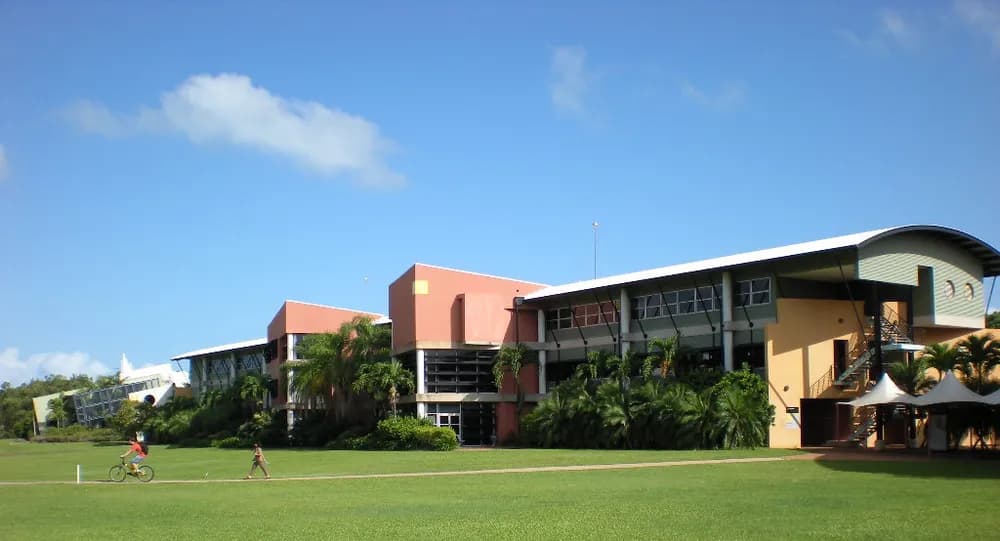
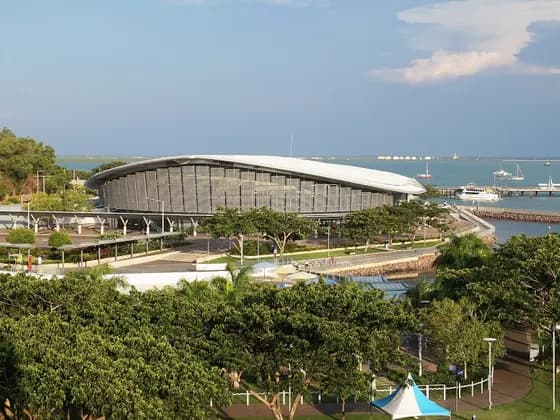
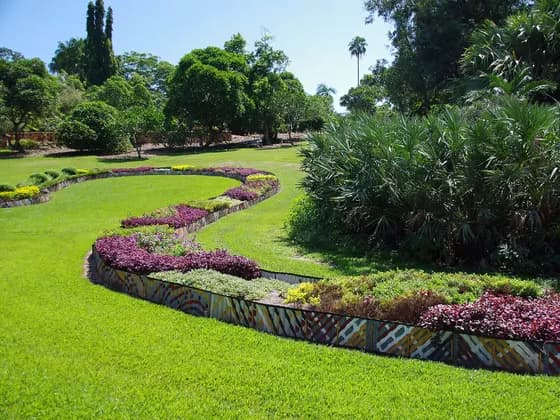
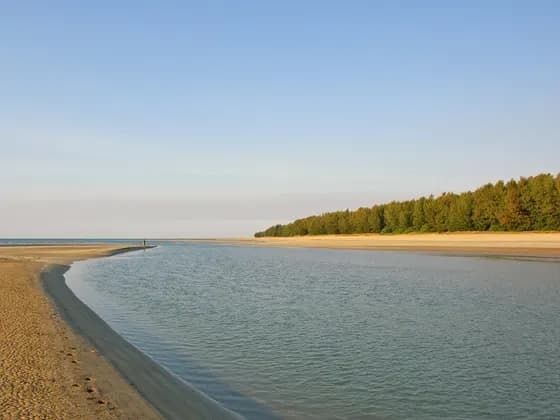
Photo: Michael Coghlan · CC BY 2.0 · cropped
Photo: Bernard Gagnon · CC BY-SA 4.0 · Photo: Balou46 · CC BY-SA 4.0 · Photo: Bidgee · CC BY 3.0
The CDU / Flinders medicine course at a glance (2027 entry)
The Northern Territory Medical Program (NTMP) is Flinders University's Doctor of Medicine (MD) taught entirely in the Northern Territory (NT), in partnership with Charles Darwin University (CDU). In Australia the MD is an extended masters-level degree. Graduates can apply straight into the MD, which is called graduate entry. School leavers reach it through CDU's Bachelor of Clinical Sciences (WCSCI1), the route this guide follows. It is a different course from CDU's own five-year CDU Menzies Medical Program (SMED01).
CDU lists the bachelor's degree as three years full time, but only the first two are CDU teaching, on the Casuarina campus in Darwin. Pass every unit and keep a grade point average (GPA) of at least 5.00, a credit average, within the set time, and your MD place is guaranteed. Your third year is then MD Year 1 with Flinders in Darwin, which also completes the bachelor's degree, awarded jointly by both universities. Three more MD years make six in all.
MD Years 1 and 2 are taught on the Casuarina campus, in Flinders' building and the CDU Anatomy Lab, through team-based learning, lab practicals, clinical skills groups and dissection. MD Years 3 and 4 are full-time placements in hospitals, general practices and Aboriginal Medical Services, health services run by Aboriginal communities.
Places come with a bond: CDU and Flinders say you will work in the NT for two years after graduating, including your intern year. Internship is the first supervised year as a doctor, known as PGY1. The Australian Medical Council (AMC), which accredits medical courses, accredits the Flinders MD until 31 March 2028. The AMC's March 2025 decision came with conditions, and one requires Flinders to plan clinical placements with key NT partners, including CDU.
| Degrees | Bachelor of Clinical Sciences (CDU and Flinders), then Doctor of Medicine (MD, Flinders) |
|---|---|
| Course length | 6 years from Year 12, including 2 at CDU; MD alone 4 years |
| Class size | 12 CDU pathway places a year; 42 began MD Year 1 in 2025 |
| Main campus | CDU Casuarina campus, Darwin, plus Flinders' campus at Royal Darwin Hospital |
| Teaching style | Team-based learning, lab practicals and small-group clinical skills in MD Years 1–2 |
| Anatomy | Anatomy and physiology units at CDU, then dissection and lab vivas |
| First patient contact | Pathway Year 3 (MD Year 1); general practice placement in MD Year 2 |
| Remote placement | Year 3 or 4: Alice Springs, Tennant Creek, Katherine or Nhulunbuy |
| Return of service | Two years' work in the NT after graduating, including your intern year |
| Accreditation | Flinders MD accredited by the AMC until 31 March 2028, with conditions |
What makes CDU / Flinders medicine different
From Year 12 to doctor, based in the Territory
All six years are based in the NT: two at CDU's Casuarina campus, then four of the Flinders MD in Darwin and the Territory's regional towns.
A remote placement for every student
Flinders expects each NTMP student to take a remote placement in Year 3 or 4, short or long, in Alice Springs, Tennant Creek, Katherine or Nhulunbuy.
A 20-week community semester in Year 3
For most NT placement models, Flinders' latest published placement plan, for 2023 to 2025, pairs Year 3 hospital rotations with a 20-week community-based semester in child health, women's health and general practice. Darwin's 2026 timetables still include that semester.
First Nations health and culture from the first semester
Cultural safety starts at CDU with Intercultural Sensitivity and Psychological Communication, then Perspectives of First Nations Health. The MD adds weekly Aboriginal health work and the Clinical Yarning Certificate in culturally safe communication. Students also join yarning sessions, a conversational Aboriginal way of sharing knowledge, with Uncle Richie Fejo, Flinders' Elder on Campus in Darwin. In 2024 the AMC found substantial Indigenous health teaching and placements in the NTMP.
Internship preparation built on NT hospitals
Final year includes intern shadowing, up to four weeks in the NT program since 2024, and PrINT, a Preparation for Internship program redesigned in 2025. PrINT uses cases and protocols from Royal Darwin and Alice Springs hospitals, the main intern allocation centres, and runs ward-call, deteriorating-patient and large internship simulations.
How CDU / Flinders teaches medicine
In the two CDU years you take four units a semester on the Casuarina campus, with course material on Learnline, CDU's online learning system. Science units are assessed by short tests, written case studies or reports and final exams, and chemistry, microbiology and haematology add laboratory practicals.
MD Years 1 and 2 run as body-system blocks. In the 2026 Year 1 timetable, each block of four or five weeks was followed by an assessment week. The core method is team-based learning (TBL), backed by lectures, lab practicals and weekly clinical skills groups.
All Flinders sites teach the same topics, and every student sits the same block and progress tests at the same time, with specialist lectures provided online. In Darwin, several sessions in the 2026 timetables are marked Local Delivery and taught by NT clinicians, such as a GP lecture on cough, a neurology examination class and Friday TBL application sessions.
From MD Year 3 you learn through work-integrated learning, working in clinical teams on placement. Teaching comes through bedside sessions, structured skills workshops and a weekly workshop. The AMC's 2024 assessment describes a Longitudinal Academic Program of teaching that runs through Year 3 alongside placements, and the Transition to Internship Program in Year 4. Both vary in form between sites. The AMC also noted that the NT's Year 3 opens with intensive skills workshops, simulation and 12 progressive clinical skills sessions.
The ways you will learn
| Team-based learning | Each week in MD Years 1 and 2 you work through set material before class. You then sit an individual readiness assurance test (iRAT) and the same test with your team (tRAT), before a clinician leads an application session on clinical problems. Prepared, in-person participation is a hurdle, a task you must pass. |
|---|---|
| Clinical skills groups | Small groups practise history taking and examination for two hours a week in the 2026 Year 1 timetable. Sessions build towards assessed consultations and life support. |
| Progressive Clinical Skills | A year-long Year 3 program of small-group role plays on the hard parts of a consultation. You practise and watch each other's history taking and examination, then discuss diagnosis and management, with scenarios growing more complex through the year. |
| Case-based learning and Grand Rounds | In Year 3, clinicians lead small groups through cases: weekly in Alice Springs in 2026, and at Palmerston GP Super Clinic for Darwin's community-based students. Alice Springs students also attend Grand Rounds, the hospital's weekly teaching meeting. |
A typical week on the CDU / Flinders course
A cardiovascular week in the 2026 Year 1 timetable began on Monday afternoon with a progress test, a paper every year group sits at once. Tuesday brought two-hour clinical skills groups, a yarning session with Uncle Richie and dissection peer teaching. Wednesday was a three-hour dissection, Thursday an ECG session with the NT cardiac team, and Friday the iRAT and tRAT. Medicine 1B, the half-year that week belonged to, lists 93 hours of lectures, 56 of practicals, 67 of workshops, 48 of tutorials and 267 of independent study.
On 2026 Year 3 rotations at Royal Darwin Hospital, students were on the ward until 12:30 on Monday, Wednesday and Friday and until 16:30 on Tuesday and Thursday. Afternoon teaching at the hospital, also streamed on Teams, covered topics such as anxiety disorders, paediatric surgery and immunisation. The 2027 calendar already books Year 3 teaching on Monday, Wednesday and Friday afternoons.
In Alice Springs, a 2026 Year 3 week held general practice sessions at Central Australian Aboriginal Congress clinics on Tuesday and Thursday mornings. Wednesday afternoon brought Congress teaching and bedside teaching at Alice Springs Hospital, and Friday clinical skills, case-based learning, Grand Rounds and student teaching.
Flinders asks clinical-year students to expect intern-like hours of 37.5 to 50 a week. Timetables give at least one free 24-hour period in seven and no more than one night of after-hours work a week. Night duty is not usually required in Year 3, but at some rural and remote sites you are on call with your supervisor.
How anatomy is taught at CDU / Flinders
Your first anatomy is at CDU. Anatomy and Physiology 1 covers cells and tissues and the musculoskeletal, cardiovascular, respiratory, nervous and endocrine systems. Anatomy and Physiology 2 adds the digestive, reproductive, urinary, lymphatic and immune systems. Each is assessed by five 20-minute tests, a 1,000-word case study and a 90-minute exam.
In the MD, anatomy is taught in the CDU Anatomy Lab alongside the body-system blocks. The 2026 Year 1 timetable lists dissection, dissection peer teaching and practicals during the cardiovascular and respiratory blocks. Medicine 1B also includes an anatomy viva, an oral exam held in the lab.
The 2027 handbook's Darwin offering of Medicine 2A, in MD Year 2, has you dissect the abdomen and then the musculoskeletal system. Each is examined by a lab viva, you complete a workbook linking the dissection to clinical practice, and your dissection group formally reviews each member's contribution. A 2025 NTMP graduate described the cadaver dissection sessions as a privilege.
When you first meet patients at CDU / Flinders
Patient contact starts with the MD, in pathway Year 3. CDU says placements, and the police check they need, begin with the MD component. In MD Year 1 you are assessed on history-taking interviews in each half-year. You are also assessed on examining the heart and chest with a simulated patient, a community member trained to play one.
Year 1 also takes you into health services. The 2026 timetable included half-day acute placements and a Remote Health Experience day in September. A 2025 Flinders page says Years 1 and 2 begin your contact with remote communities through the Remote Health Experience and a Regional Community Week. You also complete a four-day nursing attachment in Year 1 or early Year 2.
MD Year 2 adds a general practice placement, recorded in a placement and procedural skills logbook; the Darwin offering of Medicine 2B includes 120 hours of clinical placement. Its Transition to Clinical Practice block teaches procedures such as injections, venepuncture and cannulation, and the 2026 timetable closes the block with a week of ward placements.
Year by year at CDU / Flinders
- Pathway Year 1
Science foundations at CDU
You enrol as a CDU student and study full time at the Casuarina campus. The year lays the science groundwork for medicine and starts your training in culturally safe communication.
- Semester 1: Anatomy and Physiology 1, Cellular Biology, Chemical Concepts, and Intercultural Sensitivity and Psychological Communication.
- Semester 2: Anatomy and Physiology 2, Introduction to Microbiology, Organic and Inorganic Chemistry, and Epidemiology and Statistics.
- Both chemistry units assume Stage 2 (Year 12) chemistry or equivalent and include six or seven written-up lab practicals.
- Introduction to Microbiology covers microbes with a focus on the NT, teaches you to grow and identify them, and includes a practical exam you must pass.
- Intercultural Sensitivity and Psychological Communication covers cultural safety and how culture shapes communication, through an essay, a presentation and tests.
- Epidemiology and Statistics has you analyse health data and write a 1,500-word report.
- Pathway Year 2
Medical sciences and the step into the MD
The second CDU year turns to the sciences closest to medicine. It completes the two CDU years whose results decide whether you continue into the MD.
- Semester 1: Haematology 1, Medical Biochemistry, Communication for Improved Patient Care, and Perspectives of First Nations Health.
- Semester 2: Pathophysiology for Healthcare, Pharmacology for Clinical Practice, Immunology, and one specialist elective.
- Haematology 1 teaches you to prepare and examine blood films and do cell counts, with a two-hour practical competency assessment you must pass.
- Perspectives of First Nations Health covers colonisation, cultural determinants of health and cultural safety, assessed mainly by a 1,500-word literature review.
- Communication for Improved Patient Care, graded pass or fail, covers rapport, clinical reasoning and evidence-based medicine, with five observed communication tasks.
- Pharmacology for Clinical Practice covers medication safety and dosage calculations and ends in a 90-minute exam.
- MD Year 1 (pathway Year 3)
Foundations and the first body systems
MD Year 1 is two half-year topics, Medicine 1A and 1B, taught in Darwin; graduate entrants start here alongside school leavers in their third year. It opens with a compulsory in-person preparation week. For school leavers, passing the year completes the Bachelor of Clinical Sciences.
- Medicine 1A: the Molecular Foundations of Medicine block, then Immunity, Microbes and Defence, each with a multiple-choice block test.
- Medicine 1B: respiratory, renal and cardiovascular blocks; in 2026, five weeks of cardiovascular, five of respiratory and four of renal.
- Weekly clinical skills with assessed history taking, case write-ups, a heart and chest examination and basic life support.
- Aboriginal health through weekly discussion-forum posts, a quiz and the Clinical Yarning Certificate.
- A Mental Health First Aid course, a self-care plan and your own personal code of ethics.
- Advanced Studies, the MD's compulsory research or coursework strand, starts with research methods, ethics, epidemiology and statistics, a biostatistics test and a literature-search exercise.
- MD Year 2
Dissection, the brain and the move to clinics
Medicine 2A covers the gastrointestinal, musculoskeletal, and endocrine and reproductive systems alongside dissection. Medicine 2B covers neurology and psychiatry and ends with the Transition to Clinical Practice block. Your Advanced Studies research project or first coursework topic runs from July to December.
- Simulated consultations on the gut, urinary and musculoskeletal systems, then a neurological assessment, plus intermediate life support.
- A general practice placement with a logbook; in 2026, psychiatry expert workshops and a healthcare law workshop with the Public Guardian and Public Trustee.
- A personal and professional development elective or project; in 2026 one student ran a Teddy Bear Hospital at his children's school.
- An Aboriginal health reflective essay, a public health essay and a legal and ethical case study.
- The Clinical Skills Consolidation assessment at the end of the year: a 30-minute observed history and targeted examination.
- MD Year 3
Hospital rotations and a community semester
Year 3 is full-time placement: Medicine 3A and 3B each have about 405 placement hours and a weekly three-hour workshop, in Darwin, Alice Springs, Katherine or Nhulunbuy. The rotations below come from Flinders' latest published model, set out in July 2022 for 2023 to 2025. Darwin's 2026 timetables keep its hospital-based and community-based streams, running side by side for different groups of students.
- 2023–25 model, in most NT placement models: eight weeks each of general medicine and general surgery, four of mental health, and a 20-week community-based semester covering child health, women's health and general practice.
- Darwin, 2026: medicine and surgery at Royal Darwin Hospital and four-week psychiatry rotations on its Cowdy Ward. Community placements used Palmerston GP Super Clinic, urgent care clinics, Danila Dilba Health Service and the hospital's Eye Clinic.
- Alice Springs, 2026: Congress GP sessions, bedside teaching at Alice Springs Hospital and a cultural immersion day trip to Atitjere.
- Three Global Assessment of Progress (GAP) reports from your supervisors each half-year, and a law and ethics task ending in a 750-word critical analysis.
- Your Advanced Studies research project or second coursework topic, January to August.
- The Year 3 OSCE (Objective Structured Clinical Examination), an exam of timed clinical stations, is a hurdle you must pass to finish the year; it fell on 13 November in the 2026 Darwin timetable.
- MD Year 4
Rotations and readiness for internship
Medicine 4A and 4B bring you to the standard of a new intern, each with about 405 placement hours and a weekly two-hour workshop. The 2027 handbook offers Year 4 in Darwin; a March 2025 Flinders page says fourth-years can elect some core rotations and electives in Alice Springs and Nhulunbuy.
- 2023–25 model: six-week placements in women's health, child health, critical care (anaesthetics, intensive care and emergency), medicine and surgery, plus a medical selective and an elective.
- Transition to Internship Program sessions on patient scenarios through the year, a prescribing skills assessment, patient safety quizzes and a deteriorating-patient assessment.
- Intern shadowing, assessed on your patient care and professional growth, and PrINT topics such as medicolegal issues, prescribing, peri-operative care and learning to teach.
- The Advanced Studies capstone: a research output and referee report, or a clinical audit and evidence-based medicine assignment, each with a community engagement activity.
- Progress tests in the first half only, and an executive summary of your portfolio for your learning coach, who meets you one to one throughout the MD.
How you are assessed at CDU / Flinders
Most CDU units are graded, and your GPA over the two CDU years decides whether you move into the MD. In the MD, the core topics, Medicine 1A to 4B, and the Advanced Studies research topics are graded pass or fail, which Flinders calls a non-graded pass. Most tasks inside a topic are hurdles. If you take the coursework route instead of a research project, most of the postgraduate topics on offer are graded. Failing one of the main 18-unit topics starts a formal student progress process.
Progress tests are 120-question multiple-choice papers: four a year in MD Years 1 to 3 and two, in the first half, in Year 4. They are for feedback only in Years 1 and 2 and count from Year 3. Each block in Years 1 and 2 also has a multiple-choice block test, and the AMC reported in 2024 that a failed summative assessment can be resat once.
In Years 3 and 4, supervisors complete GAP reports rating you against six criteria. The AMC reported at least three mini clinical evaluation exercises per placement, in which a supervisor watches you with a patient and scores the encounter. Handover presentations are marked against a rubric.
The Year 3 OSCE is the main clinical exam: you rotate through timed stations, each testing a clinical task with a patient. It runs in Darwin and at Bedford Park in Adelaide, with the same stations at the same time. The AMC's report on its 2024 assessment describes eight 10-minute stations, each judged on three domains, with a pass mark of 17 of the 24 judgements. Flinders' own report on the November 2023 OSCE gave 12 minutes per station. You receive an overall score and written feedback on each domain.
Your learning coach portfolio is a hurdle every half-year. Taking more than six consecutive years to finish the MD can count as not meeting academic requirements, and approved leave is capped at four semesters. A break of six months or more may require a Clinical Practice Preparedness refresher topic.
- The 2026 Year 3 timetables include an oral critical appraisal assessment, and Alice Springs students sat practice and mock OSCEs before the real one.
- Flinders' NT program page places the Advanced Studies capstone in the first half of Year 4, while the 2027 handbook lists its tasks under Medicine 4B, the second half.
Where you will actually be at CDU / Flinders
All four MD years are based in the NT, apart from any elective you arrange elsewhere. Flinders' 2027 application guide says NTMP students cannot change their location from the NT to South Australia. MD Years 1 and 2 are in Darwin, where you find your own accommodation.
Year 3 can be based in Darwin, Alice Springs, Katherine or Nhulunbuy, the four NT offerings of the Year 3 topics in the 2027 handbook. Every student is also expected to take a remote placement in Year 3 or 4. Flinders offers short and long ones in Alice Springs, Tennant Creek, Katherine and Nhulunbuy, and you preference a region in Year 2 to be placed there in Year 3 where possible.
Flinders' pages describe the longest option differently. Its NT entry page (August 2026) offers the chance of a whole year or more in a remote area. Its clinical experiences page (March 2025) says third-years can spend six months or more in a remote location. One 2025 graduate spent six months in Katherine and also had a placement in Nhulunbuy.
Flinders manages furnished shared houses and units for placement students in Alice Springs, Darwin, Katherine, Nhulunbuy and Tennant Creek, with single rooms and a $200 refundable deposit. Using them means attending Flinders' free cultural workshop on working with Aboriginal clients in that region. The AMC reported in 2024 that NTMP students on regional placements are given accommodation, but students found suitable housing in smaller centres hard to get and raised safety concerns.
Before placements, Flinders registers you as a student with the Medical Board of Australia through AHPRA, the Australian Health Practitioner Regulation Agency, and you must meet immunisation rules. The NT adds an Ochre Card (its working with children clearance), tuberculosis screening, a signed confidentiality deed poll, manual handling training and a police certificate from an Australian police service. Some community placements are confirmed at short notice.
Base for MD Years 1 and 2, Darwin's Year 3 hospital-based and community-based streams, and Year 4. Royal Darwin Hospital is a 360-bed public hospital covering all specialty areas.
- Royal Darwin Hospital, including Cowdy Ward and the Eye Clinic
- Palmerston GP Super Clinic and its skin and women's health clinics
- Darwin and Palmerston Medicare Urgent Care Clinics
- Danila Dilba Health Service clinics at Malak, Rapid Creek and Palmerston
- FCD Health GP Clinic, Eaton
A Year 3 base and remote placement town; its 2026 timetable also included a visit to the Sexual Assault Resource Centre.
- Alice Springs Hospital
- Central Australian Aboriginal Congress clinics at Gap Road, Alukura, Larapinta and Sadadeen
- Flinders campuses in the Rural and Remote Health building and the Rubuntja Building
A Year 3 base. The 60-bed hospital serves Katherine, the surrounding region and remote areas, and Flinders runs a one-day Orientation to Katherine Regional Cultures and Context course.
- Katherine District Hospital
- Flinders campus, O'Keefe House
A Year 3 base, and an option for some Year 4 rotations according to a 2025 Flinders page. The 30-bed hospital takes patients referred from 15 remote communities.
- Gove District Hospital
- Flinders NT Clinical Education Training Facility
A short or long remote placement option. The 20-bed hospital serves the Barkly region, and the 2026 community-based timetable includes a three-week placement there.
- Tennant Creek Hospital
- Flinders Tennant Creek office, Karguru Centre
Electives, selectives and options at CDU / Flinders
Choice starts in Pathway Year 2 with one specialist elective: Society, Culture and Health; Health Informatics; Rural and Remote Health; or HSC111. The course page calls HSC111 Mental Health and Wellbeing, but the 2027 unit catalogue lists it as Ethics in Health Care.
In MD Year 2 you choose a personal and professional development elective in the medical humanities, either a short course or a community activity. Medicine 2A adds a medical humanities project on the experience of illness. Advanced Studies is the larger choice: a supervised research project or two postgraduate coursework topics. The coursework is taught online, some of it also in person in Adelaide, and includes Remote and Indigenous Primary Health Care.
For the final year, Flinders' 2023–25 model includes one elective and a medical selective. An information session runs in Year 3, and interstate and overseas electives need your topic coordinator's approval. One 2025 NTMP graduate took his elective at St George's Hospital in London.
Intercalation and research degrees at CDU / Flinders
Research is built into the MD rather than taken as an extra year. Advanced Studies starts with research methods in MD Year 1. A supervised project or coursework runs from July of Year 2 to August of Year 3, and the capstone follows in Year 4. Projects can be based at the university or in NT health services.
Flinders' combined MD-MPH pauses the MD after Year 2 for a year of full-time Master of Public Health study, but NT bonded students cannot apply at present.
Facilities and support at CDU / Flinders
Where you will learn
Your CDU years are on the Casuarina campus, CDU's largest, on Larrakia country about 15 km from central Darwin, with a library, student accommodation options and a free semester-time bus to CDU Waterfront.
MD teaching is in CDU Yellow Building 4, Flinders' Darwin facility on the same campus. Flinders told the AMC in 2024 that it had recently been refurbished for larger intakes and that further expansion was being planned; the CDU lease runs to 2035. The 2026 timetables name its Clinical Skills Lecture and Ward rooms, small-group rooms and the CDU Anatomy Lab.
Flinders' second Darwin campus, Building 4A at Royal Darwin Hospital, holds the program's administration centre and teaching rooms. The 2026 timetables use them for Year 3 teaching, progress tests and Year 2's long cases. Both Darwin campuses have student common rooms with kitchens and 24-hour swipe access, some free parking and childcare; a locker key at the hospital needs a $20 deposit.
Alice Springs students have lecture rooms and simulated learning spaces open around the clock, and more than 60 bikes to borrow. Katherine has teaching rooms in O'Keefe House at the hospital. In Nhulunbuy, the Clinical Education Training Facility at Gove District Hospital hosts video-conference teaching for Year 3 and 4 students and interdisciplinary simulation days.
Support while you study
Flinders recruits learning coaches in the NT, and they need no medical training. When the AMC visited in October 2024, NTMP students had a psychologist available three days a week, which it commended. Medical mentors met Year 1 and 2 students up to five times a year about their progress. The AMC also found support structures less visible in the NTMP than in Flinders' rural South Australian stream.
Each NT campus has a local student support officer, and EASA, a local provider, offers counselling. On placement, Flinders' NT placement team offers pastoral support and local knowledge. In your CDU years you use CDU's services, including counselling, First Nations tutorial support and a 24-hour wellbeing support line.
Aboriginal and Torres Strait Islander students have Yungkurrinthi Student Engagement. It offers student spaces in CDU Yellow Building 4 and Building 4A at Royal Darwin Hospital, Indigenous Student Success Officers, free tutoring and its own counsellors. Elders on Campus offer cultural mentoring in Darwin, and Flinders' December 2024 news names an Indigenous Pathways to Medicine program of academic and pastoral help.
Two student groups, the Flinders Medical Students' Society NT and the Students Association for Rural and Remote Health, run events; in 2023 they hosted the Australian Medical Students' Association Rural Summit in Darwin. Flinders' NT Regional Training Hub supports doctors from internship to specialist training. For final-year students in 2025, it gave a talk on rural and remote medical careers, sponsored a networking lunch and hosted a pre-intern meet and greet.
Is the CDU / Flinders course right for you?
This course may suit you if
- You want to go from Year 12 to a medical degree while staying based in the Territory.
- You want remote medicine in your training, through a remote placement in Year 3 or 4 that can last months.
- You learn well by preparing ahead and testing yourself with a team each week, the core of MD Years 1 and 2.
- You want First Nations health throughout, from CDU's cultural safety units to placements with Danila Dilba and Central Australian Aboriginal Congress.
Things to think about
- The bond is a real commitment: two years' work in the NT after graduating.
- Your MD place depends on passing every CDU unit and reaching a GPA of 5.00 within the set time.
- Remote placements mean living away from Darwin for a time, and students told the AMC in 2024 that suitable housing in smaller centres was hard to find.
- The latest published rotation lists date from Flinders' 2023–25 model. The AMC also warned in 2024 that rising numbers and CDU's new medical program will mean more competition for NT placements.
CDU / Flinders medicine course — frequently asked questions
Applying to CDU / Flinders?
How to get into CDU / Flinders
Entry requirements, admission tests, written application and interview, step by step.
Open the guide →CDU / Flinders entry requirements
ATAR or GPA, GAMSAT and UCAT ANZ thresholds, interview format and place types.
See the requirements →Compare CDU / Flinders with other schools
Put the teaching style, anatomy teaching and placements next to another school.
Open the comparison →Where this CDU / Flinders course guide came from
This guide was written from 65 official sources — Charles Darwin University — Northern Territory Medical Program's own course pages and programme documents, plus the Australian Medical Council or Australian Dental Council and the health services the school places students with where they publish detail — read on 2026-10-08, then checked claim by claim against those sources.
- Charles Darwin University: Bachelor of Clinical Sciences (WCSCI1), 2027 course page
- CDU Unit Catalogue 2027: SBI161 Anatomy and Physiology 1
- CDU Unit Catalogue 2027: SBI162 Anatomy and Physiology 2
- CDU Unit Catalogue 2027: PSY116 Intercultural Sensitivity and Psychological Communication
- CDU Unit Catalogue 2027: SBI183 Introduction to Microbiology
- CDU Unit Catalogue 2027: SCH101 Chemical Concepts
- CDU Unit Catalogue 2027: SCH102 Organic and Inorganic Chemistry
- CDU Unit Catalogue 2027: HSC233 Epidemiology and Statistics
- CDU Unit Catalogue 2027: MLS200 Haematology 1
- CDU Unit Catalogue 2027: HSC133 Perspectives of First Nations Health
- CDU Unit Catalogue 2027: SCL200 Communication for Improved Patient Care
- CDU Unit Catalogue 2027: SBI242 Pharmacology for Clinical Practice
- CDU Unit Catalogue 2027: HSC111 Ethics in Health Care
- Charles Darwin University: Bachelor of Clinical Science Medicine/Doctor of Medicine (SMED01), CDU's separate five-year course
- Charles Darwin University: Casuarina campus
- Charles Darwin University: Life, health and wellbeing support for current students
- Flinders NT: Undergraduate entry to the NT Medical Program through CDU
- Flinders NT: Study medicine in the NT, Northern Territory Medical Program
- Flinders University: Study medicine in the Northern Territory (graduate entry)
- Flinders University in the Northern Territory
- Flinders NT: Campus locations in the Northern Territory
- Flinders NT: Student placements and accommodation in the Northern Territory
- Flinders University: Doctor of Medicine course page
- Flinders University: Doctor of Medicine Domestic Application Guide 2027
- Flinders Handbook 2027: Bachelor of Clinical Sciences, Flinders/CDU Doctor of Medicine pathway
- Flinders Handbook 2027: Doctor of Medicine (CDU/Flinders, Darwin)
- Flinders Handbook 2027: MMED9150 Medicine 1A, Darwin offering
- Flinders Handbook 2027: MMED9151 Medicine 1B, Darwin offering
- Flinders Handbook 2027: MMED9250 Medicine 2A, Darwin offering
- Flinders Handbook 2027: MMED9251 Medicine 2B, Darwin offering
- Flinders Handbook 2027: MMED9350 Medicine 3A, NT offerings
- Flinders Handbook 2027: MMED9351 Medicine 3B, NT offerings
- Flinders Handbook 2027: MMED9450 Medicine 4A, Darwin offering
- Flinders Handbook 2027: MMED9451 Medicine 4B, Darwin offering
- Flinders Handbook 2027: MMED8205 Advanced Studies Research Project 1
- Flinders Handbook 2027: MMED8304 Advanced Studies Research Project 2
- Flinders Handbook 2027: REMH8002 Remote and Indigenous Primary Health Care (Advanced Studies coursework option)
- Flinders University Students: Northern Territory campuses and published 2026 NT timetables
- Flinders University Students: Medicine placement requirements
- Flinders University Students: Aboriginal and Torres Strait Islander students (Yungkurrinthi)
- Flinders NT Regional Training Hub: Medical career pathways
- Flinders University: Clinical experiences (March 2025)
- Flinders University: Doctor of Medicine / Master of Public Health
- Flinders Medical Program blog: MD clinical placement model 2023-2025 (July 2022)
- Flinders Medical Program blog: Updates from the NT Medical Program (November 2022)
- Flinders Medical Program blog: Updates from the NT Medical Program (March 2023)
- Flinders Medical Program blog: Updates from the NT Medical Program (September 2023)
- Flinders Medical Program blog: Year 3 OSCE 2023 (December 2023)
- Flinders Medical Program blog: Programmatic assessment, portfolios and coaching in the MD (October 2025)
- Flinders Medical Program blog: Learning coaches in 2026 (October 2025)
- Flinders University News: Major milestones for the medical program in the NT (February 2025)
- Flinders University News: NT medical graduates (December 2024)
- College of Medicine and Public Health news: NTMP Preparation for Internship (November 2025)
- College of Medicine and Public Health news: an NTMP student's remote year (December 2025)
- College of Medicine and Public Health news: an NTMP graduate's story (November 2025)
- College of Medicine and Public Health news: Year 2 Teddy Bear Hospital project (August 2026)
- Australian Medical Council: Accreditation Report, Flinders University College of Medicine and Public Health (March 2025, on the October 2024 assessment)
- Australian Medical Council: Accredited medical schools
- Medical Board of Australia: Interns
- Health Jobs NT (NT Government): Interns, 2027 clinical year
- NT Health: NT medical school (older, undated page)
- NT Government: Royal Darwin Hospital
- NT Government: Katherine Hospital
- NT Government: Gove District Hospital
- NT Government: Tennant Creek Hospital
Courses are restructured between cycles. Anything here that decides your application — an anatomy offer, a placement city, a compulsory intercalated year — should be confirmed against the official page for your entry year.
Applying to CDU / Flinders?
We have helped hundreds of applicants turn their GAMSAT / UCAT ANZ, written application and interview prep into offers from CDU / Flinders and other Australian medicine schools.