
The Charles Darwin University Medicine course
What you actually study, and where you will be
Charles Darwin University's MD is a 5-year (direct entry) course taught through problem-based learning in an integrated curriculum, with patient contact from Year 1 and placements in Darwin, Katherine, Tennant Creek, Alice Springs, Nhulunbuy and smaller communities (2027 entry). CDU's five-year medical course, the CDU Menzies Medical Program, teaches Years 1 and 2 on the Casuarina campus in Darwin through small problem-based learning groups, lectures, labs and practice with simulated patients. Years 3 to 5 are spent entirely on placement, in blocks across the Northern Territory from Darwin to Alice Springs. The course is new: its first 42 students started in February 2026, so no one has yet reached the clinical years.
- Degree
- MD
- Length
- 5 years (direct entry)
- Teaching
- Problem-based learning + Integrated
- Clinical contact
- Year 1
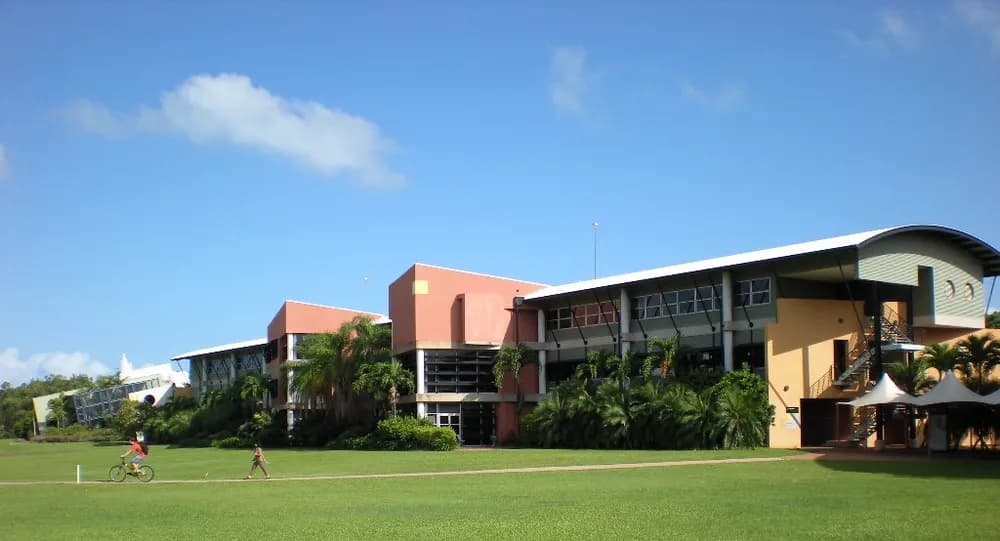
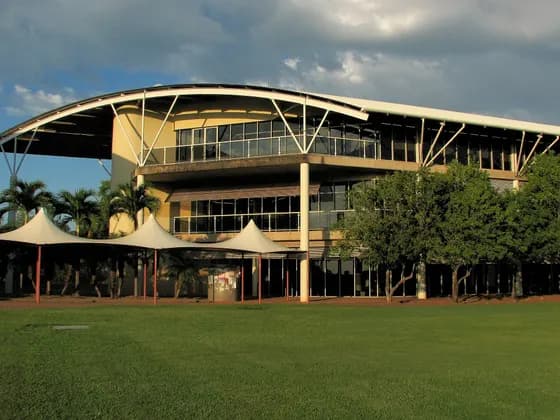
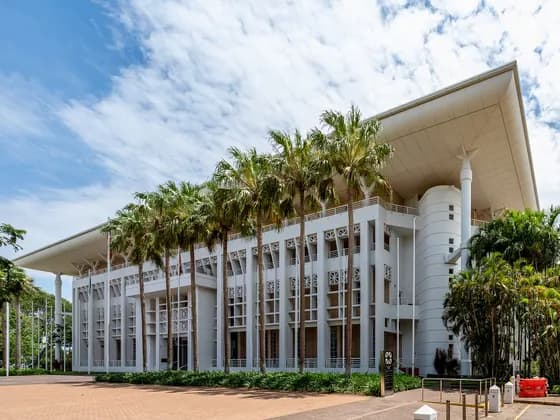
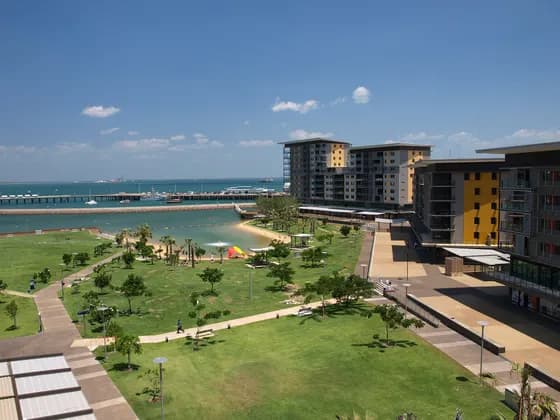
Photo: Michael Coghlan · CC BY 2.0 · cropped
Photo: Stephen Barnett from Darwin, Australia · CC BY 2.0 · Photo: Dietmar Rabich · CC BY-SA 4.0 · Photo: Alex Healing · CC BY 2.0
The Charles Darwin University medicine course at a glance (2027 entry)
Charles Darwin University's Bachelor of Clinical Science Medicine/Doctor of Medicine, which CDU calls the CDU Menzies Medical Program, is a five-year, full-time medical course you can start straight from Year 12 (direct entry). It is run by the School of Medicine in CDU's Faculty of Health. The Doctor of Medicine (MD) is an extended masters-level degree in Australia. The Australian Medical Council (AMC), which accredits medical courses, describes this one as a three-year bachelor degree with a two-year extended masters in Years 4 and 5.
CDU created the course in response to the health needs of the Northern Territory (NT). Its stated purpose is to give local NT and First Nations students the chance to study medicine and to build a home-grown medical workforce for the Territory.
The teaching leans towards First Nations health and wellbeing, remote and rural medicine, and rural generalism, meaning general practice that also covers rural hospital and emergency work. Five themes run through all five years: patient care, professional and personal development, health in the community, First Nations culture and health, and the scientific basis of medicine.
The course has two phases. In Years 1 and 2 you study at the Casuarina campus in Darwin, where teaching is built around small problem-based learning (PBL) groups. Each group works through a patient case and decides what it needs to learn, with lectures, labs and clinical skills classes in support. Years 3 to 5 are spent entirely on clinical placement, in blocks across the Territory.
This is a new course, and it started a year later than first planned. CDU announced in August 2024 that 20 students would begin in 2025, but the AMC's accreditation decision that November barred any start before 1 January 2026. The first cohort, 42 students, began in February 2026, so the clinical years have not yet run. The program carries the name of its research partner, the Menzies School of Health Research, and is built on a curriculum CDU bought from Western Sydney University.
It is a different course from CDU's three-year Bachelor of Clinical Sciences, which is the pathway into Flinders University's separate Northern Territory Medical Program. If you want CDU's own five-year course, the code to look for is SMED01.
| Degree | Bachelor of Clinical Science Medicine/Doctor of Medicine (MD) |
|---|---|
| Course length | 5 years full time, 400 credit points; no part-time option |
| Main campus | Casuarina campus, Darwin, for Years 1 and 2 |
| Teaching style | Small-group problem-based learning, with lectures, labs and simulated patients |
| First patient contact | Year 1 with simulated patients; full-time placements from Year 3 |
| Placement area | About 95 weeks across Darwin, Katherine, Tennant Creek, Alice Springs, Nhulunbuy and smaller communities |
| Research | MD Project in Year 4; research mentors from Menzies School of Health Research |
| First intake | 42 students, February 2026 |
| Accreditation | AMC accredited to 31 March 2031, with conditions |
| Early exit | Bachelor of Clinical Science Medicine after 3 years (240 credit points) |
What makes Charles Darwin University medicine different
Three clinical years spent across the Territory
From Year 3 you join clinical teams for blocks of several weeks or months, in Darwin hospitals and in rural and remote towns across the NT. When a block is outside Darwin you live in that town for the length of the attachment, which CDU sees as central to understanding how health care is delivered across the Territory.
First Nations health assessed in every early unit
First Nations culture and health is one of the course's five themes, and the program has a First Nations Lead on its executive team. Every Year 1 and 2 unit includes a First Nations task you must pass, one of them a recorded group interview with a First Nations health worker.
Learning medicine through clinical cases from the start
In Years 1 and 2, your PBL group works through an authentic clinical scenario and pulls the anatomy, physiology, pathology and clinical reasoning together around that patient. In the first cohort's 2026 timetable, PBL groups met twice a week for two and a half to three hours, with lectures, labs and workshops arranged around them.
Practising on trained community members first
Every Year 1 and 2 unit includes bedside teaching with simulated participants, community members whom CDU trains and pays to play patients. They act out histories and emotions, allow non-intimate examinations, take part in Objective Structured Clinical Examinations (OSCEs), which are circuits of timed clinical stations, and give you structured feedback. CDU especially welcomes First Nations community members and people with lived experience of illness.
Research with the Menzies School of Health Research
CDU says you can do research in partnership with communities, mentored through the Menzies School of Health Research. Research runs through the course: evidence-based practice and critical reading of the medical literature in Year 1, framing an answerable research question in both Year 2 units, and the MD Project in Year 4.
A bought curriculum, reshaped for the Territory
CDU bought Western Sydney University's medical curriculum and assessment system under a 2024 agreement and is reshaping it for the NT. A Curriculum Working Group and a First Nations Community Advisory Group guide that work. The AMC called the purchase a sound basis for the course. By November 2024 the first two years had been adapted, and one of the AMC's conditions covers adapting the final three.
How Charles Darwin University teaches medicine
Years 1 and 2 are taught through problem-based learning, which the AMC's 2024 report calls the core of the first two years. Each semester is a single 16-week unit worth 40 credit points. CDU says its units are larger than most university units because the sciences, clinical skills and professional topics are taught and assessed together. Lectures, tutorials and practical classes are there to support the cases.
CDU describes the curriculum as integrated in two directions. Within a unit, the disciplines are taught around the same cases. Between units, ideas come back with more complexity, and basic science is revised and applied again in the clinical years, an approach CDU calls a spiral curriculum. The design follows adult learning principles, such as learning through problems and direct experience. Year 1 is more directed and structured, and later years expect you to steer more of your own learning.
Attendance is expected at every session and is compulsory for labs, tutorials and clinical attachments. Early on, much of your study is directed self-learning: set reading, lecture and lab material and compulsory online modules. In the clinical years there is less formal teaching, and self-directed learning, where you decide what to study with guidance from tutors and supervisors, becomes essential.
From Year 3 you learn as a member of the clinical team on wards and in outpatient clinics, specialist rooms, operating theatres, emergency departments and community health services. What you see depends on who comes in, so one student may meet many patients with a condition while another meets none. Attachment guides and a list of core conditions set out what everyone should cover, and some attachments add tutorials or workshops. Online scientific streams let you solve clinical case studies with classmates, keeping your science current.
The ways you will learn
| Problem-based learning sessions | Small groups work through real-world clinical problems, building critical thinking, teamwork and the habit of finding things out for yourself. Your contribution is assessed: a PBL participation report is a pass-or-fail hurdle in each Year 1 and 2 unit. |
|---|---|
| Lectures | Lectures give you a framework, open up complex topics or bring in people and ideas you would not otherwise meet. CDU records most of them, but some are not recorded for cultural, clinical, intellectual property or technical reasons, and you are encouraged to attend in person. |
| Laboratories | Practical classes, used mainly for anatomy, physiology and pathology, where you study the body's three-dimensional structure and disease states and begin some practical skills. |
| Communication and clinical skills sessions | You practise talking with patients, examining them and some procedures on classmates, simulated patients and real patients. In the clinical years, workshops cover resuscitation, suturing and other procedural skills. |
| First Nations Culture and Health workshops | The program's First Nations leaders help shape these workshops, which run through the course. You learn to build on the strengths of First Nations communities and to see how social and cultural conditions shape health. You also learn to work with patients so that the care you give feels culturally safe to them. |
| Personal and Professional Development workshops | Held in Years 1 and 2, these help you grow into the role of a doctor. You work on looking after your own wellbeing, handling ethical questions, behaving professionally and working well in a team. You also reflect on your experiences with classmates and mentors, to prepare for the pressures of clinical work. |
A typical week on the Charles Darwin University course
CDU's Program at a Glance puts average contact time in Years 1 and 2 at 25 to 30 hours a week, and expects at least as much again in self-study. The first cohort's 2026 timetable fits that figure, with about 30 timetabled hours in a typical week. Most days start between 8am and 9am and finish around 4pm or 5pm, with some free study periods. The admissions guide warns that this leaves little room for paid work.
The year has fixed breaks: a week in April, a week in September, three weeks across June and July, and nine weeks at the end of each year. The 2027 intake starts on 8 February 2027.
CDU publishes each timetable about six weeks before teaching starts, so the latest full example is the first cohort's 2026 year. Semester 1 teaching ran from 2 February to 29 May, with PBL from the first week and lectures from 9 February, then a revision week and exams from 8 to 19 June. Semester 2 runs from 13 July to 30 October, with exams from 9 to 20 November. A typical semester 1 week in 2026 looked like this:
- Monday: three one-hour lectures, then a three-hour PBL session from 2pm.
- Tuesday: a lecture, a two-hour lecture-workshop and, in most weeks, a two-hour tutorial.
- Wednesday and Thursday: three workshops a day, from 9am to noon, 1pm to 2.30pm and 2.30pm to 5pm.
- Friday: in most weeks, a two-hour seminar and a one-hour revision session, then the second PBL session of the week from 2.30pm.
How anatomy is taught at Charles Darwin University
Anatomy runs through all four Year 1 and 2 units, taught with physiology, biochemistry, pathology and pharmacology for each body system as you reach it. Lab classes are where you study the body's three-dimensional structure, and the program has its own Anatomy and Histology Coordinator. Each unit includes a one-hour anatomy practical exam.
In the first cohort's 2026 timetable, semester 2 had a two-hour anatomy workshop every Tuesday morning and two 90-minute anatomy lab preparation sessions a week, on Wednesday and Thursday afternoons. Three-hour lab classes ran on most Wednesday and Thursday mornings.
When you first meet patients at Charles Darwin University
Your first patients are simulated. From semester 1, bedside teaching uses simulated participants, so you can practise taking a history and examining someone in a setting that protects real patients. Across the course, clinical skills sessions use classmates, simulated patients and real patients.
You also visit real services before Year 3. For the on-campus years, CDU's FAQ lists one-day observation placements: a community service organisation in semester 1, then a general practice or Aboriginal Community Controlled Health Organisation (ACCHO) in semester 2. An ACCHO is a primary health care service run by its local Aboriginal community. Year 1 units include community visits, and Year 2 units add procedural skills and sessions in hospitals and primary care.
Full-time clinical work starts in Year 3, when you join teams on placement. Year 4 expects clinical reasoning and procedures at a higher level of complexity and independence, and Year 5 builds towards near-independent practice. The aim is readiness for internship, the first supervised year of work as a doctor after graduating, also called postgraduate year 1 (PGY1).
Year by year at Charles Darwin University
- Year 1
Foundations: the body, nutrition, gut, heart and lungs
Year 1 is taught on campus in two 16-week units, each worth 40 credit points: MED101 Clinical Sciences 1 and MED112 Clinical Sciences 2. Alongside the science you learn to take a medical history and examine a patient, and you start a personal learning portfolio with the help of Professional Advisors.
- MED101 (semester 1): an introduction to the human body, then nutrition and metabolism.
- MED112 (semester 2): the gastrointestinal tract, then the cardiovascular and respiratory systems.
- In both units: the human context of health and disease, professionalism, quality and safety in health care, evidence-based practice and research, through community visits and workshops.
- First Nations tasks you must pass: a 1,000-word guided reflection in MED101 and a 15-minute group poster in MED112.
- Personal and Professional Development: a 1,000-word assignment in MED101, then a 500-word reflection and a 1,000-word essay in MED112.
- CDU encourages students who have not studied health or science subjects in the last two years to take an online, self-paced short course in semester 1. It is called Introduction to Chemistry and Cell Biology for Medical Students, and you can start it once your enrolment is confirmed.
- Year 2
More body systems, pharmacology and population health
Year 2 stays on campus with MED201 Clinical Sciences 3 and MED212 Clinical Sciences 4, two more 16-week, 40-credit-point units. Pharmacology, pathophysiology and how major diseases develop become central, and your history taking and examination grow more complex. These units run for the first time in 2027.
- MED201 (semester 1): the renal, musculoskeletal and nervous systems, with procedural skills added to bedside teaching.
- MED212 (semester 2): reproduction and endocrinology, infectious diseases, immunology and cancer.
- Hospital and primary care sessions join the community visits, and the year also covers epidemiology, mental health, global health and the social determinants of health.
- Population health: two 1,000-word assignments in each unit, and you learn to frame an answerable research question.
- First Nations tasks you must pass: a 20-minute group presentation on a community health topic (MED201) and a recorded group interview with a First Nations health worker (MED212).
- The OSCE lengthens to two hours in both units.
- Year 3
Joining the clinical team: MED301
Year 3 is one 80-credit-point, full-year unit, MED301 Applied Clinical Sciences 1, and it moves you off campus into full-time clinical and community placements. You apply your science to real patients on wards and in outpatient clinics, operating theatres, emergency departments and community health services. The course page lists MED301 as available from 2028, when the first cohort reaches Year 3.
- Placements run in blocks of 5 to 9 weeks across the NT, including Darwin, Katherine, Tennant Creek, Alice Springs and Nhulunbuy.
- Contact time can pass 40 hours a week, including evenings, weekends and night shifts.
- On CDU's full-time study plan, a February 2027 starter reaches Year 3 (MED301) in 2029, a year after the first cohort.
- Year 4
Specialty rotations and the MD Project: MED501
Year 4 is a second 80-credit-point, full-year unit, MED501 Applied Clinical Sciences 2, listed as available from 2029. The same live-and-work placement model continues as you move into specialty and subspecialty rotations, using clinical reasoning and procedural skills at a higher level of complexity and independence.
- Settings include large metropolitan hospitals, general practices and rural or remote First Nations medical services.
- The MD Project, a substantial piece of scholarly research, falls in this year.
- Your portfolio continues, recording your growth across all five curriculum themes.
- Year 5
Getting ready for internship: MED512 and MED601
The final year has two units. MED512 Applied Clinical Sciences 3 (60 credit points) continues specialty placements, building towards near-independent practice. MED601 Medicine in Practice (20 credit points) is the final unit, drawing the course together and consolidating your readiness for internship. Both are listed as available from 2030.
- By graduation you must meet the AMC's graduate outcomes in four domains: clinical practice, professionalism and leadership, health and society, and science and scholarship.
- The AMC's 2024 report says the curriculum CDU bought includes a 10-week pre-internship term at the end of the course, focused on preparing for internship.
- Career guidance runs through the course, and the final year looks at the training pathways open to you once you have general registration.
- You graduate with the Bachelor of Clinical Science Medicine/Doctor of Medicine, which makes you eligible for provisional registration with the Medical Board of Australia through the Australian Health Practitioner Regulation Agency (Ahpra).
- After a compulsory internship year in approved health facilities, you become eligible for general registration.
How you are assessed at Charles Darwin University
Each unit sets its own assessment, described in its unit guidebook and in CDU's online unit catalogue. Most tasks combine disciplines, although the clinical units also have discipline-specific assessments. Formative assessments carry no mark and give you feedback before the tasks that count. Summative assessments make up your grade, and some are hurdles: you must pass or satisfactorily complete them to progress.
Summative methods listed for the MD include written exams with multiple-choice, extended matching, short-answer and modified essay questions, and written assignments. Clinical assessments include OSCEs, the mini-CEX, where a supervisor watches you with a patient and rates the encounter, case-based learning tasks, structured clinical assessments and entrustable professional activities (EPAs). An EPA is a routine clinical task for which a supervisor decides how far you can be trusted to work unsupervised. Professional behaviour is assessed throughout, alongside the MD portfolio, a procedural skills log and logbooks.
Written exams and OSCEs are standard set: a group of content experts reviews each question and station to fix the pass standard, as the AMC requires. Weightings can change from one year to the next. In the first cohort's 2026 version of MED101, the OSCE was pass-or-fail and the anatomy practical and two 90-minute papers were worth 20% each.
Units are taken in order, and each must be passed before the next. Every Year 1 and 2 unit mixes written papers, an anatomy practical exam, population health work and an OSCE. Alongside them sit pass-or-fail hurdles: a PBL participation report, Personal and Professional Development tasks, a First Nations Culture and Health task and two 10-minute portfolio presentations. Professional behaviour is a hurdle too, including at least 80% attendance and participation at workshops and practical sessions. In 2027, your first unit, MED101, is weighted like this:
- Papers A and B: one-hour short-answer and multiple-choice papers, 10% each.
- Population health: a 1,500-word assignment (10%) and two 30-minute quizzes (5% between them).
- Paper C: a one-hour anatomy practical exam, 15%.
- Paper D, a 90-minute short-answer and modified essay paper, and Paper E, a 90-minute multiple-choice paper: 15% each.
- OSCE: one hour, 20%.
- Pass-or-fail: a 500-word Medicine in Context reflection, plus the hurdles above.
- MED112 shifts the balance: three quizzes (10%), 20% each for the anatomy practical and Papers D and E, and a pass-or-fail OSCE.
Where you will actually be at Charles Darwin University
Years 3 to 5 are delivered entirely through clinical placements, so you will not be based on campus. Placements run as blocks: you spend several consecutive weeks or months at one site, then rotate to the next. CDU counts around 95 weeks of placement in community, primary care and hospital settings across the Northern Territory's five regions. It says staff will help you get ready for each placement, manage it and talk it through afterwards.
Before any placement you must be compliant: immunisations, a national police check, a Working with Children clearance and fitness-to-practise requirements. You arrange and pay for the vaccinations and clearances yourself, and CDU's admissions guide adds a senior first aid certificate to these placement costs. CDU's Faculty of Health warns that clearances can take up to three months and immunisations up to eight, so start once you enrol. You must also be registered as a student with Ahpra.
CDU says accommodation is arranged for each attachment outside Darwin. You still pay travel, accommodation and living costs on rural and remote placements, with subsidies, scholarships and other support to help.
The AMC assessed the course in 2024, before any student had enrolled. CDU then had an overarching agreement for clinical places with NT Health, the Northern Territory Government's health department, whose five regional health services include six hospitals and 74 primary care clinics. It also had contracts with Darwin Private Hospital, Palmerston GP Super Clinic and ACCHOs. Danila Dilba Health Service in Darwin and Central Australian Aboriginal Congress in Alice Springs had committed to supervising Year 3 to 5 students.
The AMC also recorded open questions. Many of the same sites and supervisors already teach Flinders University's NT Medical Program students, capacity for both programs had not been agreed, and it was unclear how placements would be allocated. It heard of significant limits on accommodation and teaching infrastructure at the planned regional and rural sites.
One condition asked CDU to develop a model with Flinders and NT Health for distributing students from both programs across NT health services, with a placement plan due in May 2025. Another asks for evidence of suitable teaching infrastructure and student accommodation at regional and rural sites by 2027.
CDU names Darwin hospitals among its placement sites. The four below are the planned partners the AMC named in November 2024, before any student had enrolled. The AMC found the Royal Darwin Hospital facilities excellent, and noted a Menzies School of Health Research facility on that campus that could be a student hub, though space is limited.
- Royal Darwin Hospital (planned; arrangements still forming in 2024)
- Darwin Private Hospital (planned; CDU contract in place in 2024)
- Palmerston GP Super Clinic (planned; CDU contract in place in 2024)
- Danila Dilba Health Service (planned; committed in 2024 to supervising Year 3 to 5 students)
A regional centre CDU names for placements. In 2024 the AMC recorded CDU's plan to use its Katherine campus as a hub for students on placement.
A regional centre CDU names for clinical placements in Years 3 to 5.
A regional centre CDU names for placements. The AMC's November 2024 report, written before any student had enrolled, records Congress's commitment and CDU's plan to use its Alice Springs campus as a hub for students on placement.
- Central Australian Aboriginal Congress (planned; committed in 2024 to supervising Year 3 to 5 students)
A regional centre CDU names for placements. In 2024 the AMC recorded CDU's plan to use its campus there as a hub for students on placement.
CDU's FAQ lists smaller communities alongside the regional towns for Years 3 to 5.
Facilities and support at Charles Darwin University
Where you will learn
Medical students are based in the Centre for Better Health Futures, a three-storey, 3,684-square-metre teaching and research building on the Casuarina campus that opened to students in 2026. You share it with students from about ten health professions, including nursing, allied health and pharmacy, which gives you chances to learn alongside them. Level 3 is reserved for medical students, with clinical training rooms and self-study space you can use after hours.
The building has a simulated emergency department, a simulated hospital ward, and preclinical and clinical simulation spaces with virtual reality and mobile technology. CDU says students at its Nhulunbuy, Katherine and Alice Springs campuses can use that technology too.
Simulated-patient training and sessions are held in the Blue 8 (Garrwa) building at Casuarina. All required medical textbooks are available online at no cost through your reading lists on Learnline, CDU's online learning system, which also holds unit materials and practice questions.
Support while you study
CDU describes the CDU Menzies Medical Program (CMMP) as small and close-knit, with direct access to academic staff. The CMMP Mentoring and Portfolio Program runs from first year to graduation. Mentors guide you on professional development, cultural safety, clinical communication, wellbeing and career planning, while your portfolio records your growth across the curriculum themes. In each early unit, Professional Advisors support the portfolio work.
You are paired with a peer advisor who checks in every other week, and peer advisors run group sessions to prepare for assignments and exams. If you are struggling or fail a unit, CDU advises starting with a meeting with the Year Coordinator, the Medical Program Course Coordinator or the Medical Program Student Support team. A Clinical Placement Coordinator sits in the program's professional team.
For Aboriginal and Torres Strait Islander students, the program has its own First Nations Medical Student Advisor. CDU adds its First Nations Student Support Team and a tutorial program offering free individual and group tutoring of 1 to 8 hours a week to eligible students. The Gurinbey Centre at Casuarina is a culturally safe space with computers, a kitchen, a sensory space and after-hours access. A Larrakia Academic-in-Residence, from the Traditional Custodians of the Darwin area, offers culturally informed guidance to all students.
The program has its own Medical Students Association, and you can also join the Australian Medical Students' Association (AMSA), the national body for medical students.
Is the Charles Darwin University course right for you?
This course may suit you if
- You want to train in the Northern Territory and may want to work there, especially in First Nations health, remote and rural medicine or rural generalism.
- You would welcome living for weeks at a time in towns such as Katherine, Tennant Creek, Alice Springs or Nhulunbuy during Years 3 to 5.
- You learn well by working through cases in a small group, with lectures and labs in support, rather than mainly from lectures.
- You want First Nations culture and health to run through the whole course, with a task to pass in every early unit.
- You want research in your degree, through the Year 4 MD Project and mentoring from the Menzies School of Health Research.
Things to think about
- The course is new. The first cohort reaches Year 3 in 2028, so no student has yet done the clinical years, and the AMC's conditions run until 2029.
- You must live in Darwin and study full time, face to face. There is no part-time or online study and no credit for previous study.
- Placements outside Darwin bring travel, accommodation and living costs, and you pay for your own vaccinations and checks, though CDU points to subsidies and scholarships.
- The clinical years are demanding, with weeks that can pass 40 hours and include evenings, weekends and night shifts.
- Many planned placement sites and supervisors already teach Flinders University's NT Medical Program students, and in 2024 the AMC found capacity for both programs had not been agreed.
Charles Darwin University medicine course — frequently asked questions
Applying to Charles Darwin University?
How to get into Charles Darwin University
Entry requirements, admission tests, written application and interview, step by step.
Open the guide →Charles Darwin University entry requirements
ATAR or GPA, GAMSAT and UCAT ANZ thresholds, interview format and place types.
See the requirements →Compare Charles Darwin University with other schools
Put the teaching style, anatomy teaching and placements next to another school.
Open the comparison →Where this Charles Darwin University course guide came from
This guide was written from 37 official sources — Charles Darwin University's own course pages and programme documents, plus the Australian Medical Council or Australian Dental Council and the health services the school places students with where they publish detail — read on 2026-10-08, then checked claim by claim against those sources.
- Charles Darwin University: Bachelor of Clinical Science Medicine/Doctor of Medicine (SMED01), 2027 course page
- CDU Menzies Medical Program Admissions Guide 2027 (June 2026)
- CDU Menzies Medical Program: Program at a Glance
- CDU Menzies Medical Program: Frequently Asked Questions
- CDU Menzies Medical Program home page (Dean's message and themes)
- CDU Menzies Medical Program Details: 2027 key dates
- CDU Unit Catalogue 2027: MED101 Clinical Sciences 1
- CDU Unit Catalogue 2027: MED112 Clinical Sciences 2
- CDU Unit Catalogue 2027: MED201 Clinical Sciences 3
- CDU Unit Catalogue 2027: MED212 Clinical Sciences 4
- CDU Unit Catalogue 2026: MED101 Clinical Sciences 1 (first cohort version)
- CDU Course Catalogue 2027: SMED01 overview, structure and credit transfer
- CDU Timetable Viewer 2026: MED101 and MED112 class timetables
- CDU Important Dates: CDU Menzies Medical Program 2026 teaching periods
- Charles Darwin University: Study medicine
- Charles Darwin University: Inherent requirements for medicine
- CDU Faculty of Health: Placement requirements
- CDU Menzies Medical Program: executive team, staff and committees
- CDU Menzies Medical Program: Simulation Participants in Medical Education
- CDU news: First medical students welcomed to CDU by Prime Minister (27 January 2026)
- CDU news: Centre for Better Health Futures opens to students (19 February 2026)
- CDU news: First look at the Centre for Better Health Futures (12 September 2025)
- CDU news: Centre for Better Health Futures construction milestone (5 December 2024)
- CDU news: Medical program is one step closer (30 August 2024)
- CDU news: Curriculum partnership with Western Sydney University (20 March 2024)
- Charles Darwin University: Bachelor of Clinical Sciences (WCSCI1), the separate NT Medical Program pathway
- Flinders University: CDU and NT Medical Program FAQ on the two separate programs
- Australian Medical Council: Accreditation Report, CDU Menzies Medical Program (November 2024)
- Australian Medical Council: Accredited medical schools list
- Ahpra: Approved programs of study (Charles Darwin University medical program record)
- Medical Board of Australia: Accreditation of medical schools
- NT Health: Student placements (Health Jobs NT, updated September 2026)
- Central Australian Aboriginal Congress: home page (the organisation's own name)
- Danila Dilba Health Service: About us
- CDU news: CDU announces new School of Medicine for the Territory (16 November 2021)
- CDU Faculty of Health: Undergraduate and Postgraduate Health Course Guide (April 2026), page 6 on the two medical courses
- Medical Deans Australia and New Zealand: Charles Darwin University member page
Courses are restructured between cycles. Anything here that decides your application — an anatomy offer, a placement city, a compulsory intercalated year — should be confirmed against the official page for your entry year.
Applying to Charles Darwin University?
We have helped hundreds of applicants turn their GAMSAT / UCAT ANZ, written application and interview prep into offers from Charles Darwin University and other Australian medicine schools.