
The Notre Dame Fremantle Medicine course
What you actually study, and where you will be
Notre Dame Fremantle's MD is a 4-year (graduate entry) course taught through problem-based learning in an integrated curriculum, with patient contact from Year 1 and placements in Perth hospitals and general practices, and rural Western Australia (2027 entry). Notre Dame Fremantle's Doctor of Medicine is a four-year graduate-entry course. The 2027 intake is the first Fremantle group to start the new national curriculum in Year 1. Years 1 and 2 run on weekly problem-based learning cases in small groups, and Year 1 includes a Wheatbelt town stay, compulsory in 2026. Years 3 and 4 are rotations in Perth public and private hospitals and general practices. Students selected by application and interview spend Year 3 in a country town with the Rural Clinical School of WA instead.
- Degree
- MD
- Length
- 4 years (graduate entry)
- Teaching
- Problem-based learning + Integrated
- Clinical contact
- Year 1
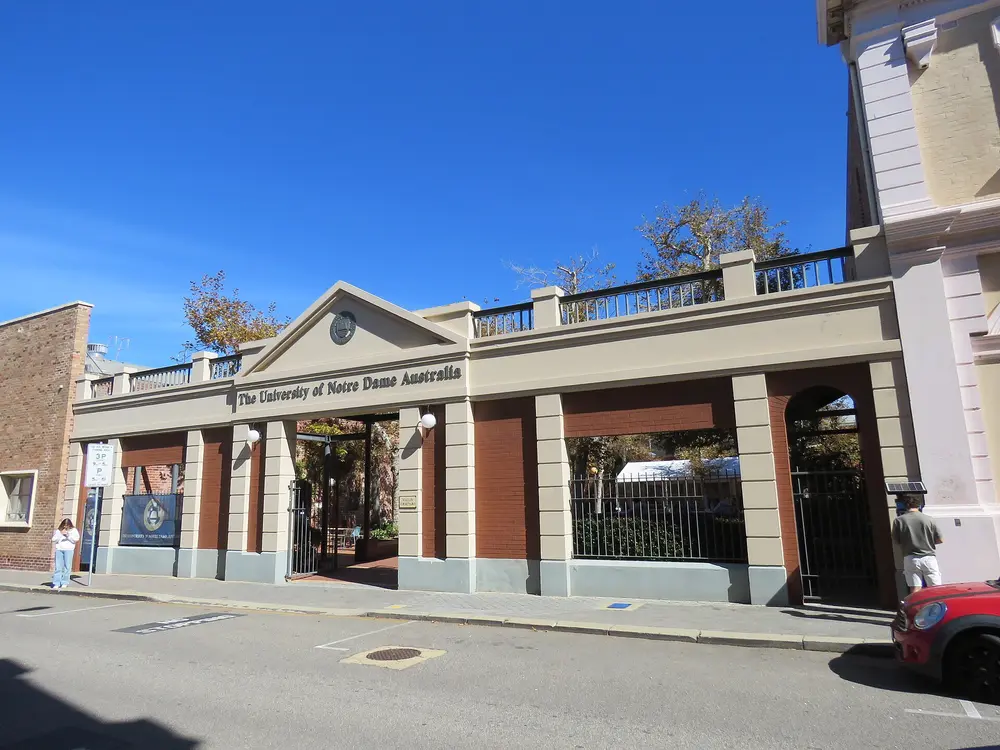
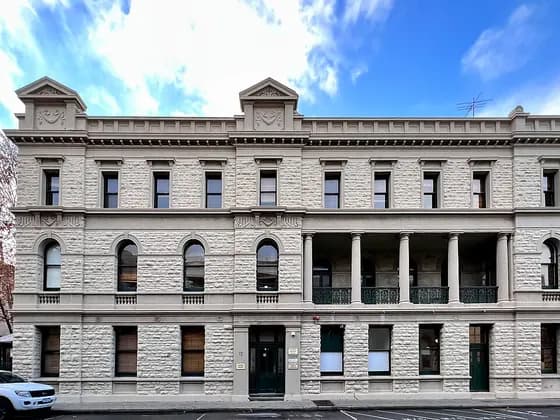
Photo: Calistemon · CC BY-SA 4.0 · cropped
Photo: Chris Olszewski · CC BY-SA 4.0 · Photo: Wikimedian132366 · CC BY-SA 4.0 · Photo: -wuppertaler · CC BY 4.0
The Notre Dame Fremantle medicine course at a glance (2027 entry)
Notre Dame Fremantle's Doctor of Medicine (MD) is a four-year, full-time, graduate-entry course run by the University of Notre Dame Australia's School of Medicine on its Fremantle campus. Graduate entry means you need a bachelor's degree first, in any subject. In Australia an MD like this is an extended masters degree, at Level 9 of the Australian Qualifications Framework (AQF).
In 2021 Notre Dame joined its Fremantle and Sydney medical schools into one National School of Medicine. From 2027 the Fremantle, Sydney and Broome campuses teach a single program with the same four year-long courses. The 2027 intake is the first Fremantle group to take the new Year 1 course, MEDI6111, while the 2026 intake took the previous one, MEDI6100. The clinical years are still organised differently on each campus, and this guide covers Fremantle.
Years 1 and 2, the foundation years, are taught mainly through problem-based learning (PBL), in which a small group works through a real-life patient case each week with a tutor. Country Western Australia features from the start, with a stay in a Wheatbelt town in Year 1. Year 2 of the previous course includes a rural and remote placement, with options in the Kimberley and Broome.
Years 3 and 4, the clinical years, are spent on rotations in public and private hospitals, general practices and community services around Perth. Students selected by application and interview spend Year 3 in a country town instead, with the Rural Clinical School of Western Australia (RCSWA). It is a network of rural teaching bases that Notre Dame shares with the University of Western Australia (UWA) and Curtin University. In Year 4 every student completes a capstone project, either applied research or an audit.
The Australian Medical Council (AMC), which accredits medical courses, first accredited the Fremantle program in 2004 as an MBBS (Bachelor of Medicine, Bachelor of Surgery). The MD replaced it from 2017. While enrolled you are registered as a student with the Medical Board of Australia, and the course is designed to prepare you for internship in Australia and New Zealand. Internship is your first supervised year as a doctor, also called PGY1 (postgraduate year 1). To start it, graduates apply to the Board through the Australian Health Practitioner Regulation Agency (AHPRA) for provisional registration.
| Degree | Doctor of Medicine (MD), an extended masters degree at AQF Level 9 |
|---|---|
| Course length | 4 years full time, with no part-time or accelerated option |
| Curriculum | New national curriculum; 2027 is the first Fremantle intake to start it |
| Main campus | School of Medicine buildings on Henry Street, Fremantle |
| Places (2027) | 92 domestic and up to 15 international places expected at Fremantle |
| Teaching style | Problem-based learning, Years 1 and 2; groups of about 8 to 10 (2025 manual) |
| First patient contact | Year 1: simulated patients, site visits and a Wheatbelt town stay |
| Clinical years | Perth public and private hospitals, general practices and community services |
| Rural Clinical School | Selective rural Year 3, by application and interview; about a quarter went in 2022 |
| Placement hours | More than 2,000 hours of clinical placements and rural experiences |
What makes Notre Dame Fremantle medicine different
Four days with a host family in the Wheatbelt
In the school's 2026 guidance, every first-year student spends three nights in a Wheatbelt town 160 to 400 km from Fremantle, with a volunteer host family. During the days you meet local GPs and health staff, visit the school, see a farm safety demonstration, join an Aboriginal engagement activity and do community service. You also cook your hosts a dinner and present to the town what you have learned.
Kimberley and Broome options in Year 2
Notre Dame's register of other course costs, viewed in October 2026 and still listed under the previous course codes, names four Year 2 options. They are a nine-day West Kimberley immersion around Derby and Fitzroy Crossing, one-week Aboriginal health and Broome immersions, and six weeks of Broome Learning on Country. The AMC's 2022 report said the Kimberley placement linked students with Aboriginal organisations, communities, schools, businesses and pastoral stations.
A rural year with the Rural Clinical School
Selected students spend Year 3 in one of 15 towns, from Albany to Kununurra. You learn general practice, surgery, internal medicine, obstetrics and gynaecology, paediatrics, psychiatry and ophthalmology in one community, with primary care and rural health as the focus.
Private hospitals as well as public ones
Clinical placements include private hospitals, such as St John of God Subiaco and Hollywood Private. When the AMC visited in 2016, it found students in private hospitals had good access to patients, with few other students competing for them. They often did their long cases, assessments built around one patient, there.
A PBL group with its own room
The school's 2025 PBL manual says your group of about eight to ten keeps the same tutor and room for a semester, then changes for second semester. The room has two whiteboards, a computer, a smart TV and swipe-card entry. You work through each case over three tutorials, taking turns as scribe, facilitator, reader and in other roles.
Ethics and Aboriginal health in every year
Ethics runs through the course: bioethics teaching from Year 1, ethical questions in the weekly cases and a compulsory ethics course in Year 2. First Nations health and culture is one of the six domains taught in all four years, and graduates are expected to recognise how kinship, culture and connection to Country underpin health and wellbeing.
How Notre Dame Fremantle teaches medicine
PBL drives Years 1 and 2. Each case opens with a patient's story. Your group picks out the important clues, suggests explanations and agrees what it needs to learn. You then spend the week finding out through lectures, laboratory classes, clinical skills sessions and your own study. The school's method adapts a seven-step approach developed at Maastricht University.
The school calls its model hybrid PBL: lectures and laboratory classes run alongside the group work and feed into it. Six domains run through all four years: basic and clinical sciences, communication and clinical practice, First Nations health and culture, public health, personal and professional development, and medical research and innovation. The domains design each case together, so the science, the patient's story and the ethical or public health questions arrive at the same time.
Notre Dame is a Catholic university, and every student takes part in its core curriculum in philosophy and theology. In the MD it takes the form of bioethics, the study of ethical questions in medicine and health care. The AMC's 2022 report said students in the foundation years spent time with nursing and physiotherapy students, learning about each profession's role and how they communicate.
The ways you will learn
| PBL tutorials | In the school's 2025 PBL manual, you open a case on Monday, share and test what each person has learned on Thursday, and close it with a full patient summary the following Monday. Your tutor guides by asking questions rather than lecturing and reviews your progress each semester. Year 1 tutors are professionals with a link to health care, and Year 2 tutors are doctors. |
|---|---|
| Lectures and laboratory classes | Lectures in the sciences, clinical practice and public health supply the content behind each week's case, alongside laboratory classes in the basic and clinical sciences. |
| Clinical skills and simulation | You complete credentialling units in skills such as aseptic technique and inserting an IV cannula, a fine tube placed in a vein. The AMC reported in 2022 that the school had added ward and emergency department simulations, in which students acted as junior doctors. Two more, set in general practice and around a transfer to intensive care, were in development. |
| Rotations and Back-to-Base days | In Years 3 and 4 you work with clinical teams under supervising clinicians. Once a week, a Back-to-Base day of small-group learning, clinical skills practice and lectures works through a set list of common and serious clinical problems, with e-learning resources for your own study. |
A typical week on the Notre Dame Fremantle course
Notre Dame's published first-year timetable, a generic week for 2026 written for the previous Year 1 course and subject to change, shows how the PBL cycle shapes the week. Monday opens at 8.30 am with the last tutorial on the previous case. The first tutorial on a new case follows from 9.30 to 11.30, then a public health lecture and an afternoon of science lectures.
Tuesday has science lectures in the morning and, from noon to 6 pm, one long block for science laboratory classes. Wednesday is for clinical practice, with lectures in the morning and clinical skills from 1 to 5 pm. Thursday brings the second PBL tutorial, a personal and professional development session and an afternoon slot for evidence-based medicine tutorials. Friday mornings are kept for one-off bioethics or Aboriginal health days, and nothing is timetabled on Friday afternoons.
In the 2025 PBL manual, Year 2 keeps the same three-tutorial pattern at different times: Monday afternoons from 1.30 to 4.30 pm and Thursdays from 3 to 5 pm. In Years 3 and 4 your week follows your rotation, plus a weekly Back-to-Base day.
In 2027 the course starts with orientation on 18 January, and you must attend in person. Semester 1 runs to a study week and mid-year exams at the end of June, followed by two weeks' break. Semester 2 starts on 19 July and ends with a study week and end-of-year exams from 25 October. Non-teaching weeks fall at Easter and in late September. The new Year 3 course starts in the week of 11 January, and final-year students on the previous course start in the week of 25 January.
How anatomy is taught at Notre Dame Fremantle
Anatomy belongs to the basic and clinical sciences domain and is tied to each week's case, alongside physiology, pathology and pharmacology. The November 2025 campus map shows an anatomy laboratory and clinical training laboratories in ND35, the School of Medicine building at 38 Henry Street. Before you start, you complete an Anatomy Act form; the Anatomy Act is the Western Australian law that regulates anatomical study of human bodies.
Where the sciences are taught has changed over time. In 2016 the AMC reported that Murdoch University taught parts of the basic and clinical sciences, with Year 1 and 2 students based there for those classes. Its 2022 report noted the Murdoch contract had been extended, and its 2023 report on Notre Dame's Sydney program says Fremantle had since brought that teaching in-house.
When you first meet patients at Notre Dame Fremantle
Your first patients are simulated. Year 1 includes a core communication skills block that takes you from patient-centred interviewing to organised history-taking and physical examination, practised on a range of simulated cases.
Real settings come early as well. Site visits support the Year 1 cases, and in Year 2 the weekly cases are linked to placements in hospitals, general practices and community settings, which the school calls work-integrated learning.
Year 3 is the first full-time clinical year, when you join clinical teams and apply what you know to real patients under supervision. The AMC described the program in 2022 as building clinical skills in stages, with early patient contact.
Year by year at Notre Dame Fremantle
- Year 1
Foundations of a Medical Vocation
Year 1 is one year-long course, MEDI6111, worth 200 of the MD's 800 units of credit and new in 2027. It covers the normal structure and function of the body and how the body keeps its balance under physiological stress, through a weekly PBL case that draws on all six domains.
- A core communication skills block with simulated patients.
- Cases that build clinical reasoning and a diagnostic approach, along with ethics, professionalism, patient safety, reflective practice, research methods, and public health and health inequalities in Australia and worldwide.
- 32 PBL weeks in the national 2027 Year 1 calendar shared with Sydney. They run from the case Blood on the Road, which spans the first two PBL weeks, to Things are not the same in mid-October.
- Community Engagement Week in mid-March, when you make the Wheatbelt trip.
- Year 2
Foundations of Clinical Practice
Year 2's main course, MEDI6222 (200 units of credit), moves from normal function to the disease processes that affect the body and how it responds. PBL is still the main way you learn the major organ systems. Alongside it sits PHIL6030 Ethical Issues in Professional Life, a compulsory course that carries no units of credit, added to the program rules in January 2026. A 2027 entrant takes Year 2 in 2028.
- History-taking and physical examination of each body system, normal and abnormal, using clinical reasoning to work towards a diagnosis.
- Literature searching, critical analysis, problem solving, professional communication, teamwork, reflective practice, and public health responses to threats to health.
- The ethics course appears on the Fremantle course descriptions page under the code PHIL6020, covering how moral philosophy applies in professional life, with seminars on topics such as confidentiality, truth-telling, power and authority.
- Year 3
Clinical Apprenticeships
Year 3 (MEDI6333, 200 units of credit) is your first full clinical year. You rotate through general practice, medicine, surgery, paediatrics and child health, women's health and psychiatry under supervising clinicians. In the 2027 calendar, the first to list MEDI6333 for Fremantle, the year runs as five eight-week rotations with a two-week break in July. A four-week elective rotation follows the November exams.
- Orientation in mid-January with a Disaster Medicine day for the whole year group, and Advanced Life Support (advanced resuscitation) training during the year.
- Five rotations: medicine, surgery, paediatrics, obstetrics and gynaecology, and general practice with community psychiatry. On the previous Year 3 course, different groups took the rotations in different orders.
- In 2022 the AMC reported that paediatrics had grown from four to eight weeks to include neonatal medicine. General practice had also grown to eight weeks, adding community placements that began with community psychiatry at headspace, the youth mental health service.
- On the previous Year 3 course in 2026, ophthalmology was taught within the surgery rotation, through a workshop, three clinics and a tutorial.
- The previous curriculum's separate Year 3 research course, a formal research proposal with an oral defence, is not part of the 2027 structure.
- Students selected for the Rural Clinical School of WA take MEDI6301 Clinical Apprenticeships in a Rural Setting instead, spending the year in a country town.
- Year 4
Preparation for Internship
Year 4 (MEDI6444, 200 units of credit) prepares you to work as an intern. You rotate through general practice, medicine, surgery and critical care, complete your capstone project and take an elective rotation. The emphasis is on forming a differential diagnosis, the list of conditions that could explain a patient's problem, then planning tests and treatment. A 2027 entrant reaches Year 4 in 2030.
- The 2027 calendar covers final-year students still on the previous course. It has eight weeks each of critical care (emergency medicine, anaesthetics, intensive care), medicine (general, geriatric and palliative) and surgery (general, musculoskeletal, and ear, nose and throat), plus four weeks of psychiatry.
- Psychiatry is listed in the new Year 3 course rather than Year 4, so a 2027 entrant's final year may be arranged differently.
- In that calendar, city-based students do a four-week rural general practice rotation, arranged by the Rural Clinical School's Rural GP Placement team. Rural Clinical School students may take two two-week options instead. The previous course's description makes a four-week rural rotation compulsory.
- Your capstone project: translational research, which carries findings into practice, or an audit, which checks care against an agreed standard, on a topic that interests you. In 2016 the AMC noted that hospitals had acted on some students' audit results.
How you are assessed at Notre Dame Fremantle
Detailed assessment information for enrolled students is posted on Blackboard, the online learning system. What follows comes from the calendars and from the AMC's accreditation reports, each dated.
In the 2027 calendars, the new Year 3 course sits its end-of-year exams in mid-November, before its four-week elective rotation. Year 2 and final-year students, still on the previous courses, sit theirs in early November and early October. On the previous courses in 2026, end-of-rotation assessments in Years 3 and 4 fell due at 11.59 pm on set Mondays. You need your own laptop, with at least four hours of battery life, to sit exams.
The AMC's 2022 report said a 2021 assessment policy set the university's grading scale, from fail to high distinction, with 50% as the pass mark, and required continuous assessment to be submitted online. Written exams, practice and real, had been sat on computer using ExamSoft since 2020. Pass marks for computer-based exams in the early years had been set with the Cohen method since 2020, and the clinical years were due to follow from 2022. The Cohen method bases the pass mark on the scores of the top-performing students.
The same report said that from 2021 clinical-year marks were given for specialty blocks rather than single disciplines, with more continuous assessment. Students presented patients as at a hospital meeting or ward round, or wrote a discharge summary, and supervisors observed their histories, examinations and procedures such as inserting an IV cannula. The school planned milestone assessments for each block, to rely less on end-of-year exams.
OSCEs (Objective Structured Clinical Examinations) test clinical skills: you move round a circuit of timed stations, each testing one task, such as examining a patient. When the AMC visited in 2016, end-of-year OSCEs tracked clinical skills in the early years. In the clinical years supervisors marked mini-CEXs, short observed patient encounters, and a logbook recorded the patients students saw. The school then offered no supplementary exams, or resits, in Years 1 to 3. The AMC's 2022 report said OSCEs had continued through the pandemic.
- In 2026, completing the Wheatbelt stay was required to pass Year 1, and your reflection on it counted for 1% of the year's mark.
- Professional behaviour counts too: you sign a declaration of professionalism every year and must tell the school of any criminal conviction or health issue that could affect your placements.
- If you repeat a course, you may be excused a continuous assessment task you passed in the previous two years, but only in exceptional circumstances.
- In the 2026 calendar for the previous final-year course, the four weeks after exams were labelled elective or remediation.
Where you will actually be at Notre Dame Fremantle
Apart from the community trips, Years 1 and 2 are based on the Fremantle campus. In Years 3 and 4 your placements are in public and private hospitals, aged care facilities, general practices and community-based services around Perth. The school's staff page names hospital coordinators at the eight hospitals listed below. In 2022 the AMC listed new placement agreements with St John of God Midland and Perth Children's Hospital.
The Year 1 Wheatbelt trip runs in Community Engagement Week in March: 10 to 13 March in 2026 and the week of 15 March in 2027. Notre Dame runs it with Rural Health West, the Wheatbelt Eastern Regional Organisation of Councils and local shires. In 2026 students prepared with a population study of the Wheatbelt in their first week. That year, exemptions from the nights away were given only for medical reasons or family commitments such as being a sole carer, not work, and exempt students did a virtual placement.
On the previous Year 2 course, MEDI6200, the 2026 and 2027 calendars set aside a rural and remote week in late July. The costs register says flights, accommodation and a stipend are provided for the northern options. Broome Learning on Country began in 2017 as a pilot for two PBL groups, 18 students, who spent six weeks in Broome at the start of second semester. By 2022, the AMC reported, 36 students were taking part.
The Rural Clinical School of Western Australia has taken Notre Dame students since 2007. You apply in Year 2: you attend an information session, list your preferred towns and are interviewed by a staff panel. You can say whether your first-choice town or being placed with one or two colleagues matters more, and sites are not negotiable once offered. The AMC put the share of Year 3 taking this route at about a quarter in 2022.
The rural year lasts 38 weeks, and you live in your town throughout. Medical coordinators, who are local doctors, lead the teaching, and you may work in the hospital, general practices, Aboriginal community controlled health services, the Royal Flying Doctor Service and population health units. Single students are housed free, students with partners can claim a bursary, and RCSWA pays your trip out from Perth and back. In 2026, 117 students across the three universities were in their RCSWA penultimate year.
After a rural Year 3 you can apply for RCSWA's Final Year Program in Broome, Geraldton, Bunbury or Albany, where you complete everything except the end-of-year exams on site. It is competitive and self-funded: RCSWA covers travel and relocation, but you pay your own living costs and rent. In 2026 it had 21 students.
- Before your first placement you upload proof of immunisations, a first aid certificate, a WA Working with Children Card and a national police check. You also complete hand hygiene and infection control modules each year.
- Before Year 3 you also need a WA Department of Health Criminal Record Screening Card, which can take four to six weeks to arrive, and mask fit testing, repeated every two years.
The AMC's 2022 report also named Royal Perth among the public teaching sites. It said Aboriginal health could be learned at all of them, with more chances at Rockingham, Armadale, Midland, Fiona Stanley and Royal Perth.
- Fiona Stanley Hospital
- Sir Charles Gairdner Hospital
- Perth Children's Hospital
- Rockingham General Hospital
- Armadale Health Service
When the AMC visited in 2016, students at St John of God Subiaco could follow pathology samples through to the laboratory.
- St John of God Subiaco Hospital
- Hollywood Private Hospital
- St John of God Midland Public and Private Hospitals
Shires that hosted the 2026 Community Engagement Week; that year the buses left from Marine Terrace in Fremantle.
- Bruce Rock
- Cunderdin
- Kellerberrin
- Merredin
- Narrogin
- Westonia
- Southern Cross (Shire of Yilgarn)
Year 2 options in the costs register, listed under the previous course codes.
- Broome
- Derby
- Fitzroy Crossing
RCSWA's 15 operating sites; its Carnarvon site is currently closed. RCSWA's headquarters are at Kalgoorlie Regional Hospital.
- Albany
- Broome
- Bunbury
- Busselton
- Collie
- Derby
- Esperance
- Geraldton
- Kalgoorlie
- Karratha
- Kununurra
- Manjimup
- Narrogin
- Northam
- Port Hedland
RCSWA's Final Year Program sites, open to students who have completed a rural Year 3 with RCSWA.
- Broome
- Geraldton
- Bunbury
- Albany
Electives, selectives and options at Notre Dame Fremantle
Every course in the MD is compulsory: the program rules list no elective courses. Choice comes through the elective rotation, your capstone topic and the rural options.
The new final-year course, MEDI6444, includes an elective clinical rotation in an area that interests you. The 2027 calendar for the new Year 3 course also ends with a four-week elective rotation after the exams, from 22 November to mid-December. Under the previous courses, Notre Dame's register of other course costs describes one four-week elective, taken in Year 3 or Year 4, which can be urban, rural, remote, interstate or international. In the 2027 calendar for final-year students still on that course, it runs from 18 October.
For a country elective, the Rural Clinical School arranges rural clinical electives across WA at set times of year. In 2022 the AMC reported that the school had added more chances to learn in and from Aboriginal settings through electives.
Facilities and support at Notre Dame Fremantle
Where you will learn
The School of Medicine works from four buildings on Henry Street in Fremantle's historic West End, a short walk from Fremantle train and bus station. They hold a 200-seat lecture theatre, simulated clinic rooms, a simulated hospital ward, clinical and procedural skills facilities and small PBL tutorial rooms, all with networked audio-visual equipment.
ND35 at 38 Henry Street, the school's address, also holds classrooms, a lecture theatre and the Galvin Study Centre. The AMC reported in 2022 that PBL rooms had been fitted with microphones and cameras and the school's Galvin library upgraded for online learning.
Port Lodge, the university's on-campus residence in Fremantle, has 25 beds; other options include shared student apartments and private rentals. The school advises sorting out accommodation and transport well before the year starts, as there is no time once it begins.
Support while you study
Mentors are assigned to you from the start of the course through to your final clinical rotation. In Years 1 and 2 your PBL tutor is also your first point of contact for academic or personal problems.
Student Success offers courses and programs to build study skills and confidence, and support for students with particular educational needs. If your first degree was not in science, the school recommends reading the first two chapters of one of four standard anatomy and physiology textbooks before you start. In Year 1 you also complete Mental Health First Aid e-learning.
Aboriginal and Torres Strait Islander students are supported by the Indigenous Health and Medicine Team and the Manjaree Student Space. The team runs a one-week preparation program each December for commencing Indigenous students. In 2022 the AMC reported support including dedicated tutors, scholarships, help with accommodation and emergency financial assistance.
MSAND, the Medical Student Association of Notre Dame, was formed in 2005 by the school's first cohort, and each year students elect a representative to the Australian Medical Students' Association. The program publishes inherent requirements, the abilities you need in eight areas from ethical behaviour to sustained performance, and the Access and Inclusion team can discuss reasonable adjustments in confidence.
Is the Notre Dame Fremantle course right for you?
This course may suit you if
- You learn well by talking cases through with the same small group and tutor for a semester at a time.
- You want to see country WA early: Year 1 includes a Wheatbelt stay, Year 2 has included a rural and remote placement, and you can apply for a whole rural year.
- You would like clinical experience in private hospitals as well as public ones.
- You want ethics and Aboriginal health treated as part of medicine in every year.
- You hope to practise rurally: a rural Year 3 can lead on to a rural final year.
Things to think about
- PBL means a lot of self-directed study, and the school's own PBL manual says workload is the loudest concern students raise.
- Attendance is compulsory at PBL tutorials and most other teaching, and some clinical attachments include after-hours work.
- You would be the first Fremantle group to take the new curriculum from Year 1, so later-year details, such as Year 4 rotations, may differ from the calendars published so far.
- Plan work and caring commitments around the March Wheatbelt stay in Year 1; it was compulsory in 2026.
- Choose your campus with care: transfers between Fremantle, Broome and Sydney are granted only in exceptional circumstances, and international students cannot take rural clinical placements.
Notre Dame Fremantle medicine course — frequently asked questions
Applying to Notre Dame Fremantle?
How to get into Notre Dame Fremantle
Entry requirements, admission tests, written application and interview, step by step.
Open the guide →Notre Dame Fremantle entry requirements
ATAR or GPA, GAMSAT and UCAT ANZ thresholds, interview format and place types.
See the requirements →Compare Notre Dame Fremantle with other schools
Put the teaching style, anatomy teaching and placements next to another school.
Open the comparison →Prepare for the Notre Dame Fremantle interview
Format breakdown, school-specific sample questions and prep tips from tutors who interviewed here.
Read the guide →Where this Notre Dame Fremantle course guide came from
This guide was written from 41 official sources — University of Notre Dame Australia (Fremantle) School of Medicine's own course pages and programme documents, plus the Australian Medical Council or Australian Dental Council and the health services the school places students with where they publish detail — read on 2026-10-08, then checked claim by claim against those sources.
- Notre Dame: Doctor of Medicine course page (program information for 2027)
- Program Requirements: Doctor of Medicine (MD), program code 5180, effective 1 January 2027
- School of Medicine, Fremantle: course descriptions (previous and new national MD courses)
- National School of Medicine: 2027 academic calendar for Fremantle, all four years
- National School of Medicine: 2027 calendars published with the Sydney MD (national Year 1 page with PBL case titles)
- School of Medicine (Fremantle): Outline of Academic Year 2026, all four years
- MEDI6100 weekly generic timetable, Year 1, 2026 (Fremantle)
- Problem Based Learning Manual, School of Medicine Fremantle (August 2025)
- School of Medicine, Fremantle Campus
- School of Medicine, Fremantle: school staff and hospital coordinators
- School of Medicine, Fremantle: school resources and student organisations
- School of Medicine, Fremantle: Community Engagement Week
- Preparing for MEDI6100 Community Engagement Placement (2026)
- School of Medicine, Fremantle: student requirements for first years
- School of Medicine, Fremantle: first-year forms and documents
- School of Medicine, Fremantle: Student Placement Mandatory Checks
- Checklist for School of Medicine Fremantle 2026 enrolment
- Notre Dame: register of other costs related to your study area (School of Medicine Fremantle entries, listed under the previous course codes; viewed October 2026)
- Fremantle campus map (November 2025)
- Notre Dame: Fremantle campus
- Notre Dame: student accommodation (Fremantle and Kimberley)
- Notre Dame: Our Core Curriculum
- Notre Dame: Pathways to Medicine
- School of Medicine Fremantle: recommended reading for students with a non-science degree
- School of Medicine: higher degree by research opportunities
- Notre Dame: Kimberley Centre for Remote Medical Training
- Kimberley Centre for Remote Medical Training Student Handbook 2026
- Notre Dame International Guide 2027: Doctor of Medicine
- GEMSAS admissions consortium: school-supplied entry for Notre Dame Fremantle and KCRMT Broome (2027 entry)
- Australian Medical Council: Accredited medical schools (expiry dates and next accreditation events)
- Australian Medical Council: Notre Dame Fremantle medical program extension report (2022, published 2024)
- Australian Medical Council: Notre Dame Fremantle reaccreditation report (2016)
- Australian Medical Council: Notre Dame Sydney extension report (2023), National School of Medicine sections
- Medical Board of Australia: student registration
- Medical Board of Australia: interns and provisional registration
- Rural Clinical School of WA: current and future medical students
- Rural Clinical School of WA: sites
- Rural Clinical School of WA: Carnarvon site status
- Rural Clinical School of WA: about us and history
- Rural Health West: Kimberley placement produces Kimberley doctors (September 2023)
- WA Department of Health: Centralised Intern Application Policy (amended August 2026)
Courses are restructured between cycles. Anything here that decides your application — an anatomy offer, a placement city, a compulsory intercalated year — should be confirmed against the official page for your entry year.
Applying to Notre Dame Fremantle?
We have helped hundreds of applicants turn their GAMSAT / UCAT ANZ, written application and interview prep into offers from Notre Dame Fremantle and other Australian medicine schools.