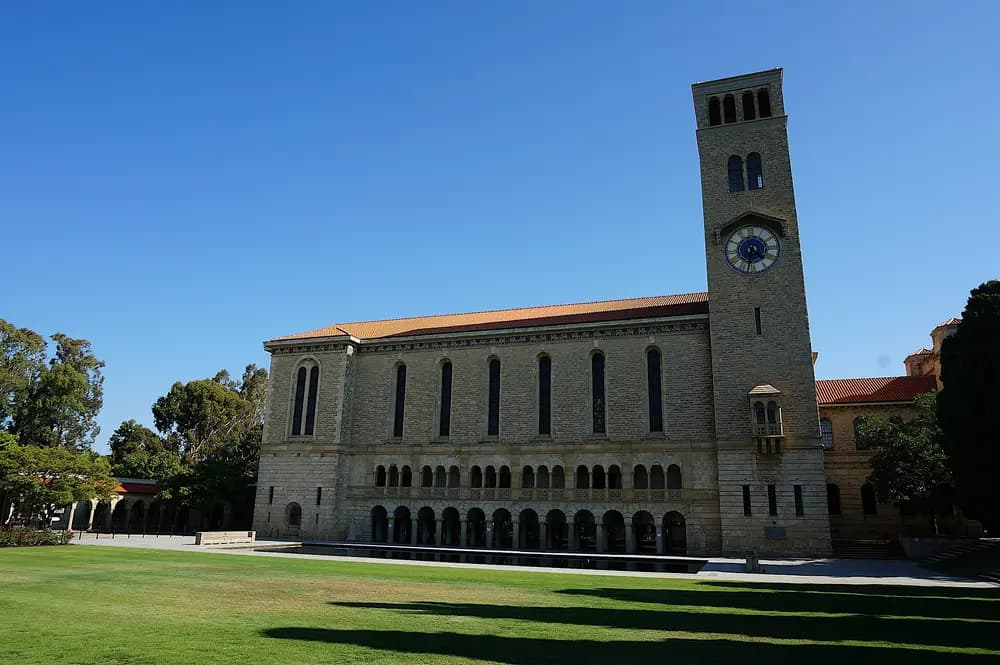
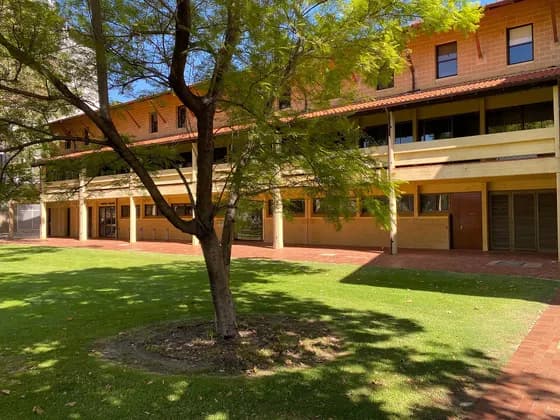
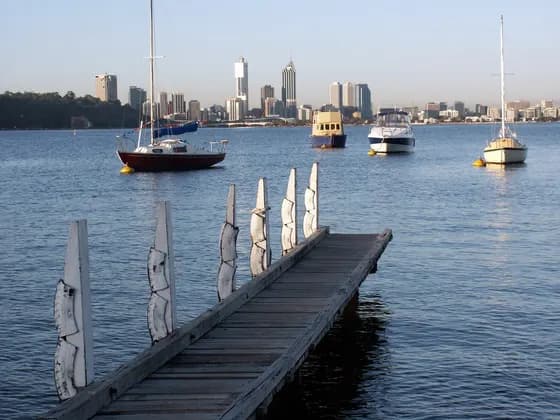
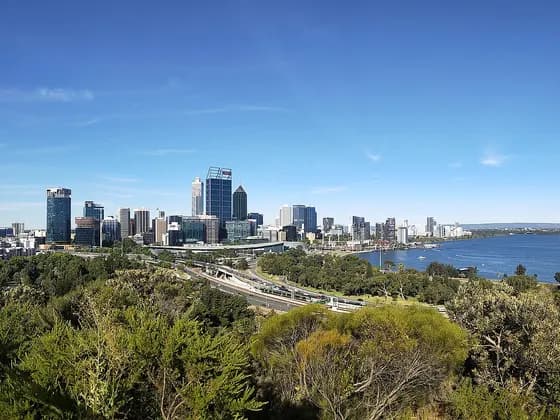
UWA delivers a dual-pathway medical program — a 6-year Bachelor-then-MD Assured Pathway and a 4-year Graduate MD — anchored at the Crawley campus and Royal Perth, Sir Charles Gairdner, and Fiona Stanley hospitals, with Rural Clinical School of WA sites across the Kimberley, Pilbara, Mid West, Goldfields, South West, Great Southern and Wheatbelt.
What makes UWA different
UWA has two entry routes into one MD: a 6-year Assured Pathway from school (3-year Bachelor of Biomedicine (Specialised) then the MD with one year of credit; UCAT-ANZ + minimum ATAR 98, or 90 via the Indigenous school-leaver pathway, + interview — the ATAR minimum is for consideration only and does not guarantee entry) and a 4-year Graduate MD (GAMSAT).
Both streams converge at MD Year 1 (Integrated Medical Systems 1 and 2), which is the third year of the Assured Pathway bachelor's. In year 3, 25% of the UWA MD cohort undertake their studies in a Western Australian rural setting, in hospitals and general practices from Esperance to Kununurra, completing the same curriculum in a longitudinal integrated clinical setting.
Dedicated Aboriginal and Torres Strait Islander entry routes: a school-leaver pathway at minimum ATAR 90 (first contact the School of Indigenous Studies) and a graduate pathway through Boola Boola Djinda (established in 2025 from the former Centre for Aboriginal Medical and Dental Health, CAMDH) assessed on GPA 5.0 or above and a one-day panel interview at the centre, with GAMSAT and ATAR not required.
UWA course & teaching
Integrated curriculum. Assured Pathway: 3-year Bachelor of Biomedicine (Specialised) with the Integrated Medical Sciences and Clinical Practice major (TISC code UG056, UWA code BP056), needing a selection GPA of 5.5 within the first two years to hold the conditional MD place; that major carries one year of credit into the MD, so the combined pathway is six years.
Graduate Pathway: 4-year MD. Both pathways converge at MD Year 1: the IMSCP major's Level 3 units are the MD Year 1 units (IMED3111/IMED3112 Integrated Medical Systems 1 and 2), taken alongside graduate entrants, so school leavers and graduates share all four MD years.
Foundations at Crawley; clinical rotations from May of Year 2 in Perth hospitals and general practices (UWA division pages and AMC visits name Sir Charles Gairdner, Royal Perth, Fiona Stanley, Perth Children's, King Edward Memorial and St John of God Subiaco; Joondalup clinicians teach as UWA adjuncts).
The Rural Clinical School of WA runs programs in 15 towns: Albany, Broome, Bunbury, Busselton, Collie, Derby, Esperance, Geraldton, Kalgoorlie, Karratha, Kununurra, Manjimup (renamed from Warren Blackwood in 2026), Narrogin, Northam and Port Hedland; the 2026 handbook still lists Carnarvon, which RCSWA's site page described as closed in October 2026.
The rural final-year program runs in Albany, Broome, Bunbury and Geraldton (the 2026 handbook also lists Kalgoorlie for the rural Year 4 units). For 2027 entry GEMSAS lists the graduate MD interviews as expected to be online (22 September - 3 October 2026).
UWA does not publish whether domestic school-leaver interviews are online or in person, telling shortlisted candidates directly; international school-leaver interviews are held in Perth, at specified overseas locations, and online. No official source describes this as a change from a previous format. UWA publishes no headline MD fee.
Commonwealth supported student contributions are charged per unit and international (and any full-fee) annual course fees per credit point, quoted through the UWA Fee Calculator and subject to annual indexation. Commonwealth supported student contribution amounts are set and indexed annually by the Australian Government, not by UWA.
UWA research strengths
UWA is strong in these research areas:
- Cardiovascular disease
- Indigenous health
- Rural workforce
- Cancer biology
Intercalation at UWA
Research and further study are built into the MD through scholarly activity in Years 3 and 4: a supervised research project, a not-for-profit service-learning project, or coursework units worth 18 points towards a master's in public health, health professions education or Aboriginal health. UWA says the Assured Pathway's IMSCP major does not lead to an Honours year.
How the UWA interview runs
Format: Multi-Mini Interview (8 stations x 7 minutes) for domestic applicants; panel of two interviewers (~50 minutes) for international applicants
UWA MMI uses 8 numbered stations of 7 minutes each — 2 minutes to consider the written question, then 5 minutes with the interviewer — with the whole process taking approximately 70-75 minutes including registration. Questions are provided in writing and interviewers may or may not ask follow-ups.
Domestic school-leaver and domestic graduate applicants sit the same 8-station MMI after pre-interview ranking; international school-leaver and international graduate applicants instead sit a panel interview with two interviewers, approximately 50 minutes including registration, typically five MMI-style questions that are not individually timed within an overall time limit. Stations span ethical reasoning, communication and role-play, motivation, teamwork, and current-issue debates.
For 2027 entry GEMSAS says graduate MD interviews are 'expected' to be held online within 22 September - 3 October 2026, and UWA gives the same window as 'around late September/early October'; graduate applicants are notified by email usually one to two weeks before the date.
UWA does not publish the venue or the online/in-person format for domestic school-leaver interviews in advance, stating only that 'interview periods and venues differ' and that specific dates go to shortlisted candidates. UWA does not publish who its interviewers are.
UWA intake
2027 cycle: 206 domestic places plus about 40 international. Up to 50% go to school-leaver (Assured Pathway) entrants and the remainder to graduate entry, for which GEMSAS lists up to 103 domestic places. Direct Pathway via UP056 Bachelor of Biomedicine TISC ranks 96.65 (2024) → 97.50 (2025).
Where UWA is
University of Western Australia Medical School was founded in 1957 and is based in Crawley.
Programmes offered:
- Rural and Remote Medicine
- Indigenous Health
- Clinical Research
- General Practice