
The Dundee Dentistry course
What you actually study, and where you will be
Dundee's BDS is a 5-year course with an integrated curriculum, with patient treatment from Year 1 and placements in Dundee, with outreach clinics across Tayside, Fife, Grampian and Highland (2027 entry). You are ready to meet patients by the end of the first semester and doing simple clinical procedures in semester two. Dundee also teaches on Thiel cadavers, which keep life-like tissue quality.
- Degree
- BDS
- Length
- 5 years
- Teaching
- Integrated
- First patients
- Year 1
- UCAS code
- A200

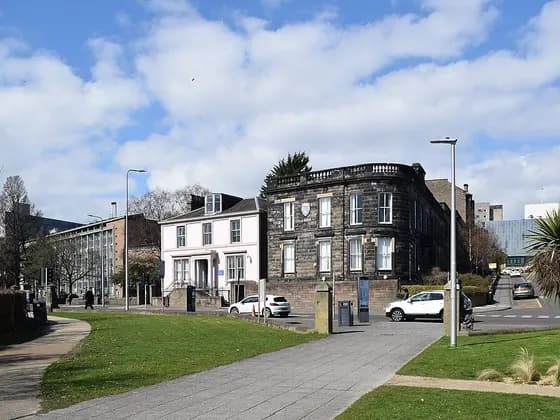

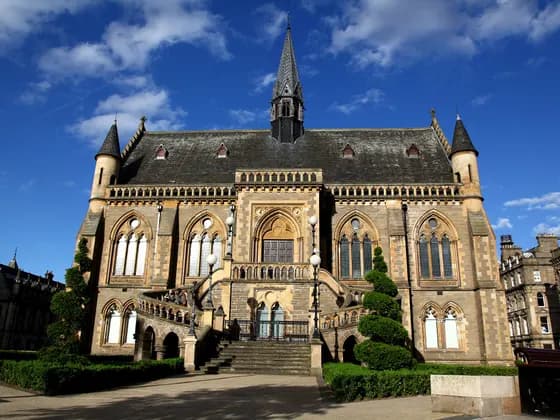
Photo: Ydam / Wikimedia Commons · CC BY-SA 3.0 · cropped
Photo: Bill Harrison · CC BY-SA 2.0 · Photo: Richard Szwejkowski · CC BY-SA 2.0 · Photo: BertieB · CC BY-SA 3.0
The Dundee dentistry course at a glance (2027 entry)
Dentistry at the University of Dundee is a five-year course leading to the BDS, the Bachelor of Dental Surgery. The General Dental Council (GDC), which regulates dentists across the UK, recognises the degree, so when you graduate you can apply to register and work as a dentist. The School of Dentistry is based in Dundee Dental Hospital and Research School, a ten-storey tower on Park Place on the university's City Campus.
The dental hospital is run together with NHS Tayside, the local health board. It is a working NHS hospital with its own specialist departments, and it is also where you treat patients as a student.
The current curriculum, which Dundee calls 4D, is built from nine modules. Each module builds on the one before, and science is taught alongside the clinical skill that needs it. For example, you learn to give local anaesthetic in the same module that covers the anatomy, physiology and pharmacology behind it. The university's course page says it is reviewing the course structure, so module names and timings may change for your intake.
Patients arrive early. You spend your first semester practising in simulated clinics, then from the second semester of year 1 you see patients in the dental hospital. Clinical time grows every year. From year 4 you also treat patients on outreach, which means working in NHS clinics outside the dental hospital, one in Dundee and the rest in other towns and cities.
The GDC inspected the course in March 2023 and came back in May 2024 to watch the first final exams of the 4D curriculum. It concluded that the degree is sufficient for graduates to register as dentists, and the course returned to routine annual monitoring during 2025-26.
| Degree | BDS (Bachelor of Dental Surgery) |
|---|---|
| UCAS code | A200 (institution code D65) |
| Course length | 5 years full time, starting in September |
| Intake | 66 students in 2022-23 and 57 in 2023-24 (GDC figures) |
| Main base | Dundee Dental Hospital and Research School, Park Place, City Campus |
| Curriculum | Nine-module 4D curriculum, currently under review by the university |
| First patients | Second semester of year 1, after simulated clinic training |
| Anatomy | Thiel-embalmed cadavers, which stay flexible and life-like |
| Outreach | Years 4 and 5, at seven NHS clinics from Kirkcaldy to Inverness |
| Elective | Five weeks in the summer between years 4 and 5 |
| Intercalation | Optional one-year BMSc (Hons) after two years of the BDS |
What makes Dundee dentistry different
Your first patients in the second semester
Module 1 spends your first semester in simulated clinics, building instrument, clinical and communication skills. In the second semester, Module 2 takes you onto clinics in the dental hospital to work with real patients. You start with histories, examinations, preventive advice and simple gum care, and more complex treatment follows year by year.
Rehearse in simulation, then treat patients
The modules follow a clear pattern. You meet a skill in the simulated clinic, then use it on patients a module or two later. You practise with dental drills in simulation in year 1 and place your first fillings on patients in year 2. You rehearse treating children in simulation in year 2 and treat child patients in year 3. Root canal treatment follows the same route.
Anatomy on Thiel-embalmed bodies
Dundee's course page says you can work with donated bodies preserved by the Thiel method, which keeps them flexible and life-like. The anatomy section explains how this differs from traditional embalming.
Every clinical session recorded and graded
Your clinical work is logged on LiftUpp, a digital record in which you and your supervisor grade each treatment. A Progress Committee reviews that record through the year. The assessment section explains how both work.
Outreach across Tayside, Fife, Grampian and Highland
In years 4 and 5 you treat patients at NHS outreach clinics outside the dental hospital. The university's current list has seven, from Kings Cross in Dundee to Inverness in the Highlands. The placements section explains where and when.
Discovery Week and a self-planned elective
Every year includes a Discovery Week, when you explore a topic of your own choice. You can build on it in your elective, a period of study you plan yourself, which can include travelling to see how dentistry works in another culture.
How Dundee teaches dentistry
Dundee lists five main teaching formats: lectures, tutorials, practical laboratory sessions, workshops and clinical skills classes. On top of these you spend a growing share of your week on supervised clinics. The university's guide for school pupils who shadow a dental student describes a typical day mixing lectures, tutorials, clinical skills sessions and clinics, moving between university and NHS buildings.
A dental student writing on the university's website in 2025 describes the curriculum as a spiral. Topics come back several times, each time in more depth and closer to real patients. The module descriptions show the pattern: in year 3, bone biology and wound healing are taught alongside your first oral surgery.
The balance shifts as you move through the course. Year 1 is built around simulation, foundation science and your first supervised patients. From year 2, a large part of your timetable goes on clinical sessions across the dental specialties.
Final year is taught mainly through clinical placements in the dental hospital and at outreach clinics, in clinical groups of seven or fewer students. Lectures are gathered into three in-person lecture weeks spread across the year, with workshops that help you connect what you have learned.
The ways you will learn
| Lectures | Lectures introduce the science and theory for each module, such as how tooth decay develops, how local anaesthetics work, or how a patient's general health affects their mouth. |
|---|---|
| Tutorials and workshops | Tutorials are smaller-group sessions for discussing and applying what you have covered in lectures. Workshops are practical sessions built around a set topic or task. |
| Team-based learning | The same 2025 student account describes clinical cases being worked through by your year group in teams. A typical task is drawing up a treatment plan together, which trains the reasoning and teamwork you need on clinic. |
| Practical laboratory and clinical skills classes | Hands-on sessions in a simulated clinic. You work on phantom heads, which are mannequin heads with artificial teeth mounted at a dental workstation. On them you learn to handle instruments, cut cavities and place fillings before you touch a patient's tooth. |
| Supervised student clinics | You treat real patients in the dental hospital's student clinics, with a qualified supervisor checking your work at each stage. The 2025 student account says you also work in teams with more experienced students on clinic, learning from them as you go. |
| Outreach clinics | In years 4 and 5 you treat patients in NHS outreach clinics outside the dental hospital, one in Dundee and six in towns and cities across Tayside, Fife, Grampian and Highland. The placements section below explains where and when. |
How anatomy is taught at Dundee
Dundee's course page says you can work with Thiel cadavers. These are the bodies of people who donated them for teaching, preserved by the Thiel method. Thiel embalming keeps the body flexible, with colour and texture close to living tissue, and the body can be moved into any position. That makes it easier to see how muscles, nerves and vessels behave in a living patient than with traditionally embalmed bodies, which are firm and stiff.
The Thiel bodies are held by the university's Centre for Anatomy and Human Identification (CAHID) in the Medical Science Institute on Dow Street, on the City Campus. Its main dissecting room has 30 stations, each with a trolley, instruments and a computer. A separate teaching suite has nine bays fitted with surgical operating lights. The centre holds around 200 Thiel cadavers at any one time and also serves other courses, such as the postgraduate forensic dentistry programmes.
One dental student, writing on the university's website in 2025, says anatomy is taught through both dissection and prosection. In dissection you cut through tissue yourself; in prosection you study specimens that anatomists have already dissected to show particular structures. This is one student's account rather than a course document, so ask at an open day how much hands-on dissection dental students do.
Applied anatomy comes back throughout the course. In year 2 it underpins learning to give local anaesthetic injections, and in year 3 it supports your introduction to oral surgery.
When you start treating patients at Dundee
Your first semester is spent in simulation. Module 1 builds the technical, clinical and communication skills you need, including periodontal instrumentation, which means using instruments to clean around the teeth and gums, and basic operative skills on artificial teeth. You must pass gateway exams, practical tests of your skills, before you are allowed to treat patients. Students told GDC inspectors in 2023 that once they passed, they got onto patient clinics without delay.
In the second semester of year 1, Module 2 brings you onto clinics in the dental hospital. You take patients' medical, dental and social histories, carry out routine examinations of the mouth, give advice on preventing disease and provide simple gum care. Meanwhile, back in simulation, you start using dental drills on set tasks.
Supervision is close. The GDC's 2023 report records at least one qualified supervisor for every five students on clinic, and one-to-one supervision when a student is doing surgery. A supervisor signs a permission-to-treat form once satisfied you understand the task, and checks your work at each stage. You also need clearance from NHS Occupational Health before starting clinics, and you have a skin health check every year.
Patients on the student clinics are adults who are not registered with a dentist and children under 16, all screened first to check that their needs suit a student clinic. Adult appointments usually last about 90 minutes and can run to three hours, and children's appointments about an hour, because each stage is checked. Clinics run Monday to Friday in term time. On the children's clinic you work alongside dental therapy students, who are training to become dental therapists.
Responsibility builds module by module. You place your first fillings in year 2 and start treating children and doing oral surgery in year 3. Crowns, bridges, dentures and root canal treatment begin on patients in year 3. In year 4 root canal work extends to back teeth with several roots, and you learn to use sedation for minor oral surgery.
Beyond the hospital's usual patients, the GDC noted in 2023 that staff and students take part in local and national projects to reach people who find it hard to get dental care. These include Ukrainian families, people reached through food bank projects, and people experiencing homelessness or substance use.
Year by year at Dundee
- Year 1
Foundations and first patients (Modules 1 and 2)
Year 1 is made up of two 60-credit modules and ran for 28 weeks in the GDC's 2023 figures. The first semester prepares you for clinic in simulation, and the second puts you in front of patients in the dental hospital.
- Module 1, Foundation for Dental Practice: the move to independent study as a student professional, with technical, clinical and communication skills taught in simulated clinics.
- Clinical skills training in periodontal instrumentation and basic operative skills in the simulated clinic.
- Teaching on fitness to practise, the standards of health and behaviour expected of a future dentist, starting in your first week.
- Module 2, Transition to Patient Care: taking histories, examining mouths, giving preventive advice and simple gum care for real patients.
- Public health, health inequalities and the burden of disease across the population.
- Your first set tasks with dental drills in the simulated clinic.
- Year 2
Fillings, pain control and wider medicine (Modules 3 and 4)
Year 2 has two 72-credit modules and ran for 33.5 weeks in the GDC's 2023 figures. You start restoring teeth on patients while the medical science behind your treatment deepens.
- Module 3: placing your first fillings as part of a patient's treatment plan, and studying how tooth decay (caries) develops and how to manage it.
- Local anaesthesia, taught together with the anatomy, physiology, pharmacology and behavioural science behind it.
- Your first work with more complex patient groups, such as anxious patients and people with additional needs, plus teaching on consent, risk and clinical trials.
- Module 4: how the teeth, face and skull develop, and simulated practice in treating children ahead of year 3.
- Occlusion (how the teeth meet when you bite) and chewing, preparing you for more advanced restorative care, the repair and replacement of teeth, in year 3.
- Genetics, tumours, ear, nose and throat conditions, the digestive system, infection and prescribing, care of pregnant and breastfeeding patients, and handling medical emergencies.
- Year 3
Children, oral surgery and complex restorations (Modules 5 and 6)
Year 3 is much longer, at 42.5 weeks in the GDC's 2023 figures, with modules worth 84 and 88 credits. Your patient list widens to children and oral surgery, and you begin replacing missing teeth and doing root canal treatment.
- Module 5: treating child patients, supported by communication skills aimed at children and your simulated practice from year 2.
- Your clinical introduction to oral surgery, backed by teaching on bone biology, wound healing and patients with bleeding disorders.
- Complex restorative problems in simulation first: filling gaps where teeth are missing, indirect restorations such as crowns made outside the mouth, and root canal treatment (endodontics).
- Module 6: fixed and removable prosthodontics (crowns, bridges and dentures) and endodontics on real patients, planning each patient's care as a whole.
- Explaining complex treatment to patients, the legal side of complex care and working with the wider dental team.
- Oral medicine (diagnosing and managing long-term and medically related conditions of the mouth without surgery), the links between oral and general health, skin conditions and facial pain that does not come from the teeth.
- Year 4
Surgery, sedation and outreach (Modules 7 and 8)
Year 4 is the longest year, at 44.5 weeks in the GDC's 2023 figures, which include three weeks of outreach and a five-week elective in the summer before year 5. You take on more complex restorative and surgical care and start treating patients in outreach clinics.
- Module 7: root canal treatment on teeth with several roots, and replacing missing teeth with fixed or removable options.
- Surgical aspects of restorative dentistry, injuries to the mouth, face and jaws (the maxillofacial region), wider maxillofacial disease and when to refer to a specialist.
- Simple treatment of children, including those needing some orthodontic care (straightening teeth), and knowing when to refer them on.
- Special care dentistry (caring for people whose disability or health makes routine dental care harder), oral pathology (the study of diseases of the mouth and jaws), healthcare law and ethics, and managing anxious patients.
- Module 8: sedation for minor oral surgery, and watching dental implants being placed and gum surgery being carried out.
- Teamwork, personal development, receiving feedback and the law on a patient's capacity to consent.
- Raising concerns about patient safety, taught through coursework and assessment with particular weight in Module 7.
- Treating patients in NHS outreach clinics, with three weeks of outreach in the year.
- Year 5
Integrated care and preparing for practice (Module 9)
Final year is a single year-long module, Clinical Dentistry 9, and ran for 35.5 weeks in the GDC's 2023 figures. It pulls everything together, with more complex cases and a shift towards working independently. Most of your learning happens on clinical placements, in groups of seven or fewer students.
- Integrated Oral Care clinics in the dental hospital and at outreach clinics, where you plan and provide a patient's whole course of care, drawing on every dental discipline.
- Outreach sessions through the first semester.
- Consultant-led clinics in restorative dentistry, oral medicine, oral surgery, paediatric (children's) dentistry and orthodontics, where you treat more complex cases.
- Management and leadership skills, and building the habit of independent, lifelong learning.
- Ethics built into your assessed work, drawing together what you have learned about professionalism.
- Final assessment combining an online knowledge exam, a clinical case presentation, coursework, a portfolio and an integrated structured clinical examination (ISCE), a series of clinical stations that test knowledge, skills and communication together.
How you are assessed at Dundee
You are assessed throughout the course, not only at the end of each year. The university lists four main types of assessment: online multiple-choice exams, assessments of practical and clinical skills, coursework and a reflective portfolio. The portfolio is where you write about what you learned from your own clinical experiences and how you will improve.
Practical exams use a station format. In an Objective Structured Clinical Examination (OSCE) you move through a series of short timed stations, each testing a clinical or communication task in front of an examiner. The GDC's 2023 report also mentions objective structured practical examinations (OSPEs), which test hands-on skills in the same way. For exams that count towards your progress, examiners set the pass mark by judging how hard the questions are, and marking is anonymous wherever possible.
Your final exams include integrated structured clinical examinations (ISCEs). These are station exams that bring clinical knowledge, skills and communication together, sometimes with actors playing patients. The GDC watched the first ISCEs in May 2024 and found them well organised, clearly linked to its learning outcomes and fairly run.
The university's module page for final year sets out how the year is weighted. An online knowledge exam of single-best-answer and extended-matching questions, two kinds of multiple-choice question, counts for 30%. The ISCE counts for 15% and a clinical case presentation for 15%. Coursework makes up 30%: an elective report (10%), two logbook assessments (5% each) and a group exercise on professional standards (10%). A portfolio counts for the last 10%.
Your clinical work is graded continuously on LiftUpp. After each treatment you and your supervisor agree a grade called a developmental indicator, and you then write a reflection in your student log. These reflections build towards a larger reflective assessment. LiftUpp also reports how many procedures of each type you have done and how well.
A Progress Committee meets six times a year to review each student's academic and clinical performance, attendance and professionalism. Lapses in professional behaviour are recorded on a form called a Notification of Lapse of Professionalism, which carries points. More than six points means an automatic referral to the Professionalism and Capability committee.
Where you will actually be at Dundee
Most of your clinical training happens in Dundee Dental Hospital and Research School, from your first patients in year 1 to consultant clinics in year 5. The hospital's eight departments cover dental accident and emergency, oral medicine, oral surgery, dental and maxillofacial radiology, special care dentistry, restorative dentistry, paediatric (children's) dentistry and orthodontics. Students regularly attend the orthodontic clinics on the fifth floor, where on staff clinics they are usually there to observe.
Outreach means treating patients in NHS clinics outside the dental hospital, so you gain experience in a different setting from the dental school. Every Dundee dental student does it. The university's current module page for final year lists seven outreach clinics: Kings Cross in Dundee, Arbroath, Perth, Cupar, Kirkcaldy, Aberdeen and Inverness. Between them they cover four NHS health boards: Tayside, Fife, Grampian and Highland.
The GDC's 2023 report lists three weeks of outreach in year 4, and the course page says outreach sessions continue through the first semester of year 5. In August 2023 NHS Shetland also ran a three-week pilot placement for six Dundee students, but Shetland is not on the university's current outreach list.
Outreach supervision matches the dental hospital, with no more than five students to each supervisor. Outreach supervisors use LiftUpp and attend an annual training day so their grading lines up with staff in Dundee. Quality checks on outreach are shared between the university and NHS Education for Scotland (NES), the NHS body responsible for education and training in Scotland. Students told GDC inspectors in 2023 that the move from hospital to outreach felt smooth, with a clear induction.
The dental hospital, used in every year, holds the student clinics and eight NHS specialist departments in one ten-storey building. Kings Cross is the one outreach clinic in the city.
- Dundee Dental Hospital and Research School, Park Place
- Kings Cross outreach clinic
Arbroath is a coastal town north-east of Dundee, and Perth lies to the west.
- Arbroath outreach clinic
- Perth outreach clinic
Two outreach clinics in towns south of the River Tay.
- Cupar outreach clinic
- Kirkcaldy outreach clinic
An outreach clinic in the city of Aberdeen, on the north-east coast.
- Aberdeen outreach clinic
An outreach clinic in Inverness, in the Highlands. It is the furthest of the seven from Dundee.
- Inverness outreach clinic
Electives and chosen modules at Dundee
Every year includes a Discovery Week, in which you explore a topic of your own choice.
You can build on a Discovery Week topic in your elective, a period of study you plan yourself. The GDC's 2023 report places a five-week elective in the summer between years 4 and 5. The university says the elective can include travelling to see dentistry in a different culture. Afterwards you write an elective report, which counts towards your final-year coursework.
One dental student, writing on the university's website in 2024, describes the elective as self-led. You choose where to go, whether locally, elsewhere in the UK or abroad, and you arrange the placement yourself. That student advises checking whether a host country allows students to treat patients under supervision.
Outside the timetable, you can join research projects through summer internships and take part in the school's Dental Wiki project.
Intercalation at Dundee
Intercalating means pausing your dental degree for a year to study for a separate degree, then returning to the BDS. It is optional. Dundee offers one-year intercalated BMSc (Hons) degrees, a Bachelor of Medical Sciences with honours, in subjects including Anatomy and Medical Education. Both are open to dental students who have successfully completed two years of a BDS.
Taking one adds a year, so your studies would last six years instead of five. The university says an intercalated BMSc lets you study a topic you choose in depth and learn how to plan and carry out research. If you are interested, ask the School of Dentistry how a year out fits around the BDS timetable.
Facilities and support at Dundee
Where you will learn
Dundee Dental Hospital and Research School is a ten-storey tower on Park Place, on the City Campus, and home to the School of Dentistry. During and after the COVID-19 pandemic several floors were completely refitted. Enclosed treatment pods were installed so that aerosol-generating procedures, such as drilling with high-speed instruments that throw a fine spray into the air, can be done safely. The school also has a simulation laboratory with phantom heads.
The school's research includes the Dental Health Services Research Unit and projects on the oral health of people experiencing homelessness, people in prison and people who use drugs. Summer research internships, mentioned in the electives section, are one way to get involved.
Support while you study
Module 1 is designed for students arriving from a range of backgrounds, and it focuses on the move to independent study. So the first semester teaches you how to learn as a student professional as well as what to learn.
Feedback is built into clinics. Your supervisor discusses every treatment with you before you agree your LiftUpp grade. The 2025 student account also describes working on clinic in teams alongside more experienced students.
Each year group has a student representative who collects feedback and sits on school committees. Students told GDC inspectors in 2023 that the school acts on their feedback and explains its reasons when it cannot.
The Progress Committee that reviews your performance is also where extra support is agreed for students who need it. GDC inspectors saw examples of adjustments made for disabled students.
Is the Dundee course right for you?
This course may suit you if
- You want to treat real patients in your first year, starting in the second semester.
- You learn well by rehearsing a skill in simulation and then using it on patients a module or two later.
- You want to learn anatomy on flexible, life-like Thiel-embalmed bodies.
- You like steady feedback, with every clinical session discussed and graded on LiftUpp.
- You are interested in public health and in reaching people who struggle to get dental care.
Things to think about
- In the GDC's 2023 figures, year 3 ran for 42.5 weeks and year 4 for 44.5 weeks, and the year 4 total includes a five-week elective in the summer before year 5. So holidays are short in the middle years.
- The university is reviewing the course structure, so the modules for your intake may differ from those described here.
- Outreach in years 4 and 5 can take you well beyond Dundee, to clinics as far away as Inverness in the Highlands.
- Professional behaviour is tracked formally, with points for lapses that can lead to a committee referral.
Dundee dentistry course — frequently asked questions
Applying to Dundee?
How to get into Dundee
Entry requirements, UCAT, personal statement and interview, step by step.
Open the guide →Dundee UCAT cut-offs and offers
UCAT cut-offs, A-level offers, interview format and decision dates.
See the requirements →Compare Dundee with other schools
Put the teaching style, anatomy teaching and placements next to another school.
Open the comparison →Prepare for the Dundee interview
Format breakdown, school-specific sample questions and prep tips from tutors who interviewed here.
Read the guide →Where this Dundee course guide came from
This guide was written from 23 official sources — University of Dundee School of Dentistry's own course pages and programme documents, plus the regulator and NHS placement partners where they publish detail — read on 2026-09-24, then checked claim by claim against those sources.
- Dentistry BDS course page, University of Dundee (2027 entry)
- Dentistry BDS teaching, assessment and modules, University of Dundee
- Clinical Dentistry 9 (final year) module page, University of Dundee module catalogue
- Clinical Dentistry 3 module page, University of Dundee module catalogue (a year 2, Level 3 module)
- Dentistry BDS careers, University of Dundee
- Anatomy (Intercalated) BMSc (Hons) entry requirements, University of Dundee (2027 entry)
- Medical Education (Intercalated) BMSc (Hons) entry requirements, University of Dundee (2027 entry)
- Medical Education (Intercalated) BMSc (Hons) careers, University of Dundee
- Get student dental treatment from Dundee Dental Hospital, University of Dundee (updated September 2026)
- Dentistry courses overview, University of Dundee
- Dental Hospital building, University of Dundee locations
- Thiel Cadaver Facility, Centre for Anatomy and Human Identification, University of Dundee
- Research in Dentistry, University of Dundee
- Pupil's guide to dentistry student shadowing, University of Dundee
- Student blog post (one dental student's personal account, not a course document): What sets Dentistry at the University of Dundee apart, University of Dundee Student Voices, May 2025
- Student blog post (one dental student's personal account, not a course document): Dental electives, University of Dundee Student Voices, September 2024
- GDC inspection report, University of Dundee BDS (inspected March 2023)
- GDC inspection report addendum, University of Dundee BDS (May 2024)
- UCAS course listing, Dentistry, University of Dundee (2027 entry)
- NHS Tayside, specialist dental services at Dundee Dental Hospital (undated page, footer dated 2014)
- NHS Tayside, departments within Dundee Dental Hospital and School (undated page, footer dated 2014)
- NHS Tayside RefGuide, orthodontics at Dundee Dental Hospital
- NHS Shetland, 2023 pilot outreach placement for Dundee dental students (news story, August 2023)
Courses are restructured between cycles. Anything here that decides your application — an anatomy offer, a placement city, a compulsory intercalated year — should be confirmed against the official page for your entry year.
Applying to Dundee?
We have helped hundreds of applicants turn their UCAT, personal statement and interview prep into offers from Dundee and other UK dentistry schools.