
The Leeds Dentistry course
What you actually study, and where you will be
Leeds's BChD is a 5-year course with an integrated curriculum, with patient treatment from Year 2 and placements in Leeds, Bradford and Hull (2027 entry). Year 1 is observation and simulated clinical skills, and students start looking after their own patients in year 2. Dental hospital clinics run from year 1 through to year 5, plus outreach placements rotating through Bradford, Hull and Beeston.
- Degree
- BChD
- Length
- 5 years
- Teaching
- Integrated
- First patients
- Year 2
- UCAS code
- A200

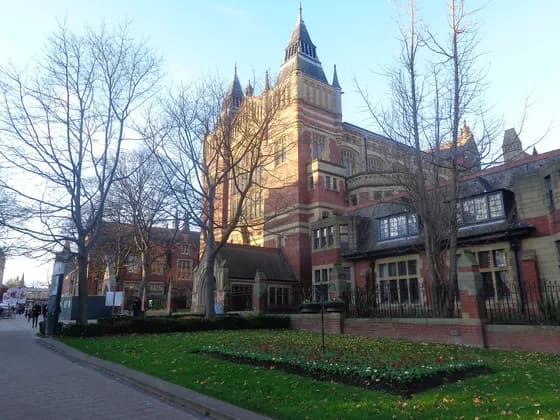

Photo: Chemical Engineer / Wikimedia Commons · CC BY-SA 4.0 · cropped
Photo: Mtaylor848 · CC BY-SA 4.0 · Photo: Chris Heaton · CC BY-SA 2.0 · Photo: Tim Green from Bradford · CC BY 2.0
The Leeds dentistry course at a glance (2027 entry)
Leeds's Dental Surgery degree is a five-year, full-time course that trains you to work as a dentist. You graduate with a Bachelor of Dental Surgery, which Leeds abbreviates as BChD. Passing it lets you apply to register with the General Dental Council (GDC), the body that regulates dental professionals in the UK and that every practising dentist must be registered with. About 96 students start the course each year.
The course is new. Leeds brought in a redesigned curriculum for students starting in September 2025, so if you start in 2027 you will be the third year group to take it. It is built around the GDC's Safe Practitioner Framework, the set of knowledge, skills and behaviours the regulator expects of a new dentist on their first day of practice. The GDC inspected the course in February 2026, looked at the plans for the new curriculum, and found every one of its requirements met.
The teaching is organised into four themes that run through the degree: Clinical Skills and Practice, Dental and Biomedical Science, Personal and Professional Development, and Enquire, which covers population health and research skills. Each year's modules follow these themes, so you can see how a topic builds over time.
Your base is the Worsley Building on Clarendon Way in Leeds, home to both the School of Dentistry and the Leeds Dental Institute, the NHS dental hospital where most of your clinical work happens. You practise first on haptic simulators, computer-based trainers that give you a sense of touch through the handpiece so you feel resistance as you cut a virtual tooth. You also use phantom heads: mannequin heads fitted with artificial teeth that you drill and fill as if they were a patient.
Two other features shape the experience. For the first two years you are taught alongside students on Leeds's BSc Dental Hygiene and Dental Therapy course, the colleagues you will later share patients with. In Years 4 and 5 you also treat patients at outreach clinics, community teaching clinics away from the dental hospital, across West and East Yorkshire.
| Degree | Bachelor of Dental Surgery (BChD) |
|---|---|
| Course length | 5 years full time, 182 weeks of study (GDC, 2026) |
| UCAS code | A200 |
| Intake | 96 students a year (GDC, 2026) |
| Curriculum | New theme-based curriculum, first taught to September 2025 entrants |
| Main base | School of Dentistry and Leeds Dental Institute, Worsley Building, Clarendon Way |
| First own patients | Year 2: examinations and preventive care for adults |
| Shared teaching | Years 1 and 2 with Dental Hygiene and Dental Therapy students |
| Outreach | Years 4 and 5, at community clinics in Leeds, Bradford and Hull |
| Intercalation | Optional year studying another course, after Year 2 or 3 |
What makes Leeds dentistry different
Two years shared with hygiene and therapy students
Years 1 and 2 are co-taught with Leeds's BSc Dental Hygiene and Dental Therapy course, and the shared modules are planned for classes of 140. You learn science, ethics and population health next to the professionals who will later share your patients. The GDC's 2026 inspectors heard both staff and students praise this shared teaching.
Haptic simulators from Year 1
You start on haptic simulators in first year. Across the course they are used to practise cavity design, removing decay, opening a tooth for root canal treatment and preparing crowns. More advanced lessons are still being developed, such as practising a crown on a digital copy of your own patient's teeth before the real appointment.
Outreach across West and East Yorkshire
In Years 4 and 5 you treat patients at outreach teaching clinics in Leeds, Bradford and Hull, moving between sites from term to term. The GDC's 2026 inspection picked out the outreach experience as a particular strength. The GDC also noted that the School's clinics serve areas of deprivation with high dental need and patients from many cultures and languages.
Ethics taught with the IDEA Centre
Professional ethics is taught by dental tutors together with ethicists from the University's Interdisciplinary Ethics Applied (IDEA) Centre, who challenge your assumptions through discussion of scenarios. In Year 2 your group presents a poster on an ethical topic to a panel of IDEA and School tutors, then you write a reflection on how your team worked.
A Capstone project you design yourself
The Enquire theme ends in a Capstone project. You plan it in Year 3 and complete it in Year 4. It can be a science-based research study, a clinical audit (checking whether care meets an agreed standard) or a patient education resource. You can work with staff researching areas such as oral biology, dental public health and digital dentistry.
Community engagement built into the course
The Enquire modules include World Café events, informal small-group discussions with invited guests. In Year 1 you hear from dental professionals who work with groups such as homeless people and older people. In Year 2 you meet people from, or working with, such communities. Each event is followed by a 1,500-word written assignment, and the programme also organises activities with groups such as care homes and schools.
How Leeds teaches dentistry
Leeds picks the teaching format to suit the topic. Core knowledge comes through large-group lectures, plus some live and pre-recorded online lectures. Smaller seminars and tutorials give you time to discuss and apply what you have learned. Each module has its own area on Minerva, the University's online learning platform, with lecture slides, discussions and messages from staff and other students.
The balance shifts sharply over five years. Dental and Biomedical Science takes 60 of your 120 credits in Year 1, then 40 in Year 2 and 20 in Years 3 and 4, and has no separate module in Year 5. Clinical Skills and Practice moves the other way, from 20 credits in Year 1 to 60 in Years 3 and 4 and 100 in Year 5. Personal and Professional Development stays at 20 credits every year.
Clinical skills are built in a fixed order: simulation first, then real patients. At key stages you must pass gateway assessments, practical tests on the simulators or phantom heads, before you can carry out that work on patients. On clinic you are supervised by GDC-registered clinicians, with at most one supervisor to six students. Dental nurses run the clinics and check infection control, and students told the GDC they found working with them especially useful.
The ways you will learn
| Lectures | Most of the core science arrives this way: the Year 1 science module alone has 73 one-hour lectures. Large-group lectures are recorded so you can go back over them. |
|---|---|
| Seminars and online tests | Small-group seminars follow the lecture topics so you can check and apply what you have learned. The science modules add online knowledge tests alongside each topic. These do not count towards your marks but show you where the gaps are before the end-of-year exam. |
| Clinical skills classroom | You build hand skills on phantom heads and haptic simulators: handling instruments and local anaesthetic equipment in Year 1, then preparing cavities and placing fillings in Year 2. The gateway assessments take place here too. |
| Simulated patients | Communication skills are practised first with simulated patients, trained people who play the part of a patient and give you feedback, alongside feedback from tutors and other students. In Year 2 you then use those skills for real, giving preventive advice to your own patients. |
| Clinic sessions | Clinical sessions at the Leeds Dental Institute run in blocks of three and a half hours. Depending on your stage you watch, assist a fellow student or treat your own patient. |
A typical week on the Leeds course
The module catalogue gives the timetabled hours for Years 1 and 2. Across Year 1 the four modules add up to about 295 hours of scheduled teaching. That is roughly 123 hours of lectures, 71 of seminars and 68 of practical sessions, plus 31.5 hours on clinic across nine sessions of three and a half hours.
The rest of Year 1 is yours to organise. The catalogue expects around 900 hours of private study across the year, over half of it for the science module, so first year asks a lot of self-directed learning.
Year 2 is much fuller, at about 498 scheduled hours. The dental surgery clinical module accounts for 336.5 of them, including 39 clinic sessions and 46 practical sessions, each three and a half hours long. Lectures across the four modules add up to around 132 hours.
How anatomy is taught at Leeds
Anatomy sits inside the Dental and Biomedical Science theme, taught by scientists who specialise in anatomy, oral biology and pathology alongside specialist clinicians. In Year 1 you study the whole body, including the heart and circulation, breathing, blood, the gut, liver and kidneys, muscle and hormones, with extra depth on the head and neck. Neuroanatomy concentrates on the cranial and facial nerves, especially the trigeminal nerve, which carries feeling from the teeth, gums and face.
Year 1 also covers histology, the study of tissues under the microscope, including enamel, dentine, bone, the ligament that holds each tooth in its socket and the lining of the mouth. You learn the embryology of the face and jaws, meaning how teeth and jaws form before birth. At the end of the year an objective structured practical exam (OSPE), a practical test marked pass or fail, checks parts of your anatomy and physiology.
In Year 2 anatomy becomes more clinical. You study the temporomandibular joint, where the lower jaw meets the skull, how infection spreads through the head and neck, and the detailed shapes of adult and baby teeth. Year 3 returns to the head and neck, and across the theme you build a detailed understanding of disease in this region.
When you start treating patients at Leeds
Your first clinical experience is watching. Early in Year 1 you spend a day observing in a general dental practice. The clinical module also includes nine sessions on clinic at the Leeds Dental Institute, where you see how dentists, nurses and patients work together. Meanwhile the clinical skills classroom introduces infection control and simulator work.
You start looking after your own patients in Year 2, under close supervision. The focus is assessment and prevention: taking histories, examining adults, working out their risk of decay and gum disease, and giving tailored preventive advice. You also assist senior students with their treatment. Removing decay and placing fillings are practised on phantom heads first.
One route to your patients is the School's volunteer scheme for members of the public who are not registered with a local dentist. After a 15-minute screening appointment, suitable volunteers join a student waiting list and sign an agreement. They then receive a single course of free treatment, such as a scale and polish, fillings, crowns, bridges or veneers, and are discharged when it is complete.
Finding enough children to treat is a challenge for dental schools locally and nationally. At the 2026 inspection the GDC saw the steps Leeds has taken to keep a steady flow of child patients coming to student clinics, and staff and students explained them to the panel.
Year by year at Leeds
- Year 1
Foundations and a first look at clinics
Year 1 lays the scientific and professional groundwork, taught jointly with dental hygiene and therapy students. Half your credits are science, and you observe clinics but do not yet treat patients.
- Dental and Biomedical Sciences 1 (60 credits): cell biology, whole-body anatomy and physiology, basic pathology, microbiology and immunity, and dental materials, including how X-ray images are produced.
- Clinical Skills and Practice 1 (20 credits): infection control, first aid, history taking, recognising common oral diseases and planning prevention, with haptic simulator practice and an introduction to local anaesthetic equipment.
- Personal and Professional Development 1 (20 credits): core ethical principles such as respecting patients' choices and avoiding harm, consent and confidentiality, and the School's code of conduct, including on social media.
- Enquire 1 (20 credits): population health, the psychology and sociology of health, literature searching in a computer cluster, a World Café event and a 1,500-word community engagement assignment.
- A two-hour practice exam covering all four modules at the end of Semester 1, then pass or fail exams in the summer, including the anatomy and physiology practical exam.
- Year 2
Operative skills and your first patients
Year 2 is when the timetable fills with hands-on work. The clinical module doubles to 40 credits and becomes a dental surgery version, while science, ethics and population health stay shared with hygiene and therapy students. You begin caring for your own adult patients under close supervision.
- Clinical Skills and Practice 2 BChD (40 credits): tooth decay, gum disease and tooth wear, and treatment planning for adults. On phantom heads and simulators you prepare cavities, place fillings and are introduced to replacing missing teeth. You also learn basic life support and safeguarding adults at risk of harm.
- On clinic: 39 sessions in which you assist senior students and give your own adult patients examinations and preventive care.
- Dental and Biomedical Sciences 2 (40 credits): tooth shape, saliva and disease in medically complex patients, plus pharmacology (how drugs work) and filling and bonding materials.
- Personal and Professional Development 2 (20 credits): the ethics poster, a 1,000-word reflective assignment, cultural competence (caring well for patients from different backgrounds) and a carbon footprint activity on sustainable practice.
- Enquire 2 (20 credits): epidemiology (patterns of disease across populations), inequalities in oral health and barriers to care. You also practise critical appraisal, judging how reliable a published paper is, and complete a second community engagement assignment.
- End-of-year exams of two hours for the science and clinical modules and one hour for Enquire, all taken in person on computer.
- Year 3
More complex adult care and children
The clinical module rises to 60 credits, half the year. You regularly assess and treat patients on clinic, take on more complex adult cases and are introduced to children's dentistry. It is also the year your Capstone project begins.
- Clinical Skills and Practice 3 BChD (60 credits): restoring more badly damaged teeth and managing tooth loss in adults, plus assessing and managing child patients, with simulator work continuing alongside regular clinics.
- On clinic you work both as the operator and as the assistant, and reflect on your progress as a routine part of each session.
- Dental and Biomedical Sciences 3 (20 credits): the head and neck, human microbiology, the immune system's role in disease, specialist dental materials and digital dental technology.
- Personal and Professional Development 3 BChD (20 credits): social accountability (shaping your work around the health needs of the community), how your own assumptions can affect patient care, and case studies on professional standards.
- Enquire 3 BChD (20 credits): theories of health behaviour and real-world interventions, and phase 1 of the Capstone, in which you plan your own project.
- Year 4
Oral surgery, outreach and leadership
Year 4 moves you to a more advanced level of clinical practice, with more complex cases in adults and children. Outreach clinics begin, you are introduced to oral surgery and orthodontics, and you complete your Capstone project.
- Clinical Skills and Practice 4 (60 credits): orthodontics (straightening teeth and correcting bites) and oral surgery, including taking out teeth. You treat your own patients across several specialties and outreach settings while learning to lead your dental team.
- Placements: outreach clinics and, according to the School's placements page, a visit to a specialist orthodontic practice and a two-week oral surgery placement at a host hospital.
- Dental and Biomedical Sciences 4 (20 credits): recent science on how disease develops, tissue repair, antibiotic resistance, and links between oral and general health.
- Personal and Professional Development 4 (20 credits): acting on feedback, fitness to practise (whether your health and conduct make you safe to treat patients), leadership and sustainable practice.
- Enquire 4 (20 credits): dentistry's place in the wider healthcare system, and phase 2 of the Capstone, in which you complete the project and produce your own evidence.
- Optional: apply for the Professional Development Elective in the summer break after Year 4.
- Year 5
Comprehensive care and sign-off
The final year is almost entirely clinical: Clinical Skills and Practice 5 is worth 100 of your 120 credits. You provide comprehensive care for adults and children, make more of the clinical decisions yourself and prepare to register with the GDC.
- Clinical Skills and Practice 5 (100 credits): comprehensive care of adults and children at the Leeds Dental Institute and outreach centres, coordinating each patient's care and presenting patient case reports.
- The School's placements page also describes a one-week oral medicine placement at a host hospital. Oral medicine deals with conditions of the mouth lining and face, such as ulcers and facial pain.
- Personal and Professional Development 5 (20 credits): your accountability to patients, the GDC, the law and the dental team, leadership, and how to debate emerging ethical questions in dentistry constructively.
- Final sign-off by the Clinical Progress Committee, the staff committee that tracks every student's clinical progress, confirming you meet the Safe Practitioner standard. The degree cannot be awarded without it.
- Preparing to apply for Dental Foundation Training, the salaried post most UK graduates take after registering with the GDC, with support from the School.
How you are assessed at Leeds
Leeds mixes written, clinical and professional assessments, each mapped to the GDC's outcomes. Written exams are closed book and taken in person on computer, using single best answer questions (multiple choice where you pick the most appropriate option) and short answers. Coursework includes reflective and community engagement assignments, and some group work, such as presentations, is assessed.
Year 1 is pass or fail throughout, with a practice exam across all modules at the end of Semester 1. From Year 2, modules carry marks. You must pass every module in a year to progress, and a good mark in one part of a module cannot make up for failing another. If you fail part of a module you can resit it, but in most Year 2 modules the mark is then capped at 40.
Clinical assessment runs alongside. You pass gateway assessments on the simulators or phantom heads at key stages. You also sit Objective Structured Clinical Examinations (OSCEs), circuits of short timed stations where examiners mark you on a set task. Other clinical assessments include unseen clinical cases, patient case reports with an oral exam, and simulated medical emergencies.
Every clinical session is graded and recorded on the School's Clinical Assessment and Feedback System (CAFS), where your supervisor adds written feedback and you add your own reflection. A cause for concern grade is reviewed by staff the same day, and you complete a structured reflection form. The Clinical Progress Committee reviews every year group four times a year and must sign you off as Ready to Progress before you move up.
To graduate, you need consistently satisfactory or better clinical grades across every area, plus a minimum number of completed treatments on real patients. A Personal Development Portfolio, your record of reflections and plans in written, audio or video form, also runs through the course. It is marked pass or fail. You get feedback on a four-step scale (not met, just met, met, exceeds) and must meet expectations in all four areas: professional standards, ethics, your learning, and self-management and wellbeing.
Where you will actually be at Leeds
Most of your clinical time is spent at the Leeds Dental Institute, an NHS dental hospital run by Leeds Teaching Hospitals NHS Trust in the same building as the School. You are timetabled on its clinics in every year from 1 to 5. They cover specialist areas including restorative dentistry (fillings, crowns, root canal treatment and replacing teeth), children's dentistry, orthodontics, oral medicine, oral surgery, pathology and radiology.
Outreach placements run in Years 4 and 5, at centres the GDC describes as spread across West and East Yorkshire. Each centre gives you its own induction before you treat patients. The School's placements page lists teaching clinics in Bradford, Hull and Beeston in south Leeds, and allocates students term by term so that everyone works across the sites.
The 2027 course page also names a centre at Chapel Allerton in north Leeds, so ask at an open day which centres your year will use. The same page says you pay your own travel to the Beeston, Bradford and Chapel Allerton centres, and Year 4 students receive £50 towards travel for external placements.
The School's placements page also describes short specialist placements. In Year 4 you visit a specialist orthodontic practice for one full day or two half days, and spend two weeks on an oral surgery placement at a host hospital. In Year 5 you spend a week on an oral medicine placement at a host hospital. That page was written before the new curriculum reached Years 4 and 5, so check the details at an open day.
The same page says you are on call during both hospital placements, including the middle weekend of the oral surgery fortnight. Being on call means you can be asked to help with urgent patients outside the normal timetable.
Your main clinical base in all five years, in the same building as the School of Dentistry.
- Leeds Dental Institute, Worsley Building, Clarendon Way
Outreach teaching clinic used in Years 4 and 5. School pages call this site either Beeston or South Leeds.
Outreach teaching clinic used in Years 4 and 5, allocated term by term.
Named on the 2027 course page as a Year 4 and 5 outreach centre.
Outreach teaching clinic in East Yorkshire used in Years 4 and 5, named on the School's placements and facilities pages. It is the furthest site from Leeds.
Electives and chosen modules at Leeds
The main optional element is the Professional Development Elective, an observational placement in the summer break after Year 4. Places are limited, so you apply, and a briefing early in Year 4 explains how. Any extra costs are explained during the course. The 2026/27 programme catalogue lists intercalation and this elective as the course's optional extras.
Outside the timetable, the School's Open Wide initiative lets dental students work with children from under-represented backgrounds around Leeds to help open up routes into dentistry.
Intercalation at Leeds
Intercalating means stepping out of the dental course for a year to study a separate course, then returning. At Leeds it is optional: you can intercalate for one year after Year 2 or after Year 3, which turns your five years into six. The course page notes that this may bring extra costs, with details given during the course.
Facilities and support at Leeds
Where you will learn
The Worsley Building holds the School of Dentistry, the Leeds Dental Institute and the University's health sciences library, along with a student common room, a faith room and a café.
Simulation happens in two recently refurbished rooms: the Clinical Skills Classroom, fitted with phantom heads, and the Dental Haptic Simulator Classroom. The School uses digital scanning and 3D printing to produce teeth and whole arches for practice, so simulated cases look more like real patients. New simulator teaching material is developed with the University's Schools of Psychology and Engineering, drawing on research into how practical skills are learned.
In the Medical Emergency simulation room you learn to manage a patient becoming unwell in the dental chair, with video playback so you can review how you did, and you are assessed there too. The School's lecture theatre has five-person group clusters, each with a linked touchscreen and delegate system, a dual-projection teaching wall, a dedicated wheelchair space and lecture capture.
Support while you study
Every student has an Academic Personal Tutor for regular one-to-one meetings about both academic progress and personal issues. Through Leeds for Life, a University resource for recording your development, you can set the agenda for these meetings yourself.
Denstudy is the School's own support team for dental students. It offers study advice, from assignment writing and revision to time management, as well as pastoral care, and students told the GDC in 2026 that they particularly valued it. The Student Support Team is the first point of contact for anything affecting your studies, and a Pastoral Care Adviser runs individual appointments and drop-ins.
The School describes a dental family approach of student-led support. Options include DentSoc's Dental Parent Scheme, Peer Assisted Study Sessions where you learn with and from other dental students, and informal get-togethers for mature students. DentSoc, the dental students' society, also runs social and sports events, visits and talks.
If you struggle, the Clinical Progress Committee can set up an individual action plan, and students who fail an assessment are supported by academic staff, personal tutors, the Student Support Team and Denstudy. Students also help shape the course through the Student and Staff Partnership Forum, where representatives raise issues with staff.
Is the Leeds course right for you?
This course may suit you if
- You want to learn alongside the dental hygienists and therapists you will later work with, since Leeds shares its first two years with them.
- You like building practical skills with technology, from haptic simulators to 3D-printed practice teeth, before you treat patients.
- You are keen to treat patients from many backgrounds, through outreach clinics across West and East Yorkshire and community engagement work from Year 1.
- You enjoy discussing ethics and reflecting on your own development, since both are assessed every year through the Personal and Professional Development theme.
- You would like to design and complete your own research, audit or patient education project.
Things to think about
- Year 1 is mostly science and independent study, with around 900 hours of private study and no patients of your own until Year 2.
- The curriculum is new: the first students started in September 2025, so no one has yet graduated from it.
- Outreach in Years 4 and 5 means travelling around Leeds, to Bradford and to Hull. The course page says you pay your own travel to the Leeds and Bradford centres.
- Every clinical session is graded, and you are expected to reflect on your performance after each one.
- The School's placements page says the Year 4 and 5 hospital placements involve being on call, including a weekend.
Leeds dentistry course — frequently asked questions
Applying to Leeds?
How to get into Leeds
Entry requirements, UCAT, personal statement and interview, step by step.
Open the guide →Leeds UCAT cut-offs and offers
UCAT cut-offs, A-level offers, interview format and decision dates.
See the requirements →Compare Leeds with other schools
Put the teaching style, anatomy teaching and placements next to another school.
Open the comparison →Prepare for the Leeds interview
Format breakdown, school-specific sample questions and prep tips from tutors who interviewed here.
Read the guide →Where this Leeds course guide came from
This guide was written from 17 official sources — University of Leeds School of Dentistry's own course pages and programme documents, plus the regulator and NHS placement partners where they publish detail — read on 2026-09-24, then checked claim by claim against those sources.
- Dental Surgery BChD course page, University of Leeds (2027 entry)
- 2026/27 Programme Catalogue: Bachelor of Dental Surgery (BChD), for students entering September 2025 onwards
- 2026/27 Module Catalogue: DSUR1251 Clinical Skills and Practice 1
- 2026/27 Module Catalogue: DSUR1252 Dental and Biomedical Sciences 1
- 2026/27 Module Catalogue: DSUR1253 Personal and Professional Development 1
- 2026/27 Module Catalogue: DSUR1254 Enquire 1
- 2026/27 Module Catalogue: DSUR2251 Dental and Biomedical Sciences 2
- 2026/27 Module Catalogue: DSUR2252 Clinical Skills and Practice 2 BChD
- 2026/27 Module Catalogue: DSUR2253 Personal and Professional Development 2
- 2026/27 Module Catalogue: DSUR2254 Enquire 2
- Work placements, School of Dentistry, University of Leeds
- Facilities, School of Dentistry, University of Leeds
- Student support (undergraduate), School of Dentistry, University of Leeds
- Volunteer for treatment, School of Dentistry, University of Leeds
- Careers and employability (undergraduate), School of Dentistry, University of Leeds
- GDC Education Quality Assurance Inspection Report, University of Leeds Dental Surgery (inspected 24 to 26 February 2026)
- Leeds Dental Institute, Leeds Teaching Hospitals NHS Trust
Courses are restructured between cycles. Anything here that decides your application — an anatomy offer, a placement city, a compulsory intercalated year — should be confirmed against the official page for your entry year.
Applying to Leeds?
We have helped hundreds of applicants turn their UCAT, personal statement and interview prep into offers from Leeds and other UK dentistry schools.