
Bristol Medicine Interview
Format, Questions & Prep Tips
Bristol medicine interviews for 2027 entry are multiple mini interviews (MMI), held December 2026 – February 2027 (anticipated, online). Published figures: UCAT interview threshold (2026 entry) 2240 home · 2270 overseas; MMI structure 6 stations, ~30 min total; Format Online (2027 entry).
- Institution
- University of Bristol
- Interview (2027 entry)
- December 2026 – February 2027 (anticipated, online)
- Decisions (2027 entry)
- As soon as possible, but possibly not until all interviews are complete


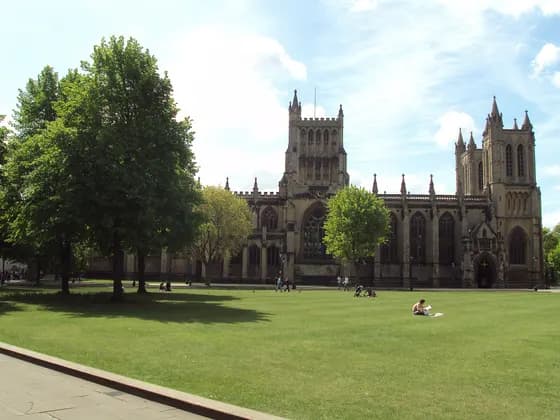

Photo: Suicasmo · CC BY-SA 4.0 · cropped
Photo: AmW22 · CC BY-SA 4.0 · Photo: Rept0n1x · CC BY-SA 3.0 · Photo: John Winder · CC BY-SA 2.0
Still deciding where to apply? Hear it from a student who's there
Bristol Medical School uses a 6-station MMI format conducted online via Zoom, lasting approximately 30 minutes total. Each station is marked by three assessors (you'll see six assessors in total, working in two groups of three who mark three stations each). Bristol's 2027-entry admissions statement confirms interviews stay online for the 2026/27 cycle, anticipated from December 2026 to February 2027.
Once academic requirements are met, Bristol selects for interview on UCAT alone (100% weighting on the combined score, excluding the SJT); for 2026 entry the threshold was 2240 for home and 2270 for overseas applicants. The MMI itself is heavily values-driven — Bristol expects you to know what the GMC's "Achieving Good Medical Practice" says about the qualities of a good doctor, and you'll be marked against those values rather than scientific knowledge.
Stations span communication (role-play), ethical reasoning, teamwork, NHS awareness, and reflection on motivation. Bristol’s style is conversational rather than viva — they want you to think out loud and engage with the interviewer, not deliver rehearsed monologues.
Bristol interview key facts (2027 entry)
| UCAT interview threshold (2026 entry) | 2240 home · 2270 overseas |
|---|---|
| MMI structure | 6 stations, ~30 min total |
| Format | Online (2027 entry) |
Interview Format
- Multiple Mini Interview (MMI) with 6 stations
- Approximately 30 minutes total interview time
- Online for the 2026/27 cycle (2027 entry); Bristol's interview page describes Zoom
- Each station marked by three assessors — two groups of three, so you see six assessors across the six stations
- Interview selection is 100% UCAT (excluding SJT) once academic minimums are met; personal statement not weighted
- Values-driven assessment based on GMC “Achieving Good Medical Practice”
- Typical themes: communication/role-play, ethics, teamwork, NHS awareness, motivation
Sample Interview Questions
Why do you want to study medicine at Bristol specifically?
Reference Bristol’s case-led integrated curriculum, the variety of clinical placements across the South West Academy, the strong research culture and the city.
What qualities make a good doctor, and which do you most need to develop?
Anchor against GMC values (compassion, integrity, communication, teamwork). Be honest about a development area — self-awareness scores more than feigned perfection.
Do you think doctors should be involved in rationing patient care?
Engage with both autonomy and justice. NHS resource allocation already involves clinicians via NICE thresholds; explore the difference between bedside and policy-level rationing.
A patient with capacity refuses a treatment that would save their life. What should the team do?
Respect autonomy. Ensure understanding is genuine. Document. Offer to revisit. Don’t override their decision — the four pillars come down clearly here.
Can you think of any strategies to improve A&E departments?
Demonstrate informed awareness: triage flow, GP access, social-care discharge bottlenecks, workforce gaps. Avoid one-line policy fixes.
A patient is upset that their consultation has been cut short. (Actor present.)
Acknowledge feelings, apologise for the impact (not for medical decisions), explain pressures, offer concrete next steps. Don’t rush the empathy.
A colleague tells you they’re struggling with the workload and asks you not to mention it. (Actor present.)
Validate their disclosure. Suggest support routes. Be clear that if you were worried about patient safety, you would have to act — be honest, not coercive.
Should the NHS fund treatments with very small benefits at very high cost?
QALY thresholds (NICE £20k–£30k per QALY), equity considerations, opportunity cost. Show familiarity without dogma.
What medical advances have you come across recently that excite you?
Pick a real story you can discuss in depth (gene therapies, GLP-1 obesity drugs, AI-assisted diagnosis). Show why it matters — not a textbook recital.
Tell me about a time you worked in a team. What was your role and what did you learn?
STAR framework. Reflect on followership as much as leadership. Bristol values self-aware contributors.
A patient asks you to share medical information about a family member who is also your patient. What do you do?
Confidentiality is paramount. Explore what they’re trying to achieve. Encourage open conversation within the family. Don’t breach without consent.
What concerns you most about a career in medicine?
Honest concerns + your strategy for managing them. Workload, burnout, emotional toll, retention crisis. Show realism.
Explain a topic from your A-Levels to me as if I’d never studied science.
Avoid jargon. Use a concrete analogy. Check understanding mid-explanation. Bristol values clarity above depth on this station.
A patient does not want their family told about a diagnosis. (Actor present.)
Respect their decision. Explore the reasons sensitively. Confidentiality without coercion. Document.
Practise the Bristol interview
Rehearse the real format before the day — on demand with our AI interviewers, or live with a tutor.
Sit a mock with photoreal AI interviewers — any time
A timed MMI or panel interview on video — British & international voices — with interviewers who listen, react and press with follow-ups. Rubric-scored feedback and a replay the moment you finish.






Live mocks with a tutor who’s been in the room
A full Bristol-style mock with a medic or dentist tutor — honest scoring against real marking criteria, a station-by-station debrief and a written action plan.
Book a mock interviewHow to Prepare
Read GMC “Achieving Good Medical Practice: Guidance for Medical Students” — Bristol’s rubric maps directly onto its values.
Drill the online MMI rhythm — short stations, multiple assessors, no time to re-warm-up between.
Practise role-play with a peer playing the patient; record yourself to review tone and body language.
Read recent NHS news so any “recent medical advance” / “NHS challenges” prompt feels natural.
Have a coherent “why Bristol” answer — case-led integrated curriculum, South West Academy placements, Bristol Royal Infirmary and Southmead trusts.
Practise online interview etiquette: camera angle, lighting, eye contact at the lens, neutral background.
Invited to interview at Bristol? Say your first answer out loud today with the free two-minute warm-up drill, then sit a timed mock set up for Bristol.
Common Pitfalls
Frequently Asked Questions
Related guides
Free, evidence-based guides from current UK medical and dental students.
Free Interview Resources
Worked-through MMI stations, ethics scenarios, and panel questions.
Read guideNHS Core Values Guide
The 6 NHS values examiners listen for in every interview answer.
Read guideMedical School Rankings
See interview format (MMI vs panel) for each UK medical school.
Read guideUCAS 2026 Personal Statement
The new three-question format your interviewer will reference.
Read guideContextual Offers for Medicine
Every UK medical school's widening-access scheme in one place.
Read guideSources & official admissions information
We cross-check every interview guide against the school’s own admissions guidance and the UK regulators.
- University of Bristol — Medicine admissions statement, 2027 entry — Online interviews for 2026/27 cycle, anticipated December–February; UCAT 100% weighting for interview; personal statement not weighted.
- University of Bristol — Medicine interviews — Zoom, ~30 minutes, six stations each marked by three assessors (two groups of three); read GMC Achieving Good Medical Practice.
- University of Bristol — MB ChB Medicine, 2027 entry — UCAT (excluding SJT) selects for interview; 2026-entry threshold 2240 home, 2270 overseas.
- UCAT Consortium — Official UCAT registration, test format, scoring methodology and free practice materials.
- General Medical Council (GMC) — Statutory regulator. Approved medical schools, the registered-doctor register, and fitness-to-practise standards.
- Medical Schools Council — Selecting-for-excellence guidance, MMI principles, and an A–Z of UK medical schools.
Ready to nail your Bristol interview?
Book a mock interview with a current medical student who recently went through the same process, or practise on demand with the AI interviewer.