
The Birmingham Medicine course
What you actually study, and where you will be
Birmingham's MBChB is a 5-year course with an integrated curriculum, with patient contact from Year 1 (2027 entry). A conventional integrated course with a clinical skills day every week of years 1 and 2, alternating between simulated practice and real general practice. The clinical years are built from long placement blocks rather than short rotations.
- Degree
- MBChB
- Length
- 5 years
- Teaching
- Integrated
- Clinical contact
- Year 1
- UCAS code
- A100

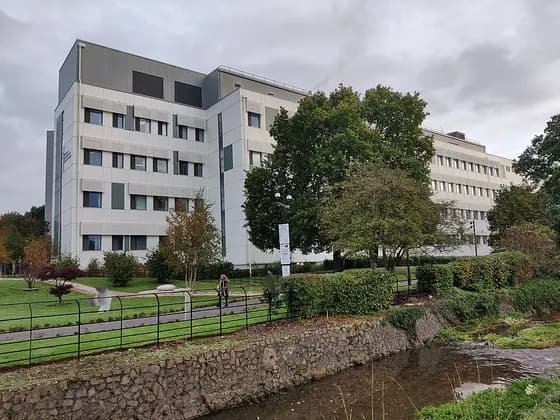
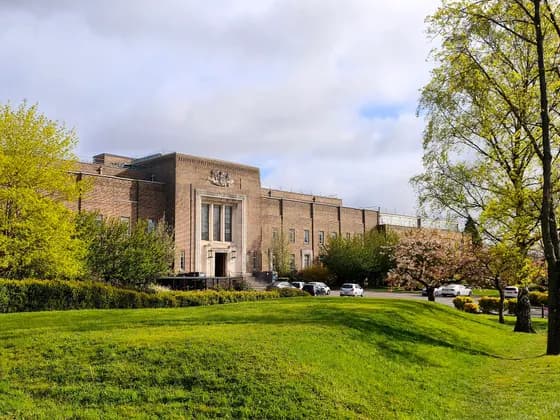
Photo: mattbuck · CC BY-SA 3.0 · cropped
Photo: Andy Mabbett · CC BY-SA 4.0 · Photo: Athikhun.suw · CC BY 4.0 · Photo: Andrew Abbott · CC BY-SA 2.0
The Birmingham medicine course at a glance (2027 entry)
Birmingham's medical degree is the MBChB, short for Bachelor of Medicine, Bachelor of Surgery. It takes five years full time, the UCAS code is A100, and it is based on the university's Edgbaston campus. The Medical School building stands next to Queen Elizabeth Hospital Birmingham, so your lecture theatre and a major teaching hospital are a few minutes apart.
The course comes in two stages. Years 1 and 2, which the school calls Phase 1, are based on campus, with one day every week given over to clinical skills. Years 3, 4 and 5 are built around hospital and general practice placements, and campus teaching shrinks to a small part of your week.
Patient contact starts almost immediately, with your first general practice placement in week two of year 1. Hospitals arrive more slowly, with an orientation day in year 1 and full-time placement from year 3.
The teaching region is large. The medical school uses 15 hospitals within easy travelling distance of campus, plus around 131 general practices across the West Midlands. Roughly 60 of those practices teach years 1 to 4 and about 70 more take final-year students. The regional population its students learn from is more than five million people.
Day to day, the first two years leave a lot of time in your own hands, and the balance then flips: from year 3 placements take around two thirds of the year. A new curriculum started with the 2026 intake, so applicants now will join the redesigned version.
| Degree | MBChB (Bachelor of Medicine, Bachelor of Surgery) |
|---|---|
| Course length | 5 years |
| UCAS code | A100 |
| Main campus | Edgbaston, Birmingham |
| Year group size | About 400 students per year |
| Teaching style | Science and clinical skills taught together, plus a weekly skills day |
| Anatomy | Prosected (already dissected) specimens, models, ultrasound and touch-screen tables |
| First patient contact | General practice placement in week two of year 1 |
| Placement area | Birmingham and the West Midlands, out to Worcestershire and Herefordshire |
| Intercalation | Optional, usually between years 2 and 3 |
| Elective | Six weeks in the spring of year 5 |
What makes Birmingham medicine different
General practice from week two of year 1
Community Based Medicine is Birmingham's name for its general practice teaching. It starts in week two of year 1 and runs in every year of the course, at a different practice each time, so you see surgeries serving very different parts of the West Midlands.
Weekly clinical skills day in years 1 and 2
One day each week is set aside for clinical skills. It alternates between simulated practice on campus and real-world experience in a general practice surgery, so a skill you rehearse in a teaching room is one you go on to use with a patient. It means the science you learn in lectures has somewhere to land almost straight away.
Hospitals near, middle and far, for everyone
Placement hospitals are grouped by distance from campus, and every student is allocated placements in all three groups across the course. That means some blocks a short trip from Edgbaston and others in Worcester, Redditch or Hereford. The school says it monitors distance travelled so that travel costs work out evenly.
Years 1 and 2 are each one big module
In years 1 and 2 the whole year is a single module, Medicine 1 and then Medicine 2. To pass it you must separately pass a written applied knowledge test, a practical clinical exam and a portfolio of work. A fail in any one of the three means a resit, even if the other two went well.
Final year built around finals, then the job
Year 5 opens with two eight-week blocks, one in acute care and one in chronic care, designed to pull five years together before the national licensing exam. Afterwards come the elective and two assistantships, where you work as the assistant to a doctor in foundation year 1, the first year of the paid training programme every UK graduate enters.
How Birmingham teaches medicine
In years 1 and 2 you are on campus most days. Teaching is a mix of lectures, small-group sessions, anatomy practicals and self-guided study, with one day each week on clinical skills. Formative work, which is practice that is marked and fed back on but does not count towards your grade, runs through both years.
The first two years are organised into named strands rather than separate subject courses. The science and population-health teaching runs through two of them, Fundamental Clinical Sciences and Social Science, Health and Health Promotion. A third, Skills for Life, Academia and Medicine, is there to support your move into university study. The Introductory Clinical Course pairs practical history and examination sessions on campus with your general practice placement.
From semester 2 of year 1, a strand called Integrated Thinking asks you to apply what you know to unfamiliar situations rather than recall facts. That is the skill the clinical years then demand. Year 2 keeps the same strands and covers the specialties that year 1 did not reach.
From year 3 the balance changes completely. Around 64 per cent of year 3 is spent on placement, rising to 65 per cent in year 4 and 66 per cent in year 5. Scheduled teaching falls to roughly 13, 10 and 3 per cent across those same years. Most learning now happens on wards, in clinics and in surgeries, with campus teaching and your own study filling the gaps.
Birmingham teaches the MBChB inside a medical school that also runs pharmacy, nursing and biomedical science degrees, and you learn alongside those students. Interprofessional working means learning to do your job in a team with other health professions. It is one of the named themes that run the length of the new curriculum, and it has its own lead in the MBChB team.
The ways you will learn
| Lectures | Whole-year lectures run in the Medical School's own theatres, which are large enough to take an entire year group at once. Lectures are recorded, and the theatres are set up for electronic audience voting, so tutors can check understanding as they go. |
|---|---|
| Small-group teaching and seminars | Seminars and tutorials sit alongside the lectures. They exist so you can work through the scientific and professional material in a group and clear up anything the lecture left unresolved. |
| Anatomy practicals | Small groups study prosections, bodies already dissected by staff so the structures are exposed, guided by anatomy tutors and demonstrators. |
| Clinical skills sessions | One day a week in years 1 and 2 is given over to clinical skills, alternating between simulated practice on campus and real-world experience in a general practice surgery. Your practice teaches sixteen days across the year, shared between two student groups, so you are there for eight of them. |
| Communication teaching | The medical school's Interactive Studies Unit has taught clinical communication here since 1993, and now teaches and assesses it across six courses: medicine, pharmacy, dentistry and adult, child and mental health nursing. Sessions are built around simulation with trained professional role players, covering consultations, raising concerns, handling uncertainty, breaking difficult news and shared decisions. |
| Community Based Medicine placements | General practice placements that run in every year of the course, at a different practice each time. Birmingham started the scheme in 1995 with 26 practices; around 60 now teach years 1 to 4 and about 70 more take final-year students. A tutor system like the hospital one operates in the practices, so there is a named person responsible for you there as well. |
| Ward-based teaching and simulation | On hospital placement you learn at the bedside with the team of doctors you are attached to, and with teaching fellows employed to teach students. At University Hospitals Birmingham that also includes simulation on remote-controlled manikins and practising skills such as catheterisation. |
A typical week on the Birmingham course
The school publishes the shape of the week rather than a full timetable. In years 1 and 2 a normal day starts at 09:00 and finishes at 17:00 or 18:00, and Wednesday afternoons have traditionally been kept clear for sport. One of those days each week is your clinical skills day.
Most of the time in those years is yours to manage. About 67 per cent of year 1 and 69 per cent of year 2 is independent study, with roughly 18 to 19 per cent in timetabled teaching and the remainder on placement.
In years 3 to 5 the day can start at 08:00 or 08:30, depending on what has been arranged. You are expected to be at your placement for five to six hours a day, not counting lunch. In the later years you also cover a late shift or an evening, night or weekend shift, so you see how a hospital runs outside office hours.
Attendance is taken seriously. The programme requires at least 80 per cent attendance on every placement. There is a limited amount of catch-up in the clinical years, and none for teaching sessions missed in years 1 and 2, so absences need watching.
How anatomy is taught at Birmingham
Anatomy at Birmingham is taught on prosections. A prosection is a body or body part that staff have already dissected, so the structures are exposed for you to study rather than something you cut open yourself. The Medical School building has its own prosectorium for this work.
Sessions there run as discussion groups supported by academic staff. They sit alongside other ways of seeing the body: anatomical models, surface anatomy, 3-D software with virtual dissection tools, video animations and ultrasound equipment.
The department also uses large touch-screen tables, where you explore a digital body with tutors and demonstrators on hand. Lectures cover topographical and regional anatomy, which means learning the body area by area. Histology, the study of tissue under the microscope, is taught in online interactive sessions with live polling on images.
The anatomy team teaching medicine, dentistry, pharmacy and biomedical science includes two senior lecturers, a lecturer, seven teaching fellows and eight demonstrators. Among them are junior doctors building careers in surgery, radiology and pathology, so the teaching tends to be framed around how anatomy is used clinically.
If full dissection appeals, that is what the intercalated Clinical Anatomy MSci offers. It includes guided dissection with anatomists and surgeons, a dissection logbook, and an oral exam over a dissected specimen.
When you first meet patients at Birmingham
Your very first placement is in general practice, inside your first fortnight. Birmingham calls these Community Based Medicine placements. They are teaching placements built around a small group of four to six students rather than work experience. They run in every year of the course, and you move to a different practice each year.
In years 1 and 2 your practice teaches for 16 days a year, split between two groups of about six students, so you get eight days there. You learn to take a history and to do basic clinical skills such as blood pressure and simple heart and chest examinations. You also interview patients about how an illness affects their daily life, then work the cases through in tutorials.
Back on campus, the Introductory Clinical Course teaches history taking and examination in practical sessions, so you arrive at the surgery with something specific to try. In year 2 that course carries on into the specialties year 1 did not cover, and placements widen into schools and other community settings.
Hospital contact builds more slowly. Year 1 includes a hospital orientation day. In year 2 you do a two-week Hospital Preparation Course, usually at the hospital where you will be based in year 3. It replaced a two-day placement for everyone starting from 2026.
Year 3 is when full-time clinical placement begins, and from that point hospitals and surgeries are where most of your learning happens.
Year by year at Birmingham
- Year 1
Foundations, and your first patients
Year 1 is a single 120-credit module called Medicine 1, taught on campus with a weekly clinical skills day. Semester 1 lays down the science and population-health foundations and starts your clinical training. Semester 2 adds more body systems and the Integrated Thinking strand, which pushes you to use knowledge in new situations rather than repeat it.
- Medicine 1 runs the full year as one 120-credit module, led by Dr Keith Brain, who also leads Phase 1 as a whole.
- Semester 1 covers Fundamental Clinical Sciences and Social Science, Health and Health Promotion, supported by the Skills for Life, Academia and Medicine strand.
- The Introductory Clinical Course starts your clinical career with general practice placements and practical sessions in history and examination skills.
- Your general practice group is about six students, and you spend eight days at the practice across the year, learning history taking, blood pressure and simple heart and chest examinations.
- A hospital orientation day gives you your first look at a ward before the clinical years.
- The applied knowledge test is worth 70 per cent of the module: a two-hour Part A in January and a four-hour Part B in the summer.
- A clinical and professional skills assessment in the summer is worth 30 per cent and runs to a maximum of three hours.
- A pass or fail portfolio is submitted in May, with review points in both semesters and around 40 hours of your own effort across the year.
- Year 2
The rest of the systems, and the specialties
Year 2 is Medicine 2, again a single 120-credit module, and keeps the shape of year 1: campus teaching, a weekly clinical skills day and general practice. The science strands continue and the clinical course reaches the specialties year 1 did not cover. Placements widen beyond the surgery into schools and community settings.
- Medicine 2 builds on the Fundamental Clinical Sciences and Social Science, Health and Health Promotion foundations and continues Integrated Thinking.
- History and examination practical sessions cover the specialties that Medicine 1 did not include.
- Community Based Medicine continues at a different GP practice, with another eight days in a small group, plus school and community placements.
- The applied knowledge test is worth 60 per cent of the module this year and the practical exam 40 per cent, with a maximum of two hours of practical assessment.
- The portfolio runs again across four domains and must be passed, alongside the two exams, to progress.
- Students starting from 2026 do a two-week Hospital Preparation Course, usually at the hospital they will be placed in for year 3.
- Year 3
Into hospital full time
Year 3 is Medicine 3, a 150-credit year and the first spent mainly in hospital. Two 14-week placements each give a different mix of internal medicine and surgical specialties, with experience of primary care alongside them. The way you learn changes with it: most of it now comes from the patients in front of you, with campus teaching and your own reading filling the gaps.
- Two 14-week hospital blocks, one per semester, described by the school as integrated clinical medicine and surgery.
- A general practice placement continues at a new practice, mixing surgery days with academic days on campus, and covering chronic illness, acute cases and an introduction to paediatrics.
- A student selected experience, a block you choose yourself to follow an interest, which the school lists among the year 3 placements.
- A school paediatric placement also appears in the school's list of year 3 placements.
- Supervised student surgeries start here: a patient sees you first, and your GP tutor goes over the case with you afterwards.
- Direct Observation of Examination Skills assessments begin: a clinician watches you examine a patient and signs the result off on your electronic portfolio, and they must be passed in each clinical year.
- You get access to SCRIPT, a prescribing and therapeutics eLearning course written by college staff, which foundation schools in England, Wales and Northern Ireland also use.
- At Russells Hall the medical school's Interactive Studies Unit runs small-group communication sessions over two days, working on how you handle different clinical situations.
- At Russells Hall Hospital in Dudley, the first four weeks run Monday to Friday with core teaching prioritised, then Monday to Thursday with specialty sessions and weekly bedside teaching.
- Year 4
Specialties across the life course
Year 4 is Medicine 4, another 150-credit year, and again mostly spent on placement. You rotate through the areas year 3 did not cover, from children to mental health to cancer care. A general practice block runs alongside the hospital work, at a practice you have not used before.
- The course page sums the year up as placements in child health, which is paediatrics, obstetrics and gynaecology, psychiatry, cancer care and specialty medicine.
- The school's placements page gives a fuller rotation list: one general practice placement and five hospital placements. They are Specialty Medicine A and B, psychiatry, neuro-muscular medicine and palliative care, surgery and peri-operative care, and a selected career experience.
- The two pages differ over where obstetrics, gynaecology and paediatrics fall. The course page puts them in year 4 and the rotation list puts them in year 5, but you cover them either way.
- Neuro-muscular medicine deals with conditions affecting the nerves and muscles. Palliative care is the care of people whose illness cannot be cured, where the work is controlling symptoms and supporting the family.
- A general practice block at a practice you have not used before, covering cases from specialist medicine such as elderly care and mental health, with supervised student surgeries again.
- The selected career experience is a block you choose yourself, so you can spend time in a specialty you are considering.
- Direct observation assessments on placement continue and must be passed to progress.
- At Russells Hall the career experience is three weeks in July shadowing staff in a specialty you want to explore.
- Year 5
Finals, elective and assistantships
Year 5 is Medicine 5, 150 credits and almost entirely placement. It opens with two eight-week blocks, one in acute care and one in chronic care spanning hospital and general practice, designed to draw the whole course together before final exams. The elective and two assistantships follow the exams.
- An eight-week acute care block and an eight-week chronic care block, the latter covering both primary and secondary care.
- The school's placements page lists five hospital placements for the year: the Acutely Ill Patient block, obstetrics and gynaecology, paediatrics and the two assistantships, alongside the general practice work.
- You sit the Medical Licensing Assessment as part of your final professional examinations. It is the national exam the General Medical Council requires every UK graduate to pass before joining the medical register.
- The General Medical Council recorded in 2024 that year 5 involved 12 Direct Observation of Examination Skills sign-offs during placement, all of which must be passed.
- In general practice you spend 12 days as an apprentice, running supervised surgeries of up to ten patients a day. You may also go out on home visits and spend time with other members of the practice team.
- Four more days at a designated practice cover consultation styles, role play and video consultations.
- A six-week elective in the spring, which you design and organise yourself.
- Two assistantships, where you work as the assistant to a doctor in foundation year 1 rather than observing, doing the job you start a few months later.
- At Russells Hall the assistantship is a four-week placement taking around 30 students, and about 52 students a year do its acutely ill patient placement between July and February.
How you are assessed at Birmingham
Every year of the course is a single module, Medicine 1 through to Medicine 5. The module catalogue sets out how the first two are examined: a written applied knowledge test, a practical clinical exam and a portfolio of work. All three are hurdles in years 1 and 2, so each has to be passed separately. Failing one sends you to a resit in the supplementary period even if the other two went well.
The applied knowledge test, or AKT, is a closed-book written exam. In years 1 and 2 it comes in two parts. Part A is a two-hour paper in January and counts for a third of the AKT mark. Part B follows in the summer as two two-hour sittings and carries the other two thirds.
The practical exam is the clinical and professional skills assessment, or CPSA. In years 1 and 2 it mixes two kinds of station. An objective structured clinical examination station, known as an OSCE, gives you a task such as taking a history while an examiner marks against a set scheme. An objective structured practical examination, or OSPE, tests practical and interpretive skills.
Some stations are watched by an examiner and some are not. To pass year 1 you need 50 per cent across the written exams and 50 per cent across the practical ones. Within that practical mark you also need at least 40 per cent in the unobserved stations, and passes in a set number of the OSCE-style stations.
The portfolio carries no marks in those two years but still has to be passed. It runs across four domains: mandatory requirements, academic skills, skills for patient care and professional behaviours. Much of it is built from timetabled teaching, it is submitted in May, and a panel judges it against a rubric. Review points in each semester flag anyone off track, so problems are caught during the year rather than at the end of it.
The clinical years work differently. Sign-offs called Direct Observation of Examination Skills, where a clinician watches you examine a patient, must be passed in each of years 3, 4 and 5. University Hospitals Birmingham runs the year 3, 4 and 5 practical exams for the medical school as its end-of-year exams. They follow a format close to the final-year one, so finals is an exam you have already sat twice. Year 5 finals also include the Medical Licensing Assessment.
- In a compliance decision published in May 2024, the General Medical Council recorded Birmingham's plan for the final practical exam. It is 12 stations taken in a single day, cut down from 14 stations across two days, for students graduating from 2024/25. The school was changing both its curriculum and this exam at the time.
- The same 2024 decision records stations of ten minutes, with three minutes of reading time beforehand, and the exam running at ten different sites on different days.
- Under that decision, passing needs at least 50 per cent overall plus a pass in eight of the 12 stations.
- Physical examination is assessed instead through the Direct Observation of Examination Skills sign-offs on placement, which is why they matter.
- Alongside those sign-offs there is a list of practical clinical procedures to get through each year. You practise them in simulation first, then do them on placement under observation, and each one is signed off in the same electronic portfolio.
- Prescribing is assessed through the national Prescribing Safety Assessment, a pass or fail test for final-year students, with the British National Formulary available throughout it.
- The General Medical Council recorded in 2024 that clinical written exams fall between April and June. Each exam period is followed by an exam board, with progression boards after the summer resits.
- At Russells Hall Hospital the practical exams are held over two to three days each February.
- You are told how each module is assessed at the start of it, and feedback arrives within four weeks.
- Progression also requires at least 80 per cent attendance on placements.
Where you will actually be at Birmingham
Placements are the core of years 3 to 5 and start in a small way in year 1. The medical school uses 15 hospitals within easy travelling distance of campus, sorted into three groups by distance, and around 131 general practices across the West Midlands.
Every student is allocated placements in all three distance groups over the course, so nobody stays close to Edgbaston the whole way through and nobody spends five years commuting. The school says it monitors distance travelled to keep travel costs fair. You are not normally allowed to swap a placement with another student.
Every trust organises its weeks differently, so two students in the same year can have quite different timetables. The Russells Hall examples elsewhere in this guide are one trust's published timetable rather than the pattern at every site. What does not change is the range of blocks you have to cover and the standards you are held to.
If you cannot travel to every site, because of health, caring responsibilities or a reasonable adjustment, there is a formal route. Before each academic year you submit a special placements request with evidence, which a committee considers, and you are told the outcome well before term starts. Students with ongoing needs reapply each year.
Most sites are reachable by public transport or car, and students often share lifts. The campus has its own station on the Cross-City Line, with trains to Birmingham New Street every ten minutes at peak times. The college contributes to travel costs in proportion to time spent on placement.
On every placement you are assigned a Senior Academy Tutor, normally with five or six students, who meets you regularly and completes an end-of-placement review. Day-to-day supervision comes from junior and senior doctors and from other clinicians such as physiotherapists, nurses and ECG technicians. Each hospital also has teaching fellows, and University Hospitals Birmingham employs 11 of them across its sites. Each placement has a coordinator who is your contact in an emergency.
The Medical School is next door to the Queen Elizabeth, which belongs to University Hospitals Birmingham NHS Foundation Trust. The Barberry is run by Birmingham and Solihull Mental Health NHS Foundation Trust, and the Midland Metropolitan sites by Sandwell and West Birmingham NHS Trust.
- Queen Elizabeth Hospital Birmingham
- Birmingham Children's Hospital
- Birmingham Women's Hospital
- Birmingham Heartlands Hospital
- Solihull Hospital
- The Royal Orthopaedic Hospital
- The Barberry
- Midland Metropolitan University Hospital, with the City and Sandwell health campuses
Russells Hall, part of the Dudley Group NHS Foundation Trust, has taught Birmingham students in years 3 to 5 since 2005 through its Ron Grimley Undergraduate Centre. New Cross belongs to the Royal Wolverhampton NHS Trust and Walsall Manor to Walsall Healthcare NHS Trust.
- Russells Hall Hospital, Dudley
- Good Hope Hospital, Sutton Coldfield
- Walsall Manor Hospital, Walsall
- New Cross Hospital, Wolverhampton
Redditch and Worcester are run by Worcestershire Acute Hospitals NHS Trust, and Hereford by Wye Valley NHS Trust. Students placed at Hereford County Hospital are provided with accommodation.
- The Alexandra Hospital, Redditch
- Worcestershire Royal Hospital, Worcester
- Hereford County Hospital, Hereford
These are the teaching sites for Community Based Medicine, and you are placed at a different one in each year of the course.
- Teaching practices across the West Midlands
Electives and chosen modules at Birmingham
The elective is a placement you design yourself. At Birmingham it falls in the spring of year 5 and is worth 10 credits. The period is six weeks, and at least four of them must be spent on the learning activity itself, normally in one setting.
It can be in the UK or overseas and does not have to be a hospital. Past projects have been in primary and secondary care, laboratories, education and leadership settings and the charity sector. The work can be a placement, structured observation, shadowing, research where ethical approval is possible, or a literature review.
You prepare by submitting a project protocol and a careful risk assessment, and completing the elective is a requirement for graduating. Most students fund it themselves. A small number of competitive bursaries are advertised through the module, and students on the NHS England bursary can access extra funds towards accommodation and other costs. Turing Fund support for overseas trips is advertised each February.
Two other choose-your-own blocks sit earlier in the course. The school lists a student selected experience among the year 3 placements and a selected career experience in year 4. Both let you follow an interest before you commit to an elective topic.
Intercalation at Birmingham
Intercalating means stepping out of medicine for a year to take a separate degree, then returning to where you left off. At Birmingham it is optional, and the course page says it usually happens between years 2 and 3. You need to meet academic criteria showing you are doing well on the medical course.
The options range from laboratory science to subjects well outside medicine. On the science side there is a BMedSc in Medical Science and MSci degrees in Medical Sciences or Clinical Anatomy. Further afield sit a BA in Medical Humanities, an MSci in Health Management and Leadership, and BSc degrees in Human Neuroscience or Sport, Exercise and Health Science. You can also take a year in Computer Science or in Civic Leadership.
Timing depends on the degree. The BMedSc is open only to Birmingham medicine and dentistry students who have finished year 2, 3 or 4. The Clinical Anatomy MSci takes medical students in year 3 or 4, and dental students in year 2, so it falls later than the usual break between years 2 and 3.
The BMedSc runs for a year. You take taught modules in the first term alongside third-year biomedical science students, then a 50-credit research project through the spring term. Modules in experimental data interpretation and a global challenge sit alongside them. The Clinical Anatomy MSci is 120 credits of dissection-based anatomy, embryology and a research project, assessed partly by a dissection logbook and an oral exam over a specimen.
If you have already completed three years, you can instead join an intercalated master's. Those include public health, health research methods, health economics and health policy, clinical trials, health data science, mental health, and artificial intelligence implementation in healthcare.
Facilities and support at Birmingham
Where you will learn
Teaching is concentrated in the Medical School building on the Edgbaston campus, which is open to students at all hours with its own security staff. It houses the prosectorium and the anatomy touch-screen tables, and a library for College of Medicine and Health students.
Lectures happen in theatres set up for recording and for electronic audience voting. The Leonard Deacon Lecture Theatre seats 450, enough for a whole year group of about 400 students, and the Arthur Thomson Hall seats 398.
For study there is the Doug Ellis Learning Hub, with open study space and laptops to borrow. The Barnes Medical Library sits next to it and holds the core texts, and a computer cluster of 276 machines fills part of the second floor.
Course material sits on Canvas, the virtual learning environment, and you build your portfolio in PebblePad from first year. From year 3 you also get SCRIPT, the prescribing and therapeutics course written by college staff. Core texts come as ebooks, among them Gray's Anatomy, Kumar and Clark's Clinical Medicine and Rang and Dale's Pharmacology, so the reading list does not have to be bought.
The building also has MedCafé, which serves hot food and drinks from 08:30 to 16:00 on weekdays in term time, and the Wolfson Student Common Room to sit in between sessions. There are lockers, prayer rooms, meeting rooms for student societies and baby changing and feeding facilities.
Birmingham has announced a second teaching centre nearby. The Birmingham Centre for Anatomy, Surgical and Clinical Skills will take 50,000 square feet of the first building on the Birmingham Health Innovation Campus, a short walk from the Medical School. Plans set out mock hospital wards, consulting rooms and a surgical theatre, wired with cameras, microphones and green screens so sessions can be filmed and reviewed. Surgical skills space with cadaveric and simulated facilities is planned for students and postgraduate trainees. The university announced it in March 2025 with planning permission granted, and has not published an opening date.
Support while you study
You are assigned a personal academic tutor who follows you through the degree, gets to know you and gives academic advice as you go. On placement, your Senior Academy Tutor and the hospital's teaching fellows are the people to go to first with anything affecting your learning there.
The College of Medicine and Health has its own student services space inside the Medical School, with a help desk open through the week and four confidential consultation rooms. Wellbeing officers see students in 30-minute appointments that you book yourself, and the careers service runs sessions in the same space.
Those wellbeing officers work closely with academic and education support staff, so the advice takes your course into account: assessment deadlines, progression points, extenuating circumstances and what happens if you need time out. The school states plainly that telling staff you are unwell will not stop you becoming a doctor.
The Interactive Studies Unit also runs one-to-one help for students who are struggling with language, communication, professional behaviour or organisation rather than with clinical procedures. It takes up to 70 students a year from across the college's healthcare courses.
The portfolio has review points built into both semesters, so a student who is drifting is picked up mid-year and offered remediation rather than finding out in May. The college also runs Pathways to Medicine, a peer mentoring scheme for students who enter through an access programme. Outside teaching, the student-run medical society MedSoc is open to everyone in the College of Medicine and Health. It runs dozens of sports teams, charity groups and academic societies as well as social events, so you meet nursing, pharmacy, dentistry and biomedical science students as well as your own year.
Preparation for the practical exams is built in. You get an assessment briefing at the start of each year. Filmed example stations and their marking rubrics sit on the virtual learning environment, so you can see what a pass looks like. Students returning after time out of the course can take a Refresher of Clinical Skills each June, eight stations in the same format, purely for practice and feedback.
Is the Birmingham course right for you?
This course may suit you if
- You want patient contact inside your first fortnight, in a small general practice group, with a new practice every year.
- You are comfortable managing your own time, since roughly two thirds of the first two years is independent study.
- You want a large cohort and a big teaching hospital next to the lecture theatre, plus a wide spread of placement sites.
- You like the idea of learning across a large region, from Birmingham and Sandwell out to Worcester and Hereford.
- You would rather learn anatomy on prosected specimens, models, ultrasound and screens than spend hours dissecting.
Things to think about
- Travel is part of the deal. Everyone gets placements in all three distance groups, and the furthest are over 20 miles from campus.
- The clinical years mean early starts, five to six hours a day on site, and late, night or weekend shifts in the later years.
- Attendance is enforced at 80 per cent per placement, with limited catch-up in the clinical years and none for missed teaching in years 1 and 2.
- In years 1 and 2 all three assessments are hurdles, so a strong written exam will not rescue a failed practical exam or an incomplete portfolio.
- Placement swaps are not normally allowed, and changes need a formal request with evidence before the year starts.
Birmingham medicine course — frequently asked questions
Applying to Birmingham?
How to get into Birmingham
Entry requirements, UCAT, personal statement and interview, step by step.
Open the guide →Birmingham UCAT cut-offs and offers
UCAT cut-offs, A-level offers, interview format and decision dates.
See the requirements →Compare Birmingham with other schools
Put the teaching style, anatomy teaching and placements next to another school.
Open the comparison →Prepare for the Birmingham interview
Format breakdown, school-specific sample questions and prep tips from tutors who interviewed here.
Read the guide →Where this Birmingham course guide came from
This guide was written from 26 official sources — University of Birmingham's own course pages and programme documents, plus the regulator and NHS placement partners where they publish detail — read on 2026-09-23, then checked claim by claim against those sources.
- Medicine and Surgery MBChB, 2027 entry - University of Birmingham
- Medicine and Surgery MBChB, 2026 entry, contact hours and teaching staff - University of Birmingham
- Medicine at Birmingham Medical School - University of Birmingham
- About Birmingham Medical School - University of Birmingham
- Clinical placements on the MBChB - University of Birmingham
- Facilities in Birmingham Medical School - University of Birmingham
- Anatomy teaching, Department of Biomedical Sciences - University of Birmingham
- Elective experiences for year 5 MBChB students - University of Birmingham
- Student support at Birmingham Medical School - University of Birmingham
- Intercalated degrees - University of Birmingham
- Medical Science BMedSc intercalated degree - University of Birmingham
- Clinical Anatomy MSci intercalated degree - University of Birmingham
- Medicine 1 module details, MEDI41898 - University of Birmingham module catalogue
- Medicine 2 module details, MEDI41904 - University of Birmingham module catalogue
- MLA clinical and professional skills assessment compliance decision for the University of Birmingham, May 2024 - General Medical Council
- MLA applied knowledge test compliance decision for the University of Birmingham, June 2024 - General Medical Council
- Medical Licensing Assessment - General Medical Council
- Prescribing Safety Assessment - Medical Schools Council and British Pharmacological Society
- University of Birmingham MBChB placements - University Hospitals Birmingham NHS Foundation Trust
- University of Birmingham students at the Ron Grimley Undergraduate Centre - Dudley Group NHS Foundation Trust
- Community Based Medicine teaching programme - University of Birmingham
- Interactive Studies Unit - University of Birmingham
- Student life at Birmingham Medical School - University of Birmingham
- New healthcare training centre announced, 18 March 2025 - University of Birmingham
- Full registration for UK graduates moving from F1 to F2 - General Medical Council
- The 2-year UK Foundation Programme - UK Foundation Programme Office
Courses are restructured between cycles. Anything here that decides your application — an anatomy offer, a placement city, a compulsory intercalated year — should be confirmed against the official page for your entry year.
Applying to Birmingham?
We have helped hundreds of applicants turn their UCAT, personal statement and interview prep into offers from Birmingham and other UK medicine schools.