
The Brighton & Sussex (BSMS) Medicine course
What you actually study, and where you will be
Brighton & Sussex's BM BS is a 5-year course with an integrated curriculum, with patient contact from Year 1 and placements in Sussex and Surrey (2027 entry). A joint Brighton and Sussex degree with an integrated curriculum, ward-based placements from year 3, and a teaching strand on health inequalities. Intercalation is capped at 40% of the cohort.
- Degree
- BM BS
- Length
- 5 years
- Teaching
- Integrated
- Clinical contact
- Year 1
- UCAS code
- A100

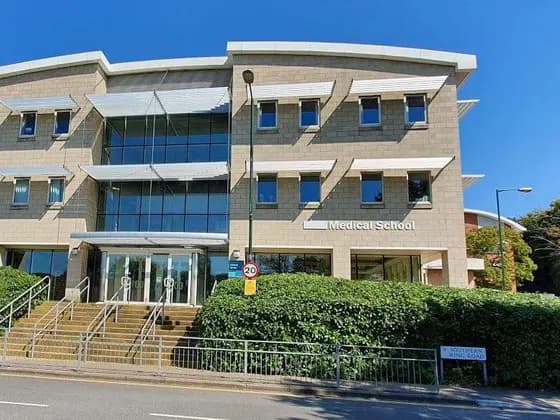
Photo: Hassocks5489 / Wikimedia Commons · CC0 · cropped
Photo: I-am-lucifer360 · CC BY-SA 4.0 · Photo: Qmin · CC BY-SA 3.0 · Photo: Arild Vågen · CC BY-SA 4.0
The Brighton & Sussex (BSMS) medicine course at a glance (2027 entry)
Brighton and Sussex Medical School (BSMS) runs a five-year medicine course leading to the BM BS, short for Bachelor of Medicine, Bachelor of Surgery. The school is a partnership between the University of Brighton and the University of Sussex. Both universities award the degree, and you are a member of both. For September 2027 the school expects to take 197 UK students and 10 international students.
The course is integrated and systems-based. Instead of studying anatomy, physiology, biochemistry, pharmacology and pathology as separate subjects, you work through the body one system at a time. For each system you learn the sciences and the matching clinical skills together. BSMS describes the design as a spiral: topics come back in later years in more depth.
Years 1 and 2 are based on the Brighton and Sussex university campuses at Falmer, a short train ride from Brighton city centre. You dissect a human body in Year 1, and about a fifth of your learning in these two years is clinical, with placements from week two. From Year 3 you move into hospitals, mainly the Royal Sussex County Hospital in Brighton, with spells at partner hospitals across Sussex and Surrey.
You learn a lot directly from patients and families. In Years 1 and 2 there are weekly clinical symposia, three-hour sessions built around one condition, often with a patient taking part. Two core programmes also take you on home visits. You visit a person living with dementia in Years 2 and 3, and a family with an autistic child in Year 4.
A teaching strand on health inequalities runs from Year 1 to Year 5. Final year is almost all placement, and after finals you spend eight weeks working alongside junior doctors to prepare for your first job.
| Degree | BM BS, awarded jointly by the Universities of Brighton and Sussex |
|---|---|
| Course length | 5 years, or 6 if you intercalate |
| UCAS code | A100 at institution code B74 (BSMS) |
| Places | 197 UK and 10 international places expected for 2027 entry |
| Years 1 and 2 base | University of Brighton and University of Sussex campuses at Falmer |
| Teaching style | Integrated and systems-based; mostly small-group teaching in Years 1 and 2 |
| Anatomy | Full-body dissection in Year 1; expert-dissected specimens (prosections) in Year 2; ultrasound |
| First patient contact | GP, hospital and community placements from week two of Year 1 |
| Main hospital | Royal Sussex County Hospital, Brighton, from Year 3 |
| Intercalation | Optional, between Years 3 and 4, capped at 40% of the cohort |
What makes Brighton & Sussex (BSMS) medicine different
Whole-body dissection in your first year
In Year 1 you dissect bodies donated for medical education, with around eight students per body so everyone takes part. Qualified doctors heading for surgery or radiology training guide you. Year 2 moves on to prosections (specimens already dissected by experts to show key structures), alongside living anatomy and portable ultrasound.
Families as teachers: dementia and autism
In Time for Dementia you and a partner visit the same person with dementia and their carer at home, three times a year across Years 2 and 3. In Year 4, Time for Autism pairs you with a family who have an autistic young person, for three home visits. Both are compulsory, core parts of the course, and both show you what living with a condition is like outside hospital.
General practice from the first module
Around 15% of the course is spent in general practice, and about 130 local practices take part in teaching. GP tutors, who still work as doctors, teach from your very first module. Placements build up to student-led surgeries, where you see patients yourself under supervision. In Year 4 you spend about a month in one practice, with your own patient list where possible.
A research project of your own in Year 4
Every student completes a year-long Individual Research Project in Year 4, supervised by a university or hospital team, for about a day and a half a week. You form your own hypothesis, design the method, get ethical approval if needed, then collect and analyse the data.
Fifteen weeks at a regional hospital in Year 5
Final year opens with 15 weeks based at a regional hospital in Chichester, Eastbourne, Hastings or Redhill. You move through five three-week attachments, from surgery to psychiatry, as a working member of the team.
Health inequalities taught from Year 1 to Year 5
Since 2018 a strand called Inequalities and Inclusion in Healthcare has been part of the Year 1 and 2 clinical and community practice teaching. It continues in later years. It looks at groups such as migrants and travelling communities, LGBTQIA+ people and disabled people, and uses role play to practise speaking up against discrimination.
How Brighton & Sussex (BSMS) teaches medicine
Years 1 and 2 cover how the body works in health and disease, one system at a time. Year 1 opens with Foundations of Health and Disease in your first term, then moves on to Heart, Lungs and Blood, and Nutrition, Metabolism and Excretion. Year 2 covers Brain, Body and Mind (called Neuroscience and Behaviour in the 2026 prospectus), Musculoskeletal and Immune Systems, and Reproduction and Endocrinology. Each year also has a Clinical and Community Practice module and a Personal and Professional Development module running alongside.
Each module mixes biomedical science with psychosocial science, which looks at how illness affects a person's mind, relationships and daily life. Most Year 1 and 2 classes are in small groups, alongside core lectures and the weekly symposia. Clinical skills are taught in the Clinical and Community Practice modules, at the same time as the science. You also take student-selected components (SSCs), short modules on a topic you choose.
From Year 3 the balance flips, and most of your week is spent on clinical rotations in hospitals and general practice. The teaching year also grows, from 32 to 34 weeks in Years 1 and 2 to around 40 weeks. Classroom teaching continues alongside, for example through the weekly Scientific Basis of Medicine sessions in Year 3.
A personal and professional development strand runs through all five years. Its taught sessions cover health inequalities, professionalism, ethics, law, dealing with mistakes, teamwork, cultural humility, leadership, and quality and safety in clinical care. Nurses, pharmacists, physiotherapists, occupational therapists, podiatrists and social workers also teach you. Inter-professional education, where you learn with and about other health professions, is assessed in Year 3.
Public health, the work of preventing disease and improving health across a whole population, is a theme that runs through all five years. It covers epidemiology (how diseases spread and whom they affect), research methods, health promotion and disease prevention, and it also appears inside specialties such as general practice and paediatrics. Some of it is taught with public health staff at Brighton and Hove City Council and East and West Sussex County Councils, so you work with real local health data.
The ways you will learn
| Lectures | Core lectures cover the science of each body system and the clinical practice that goes with it. Recordings, slides and quizzes go on My Studies, the school's online learning platform, so you can revisit them. |
|---|---|
| Small-group tutorials and practical classes | Most Year 1 and 2 teaching happens in small groups: tutorials, seminars and practical classes in anatomy, the labs, living anatomy and microbiology. Pathology classes are interactive, and virtual microscopy lets you examine tissue slides on screen. |
| Clinical symposia | Three-hour sessions, held weekly in Years 1 and 2, built around one medical problem or disease. A scientist, a clinician and a patient often take part. Together they show the condition from three angles: how it works, how it is treated and what it is like to live with. |
| Clinical skills and simulation | You practise taking a history, examining patients and explaining things clearly. The skills rooms are laid out like GP surgeries and hospital outpatient clinics, and professional actors play patients. A computer-controlled simulator mimics normal and abnormal body functions and reacts to drugs as a real patient would. |
| Patient educators | Volunteers from the school's Patient Educator Group share what it is like to live with a long-term condition or to care for someone. They also let you practise taking medical histories and basic examinations, and help with role plays. |
| Clinical rotations | From Year 3 you learn on hospital wards and in GP practices as part of a clinical team. You keep a logbook of what you see and do. At the end of each placement your supervisor reports on your attendance, teamwork and professionalism. |
A typical week on the Brighton & Sussex (BSMS) course
BSMS publishes a sample week for each year, based on the 2024/25 timetables, so treat these as a guide. In Year 1, Monday was lectures and tutorials, and Friday morning was lectures. Tuesday began with a clinical practice lecture, followed by an afternoon placement, clinical skills or small-group work with clinical practice facilitators.
Wednesday morning in Year 1 was for academic skills tutorials or your SSC, and Wednesday afternoon was free for study or sport. Thursday opened with a symposium, sometimes with patients describing how their condition has affected them. Thursday and Friday afternoons were practical classes in the dissection room, labs, living anatomy or microbiology.
Year 2 used the same ingredients in a different order. Monday started in the dissection room and Tuesday morning was for your SSC. Thursday had the clinical practice lecture and afternoon placement, and Wednesday afternoon was kept for Time for Dementia visits or free time.
From Year 3 the week is mostly clinical. In the sample Year 3 week, Monday was lectures and Tuesday to Friday were spent on rotations. In Year 4, Monday was the research project day. In Year 5, Tuesday was for seminars and the other four days were clinical attachment, including ward rounds, clinics and skills teaching.
For 2026/27, Year 1 starts with an induction week on 21 September 2026 and finishes on 4 June 2027, exams included, with resits from 2 to 13 August. Years 1 and 2 have three terms. Year 3 starts on 14 September 2026, and Years 4 and 5 start on 1 September; all three run until mid-June.
How anatomy is taught at Brighton & Sussex (BSMS)
Anatomy starts in your first term, in the Foundations of Health and Disease module, and continues through every systems module in Years 1 and 2. In each systems module you spend, on average, four sessions in the anatomy laboratory. You also have at least one tutorial on living anatomy and ultrasound in each module. Living anatomy means finding structures by their surface landmarks on living people, which is the basis of examining a patient.
Year 1 focuses on full-body cadaveric dissection, which means carefully taking apart a body donated for medical education. You work in a group of around eight students per body, with detailed notes to guide each session. Faculty and demonstrators are on hand. The demonstrators are qualified doctors working towards training in surgery or radiology. The anatomy team cares for around 60 donors a year.
Year 2 moves to prosections: specimens that experts have already dissected to show particular structures clearly. Across both years you also use plastic models, 3D-printed material, virtual and augmented reality, and an iPad app built for the dissection room. Portable ultrasound machines show you how structures look on a real clinical scan, and you learn to interpret X-rays, ultrasound and MRI images.
You come back to the anatomy facility in Year 4, during rotations such as ear, nose and throat (ENT), ophthalmology and orthopaedics. This time you study the specialised anatomy those specialties rely on.
When you first meet patients at Brighton & Sussex (BSMS)
Clinical learning starts in your first week. Placements in GP surgeries, hospitals and community settings begin from week two of Year 1. Around 20% of your learning in Years 1 and 2 is clinical, so this is regular contact rather than an occasional visit. Early on you watch doctors at work and practise the basics: taking a history, examining patients and communicating well, first in the classroom and then on placement.
Some contact is long-term. In Year 1 you may spend time learning from a family with a new baby. In Years 2 and 3 you may follow a patient with dementia or a long-term condition, and you write reports on these family studies. Year 2 adds four immersion weeks in general practice and community care.
From Year 3 you spend most of the week on hospital wards. By Year 5 you act as a member of the clinical team, closely involved in routine cases.
Year by year at Brighton & Sussex (BSMS)
- Year 1
Science foundations and first placements
You start with Foundations of Health and Disease, then study two systems modules: Heart, Lungs and Blood, and Nutrition, Metabolism and Excretion. Clinical and Community Practice 1 and Personal and Professional Development run alongside them all year. You are based at the Falmer campuses in lectures, small groups and labs, and you are on placement from week two.
- Full-body dissection in the anatomy laboratory, plus living anatomy and ultrasound tutorials.
- Clinical and Community Practice teaching, with placements in GP surgeries, hospitals and community care.
- A possible family study, learning from a family with a new baby.
- Basic life support training.
- Clinical skills sessions on taking and interpreting a blood pressure, measuring peak flow (how fast you can breathe out) and recording basic observations such as pulse and temperature.
- Two SSC modules on topics you choose.
- Assessment by an assignment, essays, a timed multiple-choice test, an IT test, a presentation and a logbook. The year ends with the Integrated Knowledge Test, a two-day multiple-choice exam on the systems modules. Summative exams, the ones that count towards progression, start in December.
- Year 2
Building clinical skills
Year 2 covers three systems modules: Brain, Body and Mind; Musculoskeletal and Immune Systems; and Reproduction and Endocrinology. Clinical and Community Practice 2 and Personal and Professional Development run alongside. Anatomy moves from dissection to prosection, clinical work steps up with immersion weeks, and you begin visiting a person living with dementia.
- Prosections, living anatomy and ultrasound sessions.
- Intermediate life support and emergency assessment skills. The prospectus also lists venepuncture (taking blood from a vein) in Year 2, though BSMS's clinical skills summary places it in Year 3.
- Clinical skills sessions on recording a 12-lead ECG (a tracing of the heart's electrical activity), testing urine and checking blood sugar from a finger-prick. You also learn to close a simple wound and give injections into a muscle or under the skin.
- Four immersion weeks in general practice and community care settings.
- Time for Dementia home visits, which continue into Year 3.
- Two more SSC modules.
- Assessment by an Objective Structured Clinical Examination (OSCE), a practical exam made up of timed clinical tasks, plus an essay, a poster, a logbook and the Year 2 Integrated Knowledge Test.
- Year 3
Hospital rotations
You move to hospital-based learning, much of it in Brighton. After a two-week introduction to medicine as it is practised in hospitals, you rotate through ward-based attachments. Surgery is a 10-week placement at the Royal Sussex County Hospital and the Princess Royal Hospital in Haywards Heath. Medicine runs in hospitals of University Hospitals Sussex NHS Foundation Trust and East Sussex Healthcare NHS Trust.
- Attachments in General Medicine, Acute Medicine and Cardiology; Elderly Medicine and Psychiatry; and Surgery, including Perioperative Medicine, Emergency Medicine, Orthopaedics and Urology.
- Weekly Scientific Basis of Medicine teaching on the clinical, social science and public health issues behind your ward work, including genetics, immunology, infectious diseases and therapeutics.
- Safe prescribing practice, assessed through SmartDrug, a case-based prescribing platform, and practical prescribing tasks.
- Skills days on inserting a cannula (a thin tube into a vein for drips and drugs) and passing a urinary catheter. You also learn to place a nasogastric tube (a feeding tube through the nose into the stomach), scrub for theatre and move and handle patients safely.
- Longer SSCs, which many students use for research, and research skills training ahead of the Year 4 project.
- Time for Dementia continues, and you meet your tutor regularly, recording your progress in your e-portfolio, an online record of your development.
- Assessment by case-based discussions, where you present a patient to examiners, plus logbooks, an essay, the Year 3 Integrated Knowledge Test and the Year 3 OSCE.
- Year 4
Specialties and research
Year 4 rotates you through specialist areas and shows how GP, community and hospital care work together around a patient. You spend most of the year in Brighton, with periods of one to five weeks at partner hospitals across West and East Sussex.
- Rotations in General Practice; ENT, Ophthalmology and Neurology; Infectious Diseases, Microbiology and Sexual Health; Rheumatology and Dermatology; Oncology, Haematology and Palliative Care; Obstetrics and Gynaecology; and Paediatrics.
- About a month in general practice, with your own list of patients where possible.
- A year-long Individual Research Project, assessed by a report and a presentation.
- Time for Autism: classroom teaching from specialists, including autistic adults and parents, then three visits to a family at home.
- Skills days on taking arterial blood gases (blood from an artery, to measure oxygen and acid levels) and blood cultures. You also practise suturing under local anaesthetic, setting up drips, giving drugs into a vein and giving a blood transfusion.
- The Year 4 Integrated Knowledge Test and OSCE. You must pass every Year 4 assessment to be allowed to sit the final-year licensing exams.
- Presentations on applying for foundation training, which continue into Year 5.
- Year 5
Preparing for practice
Final year is about working as part of a clinical team. It opens with 15 weeks at a regional hospital in Chichester, Eastbourne, Hastings or Redhill, split into five three-week attachments. After finals come a four-week elective and Foundation 0, an eight-week assistantship: a placement where you work alongside junior doctors, learning to do their job. The General Medical Council (GMC), which regulates doctors in the UK, requires every medical degree to include one.
- Five three-week regional attachments: surgery, psychiatry, medicine for older adults, general medicine and emergency medicine. You handle routine cases as a member of the team, joining ward rounds, clinics and theatre sessions.
- Applying at the start of the year for the Foundation Programme, the two-year training programme new UK doctors work in after graduating.
- Practical procedures observed and signed off on placement or in the simulation suite, plus Advanced Life Support training.
- Both parts of the Medical Licensing Assessment (MLA), the national exam UK graduates must pass to practise, and the Prescribing Safety Assessment (PSA), a national test of safe prescribing.
- Assessment by written case reports, supervisor sign-offs and observed work on placement, procedure logbooks, the Year 5 Integrated Knowledge Test and the Year 5 OSCE.
- A four-week elective towards the end of the year, in the UK or abroad.
- Foundation 0 with a clinical team at a partner hospital, working alongside junior doctors. Each week is themed around a part of the job that new doctors find hard, with sessions to reflect on it.
How you are assessed at Brighton & Sussex (BSMS)
BSMS tests knowledge, clinical skill and professional behaviour together, so it uses many kinds of assessment. Knowledge is tested with single best answer questions, a multiple-choice format where you pick the best of several options. Every year ends with an Integrated Knowledge Test, a timed multiple-choice exam. In Years 1 and 2 it runs over two days and covers the year's systems modules, with questions spread evenly between them.
Coursework includes essays, posters, presentations, family study reports and your research project, and your personal development portfolio counts too. In the clinical years you are also assessed on placement. A case-based discussion is a timed spoken presentation of a patient you have seen, covering the history, examination, possible diagnoses and a management plan, followed by examiners' questions. A Case in Depth is a structured written report on one patient, focused on clinical decisions and the evidence for treatment.
Practical skills are tested with Objective Structured Clinical Examinations (OSCEs). You move round a series of timed stations, each a clinical task such as taking a history, examining a patient or interpreting a scan, while an examiner watches and marks you. Some stations use real patients and some use actors. Your first OSCE comes in Year 2, pitched at your level, so the format is familiar well before finals.
Since 2024/25 the GMC has required a pass in the MLA for every UK medical degree. Its written part, the Applied Knowledge Test (AKT), is set nationally by the Medical Schools Council. You sit it at BSMS in Year 5, before the elective and Foundation 0, on the same day as other medical schools that choose that date. When the GMC approved BSMS's arrangements in June 2024, it was two two-hour computer papers of 100 single best answer questions each.
The MLA's practical part, the Clinical and Professional Skills Assessment, is BSMS's final-year OSCE, approved by the GMC in May 2024. It is sequential: everyone sits seven 10-minute stations on one day and two 20-minute stations the next, each sequence including a real patient and a station on handling uncertainty. Students close to the pass mark sit a second sequence at least a week later, after written feedback. Anyone who fails that repeats Year 5, with mentoring and extra training.
You also sit the PSA in Year 5, a national online exam that checks you can prescribe medicines safely, for example by writing and reviewing prescriptions and calculating doses. Every new doctor must pass it by the end of their first foundation year. If you fail any assessment on the course, you get another attempt, either in a resit period a few weeks later or after repeating the year. The list below shows how the marks split each year.
- Year 1: written exams 30%, coursework 40%, practical assessments 30%.
- Year 2: written exams 14%, coursework 28%, practical assessments 58%.
- Year 3: written exams 8%, coursework 17%, practical assessments 75%.
- Year 4: written exams 10%, coursework 10%, practical assessments 80%.
- Year 5: written exams 13%, coursework 20%, practical assessments 67%.
Where you will actually be at Brighton & Sussex (BSMS)
In Years 1 and 2, placements are sessions and immersion weeks in GP surgeries, hospitals and community services, fitted around campus teaching at Falmer. General practice runs through the whole course and makes up around 15% of it. BSMS's GP calendar for 2026/27 shows two Tuesday-afternoon visits to a practice in Year 1 and three GP immersion weeks in Year 2, each running Tuesday to Thursday. In Year 4 the GP rotation lasts about four weeks, with placement days Tuesday to Friday.
From Year 3 you are based in hospitals, with much of the teaching in Brighton at the Royal Sussex County Hospital and the Audrey Emerton Building. In Year 3, surgery is a 10-week placement at the Royal Sussex County Hospital and the Princess Royal Hospital in Haywards Heath. Year 3 medicine runs in hospitals of University Hospitals Sussex and East Sussex Healthcare NHS Trust. Year 4 is mostly in Brighton, with blocks of one to five weeks at partner hospitals in West and East Sussex.
Year 5 opens with a 15-week regional placement, made up of five three-week attachments. BSMS's travel and accommodation policy for 2024/25, the latest it has published, names the regional centres as Chichester, Eastbourne, Hastings and Redhill. For all placements in Chichester, Eastbourne and Hastings, and most in Redhill, BSMS books and pays for accommodation in advance, mostly on or very near the hospital site. It also repays up to one return trip a week between Brighton and the regional centre.
Outside Year 5, most placements beyond Brighton that last four weeks or more are also residential, so you live near the hospital and become a full part of its team. BSMS encourages students to live in or near Brighton so they can get to placements and clinical activities.
BSMS names 12 hospitals as affiliated with the school, grouped by area below. Its two teaching trusts are University Hospitals Sussex NHS Foundation Trust and Sussex Partnership NHS Foundation Trust. The first runs seven hospitals across Brighton and Hove, West Sussex and parts of East Sussex, and the second provides mental health services. Associate trusts include East Sussex Healthcare NHS Trust and Surrey and Sussex Healthcare NHS Trust.
The Royal Sussex County Hospital, run by University Hospitals Sussex, is the main hospital base from Year 3 and hosts Year 3 surgery. Mill View is run by Sussex Partnership, the mental health trust.
- Royal Sussex County Hospital, Brighton, including the Louisa Martindale Building
- Audrey Emerton Building (teaching and library centre)
- Brighton General Hospital, Brighton
- Mill View Hospital, Hove
Chichester is a Year 5 regional centre. Princess Royal shares Year 3 surgery with the Royal Sussex County Hospital. Worthing and Southlands are affiliated University Hospitals Sussex sites, and Langley Green is run by Sussex Partnership, the mental health trust.
- St Richard's Hospital, Chichester
- Princess Royal Hospital, Haywards Heath
- Worthing Hospital, Worthing
- Southlands Hospital, Shoreham-by-Sea
- Langley Green Hospital, Crawley
Hastings and Eastbourne are Year 5 regional centres. Their two hospitals are run by East Sussex Healthcare NHS Trust, which also hosts Year 3 medicine.
- Conquest Hospital, Hastings
- Eastbourne District General Hospital, Eastbourne
- Lewes Victoria Hospital, Lewes
Run by Surrey and Sussex Healthcare NHS Trust. Redhill is a Year 5 regional centre.
- East Surrey Hospital, Redhill
Electives and chosen modules at Brighton & Sussex (BSMS)
Student-selected components (SSCs) let you choose what to study in depth, informed by current research. You take two SSC modules in each of Years 1 and 2. Options have included research projects, imaging at the on-campus Clinical Imaging Sciences Centre, and a course on the poetry of medicine that explored the human side of illness through creative writing.
In Year 3 the SSCs are longer, and many students use them to do more research. This leads into the Individual Research Project in Year 4.
The elective is a four-week placement towards the end of Year 5, after finals. You spend it in a clinical, non-clinical or research setting different from your training so far, in the UK or abroad, and with guidance you set your own learning goals. You cover the travel and living costs yourself, though reimbursement schemes and bursaries can help.
Intercalation at Brighton & Sussex (BSMS)
Intercalating means taking a year out of medicine to earn a second degree, a BSc or a master's, before returning to the course. At BSMS it is optional and happens between Years 3 and 4, subject to your performance, so your studies take six years instead of five. Places are capped at 40% of the cohort, with priority for students who do not already have a degree. In a 2024 submission to the GMC, BSMS said about 40% of its students intercalate.
As a rule of thumb, a bachelor's needs two years (240 credits) of study before you start, and a master's needs three years (360 credits). After three years of medicine you may therefore qualify for a master's. You can intercalate at BSMS, the University of Brighton, the University of Sussex or another university. Most options include a research project, and depending on the project you may be able to publish or present your findings. The options listed by BSMS are:
- At BSMS: MSc Ageing and Dementia, Global Health, Healthcare Leadership and Commissioning, Medical Education, Medical Research, Paediatrics and Child Health, or Public Health.
- At the University of Brighton: BSc Sport and Exercise Science, MSc Applied Exercise Physiology, MRes Stress, Ageing and Chronic Disease, MSc Strength and Conditioning, MSc Health Promotion, or Applied Sport Physiology MSc.
- At the University of Sussex: BSc Biochemistry, BSc Neuroscience, BSc Medical Neuroscience, or Experimental Psychology MSc.
Facilities and support at Brighton & Sussex (BSMS)
Where you will learn
Years 1 and 2 use purpose-built facilities on the Falmer campuses. These include the anatomy laboratory, lecture theatres, seminar rooms, clinical science labs and IT suites. The clinical skills area, with its mock consultation rooms and patient simulator, is here too, as is the Clinical Imaging Sciences Centre.
In Brighton, the Audrey Emerton Building has a medical library, computer suites, pathology facilities, a clinical skills area, teaching rooms and a top-floor restaurant with sea views. The Louisa Martindale Building opened in 2023 at the Royal Sussex County Hospital, with outpatient, ward and specialist services across 11 floors. Besides the university libraries at Falmer, there are NHS libraries at the Royal Sussex County Hospital, the Sussex Education Centre in Hove and the Princess Royal Hospital in Haywards Heath.
Much of your learning is supported online. My Studies holds lecture recordings, quizzes and interactive cases. Capsule offers over 750 clinical cases for practising investigation, diagnosis and management, matched to the MLA. SmartDrug trains prescribing, and the Anatomy Lab Interface app supports dissection sessions. Sofia maps the curriculum against the GMC's graduate outcomes and the MLA. BSMS students also get free access to Passmedicine, a revision question bank, in Years 4 and 5.
Support while you study
In Year 1 you are given a personal tutor, a clinician (usually a GP, hospital consultant or specialist doctor) who supports you until graduation. You meet at least three times a year, about once a term, to discuss your progress and any problems. Tutors also help deliver the personal and professional development teaching. You record these meetings, reflections on critical incidents and your achievements in an e-portfolio similar to the one junior doctors use.
From day one you belong to an academic support group of eight students, deliberately mixed to include school leavers, graduates and mature students. There is a buddy scheme for Year 1 students. Medic families add a peer network, in which fellow students take the role of parents and siblings to help you settle in.
The Student Wellbeing and Advice team are non-academic staff who give confidential help. They can advise on health, stress, homesickness, time management, money, course difficulties and reporting bullying or harassment, and can refer you to specialist services. Designated clinical staff at each training hospital support you on placement. Students with disabilities, long-term conditions or dyslexia can get a Learning Support Plan setting out reasonable adjustments to teaching and exams. The course also includes teaching on looking after your own wellbeing.
Is the Brighton & Sussex (BSMS) course right for you?
This course may suit you if
- You want to learn anatomy by dissecting a whole body in Year 1, not only from models and screens.
- You want to meet patients early and often, starting in week two of Year 1.
- You would value getting to know a family living with dementia, and later a family with an autistic child, over repeated home visits.
- You would like a year-long research project of your own in Year 4, with longer research SSCs beforehand.
- You want health inequalities taught as a strand across all five years rather than in a single lecture.
Things to think about
- From Year 3 the teaching year runs to around 40 weeks, and Years 4 and 5 start on 1 September, so your summers are shorter than those of friends on other courses.
- Placements take you across West Sussex, East Sussex and Surrey. Expect spells living away from Brighton, including 15 weeks at a regional hospital in Year 5.
- Your base moves after Year 2, from the Falmer campuses to hospitals, mainly in Brighton.
- Intercalation is capped at 40% of the cohort, with priority for students without a degree, so a place is not guaranteed.
- The final OSCE is sequential. If you are borderline you sit a second set of stations, and failing that means repeating Year 5.
Brighton & Sussex (BSMS) medicine course — frequently asked questions
Applying to Brighton & Sussex (BSMS)?
How to get into Brighton & Sussex (BSMS)
Entry requirements, UCAT, personal statement and interview, step by step.
Open the guide →Brighton & Sussex (BSMS) UCAT cut-offs and offers
UCAT cut-offs, A-level offers, interview format and decision dates.
See the requirements →Compare Brighton & Sussex (BSMS) with other schools
Put the teaching style, anatomy teaching and placements next to another school.
Open the comparison →Prepare for the Brighton & Sussex (BSMS) interview
Format breakdown, school-specific sample questions and prep tips from tutors who interviewed here.
Read the guide →Where this Brighton & Sussex (BSMS) course guide came from
This guide was written from 39 official sources — Brighton and Sussex Medical School's own course pages and programme documents, plus the regulator and NHS placement partners where they publish detail — read on 2026-09-24, then checked claim by claim against those sources.
- BSMS - Our course
- BSMS - Course structure
- BSMS - Assessments
- BSMS - Intercalated degrees
- BSMS - Term dates 2026/27
- BSMS - Typical weeks (2024/25 timetables)
- BSMS - Anatomy and imaging
- BSMS - Early clinical experience
- BSMS - General practice
- BSMS - Teaching and learning
- BSMS - Supportive environment
- BSMS - Research integrated
- BSMS - Inequalities teaching
- BSMS - Supporting your learning
- BSMS - Admissions process (places and UCAS codes for 2027 entry)
- BSMS - Our partners (parent universities and NHS trusts)
- BSMS - Anatomy facility
- BSMS - Student Wellbeing and Advice
- BSMS - Time for Dementia and the Patient Educator Group
- BSMS - Time for Dementia education programme
- BSMS - Time for Autism
- BSMS digital prospectus - Course structure, Years 1 to 5
- BSMS digital prospectus - Why BSMS
- BSMS digital prospectus - Learning experience
- BSMS digital prospectus - Support and wellbeing
- BSMS digital prospectus - Accommodation
- GMC - MLA Applied Knowledge Test compliance decision for Brighton and Sussex Medical School (June 2024)
- GMC - MLA Clinical and Professional Skills Assessment compliance decision for Brighton and Sussex Medical School (May 2024)
- Prescribing Safety Assessment - MSC Assessment and British Pharmacological Society
- University Hospitals Sussex NHS Foundation Trust - Hospitals
- Surrey and Sussex Healthcare NHS Trust - Contact us (East Surrey Hospital, Redhill)
- BSMS - Frequently asked questions (affiliated hospitals and MLA sitting)
- BSMS - Student Travel and Accommodation Policy, Year 5 (2024/25, latest published)
- University of Brighton - Medicine BM BS, module descriptions for 2027 entry
- BSMS - GP placement dates and curriculum by year, 2026/27
- BSMS - Primary care and public health: general practice and public health teaching
- BSMS - Summary of clinical skills teaching, Years 1 to 5
- BSMS - Undergraduate Prospectus 2026 curriculum outline
- Sussex Partnership NHS Foundation Trust - Hospitals and locations
Courses are restructured between cycles. Anything here that decides your application — an anatomy offer, a placement city, a compulsory intercalated year — should be confirmed against the official page for your entry year.
Applying to Brighton & Sussex (BSMS)?
We have helped hundreds of applicants turn their UCAT, personal statement and interview prep into offers from Brighton & Sussex (BSMS) and other UK medicine schools.