
The Buckingham Medicine course
What you actually study, and where you will be
Buckingham's MB ChB is a 4.5-year course with an integrated curriculum, with placements in Buckinghamshire, Northamptonshire, Warwickshire and Cheshire (2027 entry). An independent medical school: privately funded, January-start only, and 4.5 years rather than five. Fees are the headline difference — £41,500 a year for UK students — and the placement estate stretches from Milton Keynes to Cheshire.
- Degree
- MB ChB
- Length
- 4.5 years
- Teaching
- Integrated

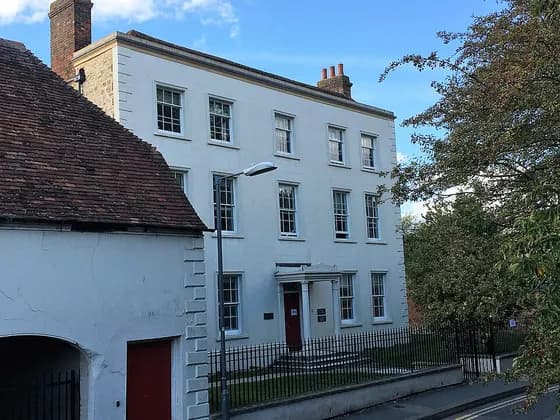

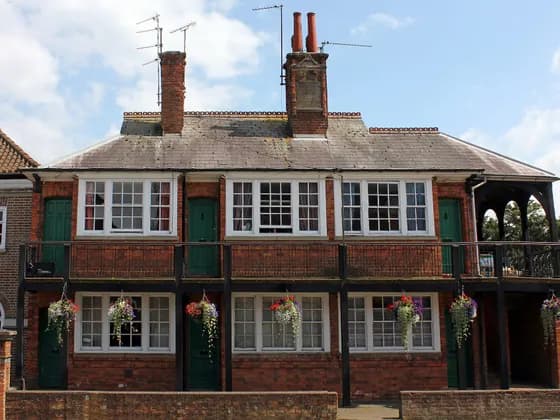
Photo: Nilo775 / Wikimedia Commons · CC0 · cropped
Photo: Tita Beaven · CC BY-SA 4.0 · Photo: DeFacto · CC BY-SA 4.0 · Photo: Jo Turner · CC BY-SA 2.0
The Buckingham medicine course at a glance (2027 entry)
Buckingham's MB ChB is a medical degree that lasts four and a half years and starts in January rather than September. Phase 1 covers years 1 and 2 on the Buckingham campus. Phase 2 covers years 3 and 4 in NHS hospitals and ends with a few months preparing for work as a doctor. The school was accredited by the General Medical Council (GMC), the UK regulator for doctors, in May 2019.
The curriculum is integrated and built around the systems of the body. Instead of taking each science as a separate course, you study one part of the body at a time, such as the cardiovascular system, and learn the science in a clinical context.
A social medicine thread runs alongside the body systems. Its units cover epidemiology (the study of disease across whole populations), health psychology and health policy. They include Health and Disease in Populations in year 1 and Health and Disease in Society in year 2.
Clinical learning starts in your first term, through a weekly clinical skills course and Narrative Medicine, in which you follow one patient with a long-term illness. Phase 2 runs from one of five base hospitals in Buckinghamshire, Warwickshire or Cheshire, and you are expected to live near it. Travel is a real part of the course.
| Degree | MB ChB (Bachelor of Medicine and Bachelor of Surgery) |
|---|---|
| Course length | 4.5 years, starting in January |
| UCAS code | 71A8 |
| Years 1 and 2 | Buckingham campus, Buckinghamshire |
| Teaching style | Integrated units built around the body systems |
| Clinical experience | From the first term, through the weekly Clinical Skills Foundation Course |
| Years 3 and 4 | One of five base hospitals in Buckinghamshire, Warwickshire or Cheshire |
| Clinical blocks | 12 blocks: six in the Junior Rotation, six in the Senior Rotation |
| Final exams | UK Medical Licensing Assessment, in March of the final year |
| Long-term patient | Narrative Medicine: you follow one patient for 18 months |
What makes Buckingham medicine different
A January start and a 4.5-year course
You start in January and finish four and a half years later, in the summer. Phase 1 has six terms of 11 teaching weeks, and Phase 2 begins in the February of year 3.
Following one patient for 18 months
In Narrative Medicine you follow one patient with a long-term illness through years 1 and 2, and you must pass it to enter Phase 2.
A clinical skills session every week from term 1
The Clinical Skills Foundation Course fills a half-day every week of Phase 1, with GP and hospital visits from term 2.
Twelve clinical blocks from one base hospital
Phase 2 has 12 blocks of about six weeks, six in the Junior Rotation and six in the Senior Rotation, each built around an area of care such as mental health. You take them all from one base hospital, allocated by a random ranking that does not use your marks.
A final stretch spent preparing for practice
After final exams comes Preparation for Professional Practice. In the 2026 and 2027 calendars it opens with a seven-week assistantship in a clinical team, then an elective of three to four weeks in May. You also need a pass in the Prescribing Safety Assessment, an online test of safe prescribing.
How Buckingham teaches medicine
The school calls its approach guided learning. Staff set out the route, but you are expected to take charge of your own progress and to aim for understanding rather than memorising. Each Phase 1 unit has a workbook that sets out every session, and the 26 workbooks are free in digital form.
Each session is built as a cycle. You meet new ideas, usually in a lecture, work on them straight away with your group while they are fresh, then follow up in self-directed study. The school's standards for Phase 1 group work (2023) and workbooks (2024) set out how this runs.
In Phase 2 you learn in the clinical environment, rotating through blocks arranged the way care is delivered in GP surgeries and hospitals. Each block has an educational supervisor who oversees your progress.
The ways you will learn
| Unit sessions | Each unit has one half-day a week: four unit slots a week in year 1 and three in year 2. A session has up to two lectures, then at least two hours of group work. You stay in the same group for every unit, with a tutor in each room, normally one of the clinical educators who lead the school's small-group teaching. |
|---|---|
| Group work | Written problem-solving tasks are the most common, and some are set out like exam questions. Sessions can also include meeting a patient with the condition you are studying, role play, 10-minute group presentations and short group quizzes. Worked answers go up on Moodle, the school's online learning site, within 72 working hours. |
| Clinical Skills Foundation Course | A weekly half-day of clinical skills teaching that runs through Phase 1. |
| Simulation and peer practice | Practical procedures, such as measuring blood pressure, are first taught in simulation using models, simulated patients and classmates. You record your attempts in your e-portfolio, an online record of your progress, and clinical educators give feedback. In Phase 2, a clinician competent in each procedure signs you off on real patients. |
| Workplace-based assessments | In Phase 2, clinical work comes with structured tasks. In a mini clinical evaluation exercise (mini-CEX), a clinician watches you with a patient and gives feedback. In a case-based discussion (CBD), you talk through a patient you have seen with a senior clinician. |
A typical week on the Buckingham course
The 2026 Phase 1 timetable shows how a week is built. Each day has a morning session from 09:00 to 12:45 and an afternoon session from 13:45 to 17:30. In year 1, each unit has one fixed half-day, two other mornings hold timetabled sessions outside the units, and the rest is self-directed study. This is a week in term 1.
Year 2 has fewer unit sessions. A term 5 week starts on Monday morning with a Student Selected Component (SSC), a strand where you choose a topic to study in depth. The clinical skills course is on Wednesday afternoon, Health and Disease in Society and the Nervous System fill Thursday, and Head and Neck is on Friday morning.
Self-directed study is not guaranteed free time. You must stay available for last-minute changes, and these slots can also be used for placements, Narrative Medicine and other compulsory sessions.
- Monday: a timetabled session in the morning, then the Molecules, Genes and Disease unit in the afternoon.
- Tuesday: Clinical Problem Solving 1 in the morning, then Tissues of the Body.
- Wednesday: the Clinical Skills Foundation Course in the morning, with the afternoon for self-directed study.
- Thursday: self-directed study all day.
- Friday: another timetabled morning session, then Metabolism in the afternoon.
How anatomy is taught at Buckingham
Anatomy is not a separate course at Buckingham. Most Phase 1 units build the anatomy of their body system into one or more sessions, planned with the school's anatomy lead. This is set out in the school's 2023 standards for Phase 1 group work.
In an anatomy session, each table works on a different task and groups rotate between them. Tasks can include identifying key features on anatomical models, reading X-rays and cross-sectional scans such as CT, surface anatomy (finding structures from the outside of the body), virtual anatomy software and dissecting animal organs. Each task is written up in the unit workbook, so you keep a record of what you learned.
When you first meet patients at Buckingham
Clinical learning begins in your first term with the Clinical Skills Foundation Course (CSFC), a half-day every week of Phase 1. From term 2 your group is attached to a GP practice and rotates between the practice, the medical school and a partner hospital: Stoke Mandeville, Warwick or Milton Keynes. The school runs a free coach to Warwick. For the other two, groups make their own way, and buses run from Buckingham to both towns.
The second strand is Narrative Medicine, which starts in year 1. You are assigned a patient living with a chronic, or long-term, illness and stay in regular contact with them for 18 months. At a couple of local practices you may meet your patient in person. The point is to understand illness through one person's experience of it.
In Phase 2, from year 3, you are on clinical placement full time. Most of your learning takes place with patients and doctors at your base hospital, with GP, mental health and community placements built into the blocks.
Year by year at Buckingham
- Year 1
Biomedical science and the first body systems
Year 1 covers terms 1 to 3, each with 11 teaching weeks. The first term lays the scientific groundwork, and systems units begin in term 2 with the musculoskeletal system.
- Term 1 units: Molecules, Genes and Disease; Tissues of the Body; Metabolism; and Clinical Problem Solving 1.
- Term 2 units: Musculoskeletal System; Infection; Mechanisms of Disease; and Health and Disease in Populations.
- Term 3 units: Cardiovascular System; Urinary System; Respiratory System; and Health Psychology and Diversity.
- Written applied knowledge tests (AKTs), which test how you apply medical knowledge to patient problems, at the end of terms 2 and 3.
- A Clinical and Professional Skills Assessment (CPSA) at the end of the year. It is an Objective Structured Clinical Examination (OSCE): a circuit of timed stations where examiners watch you carry out tasks.
- A Narrative Medicine case-based discussion in term 3, and the first review of your e-portfolio.
- Year 2
The remaining systems and the move towards clinical work
Year 2 covers terms 4 to 6 and completes Phase 1. The remaining body systems are taught alongside pharmacology, a weekly SSC lets you study a topic of your choice, and the last term prepares you for clinical training.
- Term 4 units: Reproductive System; Gastrointestinal System; and Principles of Pharmacology.
- Term 5 units: Nervous System; Head and Neck; and Health and Disease in Society.
- Term 6 units: Pharmacology and Therapeutics; the Integrative unit; Clinical Transition; and Clinical Problem Solving 2.
- A structured reflective conversation about your Narrative Medicine patient in term 5, which you must pass to enter Phase 2.
- AKTs at the end of terms 5 and 6 and a CPSA at the end of the year. In term 6 you also rank the five base hospitals for Phase 2.
- Year 3
Junior Rotation
Phase 2 starts with an induction in the February of year 3, followed by the Junior Rotation: six blocks based mainly at your base hospital. In the 2026 and 2027 calendars each block lasts six weeks, starting with an induction week.
- Six blocks: Musculoskeletal Care, Mental Health, Primary Care, Gastrointestinal Care, Cardiorespiratory Care and Peri-Operative Care.
- Most blocks run at your base hospital, but Mental Health and Primary Care take you to mental health services and GP practices elsewhere in the area.
- The Primary Care block combines three days a week in a GP practice with two days of teaching from facilitators at a local base, such as the Buckingham campus for Milton Keynes students.
- A formative exam, which gives feedback but does not count, in week 5 of each block, and an educational supervisor for each block.
- Practical procedures signed off by clinicians on the wards. Under the school's 2023 policy, by the end of the year you need evidence of progress in at least 10 of the 23 procedures the GMC requires.
- Two SSC weeks in July in the 2026 and 2027 calendars, one of them themed on major incidents.
- The Intermediate Professional Examination in January: a written AKT, a CPSA and a portfolio review.
- Year 4
Senior Rotation and final exams
After the Intermediate Professional Examination in January and a resit window, a six-week professional development period leads into the Senior Rotation in April. Its six blocks also last six weeks each and are mostly hospital based. The last block runs into January, and the rotation ends with the Final Professional Examination in March.
- Six blocks: Child Health, Acute Care, Elderly and Chronic Care, Cancer Care, Special Senses and Reproductive Health.
- Elderly and Chronic Care includes a weekly GP surgery placement and a social care element with community services.
- Two or three SSC weeks in the summer in the 2026 and 2027 calendars, including a student-led SSC in 2026.
- All 23 practical procedures must be evidenced in your e-portfolio by the end of the rotation.
- A mock AKT in November and the first Prescribing Safety Assessment sitting in January, in the 2026 to 2027 timetable.
- The Final Professional Examination in March: the national AKT, the school's final CPSA and a portfolio review.
- Final months
Preparation for Professional Practice
After final exams you move into Preparation for Professional Practice, which bridges the gap between medical student and junior doctor. It runs until the final sign-off in June, and in the 2027 calendar graduation is in July.
- The assistantship, a placement where you join a clinical team and, under supervision, take on much of the work of a junior doctor. In the 2026 and 2027 calendars it lasts seven weeks and starts soon after final exams.
- A recheck, during the assistantship, of practical procedures signed off earlier in the course.
- An elective of about three to four weeks in May.
- A pass in the Prescribing Safety Assessment, with several sittings on the final-year timetable.
- An action plan for your first year as a doctor, then Final Professional Sign Off, the last check of your portfolio before the degree is awarded.
How you are assessed at Buckingham
Buckingham assesses you through written papers, structured clinical exams and an e-portfolio. The detailed rules are in the school's Code of Practice for Assessment, in force from May 2026. It sets five progression points: the end of year 1, year 2, the Junior Rotation and the Senior Rotation, and graduation. At each one you must pass every component on its own, and grades are simply Satisfactory or Unsatisfactory.
Year 1 papers mix question types, including multiple choice, filling in a blank and clicking on the right part of an image. Many come as question sets: a short patient case followed by linked questions. From year 2, papers use single best answer questions, where you pick the best of several options, in the style of the national final exam.
In Phase 1, a formative exam in week 9 of each term gives you practice that does not count, and there are mock papers before the real ones. In Phase 2 there is an AKT and a CPSA at the end of each rotation.
In the clinical exams, examiners rate you in four areas at every station: communication, practical skills, knowledge and problem solving, and professionalism. Stations become more complex and more integrated as the course goes on. In Phase 2, some stations involve real patients or simulated patients, who are trained actors.
If you fail a component, you get one more attempt at it in a qualifying exam in the same academic year, which in Phase 1 falls in December. Any further attempt is at the examiners' discretion, and you can normally repeat a stage of the course only once. Narrative Medicine and the portfolio must also be passed in their own right.
The final exams include the UK Medical Licensing Assessment (UKMLA). From the 2024 to 2025 academic year, you need a pass in it for your degree to qualify you to register as a doctor. It has two parts. The Applied Knowledge Test is set nationally by the Medical Schools Council, and the Clinical and Professional Skills Assessment is run by each school.
- National AKT: two computer-based papers of 100 single best answer questions, each lasting two hours, taken on consecutive days. The pass standard is that of a doctor in their first week of foundation training, the two-year, work-based training programme new UK doctors start after graduating.
- Final CPSA: in its 2024 submission to the GMC, the school described 12 ten-minute stations over two days. You pass by meeting the standard in at least 75% of stations, which is 9 of 12. The CPSA also covers sign-off of the 23 practical procedures.
- Portfolio: your e-portfolio is reviewed every year in the Annual Review of ePortfolio Progression (ARPP). It gives feedback only in Phase 1 and counts towards progression in Phase 2.
- Excellence: merits and distinctions are recorded separately from pass grades. Enough of them across the course can lead to the MB ChB with honours.
Where you will actually be at Buckingham
In Phase 1 you travel to a placement about once a week and arrange your own transport. The school's GP practice list, dated December 2025, runs from the Swan Practice in Buckingham itself to Danes Camp in Northampton, about 18 miles away. Greens Norton, about 13 miles away, has no public transport, so the school suggests sharing a car or taxi. Mileage beyond the first 25 miles each way is refunded.
For Phase 2 you are allocated a base hospital, which the school calls a Local Education Provider (LEP): an NHS trust that hosts your clinical teaching. There are five. By road from the Buckingham campus they range from 16 miles for Milton Keynes to 140 miles for Macclesfield. You are expected to move close to your base, and long commutes from home are strongly discouraged.
Allocation happens in term 6 of year 2, and in 2026 the results are due on 5 October. You rank all five bases, and each student gets a random computer-generated rank that has nothing to do with exam results. An algorithm then gives as many students as possible their first choice and places the rest in their highest-ranked base with space.
Some students are placed first through pre-allocation. Under the August 2026 policy you can apply on four grounds. The first two are caring for a child under 18 as a parent or legal guardian, and being the primary carer for a disabled partner, sibling or parent. The others are a health condition or disability that needs ongoing treatment in that area, and extraordinary circumstances. Approval can be to one hospital or to a region.
Once allocations are confirmed, you would not normally be allowed to change base, and there are no swaps between students. A change is considered only for new exceptional circumstances, such as a disability-related need, pregnancy or a safeguarding concern.
Every student travels beyond their base at some point in Phase 2. Warwick-based students, for example, have GP placements in Northampton and Bicester, 36 to 46 miles from Warwick. The school strongly advises access to a car. You pay for travel within 25 miles of your base and can claim extra mileage beyond that, up to a limit per journey.
16 miles from the campus. Most blocks run at the hospital. Cancer Care includes a week at Willen Hospice, Special Senses involves trips to eye clinics at Lloyds Court, and Mental Health is at St Andrew's Healthcare in Northampton.
- Milton Keynes University Hospital
- Willen Hospice
- Lloyds Court, Central Milton Keynes
- St Andrew's Healthcare, Northampton
- Central and North West London NHS Foundation Trust (CNWL), Walton Hall
- Bletchley Community Centre
Buckinghamshire Healthcare NHS Trust. Stoke Mandeville (23 miles from campus) is the main site and Wycombe (48 miles) the second, and many blocks are split between them. Students often live around Aylesbury. Mental Health is based at CNWL in Milton Keynes.
- Stoke Mandeville Hospital
- Wycombe Hospital
- Amersham Hospital
- Berrycroft Community Health Centre, Aylesbury
- CNWL, Milton Keynes
- The Brookside, Aylesbury
South Warwickshire University NHS Foundation Trust, 42 miles from the campus. Most teaching is at Warwick Hospital, with some blocks at Stratford Hospital, a 20-minute drive away. Mental Health is based at The Railings, an outpatient clinic in Rugby.
- Warwick Hospital
- Stratford Hospital
- The Railings, Rugby
- The Caludon, Coventry
- St Michael's, Warwick
Mid Cheshire Hospitals NHS Foundation Trust, 128 miles from the Buckingham campus. Most blocks run at Leighton Hospital, where parking is free with a student permit. You go to Macclesfield for Cancer Care, and Mental Health is with Cheshire and Wirral Partnership.
- Leighton Hospital
- Macclesfield District General Hospital
- Cheshire and Wirral Partnership, Macclesfield
East Cheshire NHS Trust, 140 miles from the Buckingham campus. Most blocks are held at the hospital, with parking provided, and you go to Leighton Hospital for Special Senses.
- Macclesfield District General Hospital
- Leighton Hospital
Electives and chosen modules at Buckingham
Student Selected Components (SSCs) run in both phases and let you study a topic of your choice in more depth. Under the school's March 2025 standards, the Phase 1 SSC runs over terms 5 and 6, about 160 hours in all. It has two parts: a compulsory weekly talk from an expert speaker, starting with research methods, and a group project run by a member of staff on their own research interest.
You choose projects in order of preference. Past topics include whether depression can be cured, diabetes awareness, gut microbes in health and disease, the history of medicine and Creative Anatomy. You are assessed on one piece of work, such as a literature review, a poster, a recording or creative writing, with written work capped at 2,000 words.
The work is marked against eight of the GMC's Outcomes for Graduates, the list of what every new UK doctor must be able to do. You need at least six at a satisfactory level. The mark is formative, so it does not count on its own, but it goes into your e-portfolio, and unsatisfactory work must be resubmitted.
In Phase 2, the 2026 and 2027 calendars include SSC weeks each summer. The elective comes after the final exams and the assistantship and lasts about three to four weeks in May. You write a reflective report on it, with a report from your supervisor confirming you completed it.
Intercalation at Buckingham
Intercalating means pausing your medical degree to complete a separate one-year degree, then returning. At Buckingham it is optional, and it means a one-year degree at Buckingham itself, ideally taken between Phase 1 and Phase 2. The degree needs to run from January to January to fit the medical school's calendar. This is set out in the school's January 2025 standards for intercalation.
You apply during terms 4 and 5 of year 2, and the Phase 1 Lead can give you the list of available courses. To be eligible you need satisfactory results in every assessment so far, no outstanding concerns about your academic work or professional behaviour, and your fees paid up.
Intercalating at another university is not normally allowed. Because Buckingham runs on a January calendar, it would mean pausing your clinical training or missing more than one year of the MB ChB.
Facilities and support at Buckingham
Where you will learn
Phase 1 exams are held in the Chandos Road Building in Buckingham, and some Phase 2 exams use the Academic Centre at Milton Keynes University Hospital. The university's medical library resources are at the Franciscan Library at Verney Park, with core textbooks also available as e-books.
If you are based at Milton Keynes, the hospital's own clinical skills and simulation team also teaches you. Its page, last updated in 2021, lists 18 skills taught across years 3 and 4, such as cannulation (placing a thin tube in a vein), urinary catheterisation, blood cultures and suturing. It also describes simulation sessions on acute illness, trauma and heart conditions.
The same page describes a ward simulation with actors, designed at the hospital in 2019, in which final-year students work at the level of a first-year foundation doctor.
You need your own laptop or tablet, as many exams run through the Examplify app and a secure exam browser. You also buy your own stethoscope, and models with recording or Bluetooth features cannot be used in clinical exams.
Support while you study
You are given a personal tutor when you start, although your tutor may change as staff move and as you enter a new phase. Your tutor is the first person to go to with any problem, and gives feedback on exam results, helps with your portfolio and talks through careers.
In Phase 2 you also have an educational supervisor for each block. You arrange to meet them at least three times per block, and at the end they check you have met the block's requirements.
The Professional Development Team teaches professionalism, organises academic support with the placement hospitals, runs the concerns process and offers careers guidance. The university's Wellbeing Hub handles health and wellbeing support, including reasonable adjustments for the course.
Anyone with an Unsatisfactory grade, or picked out by the examiners as needing help, is referred for academic support. The Student Support Team also runs careers workshops and talks, and can help with choosing a specialty, applying for electives, CVs and interviews.
Is the Buckingham course right for you?
This course may suit you if
- You want a January start and to graduate four and a half years later rather than after five.
- You would value getting to know one patient over 18 months through Narrative Medicine.
- You are comfortable directing your own study, with several half-days a week left for it.
- You want weekly clinical skills teaching and regular GP and hospital visits from year 1.
- You drive, or are happy to plan journeys by public transport, as travel is part of both phases.
Things to think about
- Your Phase 2 base is allocated by random ranking, not by marks. It could be a Cheshire hospital 128 to 140 miles from Buckingham, and you would not normally be able to change it.
- You are expected to move near your base hospital for years 3 and 4, which may mean a second move after Phase 1.
- Travel within 25 miles of your campus or base is at your own cost, and the school strongly advises having access to a car.
- Progression is strict: every component must be passed separately, one resit is allowed as of right, and a stage can normally be repeated only once.
- Intercalating would normally mean a one-year degree at Buckingham, as intercalating at another university is not usually allowed.
Buckingham medicine course — frequently asked questions
Applying to Buckingham?
How to get into Buckingham
Entry requirements, UCAT, personal statement and interview, step by step.
Open the guide →Buckingham UCAT cut-offs and offers
UCAT cut-offs, A-level offers, interview format and decision dates.
See the requirements →Compare Buckingham with other schools
Put the teaching style, anatomy teaching and placements next to another school.
Open the comparison →Prepare for the Buckingham interview
Format breakdown, school-specific sample questions and prep tips from tutors who interviewed here.
Read the guide →Where this Buckingham course guide came from
This guide was written from 25 official sources — University of Buckingham's own course pages and programme documents, plus the regulator and NHS placement partners where they publish detail — read on 2026-09-24, then checked claim by claim against those sources.
- MB ChB Medicine (4.5-year degree), University of Buckingham
- MB ChB 4.5-year course overview diagram (2024), from the official course page
- Programme Specification: MB ChB Medicine (revised November 2025)
- Locations and Travel Requirements, Faculty of Medicine and Health Sciences
- GP Practice Locations, list dated December 2025, linked from Locations and Travel Requirements
- Phase 2 Allocation and Pre-allocation Policy, V4 (implemented August 2026)
- Student Guide to the Phase 2 Allocation Process, 2026
- MB ChB Assessments page and 2026 and 2027 assessment timetables, Buckingham Medical School VLE
- The Medical Course at Buckingham, Buckingham Medical School VLE
- MB ChB Selection for the School: additional expenses, workbooks and campuses, Buckingham Medical School VLE
- MB ChB Professional Development: personal tutors and educational supervisors, Buckingham Medical School VLE
- Code of Practice for Assessment, MB ChB programme, V3 (revised April 2026, in force from May 2026)
- 2026 Phase 1 Weekly Timetable, years 1 and 2
- 2026 MB ChB Medicine Term Dates
- 2027 MB ChB Medicine Term Dates
- Standards for Group Work in Phase 1 (July 2023)
- Standards for Phase 1 Workbooks (December 2024)
- Standards for Phase 1 Student Selected Components (revised March 2025)
- Standards for Intercalation (January 2025)
- Junior Rotation Stream Order
- The Practical Procedures Policy (February 2023)
- University of Buckingham Medical School, Clinical Skills and Simulation, Milton Keynes University Hospital NHS Foundation Trust
- GMC MLA CPSA compliance decision: Buckingham Medical School (June 2024)
- GMC MLA AKT compliance decision: Buckingham Medical School (June 2024)
- The University of Buckingham announces strategic relocation of teaching activities from Crewe to Buckingham (March 2024)
Courses are restructured between cycles. Anything here that decides your application — an anatomy offer, a placement city, a compulsory intercalated year — should be confirmed against the official page for your entry year.
Applying to Buckingham?
We have helped hundreds of applicants turn their UCAT, personal statement and interview prep into offers from Buckingham and other UK medicine schools.