
The Chester Medical School (GEM) Medicine course
What you actually study, and where you will be
Chester Medical School's MBChB is a 4-year (graduate entry) course taught through case-based learning in a spiral curriculum, with patient contact from Year 1 and placements in Cheshire, Shropshire and North Wales, plus a neurology week in Liverpool (2027 entry). A four-year graduate-entry course open to graduates of any discipline, with a placement estate that crosses the border — Cheshire, Shropshire and North Wales.
- Degree
- MBChB
- Length
- 4 years (graduate entry)
- Teaching
- Case-based learning + Spiral
- Clinical contact
- Year 1
- UCAS code
- A101

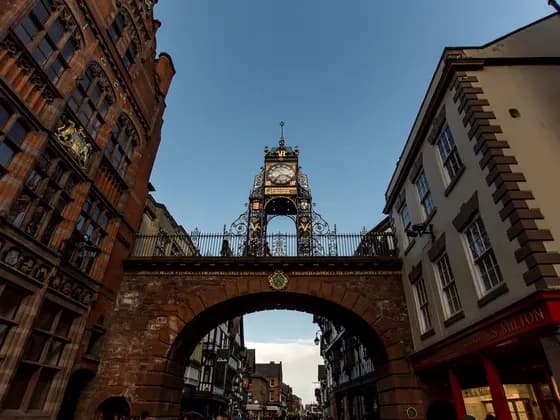


Photo: secretlondon123 · CC BY-SA 2.0 · cropped
Photo: Brian Deegan · CC BY-SA 2.0 · Photo: Stephen Rogerson · CC BY-SA 2.0 · Photo: Alex Liivet from Chester, United Kingdom · CC0
The Chester Medical School (GEM) medicine course at a glance (2027 entry)
Chester Medical School, part of the University of Chester, teaches a four-year MBChB, which the university describes as a Bachelor of Medicine and Surgery. It is a graduate-entry course, so everyone starts with a degree already behind them. That first degree can be in any subject, which means a year group can include graduates of the arts, humanities and languages as well as the sciences. If you are still at school, this is a route to keep in mind for after your first degree.
The school is new. Its first students started in September 2024, and the course is taught from the Wheeler Building in Chester city centre, beside the River Dee. The General Medical Council (GMC), which regulates doctors and approves UK medical degrees, checks a new course year by year as the first students move through it. Warwick Medical School is Chester's contingency partner, there to keep students' studies going if something serious went wrong, and Chester says its course is based on Warwick's, adapted to the local area.
Teaching is built around case-based learning (CBL). In a small group with a tutor, you work through realistic patient cases and use them to learn the science, the psychological and social side, and the clinical side together. The course is also a spiral curriculum. Nine themes, such as anatomy, prescribing and medical ethics, run through all four years, and you return to each one at a deeper level as you go.
Year 1 is spent mostly on campus, but you meet patients early through general practice (GP) and community placements. From Year 2 you spend most of your time in hospitals, GP surgeries and community services across Cheshire, Shropshire and North Wales, rotating through different specialties.
The final year prepares you for the Medical Licensing Assessment (MLA), which every UK medical student must pass as part of their degree, and for work as a Foundation doctor. Foundation doctors are newly qualified doctors on the two-year Foundation Programme, the usual first stage of training after a UK medical degree.
| Degree | MBChB (graduate entry) |
|---|---|
| Course length | 4 years, full time |
| UCAS code | A101 |
| Main teaching base | Wheeler Building, Castle Drive, Chester city centre |
| Year group | 2025 intake planned at 55 home and up to 25 international |
| Teaching style | Case-based learning in small tutor-led groups |
| Anatomy | Plastinated human specimens, 3D software, augmented reality, imaging, Anatomage table |
| First patient contact | Year 1, through GP and community placements |
| Placement area | Cheshire, Shropshire and North Wales, plus a neurology week in Liverpool |
| GMC status | New school under GMC review; first students started in 2024 |
| Year 1 timetabled teaching | 599 hours over a standard 30 weeks |
What makes Chester Medical School (GEM) medicine different
A year group of graduates from any subject
Every student arrives with a previous degree, and it does not have to be in science or healthcare. You may learn alongside graduates of the arts, humanities or languages as well as science graduates. Year 1 gives everyone the same grounding in the science and clinical skills before the placement-heavy years, and CBL lets you bring what you learned in your first degree into the discussion.
Every teaching week built around patient cases
CBL runs through all four years. Each teaching week is organised around the cases your small group works on with a tutor, and that week's lectures, anatomy, clinical skills and e-learning all connect to them. The cases are usually common conditions, so you learn the science in the form you will meet it as a doctor.
Nine themes that come back every year
The curriculum is a spiral. Nine themes, including cell and tissue biomedicine, clinical anatomy and imaging, pharmacology and prescribing, and values, law and ethics, run from Year 1 to Year 4. You meet each one at a basic level first, then return to it in more depth as your clinical work grows, so the science stays tied to the patients you are seeing.
Weekly hands-on anatomy with real preserved specimens
Every week an anatomy seminar is followed by a practical session with anatomists in a newly built anatomy facility in the Wheeler Building, next to the clinical skills suites. You study real preserved human specimens alongside 3D anatomy software, augmented reality and medical images, and the topic matches that week's CBL case.
Placements on both sides of the Welsh border
The school's partner hospitals include the Countess of Chester Hospital, hospitals in Warrington, Runcorn and Crewe, Wrexham Maelor Hospital in North Wales and a specialist orthopaedic hospital in Oswestry, Shropshire. Partners also include a mental health and community trust and GP practices across the region. In Year 3 every student also spends a week at a specialist hospital for brain and nerve conditions in Liverpool.
A senior clinician who meets you every week
On each placement from Year 2, an educational supervisor oversees your progress. This is normally a consultant (a fully trained senior hospital doctor), a fully qualified GP or another senior doctor. The school asks them to meet you for at least an hour every week, on your own or in a small group, to agree goals, review your portfolio and give feedback.
How Chester Medical School (GEM) teaches medicine
CBL is the centre of the course in all four years. Your small group works with a tutor on cases that reflect current clinical practice. Rather than being handed a list of facts, the group works out what it needs to know to understand the patient, then follows that up through guided study and in your own time.
The school says CBL mirrors the way doctors keep learning throughout their careers, and it expects you to draw on the knowledge and experience you already have. Each case mixes biomedical science, psychological and social factors and clinical practice. Working through cases together also builds teamwork and communication, which you will rely on in every clinical team.
Around the CBL sessions you have interactive lectures, seminars, anatomy and imaging, clinical and communication skills sessions and some e-learning. The course is designed for in-person study, with a few online activities.
The setting changes sharply after Year 1. In Year 1 most teaching happens on campus. From Year 2 you rotate through clinical placements, and much of your teaching comes from the clinicians you work with. Academic blocks and days on campus are built into Years 2 to 4 for extra teaching, support and consolidation.
You also learn with and about other health professionals. The clinical skills and simulation facility is shared with other healthcare courses and hosts interprofessional sessions throughout the programme. The nine curriculum themes that run through every year are listed below.
- Personal and Professional Development
- Social and Population Perspectives
- Cell and Tissue Biomedicine
- Pharmacology, Prescribing and Therapeutics
- Clinical Anatomy and Imaging
- Clinical and Communication Skills
- Values, Law and Ethics
- Community Learning
- Research, Education and Leadership
- Alongside the themes runs a professionalism and personal development strand. It covers teamworking, patient safety and how medical errors happen, leadership, managing uncertainty and complexity, prioritising your time, teaching others, reflection and looking after your own wellbeing.
The ways you will learn
| Case-based learning (CBL) | Small groups work through realistic patient cases with a tutor and decide together what they need to learn. The cases are usually common conditions, and each teaching week is organised around them. The school's staff include tutors whose role is running CBL groups. |
|---|---|
| Lectures and seminars | Interactive lectures and seminars give you the core science and clinical knowledge linked to the week's case. Anatomy also starts each week with a seminar before the practical session. |
| Clinical and communication skills sessions | From Year 1 you practise examinations, procedures and consultations in small groups, most of them led by a qualified healthcare practitioner. In later years you can also use the facility for self-directed practice before assessments. Skills teaching continues on placement, where specialists teach you and your progress is recorded in a logbook and your e-portfolio. |
| Simulation and simulated patients | Before and alongside real patients, you rehearse consultations with simulated patients, people trained to play the part of a patient, and practise in the simulation facility. You can make mistakes and get feedback without any risk to a real patient. |
| Practical anatomy | A weekly hands-on session with anatomists in the anatomy facility in the Wheeler Building, matched to the week's case. The anatomy section below explains what you use and how. |
| Learning on placement | From Year 2 most of your learning happens inside clinical teams in hospitals, GP surgeries and community services. A clinical supervisor oversees your day-to-day work, an educational supervisor tracks your overall progress, and you record what you do in your electronic portfolio, known as UMeP. |
A typical week on the Chester Medical School (GEM) course
The university's 2026 module description for Year 1 lists 599 hours of timetabled teaching and 505 hours of independent study over a standard 30 weeks. That averages about 20 hours a week of scheduled sessions, such as CBL groups, lectures, anatomy practicals and clinical skills, plus around 17 hours of study on your own. On top come 96 hours of placement, including a creative health placement, where you see how arts and creative activities are used to support health and wellbeing.
Year 2 is mostly placement. Its 2026 module description lists 720 placement hours across three nine-week Core Clinical Education (CCE) blocks, which works out at roughly 27 hours a week while a block runs. Around them sit four academic blocks of lectures, workshops and practical classes, with 240 hours of timetabled teaching and 240 hours of independent study across a 44-week year.
A Year 2 block is not only hospital work. The school's 2025/26 guidance for placement providers shows that the medicine block and the community and specialty block each include general practice, where you must complete at least 18 face-to-face patient consultations. The community and specialty block also has a community placement every Thursday.
Year 3 opens with an eight-week project block that mixes teaching at the Wheeler Building with two or three self-directed days a week for your project. Across Year 3, teaching is grouped into fuller days, some running from 9am to 5pm, so that you make fewer trips into university for single sessions. These details come from the 2026/27 Year 3 handbook.
Once the specialist placements start, you spend most days at your placement hospital or service. On the first, third and fifth Mondays of each block the whole year group returns to the university for an academic day built around that week's CBL case. Prescribing sessions on these days prepare you for the Prescribing Safety Assessment (PSA), a national online exam that checks you can prescribe medicines safely. The five-week medical block has no academic days.
Some blocks follow their own pattern. In the six-week general practice block you are at your practice every Tuesday, Wednesday and Friday, and at the university every Thursday and on the second, fourth and sixth Mondays. In the surgical block you normally attend from 08:00 to 16:00, with ward rounds often starting at 8am or earlier, and the emergency surgery week can bring later starts and evening finishes.
How anatomy is taught at Chester Medical School (GEM)
Anatomy belongs to the Clinical Anatomy and Imaging theme and is taught every week. Each week's anatomy follows the themes of that week's CBL cases and links closely to your clinical skills sessions. That way you see straight away why the structures you are learning matter when you examine a patient.
You first cover the topic in a seminar, then in a practical session led by anatomists. The practical sessions take place in a newly built anatomy facility in the Wheeler Building, next to the clinical skills and simulation suites.
The school combines several tools. Plastinated specimens are real human bodies or body parts preserved with a plastic-like material, so they can be handled safely and studied again and again. You use them alongside 3D anatomy software, augmented reality, which lays digital images over what you see, and medical imaging such as scans. The course page also shows students working together at an Anatomage table, a life-size touchscreen that displays a 3D virtual body you can cut through layer by layer.
The school uses real human specimens so that you see how intricate anatomy is and how it varies from one person to another, as well as how it applies to clinical work.
When you first meet patients at Chester Medical School (GEM)
You meet patients in Year 1, even though most of that year is on campus. You are prepared first through clinical skills training and simulated consultations. You then take part in GP and community placements and hospital-based teaching, which put you in front of a range of patients in different settings.
During Year 1 you also follow patients along their care pathway, the route a person takes through different health and care services, and learn what the different health and social care workers do.
Contact rises steeply from Year 2, when you spend most of your time in clinical settings, and continues through the specialist placements of Years 3 and 4. The course ends with the Assistantship, a placement in which you work alongside Foundation doctors to prepare for your own first job.
Year by year at Chester Medical School (GEM)
- Year 1
Foundations of Science and Medicine
Year 1 gives you the knowledge and clinical skills you need to get the most from the placement-heavy years that follow. It is a single 120-credit module, Foundations of Science and Medicine, taught mainly in the Wheeler Building. You learn biomedical, psychological, social and clinical knowledge side by side, and you meet patients early.
- Five teaching blocks of five weeks each, built around CBL cases with lectures, practical sessions, simulation and clinical skills sessions.
- Weekly anatomy seminars and practical sessions matched to the cases.
- GP and community placements and hospital-based teaching, prepared for through simulated patients and clinical skills training. The 2026 module description lists 96 placement hours, made up of a hospital week, a GP placement and a creative health placement.
- Interprofessional learning with and about other health and care professions.
- A compulsory occupational health appointment at the start of the course, with blood tests for immunity and infection and any vaccinations you need, before you can join clinical placements.
- A final transition to Year 2 block to consolidate what you have learned and get to know how Year 2 works.
- Year 2
Core Clinical Education and Principles of Clinical Practice
Year 2 moves you into the clinical environment for most of the year, where you build on what you learned in Year 1. It is a single 120-credit module, Core Clinical Education and Principles of Clinical Practice. It is organised around three placement blocks, with four academic blocks for extra teaching, support and guidance.
- Three Core Clinical Education (CCE) placement blocks: general medicine, surgery and anaesthetics, and a block of community and specialty placements.
- Each CCE block lasts nine weeks, according to the 2026 module description, which counts 720 placement hours across the three blocks.
- Placements in general practice and in community psychiatry, which is mental health care delivered outside hospital.
- A Year 2 student-selected component (SSC), a project on an area of practice or a clinical specialty that interests you.
- Workplace-based assessments, in which the clinicians supervising you watch you with patients and record feedback. They are gathered in your e-portfolio and reviewed by your educational supervisor, and in Year 2 they are for feedback rather than marks.
- Year 3
Speciality Training Preparation for Practice 1
Year 3 opens with a project block and then moves into Specialist Clinical Placements (SCPs), rotations through individual specialties. It is a single 120-credit module, Speciality Training Preparation for Practice 1. There are eight SCPs in all: you do six in Year 3 and the last two in Year 4, in hospitals, GP surgeries and community services around the region.
- An eight-week block opening the year, where you complete your SSC, a research project on a topic you choose. It includes the National Institute for Health and Care Research (NIHR) online Good Clinical Practice course on research ethics, plus clinical skills and placement preparation sessions.
- SCPs of six weeks, except the five-week Care of the Medical Patient block. You rotate through them with a student group, so the order depends on your group. The 2026/27 Year 3 handbook describes the eight blocks below.
- Care of the Medical Patient (five weeks): mainly heart, lung, digestive and hormone medicine at your allocated hospital, plus a week of neurology at The Walton Centre, a specialist brain and nerve hospital in Liverpool. In 2026/27 it is everyone's sixth block, from late June to early August.
- Acute Care (six weeks): a week in intensive care, two weeks in the emergency department and two in the acute medical unit, where medical emergencies are first assessed. The last week covers eye casualty, an ear, nose and throat (ENT) rapid access clinic and evening or night emergency shifts.
- Paediatrics (six weeks): the children's ward, the children's assessment unit and emergency department, the neonatal unit for newborn and premature babies, newborn baby checks and children's outpatient clinics, with weekly bedside teaching.
- Obstetrics and Gynaecology (six weeks), covering pregnancy, birth and women's reproductive health, with a single placement provider: labour ward, antenatal and gynaecology clinics, emergency gynaecology and theatres. It includes some supervised late-evening and weekend attendance.
- Care of the Surgical Patient (six weeks): a different surgical specialty each week, including upper gut, bowel and emergency surgery. Where the hospital offers them, you may also see ENT, plastic surgery, urology (kidney and bladder), vascular (blood vessel) or face and jaw surgery.
- Musculoskeletal, or MSK (six weeks), covering bones, joints and muscles. You spend five weeks at the Robert Jones and Agnes Hunt Orthopaedic Hospital in Oswestry, including its spinal injuries centre. The sixth week is with the trauma orthopaedic team at the Countess of Chester Hospital, treating fresh injuries.
- Psychiatry (six weeks): with either Cheshire and Wirral Partnership NHS Foundation Trust or Elysium Healthcare, a private provider of psychiatric inpatient care. It starts with a two-day induction that includes safety training, then covers inpatient wards and community mental health teams.
- General Practice (six weeks): at least 18 supervised patient consultations, two of them video-recorded on a university tablet for feedback. You also follow one patient through the block as a long case, and finish with a long-case assessment with a simulated patient at the university.
- Year 4
Speciality Training Preparation for Practice 2
The final year prepares you for the MLA and for working as a Foundation doctor. It is a single 120-credit module, Speciality Training Preparation for Practice 2. After the MLA, the focus moves from exams to getting ready for the job.
- Your last two specialist clinical placements, completing the eight blocks.
- The Advanced Clinical Cases block, which draws your clinical learning together ready for the MLA.
- Both parts of the MLA, which you sit at Chester on dates the school sets.
- An elective after the MLA, in the UK or overseas, to explore an area that interests you.
- The Assistantship to finish the course, working with Foundation doctors before you start your own first Foundation post.
How you are assessed at Chester Medical School (GEM)
Year 1 has three assessments, and each is pass or fail. The first is a 4-hour written exam of multiple-choice questions (MCQs) and very short answer questions, where you type a word or phrase rather than pick from a list. The second is a 3.5-hour Objective Structured Clinical Examination (OSCE): you move round timed stations, each testing one task, such as examining a patient or explaining a treatment. The third assesses your professionalism, including attendance, engagement and reflection.
At the end of Year 2 you sit two 2-hour papers on screen, mixing MCQs and short answer questions, and the two scores are combined into a mark out of 200. The pass mark is set by examiners judging how a borderline student would do on each question. You also sit a 2.5-hour OSCE and complete a logbook of practical procedures practised in simulation. You must pass every part to move into Year 3.
On placement, the clinicians you work with assess you through workplace-based assessments. In a mini clinical evaluation exercise (mini-CEX), a senior clinician watches you with a patient and gives feedback. In a case-based discussion (CBD), you talk them through a patient you have seen. An Objective Structured Long Examination Record (OSLER) is a long case: you take a full history from one patient, examine them and present your findings.
In Year 2 you complete one mini-CEX, one CBD and one OSLER on each hospital placement. They are formative, meaning they are for feedback: you can fail one, but you must complete them and get a satisfactory sign-off at the end of each block. In Year 3 each block needs at least one mini-CEX and one CBD, plus an OSLER in the last two weeks that a consultant grades.
Each Year 3 block also has a 50-question practice MCQ test in the style of the MLA's knowledge exam. You collect Team Assessment of Behaviour (TAB) forms, in which doctors, nurses and other staff rate your teamwork, communication and professionalism, and need at least 14 by the end of the seventh block. You log practical skills done on real patients in your e-portfolio, with at least eight signed off by the fourth block.
In Year 4 you sit the MLA. It has two parts, both taken at Chester on dates the school sets. The Applied Knowledge Test (AKT) is an on-screen multiple-choice exam, and the Clinical and Professional Skills Assessment (CPSA) is a practical exam that Chester designs and runs. Both count only once the GMC confirms they meet its standards. No decision on Chester's had been published by September 2026, and a full new submission is due by January 2027.
- Attendance: in Years 1 and 2 you are expected to attend everything, and to progress you need at least 80% attendance plus evidence that you have caught up on anything you missed.
- On placement, 100% attendance is required. Missing scheduled sessions is treated as a professionalism concern, and you can fail a placement for poor attendance.
- At the end of each placement a senior clinician, such as your supervising consultant or educational supervisor, signs you off once they are satisfied you are working at the level expected for your stage.
Where you will actually be at Chester Medical School (GEM)
Your placements are in community services, GP practices and NHS hospitals across Cheshire, Shropshire and North Wales, and the 2026/27 Year 3 handbook adds a week in Liverpool for every student. The areas below list the trusts and hospitals the school names. The university presents its course-page list as a summary of some partners, not a complete list.
Placements run as rotations. In Year 2 you move through the three CCE blocks, and in Years 3 and 4 you rotate through the SCPs with a student group, so your timetable depends on your group. The NHS organisations that host students are called local education providers (LEPs). The GMC also heard in 2026 that private, independent and voluntary organisations help the school deliver placement experiences.
On every placement a clinical supervisor, normally a consultant-level doctor, oversees your day-to-day work and makes sure you only do what you are trained and safe to do. Your educational supervisor holds overall responsibility for your progress. At your first meeting they check you have had an induction and a timetable, and you agree your learning objectives for the block.
Travel to placements is one of the extra costs the university lists as not covered by tuition fees. Some blocks take you further afield for weeks at a time: in Year 3 the MSK block keeps you in Oswestry, Shropshire, for five weeks, and the medical block includes a week in Liverpool.
Run by the Countess of Chester Hospital NHS Foundation Trust. It has a 600-bed district general hospital, a local NHS hospital covering most common specialties. At Ellesmere Port it runs a 64-bed intermediate care service, giving short-term care that helps people recover after a hospital stay. The university's Bache Hall research building borders the hospital grounds.
- Countess of Chester Hospital, Countess of Chester Health Park
- Ellesmere Port Hospital (intermediate care)
Warrington and Halton Hospitals NHS Foundation Trust. Warrington Hospital has around 500 beds, its accident and emergency department sees over 100,000 patients a year, and about 3,000 babies are born there each year. Halton General, about 10 miles away, focuses on routine surgery and has an urgent care centre and an orthopaedic treatment centre.
- Warrington Hospital
- Halton General Hospital, Runcorn
- Cheshire and Merseyside Treatment Centre, Halton General campus
Mid Cheshire Hospitals NHS Foundation Trust has around 540 beds. Its services include emergency care, general and specialist surgery and medicine, care of older people, paediatrics, and obstetrics and gynaecology.
- Leighton Hospital, Crewe
- Victoria Infirmary, Northwich
- Elmhurst Intermediate Care Centre, Winsford
Betsi Cadwaladr University Health Board runs NHS services across North Wales. Most of Chester's placements with the board are at Wrexham Maelor Hospital, about 15 miles from Chester, and with local GPs.
- Wrexham Maelor Hospital
- GP practices around Wrexham
A specialist orthopaedic hospital for bone, joint and soft tissue conditions near the Welsh border, with eight inpatient wards and ten operating theatres. In the Year 3 MSK block you spend five of your six weeks here, including time at its Midland Centre for Spinal Injuries. The GMC met the trust on its February 2026 visit.
- Robert Jones and Agnes Hunt Orthopaedic Hospital, Oswestry
Cheshire and Wirral Partnership provides mental health, learning disability and community physical health services across Cheshire, Wirral and some neighbouring areas, from inpatient units to people's own homes. For the Year 3 psychiatry block you are placed either there or with Elysium Healthcare, a private company running psychiatric inpatient services.
- Cheshire and Wirral Partnership NHS Foundation Trust
- Elysium Healthcare (private psychiatric inpatient provider)
The school works with a range of general practices across the region, and primary care providers were among the placement partners the GMC met in February 2026.
- GP practices across the region
A specialist neuroscience hospital, treating conditions of the brain, spinal cord and nerves. Every student spends one week of neurology here during the five-week Care of the Medical Patient block in Year 3.
- The Walton Centre NHS Foundation Trust
Electives and chosen modules at Chester Medical School (GEM)
Student-selected components (SSCs) are projects you choose, and they run through all four years. Each option relates to the core curriculum but lets you go deeper into one topic, which can come from the scientific, clinical or social sciences. They are designed to build research skills you will use long after the course.
In Year 2 your SSC focuses on an area of practice or a clinical specialty that interests you. In Year 3 it is a research project, completed during the block that opens the year.
Your elective comes in Year 4, after the MLA exams. It is a chance to explore an area of medicine that interests you, and you can take it in the UK or overseas.
Facilities and support at Chester Medical School (GEM)
Where you will learn
The Wheeler Building on Castle Drive, overlooking the River Dee in Chester city centre, is the home of the MBChB. It holds the clinical skills and simulation facility, the newly built anatomy facility next to it, a 192-seat lecture theatre and a library with health collections and computer suites.
Wheeler is shared with the university's School of Nursing and Midwifery and School of Law and Social Justice. It is about a 20-minute walk from both Chester railway station and the university's Exton Park site, and there is no student parking at the building.
Bache Hall, next to the Countess of Chester Hospital, is Chester Medical School's research base. It has laboratories for work such as tissue culture, cell imaging, molecular biology and microbiology, research clinic rooms, a computer suite with statistics software and seminar rooms for small-group teaching.
Support while you study
You have a Personal Academic Tutor through the university's tutor system. When you are on placement, the school links this with your clinical supervision, so academic and clinical problems can be spotted and sorted out together.
Your educational supervisor on each placement is your first point of contact if you are worried about patient safety or about a teacher or department. They can point you to the school's Raise a Concern form, and they are expected to talk with you about your career plans.
The school has a Student Support Lead, and its staff include a senior lecturer whose role covers student support. If you are disabled or have a long-term health condition, you, the school and the placement agree a Reasonable Adjustment Placement Plan to identify and address any barriers to learning on placement. You still need to reach the same standards as every other student.
Is the Chester Medical School (GEM) course right for you?
This course may suit you if
- You learn well by working through patient cases in a small group, because CBL shapes every teaching week for all four years.
- You want to move into clinical work quickly: after one mainly campus-based year, you spend most of Year 2 on placement.
- Your first degree is not in science and you want a course open to graduates of any subject, with Year 1 building the scientific foundations.
- You like hands-on anatomy with real preserved specimens, combined with 3D software, augmented reality and medical images.
- You would be happy training across Cheshire, Shropshire and North Wales, with a week in Liverpool, in settings from district general hospitals to a specialist orthopaedic hospital.
Things to think about
- Chester is a new school. Its first students started in September 2024, so no one had graduated when this guide was checked, and the university expects full GMC approval in 2028.
- After its February 2026 visit the GMC left several requirements open, including better communication with Year 2 students and enough experience of mental health, women's health and paediatrics. The FAQ below gives the detail.
- The GMC had not yet confirmed that Chester's final exams meet MLA requirements; a full new submission is due by January 2027.
- Placements can take you to Wrexham, Warrington, Crewe or Oswestry, where the MSK block lasts five weeks, and to Liverpool for a neurology week. Travel to placements is a cost you cover yourself.
- If you might want to work in the USA, note that Chester students cannot currently take the US licensing exams (USMLE). The university links this to gaining full GMC approval, expected in 2028.
Chester Medical School (GEM) medicine course — frequently asked questions
Applying to Chester Medical School (GEM)?
How to get into Chester Medical School (GEM)
Entry requirements, UCAT, personal statement and interview, step by step.
Open the guide →Chester Medical School (GEM) UCAT cut-offs and offers
UCAT cut-offs, A-level offers, interview format and decision dates.
See the requirements →Compare Chester Medical School (GEM) with other schools
Put the teaching style, anatomy teaching and placements next to another school.
Open the comparison →Prepare for the Chester Medical School (GEM) interview
Format breakdown, school-specific sample questions and prep tips from tutors who interviewed here.
Read the guide →Where this Chester Medical School (GEM) course guide came from
This guide was written from 18 official sources — University of Chester Medical School's own course pages and programme documents, plus the regulator and NHS placement partners where they publish detail — read on 2026-09-24, then checked claim by claim against those sources.
- Graduate Entry Medicine MBChB course page, University of Chester
- Graduate Entry Medicine overview and clinical placement partners, University of Chester
- Chester Medical School Combined Clinical Education and Clinical Supervision Guidance 2025/26
- Chester Medical School, University of Chester
- Wheeler, Chester: campus location page, University of Chester
- Bache Hall, Chester: campus location page, University of Chester
- First Graduate Entry Medicine students begin their studies at Chester, University of Chester news, September 2024
- GMC Annual Quality Assurance Summary for new schools: Chester Medical School, 2025-26
- GMC new medical schools reports
- GMC MLA compliance reports
- GMC MLA compliance reports: medical schools A to L
- MBChB Year Three Academic and Placement Handbook, effective 2026/27, Chester Medical School
- Guidance for Year 2 Clinical Placements for Local Education Providers 2025/26, Chester Medical School
- Module MD5401 Foundations of Science and Medicine, 2026, University of Chester Course Catalogue
- Module MD6401 Core Clinical Education and Principles of Clinical Practice, 2026, University of Chester Course Catalogue
- Chester Educators Network, Chester Medical School
- Taking the MLA: what the assessment involves, GMC
- Prescribing Safety Assessment, British Pharmacological Society and MSC Assessment
Courses are restructured between cycles. Anything here that decides your application — an anatomy offer, a placement city, a compulsory intercalated year — should be confirmed against the official page for your entry year.
Applying to Chester Medical School (GEM)?
We have helped hundreds of applicants turn their UCAT, personal statement and interview prep into offers from Chester Medical School (GEM) and other UK medicine schools.