
The University of Greater Manchester Medicine course
What you actually study, and where you will be
University of Greater Manchester's MBChB is a 5-year course with an integrated, spiral curriculum, with patient contact from Year 1 and placements in North West England (2027 entry). A new medical school in Bolton, teaching in £40 million purpose-built facilities and placing students across four north west NHS hospital trusts.
- Degree
- MBChB
- Length
- 5 years
- Teaching
- Integrated + Spiral
- Clinical contact
- Year 1
- UCAS code
- A100

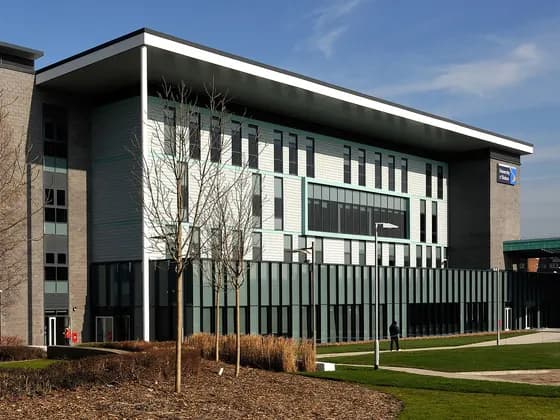

Photo: BoltonUni · CC BY-SA 4.0 · cropped
Photo: BoltonUni · CC BY-SA 4.0 · Photo: Tony Grist · CC0 · Photo: Humphrey Bolton · CC BY-SA 2.0
The University of Greater Manchester medicine course at a glance (2027 entry)
Medicine at the University of Greater Manchester is a five-year MBChB taught by the university's medical school in Bolton. You study full time, taking 120 credits each year. Teaching is based in the Institute of Medical Sciences, a £40 million building in the grounds of the Royal Bolton Hospital in Farnworth, which officially opened in December 2025. The first medical students started in September 2025.
This is a new medical school, and that shapes the course in two ways. First, like every new UK school, it is under closer oversight from the General Medical Council (GMC), the body that regulates doctors and approves medical degrees, until its first students graduate. Second, the curriculum is adapted from the one used at the University of Leicester Medical School. Leicester is also the contingency partner, so students could continue their studies there if the need arose.
For September 2026 and September 2027 entry, the university is only offering the course to international applicants. Your year group is therefore made up of international students, and the school runs a dedicated induction for them. The university was called the University of Bolton until December 2024, so some official course documents still carry the old name.
The course is integrated and patient-focused rather than problem-based. You learn the science of the body through lectures, team-based tutorials and small-group work, built around patients and their needs. Sixteen themes, such as safe prescribing and safeguarding, run through all five years and come back each year in more depth. Years 1 and 2 (Phase 1) are mainly taught on campus. Years 3 to 5 (Phase 2) are spent mainly on clinical placements across Greater Manchester and Lancashire.
Patients are part of the course from Year 1, through observation in general practice, hospital experience and a care skills certificate you must complete before Year 2. In the clinical years you work as part of hospital and GP teams, returning to campus for regular university days.
| Degree | MBChB (Bachelor of Medicine and Surgery) |
|---|---|
| Course length | 5 years full time, 120 credits a year |
| Main base | Institute of Medical Sciences, Royal Bolton Hospital grounds, Farnworth, Bolton |
| First intake | September 2025 |
| Who can apply now | International applicants only, for 2026 and 2027 entry |
| Teaching style | Integrated lectures, team-based tutorials and small groups; not problem-based learning |
| Anatomy | Five Anatomage tables in Bolton; fresh frozen prosection sessions at a partner hospital |
| First patient contact | Year 1, through GP observation and early clinical experience |
| Clinical years | Years 3 to 5, mainly full-time placements |
| Placement area | Greater Manchester and Lancashire; NHS hospital trusts across the North West |
| Contingency partner | University of Leicester Medical School |
What makes University of Greater Manchester medicine different
A curriculum adapted from Leicester Medical School
The school teaches the University of Leicester's medicine curriculum, which it is implementing and developing for Bolton. Leicester is also the school's contingency partner. The head of Leicester Medical School spoke to the 2026 intake during induction.
Team-based tutorials led by junior doctors
Team-based learning tutorials, where you prepare in advance and then solve problems as a group, are part of a normal Year 1 day alongside lectures. Junior doctors, qualified doctors in the early years of their training, facilitate them.
Anatomy on digital tables and real specimens
You learn anatomy both on digital Anatomage tables in Bolton and from fresh frozen prosections, real bodies dissected in advance by experts. The prosection teaching takes place at a partner hospital; the first was a two-day block in February 2026. The school says it builds on what you have already learned on the tables.
A care skills certificate before Year 2
In Year 1 you complete the NHS Health Care Certificate, which covers keeping patients safe, meeting their needs, person-centred care and treating people with dignity and respect. The school uses it as early clinical experience. You must finish every part of it, including the practical skills and e-learning, before you can progress to Year 2.
An early clinical apprenticeship across Years 1 and 2
Alongside the science units, a thread called the Early Clinical Apprenticeship runs through all four semesters of Phase 1. Its teaching sessions are paired with clinical experiences in hospitals and GP practices around Greater Manchester, so from Year 1 you see the patients behind the topics you study.
General practice in every year
You have observation visits in general practice in Year 1, formal early clinical experience in Year 2, and substantial GP placements in the clinical years. In September 2026 the school set out plans for a Primary Care Academy: hubs of GP practices and community services across the region, each with academic GP leadership and its own educator team.
How University of Greater Manchester teaches medicine
The course is integrated, which means subjects such as anatomy, physiology and pharmacology are not taught as separate courses. Each Year 1 unit takes one topic or body system, such as the cardiovascular system or infection, and teaches it from every angle at once. The school states plainly that this is not a problem-based learning (PBL) course, the style where small groups teach themselves from a patient case with little formal teaching.
The curriculum is also spiral. Sixteen themes drawn from the GMC's Outcomes for Graduates, the standards every new UK doctor must meet, run through all five years. They include prescribing medicines safely, safeguarding vulnerable patients, dealing with complexity and uncertainty, and leadership and teamworking. You return to each theme every year, at a deeper level each time.
In Phase 1 (Years 1 and 2), teaching is mostly on campus: lectures, guest lectures, seminars, tutorials, group work and practical sessions, with some learning online. Year 2 adds more simulation, from paper-based clinical scenarios to mannequins for practical procedures and actors playing patients for consultation practice. Over the summer breaks the school supports you online through Moodle, its virtual learning environment.
In Phase 2 (Years 3 to 5), you learn mainly on the job. Practising clinicians teach each area through bedside teaching, group work and lectures, and workbooks guide what you cover on each placement. Campus teaching continues through induction weeks, university days and simulation. The balance shifts sharply: in Years 1 and 2 half your time is timetabled teaching, but in Years 3 to 5 about 60% is placement, 30% private study and 10% timetabled teaching.
The ways you will learn
| Lectures | Large-group teaching from subject experts and guest lecturers. Each session ends with a discussion forum led by the expert who gave it, so you can question what you have just heard. |
|---|---|
| Team-based learning tutorials | You do preparatory work first, then tackle unseen tasks as a team, which tests what you know and gets you discussing and solving problems together. Junior doctors facilitate these tutorials. |
| Case-based learning and small groups | Phase 1 uses clinical scenarios to put the science into context. In case-based learning you work through a patient case in a group, linking what you have learned in lectures to the way illness shows up in real people. |
| Clinical skills and simulation | You learn history taking, examination and procedures first with simulated patients (actors trained to help you learn), volunteers and mannequins in the simulation suites. People with lived experience of illness also take part in teaching, giving a realistic view in a safe setting. |
| Interprofessional learning | Simulation and role-play sessions with other healthcare professionals, based on scenarios you could meet in practice. The aim is to understand what other professions do and how teams work together around a patient. |
| Bedside teaching and placement workbooks | In Years 3 to 5, clinicians teach you on the wards and in clinics. Each placement also includes structured activities, procedural skills training and simulation, and a workbook sets out what you need to learn. |
A typical week on the University of Greater Manchester course
In Years 1 and 2 you have about 24 hours of timetabled teaching a week. The school expects you to spend about the same again on self-directed study, such as background reading, preparing for group work and practical sessions, and revising. A typical Year 1 day contains two lectures and a team-based learning tutorial.
Each of Years 1 and 2 is planned as 1,200 hours of study. Of these, 628 hours are scheduled teaching, 504 are independent study and 68 are clinical placement. Each year is split into two semesters, so Phase 1 runs over four semesters in total.
How anatomy is taught at University of Greater Manchester
Anatomy is taught with several tools side by side. The Institute of Medical Sciences has five Anatomage tables: large touchscreen tables showing a 3D digital human body that you can dissect virtually, layer by layer. You also learn from bones, anatomy models and clinical images.
On top of this you study fresh frozen prosections. A prosection is a body, or part of one, that experts have already dissected so the structures are ready to examine. Fresh frozen means it was preserved by freezing rather than with chemicals, so the tissues stay closer to how they look in life. The specimens come from people who donated their bodies to medical education.
The first cohort's first prosection teaching was a two-day programme in February 2026 at Wrightington, Wigan and Leigh Teaching Hospitals. Students worked in small groups in a wet lab, a lab where real tissue is handled, on the lower limbs, pelvis and spine. Orthopaedic consultants and the school's anatomy lead ran the sessions, linking each structure to its clinical relevance.
Anatomy continues into Year 2 with a unit on applied head and neck anatomy and an introduction to neuroanatomy, the structure of the brain and nerves. Year 2 ends with the integrated understanding practical assessment (IUPA), ten practical stations of five minutes each. A school news post describes this integrated understanding format as an anatomy practical exam, and the February 2026 prosection sessions included practice at it.
When you first meet patients at University of Greater Manchester
You start by practising communication and examination with simulated patients, who are actors trained to help you learn, and with volunteers. The school then moves you on to real patients early. In Year 1 you have observation visits in general practice and clinical experiences in hospitals and GP practices across Greater Manchester, as part of the Early Clinical Apprenticeship.
Year 1 also includes the NHS Health Care Certificate, which the school treats as a formal part of your early clinical experience. In Year 2 the GP element becomes formal early clinical experience. By the end of Phase 1 you should be able to talk to patients and examine them, and you must pass a formal clinical exam to move on.
Phase 1 also includes community attachments: time in community settings that shows how people's social and psychological circumstances shape their health and illness. They sit alongside your classroom teaching in social and behavioural science.
From Year 3 you work mostly full time in clinical settings. On each placement you join a team caring for patients, so the range of people and illnesses you see reflects what doctors actually deal with. The school describes Bolton and the surrounding area as having a diverse, multicultural population, which is reflected in the patients you meet.
Year by year at University of Greater Manchester
- Year 1
Foundations: the body, the patient and the NHS
Year 1 is the first half of Phase 1 and is taught mainly on campus in Bolton over two semesters. Each unit covers one topic or body system in an integrated way, alongside ethics, patient safety and social science. You also begin clinical experience and complete a care skills certificate.
- Science units include Medical Cell Biology and Genetics; Metabolism, Endocrinology and Haematology; Body Logistics, whose reading list covers anatomy, physiology and embryology; the Musculoskeletal System; the Cardiovascular System; Infection; and Pathological Processes.
- Other units cover Medical Ethics and Law, Patient Safety, Population and Social Science, Introduction to Cell Physiology and Pharmacology, Professionalism, and Health Enhancement, which focuses on your own health and wellbeing.
- The NHS Health Care Certificate, which you must complete in full, including practical skills and e-learning, to move into Year 2.
- The Early Clinical Apprenticeship, with observation visits in general practice and clinical experiences in hospitals and GP practices.
- A practice written paper at the end of semester 1 and a practice OSCE (Objective Structured Clinical Examination, a circuit of timed clinical stations) in semester 2. Neither counts towards progression.
- End-of-year written exams, which make up all of the Year 1 assessment that counts.
- Year 2
Body systems and clinical reasoning
Year 2 completes Phase 1. The science moves through the remaining body systems, and you start applying it to clinical reasoning, prescribing and teamwork. It ends with the exams you must pass before starting full-time clinical placements.
- System units on the respiratory, reproductive, gastrointestinal and urinary systems, plus Clinical Neuroscience and Clinical Immunology.
- Applied Head and Neck Anatomy and Introduction to Neuroanatomy.
- Clinical Pharmacology, Therapeutics and Introduction to Prescribing, and a unit on Stroke Medicine and Interprofessional Working.
- Integration for Clinical Application, and an Early Clinical Experience unit with formal early clinical experience in general practice.
- A practice written paper midway through semester 4 and a practice IUPA at the end of it. Neither counts towards progression.
- Exams that count: a 120-mark single best answer paper, a 150-mark short answer paper, a 12-station OSCE lasting 120 minutes, a 10-station IUPA and a practice portfolio.
- You must pass the OSCE and the IUPA separately to progress to Year 3.
- Year 3
Clinical clerkships
Phase 2 begins and you move from campus into full-time clinical work. Year 3 is built around longer clerkship-style placements in medicine, surgery and general practice. In a clerkship you join a clinical team for an extended block and learn by working alongside it.
- Clerkships in medicine, surgery and primary care, based in hospitals or GP practices.
- Structured activities, procedural skills training and simulation on each placement, guided by workbooks.
- Regular university contact days and induction weeks back on campus.
- Your e-portfolio starts to work as a tool for assessing your clinical work on placement.
- Year 4
Specialty placements
Year 4 is organised as specialty blocks. You gain experience across a wide range of disciplines in both physical and mental health.
- Specialty blocks named by the school include obstetrics and gynaecology (pregnancy, childbirth and women's health), child health, cancer care and psychiatry.
- Placements in acute hospital trusts, primary care and mental health trusts.
- Continued university days and simulation alongside your placements.
- Year 5
Preparing for your first job
The final year focuses on getting you ready to work as a Foundation Year 1 doctor, the first post after graduation. The year centres on foundation assistantships, extended placements where you work closely with junior doctors and take on parts of their role under supervision. You also take an elective.
- Foundation assistantships in emergency medicine, medicine, surgery and primary care.
- An elective placement in a location of your choice, which could be abroad.
How you are assessed at University of Greater Manchester
Written exams come at the end of each year and use two formats. Single best answer (SBA) questions give you a scenario and several options, and you pick the best one. Short answer questions (SAQ) ask you to write brief answers of your own. Clinical skills are tested in OSCEs. Across the course you will also meet reflections, presentations and assessment of your practice on placement.
Throughout the course you keep an e-portfolio, a digital record of your skills, reflections, professionalism, future action plans and attendance. In Phase 2 it develops into a tool for assessing your clinical work in the workplace.
The mix changes as you go. In Year 1 the assessment that counts is entirely written. Year 2 has the SBA and SAQ papers, the OSCE, the IUPA practical and a practice portfolio marked pass or fail. Across Years 3 to 5 taken together, practical exams make up 50% of assessment, written exams 40% and coursework 10%.
Pass marks are not a fixed percentage. They are set by standard setting, where examiners decide what a student who only just meets the standard should score. The main method is modified Angoff: a panel estimates how that borderline student would do on each question, and those estimates set the pass mark. For the Year 1 practice OSCE, the descriptor names borderline regression, which works from examiners' overall grades at each station.
To move up a year you must pass that year's exams or their resits, with one resit allowed for each assessment that counts. You must also not have neglected your professionalism or patient safety obligations. Practice assessments come first so you know the format. You are expected to take part in them, but you do not need to pass them.
Every student graduating from a UK medical school must pass the Medical Licensing Assessment (MLA) to join the medical register. It has two parts: the Applied Knowledge Test (AKT), a written exam, and the Clinical and Professional Skills Assessment (CPSA), a practical exam set by each school and quality assured by the GMC. The school says its curriculum prepares you for the MLA from early on. It also offers advice on the United States Medical Licensing Examination (USMLE) and the Medical Council of Canada Qualifying Examination (MCCQE).
Where you will actually be at University of Greater Manchester
For the first two years you are based at the Institute of Medical Sciences in Bolton, where clinical skills and simulation teaching also take place. Your early clinical experiences happen at partner NHS trusts and GP surgeries around Greater Manchester. From Year 3 most of your time is on placement, with regular days back at the university.
The school's own pages give different numbers of partner hospitals. The summary box on its course pages mentions five North West NHS hospital trusts, but the medical school's home page says four North West NHS hospitals. The programme specification says clinical-year placements are in acute hospital trusts, primary care and mental health trusts.
The course listing describes placements in hospitals, general practice and community settings across Greater Manchester and South Lancashire. So far the one placement trust the school has named is East Lancashire Hospitals NHS Trust (ELHT), whose chief executive spoke to the 2026 intake. ELHT's main hospitals are the Royal Blackburn Teaching Hospital and Burnley General Teaching Hospital, in East Lancashire.
Placements can involve a lot of travel. You pay your own costs to get to the medical school and to placements, although the school may be able to reimburse mileage for long journeys. With the one named placement trust based in Blackburn and Burnley, build travel into your plans.
General practice teaching is being organised through the Primary Care Academy, announced in September 2026. The proposed model is a network of hubs across the region, each grouping GP practices and community providers under academic GP leadership with its own educator team. You would learn alongside the whole primary care team, and patients and carers would help shape teaching.
Where Years 1 and 2 are mainly taught, including clinical skills and simulation. The building was designed with senior clinicians from Bolton NHS Foundation Trust.
- Institute of Medical Sciences, Royal Bolton Hospital grounds, Farnworth
Named by the school in September 2026 as a trust where students will do clinical placements.
- East Lancashire Hospitals NHS Trust: Royal Blackburn Teaching Hospital and Burnley General Teaching Hospital
GP observation in Year 1, early clinical experience in Year 2 and longer GP placements later, to be organised through Primary Care Academy hubs.
Electives and chosen modules at University of Greater Manchester
An elective is a placement in a location you choose yourself. Here it comes in Year 5, alongside the foundation assistantships, and the school says it could be anywhere in the world.
Facilities and support at University of Greater Manchester
Where you will learn
The Institute of Medical Sciences is a £40 million building in the grounds of the Royal Bolton Hospital in Farnworth. It houses the medical school and the wider Institute of Medicine, and was officially opened in December 2025, the university's 200th anniversary year. Its design team worked with senior clinicians from Bolton NHS Foundation Trust on the layout and equipment.
For simulation there are two high-fidelity suites, rooms that closely recreate real clinical settings and are designed for assessing clinical practice. One can be converted into an operating theatre. A community simulation suite is set up like a home, for practising the kind of care doctors give outside hospital.
Equipment includes a SimMan 3G PLUS, a full-body patient mannequin that can be moved like a real patient and connected to real clinical devices, used to rehearse complex cases. The five Anatomage tables are used for anatomy. At the start of the course the school gives you a tablet or iPad for course materials, a standard stethoscope and access to key textbooks.
Support while you study
Each student has a personal tutor for support and guidance, and there is pastoral support specifically for medical students. The school also offers medicine-specific reasonable adjustments, occupational health, and support through Fitness to Practise, the process that handles concerns about a student's health or conduct. You get feedback on practice assessments as well as on the ones that count.
Because the current intake is international, the school runs a dedicated induction before teaching starts. The first cohort had a three-week induction in 2025, and the 2026 intake a two-week programme. Sessions covered the UK health system and general practice, cultural competence, communication skills, assessments, studying anatomy and wellbeing.
Induction also introduced student networks such as the British International Doctors Association (BIDA) Student Wing and the Medical Women's Federation, for peer support and mentoring. Your own health is built into the curriculum through the Health Enhancement unit in Year 1, part of what the school calls its Health Enhancement Programme.
Is the University of Greater Manchester course right for you?
This course may suit you if
- You like structured teaching, with lectures and prepared team-based tutorials, more than the self-directed group work of a PBL course.
- You would like anatomy on digital Anatomage tables, plus off-site sessions on real fresh frozen prosections; the first was a two-day block in February 2026.
- You want general practice to run through all five years rather than appear as a single placement.
- You are an international student who would value a dedicated induction to the UK health system before teaching starts.
- You may want to work as a doctor in the US or Canada later, since the school offers advice on their licensing exams as well as the UK MLA.
Things to think about
- UK applicants cannot apply for 2026 or 2027 entry; the course is open only to international applicants.
- As a new school it has no graduates yet, and the GMC is still reviewing it. By September 2026 the GMC had published no quality assurance report on the school.
- No one has yet taken Years 3 to 5, and their module descriptors were not published by September 2026. The clinical-year timetable, placement sites and exams may still change.
- You pay your own travel to placements, and the one placement trust named so far is based in Blackburn and Burnley, in East Lancashire.
University of Greater Manchester medicine course — frequently asked questions
Applying to University of Greater Manchester?
How to get into University of Greater Manchester
Entry requirements, UCAT, personal statement and interview, step by step.
Open the guide →University of Greater Manchester UCAT cut-offs and offers
UCAT cut-offs, A-level offers, interview format and decision dates.
See the requirements →Compare University of Greater Manchester with other schools
Put the teaching style, anatomy teaching and placements next to another school.
Open the comparison →Prepare for the University of Greater Manchester interview
Format breakdown, school-specific sample questions and prep tips from tutors who interviewed here.
Read the guide →Where this University of Greater Manchester course guide came from
This guide was written from 22 official sources — University of Greater Manchester's own course pages and programme documents, plus the regulator and NHS placement partners where they publish detail — read on 2026-09-24, then checked claim by claim against those sources.
- Undergraduate Medical School, University of Greater Manchester Medical School
- MBChB Medicine programme details
- MBChB Medicine course listing, 2026-27
- MBChB Medicine programme specification, 2026-27 onwards
- MBC4001 MBChB Year 1 module descriptor
- MBC5001 MBChB Year 2 module descriptor
- Facilities gallery, Institute of Medical Sciences
- GMC quality assurance update from the medical school, June 2025
- Primary Care Academy announcement, September 2026
- First prosection anatomy sessions at Wrightington, Wigan and Leigh Teaching Hospitals, February 2026
- Medical school welcomes its first MBChB students, September 2025
- First cohort completes induction and begins lectures, October 2025
- First induction week at the medical school, September 2025
- Welcome to the 2026 MBChB Medicine cohort
- 2026 medical students complete induction, September 2026
- Official opening of the Institute of Medical Sciences, December 2025
- University of Bolton renamed University of Greater Manchester, December 2024
- The Medical Licensing Assessment explained, GMC
- University of Greater Manchester Medical School home page
- Our hospitals and locations, East Lancashire Hospitals NHS Trust
- New schools and programmes under review, GMC
- Reports on newly approved medical schools, GMC
Courses are restructured between cycles. Anything here that decides your application — an anatomy offer, a placement city, a compulsory intercalated year — should be confirmed against the official page for your entry year.
Applying to University of Greater Manchester?
We have helped hundreds of applicants turn their UCAT, personal statement and interview prep into offers from University of Greater Manchester and other UK medicine schools.