
The Hull York (HYMS) Medicine course
What you actually study, and where you will be
Hull York's MB BS is a 5-year course taught through problem-based learning, with patient contact from Year 1 and placements in East and North Yorkshire, northern Lincolnshire and Teesside (2027 entry). A joint Hull and York degree taught through clinician-led problem-based learning, with regular clinical experience from the third week of year 1 and placements across East and North Yorkshire, northern Lincolnshire and Teesside.
- Degree
- MB BS
- Length
- 5 years
- Teaching
- Problem-based learning
- Clinical contact
- Year 1
- UCAS code
- A100

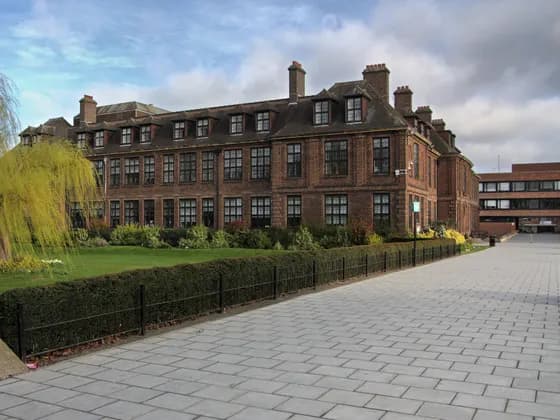
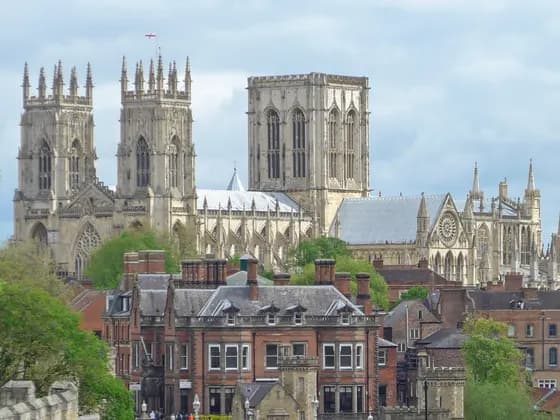

Photo: Tadeusz Hare · CC BY-SA 4.0 · cropped
Photo: Paul Lakin · CC BY 3.0 · Photo: Tim Green from Bradford · CC BY 2.0 · Photo: Ridiculopathy · CC0
The Hull York (HYMS) medicine course at a glance (2027 entry)
Hull York Medical School (HYMS) is a joint medical school run by the University of Hull and the University of York, working with NHS hospital trusts across its region. Its five-year MB BS (Bachelor of Medicine, Bachelor of Surgery) is awarded jointly by both universities. For the September 2026 intake the school listed 228 places for UK students and 11 for international students.
The course is built around problem-based learning (PBL). Instead of starting from a lecture series, you meet in a small group with an experienced clinician as your tutor and work through a made-up patient case. The group decides what it needs to find out, and the lectures, anatomy, clinical skills classes and placement that follow all help you understand the same case.
Patients appear early. Regular clinical experience starts in the third week of year 1, with part-time placements in or around Hull or York. From year 3 you are on full-time placements, and by year 5 you work as the most junior member of hospital and GP teams.
Where you live changes as the course goes on. With your offer you are randomly allocated a home campus, Hull or York, for years 1 and 2, and both campuses teach the same curriculum. From year 3 you are given a base in Hull or York each year. Some of your placements will be away from that base, at hospitals that may include Grimsby, Scunthorpe, Scarborough, Northallerton and Middlesbrough.
The course runs in three phases: Phase I is years 1 and 2, Phase II is years 3 and 4, and Phase III is year 5. Alongside the core teaching you complete a small project in each of the first four years, and year 5 opens with a six-week elective.
| Degree | MB BS, awarded jointly by the University of Hull and the University of York |
|---|---|
| Course length | 5 years full-time, in three phases |
| UCAS code | A100 (institution code H75) |
| Places | 228 home and 11 international places for September 2026 entry |
| Years 1 and 2 | Based at the Hull or York campus, allocated at random |
| Teaching style | Problem-based learning in small groups led by clinician tutors |
| Anatomy | Prosections, models and imaging; dissection only through a project, the elective or an MSc |
| First patient contact | Regular clinical experience from the third week of year 1 |
| Placement hospitals | Eight hospitals across Hull (two), York, Scarborough, Grimsby, Scunthorpe, Northallerton, Middlesbrough |
| Intercalation | Optional extra year, taken after year 2 or year 3 |
What makes Hull York (HYMS) medicine different
An experienced clinician runs your PBL group
Your PBL group is led by an experienced clinician who works in a hospital or GP surgery, so case discussions come with real clinical examples. You keep the same group for all of year 1, then join a new one in year 2. The same tutor is your main pastoral contact, the person who checks you are settling in and coping with the course.
Placements at eight hospitals across a wide region
From year 3 your placements can take you to any of eight named hospitals, from James Cook University Hospital in Middlesbrough down to Diana, Princess of Wales Hospital in Grimsby. GP surgeries and community services add to the mix. The school describes rural, coastal and city settings, so the patients you meet change from site to site.
A year-long clerkship option in semi-rural North Yorkshire
In year 4, up to 16 students can swap the usual rotations for a Longitudinal Integrated Clerkship (LIC). You stay with one GP surgery near Northallerton for the whole year, follow the same patients when they go into hospital, and work up to running your own supervised clinic. You work to the same learning outcomes and sit the same exams as the rest of year 4.
Final clinical exams use long patient encounters
The final clinical exam is an Objective Structured Long Examination Record (OSLER) rather than a circuit of short stations. At each long station you spend time with a real or simulated patient, then an examiner questions you on your reasoning and management. The General Medical Council (GMC), which regulates doctors, approved it in 2024. Year 4 also ends with an OSLER.
Two universities, one curriculum
You register as a student of either Hull or York, depending on your allocated campus, but you can use facilities at both universities, such as libraries and computing. Teaching follows the same curriculum on both campuses, and everyone graduates with the same MB BS awarded jointly by the two universities.
A project of your choosing in years 1 to 4
In the Scholarship and Special Interest Programme (SSIP) you complete a project of your choice in each of years 1 to 4. In Phase I you pick from projects run by tutors who are active researchers. In Phase II you move on to clinical projects, such as audits that check care against agreed standards. The school describes the year 5 elective as the final part of the programme.
How Hull York (HYMS) teaches medicine
The curriculum is integrated, which means subjects are not taught in separate blocks. The school's assessment rules group the summative exams into three themes. Applied Life Sciences is the science of how the body works and goes wrong. Clinical Skills and Reasoning covers consultations, examination and diagnosis, and Health, Society, Professionalism and Ethics covers ethics, professional behaviour and the social side of health.
In Phase I you are on campus at Hull or York. The current PBL case sets the agenda, and lectures, workshops, anatomy sessions, clinical and communication skills classes and a regular placement are arranged around it. Much of the learning is self-directed: you research the questions your group has set, then bring what you found back to the next session.
In Phase II and Phase III the balance moves to hospital wards and GP surgeries. You still have seminars, teaching sessions and clinical skills practice, but these take place in teaching facilities inside each placement hospital. Clinical reasoning workshops run through Phase II, and communication masterclasses taught by GPs and hospital doctors continue in years 3, 4 and 5.
Attendance is part of the course requirements. The school's training agreement for 2026-27 says you are expected to attend from 8am to 6pm, Monday to Friday. Placements count as full-time, and on placement you will occasionally work evenings and weekends.
The ways you will learn
| Problem-based learning | A small group meets with a clinician tutor to work through a hypothetical patient case. In the first session you work out what you do not yet understand and set learning goals. In a follow-up session you share what you found and the tutor makes sure the key points are covered. You stay in one group for year 1 and move to a new group in year 2. |
|---|---|
| Lectures and workshops | These give you the core knowledge linked to the current PBL case. They sit alongside PBL rather than replacing it, and from year 3 they give way to seminars and teaching sessions held at the placement hospitals. |
| Clinical and communication skills classes | Small-group classes led by a clinician tutor. You learn physical examination by examining each other in supervised mixed-gender groups, known as peer physical examination. You practise consultations with simulated patients, many of them professional actors, while classmates watch over a live video link and then give you structured feedback. |
| Clinical placements | Supervised time with patients in GP surgeries, hospitals and community services. Placements are regular but part-time in years 1 and 2 and full-time from year 3, with a clinical tutor acting as your Educational Supervisor. |
| Procedural skills and simulation | From year 3, at the hospital teaching facilities, you learn practical procedures such as suturing, taking blood, and inserting cannulas (thin tubes placed into a vein) and catheters. You can practise each several times. You also take part in scenarios on a simulator mannequin that can mimic a range of symptoms and responses to drugs, then give and receive feedback as a group. |
A typical week on the Hull York (HYMS) course
In April 2026 the school published accounts from two Phase I students, one based in Hull and one in York, describing their weeks. The school notes that individual accounts may not apply to every student. Both describe the same cycle, built around one PBL case that runs from a Thursday to the following Monday.
From year 3 the week is organised around full-time placements instead, as described in the year-by-year section below.
- Thursday: the new PBL case is introduced. The group picks out the key issues and sets learning objectives, with members taking roles such as chair or scribe. The Hull student also had clinical skills and anatomy that day, making it her busiest.
- Friday: lectures linked to the case. The Hull student said these were sometimes given in Hull and sometimes streamed from York.
- Weekend: independent study on the learning objectives, concentrating on topics you find harder or more interesting.
- Monday: the group meets again to review what everyone found, often using quizzes or games to test each other.
- Tuesday: clinical placement. The York student described a half-day in a hospital or GP surgery, talking to patients in small groups, taking histories and sometimes practising basic examinations. The Hull student alternated between GP and hospital settings.
- Wednesday: both students described a lighter day, used for rest, sport and preparing for the next case.
How anatomy is taught at Hull York (HYMS)
You learn anatomy in weekly sessions tied to the PBL case, so the structures you study match the patient problem your group is working on. The focus is on anatomy you will use as a doctor: explaining a patient's symptoms, carrying out examinations and reading clinical images.
The main teaching material is prosections. These are real human specimens that the school's anatomists have already dissected to show particular structures, so you can study a region quickly and compare how it varies between bodies. Some are formalin-embalmed, which keeps them flexible enough to move structures and see how they sit in three dimensions.
Others are plastinated, meaning the body fluids and fat have been replaced with materials such as silicone resin. They are firmer, can be handled without gloves and last indefinitely. You also use anatomical models, which can be taken into PBL sessions, and medical imaging such as CT, MRI and ultrasound, which is how most doctors see anatomy in practice.
For study outside the lab you get access to two digital 3D programs, Complete Anatomy and Acland's Video Atlas of Human Anatomy, both usable in class and from home.
Dissecting a body yourself is not part of the core course. If you want to, you can carry out a detailed dissection of one region of the body as an SSIP project or during the year 5 elective. Whole-body dissection is available if you intercalate on the MSc in Clinical Anatomy or the MSc in Clinical Anatomy and Education.
Anatomy is tested partly through spotter exams. You move round stations of specimens with labelled structures and answer questions on what a structure is, what it does or how it relates to its neighbours. Year 1 includes a formative spotter, a practice exam that gives feedback but does not count towards progression.
When you first meet patients at Hull York (HYMS)
Clinical experience starts in the third week of year 1. In years 1 and 2 placements are in or around your home campus city, and you work in small groups under a clinical tutor, talking to patients, taking histories and starting to examine them. What you see on placement links back to your PBL case.
Students' own accounts on the school's website fill in the detail for year 1. Placement is usually half a day a week, in a group of about two to five students with a tutor, and alternates week by week between a hospital and a GP surgery. You go over pre-set work with the tutor first. Then one student takes the patient's history while the others watch, add their own questions and give feedback afterwards.
You prepare for placements in clinical skills classes. From year 2 you also have dedicated sessions on clinical reasoning, which is the process of working out the most likely cause of a patient's symptoms from the history, the examination and test results.
Year 3 is the step up to full-time clinical work in hospitals, GP surgeries and community services, and your responsibility grows from there. By year 5 you take part in on-call and shift work, are allocated your own patients on surgical placements, and manage common conditions in general practice under supervision.
In the same set of accounts, final-year students describe days that start with handover and a ward round, where the consultant may quiz you. Afternoons bring clinics, prescribing and clinical skills, and you help the team with jobs such as taking blood, inserting cannulas and catheterising patients.
Year by year at Hull York (HYMS)
- Year 1
Phase I: PBL foundations on your home campus
You start at your allocated campus in Hull or York and join a PBL group that stays together for the whole year, led by a clinician tutor. Science, clinical skills and professional topics are taught around the PBL cases, and placements begin in week three.
- PBL cases drawing on applied life sciences, health in society, and professionalism and ethics.
- Clinical and communication skills classes, including peer physical examination and consultations with simulated patients.
- Weekly anatomy sessions, with a formative spotter exam.
- Your first SSIP project, chosen from a range of topics and supervised by tutors who are active researchers.
- Formative written assignments, online tests and oral presentations, then summative written papers at the end of the year. There is no summative clinical exam in year 1.
- Year 2
Phase I continued: a new group and clinical reasoning
Year 2 keeps the same PBL pattern on the same campus, but with a new group. Clinical skills teaching starts to focus on clinical reasoning, and the year ends with your first summative clinical exam alongside the written papers.
- A new PBL group, continuing the case cycle alongside lectures, anatomy and regular placements in or around Hull or York.
- Dedicated clinical reasoning sessions within the clinical skills curriculum.
- A second Phase I SSIP project, again chosen from a range of topics and individually graded.
- A formative clinical skills exam, plus written assignments, online tests and presentations. This practice clinical exam may be an Objective Structured Clinical Examination (OSCE), which is a circuit of short timed stations, or an OSLER.
- End-of-year summative written papers and a clinical exam in OSCE format, all of which you must pass to move into Phase II.
- The option to intercalate after year 2 on a specially designed intercalated BSc.
- Year 3
Phase II: full-time placements begin
From year 3 you are on full-time clinical placements. Each year you are allocated a base site in Hull or York. You rotate through hospitals, GP surgeries and community services across the region, returning to the hospital teaching facilities for seminars and skills sessions.
- In years 3 and 4, unless you take the LIC, you spend four days a week in a hospital and one day in a GP surgery, with visits to community services.
- Practical procedures such as suturing, taking blood, and inserting cannulas and catheters, signed off by hospital clinical supervisors once you are competent under supervision.
- Simulation scenarios on a mannequin, and clinical reasoning workshops that continue through Phase II.
- A group SSIP: a quality improvement project, which means studying how care is delivered and testing a change to improve it, assessed by a group presentation.
- Formative OSLERs on at least one patient per rotation, then summative written papers and an OSCE clinical exam at the end of the year.
- The option to intercalate after year 3 on a BSc, a master's degree or, exceptionally, a PhD.
- Year 4
Phase II continued: specialties, or the LIC
The standard year 4 is made up of four eight-week clinical blocks, with a move to a new hospital and GP placement after 16 weeks. Alternatively, up to 16 students take the Longitudinal Integrated Clerkship based around Northallerton, covering the same ground across the whole year.
- Areas covered include child health, ear, nose and throat (ENT), eye medicine (ophthalmology), women's health including sexual health, skin conditions (dermatology), acute care, and care of older people and neuromuscular conditions, including palliative care.
- An individual SSIP on a clinical interest, which might be a research project, an audit or improvement project, or new teaching or assessment material for future doctors. It is assessed through a poster presentation.
- A summative clinical exam in the same OSLER format as the final exam. The GMC's 2024 report says it covers clinical areas the final exam does not, at the standard expected of a Foundation Year 1 doctor, meaning a doctor in their first year of work.
- Summative written papers. Passing everything in year 4, including the SSIP and portfolio, is required to enter the final year.
- LIC students work to the same learning outcomes and take the same assessments as students on rotations.
- Year 5
Phase III: elective and preparing for work
The final year opens with a six-week elective, then continues with rotations in medicine, surgery and general practice across the region. You act as an assistant intern, the most junior member of a multidisciplinary team of doctors, nurses and other professionals. The year is designed to prepare you to start work as a doctor.
- A six-week elective before final-year placements, followed by a summative presentation at the school's annual elective conference.
- Surgical placements where you are given your own patients, help with their care before and after operations and follow them to theatre.
- General practice placements where you see patients in surgery and manage common conditions under a GP's supervision.
- Experience of on-call and shift work, prescribing, and the routine procedures a resident (junior) doctor carries out.
- A student assistantship, which the GMC's 2024 report describes as the final rotation, shadowing a Foundation Year 1 doctor. You complete a portfolio of assessment during it.
- Final exams: the national Applied Knowledge Test, a computer-based exam of medical knowledge; the OSLER clinical exam; and the Prescribing Safety Assessment, a national online exam on safe prescribing.
- Applying for the Foundation Programme, the two years of training as a working resident doctor that follow medical school, through the UK Foundation Programme Office.
How you are assessed at Hull York (HYMS)
Assessment is split into formative and summative work. Formative assessments give you feedback but do not count towards progression, while summative assessments decide whether you move on. A compulsory formative test in the style of the real exams comes at the end of each block or rotation, and summative exams are held at the end of every year.
In years 1 to 4 the written papers combine multiple choice and modified essay questions. The multiple choice questions can be single best answer (pick the best of several options), extended matching (match options to several short scenarios) or true or false. Modified essay questions take you through a case in stages, with short written answers. Material from earlier years can come up again.
Clinical exams put you in front of a trained examiner who watches what you do. In years 2 and 3 the summative clinical exam is an OSCE, a circuit of short stations testing communication, physical examination and problem-solving with simulated patients or healthy volunteers. In years 4 and 5 it is an OSLER: at each long station you consult a real or simulated patient, then answer questions on the likely diagnosis and management.
In year 5 you sit the UK Medical Licensing Assessment (UKMLA), which the GMC requires UK medical graduates to pass before joining the medical register. Its written part, the Applied Knowledge Test (AKT), is set nationally with the Medical Schools Council and uses single best answer questions only. Its clinical part, the Clinical and Professional Skills Assessment (CPSA), is your year 5 OSLER. You must also pass the Prescribing Safety Assessment (PSA), a national online exam on prescribing medicines safely.
When the GMC approved the school's CPSA in March 2024, it had six stations, usually taken two a day over three days. Each station had 15 minutes with a real or simulated patient, three minutes of thinking time and 12 minutes of structured questions on problem-solving and management, three hours in total. The GMC's report noted the school was considering a move to eight stations from 2025, so the details may have changed.
Each summative assessment is graded Excellent, normally the top 15% of the cohort, Pass or Fail. An online portfolio records your attendance, professionalism and procedural skills and must be complete for you to progress. In years 1 to 4 you have two valid attempts at each assessment, and final-year assessments allow up to four. The MB BS is unclassified, but exceptional students can graduate with Honours.
- To graduate you must pass every year 5 summative assessment, including the AKT, the OSLER-based CPSA, the Prescribing Safety Assessment and the elective presentation.
- You must also complete the student assistantship and its portfolio, and show competence in all the required clinical procedures.
- Finally, you must be in good standing with the school's Student Fitness to Practise Committee, which decides whether a student is safe to continue towards becoming a doctor.
Where you will actually be at Hull York (HYMS)
In years 1 and 2 your placements are in or around Hull or York, depending on your home campus, and you are expected to live within 30 miles of your university during term. From year 3 you are allocated a clinical base site in either Hull or York each year and keep your own accommodation there.
Some placements are away from your base, in towns such as Grimsby, Scunthorpe, Scarborough, Northallerton or Middlesbrough. When a placement needs extra accommodation, the school gives support so you do not pay for two homes at once, either by reimbursing you or by paying some costs directly. You agree each year to attend any placement site the school assigns, and requests to change cannot always be met.
Each placement hospital has a student teaching area with a medical library, computers, lockers, a kitchen and a common room. A Student Liaison Team and the Primary Care Team are based there to organise and support you. The school says it reviews its placements regularly, so arrangements may change in future years.
Both run by Hull University Teaching Hospitals NHS Trust. Hull is one of the two base sites from year 3.
- Hull Royal Infirmary
- Castle Hill Hospital
Run by York and Scarborough Teaching Hospitals NHS Foundation Trust. York is the other base site from year 3.
- York Hospital
Run by the same trust as York Hospital.
- Scarborough Hospital
Run by Northern Lincolnshire and Goole NHS Foundation Trust.
- Diana, Princess of Wales Hospital
Also run by Northern Lincolnshire and Goole NHS Foundation Trust.
- Scunthorpe General Hospital
The Friarage is run by South Tees Hospitals NHS Foundation Trust and has a medical education facility called STRIVE. This is the home of the year 4 LIC.
- Friarage Hospital
- Semi-rural GP practices within 20 miles of the Friarage
Run by South Tees Hospitals NHS Foundation Trust. LIC students have scheduled time here to cover learning they cannot get at the Friarage or in their GP surgery.
- James Cook University Hospital
General practice runs through the whole course, from early visits in year 1 to managing common conditions under a GP's supervision in year 5.
- GP surgeries
- Community services in dermatology, sexual health, mental health, women's health and paediatrics
Electives and chosen modules at Hull York (HYMS)
The SSIP runs through years 1 to 4. In each Phase I year you choose a project from a list and work with tutors who are active researchers. Themes range from medical humanities and health inequalities to global public health, experimental medicine and biomedicine. Each project is graded, and you must pass it to progress.
In Phase II the projects become clinical and follow your own interests. In year 3 you work in a group on a quality improvement project and present it together. In year 4 you complete an individual project, which could be research, an audit of patient care, or teaching and assessment materials for future doctors, and present it as a poster. LIC students can link theirs to their GP placement.
The elective is six weeks long and comes in year 5, before final-year placements. You choose where to go and what to do: more time in an area of practice that interests you, research, or a specialty you have not yet seen. The school lists past destinations including the Institute of Neurology in London, Fort William, Shetland, Vanuatu, Nepal, Belize, Malaysia, South Africa and NASA in the USA.
You pay for the elective yourself, and costs depend on where you go. Afterwards you present your experience at the school's annual elective poster and presentation conference, and you must pass this presentation to graduate.
For extra research experience, the school takes part in INSPIRE, a national scheme coordinated by the Academy of Medical Sciences and funded by the Wellcome Trust. Its funding, received since 2014, pays for student projects, an annual student conference and workshops. The student research society runs its own annual conference, and the school offers help with costs if you are invited to present at a research conference.
Intercalation at Hull York (HYMS)
Intercalating means taking a year out of the MB BS to complete a separate degree, which adds a year to your studies. It is optional at HYMS, but the school encourages everyone to consider it. You can intercalate after year 2 on a specially designed intercalated BSc, or after year 3 on a BSc, a master's degree or, in exceptional cases, a PhD.
You can study at HYMS or at another university in the UK or abroad. The school's own master's options are Clinical Anatomy; Clinical Anatomy and Education; Health Technology and Human Anatomy; Health Professions Education; Pharmacology and Drug Development; and Pharmacology and Education. The two Clinical Anatomy courses include whole-body dissection. There is also a research MSc by thesis.
Two intercalated BSc (Hons) Medical Sciences degrees are run with the parent universities. One is based at Hull's Centre for Biomedicine. The other is with York's Department of Biology and covers topics such as cancer biology, infectious disease, immunology and neuroscience. The school also lists master's courses at the two universities, including public health, mental health research, and health and climate change.
Facilities and support at Hull York (HYMS)
Where you will learn
In Hull, the medical school is based in the Allam Medical Building, at the centre of the University of Hull's £28 million health campus. In the building you mix with students training in nursing, midwifery and as physician associates.
In York, the school's teaching space was refurbished in 2020 at a cost of £5.8 million and includes a PBL suite and a collaborative learning space. Clinical skills are taught in rooms in the nearby Seebohm Rowntree Building.
From year 3 most teaching moves to the student teaching facilities at each placement hospital, where you practise procedures and run simulated scenarios with a mannequin. Students on the LIC also use the STRIVE medical education facility at the Friarage Hospital.
Support while you study
Your PBL tutor, an experienced clinician, is your main pastoral contact in the early years. On placement a clinical tutor acts as your Educational Supervisor, helping you develop your consultation and examination skills. On the standard year 4 you change supervisor after 16 weeks, while LIC students keep one supervisor for the year and have weekly supervision.
Every placement site has a Student Liaison Team that helps with local learning issues and can advise on living in the area. The Student Wellbeing Team specialises in supporting medical students and can point you to help in the school, the two universities or outside services. There is also a dedicated mental health practitioner you can contact directly and in confidence.
A Case Management Group picks up early concerns, such as poor attendance, late work or skipping practice assessments, and offers support before anything becomes a formal fitness to practise matter. You can also use student support services at both universities, and student representatives sit on the school's Student Staff Committee and Management Board.
Is the Hull York (HYMS) course right for you?
This course may suit you if
- You learn well by talking problems through in a small group and then researching the gaps yourself, since PBL cases drive the first two years.
- You want to meet patients almost straight away, with regular clinical experience from the third week of year 1.
- You would like to see medicine in cities, coastal towns and rural areas, with placements from Middlesbrough to Grimsby.
- You are interested in general practice or continuity of care and would value the option of a year following the same patients on the LIC.
- You want research or quality improvement experience built into each of years 1 to 4 through the SSIP.
Things to think about
- You do not normally choose between Hull and York: campuses are allocated at random, with requests considered only in specific circumstances.
- From year 3 you should expect placements away from your Hull or York base, in towns such as Grimsby, Scunthorpe or Middlesbrough, although the school helps with the cost of extra accommodation.
- If hands-on dissection matters to you, it is only available through an SSIP project, the elective or an intercalated master's degree, not as a routine part of the course.
- PBL relies on self-directed study, and the students' own accounts describe spending weekends researching the week's learning objectives.
- At each long station of the final clinical exam, an examiner questions you on your reasoning and management (for 12 minutes when the GMC reviewed it in 2024). You need to be comfortable explaining your thinking out loud.
Hull York (HYMS) medicine course — frequently asked questions
Applying to Hull York (HYMS)?
How to get into Hull York (HYMS)
Entry requirements, UCAT, personal statement and interview, step by step.
Open the guide →Hull York (HYMS) UCAT cut-offs and offers
UCAT cut-offs, A-level offers, interview format and decision dates.
See the requirements →Compare Hull York (HYMS) with other schools
Put the teaching style, anatomy teaching and placements next to another school.
Open the comparison →Prepare for the Hull York (HYMS) interview
Format breakdown, school-specific sample questions and prep tips from tutors who interviewed here.
Read the guide →Where this Hull York (HYMS) course guide came from
This guide was written from 32 official sources — Hull York Medical School's own course pages and programme documents, plus the regulator and NHS placement partners where they publish detail — read on 2026-09-24, then checked claim by claim against those sources.
- MB BS Medicine course page, Hull York Medical School
- Curriculum overview, Hull York Medical School
- Problem based learning, Hull York Medical School
- Clinical placements, Hull York Medical School
- Anatomy teaching, Hull York Medical School
- Clinical and communication skills, Hull York Medical School
- Assessment and feedback, Hull York Medical School
- Scholarship and Special Interest Programme, Hull York Medical School
- Elective, Hull York Medical School
- After medical school, Hull York Medical School
- Longitudinal Integrated Clerkship, Hull York Medical School
- Intercalation for Medicine students, Hull York Medical School
- Intercalated degrees offered by Hull York Medical School
- Research opportunities for Medicine students, Hull York Medical School
- Campus allocation, Hull York Medical School
- Accommodation, including placement years, Hull York Medical School
- Life in Hull, Hull York Medical School
- Life in York, Hull York Medical School
- Support and wellbeing for Medicine students, Hull York Medical School
- MB BS Medicine with a Gateway Year, Hull York Medical School
- Phase 1 spotlight: a Hull-based student's week, published April 2026
- Phase 1 spotlight: a York-based student's week, published April 2026
- What is it like on clinical placements? Student accounts, Hull York Medical School
- Regulations for the degree of MB BS, approved July 2026
- Code of Practice on Assessment and Evaluation for MB BS, from 2026-27
- Conditions of Training Annual Agreement for MB BS students, 2026-27
- GMC compliance decision on the Hull York CPSA, March 2024
- GMC compliance decision on the Hull York AKT, June 2024
- Hull University Teaching Hospitals NHS Trust, our hospitals
- York and Scarborough Teaching Hospitals NHS Foundation Trust
- Northern Lincolnshire and Goole NHS Foundation Trust
- South Tees Hospitals NHS Foundation Trust
Courses are restructured between cycles. Anything here that decides your application — an anatomy offer, a placement city, a compulsory intercalated year — should be confirmed against the official page for your entry year.
Applying to Hull York (HYMS)?
We have helped hundreds of applicants turn their UCAT, personal statement and interview prep into offers from Hull York (HYMS) and other UK medicine schools.