
The King's College London (KCL) Medicine course
What you actually study, and where you will be
King's College London's MBBS is a 5-year (6 with intercalation) course taught through case-based learning in an integrated curriculum, with placements in London and the south east of England (2027 entry). An integrated London course built around three stages rather than years, taught across Guy's, King's and St Thomas'. The placement estate reaches well beyond London — district general hospitals across the south east and more than 350 general practices.
- Degree
- MBBS
- Length
- 5 years (6 with intercalation)
- Teaching
- Integrated + Case-based learning
- UCAS code
- A100

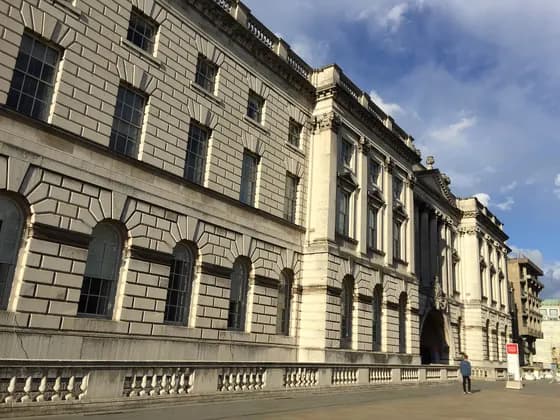
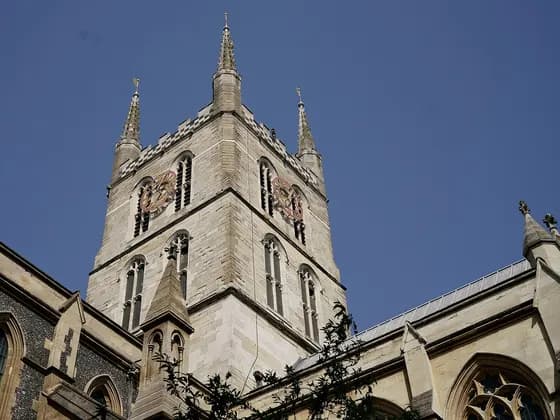
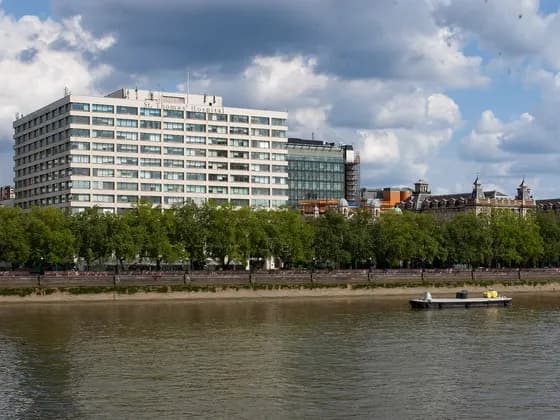
Photo: K Ulysses-Ono · CC BY-SA 4.0 · cropped
Photo: KiloCharlieLima · CC BY-SA 4.0 · Photo: Peter Trimming · CC BY-SA 2.0 · Photo: Jim Osley · CC BY-SA 2.0
The King's College London (KCL) medicine course at a glance (2027 entry)
Medicine at King's College London leads to an MBBS, the standard UK medical degree, and takes five years. It is taught by King's medical school, the GKT School of Medical Education, whose three main partner hospitals are Guy's, King's College Hospital and St Thomas'. Teaching is based at two London campuses: Guy's, next to London Bridge, and Denmark Hill a few miles south. The UCAS code is A100. Around 300 students start A100 each year, inside a medical school of about 2,400 students across all its entry routes.
The course is organised as three stages rather than five separate years. Stage 1 is year 1: biomedical science plus population science, which is how illness and health vary across whole groups of people rather than in one patient. Stage 2 covers years 2 and 3 in blocks built around stages of life and around the processes that make people ill. Stage 3 covers years 4 and 5 and aims to get you ready to start work as a doctor.
Science and clinical work are taught next to each other rather than as two separate halves of the degree. Year 1 is mostly campus-based. From year 2 you are in one general practice for a day a week across the whole academic year. From year 3 most of your time is in hospitals and community services.
Placements are not confined to central London. King's also uses district general hospitals, which are the general hospitals serving a town or a county rather than a big city teaching centre, currently mostly in Kent and Sussex. There is a large network of teaching general practices too. Unless there are exceptional circumstances, every student spends time at both London and non-London sites.
A thread of project work runs through the degree. A student selected component, a scholarly project, a quality improvement project and an elective all carry credit, and all involve choice about what you study. In a student selected component you pick a subject or a short course and study it in more depth.
| Degree | MBBS |
|---|---|
| Course length | Five years, or six with the optional intercalated BSc |
| UCAS code | A100 |
| Course structure | Three stages: year 1, years 2 and 3, years 4 and 5 |
| Main campuses | Guy's Campus and Denmark Hill Campus, London |
| Main teaching hospitals | Guy's, St Thomas' and King's College Hospital |
| Anatomy teaching | Dissection of donated bodies, in the Guy's Campus dissection rooms |
| First patient placement | Year 2, one day a week in the same GP practice |
| Placement area | South London, Kent, Medway and Sussex |
| Intercalation | Optional one-year BSc between years 3 and 4 |
| Year group | Around 300 students on the A100 course |
| Medical students | Around 2,400 across all years and entry routes |
What makes King's College London (KCL) medicine different
A whole year attached to one GP practice
In year 2 you join a single practice in a group of eight students and return to it for 22 days across the year, always with the same GP tutor. That placement makes up a quarter of your year 2 studies. Your tutor is also your educational supervisor and signs off your portfolio.
An eight-week GP block in the final year
In year 5 you are based in one practice for eight weeks. By the end of week two you consult alone in your own room, working towards 20 to 30 clinical encounters a week. Two hours of one-to-one tutorial are protected each week, alongside an online seminar with students placed elsewhere.
Quality improvement is a must-pass module
In year 4 you work in a group of three to five students on a quality improvement project, a structured attempt to make one part of a service work better. It is a 30-credit module you have to pass, with Wednesday mornings protected for it.
Placements well beyond central London
Alongside the three big London teaching hospitals, King's places students at district general hospitals across Kent and Sussex, including Maidstone, Medway, Ashford, Margate, Eastbourne and Hastings. Everyone spends time at both London and non-London sites.
A shadowing module after finals
Transition to Foundation Year 1 is a 30-credit module at the end of year 5, taken once you have sat your finals. Foundation Year 1 is the first of two paid, supervised years every UK medical graduate works before choosing a specialty. At East Sussex Healthcare NHS Trust, students on it spend most of their time shadowing the foundation doctors they are about to replace.
How King's College London (KCL) teaches medicine
King's runs an integrated course: the science and the clinical material are taught next to each other rather than in separate blocks of years. Year 1 is mostly campus-based, built from lectures, seminars and independent study. King's counts one credit as roughly ten notional hours of learning, so year 1 at 120 credits stands for about 1,200 hours of taught and private study.
From year 2 the balance tips towards patients. One day a week is spent in general practice, and the rest of the week mixes campus teaching, clinical skills work and, from year 3, hospital attachments. King's uses the word block to mean an eight-week unit of clinical time, and each clinical year is built from several of them.
Stage 2, across years 2 and 3, is worth 300 credits; Stage 3, across years 4 and 5, is worth 360. In years 4 and 5 you work much more like a junior member of the clinical team. Most learning happens on placement, with a central King's teaching session online on Wednesday mornings.
The final year adds a weekly online seminar, where students at different practices compare what they have seen. It also adds the turnaround clinic, in which you and your GP tutor take turns watching each other consult. The point of both is to make your own reasoning visible so it can be corrected.
The ways you will learn
| Lectures and seminars | Large-group lectures introduce the science and smaller seminars work through it in discussion. These dominate year 1 and stay on the timetable as campus days later in the course. |
|---|---|
| Case-based learning (CBL) | You work through a real patient case in a small group with a tutor guiding the discussion, rather than being left to run the session yourselves. King's said in its July 2023 applying to medicine FAQ that it uses case-based learning extensively, and that problem-based learning, or PBL, the same idea with far less tutor input, features only on its separate widening-access route. |
| Anatomy practicals | Sessions in the dissection rooms at Guy's Campus, worked through at numbered stations. Medicine students dissect donated bodies themselves rather than only studying specimens somebody else has already opened up. The larger room has projectors, screens and tablets around it so a group of 160 can still be taught in small clusters. |
| Clinical skills and simulation | Sessions in the SaIL centres, which combine clinical skills teaching with high-fidelity simulation. You practise observations, patient assessment and examination, cannulation, suturing and injection technique in a risk-free setting before doing any of it on a real patient. |
| GP teaching clinics | In year 2 you and a partner sit in with your GP tutor for a surgery of about six booked patients over two hours. The mix of pre-booked and same-day appointments means you see problems as they actually arrive. |
| GP simulation clinics | Four days a year at the Royal College of General Practitioners. One group of students works through five simulated appointments in the morning and a second group repeats them in the afternoon, so your sitting is half a day. You consult with actors trained to play patients and with expert patients, who live with a condition and help teach. Peers and a GP watch and give feedback. |
| Hospital blocks | Eight-week attachments to a clinical area at a partner hospital, learning on wards and in clinics alongside the team looking after those patients. |
A typical week on the King's College London (KCL) course
In year 1 the week is built from lectures, seminars, anatomy sessions and your own reading, almost all of it on campus. King's said in its applying to medicine FAQ, published in July 2023, that the earlier years of the course run more or less nine to five. Later on, as the work becomes clinical, you need to be able to stay past five when the team you are with is still going.
In year 2 one day a week is a practice day, on either a Tuesday or a Friday. Half the day is a workshop for the whole group of eight, on a theme such as breathlessness, safe prescribing or a painful joint. For the other half, one or two pairs sit in on a teaching clinic while the rest do group project work or visit patients from their patient bank.
In years 3 and 4 most days are spent on an eight-week hospital block, on wards and in clinics alongside the team looking after those patients. Four days a year are different: you go to the Royal College of General Practitioners for a simulation clinic. One group of students works through five simulated appointments in the morning and a second group repeats the same five in the afternoon, so your own sitting there is half a day.
The final-year GP block defines the week as ten sessions. Five are supervised clinical sessions in the practice, each three and a half to four hours. One is a two-hour online seminar with a GP teacher. Wednesday morning is a central teaching session run by King's and delivered online, and Wednesday afternoon is your own time. The last two sessions are private study.
On top of those ten sessions, two hours of one-to-one tutorial with your GP tutor are protected every week of the block. Consultation length is agreed with your tutor and shortens over the eight weeks, starting around 60 minutes and working down towards 30.
- Year 2 practice days run on Tuesdays or Fridays, for 22 days across the academic year.
- Year 2 also has six campus days, and on those days nobody is at the practice.
- Three further year 2 teaching days are held at the Royal College of General Practitioners, on clinical reasoning, on clinical examination in the consultation, and on putting it all together.
- In year 4, Wednesday mornings are kept free for the quality improvement project.
How anatomy is taught at King's College London (KCL)
Anatomy in year 1 sits inside a 45-credit module called Physiology & Anatomy of Systems. Structure and function are taught together, so the week you learn how a body system is built is also the week you learn how it works.
Two words are worth knowing before an open day. Dissection means students open a donated body themselves, over weeks or months. Prosection means an expert has already done that work and you study the structures they have exposed.
At King's, medicine students dissect. You work on bodies donated for teaching, in the dissection rooms at Guy's Campus, and the larger of the two rooms takes up to 160 students and 80 donated bodies at a time. Every year staff and students attend a service of thanksgiving at Southwark Cathedral for the people who made that gift.
The larger room is laid out as 12 stations, with a wide range of dissection and prosection material, projectors, screens and tablets, so a big cohort can still work in small clusters. The smaller room seats about 40 at 16 height-adjustable stations and is used for specialist modules and for surgical training courses on unembalmed specimens.
Guy's Campus also holds the Gordon Museum of Pathology, whose job is to help medical, dental and biomedical students and professionals learn to diagnose disease. It keeps about 8,000 specimens, the oldest of them dating from 1608. They include Lister's antiseptic spray, and the kidneys, adrenal glands and lymph nodes that led Richard Bright, Thomas Addison and Thomas Hodgkin to describe the three diseases now named after them.
- King's anatomy pages point people who want to donate their body towards the London Anatomy Office, which coordinates donation to London's medical and dental schools.
When you first meet patients at King's College London (KCL)
Year 1 is mostly campus-based, but it includes a 30-credit module called Introduction to Values Based Clinical Practice. Values based clinical practice is the King's phrase for the human side of the job. The assessment form used later in the course spells out what it means. You address the patient's problem, treat them with dignity and respect, build trust, show empathy and keep confidence.
Real placements begin in year 2, in general practice. Each pair of students is given two patients who have consented to regular student contact, and follows them through the year, visiting them away from the timetabled clinics. They are picked to include common long-term conditions such as diabetes or chronic lung disease, and people with more complicated needs such as dementia or the effects of a stroke. Some groups also follow a woman through pregnancy and birth.
Examination skills are layered year by year. In year 2 you learn to examine the respiratory, cardiovascular and abdominal systems. Year 3 adds neurological and musculoskeletal examination, and in year 4 each block brings its own, such as examining a child. By the final year you are expected to take clinical responsibility under close supervision.
Year by year at King's College London (KCL)
- Year 1
Stage 1: the science foundation
Year 1 is the whole of Stage 1 and is mostly taught on campus. It covers biomedical and population science, the physiology and anatomy of each body system, and an introduction to what clinical practice asks of you. It is worth 120 credits and there are no optional modules.
- Foundations of Biomedical Science, a 45-credit module.
- Physiology & Anatomy of Systems, a 45-credit module covering the structure and function of each body system.
- Introduction to Values Based Clinical Practice, a 30-credit module.
- An early formative assessment, meaning one that gives you feedback without counting towards your degree, designed to spot students who need extra support.
- Portfolio assessment begins here and runs for the rest of the course.
- Stage 1 ends with written examinations.
- Year 2
Stage 2: first placements and the GP year
Year 2 is where clinical placements start. A general practice placement runs all year and accounts for a quarter of your studies, while the rest of the year builds the science and clinical reasoning behind what you see there. Stage 2 runs across years 2 and 3 as one 300-credit set of modules, so the two years do not split into separate module lists.
- From Science to Clinical Practice 1 (105 credits) and 2 (120 credits) are the two big Stage 2 modules, taken across years 2 and 3.
- Digital Health and Doctor as Teacher, two 15-credit Stage 2 modules, sit alongside them.
- A longitudinal GP placement: 22 days at one practice, in a group of eight, on Tuesdays or Fridays.
- Workshops on themes such as eliciting a history, digital primary care, safe prescribing, breathlessness and health promotion.
- At least one health check clinic per pair, screening patients for long-term conditions and discussing lifestyle.
- A group assignment on health inequalities and the needs of the local population.
- A 14-week student selected component, usually starting the second Thursday in January.
- Three progress tests, which are written papers spread through the year that sample the whole course rather than just the last block, plus a practice OSCE in the week beginning 29 March. An OSCE, or Objective Structured Clinical Examination, is a circuit of short timed stations.
- A portfolio of five written-up cases and reflective accounts.
- The portfolio also holds a mini clinical evaluation exercise, where a tutor watches you take a history or examine a patient and writes you feedback, and a case-based discussion, where you talk a tutor through a patient you saw.
- Year 3
Stage 2: hospital blocks begin
Year 3 moves you into hospital, rotating through four clinical blocks while a mental health placement runs across the whole year. General practice teaching continues, but in simulation at the Royal College of General Practitioners rather than in a surgery. Stage 2 finishes at the end of this year.
- Four hospital blocks: vascular; cancer and clinical genetics; trauma and accidents; and cognition, movement and senses.
- A longitudinal mental health placement running alongside the hospital blocks.
- Four GP simulation clinic days at the Royal College of General Practitioners, with topics matched to the block you are on.
- A 30-credit scholarly project over 14 weeks, on Tuesdays or Fridays from mid-September, chosen from across the university.
- Neurological and musculoskeletal examination are added to the three systems you learned in year 2.
- Stage 2 ends here, with a written exam and an OSCE you have to pass before moving into Stage 3.
- Year 4
Stage 3: senior clinical blocks and quality improvement
Year 4 opens Stage 3, the part of the course aimed at practice. Four more hospital blocks cover specialties you have not yet met, and a group quality improvement project runs across the year on protected Wednesday mornings. Stage 3 is worth 360 credits across years 4 and 5.
- Four hospital blocks: child health; women's health; emergency and critical care; and mental health.
- Integrated Clinical Practice 1 (135 credits) and 2 (120 credits) run across years 4 and 5.
- The Quality Improvement & Evidence Based Practice Project, a 30-credit must-pass module run in groups of three to five.
- Tutorials with your supervisor work through plan-do-study-act cycles; the module guide published for 2023-24 sets out six, ending in a group presentation and an individual report.
- Four more GP simulation clinic days at the Royal College of General Practitioners, held on Fridays across the year.
- Block-specific examination skills, such as examining a child, taught at the end of the relevant block.
- Progress tests through the year and a practice OSCE in June, which is for feedback rather than for marks.
- Year 5
Stage 3: final year and the step into work
The final year is built around Integrated Clinical Practice 2 plus shorter modules that each do a specific job. You spend eight weeks in general practice, take an elective, sit the national licensing assessment, then shadow foundation doctors before starting work.
- The final-year GP block sits inside Integrated Clinical Practice 2, the 120-credit Stage 3 module.
- An eight-week GP block in one of three block periods running from June to December; a third of the year group is allocated to each.
- Two campus induction days open the block, including simulated surgeries with trained actors run by GPs; your first day in practice is the Wednesday afternoon of week one.
- By the end of week two you consult on your own in your own room, with your tutor reachable straight away.
- A portfolio of one observed consultation, a case-based discussion, six reflective notes and a daily engagement log, signed off by your GP tutor.
- Elective & Global Health, a 30-credit module, and a 15-credit Career Development Period.
- Transition to Foundation Year 1, a 30-credit module taken after finals.
- Finals: the end-of-Stage-3 OSCE you have to pass, which is the 16-station Clinical and Professional Skills Assessment, plus the national Applied Knowledge Test you must also pass to graduate.
How you are assessed at King's College London (KCL)
King's splits assessment into formative and summative. Formative work exists to give you feedback and does not count towards your degree; summative work decides whether you have met the standard. Stage 1 includes an early formative assessment whose purpose is to find students who need more support before anything is at stake.
Written assessment changes shape as you go. Stage 1 finishes with written examinations. In Stages 2 and 3 written knowledge testing is spread through the year as progress tests, which sample the whole curriculum rather than only what you have just covered. Year 2 alone has three of them. Stage 2 then closes with a written exam and a summative OSCE. In Stage 3 the written testing is those progress tests plus the national Applied Knowledge Test described below, and the summative OSCE is the Clinical and Professional Skills Assessment.
Practical assessment is by OSCE, short for Objective Structured Clinical Examination. An OSCE is a circuit of timed stations, each with a task such as taking a history or examining a system, and each marked against the same criteria for every candidate. King's set the pattern out in its July 2023 applying to medicine FAQ. The practice OSCEs in years 2 and 4 are there for feedback, and the ones in years 3 and 5 must be passed before you can move on.
Alongside exams, a portfolio runs from Stage 1 to graduation, collecting observed consultations, case discussions, reflective writing and attendance records signed off by your supervisors. The projects in Stages 2 and 3 are assessed in their own right.
Every UK medical student now has to pass the Medical Licensing Assessment, often written as the UKMLA, before joining the medical register. The General Medical Council (GMC) has required it to be part of any UK medical degree since the 2024 to 2025 academic year. It has two parts: an Applied Knowledge Test (AKT) and a Clinical and Professional Skills Assessment (CPSA). The GMC judged the King's versions compliant, the CPSA in March 2024 and the AKT in June 2024.
- The Applied Knowledge Test is two computer papers of 100 single-best-answer questions, each two hours, taken on consecutive days.
- Those papers are written and standard-set nationally through the Medical Schools Council, at the level of a doctor in their first week as a foundation doctor.
- This is the design King's set out to the GMC in 2024, when the regulator judged it compliant: a single OSCE of 16 stations over two days, eight minutes per station plus two minutes of reading time.
- To pass you need 12 of the 16 stations, plus an overall minimum competency score across the whole exam.
- The stations cover four physical examinations, four histories, three communication tasks, three practical skills and two whole-patient assessments.
- The four examination stations focus on the core body systems, most often cardiovascular, respiratory, gastrointestinal and neurological.
- It runs at four sites, and you are sent to ones unconnected to your placements, attending a different site each day.
- Real and simulated patients add a score of their own, based on whether they would want to see that doctor again.
- Stage 3 includes one external assessment supporting Foundation Year 1 training that you do not currently have to pass to graduate.
Where you will actually be at King's College London (KCL)
Your hospital learning is anchored on three large London teaching hospitals: Guy's, by London Bridge, St Thomas' in central London, and King's College Hospital at Denmark Hill. Around those sit district general hospitals and mental health trusts across south London, Kent, Medway and Sussex.
From year 3 onwards clinical time is organised into eight-week blocks. Unless there are exceptional circumstances, every student does both London and non-London placements, so expect part of your clinical years to be spent outside the city. Those peripheral placements are currently mostly in Kent and Sussex.
General practice teaching is run by a separate team, King's Undergraduate Medical Education in the Community, or KUMEC, based in Addison House on Guy's Campus. It works with a network of around 200 teaching general practices plus additional independent GP tutors, and the school describes clinical placements across more than 350 practices in total.
Travel and accommodation work differently depending on the placement. KUMEC allocates your GP practice, and final-year students are given a choice about the type and location of theirs.
For the final-year GP block you are expected to cover the equivalent of an off-peak Transport for London zone 1 to 6 day travelcard yourself, and to claim anything above that. Daily costs more than double that figure, or a plan to drive, need approval before the block starts.
On mental health blocks with the Kent and Medway trust, King's students are accommodated through partner acute hospitals. The trust reimburses approved travel between accommodation and placement, and King's covers one return journey at the end of the block.
- Attendance on the final-year GP block is expected to be 100 per cent, and anything under 90 per cent triggers a conversation between your tutor and the school.
- Eight monitored teaching sessions must be signed off during that block: a one-to-one tutorial, a mid-block turnaround clinic in week four or five, and six of the seven weekly seminars.
- On the Kent and Medway mental health block, King's runs a full day of teaching every Thursday, covering on-call psychiatry, child mental health, risk, and older adult mental health.
Clinical placement sites in Greater London, listed on the school's April 2024 map.
- Guy's Hospital
- St Thomas' Hospital
- King's College Hospital
- University Hospital Lewisham
- Queen Elizabeth Hospital, Woolwich
- Princess Royal University Hospital
- Croydon University Hospital
Where most of the non-London placements sit, listed as clinical placement sites on the school's April 2024 map.
- Darent Valley Hospital, Dartford
- Maidstone Hospital
- Tunbridge Wells Hospital
- Medway Maritime Hospital
- William Harvey Hospital, Ashford
- Queen Elizabeth the Queen Mother Hospital, Margate
East Sussex Healthcare NHS Trust takes King's final-year students at Eastbourne District General and the Conquest in Hastings, and runs the transition to foundation placement after finals. It teaches students from King's and from Brighton and Sussex Medical School.
- Eastbourne District General Hospital
- Conquest Hospital, Hastings
Kent and Medway placements run in East Kent at Ashford, Canterbury and Margate, and in West Kent at Dartford, Maidstone and Medway. The school's 2024 map still lists that trust under its former name, the Kent and Medway NHS and Social Care Partnership Trust.
- South London and Maudsley NHS Foundation Trust
- Oxleas NHS Foundation Trust
- Kent and Medway Mental Health NHS Trust
Around 200 teaching practices host the year 2 longitudinal placement and the final-year eight-week block.
Electives and chosen modules at King's College London (KCL)
Choice is built into the degree through four separate pieces of credit-bearing work. The student selected component in year 2 is a 15-credit module of projects or short courses in medical, scientific and non-medical subjects, picked according to your own interest. It runs for 14 weeks from January. King's says on the course page that it wants to widen the range of project modules and the choice inside them, so the projects on offer may differ by the time you reach them.
The scholarly project in year 3 is larger at 30 credits and runs for 14 weeks on either Tuesdays or Fridays from mid-September. Because King's is a multi-faculty university, the subject can be drawn from well outside medicine.
An elective is a placement you choose and largely arrange yourself, often abroad. It sits in Stage 3 inside a 30-credit module called Elective & Global Health. Medicine students can spend the fifth-year elective at one of King's partner institutions abroad, arranged through the GKT School of Medical Education.
Stage 3 also holds a 15-credit module called the Career Development Period, a further clinical placement that final-year students can choose to spend in general practice. The Royal College of General Practitioners South London Faculty awards an annual prize to final-year students who show real aptitude for general practice on any of these placements.
Intercalation at King's College London (KCL)
Intercalating means pausing the medical degree for a year to take a separate bachelor's degree, then returning. At King's it is optional, lasts one year, and must be taken between Stages 2 and 3, which in practice means between year 3 and year 4. Taking it makes the course six years instead of five.
King's currently lists nine intercalated BSc programmes: anatomy, developmental and human biology; cardiovascular medicine; global health; healthcare genetics and genomics; neuroscience; physiology; primary care; regenerative medicine and innovation technology; and women's health. Each involves studying a subject in more depth and running your own research project. King's said in its July 2023 applying to medicine FAQ that if it does not run the subject you want, you can spend that year at another university.
King's medical students must have passed Stage 1 and Stage 2 to be accepted onto one, and applications open on 1 October for the following September. The primary care iBSc shows what such a year can look like. It combines a general practice clinical experience, study of health systems and inequalities, a quality improvement project and a research project students are supported to write up for publication.
Facilities and support at King's College London (KCL)
Where you will learn
Clinical skills and simulation teaching happens in the King's Simulation and Interactive Learning centres, shortened to SaIL. There are two: the Weston Education Centre at Denmark Hill and the Chantler centre in Shepherd's House at Guy's Campus. They are set up as clinical classrooms and mock hospital and community settings, and are shared with nursing, midwifery, physiotherapy, nutrition and dental students.
The Chantler centre has eight hospital bed bays, actors who play patients, and mannequins that talk, breathe and have a pulse. They let you be taught anything from spotting an abnormal heart rhythm to defibrillation, the controlled electric shock used to correct a dangerous one. You are assessed there as well as taught there.
Guy's Campus holds the anatomy dissecting rooms, the Gordon Museum of Pathology and the Museum of Life Sciences. The latter opened in 2009 and its collection runs from skeletal material and preserved specimens to taxidermy, fossils and dried plants. Addison House on the same campus is home to the KUMEC team of 12 academics and six administrative staff.
Teaching materials, lesson plans and the intended learning outcomes for each placement sit on KEATS, the university's online learning platform, which your GP tutors use too. The guidance for your ePortfolio is published there as well. Some teaching days are held away from King's entirely, at the Royal College of General Practitioners in London.
Facilities on placement vary by trust. At East Sussex Healthcare, each medical education centre has a 90-seat lecture hall, seminar rooms with video conferencing, a simulation suite and a 24-hour library. The Kent and Medway mental health trust issues King's students a laptop for the block so they can reach electronic patient notes on site.
Support while you study
Much of the support here is built into the placements rather than bolted on beside them. Your year 2 GP tutor is also your educational supervisor. They meet you one to one, usually after each teaching clinic, to talk about how you are getting on and to point you towards help if you need it. They also sign off your portfolio, and a mid-point mentoring session is written into the year 2 calendar in January.
The same pattern repeats in the final year. Your GP tutor is your clinical supervisor for the eight-week block, provides two protected hours of one-to-one tutorial a week, and assesses your portfolio. You fill in a self-assessment form before the block and discuss it in the first tutorial, so teaching can be aimed at your gaps rather than at the average student.
KUMEC asks tutors to raise concerns about attendance or performance early, and will meet a student and tutor together to sort out a problem. If a placement relationship breaks down beyond repair, the student is moved elsewhere, though the team treats that as a last resort.
Stage 1 includes an early formative assessment intended to identify students needing extra academic help before any assessment counts. Year 2 has a student support day timetabled in February and consolidation weeks before the progress tests. At the Kent and Medway mental health trust there are separate King's undergraduate administrators for East and West Kent. East Sussex Healthcare has sub-deans and programme administrators for its medical students.
Is the King's College London (KCL) course right for you?
This course may suit you if
- You want regular contact with real patients from year 2 rather than waiting for the clinical years.
- Continuity appeals to you: the same practice, the same tutor and the same two patients across a whole year.
- You want the breadth of a large London base and clinical blocks running from vascular disease to child health.
- You are interested in improving how services run, since quality improvement is a 30-credit module you must pass.
- You want choice inside the degree, through a selected component, a scholarly project, an elective and nine intercalated BSc options.
Things to think about
- Everyone spends time at non-London sites, mostly in Kent and Sussex, so expect commuting or periods living away.
- Progress tests are spread through stages 2 and 3, so there is rarely a term with nothing being assessed.
- The final clinical exam demands passes in 12 of 16 stations across two days, at sites you have not been placed at.
- The final-year GP block is demanding: ten sessions a week, 20 to 30 clinical encounters and full attendance expected.
- Intercalation adds a year and is only open to you once you have passed Stages 1 and 2.
King's College London (KCL) medicine course — frequently asked questions
Applying to King's College London (KCL)?
How to get into King's College London (KCL)
Entry requirements, UCAT, personal statement and interview, step by step.
Open the guide →King's College London (KCL) UCAT cut-offs and offers
UCAT cut-offs, A-level offers, interview format and decision dates.
See the requirements →Compare King's College London (KCL) with other schools
Put the teaching style, anatomy teaching and placements next to another school.
Open the comparison →Prepare for the King's College London (KCL) interview
Format breakdown, school-specific sample questions and prep tips from tutors who interviewed here.
Read the guide →Where this King's College London (KCL) course guide came from
This guide was written from 29 official sources — King's College London's own course pages and programme documents, plus the regulator and NHS placement partners where they publish detail — read on 2026-09-21, then checked claim by claim against those sources.
- Medicine MBBS course page, King's College London
- Medicine MBBS teaching and modules, including the module list for all three stages
- Medicine MBBS entry requirements page, which states the number of places on A100
- Medical Education, GKT School of Medical Education, Faculty of Life Sciences and Medicine
- King's Undergraduate Medical Education in the Community (KUMEC)
- About KUMEC: the community teaching network and team
- MBBS KUMEC curriculum: GP teaching, student selected components and quality improvement projects
- Stage 2 GP Longitudinal Placement Quick Reference Guide 2026-27
- Stage 2 Year 3 Quick Reference Guide 2026-27: GP simulation clinics and year 3 blocks
- Stage 3 Year 4 Quick Reference Guide 2026-27: GP simulation clinics and year 4 blocks
- Stage 3 GP Placement Block Quick Reference Guide 2026-27
- GP Placement Block Guide, Stage 3 Integrated Clinical Practice 2, 2026-27
- Quality Improvement Project, Stage 3 Year 4, Quick Reference Guide 2023-24
- GKT School of Medical Education clinical placement sites map, April 2024
- Anatomy teaching facilities, Faculty of Life Sciences and Medicine
- Department of Anatomy, Faculty of Life Sciences and Medicine
- The Gordon Museum of Pathology and the Museum of Life Sciences
- King's Simulation and Interactive Learning (SaIL) centres
- Specialist teaching facilities and clinical partners
- Intercalated BSc programmes at King's, including entry conditions
- Primary Care intercalated BSc course page
- Study abroad in medicine: the fifth-year elective at partner institutions
- GMC compliance decision on the King's clinical and professional skills assessment, March 2024
- GMC compliance decision on the King's applied knowledge test, June 2024
- Medical students and transition to foundation placements, East Sussex Healthcare NHS Trust
- Undergraduate psychiatry placements, Kent and Medway Mental Health NHS Trust
- Guy's Campus tour accessible script: dissection labs, cadaveric dissection and the annual service of thanksgiving
- King's College London Medicine Frequently Asked Questions, July 2023
- King's College Hospital NHS Foundation Trust - trust home page giving the Denmark Hill address
Courses are restructured between cycles. Anything here that decides your application — an anatomy offer, a placement city, a compulsory intercalated year — should be confirmed against the official page for your entry year.
Applying to King's College London (KCL)?
We have helped hundreds of applicants turn their UCAT, personal statement and interview prep into offers from King's College London (KCL) and other UK medicine schools.