
The Leicester Medicine course
What you actually study, and where you will be
Leicester's MBChB is a 5-year course with an integrated curriculum, with patient contact from Year 1 and placements in Leicester, the Midlands, Lincolnshire and Northamptonshire (2027 entry). Anatomy is taught by full-body dissection. Clinical placements are long — 11- and 12-week blocks in year 3 — and stretch across the Midlands, Lincolnshire and Northamptonshire.
- Degree
- MBChB
- Length
- 5 years
- Teaching
- Integrated
- Clinical contact
- Year 1
- UCAS code
- A100

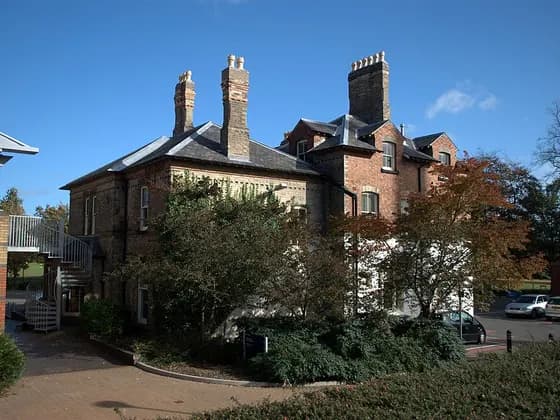
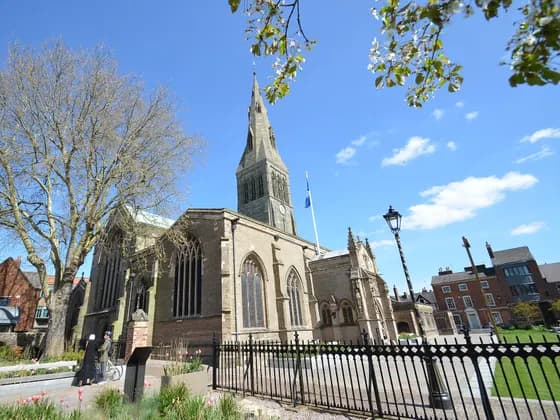

Photo: NotFromUtrecht · CC BY-SA 3.0 · cropped
Photo: NotFromUtrecht · CC BY-SA 3.0 · Photo: Jules & Jenny from Lincoln, UK · CC BY 2.0 · Photo: Brian Deegan · CC BY-SA 2.0
The Leicester medicine course at a glance (2027 entry)
Medicine at Leicester is a five-year MBChB (UCAS code A100) taught by Leicester Medical School, which marked its 50th anniversary in 2025. The curriculum is approved by the General Medical Council (GMC), the body that regulates doctors in the UK. Graduating makes you eligible for provisional registration, which lets you start work as a Foundation Year 1 (F1) doctor, the first year of paid work after medical school.
There are 293 places a year. That includes 18 for international students and about 38 for students moving up from the school's six-year Medicine with Foundation Year course. Your first two years are based mainly in the George Davies Centre, the medical school building on the university campus in Leicester.
The course has two phases. Phase 1 (years 1 and 2) teaches how the body works and goes wrong, alongside communication and examination skills. Phase 2 (years 3 to 5) is spent almost entirely working full-time in hospitals, general practice and community settings. These are spread across the city, the county and a wider region that takes in the Midlands, Lincolnshire and Northamptonshire.
Leicester calls its curriculum integrated and patient-focused. It is not a problem-based learning (PBL) course, in which small groups decide what to study from a patient case. Subjects such as anatomy and physiology are not taught as separate courses. You learn them through body systems and patient cases, using lectures, small-group work guided by doctors and academics, full-body dissection and clinical teaching.
Patients appear early: in year 1 you train on hospital wards and start practising consultations with actors and patients. Three features stand out in how the school describes the course: small-group dissection, a focus on empathy that runs through every year, and long apprenticeship-style placements in year 3.
| Degree | MBChB (Bachelor of Medicine and Bachelor of Surgery) |
|---|---|
| Course length | 5 years; 6 if you take an intercalated degree |
| UCAS code | A100 |
| Places | 293, including 18 international and about 38 from the foundation year |
| Teaching style | Integrated and patient-focused, not problem-based learning |
| Anatomy | Full-body dissection of donated bodies, one per group of 8 to 10 |
| First patient contact | Year 1, with ward training for the NHS Health Care Certificate |
| Main base | George Davies Centre on the University of Leicester campus |
| Placement area | Leicester, Leicestershire, the Midlands, Lincolnshire and Northamptonshire |
| Final exams | UK Medical Licensing Assessment plus a separate short answer paper |
What makes Leicester medicine different
Full-body dissection in small groups
You learn anatomy by dissecting whole donated bodies (cadavers), not only by studying ready-prepared specimens. Each group of eight to ten students has its own cadaver and, over years 1 and 2, dissects almost the entire body.
Qualify as a healthcare assistant in year 1
In year 1 you train on hospital wards for the NHS Health Care Certificate, which qualifies you for paid healthcare assistant work in the NHS. The school says students value the confidence on wards and the experience of working alongside other health professionals that it brings.
Group work guided by doctors, not PBL
About half of your learning in years 1 and 2 is small-group work on clinical scenarios, guided by qualified doctors called Clinical Teaching Fellows. It is how Leicester gives you regular case discussion without running a PBL course.
Long apprenticeships with one team in year 3
Year 3 is three placements of 11 or 12 weeks, in hospital medicine, hospital surgery and general practice. On each you are attached to one team and learn by working alongside it, as an apprentice would.
Empathy built into every year
The medical school works with the university's Stoneygate Centre for Empathic Healthcare, which researches empathy in healthcare and feeds it into MBChB teaching. Empathic, patient-centred care is one of eight themes that run through the course. The years 1 and 2 clinical skills course also builds equality, diversity and non-judgemental practice into everyday consultation teaching rather than treating them as extras.
A final year of foundation assistantships
Year 5 is four five-week foundation assistantships, in emergency medicine, medicine, surgery and general practice. In each you work as an assistant in the kind of team you will join as a new doctor. A six-week block for an elective or a student-selected component (a topic you choose) completes the year.
How Leicester teaches medicine
Teaching is integrated, which at Leicester means every subject is learned in a clinical context. Instead of separate anatomy, physiology and pharmacology courses, much of Phase 1 is organised by body system, such as the cardiovascular or respiratory system. Each system unit covers how it is built, how it works, how it goes wrong and how doctors assess and treat it.
The programme specification says large lectures are kept to a minimum. Much of your contact time is spent working in groups with expert tutors, because the school wants you to build the problem-solving and reasoning skills a doctor needs. You are also expected to organise your own study and reflect on how your skills are developing.
Eight themes run through the course and appear to some degree in every unit and placement. They are empathic patient-centred care; equality, diversity and inclusion; personal development and professional practice; and population and social sciences. The other four are clinical reasoning and biomedical principles; professional skills; patient safety and quality improvement; and working in teams with other professions.
In Phase 2 the style changes. You learn mainly by working with doctors in hospitals and GP practices. Workbooks and structured activities guide you through each placement, with procedural training and simulation built in, and every placement has clear outcomes describing what you should be able to do by graduation.
The ways you will learn
| Lectures | Lectures give the whole year the core science for each unit, but they are one part of a mix rather than the backbone of the course. Lecture materials, video tutorials and group work resources are all delivered electronically to your iPad. |
|---|---|
| Clinician-guided group work | In small groups you apply what you have learned to clinical scenarios, working through a patient's problems with a Clinical Teaching Fellow. These fellows are qualified doctors who have worked as doctors for at least two years, so they can share their own clinical experience. This makes up roughly half of your learning in years 1 and 2. |
| Simulated patients | Simulated patients are actors trained to help students learn. In year 1 you practise taking a history, communicating and examining with them before doing the same with real patients. Actors are also used in the Clinical Skills Unit and in exams. |
| Apprenticeship placements | From year 3 you learn on the job as part of a clinical team, on hospital wards and in general practice. Workbooks set out what to do and learn on each placement, and clinical teachers lead your learning. |
| iPad and digital learning | You receive an iPad at induction, which is yours to keep, and use it to take notes in lectures and group work. You carry it onto placements in Phase 2. The school also uses 3D printing and 3D reconstructions as teaching tools. |
A typical week on the Leicester course
The school's advice to applicants is to treat the degree like a full-time job, roughly 9am to 5pm. A usual campus week has lectures and group work in either the morning or the afternoon, plus sessions on clinical skills or in the dissecting room. There is also plenty of time for your own study.
Self-study fills the gaps. It typically means reading books and journal articles, working on individual and group projects, preparing presentations and revising for exams. You can use the library and the study spaces in the halls of residence.
How anatomy is taught at Leicester
Anatomy is taught through full-body dissection of cadavers, the bodies of people who donated them for medical education; Leicester's donors are members of the public in the East Midlands. You work in a group of eight to ten students, and each group has its own cadaver. You need your own white coat for sessions in the dissecting room.
You dissect almost the whole body over years 1 and 2. You start by studying the body's tissues, then move on to dissecting whole body systems, such as the heart and blood vessels or the lungs and airways. In later years you return to the dissecting room to revise and consolidate what you learned. There are also dissection prizes for students who want to test their surgical skills.
The dissecting room is in the Maurice Shock Building, next to the George Davies Centre, and holds more than 250 students. Models, bones and preserved specimens are used to teach sectional anatomy, which means studying the body in slices, as it appears on scans. Large wall screens are linked to Apple TVs, and an audio-visual system broadcasts live dissections from a central demonstration area to every part of the room.
Anatomy is also spread through the body-system units rather than taught as one separate course. The musculoskeletal unit in year 1, for example, covers the bones, joints and muscles, and the blood and nerve supply of the arms, legs and spine. Year 2 has a unit on applied head and neck anatomy with an introduction to neuroanatomy, the structure of the brain and nerves.
Living anatomy matters too. In year 1 a Surface Anatomy unit teaches you how the body's structures relate to what you can see and feel on the surface, which is the basis of physical examination. The cardiovascular and musculoskeletal units also cover how doctors use imaging to assess the body.
When you first meet patients at Leicester
You meet patients from year 1. During year 1 you train on hospital wards for the NHS Health Care Certificate, which teaches the key skills of the Care Certificate. That is the national standard for people new to health and social care support work, now set jointly by Skills for Care, Skills for Health and NHS England. Once qualified you can take paid healthcare assistant work in the NHS if you want to.
At the same time you start the CHDD course, the clinical skills strand that runs through years 1 and 2. Its full name sets out its aims: compassion, care of the whole person, and working out a diagnosis like a detective. You practise consultations and examinations first with simulated patients and volunteers, then with patients in the medical school and in hospitals.
Phase 1 also includes community attachments, which show how people's social and psychological circumstances affect their health and illness. In semesters 3 and 4, Practice-Based Learning takes you into hospitals and general practice to keep building your clinical skills with real patients.
To move into Phase 2 you must pass a formal clinical exam at the end of year 2. You also need to show you can perform the core Phase 1 skills, such as measuring vital signs and testing urine. From year 3 you are on placement full-time.
Year by year at Leicester
- Year 1
Cells, tissues and the first body systems
Year 1 builds the scientific foundations: cells, genes, tissues, metabolism and how drugs act on the body. In the second semester you move on to infection, disease processes and your first two body systems. Alongside this run the CHDD clinical skills course and ward training for the NHS Health Care Certificate.
- Semester 1 units: Medical Cell Biology and Genetics; Body Logistics, on how the body's tissues are built and work; and Metabolism, Endocrinology and Haematology, which includes obesity, diabetes and how blood cells are made.
- Semester 2 units: Infection, Pathological Processes, Introduction to Cell Physiology and Pharmacology, and the musculoskeletal and cardiovascular systems.
- Early Clinical Experience: ward training for the NHS Health Care Certificate.
- CHDD units include Communication Skills and Examination and Procedural Skills, both taught with simulated patients, plus Surface Anatomy and Information Handling Skills, on finding and judging medical information.
- A Health Enhancement Programme on managing stress and staying well, for your future patients and for yourself.
- Population and Social Sciences 1 covers disease surveillance, epidemiology and the social and psychological factors that shape illness. Ethics and Law teaching begins and continues through years 1 and 2.
- End-of-year written exams, plus a formative (practice) Objective Structured Clinical Examination (OSCE), a practical exam in which you move round timed stations.
- Year 2
The remaining body systems and the brain
Year 2 completes the body systems and pulls your knowledge together ready for clinical work. You study the gut, reproductive, urinary and respiratory systems, the head, neck and brain, and immunology and prescribing. More of your clinical skills practice now happens with real patients in hospitals and general practice.
- Semester 3: the gastrointestinal, reproductive, urinary and respiratory systems, plus Applied Head and Neck Anatomy and Introduction to Neuroanatomy.
- Clinical Immunology explains how the immune system works through conditions such as allergy.
- Semester 4: Clinical Neuroscience, which links the nervous system to neurological and psychiatric conditions, and Clinical Pharmacology, Therapeutics and Introduction to Prescribing.
- Integration for Clinical Application revisits what you have learned from new angles, such as the needs of particular patient groups like older people and children.
- Practice-Based Learning takes your CHDD skills onto hospital wards and into general practice. A semester 4 unit uses a stroke unit to show how different professions work together.
- Population and Social Sciences 2 continues the public health strand. Across years 1 and 2 this includes a simulated research project in which you design a questionnaire and analyse the results.
- End-of-year assessments: a written exam covering years 1 and 2, a summative OSCE, and an examiner-led practical assessment of how well you link the Phase 1 topics.
- Year 3
Clinical apprenticeships
Year 3 starts Phase 2, when you work full-time in clinical settings. You spend three blocks of 11 or 12 weeks as an apprentice: one in hospital medicine, one in hospital surgery and one in primary care, meaning general practice. You also complete your first student-selected component.
- Junior Medicine Apprenticeship: mornings with a medical team on one ward; afternoons learning about specialties such as rheumatology, gastroenterology, respiratory and cardiac medicine.
- Junior Surgery Apprenticeship: mornings with a surgical team on a ward; afternoons on specialties such as orthopaedics, vascular surgery, ENT and ophthalmology (eye care).
- Junior Primary Care Apprenticeship: attached to a Primary Care Academy in general practice, learning about the conditions GPs and their teams deal with every day.
- Student Selected Component (SSC): a four-week block that every student completes, in a clinical or non-clinical area you choose. A Medicine Careers Fair helps you decide, and a practice (formative) assessment helps build your academic writing.
- Assessment: written papers on medicine, surgery, primary care and the course themes, plus an OSCE. You must pass each part.
- Year 4
Specialty placements
Year 4 rotates you through six specialty blocks of six or seven weeks each. They take you through the main specialties, from children and pregnancy to mental health and cancer. Several blocks combine hospital and community settings.
- Child Health: children's medicine in hospital and in the community.
- Reproductive Health: working in an obstetrics and gynaecology team, covering pregnancy, childbirth and women's reproductive health.
- Mental Health: how psychiatric illness is assessed and treated, both in the community and in hospital.
- Cancer Care: how cancers present and are managed, including care at the end of life.
- Older Persons and Integrated Care: care of older people, and how social care, community care and general practice work together around them.
- Neurology and Special Senses: neurology, stroke medicine, dermatology (skin), ophthalmology and ENT.
- Every student takes part in the Leicester Medical School research conference, a teaching day run like a real conference, with the chance to present research and join research-skills workshops.
- Assessment: written papers, including single best answer questions, and an OSCE.
- Year 5
Foundation assistantships and finals
Final year prepares you to start work as a doctor. You complete four five-week foundation assistantships, working as an assistant in the kinds of teams you will soon join. You also have a six-week elective or student-selected block, and you sit finals, including the national licensing exam.
- Emergency Medicine: five weeks in one of the region's busy emergency departments.
- Medicine and Surgery: five weeks in a medical team and five weeks in a surgical team, each time placed with a foundation doctor and putting your skills into practice. A foundation doctor is a newly qualified doctor in the two-year Foundation Programme.
- Primary Care: five weeks working with the multi-professional team in a general practice.
- Elective or SSC: a six-week block to explore a branch of medicine that interests you, abroad, elsewhere in the UK or through a local SSC.
- A logbook of practical procedures, based on the GMC's outcomes for new graduates, completed during the assistantships.
- Finals: both parts of the UK Medical Licensing Assessment, a short answer paper, and a review of your progress through the assistantships.
How you are assessed at Leicester
Leicester's exams are integrated, like its teaching. The course is not split into separately examined modules. Each year ends with combined assessments that you must pass to move on, and written papers are cumulative, so later exams can test anything you have learned since year 1. In years 1 and 2 you also get regular formative tests, which do not count but give you feedback.
Written papers use two formats. Single best answer (SBA) questions give a clinical scenario and several options, and you pick the best one. Short answer questions (SAQs) ask you to write brief answers. In year 1 the SBA and SAQ papers and an Integrated Understanding paper are combined into one mark. In year 2 the written mark covers both years.
In an OSCE, an examiner marks you at each timed station as you complete a task such as taking a history, examining a patient or explaining a diagnosis. Your year 1 OSCE is for practice. From year 2 each year has an OSCE you must pass, and year 2 adds an examiner-led practical assessment of how well you connect the Phase 1 topics.
Finals in year 5 have several parts, and all must be passed in the same academic year. They include both parts of the UK Medical Licensing Assessment (UKMLA), which every UK medical student must now pass to be licensed. The Applied Knowledge Test (AKT) is a national written exam set by the Medical Schools Council Assessment Alliance. The Clinical and Professional Skills Assessment (CPSA) is Leicester's own final OSCE.
The GMC's 2024 review of the AKT describes it as two computer-based papers of 100 SBA questions, each lasting two hours, sat on consecutive days. Leicester runs it on university computers in campus computer labs. You also sit a separate short answer paper, which you must pass on its own.
The GMC approved Leicester's CPSA in April 2024. Its decision describes 16 ten-minute stations, each with two minutes' reading time, split into two circuits of eight on two non-consecutive days in the same week. To pass, you need the overall pass mark and passes in at least 12 of the 16 stations. You also sit a mock OSCE four to six weeks before the CPSA, and get a briefing on its format and pass criteria six months ahead.
- Year 5 also includes a Summative Review of Competence Progression: you need satisfactory reports from clinical supervisors and evidence of observed practice across a set number of outcomes.
- The school notes that all graduates must pass the Prescribing Safety Assessment (PSA), a national online test of safe prescribing.
- The MBChB is unclassified, but the top 10% of each graduating year receive MBChB (Hons). This is judged on performance across the whole degree, with extra weight on the final-year exams.
Where you will actually be at Leicester
For almost all of years 3 to 5 you work full-time in clinical settings. Placements run in hospitals in Leicester, across the county and in the wider region, plus attachments in general practice and the community. The course page describes the range as Leicester's big city hospitals and smaller district centres across the Midlands, Lincolnshire and Northamptonshire.
In the city, Leicester's big hospitals are the three acute sites of University Hospitals of Leicester NHS Trust, a long-standing NHS partner of the medical school. The school singles out Glenfield Hospital for its heart and lung care, and its Simulation Centre is on the Royal Infirmary site.
Expect to travel, especially in years 3 and 4, which the course page says is when most placement travel costs arise. The medical school currently gives some help towards these costs, but says this depends on its funding at the time.
Many students stay in the area after graduating. In 2026, about 41% of Leicester's 297 new doctors took foundation jobs in Leicester, Leicestershire, Northamptonshire and Rutland. The figure comes from the local NHS deanery, which runs training for junior doctors, as reported by the university.
The Royal Infirmary, in the city centre, has Leicestershire's only emergency department and houses the children's hospital. Glenfield, north-west of the centre, treats heart disease, lung cancer and breast conditions. The General, in the east of the city, covers kidney care, diabetes research, urology and brain injuries.
- Leicester Royal Infirmary (University Hospitals of Leicester NHS Trust)
- Glenfield Hospital (University Hospitals of Leicester NHS Trust)
- Leicester General Hospital (University Hospitals of Leicester NHS Trust)
Phase 2 placements also take you to district hospitals and community settings across the county and the wider region. Leicester's simulation pages describe teaching for its students at Queen's Hospital in Burton and Northampton General Hospital, and a 2024-25 SSC list included paediatrics at Kettering General Hospital.
Electives and chosen modules at Leicester
Student Selected Components (SSCs) let you study an area you choose in more depth, alongside the core course. Some are university-based, with topics such as medical ethics and law or a language. Others give you a new clinical experience or build on one you enjoyed, and some are projects, such as a quality improvement project in a clinical setting.
Your first SSC is a four-week block in year 3, which every student completes. To help you choose, you are invited to a Medicine Careers Fair, where clinicians, trainees and specialty representatives explain their day-to-day work, how training works and how to build a portfolio. The block includes a formative assessment, which does not count towards your marks but is designed to build your academic writing skills.
In year 5 you have a six-week block for either an elective or a further SSC. The elective lets you experience healthcare somewhere new, abroad or elsewhere in the UK, and the school says many students choose to travel. If you stay local, you can pick from a range of SSCs, which you might use to revisit a specialty you are thinking of as a career.
You can present your SSC at presentation days held for both the year 3 and year 5 blocks. Topics offered in 2024-25 ranged from anaesthesia, radiology and plastic surgery to global health, sports and exercise medicine and many general practice placements.
Intercalation at Leicester
Intercalating means taking a year out of the medicine course to study for an extra degree, which makes your course six years long. At Leicester it is optional and actively encouraged. You can take a bachelor's degree (iBSc) after year 2 or year 3, or a master's degree (iMSc) after year 3.
Leicester runs five of its own intercalated master's programmes: Clinical Education, Health Law (an LLM, the law master's degree), Healthcare Management, Medical Research and Psychology. The Medical Research iMSc combines four taught modules in qualitative and quantitative research methods with a substantial research project. You can also intercalate at another university, which widens the choice.
The school's reasons to intercalate are practical. You get time to study one subject in depth and sometimes a chance to present or publish your work. The research skills also help later applications to the Specialised Foundation Programme (foundation jobs with time for academic work) and to specialty training. Leicester students apply through a local process on the course's online learning site.
You do not have to intercalate to get involved in research. The programme specification says many students find research projects through their placements. It also names student-led groups: LUMRS, a medical student research society supported by the Academy of Medical Sciences' INSPIRE programme, runs journal clubs (discussions of published research) and student conferences. The Medical Education Society is for students interested in teaching, and MEDRift involves students in developing and researching new technology for medical education.
Facilities and support at Leicester
Where you will learn
The George Davies Centre is where you learn in the early years. As well as teaching, it is a base for Leicester's research into long-term conditions such as kidney disease, stroke, diabetes and chronic lung disease, and into patient safety. The medical school's Pastoral Support Unit is based there too.
The medical school's clinical skills and simulation centre, the Simulation Centre at Leicester, is in the Robert Kilpatrick Building on the Leicester Royal Infirmary hospital site. It opened in March 2016 and combines the school's clinical skills centre with a simulation centre.
The school's Clinical Skills Unit has mock-up hospital wards and intensive care units. Manikins called iStan and SimMan can be programmed to react as a critically ill patient might, and actors play patients. It lets you practise assessing and treating patients where a mistake cannot harm anyone.
Simulation continues into the clinical years, with sessions linked to the year 3 medicine and surgery apprenticeships. After finals, the centre is turned into a 22-bed ward. You are placed in a team of junior doctors that takes handover and runs the ward, a safe chance to experience being a first-year doctor.
Support while you study
Every student has a Personal Tutor, a member of academic or clinical staff who tutors your whole small group and helps you settle into university. There are scheduled meetings at set points in years 1 and 2, and many tutors meet their groups more often and informally, over coffee or a dog walk. In years 3 to 5 you have a Clinical Academic Tutor, who helps you adjust to clinical learning and offers career advice.
The Pastoral Support Unit (PSU) is the medical school's own welfare team. It supports your social, emotional, mental and physical health through face-to-face or online appointments, and it offers on-site support during some hospital placement blocks. The school says more than 80% of its students use it at some point.
The Academic Support Unit (ASU) helps with studying efficiently, revision strategies and exam technique, including one-to-one appointments. The GMC's 2024 review of Leicester's final OSCE describes what happens if you fail it. An ASU tutor, a senior clinician with a special interest in academic support, goes through your scores and examiner feedback with you. Resitting students also get group teaching, revision sessions and a practice OSCE with feedback.
Outside the timetable, LUSUMA, the students' union medical association, is run by students and organises social events, sports clubs and interest groups. You can also volunteer through the MedReach programme with local school pupils, student groups such as Teddy Bear's Hospital and Medsin, or Project Light, which works with local homeless charities.
Is the Leicester course right for you?
This course may suit you if
- You want to learn anatomy by dissecting a whole human body, working with the same small group on your own cadaver.
- You like small-group teaching guided by doctors, but would rather not follow a problem-based learning course.
- You want hands-on ward experience in year 1, including a healthcare assistant qualification you could use for paid NHS work.
- You would learn well by joining one team for 11 or 12 weeks at a time in year 3, as an apprentice.
- You are interested in education, law, management, research or psychology, since Leicester runs its own intercalated master's degrees in these subjects.
Things to think about
- Clinical placements spread across Leicester, the Midlands, Lincolnshire and Northamptonshire, so expect travel costs, especially in years 3 and 4, with only partial help from the school.
- With 293 places a year, you join a large year group, though much of your teaching happens in small groups, such as your dissection group of eight to ten.
- Years 1 and 2 are mainly campus-based science and skills teaching; full-time clinical work starts in year 3.
- Finals include the UKMLA plus a separate short answer paper, and every part must be passed in the same academic year.
Leicester medicine course — frequently asked questions
Applying to Leicester?
How to get into Leicester
Entry requirements, UCAT, personal statement and interview, step by step.
Open the guide →Leicester UCAT cut-offs and offers
UCAT cut-offs, A-level offers, interview format and decision dates.
See the requirements →Compare Leicester with other schools
Put the teaching style, anatomy teaching and placements next to another school.
Open the comparison →Prepare for the Leicester interview
Format breakdown, school-specific sample questions and prep tips from tutors who interviewed here.
Read the guide →Where this Leicester course guide came from
This guide was written from 19 official sources — University of Leicester's own course pages and programme documents, plus the regulator and NHS placement partners where they publish detail — read on 2026-09-23, then checked claim by claim against those sources.
- Medicine MBChB course page, University of Leicester (2026 and 2027 entry)
- MBChB programme specification for entry year 2026/27, University of Leicester
- A100 Five Year MBChB frequently asked questions, 2027 entry, Leicester Medical School
- Applying to Leicester Medical School: student support and facilities
- Leicester Medical School curriculum microsite, overview (undated, 2019 diagrams; linked from the 2027 course page)
- Leicester Medical School curriculum microsite, Phase 1 units (undated; linked from the 2027 course page)
- Leicester Medical School curriculum microsite, Phase 2 placements (undated; linked from the 2027 course page)
- Intercalated degrees, Leicester Medical School
- University medics choose to stay local, boosting NHS workforce (University of Leicester news, July 2026)
- GMC compliance decision: MLA Clinical and Professional Skills Assessment, Leicester Medical School (April 2024)
- GMC compliance decision: MLA Applied Knowledge Test, Leicester Medical School (June 2024)
- Our hospitals, University Hospitals of Leicester NHS Trust
- Student Selected Component (SSC), Leicester Medical School
- Dissection room, Leicester Medical School
- Facilities, Leicester Medical School
- Simulation Centre at Leicester, Leicester Medical School
- Undergraduate simulation, Leicester Medical School
- Simulation at Burton, Leicester Medical School
- Northampton General Hospital simulation suite, Leicester Medical School
Courses are restructured between cycles. Anything here that decides your application — an anatomy offer, a placement city, a compulsory intercalated year — should be confirmed against the official page for your entry year.
Applying to Leicester?
We have helped hundreds of applicants turn their UCAT, personal statement and interview prep into offers from Leicester and other UK medicine schools.