
The Manchester Medicine course
What you actually study, and where you will be
Manchester's MBChB is a 5-year course taught through case-based learning and team-based learning, with patient contact from Year 1 and placements in Greater Manchester and the north west (2027 entry). Manchester teaches through themed case discussions rather than lecture blocks, and students learn anatomy through dissection. Clinical immersion starts at the beginning of year 3 and runs to the end of the course.
- Degree
- MBChB
- Length
- 5 years
- Teaching
- Case-based learning + Team-based learning
- Clinical contact
- Year 1
- UCAS code
- A106

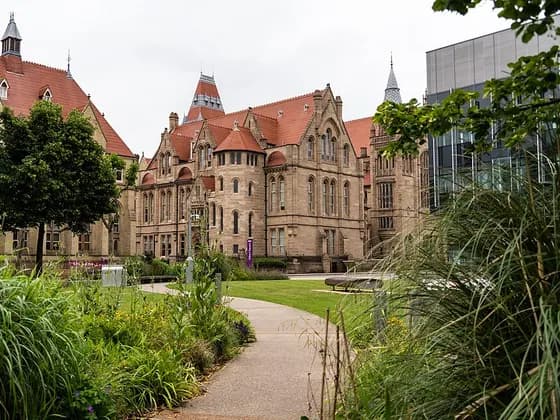

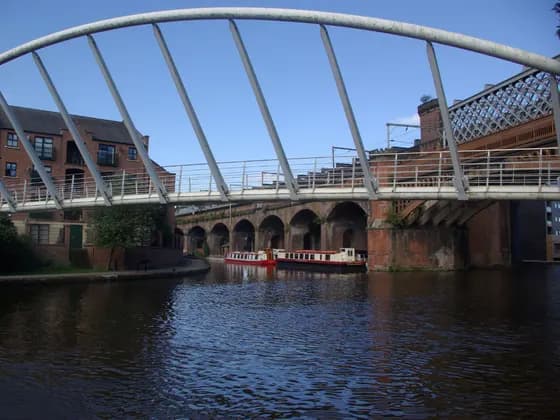
Photo: Happytree9527 / Wikimedia Commons · CC BY 4.0 · cropped
Photo: citysuitesimages · CC BY 2.0 · Photo: Arcona B B · CC BY 3.0 · Photo: Stephen McKay · CC BY-SA 2.0
The Manchester medicine course at a glance (2027 entry)
Manchester's MBChB is a five-year medicine degree run by the School of Medical Sciences in the Faculty of Biology, Medicine and Health. Manchester is a large school, and the University says more than 2,500 undergraduates are studying medicine there. When you graduate you can apply for provisional registration with the General Medical Council (GMC) and for a place on the UK Foundation Programme. That is the two years of supervised training every new doctor does after medical school, and Foundation Year 1 is the first of them.
The course falls into two very different halves. In Years 1 and 2 you are mostly based in the Stopford Building on the University's Oxford Road campus, learning how the body works through weekly patient cases tackled in small teams. From the start of Year 3 until you graduate, you are based at one of four NHS teaching hospitals, called Clinical Education Campuses, and spend most of your week learning from real patients.
Science and clinical skills are taught side by side from the first term. Around each week's case you have anatomy sessions in the dissecting room, laboratory practicals and consultation skills sessions with actors playing patients. You visit GP surgeries in Year 1 and your future base hospital in Year 2, so full-time placements in Year 3 are not your first time in a clinical setting.
Two features shape life on this course more than any others. You dissect a whole donated body yourself in Years 1 and 2, rather than learning anatomy only from models and screens. And the clinical years are spread across a wide area, from Preston to Crewe and North Wales. Unless an approved personal reason or a successful Preston request settles it, your campus is allocated at random during Year 1.
| Degree | MBChB (Bachelor of Medicine and Bachelor of Surgery) |
|---|---|
| Course length | 5 years |
| UCAS code | A106 (institution code M20) |
| Funded places | 401 across all Manchester medicine courses, 28 of them for international students |
| Years 1 and 2 base | Stopford Building, Oxford Road campus, Manchester |
| Teaching style | Weekly themed cases, taught through team-based learning in Years 1 and 2 |
| Anatomy | Whole-body dissection, plus ready-dissected specimens (prosections), imaging and ultrasound |
| First patient contact | Year 1: simulated patients from the start, GP visits in Semester 2 |
| Years 3 to 5 | Based at one of four NHS Clinical Education Campuses |
| Intercalation | Optional, after Year 2, 3 or 4 |
What makes Manchester medicine different
Whole-body dissection throughout Years 1 and 2
Anatomy runs right through both pre-clinical years in the Stopford Building dissecting room, where you dissect a donated body yourself, region by region. You also learn from ready-dissected specimens, bones, X-ray, CT and MRI scans, and an ultrasound room with 20 handheld scanners.
A structured team-based week built around one case
In Year 1 each week opens on Monday with a whole-year session that presents a clinical scenario. You study it through the week, then meet in a group of about 60 students, working in a fixed team of six. You take a short quiz alone, retake it as a team, then solve problems together.
Three years based inside the NHS
From Year 3 your base is a hospital campus rather than the University: Oxford Road or Wythenshawe in Manchester, Salford Royal, or Royal Preston Hospital. Each has its own undergraduate department, Hospital Dean and support team, and organises your placements across linked district hospitals, GP practices and community services.
Projects in Years 1, 2, 3 and 5
Under the Personal Excellence Path you make a group poster in Year 1 and write a literature review in Year 2. From April to June of Year 3 you carry out an original project, such as research or a service evaluation, with a University or NHS supervisor. After Finals in Year 5, a four-week project covers clinical audit, which checks care against agreed standards, or information for patients.
A final year that rehearses your first job
Year 5 includes shift work across the seven-day week. After Finals in March you spend four weeks as a student assistant, paired with a resident doctor, meaning a doctor who has graduated but is still in training. You shadow and assist that doctor, and at least eight hours of the four weeks must be out of hours. A four-week project on clinical audit or patient information follows.
How Manchester teaches medicine
Manchester's approach is active learning through themed cases. Each week is built around a clinical scenario, chosen to cover key science and common health problems in the UK today. Lectures and webinars, short online learning modules, practicals and anatomy sessions then support what the case asks you to find out.
In Years 1 and 2 the cases are taught through team-based learning (TBL), a structured form of small-group work. You belong to a community of practice of about 60 students with several facilitators, and inside it a team of six that stays together for the semester. After Semester 1 your community is reshuffled to match the hospital campus you have been allocated, so you learn to work with new people.
In Years 3 and 4 the themed case approach continues around your placements. Each week you work through online cases, then discuss a case you have not seen before with an expert tutor. Year 5 teaching is different. You get half a day to a day each week of compulsory workshops, lectures and seminars, covering prescribing, communication, ethics, blood transfusion, wound management and simulation.
The course is built from four strands that run alongside each other: the science foundations of medicine, clinical practice, your own project path, and personal and professional development. The last of these means keeping a reflective portfolio in every year of the course. You gather evidence against set learning outcomes and discuss it with your Academic Advisor, and those meetings are compulsory.
The ways you will learn
| Team-based learning | Used in Years 1 and 2. You first take a short individual quiz of about ten multiple choice questions on the week's case. Your team then sits the same quiz together, discussing and justifying each answer. Application exercises follow, so you use the knowledge rather than just recall it. |
|---|---|
| Themed case discussions | In Years 3 and 4 a new theme opens online each week, listing the conditions and presentations you need to learn. At the discussion session an expert tutor and a facilitator give you an unseen case, and you must explain how you reached your conclusions. Year 3 sessions run on Fridays and last 90 minutes. |
| Consultation skills sessions | In the Consultation Skills Learning Centre you work in small groups with tutors and simulated patients, who are trained actors. You learn to build trust, take a history, examine patients, reason clinically and talk with patients about changing their behaviour. Year 2 adds new examinations and some fully immersive sessions. |
| Clinical debrief | In Year 1 you watch real GP consultations in a group of six and talk them through with a tutor. In Year 2 there are three or four of these sessions, run online with a GP tutor. In Year 3 it becomes a weekly face-to-face session of two and a quarter hours, in a group of six to eight with the same GP tutor all semester. |
| Supervised clinical placements | From Year 3 every placement has a Clinical Placement Supervisor who agrees your learning goals and signs you off. You record evidence in an electronic logbook. In Year 3 the minimum is three patient assessments a week plus one case presented to a doctor; in Year 5 it is five a week. |
A typical week on the Manchester course
A Year 1 week follows a set rhythm. On Monday morning the whole year group meets for a compulsory interactive opening session, where a clinical scenario unfolds with symptoms, test results, multimedia and sometimes simulated patients. By the end of the session you have started working out what you need to learn that week.
Through the week you study the case using online modules, lecture presentations and webinars, alongside timetabled anatomy, practicals, consultation skills and early clinical experience. The week ends with your team-based learning session. Your personal timetable sits on the course's online system, 1Med, and can change at short notice.
Year 3 looks very different. On placement blocks you are expected to spend about 60% of your time in the clinical environment and the rest in mandatory teaching or private study. When nothing is timetabled, you go to your ward and ask to see suitable patients. Fridays hold your themed case discussion and other set teaching.
- Year 3: a weekly clinical debrief with a GP tutor.
- Year 3: in each of the four five-week blocks, at least four hours of clinical work outside Monday to Friday, 8am to 5pm is recommended, so you see out-of-hours care.
- Year 5 medicine, surgery and acute placements: shift work across the seven-day week where the placement allows.
How anatomy is taught at Manchester
Anatomy at Manchester is taught with real human bodies. Across Years 1 and 2 you dissect a whole donated body yourself, and you also study prosections. A prosection is a body part already dissected by experts, so you can learn the structures without cutting them yourself.
The dissecting room in the Stopford Building is a large space where up to 40 body donors are used to teach anatomy region by region. Donors are people who chose to leave their bodies to the University for teaching and research. Access is regulated under the Human Tissue Act 2004, so before you start you attend an introductory talk and sign a strict code of conduct.
In the room you must wear a lab coat and gloves, keep your phone in your bag and never photograph specimens. You also use potted specimens showing common diseases and a large collection of bones. You compare these with X-rays, CT and MRI scans, so you learn how anatomy appears on clinical images.
A dedicated ultrasound room has 20 handheld scanners and two larger portable machines. For study away from the lab there are Anatomage tables, which are life-size touchscreen virtual dissection tables, and glasses-free 3D displays. You also get Complete Anatomy and Acland's video atlas, plus digitised histology slides you can view from anywhere.
- Teaching is delivered by anatomy academics working with GMC-registered Clinical Teaching Fellows.
- The anatomy department works closely with the Manchester Surgical Skills and Simulation Centre on the same site.
When you first meet patients at Manchester
Your first patients are simulated. From Year 1 you practise consultations in the Consultation Skills Learning Centre with trained actors and tutors. You cannot visit any real clinical setting until your DBS (criminal records) check is complete, and occupational health appointments for vaccinations start in your first semester.
Real patients arrive in Semester 2 of Year 1, when you make two GP surgery visits in pairs, each lasting six hours, followed by a structured group debrief. In Year 2 you make two more full-day GP visits and spend four days at the hospital campus you will join in Year 3. You also join a half-day community placement with health, social care and education professionals.
From Year 3 you are a member of the clinical team, starting with a four-week Introduction to Clinical Learning that front-loads examination and procedural skills. By Year 5 you carry out, under supervision, almost all the tasks of a Foundation Year 1 doctor. Anything that needs registration with the GMC is off limits: you cannot authorise a real prescription, and you cannot sign statutory forms such as a death or cremation certificate or a sick note.
Year by year at Manchester
- Year 1
Life Cycle and Cardiorespiratory Fitness
Year 1 opens with an Essential Skills block that prepares you for university study and for meeting patients. The rest of the year is two semester-long modules, each built from weekly themed cases, with dissection, practicals and consultation skills running alongside. The work covers anatomy, physiology, pharmacology, biochemistry, pathology, immunology, genetics, microbiology, and behavioural and social sciences.
- Life Cycle (Semester 1): the cell and molecular processes behind reproduction, development and growth, plus the immune system, genetic disease and cancer.
- Cardiorespiratory Fitness (Semester 2): the chest and how the heart, lungs and blood work.
- Two six-hour GP surgery visits in Semester 2, made in pairs, with a group debrief afterwards.
- Personal Excellence Path: a group scientific poster in Semester 2, guided by an academic facilitator.
- Exams: a semester test after each module of 125 single best answer questions in 2.5 hours, plus the Progress Test. Year 1 also has a 10-station Clinical Competency Assessment (CCA), a circuit of short timed practical stations.
- An Academic Advisor from the start, who helps you build a reflective personal and professional development portfolio.
- Your Clinical Education Campus for Years 3 to 5 is confirmed in December.
- Year 2
Mind and Movement; Nutrition, Metabolism and Excretion
Year 2 completes the science foundations and starts preparing you for hospital life. In Semester 4 cases release information in stages so you practise clinical reasoning, and your hospital visits take place at the campus you will join in Year 3.
- Mind and Movement (Semester 3): the brain and peripheral nervous system, cognition and mental health, with a focus on neuroscience and neuropsychiatry.
- Nutrition, Metabolism and Excretion (Semester 4): the gut, the kidneys and the hormones that regulate them.
- Physiology and pharmacology practicals in Semester 3, with anatomy continuing all year.
- Early clinical experience: two full-day GP visits, four days at your allocated hospital campus and a half-day community placement.
- Evidence-based medicine teaching on reading and judging research.
- Personal Excellence Path: a literature review dissertation on a topic offered by a member of staff.
- Exams: semester tests, the Progress Test and a Clinical Competency Assessment.
- Year 3
Into the hospital: general medicine and surgery
You move to your Clinical Education Campus and spend most of the week learning from patients. Five placements fill the first 24 weeks. The year then finishes with your own project and a placement in a specialty you choose.
- Introduction to Clinical Learning: four weeks learning examination and procedural skills while joining a clinical team.
- Four five-week placement blocks: three in general medicine and one in general surgery, which begins with an anaesthetic tutorial.
- Friday themed case discussions, small-group teaching on communication, prescribing, ethics and law, and a weekly clinical debrief.
- First procedural skills sign-offs, such as taking blood, inserting a cannula and recording an ECG.
- Applied Personal Excellence Path, April to June: an original project such as research, service evaluation or educational development, assessed by report and presentation.
- A student-selected clinical placement in an area that interests you, within Manchester's placement region.
- Exams: a practice Clinical Competency Assessment (CCA) of 8 stations for feedback, a 16-station CCA that counts towards the year, and two Progress Tests.
- Your year group grows now: students who began at St Andrews or at the International Medical University in Malaysia join for Years 3 to 5. Qualified dental graduates planning a career in oral and maxillofacial surgery also join.
- Year 4
Specialties and the elective
Year 4 broadens your experience across 14 specialties in eight four-week placement blocks, arranged as two 16-week rotations. Placements can take you across Greater Manchester, North Wales, Preston and parts of Yorkshire. The year ends with your elective.
- Four-week blocks in children's health, women's health, general practice, mental health, ageing and complex health, and musculoskeletal health.
- A neurology and special senses block, split into shorter placements in neurology, ENT (ear, nose and throat) and ophthalmology.
- A cancer, skin and infection block, split across dermatology, infectious diseases, oncology and breast.
- Weekly themed case discussions in small groups within your placement, lasting 1.5 to 2.5 hours.
- Further procedural skills, including ophthalmoscopy and otoscopy.
- Exams: two 16-station CCAs that count towards the year, and two Progress Tests.
- A four-week elective at the end of the year, anywhere in the world with School approval.
- Year 5
Preparation for practice
Final year prepares you to work as a Foundation Year 1 doctor. You complete four five-week placements, sit Finals in March, then finish with two four-week blocks that bridge the gap into your first job.
- Placements in medicine, surgery, acutely ill patients and general practice, five weeks each, with shift work where the placement allows.
- Two weeks of revision and one week of personal study before Finals.
- Finals in March: the national Applied Knowledge Test and a 16-station CCA, which together form your Medical Licensing Assessment. Resits are in May.
- The Prescribing Safety Assessment, a national online exam on using medicines safely, which from 2025-26 you must pass to graduate.
- A mandatory Immediate Life Support course.
- Student assistantship: four weeks shadowing and assisting a resident doctor, including out-of-hours shifts.
- Quality and Evidence project: four weeks on clinical audit, quality improvement or information for patients and the public.
How you are assessed at Manchester
Manchester uses formative assessments, which tell you how you are doing, and summative ones, which decide whether you progress and normally come at the end of each year. Most results are graded Unsatisfactory, Low Pass, Satisfactory, Honours or Distinction, and knowledge test pass marks are set against the performance of the cohort's strongest students.
Knowledge is tested with single best answer questions, where you choose the best of five options and a wrong answer simply scores zero. Years 1 and 2 each have two semester tests. From Year 1 to Year 4 you also sit the Progress Test, 125 questions in 2.5 hours, with 50 extra questions on that year's teaching in the summer sitting of Years 3 and 4.
Clinical skills are tested in the Clinical Competency Assessment (CCA), which is Manchester's name for an Objective Structured Clinical Examination (OSCE). That is a circuit of timed stations where examiners watch you take a history, examine a patient or explain a diagnosis. Years 1 and 2 each end with a 10-station CCA, and you must pass at least six stations. From Year 3 the CCAs that count have 16 stations of eight minutes, with 90 seconds to prepare for each, and you must pass at least 12.
Since 2024-25 every UK medical degree must include a pass in the Medical Licensing Assessment (MLA), made up of an Applied Knowledge Test (AKT) and a clinical and professional skills assessment. At Manchester both are built into Year 5 Finals, so there are no extra exams. The AKT is two papers of 100 questions, two hours each, and the GMC has approved the Year 5 CCA as the skills part.
You are also assessed at work. Each placement must be signed off as satisfactory using your logbook, and across Years 3 to 5 you complete Undergraduate Procedural Skills Assessments (UPSAs). These are practical procedures such as taking blood, catheterisation and arterial blood gas sampling, signed off by qualified staff. Written reports assess your projects, and your professional behaviour is assessed too.
The degree can be awarded with Honours to no more than the top 15% of graduates. Under the rules for students graduating from 2027-28, this is based on standardised scores from Years 3, 4 and 5, weighted roughly evenly. Year 3 counts for 29%, Year 4 for 35% and Year 5 for 36%.
Where you will actually be at Manchester
For Years 3 to 5 you are based at one of four Clinical Education Campuses. Each is an NHS teaching hospital trust with its own undergraduate department, and it organises your placements across its main hospital, linked district general hospitals, GP practices and community services. Each campus normally takes about 20% to 27% of the year group.
You cannot simply pick your campus, but before allocation you can apply for approved extenuating circumstances, and a panel of clinical and University staff decides each case. Some reasons count at allocation and again later if your life changes. They cover being the parent or legal guardian of a child under 18 who mainly lives with you, or the recognised main carer of a disabled person. A disability confirmed by the University's disability service also counts, if you must have ongoing follow-up care in one place.
Other reasons count only at the first allocation. If you lived at your parents' or your own home in Manchester or Preston before applying, you can ask for one of the three Greater Manchester campuses or Preston. You must plan to keep living there for money reasons for the whole course. Strict religious requirements that cannot be met at another campus, and elite sport for students on a University Sport Scholarship, are also considered. Every request is granted only where the campus has space, so none is guaranteed.
You can also say you would prefer Preston, and the School tries to place you there. Students who ask normally make up a minority of those placed at Preston, but if too many ask, the extra students are allocated at random to the other campuses. Everyone else is placed by an anonymous random process, confirmed in December of Year 1. The University strongly advises you not to buy or commit to long-term housing before then, because owning property will not change your allocation.
Travel is part of the course. You are expected to live within easy commuting distance of your campus, and many placements mean travelling there and back each day. Some specialty placements, such as neurology, infectious diseases and ophthalmology, may be away from your campus. Some travel bursaries are available in Years 3 to 5, and for distant placements the campus may provide a bursary or accommodation.
Placements also reach specialist centres in oncology, women's and children's health, neurology, dermatology and ophthalmology. The University names The Christie NHS Foundation Trust, Manchester University NHS Foundation Trust and the neurology and dermatology centres at the Northern Care Alliance. Across the North West there are more than 700 community placements, including in central Manchester, Lancashire and Wigan.
Nearly every specialty is taught across the two hospital sites, linked by a free minibus; cardiothoracics, GP and psychiatry are the main exceptions. The trust has places for up to 300 medical students each academic year and Clinical Placement Facilitators who coach you on placement. Students on the Preston Widening Access Programme are placed here automatically.
- Royal Preston Hospital
- Chorley and South Ribble District General Hospital
- Lancashire and South Cumbria NHS Foundation Trust (community services)
Specialist placements can also be at The Christie, Greater Manchester Mental Health, Withington Community Hospital, Altrincham Hospital and Wythenshawe Hospital. The on-site undergraduate department has a clinical skills area, common room, computer cluster, showers and lockers.
- Manchester Royal Infirmary
- Manchester Royal Eye Hospital
- Saint Mary's Hospital
- Royal Manchester Children's Hospital
- Trafford General Hospital
- North Manchester General Hospital
- NCA Oldham
- NCA Bury (Fairfield General Hospital)
- Tameside Hospital
- Wrexham Maelor Hospital, North Wales
- Glan Clwyd Hospital, North Wales
- Nobles Hospital, Isle of Man
Specialist placements can also be with Pennine Care, the Northern Care Alliance, Bolton, North Manchester General Hospital and Wrightington, Wigan and Leigh. The undergraduate department has a student common room, a clinical skills area and a simulation suite.
- Wythenshawe Hospital
- Withington Community Hospital
- Trafford Hospital
- Altrincham Hospital
- Leighton Hospital, near Crewe (Mid Cheshire Hospitals NHS Trust)
- Stepping Hill Hospital, Stockport
- Macclesfield Hospital (East Cheshire NHS Trust)
- The Christie NHS Foundation Trust
The undergraduate department is at Salford Royal, but placements can be at any of the four NCA hospitals, with placements at Bolton and Wigan in every clinical year. Specialist placements include The Christie, Greater Manchester Mental Health, North Manchester General Hospital and Manchester's children's and eye hospitals.
- NCA Salford Royal
- NCA Oldham
- NCA Bury
- NCA Rochdale
- Royal Bolton NHS Foundation Trust
- Wrightington, Wigan and Leigh Foundation Trust
Electives and chosen modules at Manchester
At the end of Year 3 comes the student-selected clinical placement. You list preferences from a menu of placements, or occasionally arrange your own, and spend the block immersed in one specialty, supervised by a senior doctor or GP. The 2025/26 programme handbook describes it as a three-week placement, while the course page for 2027 entry calls it four weeks, so check the length for your year. It must be within Manchester's placement region, and you write a 300-word reflection on how it shaped your thinking about your career.
The elective is a four-week placement at the end of Year 4, and it can be anywhere in the world. Most students go abroad, but you can stay in the UK or even locally. You arrange it yourself, need formal School approval before travelling, and need a supervisor at consultant level or in independent practice who is not a relative or family friend.
You can split the elective between two hosts if you spend at least two weeks at each. Research can be part of it, as long as at least half the time is spent with patients and the host already has ethics approval. Some countries, including the USA, Canada and Australia, may need at least 12 months' notice.
You pay for the elective yourself. The School points students to external grants it advertises during the course, the Medical Schools Council list of elective bursaries, and Turing Scheme funding for study abroad. If you receive the NHS Bursary, you may also be able to claim some travel and extra accommodation costs.
Intercalation at Manchester
Intercalation means pausing your medical degree to complete a separate degree, then returning to medicine. At Manchester it is optional. You can apply to take a one-year BSc after Year 2, 3 or 4, or a master's degree after Year 3 or 4. Most students choose to intercalate after Year 3 or Year 4.
BSc students join the final year of an existing Manchester degree. Options include Biochemistry, Biomedical Sciences, Genetics, Global Health, Immunology, Medical Biochemistry, Neuroscience and Medical Physiology. Some courses need you to have completed at least a year of clinical medicine, and most include a large research component based in a laboratory or on a literature review.
Master's options include Genomic Medicine, Precision Medicine, Oncology Research and Occupational Medicine. Most students intercalate at Manchester. You can apply to another UK university if its course differs enough, but you may not be eligible for the full range of bursary funding.
For future clinician-scientists there is a Cancer Research UK-funded MB-PhD. You take a three-year cancer-focused PhD between Years 3 and 4 and graduate with both an MBChB and a PhD. Projects span areas such as genomics, immunology, physics, data science, AI and clinical trials.
Facilities and support at Manchester
Where you will learn
In Years 1 and 2 nearly everything happens in the Stopford Building on Oxford Road. It houses the anatomy dissecting room, the Consultation Skills Learning Centre, teaching laboratories, computer clusters and the Stopford library, which holds core texts for first and second years.
The Consultation Skills Learning Centre has 24 consultation rooms set up like hospital outpatient clinics and GP surgeries. Here you practise taking histories and examining patients with classmates and simulated patients, and practise clinical skills on SimMan, a lifelike patient simulator manikin.
The first-floor teaching laboratory is equipped mainly for physiology and pharmacology practicals. The second-floor laboratory has microscopes for studying tissues, plus equipment for biochemistry, microbiology and molecular work.
In the clinical years you are given an iPad, which holds your logbook, placement sign-off forms and learning materials. Each hospital campus has its own undergraduate facilities. At Preston, for example, these include clinical skills labs, simulation and resuscitation rooms with high-fidelity manikins, education centres in Preston and Chorley, libraries and student common rooms.
Support while you study
In Years 1 and 2 the Student Pastoral Support team in the Stopford Building helps with personal, family, health or money worries, and with doubts about studying medicine. You also have an Academic Advisor from the start of Year 1, with meetings every semester, and Year 1 includes study skills workshops on time management, active study and exam technique.
The peer mentoring scheme, known as Mummies and Daddies, supports new first years with trained Year 2 mentors and a team of Year 3 student coordinators. There are also mentors for international students and for mature students or those who have taken time out.
When you move to your hospital campus, a Clinical Academic Advisor, who is an experienced clinician, takes over and stays with you until graduation. Each campus has a Hospital Dean, an Associate Hospital Dean for pastoral support and a local support team. A base hospital peer mentoring scheme, run by students a year ahead, helps you settle into clinical life.
Is the Manchester course right for you?
This course may suit you if
- You want to learn anatomy by dissecting a whole body rather than mainly from models and screens.
- You enjoy solving problems in a team and explaining your reasoning out loud, which team-based learning and themed case discussions both demand.
- You want three full years based in NHS hospitals, learning mostly from patients rather than on a university campus.
- You would like to try research or quality improvement, since you complete a project in four of the five years, including an original project of your own choosing in Year 3.
- You are happy to live wherever your campus turns out to be, whether that is Oxford Road or Wythenshawe in Manchester, Salford or Preston.
Things to think about
- Unless an approved personal reason or a successful Preston request settles it, your clinical campus is allocated at random in Year 1, so you cannot count on staying in central Manchester.
- Some campuses use hospitals as far away as Crewe, Macclesfield, North Wales and the Isle of Man, and daily commuting adds time and cost.
- Years 1 and 2 are mostly classroom, laboratory and dissecting-room based, with a small number of GP and hospital visits before Year 3.
- Every clinical placement needs a satisfactory sign-off based on your logbook, so you have to seek out patients yourself rather than wait to be taught.
Manchester medicine course — frequently asked questions
Applying to Manchester?
How to get into Manchester
Entry requirements, UCAT, personal statement and interview, step by step.
Open the guide →Manchester UCAT cut-offs and offers
UCAT cut-offs, A-level offers, interview format and decision dates.
See the requirements →Compare Manchester with other schools
Put the teaching style, anatomy teaching and placements next to another school.
Open the comparison →Prepare for the Manchester interview
Format breakdown, school-specific sample questions and prep tips from tutors who interviewed here.
Read the guide →Where this Manchester course guide came from
This guide was written from 60 official sources — University of Manchester's own course pages and programme documents, plus the regulator and NHS placement partners where they publish detail — read on 2026-09-23, then checked claim by claim against those sources.
- MBChB Medicine (2027 entry), University of Manchester course page
- Undergraduate Medicine, Faculty of Biology, Medicine and Health
- Teaching and learning, Medicine MBChB
- Anatomy, Medicine MBChB
- Anatomy facilities, Faculty of Biology, Medicine and Health
- Personalised learning, Medicine MBChB
- Clinical experience and placements, Medicine MBChB
- Intercalation, Medicine at Manchester
- Facilities, Medicine at Manchester
- Student support, Medicine at Manchester
- Medicine applicant FAQs, University of Manchester
- MBChB Programme Handbook 2025/26, University of Manchester
- MBChB Programme Handbook: The Student Journey
- MBChB Programme Handbook: Year 1 Teaching and Learning Activities
- MBChB Programme Handbook: Year 1 Early Clinical Experience
- MBChB Programme Handbook: Year 2 Teaching and Learning Activities
- MBChB Programme Handbook: Year 2 Early Clinical Experience
- MBChB Programme Handbook: Year 3 Learning in Clinical Placements
- MBChB Programme Handbook: Year 3 Learning in Teaching Sessions
- MBChB Programme Handbook: Year 3 Student Selected Clinical Placement
- MBChB Programme Handbook: Year 4 Learning in Clinical Placements
- MBChB Programme Handbook: Year 4 Learning in Teaching Sessions
- MBChB Programme Handbook: Year 4 Elective Placement
- MBChB Programme Handbook: Year 5 Learning in Teaching Sessions
- MBChB Programme Handbook: Year 5 Learning in Clinical Placements
- MBChB Programme Handbook: Personal Excellence Paths
- MBChB Programme Handbook: Personal and Professional Development Portfolio
- MBChB Programme Handbook: Year 3 Personal and Professional Development Portfolio
- MBChB Programme Handbook: Progress Test
- MBChB Programme Handbook: Year 1 Semester Tests
- MBChB Programme Handbook: Overview of Year 1 Assessments
- MBChB Programme Handbook: Year 1 Clinical Competency Assessment
- MBChB Programme Handbook: Overview of Year 2 Assessments
- MBChB Programme Handbook: Year 2 Clinical Competency Assessment
- MBChB Programme Handbook: Year 3 Clinical Competency Assessment
- MBChB Programme Handbook: Year 4 Clinical Competency Assessment
- MBChB Programme Handbook: Overview of Year 5 Assessments and the MLA
- MBChB Programme Handbook: Year 5 Applied Knowledge Test
- MBChB Programme Handbook: Year 5 Clinical Competency Assessment
- MBChB Programme Handbook: Prescribing Safety Assessment
- MBChB Programme Handbook: Undergraduate Procedural Skills Assessments
- MBChB Programme Handbook: MBChB with Honours eligibility
- MBChB Programme Handbook: Intercalation
- MBChB Programme Handbook: Transition into Year 3
- MBChB Programme Handbook: Direct Entry into Year 3
- MBChB Programme Handbook: Consultation Skills Learning Centre
- MBChB Programme Handbook: Laboratories
- MBChB Programme Handbook: Provision of iPads
- MBChB Programme Handbook: Libraries
- MBChB Programme Handbook: Additional Support in Years 1 and 2
- MBChB Programme Handbook: Additional Support in Years 3, 4 and 5
- MB ChB Programme Policy on Allocation to a Clinical Education Campus, 2026/27
- MBChB Programme Agreement, Academic Year 2026/27
- GMC: MLA clinical and professional skills assessment compliance decision, University of Manchester
- Lancashire Teaching Hospitals Health Academy: Undergraduate Medical Education
- Lancashire Teaching Hospitals Health Academy: Undergraduate Support
- Manchester University NHS Foundation Trust: Undergraduate Medical Education
- Manchester Surgical Skills and Simulation Centre
- MBChB Programme Handbook: Academic Dates
- Introduction to the UK Foundation Programme, UK Foundation Programme Office
Courses are restructured between cycles. Anything here that decides your application — an anatomy offer, a placement city, a compulsory intercalated year — should be confirmed against the official page for your entry year.
Applying to Manchester?
We have helped hundreds of applicants turn their UCAT, personal statement and interview prep into offers from Manchester and other UK medicine schools.