
The Norwich (UEA) Medicine course
What you actually study, and where you will be
Norwich's MBBS is a 5-year course taught through problem-based learning and case-based learning in an integrated, spiral curriculum, with patient contact from Year 1 and placements in Norfolk, Suffolk, Essex and Cambridgeshire (2027 entry). Problem-based learning in small groups, with placements starting within the first month and roughly half the course spent on placement. The teaching hospital is 100 metres from the medical school.
- Degree
- MBBS
- Length
- 5 years
- Teaching
- Problem-based learning + Case-based learning + Integrated + Spiral
- Clinical contact
- Year 1
- UCAS code
- A100


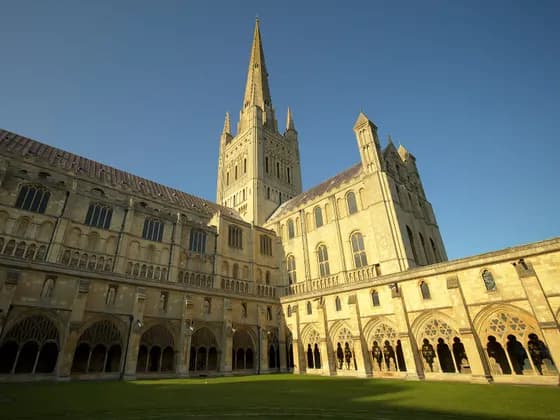

Photo: Bryn Holmes / Geograph Britain and Ireland · CC BY-SA 2.0 · cropped
Photo: Oxyman · CC BY 2.5 · Photo: Jorge Pena Ramos · CC BY-SA 4.0 · Photo: Jeff Buck · CC BY-SA 2.0
The Norwich (UEA) medicine course at a glance (2027 entry)
The MBBS at the University of East Anglia (UEA) is a five-year, full-time medicine degree taught by Norwich Medical School on the Norwich Research Park. MBBS stands for Bachelor of Medicine and Bachelor of Surgery. UEA plans 205 places for 2027 entry: 192 for UK students and 13 for international students.
When you graduate, having passed the national licensing exam, you can register provisionally with the General Medical Council (GMC), which regulates UK doctors. You can then work in the Foundation Programme, the first two years of work after medical school, as a foundation doctor.
The course is integrated, meaning science and clinical practice are taught side by side rather than in separate science and clinical stages. Years 1 to 3 are built from body-system modules, starting with bones, joints and muscles and moving through the heart, lungs, gut, kidneys, brain and hormones. Year 4 covers women's health, children, mental health, older people and cancer care.
Much of the learning starts from patient cases worked through in small groups. UEA uses both problem-based learning (PBL), where a group is given a patient's story and works out what it needs to learn, and case-based learning (CBL). In general, CBL gives the group more structure and tutor guidance than PBL. Topics come back in later years at greater depth, a design known as a spiral curriculum.
Patients come early: you start in general practice (GP surgeries, also called primary care) in your first month. About half the course is spent on placement across Norfolk, Suffolk, Essex and Cambridgeshire, and the final year is shaped around the job you are about to start.
| Degree | MBBS (Bachelor of Medicine and Bachelor of Surgery) |
|---|---|
| Course length | 5 years, full time |
| UCAS code | A100 |
| Places | 205 for 2027 entry (192 UK, 13 international) |
| Main campus | Norwich Medical School, UEA, Norwich Research Park |
| Teaching style | Body-system modules with problem-based and case-based group learning |
| Anatomy | Dissection of donated bodies, prosections (ready-dissected specimens) and models |
| First patient contact | General practice within your first month |
| Time on placement | About half the course, in Norfolk, Suffolk, Essex and Cambridgeshire |
| Intercalation | Optional Master's year, usually after Year 3 or Year 4 |
What makes Norwich (UEA) medicine different
General practice linked to each module
Your time in GP surgeries is matched to the module you are in, so the patients you meet have the conditions you are studying. You practise talking to and examining them, then see the same conditions on the wards in the module's hospital blocks.
A teaching hospital 100 metres from the school
The Norfolk and Norwich University Hospital is about 100 metres from Norwich Medical School, so hospital teaching in Norwich is a short walk away. It is one of five hospitals the school has links with.
Practical exams in a familiar format throughout (GMC, 2023)
An Objective Structured Clinical Examination (OSCE) is a circuit of short, timed stations, each a practical task such as examining a patient, marked by an examiner. In UEA's 2022 submission, which the GMC approved in December 2023, students sat OSCEs in the same format in all five years, so the format was familiar by finals.
A final year that works like the first job
In the Student Assistantship you spend two five-week blocks, one in medicine and one in surgery, as part of a hospital team. You work alongside foundation doctors on daily ward work under a named consultant, who reports on your performance.
Research and your own choices built in
Student selected components in Years 1, 3 and 4 let you study a topic you pick; Year 3 themes include sports medicine, plastic surgery and law. You write a research protocol, the detailed plan for a study, in Year 3. In Year 4 you carry out a clinical audit, which checks care against an agreed standard.
How Norwich (UEA) teaches medicine
In Years 1 to 3, each module covers one or two body systems and teaches the science, clinical skills and social side of medicine together. In Year 1, for example, you study the anatomy of bones, joints and muscles alongside biochemistry, physiology, genetics, pathology, psychology, public health, sociology, ethics, law, health economics, and diet and health. You start communication skills at the same time and use all of it on placement.
Small-group case work is central, and UEA uses both problem-based and case-based learning. The James Paget University Hospitals trust, a partner in the medical school, describes the degree as structured on PBL, with lectures, seminars and whole-class discussions supporting the groups.
The balance shifts as you go. Early modules alternate campus weeks with hospital blocks, Year 4 moves into specialties such as paediatrics and mental health, and Year 5 is mostly spent on placement. Research and reflection run throughout: you learn how medical research works and how to reflect on your own practice as a doctor.
The ways you will learn
| Problem-based and case-based learning | You work through patient cases in a small group, reasoning together about the symptoms, the likely diagnosis and the treatment options. The aim is to build clinical reasoning, the way a doctor thinks through a problem. The medical school has rooms purpose-built for these groups. |
|---|---|
| Lectures, seminars and workshops | Keynote lectures cover the core material for each module. Seminars are smaller sessions for discussing a topic in more depth, and some modules, such as those on the lungs and the heart, add interactive workshops. |
| Consultation skills sessions | Classroom sessions, often with actors playing patients, where you practise taking a history (the patient's account of their symptoms and background) and giving information. The James Paget trust describes this small-group work continuing through all five years, building up to breaking bad news and handling anger and conflict. |
| Clinical skills and simulation | You learn procedures on models before doing them on patients. The James Paget trust describes skills teaching that runs from measuring blood pressure to inserting a urinary catheter, suturing and giving injections. Its simulation suite, where you diagnose and treat staged scenarios written by clinicians, is used in most modules taught there. |
| Hospital placement blocks | Each module includes hospital blocks, where you see how hospital teams assess and manage the conditions you have studied. At the James Paget, much of the core hospital teaching is structured sessions with volunteer patients, who come in for a few hours so students can practise examining them. |
A typical week on the Norwich (UEA) course
A campus-based week mixes group learning on cases, lectures and seminars, with time for independent study. Regular consultation skills classes and anatomy practicals run through these weeks. One day of each campus week you are out in a GP surgery. Campus weeks alternate with blocks of hospital placement.
Some modules have a set week-by-week shape. Year 4's Continuing, Supportive and Cancer Care module starts with an introductory week on campus. Then come three weeks in general practice, and one week each in older people's medicine, oncology (cancer medicine) and palliative care (care for people nearing the end of life). A final week is kept for reflection and review.
How anatomy is taught at Norwich (UEA)
You learn anatomy through dissection classes on human specimens and on models, so you understand both how the body is built and how it works. The classes take place in the Anatomy Suite. It is licensed by the Human Tissue Authority, the national regulator for the use of human tissue, to receive, store and examine human remains under the Human Tissue Act 2004.
UEA's description of its current suite, in the Queen's Building on campus, gives a picture of the teaching materials. There are eleven embalmed cadavers: bodies that people have left to medical education, preserved so they can be dissected or used for demonstration. There is also a large collection of prosections, which are specimens already dissected by experts to show particular structures clearly.
Alongside these you use more than 200 anatomical models, digital x-rays of normal and diseased anatomy, and real and plastic bones. A live camera feed puts close-up detail on eight large screens, so a whole group can follow a demonstration. The teaching laboratory holds up to 90 students, and you may be taught in small or large groups, with tablets to support your learning.
The suite is moving. UEA is building a new one as an extension of the Edith Cavell Building on the Norwich Research Park, next to the Norfolk and Norwich hospital. In 2024 the university said the new suite would be in use during 2026, with more teaching space. The move also lets the school meet newer safety rules on formaldehyde, the chemical used to preserve bodies, which UEA said the Queen's Building could not meet from 2024.
Anatomy follows the module you are in. Year 1 covers the clinical anatomy of the musculoskeletal system. It comes back later: in Year 3, neurology teaching includes neuroanatomy such as the motor and sensory pathways and the cranial nerves, and the kidney module covers how the urinary tract forms before birth. Anatomy is also one of the themes you can choose for a student selected component.
When you first meet patients at Norwich (UEA)
Placements in both general practice and hospital start in Year 1, and you are in a GP surgery within your first month. Hospital care is often called secondary care. Year 1 is partly about getting used to clinical settings, learning how to learn from patients and starting to assess them yourself.
Contact grows from there. Each body-system module in Years 2 and 3 repeats the pattern of GP days and hospital blocks, and some go further, such as the rehabilitation centres used in the stroke module. In Year 4 you spend three weeks in general practice following patients over a longer period. By Year 5 you work as part of hospital teams, including in emergency departments, intensive care units and operating theatres.
Year by year at Norwich (UEA)
- Year 1
Foundations of medicine and the musculoskeletal system
Year 1 introduces the biological, clinical and social sciences behind medicine, taught through the musculoskeletal system of bones, joints and muscles. The clinical focus is orthopaedics, the surgery of bones and joints, and rheumatology, the care of conditions such as arthritis. You also get used to clinical settings and learn how to learn from patients.
- Module 1, Foundations of Medicine and the Musculoskeletal System, worth 120 credits and most of the year: the core sciences taught together with musculoskeletal medicine, rheumatology and orthopaedics
- Placements in general practice and hospital, where you begin assessing patients and practising communication skills
- A student selected component (SSC), a piece of work on a topic you choose
- Interprofessional Learning: a two-hour session with students on other UEA healthcare courses about teamwork when patients have cognitive impairment or communication difficulties, assessed by multiple-choice questions
- An integrative period worth 30 credits, time set aside to consolidate and connect what you have learned in the year
- A fitness to practise review: at the end of every year, the school's Professionalism Committee must confirm you are fit to practise before you can progress or graduate
- Year 2
Blood, skin, lungs, heart and circulation
Year 2 has four core body-system modules of 30 credits each. Every one pairs campus teaching with placements in general practice and hospital, so you build history-taking and examination skills one system at a time.
- Module 2A, the haematological system (blood) and skin: blood disorders, especially anaemia, and recognising common skin conditions and their effect on patients' lives
- Module 2B, the respiratory system: lung disease, examining the chest, and caring for people with sudden and long-term breathing problems
- Module 2C, the cardiovascular system: chest pain, heart attacks, angina, heart valve disease, abnormal heart rhythms, heart failure, congenital heart disease, and emergencies such as shock and cardiac arrest
- Module 2D, the vascular system and stroke: stroke, mini-strokes, high blood pressure, poor leg circulation, varicose veins, leg ulcers and aortic aneurysm, with placements that include rehabilitation centres
- The optional Medical Humanities programme
- A 30-credit integrative period to pull the year's learning together
- Year 3
Gut, kidneys, nervous system and hormones
Year 3 follows the same pattern with four more 30-credit body-system modules. They take in surgical and specialist areas as well as medicine, including general surgery, urology, eye disease and ear, nose and throat (ENT). You also write a research protocol.
- Module 3A, the digestive system: medical and surgical gut conditions at all ages, the role of nutrition, general surgical experience, and investigations including radiological procedures
- Module 3B, the renal and urological system: acute and chronic kidney disease, fluid and electrolyte balance, and urological problems from infections and kidney stones to cancers
- Module 3C, the neurological system and vision: conditions of the brain, spinal cord, nerves and muscles, such as Parkinson's disease and multiple sclerosis, plus eye conditions such as glaucoma, cataracts and macular degeneration
- Module 3D, the endocrine system and ENT: hormone disorders including type 1 and type 2 diabetes. The ENT half covers hearing loss, balance problems, voice disorders and head and neck tumours.
- A 30-credit integrative period in three parts: writing a research protocol with the help of lectures and workshops, a portfolio report reflecting on your experiences and feedback, and a student selected component
- Year 3 SSC themes include anatomy, clinical pharmacology, ethics, genetics, law, medical education, microbiology, nutrition, plastic surgery, psychology, public health, radiology, sports medicine and upper GI (gut) surgery. You present a five-minute poster, or write a 2,000-word essay if you choose ethics.
- Year 4
Specialties across the whole of life
Year 4 broadens your experience into specialties that cover pregnancy and birth, childhood, mental health, older age, cancer and the end of life. General practice is part of the year too. It also includes an elective placement over the summer, which you plan yourself.
- Module 4A, Women's Health: reproduction, obstetrics (pregnancy and childbirth) and gynaecology (the health of the female reproductive system)
- Module 4B, Child Health: recognising and managing common and important conditions in children and teenagers, and communicating with young people and their families
- Module 4C, The Mind: the biological, psychological and social sides of mental illness, working in a multidisciplinary team (doctors, nurses, psychologists and other professionals working together) and reducing stigma
- Module 4D, Continuing, Supportive and Cancer Care: older people's medicine, oncology and palliative medicine, with three weeks in general practice
- A clinical audit, a student selected component and a 20-credit integrative period
- Module 4E, the External Elective (10 credits), over the summer, and an optional programme that develops your teaching skills as a clinical educator
- Year 5
Preparing for practice
The final year prepares you to start work as a new doctor. Most of it is spent on placement, with a focus on emergency care and the skills a foundation doctor needs. You sit your final exams, which include the national licensing exam, and finish with a placement linked to your career plans.
- Module 5A, Emergency Care: managing seriously ill patients, with teaching on airway management, anaesthesia and critical care, and placements in A&E (the emergency department), intensive care units and operating theatres
- Module 5B, the Student Assistantship: two five-week blocks, in medicine and in surgery, working with foundation doctors under a named consultant, who writes a report on you at the end of each block
- Compulsory tutorials with a Module 5B tutor at your placement hospital
- Final exams: the Applied Knowledge Test (the national written paper) and the finals OSCE (the practical exam). Together they make up the Medical Licensing Assessment (MLA), the national licensing exam. You are also supported to take the Prescribing Safety Assessment, a national test of safe prescribing.
- Module 5C, the Career Development Placement: six weeks after finals, shaped around your career plans
- A 40-credit final integrative period and a last Professionalism Committee sign-off before you graduate
How you are assessed at Norwich (UEA)
You are assessed at regular points throughout the course. Formative assessments tell you how you are doing, while summative assessments are pass or fail. Methods include written exams and written work, assessments of your clinical skills on placement, professionalism assessments and OSCEs.
The GMC approved UEA's final exams in December 2023 (from a 2022 submission) and June 2024, and its reports describe the wider system at that time. Each year ended with an applied knowledge exam including single best answer (SBA) questions, where you pick the best of several options. Some came from a bank UK medical schools share through the Medical Schools Council (MSC). Each exam tested new and earlier topics, with an extra progression hurdle before the last two years.
Since 2024-25, every UK medical degree has had to include a pass in the Medical Licensing Assessment (MLA), often called the UKMLA. It has two parts. The Applied Knowledge Test (AKT) is a national written exam set through the MSC. The Clinical and Professional Skills Assessment (CPSA) is a practical exam each school runs to GMC requirements.
The GMC found both of UEA's versions compliant. At that time the AKT was two computer-based papers of 100 SBA questions, two hours each, on consecutive days, and UEA's final-year knowledge exam had used that format since 2014-15. UEA aligns all its exams to the MLA, so the final exams should not feel different.
The CPSA was the finals OSCE: 18 stations over three days, six a day, each eight minutes long with a minute and a half of reading time. To pass you needed the overall pass mark and at least 12 of the 18 stations. Examiners marked with checklists.
In UEA's submission to the GMC, other assessments ran alongside the OSCE. Practical procedures were signed off on real patients during placements. In the final two years students also completed three case-based discussions, structured talks with a senior doctor about a patient they had looked after. You are supported to take the Prescribing Safety Assessment (PSA), a national assessment of safe prescribing.
Where you will actually be at Norwich (UEA)
About half of the course is spent on placement. Settings include hospitals, GP surgeries, community services, social services, and voluntary or private organisations. Placements are usually allocated across Norfolk, Suffolk, Essex and Cambridgeshire. UEA says every placement is within an hour and a half of campus, and it offers residential accommodation for some placements so you do not have to travel each day.
The school has links with five hospitals. The closest is the Norfolk and Norwich University Hospital, about 100 metres from the medical school. Another long-standing teaching site is the James Paget University Hospital in Gorleston, near Great Yarmouth, which has its own OSCE lead and holds OSCEs several times a year.
In the final year you can ask for particular specialties and hospitals for the Student Assistantship, but the school cannot always meet requests. If you need to resit finals, your career development placement is replaced by a placement at the Norfolk and Norwich or the James Paget, with revision tutorials.
The closest partner hospital, next door to the medical school. UEA's new Anatomy Suite is being built beside it.
- Norfolk and Norwich University Hospital
Has taught UEA medical students since the first intake of 100 in September 2002, and gained university hospital status in 2006. It has its own simulation suite and skills teaching.
- James Paget University Hospital
Electives and chosen modules at Norwich (UEA)
Student selected components (SSCs) let you study a topic you choose, in Years 1, 3 and 4. They build skills in reviewing research, critical thinking, presenting and teaching, and forming a clinical or research question. In Year 3 you pick themes through an online sign-up at the start of the year, and the school aims to give you your first or second choice.
Two optional programmes add breadth. In Year 2 you can join the Medical Humanities programme, with choices such as the history of medicine, philosophy and the doctor in society. In Year 4 you can follow an integrated programme that develops your teaching skills as a clinical educator.
The External Elective (Module 4E) takes place in the summer of Year 4. It is your chance to see medicine in a setting different from Norwich and its hospitals, and you plan and organise it yourself. It can be anywhere in the world, provided the risk is not excessive. Judging that risk is part of the learning, and tutors help. Lectures and seminars cover preparation, staying healthy, global public health and resilience.
An elective can be clinical, meaning a new specialty or a familiar one in a different service, place or culture. It can be research-based, such as a community project, a survey of disease patterns in a population or a lab study. Or it can be a service development internship in the management, education or strategy side of a health system. Many students go overseas.
The Career Development Placement (Module 5C) follows final exams in Year 5. It lasts six weeks, is mostly clinical, and lets you explore or strengthen part of your future career, which may help in your first foundation job or in specialty applications. You can spend up to half of it on research, management, or patient safety and effectiveness.
Intercalation at Norwich (UEA)
Intercalating means taking a year out of the medicine course to complete another qualification. At UEA it is optional, and the qualification is a Master's degree. It usually happens between Years 3 and 4, or between Years 4 and 5. The school says this timing leaves you enough time, once you return, to prepare for your final exams.
As a current UEA student you need the school's formal permission, called a concession, to intercalate. You must be in good academic standing, having passed all your assessments, and have no outstanding fitness to practise issues, meaning unresolved concerns about your professional conduct or your ability to practise safely. During the Master's year you are registered as a postgraduate student, not an MBBS student.
You can keep your clinical skills going during the year. UEA lets intercalating students arrange optional clinical time at the Norfolk and Norwich with a consultant who agrees to supervise them. It can be taken as a block or in smaller slots, such as one afternoon a week, fitted around your Master's teaching.
UEA lists four Master's routes for intercalating students. For the research route, it publishes a research directory and a 360-degree virtual tour in which past intercalating students and supervisors talk about their work.
- MRes (Master of Research) in Clinical Science: training in how to carry out clinical research in an ethical way that keeps patients at the centre
- Master's in Clinical Education: for students who want to develop as teachers and leaders in health education
- Master's in Cognitive Neuroscience: research methods for studying how the brain works normally and in illness
- MSc (Master of Science) in Molecular Medicine: genetics and biotechnology used to understand disease at the level of cells
Facilities and support at Norwich (UEA)
Where you will learn
Norwich Medical School runs the Anatomy Suite and the Norwich Clinical Trials Unit. It also has rooms purpose-built for problem-based learning groups.
The Bob Champion Research and Education Building, which cost £19 million, has laboratories and teaching rooms laid out like working hospital bays for training doctors. It also holds a bio-bank that stores DNA and tissue samples for research.
In UEA's 2022 submission, approved by the GMC in December 2023, the finals OSCE was held in an area designed for clinical skills teaching and assessment. It had simulated ward areas of up to six cubicles each, separated by standard NHS curtains. UEA also told the GMC that it uses real medicines in teaching and assessment, overseen by a senior teaching nurse and a senior teaching pharmacist.
At the James Paget, the Education and Training Centre, opened in January 2006, is the medical school's base on that site. The trust added the Burrage Centre in 2013, with conference, research and library space.
Support while you study
Every medical student has a personal advisor, who supports you academically and personally throughout the degree. A Senior Advisor and a wellbeing team back up your personal advisor, and you can contact the Senior Advisor directly with questions about support, including adjustments for clinical exams.
The school considers requests for adjustments under the Equality Act 2010, and asks offer holders with a current or past health condition to tell occupational health early so support can be arranged. A health condition or disability is not in itself a fitness to practise concern. In the OSCE arrangements the GMC approved in 2023, a yellow card system let disabled students apply an adjustment only when they needed it.
Students get regular chances to be heard. When the GMC approved UEA's knowledge exam in June 2024, UEA described a student-led forum each term, where students could put questions to senior staff, with the minutes shared with everyone. Each year the course director and year leads also gave every year group a course update.
When the GMC approved UEA's finals OSCE in 2023, it singled out a mock OSCE that junior doctors ran in the finals venue before finals. At that time, a failed exam led to advice or results clinics with senior staff and revision support aimed at your weaker areas.
Is the Norwich (UEA) course right for you?
This course may suit you if
- You want to meet patients in general practice from the start, alongside what you are studying on campus.
- You learn well by working through patient cases in a small group, with lectures supporting the cases.
- You like studying one or two body systems at a time and seeing each topic on campus, in general practice and in hospital.
- You would value sitting OSCEs in a familiar format throughout the course before the high-stakes finals OSCE, as UEA described its exams to the GMC in 2022-23.
- You want a final year spent working in hospital teams alongside foundation doctors, before you become one.
Things to think about
- Placements are spread across Norfolk, Suffolk, Essex and Cambridgeshire, up to an hour and a half from campus, and for some you may stay in accommodation the school offers.
- With 205 places for 2027 entry, you join a large year group.
- As UEA described it to the GMC in 2024, a knowledge exam ends every year and also covers earlier topics, with an extra progression hurdle before the last two years.
- Final-year requests for particular specialties and hospitals are considered but cannot always be met.
Norwich (UEA) medicine course — frequently asked questions
Applying to Norwich (UEA)?
How to get into Norwich (UEA)
Entry requirements, UCAT, personal statement and interview, step by step.
Open the guide →Norwich (UEA) UCAT cut-offs and offers
UCAT cut-offs, A-level offers, interview format and decision dates.
See the requirements →Compare Norwich (UEA) with other schools
Put the teaching style, anatomy teaching and placements next to another school.
Open the comparison →Prepare for the Norwich (UEA) interview
Format breakdown, school-specific sample questions and prep tips from tutors who interviewed here.
Read the guide →Where this Norwich (UEA) course guide came from
This guide was written from 14 official sources — University of East Anglia (Norwich)'s own course pages and programme documents, plus the regulator and NHS placement partners where they publish detail — read on 2026-09-23, then checked claim by claim against those sources.
- MBBS Medicine 2027/28, course page for September 2027 entry, University of East Anglia
- MBBS Medicine 2026/27, course page with year-by-year modules, University of East Anglia
- Study Medicine at UEA: placements, simulation and student support
- Facilities, Norwich Medical School
- Anatomy Suite, Norwich Medical School
- Work underway on UEA's new anatomy centre, UEA news, August 2024
- Clinical Anatomy Suite appeal, Giving to UEA
- About Norwich Medical School
- Undergraduate Medical Degrees, Norwich Medical School
- Intercalated Medical Degrees, Norwich Medical School
- Intercalated Medical Degrees information sheet, Norwich Medical School
- Norwich Medical School at the James Paget University Hospitals NHS Foundation Trust
- GMC compliance decision on the Norwich Medical School MLA clinical and professional skills assessment, December 2023
- GMC compliance decision on the Norwich Medical School MLA applied knowledge test, June 2024
Courses are restructured between cycles. Anything here that decides your application — an anatomy offer, a placement city, a compulsory intercalated year — should be confirmed against the official page for your entry year.
Applying to Norwich (UEA)?
We have helped hundreds of applicants turn their UCAT, personal statement and interview prep into offers from Norwich (UEA) and other UK medicine schools.