
The Peninsula (Plymouth) Medicine course
What you actually study, and where you will be
Peninsula's BMBS is a 5-year course taught through case-based learning, with patient contact from Year 1 and placements in South West England (2027 entry). Placements start at the beginning of year 1, and the course has an interprofessional strand. Years 1–2 are in Plymouth, and every student then spends at least one year based in Torbay or Taunton. Anatomy is taught with Anatomage virtual dissection tables, models, imaging and surface anatomy.
- Degree
- BMBS
- Length
- 5 years
- Teaching
- Case-based learning
- Clinical contact
- Year 1
- UCAS code
- A100
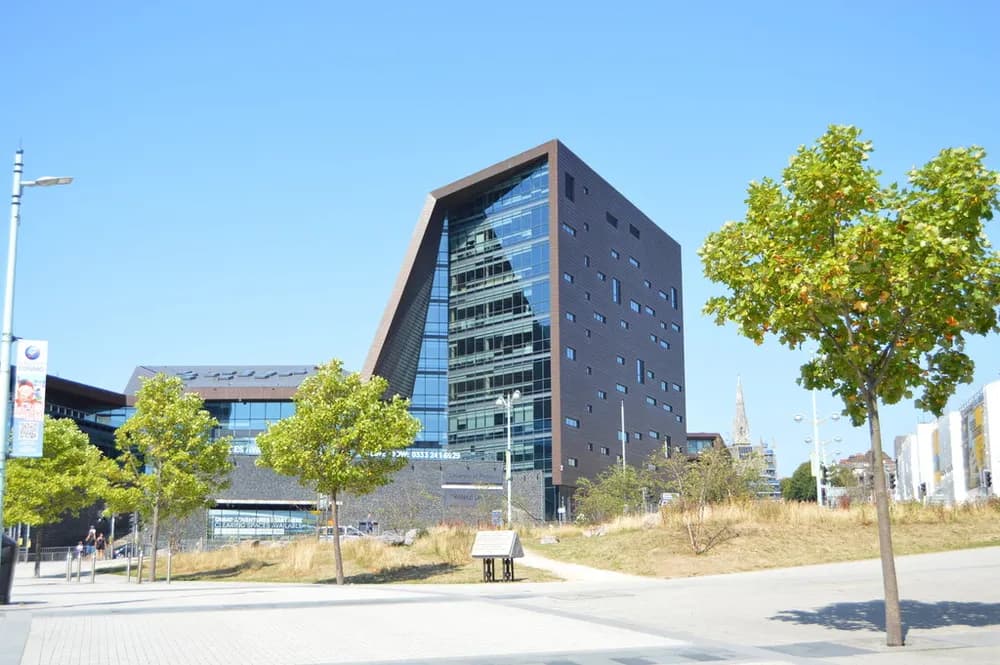
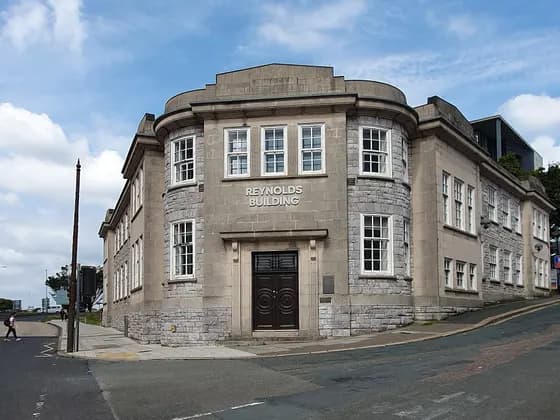


Photo: N Chadwick · CC BY-SA 2.0 · cropped
Photo: Mutney · CC BY 4.0 · Photo: Herbythyme · CC BY-SA 4.0 · Photo: Lauren · CC BY-SA 2.0
The Peninsula (Plymouth) medicine course at a glance (2027 entry)
The BMBS (Bachelor of Medicine, Bachelor of Surgery) at the University of Plymouth is a five-year, full-time medicine degree run by Peninsula Medical School. It is accredited by the General Medical Council (GMC), the body that sets standards for UK medical schools and registers doctors. It prepares you to start work as a Foundation Year 1 (F1) doctor, the first of the two foundation years every new UK doctor works.
Plymouth and Exeter once ran a joint Peninsula College of Medicine and Dentistry. Plymouth began teaching its own BMBS in September 2013. In January 2018, the year its first graduates qualified, the GMC listed the University of Plymouth as an awarding body in its own right, able to grant medical degrees without Exeter. Peninsula Medical School in Plymouth and the University of Exeter Medical School are now different schools with different courses.
The course is a spiral curriculum. Rather than studying each subject once and moving on, you come back to the same topics every year, each time in more depth and closer to real practice. Science, clinical skills and professional development are taught side by side from the start, and much of the early teaching happens in small groups working through real clinical cases.
Patients are part of the course from the beginning of year 1, through placements in community services and GP (general practitioner, or family doctor) surgeries. Years 1 and 2 are based in Plymouth. From year 3 you spend most of your time in hospitals, GP surgeries and community services. The final year is run like an apprenticeship inside clinical teams.
| Degree | BMBS (Bachelor of Medicine, Bachelor of Surgery) |
|---|---|
| Course length | 5 years, full-time |
| UCAS code | A100 (institution code P60) |
| Study locations | Plymouth, Torbay and Somerset |
| Teaching style | Spiral, integrated curriculum with case-based small-group learning |
| Years 1 and 2 | Main Plymouth campus, plus clinical skills at Derriford about once a week |
| First patient contact | Year 1, on community and general practice placements |
| Anatomy | Virtual dissection tables, models, ultrasound simulators and living surface-anatomy models |
| Clinical years | Based in Plymouth, Torbay or Taunton; at least one year outside Plymouth |
| Intercalation | Optional and selective, taken between years 4 and 5 |
What makes Peninsula (Plymouth) medicine different
Clinical training across three NHS areas
From year 3 you rotate between three areas, each built around a partner NHS trust: Plymouth (Derriford Hospital), Torbay and South Devon (Torbay Hospital), and Somerset (Musgrove Park Hospital, Taunton). A student on the course page says the smaller hospital at Torbay made it easy to get involved in teaching and conferences.
A final year spent working like an F1 doctor
In year 5 you are attached to clinical teams in blocks, in both GP and hospital settings, and encouraged to shadow and work as though you were the team's F1 doctor. The main module, Clinical and Professional Practice, carries 70 of the year's 120 credits.
Learning alongside other health professions
Interprofessional Learning modules run in years 1, 2 and 3. You work in groups with students from other healthcare courses, so you understand what each profession brings, and where your own role fits, before you work together on the wards.
A student-selected module in each of years 2 to 5
Student-selected components (SSCs) are modules where you choose the topic, and each one has its own theme. Year 2 covers research skills and teaching, year 3 advocacy and public engagement, and year 4 quality improvement and patient safety. In year 5 it is an elective you design yourself.
Knowledge tests with personal feedback
The 2025/26 programme specification describes knowledge tests through years 1 to 4. In years 1 and 2 they follow what you have just been taught, and in years 3 and 4 they are mapped to the GMC blueprint of what a new doctor must know. Each comes with individual feedback on the areas you need to work on.
How Peninsula (Plymouth) teaches medicine
Plymouth's programme specification describes the curriculum as spiral and integrated. Integrated means science, clinical skills and professional development are taught together around patients, rather than as separate blocks of theory followed by practice. The early years mix introductory and more advanced material, but from year 3 everything is pitched at the level of the final year of an honours degree.
In years 1 and 2, teaching is built around clinical cases and patient stories. You work through them in structured small-group activities, backed up by plenary sessions for the whole year group, workshops and supported independent study. Year 1 introduces the science of health and wellbeing and why it matters for patients. Year 2 turns to pathology, meaning how disease damages the body, and to the human and social impact of illness.
In years 3 and 4 most learning moves into hospitals and GP practices, where you learn from patients with clinicians supervising you. You follow patient pathways, learning each condition through the journeys patients make across the health service. Lectures, seminars, workshops and small groups run alongside to link what you see back to the science. In year 5 the emphasis shifts to learning on the job, in primary care (GP and community services) and secondary care (hospitals).
The ways you will learn
| Case-based small groups | In years 1 and 2 you meet regularly in a small group with a tutor to work through a clinical case or patient story. Structured activities help you connect the science you are learning to the person in the case. Separate small groups are used for reflection and feedback on your experiences. |
|---|---|
| Plenaries, workshops and tutorials | Plenaries work much like lectures, introducing topics to the whole year at once. The GMC noted in 2024 that plenaries were also used to talk the year through each knowledge test afterwards. Workshops and tutorials are smaller and more interactive. |
| Clinical skills sessions | About once a week in years 1 and 2 you go to the Clinical Skills Resource Centre at Derriford. Tutors teach examinations and procedures in small groups, often with simulated patients (people trained to act as patients) and manikins, so you practise safely before doing it for real. |
| Life Sciences Resource Centre sessions | Tutor-led anatomy and science sessions in the Portland Square Building on the main campus, using virtual dissection tables, anatomical and molecular models and ultrasound simulators. The same resources are open to you for self-directed study. |
| Interprofessional learning | Group work with students from other healthcare courses, running as its own module in each of years 1, 2 and 3. |
How anatomy is taught at Peninsula (Plymouth)
Anatomy is taught mainly in the Life Sciences Resource Centre (LSRC) in the Portland Square Building. Its centrepiece is a set of Anatomage tables: large touchscreen tables showing digital human bodies built from real anatomical data and CT scans. You can peel back layers of tissue, rotate the body, isolate an organ and compare healthy anatomy with disease, and you can use the tables whenever the LSRC is open.
Alongside the tables you use 3D anatomical models that fit together like jigsaws, custom-printed molecular models, and ultrasound simulators that recreate a patient's landmarks and scan images. A team of surface-anatomy models, who are living people, act as your first patients. With them you learn to find landmarks by touch while talking to the person you are examining, which you later need in clinical exams.
When the school bought its first virtual dissection table in 2015, it said its anatomy teaching was designed to work from the outside in, on living people, rather than on cadavers. The resources it describes today follow the same pattern: digital dissection, anatomical models, imaging and living surface-anatomy models.
When you first meet patients at Peninsula (Plymouth)
You meet patients from the very start of year 1. In years 1 and 2, community and general practice placements show you how care works outside hospital. You meet patients and people who use local services, and learn from the health and social care professionals who support them.
Much of your early hands-on practice happens in simulation first. Year 1's Clinical Practice module teaches you to take a medical history. It also has you practise basic examinations, simple procedures and basic life support in a simulated setting before you use them with patients.
From year 3 the balance flips, and most of your time is spent in hospital, general practice and community settings. By year 5 you are working inside the clinical team rather than observing it.
Year by year at Peninsula (Plymouth)
- Year 1
Scientific foundations and first clinical skills
Year 1 lays the scientific foundations of medicine in their social and clinical context and starts your clinical and professional skills. You learn from real clinical cases and meet patients in community settings. Year 1 has been redesigned. The year 2 to 5 modules below are the ones current students take, and they may change as the first students on the new year 1 move up through the course.
- Medical and Human Sciences 1a and 1b: two linked modules on the biomedical and human sciences that medicine rests on, and how they explain health and disease in real patients.
- Clinical Practice 1: taking a medical history and sharing it with the clinical team, basic examination techniques, simple procedures in simulation, and basic life support and other step-by-step routines for emergencies.
- Clinical Practice 1 also covers professional skills: compassionate communication, organising yourself, reflecting on your practice and self-awareness.
- Core Competencies 1, Foundations of Evidence: finding and critically weighing up research evidence on focused health topics, then presenting what you found in writing, in person and in digital formats.
- Interprofessional Learning 1, plus community placements where you meet patients and learn from health and social care staff.
- Year 2
Disease and the impact of illness
Year 2 deepens your knowledge and clinical skills, with more emphasis on disease processes and on the human and social impact of illness. You take more responsibility for your own learning, see teamwork in action on placement and practise it in group tasks. The year is worth 120 credits.
- Medical Knowledge 2 (50 credits): applying the human and biomedical sciences together, at the level expected of a second-year student.
- Clinical and Communication Skills 2 (30 credits): the next layer of core clinical and communication skills.
- Personal Development and Professionalism 2 (10 credits): teamwork, reflection, time management, ethical practice and using feedback.
- Student Selected Component 2 (30 credits): a research-skills project that also looks at the doctor's role as a teacher.
- Interprofessional Learning 2, and continued community and general practice placements.
- Year 3
Learning in clinical settings
Year 3 is the first year spent mostly in clinical environments: general practice, hospital medicine and community settings. You are based at Derriford in Plymouth, at Torbay or at Taunton, and see first hand how NHS teams work together. The year also builds your ability to speak up for patients and communities and to lead change.
- Medical Knowledge 3 (40 credits): the science behind clinical practice, now tied to the patients you see.
- Clinical and Professional Development 1 (50 credits): core clinical skills and professional behaviour, applied in real clinical settings.
- Student Selected Component 3 (30 credits): a project on doctors as advocates for health and wellbeing.
- Interprofessional Learning 3, the last of the three interprofessional modules.
- Passing year 3 takes you to 360 credits. Leaving then earns a Bachelor of Medical Science (BMedSci), a degree that does not let you register as a doctor. Leaving after year 1 or year 2 earns a Certificate or Diploma of Higher Education.
- Year 4
Building clinical capability
Year 4 continues in hospital and general practice, sharpening your communication, clinical, teamwork and problem-solving skills. The GMC's 2023 review found this was the year students sat the practical half of the national licensing exam. Selected students can take a year out to intercalate after it.
- Medical Knowledge 4 (40 credits): continued clinical science, tested against the knowledge a new doctor needs.
- Clinical and Professional Development 2 (50 credits): refining your clinical skills and professional behaviour on placement.
- Student Selected Component 4 (30 credits): a project on quality improvement and patient safety, with leadership, teamwork and peer assessment.
- The Clinical and Professional Skills Assessment (CPSA): the practical half of the Medical Licensing Assessment (MLA) that every UK medical graduate must now pass, run by the school as a station-based clinical exam.
- Year 5
Preparing for practice
The final year follows an apprenticeship model. You are attached to clinical teams in blocks, in GP and hospital settings, and encouraged to shadow and work as though you were the team's F1 doctor. You also plan and carry out an elective of your own design.
- Clinical and Professional Practice (70 credits): showing you can carry out procedures and investigations, interpret the results and write a management plan for common acute and chronic conditions. You do this as part of a team of doctors, nurses and other professionals.
- Medical Knowledge 5 (40 credits): the year's knowledge module, linked to the national Applied Knowledge Test (AKT), the written half of the MLA.
- Student Selected Component 5 (10 credits): the elective.
- The GMC's 2023 report describes year 5 workplace-based assessments on placement. They cover practical skills, clinical examinations and case-based discussions (talking through a patient's care with a senior doctor), matched to the training plan for new doctors.
- The Prescribing Safety Assessment, a national online exam that checks you can prescribe medicines safely.
How you are assessed at Peninsula (Plymouth)
Every year has its own knowledge modules: Medical and Human Sciences 1a and 1b in year 1, then Medical Knowledge 2 to 5. The 2025/26 programme specification describes the year 1 and 2 tests as Medical Science Assessments, tied to that year's teaching. In years 3 and 4 you sit Applied Medical Knowledge tests, mapped to the GMC blueprint of what a new doctor must know. Each comes with individual feedback on the areas you need to work on.
When the GMC reviewed the school's knowledge testing in 2024, it described a progress-testing model. A progress test is pitched at the level of a new doctor and repeated through the course, so your score should rise as you learn. At that time students in years 1 to 4 sat four tests a year, and by the final year had answered at least 2,000 questions. Because the newer specification ties the year 1 and 2 tests to that year's teaching, this pattern may have changed.
Clinical skills are examined in an Integrated Structured Clinical Examination (ISCE), Plymouth's version of the OSCE (Objective Structured Clinical Examination). You rotate through stations with real or simulated patients and are marked on communication, patient assessment, diagnosis, management planning and procedures. You must also show competence in an agreed set of examinations and procedures, first practised in the skills lab and then assessed with real patients on placement.
Professionalism is judged throughout the course by clinical and community supervisors, academic tutors and small-group facilitators, who look at your teamwork, organisation, reflection and patient-centred care. Structured reflective writing counts towards these judgements. On placement, clinical reasoning assessments, clinical evaluation exercises and case-based discussions test how you gather information from patients and plan their care.
Medical degrees awarded by UK universities from 2024-25 must include a pass in the MLA, which has two parts: the AKT and the CPSA. In 2023 the GMC found that Plymouth's CPSA met its requirements. It was then sat in year 4 as a sequential exam: everyone took eight stations over two days, and students who failed or were borderline took eight more stations on a further day.
Each station lasted 22 minutes, with two minutes of reading time, used trained simulated patients rather than real ones, and included a professionalism mark. Because of the two-phase design there was no separate resit within the year. Workplace-based assessments with real patients follow in year 5.
- Applied Knowledge Test: a nationally set, computer-based exam of single-best-answer questions (you pick the best of several options). In 2024 the GMC reported that it was the only knowledge exam that counted in year 5, and that final-year students sat four practice progress tests before it.
- Prescribing Safety Assessment: required in year 5.
- Progression: you normally need to pass every module to move up a year. Failing one module in years 1 to 4 means repeating the whole year, failing more than one can lead to removal from the course, and you cannot repeat the same year twice.
- Merit and Distinction: the BMBS can be awarded with Merit or Distinction based on year 5 results in Medical Knowledge 5 and Clinical and Professional Practice. Only students who passed every year at the first attempt are eligible.
Where you will actually be at Peninsula (Plymouth)
Placements run across the south west of England, in hospitals, GP practices and community services. For years 1 and 2 you are based in Plymouth. From year 3 to year 5, placements are organised around three areas, each built on a partner NHS trust: Plymouth, Torbay and South Devon, and Somerset.
Every student spends at least one of those years based in Torbay or Taunton. The school describes these as extended placements of up to a year, rotating around its sites, and you also travel out from the main hospitals to GP practices. The university says students arrange their own accommodation on placement, and the Faculty of Health lists placement travel and accommodation among costs that tuition fees do not cover.
Every hospital, community and GP provider works to a formal agreement with the university that sets out the teaching hours, supervision, staff training and assessment on that placement. Each clinical area has a named Clinical Teacher Lead. You can contact them about problems such as a timetable change or a patient safety concern, and each placement opens with an introduction to its learning objectives and assessments.
Your base for years 1 and 2 and one of the three clinical areas. Derriford is the region's major trauma centre. The trust says Peninsula students in years 3 to 5 take attachments in its critical care unit, joining ward rounds and receiving teaching from consultants.
- Derriford Hospital (University Hospitals Plymouth NHS Trust)
- Clinical Skills Resource Centre, John Bull Building, Derriford campus
Torbay has long hosted final-year medical students and began taking Plymouth's year 3 and 4 students in 2017. By 2021, the trust says, medical students on site had risen from about 50 to about 110. In 2022 the medical school paid £660,000 to refurbish the Horizon Centre, the hospital's education building, adding simulation suites, debrief rooms and study rooms.
- Torbay Hospital (Torbay and South Devon NHS Foundation Trust)
- Horizon Centre and Torbay Clinical Skills Wing, Torbay Hospital
Musgrove Park is a general hospital with emergency, intensive care, maternity, children's and cancer services. Students on placement can join the trust library, which offers 24-hour access.
- Musgrove Park Hospital, Taunton (Somerset NHS Foundation Trust)
- Musgrove Park Hospital Academy library, Jubilee Building
GP practices in rural and inner-city parts of Devon, Somerset and Cornwall host primary care placements throughout the course.
Electives and chosen modules at Peninsula (Plymouth)
Student-selected components (SSCs) are modules where you pursue an interest outside the core curriculum while building general skills such as research, communication and project management. On the current course page there is one in each of years 2 to 5, each with its own focus.
Some SSCs happen on placement. The faculty's partnerships with Devon Integrated Care Board (the NHS body that plans and funds health services in Devon) and local trusts provide SSC placements and shadowing as well as clinical placements.
The elective comes in year 5. You plan a placement in the UK or overseas, in a setting of your choice that the school agrees, and use it to bring your learning together in a different social or cultural context. One graduate featured on the course page spent four weeks with a dermatology team in a public hospital in Kathmandu, Nepal.
- Year 2 (30 credits): research skills, such as searching the literature, evaluating and presenting evidence, forming research questions and managing a project, plus the doctor's role as an educator.
- Year 3 (30 credits): communication, research and critical thinking, with a focus on doctors as advocates for health and on working with patients and the public.
- Year 4 (30 credits): quality improvement and patient safety, with leadership, teamwork and peer assessment.
- Year 5 (10 credits): the elective, a period of study you design yourself.
Intercalation at Peninsula (Plymouth)
Intercalating means taking a year out of medicine to earn an extra degree. At Plymouth it is optional and selective: some students are offered the chance at the end of year 4, then return to start year 5 a year later.
You can join the third year of another undergraduate course, leading to a BSc or BA, or take a one-year master's degree. The university's own list includes intercalated BScs in Critical Care and in Urgent and Emergency Care, and a BSc in Medical Sciences. Master's options include Global Health, Expedition and Marine Medicine, Clinical Education and Clinical Research, and arts and humanities options such as History, English and Music are also listed.
Places on these programmes depend on their entry requirements and the programme lead's approval. Plymouth medical students get guidance from their own programme team on how to apply.
Facilities and support at Peninsula (Plymouth)
Where you will learn
The Portland Square Building on the main campus is where most year 1 and 2 teaching happens. It houses the Life Sciences Resource Centre, whose teaching rooms and resources you can also use for private study, group work and peer teaching.
The Clinical Skills Resource Centre is in the John Bull Building on the Derriford campus at Plymouth Science Park, in the north of the city. Its teaching rooms have examination couches and equipment trolleys, so a tutor can teach a skill such as a neurological examination to eight students at once. Simulation suites recreate emergency department bays and resuscitation rooms.
SimMan, a computer-controlled manikin, shows clinical signs and reacts to what you do. Staff run each scenario from a control room behind a one-way mirror and record it for debriefing afterwards.
A bookable Supported Student Learning room has part-body trainers for taking blood, inserting a cannula (a thin tube into a vein), taking arterial blood samples, giving injections, handling sharps safely and suturing. A scrub room teaches surgical scrubbing, gowning and gloving before your first operating theatre placements.
The programme specification says each of the three clinical areas has its own Clinical Skills Resource Centre, so skills practice continues when you are based in Torbay or Taunton.
Support while you study
Academic Tutors guide how you learn, go through your assessment results and feedback with you, and give the first level of help if you fall behind. Problems and agreed solutions are written into a learning contract or action plan, and you keep your assessment feedback in a portfolio.
If difficulties continue, Senior Academic Tutors step in, and a specialist Remediation Team works with students on study skills and on wider personal and health issues. An Academic Review Group meets every term to look at each student's progress and recommend support.
Pastoral Tutors help with non-academic worries and can point you to services such as student counselling. They are based on the university campus and at the John Bull Building. There are also Pastoral Tutors at the acute hospitals in South Devon and Somerset, so there is someone to talk to when you are based away from Plymouth.
Some tutors are practising doctors: University Hospitals Plymouth offers its senior clinicians academic and pastoral tutor roles. Outside the formal system, the student medical society, Peninsula MedSoc, pairs each new first-year with two second-year students as a first point of contact and runs student-led teaching.
Is the Peninsula (Plymouth) course right for you?
This course may suit you if
- You want to meet patients from your first year, through community and GP placements, rather than waiting for the clinical years.
- You learn well by talking cases through in small groups and by practising clinical skills hands-on every week in years 1 and 2.
- You want to learn to work with other health professions, with interprofessional modules in each of years 1 to 3.
- You would like a final year that works like an apprenticeship, inside clinical teams, before you start as a doctor.
Things to think about
- At least one clinical year is based in Torbay or Taunton, and you arrange your own housing there. Tuition fees do not cover the upfront cost of placement travel and accommodation, so budget for it.
- Anatomy is taught with digital dissection tables, models, imaging and living surface-anatomy models. If working with donated human bodies matters to you, ask about it at an open day.
- Progression rules are strict: failing a single module in years 1 to 4 normally means repeating the whole year.
- Intercalation is not guaranteed. It is offered to selected students, and only after year 4.
Peninsula (Plymouth) medicine course — frequently asked questions
Applying to Peninsula (Plymouth)?
How to get into Peninsula (Plymouth)
Entry requirements, UCAT, personal statement and interview, step by step.
Open the guide →Peninsula (Plymouth) UCAT cut-offs and offers
UCAT cut-offs, A-level offers, interview format and decision dates.
See the requirements →Compare Peninsula (Plymouth) with other schools
Put the teaching style, anatomy teaching and placements next to another school.
Open the comparison →Prepare for the Peninsula (Plymouth) interview
Format breakdown, school-specific sample questions and prep tips from tutors who interviewed here.
Read the guide →Where this Peninsula (Plymouth) course guide came from
This guide was written from 20 official sources — University of Plymouth's own course pages and programme documents, plus the regulator and NHS placement partners where they publish detail — read on 2026-09-23, then checked claim by claim against those sources.
- BMBS Bachelor of Medicine, Bachelor of Surgery - University of Plymouth course page
- BMBS programme specification, academic year 2025/26 - Peninsula Medical School
- GMC compliance decision on the MLA Clinical and Professional Skills Assessment, Peninsula Medical School (2023)
- GMC compliance decision on the MLA Applied Knowledge Test, Peninsula Medical School (2024)
- GMC list of awarding bodies and new schools
- Peninsula Medical School - University of Plymouth
- Peninsula Medical School facilities - University of Plymouth
- Clinical Skills Resource Centre, John Bull Building - University of Plymouth
- Life Sciences Resource Centre - University of Plymouth
- Virtual dissection table news release, University of Plymouth (2015)
- Intercalated degrees at the University of Plymouth
- Accommodation for health students undertaking placements - University of Plymouth
- Faculty of Health additional costs - University of Plymouth
- About us - University Hospitals Plymouth NHS Trust
- Medical and dental careers - University Hospitals Plymouth NHS Trust
- Intensive care unit information for healthcare professionals - University Hospitals Plymouth NHS Trust
- Horizon Centre redevelopment supports medical student and staff training - Torbay and South Devon NHS Foundation Trust (2022)
- Health professionals - Torbay and South Devon NHS Foundation Trust
- Musgrove Park Hospital - Somerset NHS Foundation Trust
- Library and Knowledge Service - Somerset NHS Foundation Trust
Courses are restructured between cycles. Anything here that decides your application — an anatomy offer, a placement city, a compulsory intercalated year — should be confirmed against the official page for your entry year.
Applying to Peninsula (Plymouth)?
We have helped hundreds of applicants turn their UCAT, personal statement and interview prep into offers from Peninsula (Plymouth) and other UK medicine schools.