
The Cardiff Dentistry course
What you actually study, and where you will be
Cardiff's BDS is a 5-year course with an integrated curriculum, with patient treatment from Year 2 and placements in Cardiff and across Wales (2027 entry). Based in the University Dental Hospital, with a £2.2 million simulation suite of phantom heads before you touch a patient. Primary care outreach placements, in and around Cardiff and across Wales, start in year 3 or 4.
- Degree
- BDS
- Length
- 5 years
- Teaching
- Integrated
- First patients
- Year 2
- UCAS code
- A200


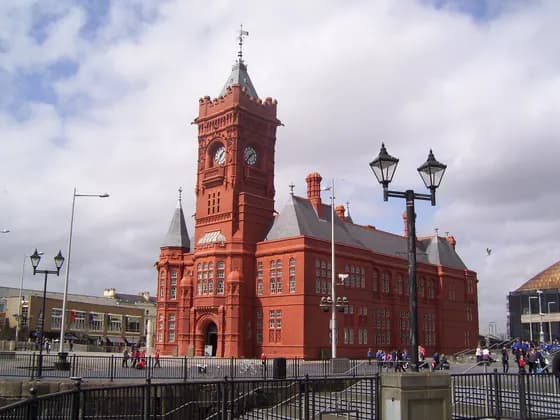

Photo: Jeremy Segrott (from Cardiff, Wales, UK) / Wikimedia Commons · CC BY 2.0 · cropped
Photo: Colin Smith · CC BY-SA 2.0 · Photo: Martin Speck · CC BY-SA 2.0 · Photo: Athena's Pix (Back, but give me time!) profile at Flickr website · CC BY 2.0
The Cardiff dentistry course at a glance (2027 entry)
Cardiff's Dental Surgery (BDS) is a five-year, full-time degree that trains you to work as a dentist. BDS stands for Bachelor of Dental Surgery. When you graduate you can apply to register with the General Dental Council (GDC), the body that regulates dental professionals across the UK. Around 74 students start each year, including a small number from overseas.
The course is run by the School of Dentistry on Cardiff University's Heath Park campus, a site it shares with the University Hospital of Wales. On the same site is the University Dental Hospital, a stand-alone NHS building that treats around 100,000 patients a year. The hospital screens patients to find people whose treatment needs suit supervised students, and runs clinics for teaching.
Skills come before patients. From year 1 you practise on phantom heads, which are mannequin heads fitted with artificial teeth and jaws, in the school's simulation suite. You see your first patient in the summer term of year 2 and then build up your own list of patients. In later years you also work on outreach placements, which means clinics away from the dental hospital, in and around Cardiff and elsewhere in Wales.
The same school trains dental therapists and dental hygienists, so you learn alongside other members of the dental team. On clinic you also work with dental nurses, dental technicians and NHS consultants. You get feedback on every pre-clinical and clinical session, and your progress is logged on an electronic portfolio (ePortfolio) that follows you through the course.
The course is changing. Cardiff is reviewing the BDS with its students, expects to finish by August 2027 and will publish the final modules for 2027 entry by September 2027. The GDC's 2025 inspection report says the school is revising its courses to fit the GDC's Safe Practitioner Framework. This is a newer set of learning outcomes for dental training, which took effect on 1 August 2025. This guide describes the current course, so some details may change for you.
| Degree | Dental Surgery (BDS), Bachelor of Dental Surgery |
|---|---|
| Course length | 5 years full time, 213 weeks of study (GDC 2025) |
| UCAS code | A200 |
| Intake | Around 74 places a year, about 4 to 5 of them for overseas students |
| Main base | School of Dentistry and University Dental Hospital, Heath Park, Cardiff |
| First patient | Summer term of year 2, after passing gateway assessments |
| Simulation | £2.2 million suite with phantom heads, intra-oral scanners and 3D printing |
| Main outreach sites | St David's Hospital in Cardiff and Ysbyty Cwm Cynon in Mountain Ash |
| Curriculum status | Under review; final modules for 2027 entry due by September 2027 |
| Latest GDC inspection | 2025: still approved for graduates to register as dentists |
What makes Cardiff dentistry different
A working dental hospital on your campus
The School of Dentistry shares the Heath Park campus with the University Dental Hospital. The hospital treats around 100,000 patients a year and screens people who are suitable for treatment by students. From year 2, much of your patient care happens in its teaching clinics, on the same site as your lectures.
Clinic visits from year 1, patients from year 2
In year 1 you spend half a day a week getting to know the clinics. You treat your first patient in the summer term of year 2, after passing gateway assessments that test your infection control and practical skills.
Outreach clinics across south and north Wales
Cardiff's two main outreach sites, where students treat adults, are St David's Hospital in Canton, Cardiff, and Ysbyty Cwm Cynon in Mountain Ash. In year 5 you also treat children with the Community Dental Service, the NHS service that treats people who find it hard to use an ordinary practice. This includes clinics in south Wales and two weeks living and working with the service in north Wales.
Training alongside dental therapists and hygienists
Cardiff also trains dental therapists and hygienists. When it opened a new simulation suite in 2016, the school said the suite was built so all three groups could train together. On clinic you often work in pairs, taking turns to treat and to assist, and patients can be shared between year groups and courses. It prepares you to lead a dental team.
Feedback logged through an ePortfolio
Cardiff uses an ePortfolio called CAFS, introduced in January 2024, in the dental hospital and on outreach. Supervising dentists, therapists, hygienists and nurses can all log feedback on you, and each patient gets a code to rate their visit anonymously. Progress panels review your record every term.
How Cardiff teaches dentistry
Cardiff uses a mix of teaching methods rather than one single approach. You meet lectures, small-group seminars and tutorials, individual teaching from supervisors on clinic, practical classes, problem-solving exercises and online learning. The school also expects a substantial amount of self-directed study. Each unit comes with a topic or module guide that sets out what every session should teach you.
Year 1 lays the science foundations, taught partly in the School of Dentistry and partly in the university's School of Biosciences, while you start basic skills in the simulation suite. From year 2 onwards most of your teaching is in the School of Dentistry. The balance then shifts from lectures and simulation towards treating patients, until year 5 is mainly clinics and outreach placements.
Simulation does not stop once patients arrive. In year 4 you have simulation training in minor oral surgery and in advanced crowns and similar restorations that cover the outside of a tooth. Year 5 still includes work in the simulation suite, and simulation is also used to train you to manage medical emergencies.
You are taught to work as part of a team. Group activities, shared patients and interprofessional teaching with other dental professions are built into the course, and you are expected to reflect on your own work in your ePortfolio throughout.
The ways you will learn
| Lectures, seminars and tutorials | Lectures give the whole year group the core science and clinical knowledge. Smaller seminars and tutorials let you discuss cases, ask questions and apply what you have learned. Lecture notes, course materials and some online assessments are kept on Learning Central, the university's online learning system. |
|---|---|
| Simulation on phantom heads | You practise procedures on mannequin heads before doing them on patients. When Cardiff opened a new simulation suite in December 2016, it said students would learn fillings, gum treatment, root canal treatment, crowns and bridges, dentures and surgical extractions there. It also listed the technical work of making crowns and dentures. |
| Supervised clinics in pairs | On clinic you often work with a partner, one of you treating while the other assists, then swapping. A supervisor registered with the GDC oversees a small group. Most feedback is spoken, during and after the session, and written comments and grades on your ePortfolio back it up. |
| Case-based seminars | Some subjects are taught through patient cases. Orthodontics, the branch of dentistry that straightens teeth and corrects bites, is taught this way in year 3. Children's and orthodontic clinic sessions start with a case-based seminar that links theory to the patients you are about to see. |
| Projects and presentations | You work on projects alone or in groups, research topics and present your work to other students. Project work builds your scientific writing and literature review skills, and leads up to a research project that starts in year 4. |
How anatomy is taught at Cardiff
In year 1 you study dental anatomy, which is the structure of the teeth and mouth, alongside physiology and the diseases that affect the mouth and teeth. This part of the course is shared between the School of Dentistry and the School of Biosciences.
The School of Biosciences houses the Wales Centre for Anatomical Education, which teaches around 2,000 undergraduates from many different courses. The centre says it offers cadaveric dissection, meaning learning from the bodies of people who chose to donate them, to science, medical and dental students, alongside tutorials and online learning. Its pages describe its teaching across all of these courses rather than the BDS in particular.
When you start treating patients at Cardiff
Before you treat anyone, you must pass gateway assessments in infection control and in the clinical skills set for your year. In year 2 you first learn the clinic routines and equipment in sessions with no patients. Your first patient comes in the summer term, when you examine patients and plan their treatment but give only preventive advice or a professional clean to remove plaque and tartar. After that your own list of patients grows through years 3 to 5.
Patients treated by students are screened first to check their needs suit student care, and they sign a form agreeing to treatment by a student. The NHS tells patients at the dental hospital that each visit takes one to two hours, longer than at an ordinary practice. You wear a name badge, and staff roles are shown by uniform colour, so patients know who everyone is.
Supervision depends on the task. The GDC's 2025 report recorded at most one supervisor to eight students on restorative clinics, which cover fillings, crowns and other repairs, and usually one to six. It recorded one to two for routine extractions, one to one for surgical extractions, and one to three on children's and orthodontic clinics.
You attend children's clinics weekly in years 3 and 4 and fortnightly in year 5. Children are referred from a consultant's clinic to a student-led children's clinic, where you complete a treatment plan the consultant, a senior hospital specialist, has already approved. You do this under supervision, and you can also watch and help in the children's emergency clinic.
Children's dentistry is the one area the GDC asked Cardiff to improve. Students told the 2025 inspectors they saw too few child patients, partly because appointments were missed, and had limited chances to follow a child through a full course of care. The GDC rated this requirement partly met.
In reply, Cardiff set out a new route for local practices to refer suitable children to students and a new student treatment-planning clinic. A patient system called Salud 2 (Titanium) would let the hospital assign children to the same student over time. It also described a new rural placement in Powys. These were plans in 2025, so ask at an open day how they are working.
Year by year at Cardiff
- Year 1
Foundations and first steps in clinic
Year 1 builds the science behind dentistry and introduces you to professional life. You study dental anatomy, physiology and the diseases of the mouth and teeth, split between the School of Dentistry and the School of Biosciences. You also start basic clinical skills in the simulation suite and spend time each week getting used to the clinics.
- Core science: dental anatomy, physiology and the pathology, meaning the causes and effects, of oral and dental disease.
- Introductory clinical skills on phantom heads in the simulation suite.
- A half-day clinical attachment each week for orientation, including observing clinics.
- Professionalism teaching on the GDC's Standards for the Dental Team, the rules every registered dental professional must follow.
- An introduction to raising concerns about patient safety and to the duty of candour, which means being open with patients when something goes wrong.
- An induction week, repeated at the start of every year, covering fitness to practise (the standard of conduct and health expected of a future dentist), academic misconduct and the school's student code of conduct.
- Year 2
Pre-clinical skills and your first patient
Year 2 moves you into the School of Dentistry, where you learn about diseases of the teeth, jaws and face and how to prevent and manage them. Simulation training focuses on the gums, tooth decay and fillings. In the summer term you meet your first patient.
- Lectures, seminars and clinical skills sessions on dento-facial disease, meaning conditions of the teeth, jaws and face.
- Simulation training in periodontics, the care of the gums, and in cariology and operative dentistry, which cover tooth decay and repairing it with fillings.
- Clinic inductions and gateway assessments, then your first patient in the summer term, as described under Treating patients.
- Continued teaching on professionalism, communication and raising concerns.
- Year 3
Treating patients across the specialties
In year 3 your patient list grows and you begin treating patients in several branches of dentistry. Lectures and seminars apply your knowledge to clinical problems, and simulation moves on to more complex procedures. The GDC's 2025 report also lists a first outreach placement this year in primary care, which is everyday dental care in the community.
- Simulation training in endodontics (root canal treatment), periodontology (gum care) and prosthodontics (restoring and replacing teeth with crowns, bridges and dentures).
- Clinical teaching in oral surgery, restorative dentistry and paediatric dentistry, with a children's clinic every week.
- Case-based teaching in orthodontics.
- An outreach placement in a primary care setting, as listed in the GDC's 2025 report.
- A growing list of your own patients, building your treatment and patient management skills.
- Year 4
Wider clinical work and a research project
Year 4 widens your clinical work to include orthodontic patients and oral medicine, and you spend time on placement in primary care in and around Cardiff and across Wales. Teaching focuses on treatment planning and on care that prevents disease. You also start a research project.
- Clinical teaching in oral surgery, restorative dentistry, paediatric dentistry, orthodontics and oral medicine, which deals with conditions such as diseases of the lining of the mouth.
- Simulation training in minor oral surgery and in advanced extra-coronal restorations, such as crowns, which cover the outside of a tooth.
- Outreach placements in primary care settings in and around Cardiff and across Wales.
- A research project.
- Two gateway tests, a year 4 clinical exam and a bridge-preparation test, which you had to pass to enter the final year under the rules set out in Exams and assessment.
- Year 5
Consolidation, outreach and finals
The final year is mainly clinical, split between the dental hospital, the simulation suite and outreach placements. You consolidate your skills across the main branches of dentistry and see how community and hospital dental services work. Finals check that you are ready to practise safely as a new dentist.
- Consolidation clinics in oral surgery (including surgical procedures), restorative dentistry, paediatric dentistry, orthodontics and oral medicine.
- Outreach placements in primary care settings.
- Children's dental care at Community Dental Service clinics in south Wales.
- A two-week residential placement with the Community Dental Service in north Wales, treating children.
- Observation in maxillofacial units at district general hospitals, where surgeons treat the face, jaws and mouth.
- Children's clinics every fortnight.
- Final exams, which under the rules set out in Exams and assessment ran from written papers in January to clinical vivas (oral exams with examiners) in May.
How you are assessed at Cardiff
Cardiff assesses you against the four areas the GDC sets for new dental professionals: clinical knowledge and skills, interpersonal skills, professionalism and managing yourself. Across the course you meet written exams and assignments, case reports, practical skills tests, projects, portfolios, online tests, oral presentations and clinical oral exams, where an examiner questions you about a patient or case.
Some assessments act as gates. You must pass gateway assessments before treating patients, and each term an Academic and Professional Progression panel reviews how you are doing. Each year group gets an assessment and feedback handbook that lists every test for the year, so you can plan ahead. Feedback and concerns logged on your ePortfolio also feed into these reviews.
The details that follow come from the school's final-year assessment handbook for 2023/24, so treat them as a guide while the course is under review. That year, Final BDS covered years 4 and 5 and made up 60% of the degree result. Written papers made up 45% of Final BDS, projects and coursework 25%, case reports 15% and vivas on unseen patient cases 15%.
The written part was two three-hour papers, one of them single best answer questions, where you pick the best of several options. The research project, of 4,000 to 6,000 words, carried 86% of the project marks and a long-running orthodontic project 14%. Project titles were confirmed in January of year 4 and the write-up was due early in year 5.
Clinical finals were three written case reports on patients you had treated, plus three vivas on patient cases you had not seen before. The adult and child cases each carried 35% of the viva marks and the oral disease case 30%. Degrees were awarded as Honours (70% or above), Commendation (60 to 69%) or Pass (50 to 59%).
Before clinical finals you had to complete all required competencies. Earlier, you had to pass a year 4 Objective Structured Clinical Examination (OSCE), a circuit of timed stations that each test a set task, and a bridge-preparation test to move into year 5. In the bridge test you shape teeth to hold a bridge, a false tooth fixed to its neighbours. Neither test counted towards the final mark.
Where you will actually be at Cardiff
Much of your early clinical work happens at the University Dental Hospital in Cardiff. Outreach placements then take you into primary care, meaning everyday dental services in the community rather than a specialist hospital. The course page describes these placements from year 4, in and around Cardiff and across Wales, and the GDC's 2025 report also lists one in year 3.
The GDC report names two main outreach sites where students treat adults: St David's Hospital in Canton, Cardiff, and the clinic at Ysbyty Cwm Cynon (Cynon Valley Hospital) in Mountain Ash. The health board lists both as part of the University Dental Hospital's service. In year 5 you also treat children with the Community Dental Service in south and north Wales, and observe in hospital maxillofacial units.
On placement an experienced clinical lead supports you. Since September 2024 a Director of Student Placements has overseen all outreach placements, with site visits normally once a year and remote check-ins every six months. You fill in a feedback questionnaire after each placement, and placement staff join the school's training days so that teaching and marking stay consistent across sites.
Cardiff's 2025 response to the GDC described a new placement in Powys, where students would work in rural dental settings within the General Dental Service, meaning ordinary NHS high-street dentistry. Students would treat both adults and children there. Cardiff presented this as a planned change, so ask at an open day how it is running.
Your main clinical base, in its own building on the University Hospital of Wales site, with teaching clinics for student treatment.
- University Dental Hospital
One of the two main outreach sites where students treat adult patients.
- St David's Hospital, Primary Care Dental Unit
The second main adult outreach site.
- Ysbyty Cwm Cynon
Year 5 clinics where you provide dental care for children.
- Community Dental Service clinics
A two-week residential placement in year 5, providing dental care for children.
- Community Dental Service
Year 5 visits to observe care of the face, jaws and mouth. You watch rather than treat.
- Maxillofacial units
A rural placement Cardiff planned in 2025, in ordinary NHS dental practices.
Facilities and support at Cardiff
Where you will learn
The simulation suite is where you learn hands-on skills. Cardiff's course page describes a £2.2 million suite with phantom heads, intra-oral scanners, which take a 3D digital impression of the teeth, and 3D printing.
The University Dental Hospital houses the clinics where students treat patients. Between them, the school's three Dental Education Clinics and four specialised clinics include oral surgery, an examination and emergency clinic, a children's clinic, an orthodontic clinic and adult clinical practice. Student clinics run on weekdays during working hours, and you learn to use the hospital's computer system for booking patients and keeping electronic records.
The School of Dentistry building on the Heath Park campus has two lecture theatres, teaching and research laboratories and a dental library with a large collection of books and journals.
Support while you study
You have a personal tutor for pastoral support throughout the course. Supervisors, topic leads and year leads give individual academic help, and on placement a clinical lead looks after you. If you fail an assessment, the relevant lead gives you extra guidance and remediation before the resit.
The Cardiff Dental Student Society (CDSS) is run by students and brings together dental surgery, hygiene and therapy students. In first year you are given dental parents, older students who mentor you. The society organises social events, sports days with other dental schools and charity work, and students run outreach such as oral health talks in local schools and hygiene packs for homeless people in Cardiff.
The school has an inclusive curriculum policy. Reasonable adjustments to most assessments can be made on the advice of the university's Student Support Unit, as long as GDC requirements are still met. You can discuss likely adjustments with the school before you apply. A school committee called WIDER leads work on wellbeing, inclusivity, diversity, equity and respect.
Students help shape the course through student-staff panels, monthly student representative meetings and consultations on the curriculum and timetable. The school's policy on how students raise concerns about patient safety was written with the student body.
Is the Cardiff course right for you?
This course may suit you if
- You want to study beside an NHS dental hospital that treats around 100,000 patients a year, with teaching clinics on the same campus as your lectures.
- You would like plenty of simulation practice and to pass skills gateways before treating anyone, with patients arriving in the summer of year 2.
- You are keen to see dentistry beyond the city, from Mountain Ash to a residential fortnight in north Wales.
- You value frequent feedback: Cardiff gives feedback on every pre-clinical and clinical session. On clinic it is mostly spoken, and it is logged on your ePortfolio in all clinical and most pre-clinical sessions.
- You want to train alongside dental therapists and hygienists, the team you will lead as a dentist.
Things to think about
- The BDS is under review and the final modules for 2027 entry are due by September 2027, so details in this guide may change.
- The GDC's 2025 inspection found students' experience of treating children only partly met its standard. Ask how Cardiff's new measures are working.
- Outreach means travelling to sites such as Mountain Ash and spending two weeks living in north Wales in year 5.
- Your first patient comes in year 2, so year 1 is mainly science and simulation, with clinic time limited to observation and orientation.
Cardiff dentistry course — frequently asked questions
Applying to Cardiff?
How to get into Cardiff
Entry requirements, UCAT, personal statement and interview, step by step.
Open the guide →Cardiff UCAT cut-offs and offers
UCAT cut-offs, A-level offers, interview format and decision dates.
See the requirements →Compare Cardiff with other schools
Put the teaching style, anatomy teaching and placements next to another school.
Open the comparison →Prepare for the Cardiff interview
Format breakdown, school-specific sample questions and prep tips from tutors who interviewed here.
Read the guide →Where this Cardiff course guide came from
This guide was written from 12 official sources — Cardiff University School of Dentistry's own course pages and programme documents, plus the regulator and NHS placement partners where they publish detail — read on 2026-09-24, then checked claim by claim against those sources.
- Dental Surgery (BDS) course page, Cardiff University (2027 entry)
- GDC Education Quality Assurance Inspection Report, Cardiff University BDS (inspected January and May 2025)
- BDS Year 5 Assessment and Feedback Handbook 2023/24, Cardiff University School of Dentistry
- Admissions information for studying Dentistry at Cardiff (places per year)
- Undergraduate courses, School of Dentistry, Cardiff University
- Dentistry subject page, Cardiff University
- Our location, School of Dentistry, Cardiff University
- Cardiff University opens dental simulation suite (news, December 2016)
- About the Wales Centre for Anatomical Education, Cardiff University
- University Dental Hospital, Cardiff and Vale University Health Board
- Treatment with students, University Dental Hospital, Cardiff and Vale University Health Board
- Dental Foundation Training overview, Health Education and Improvement Wales
Courses are restructured between cycles. Anything here that decides your application — an anatomy offer, a placement city, a compulsory intercalated year — should be confirmed against the official page for your entry year.
Applying to Cardiff?
We have helped hundreds of applicants turn their UCAT, personal statement and interview prep into offers from Cardiff and other UK dentistry schools.