
The King's College London (KCL) Dentistry course
What you actually study, and where you will be
King's College London's BDS is a 5-year course with an integrated curriculum, with placements in London and Portsmouth (2027 entry). King's graduates around 150 dentists a year and teaches in partnership with Guy's, St Thomas' and King's College Hospitals. Simulation includes high-fidelity augmented reality haptics.
- Degree
- BDS
- Length
- 5 years
- Teaching
- Integrated
- UCAS code
- A205
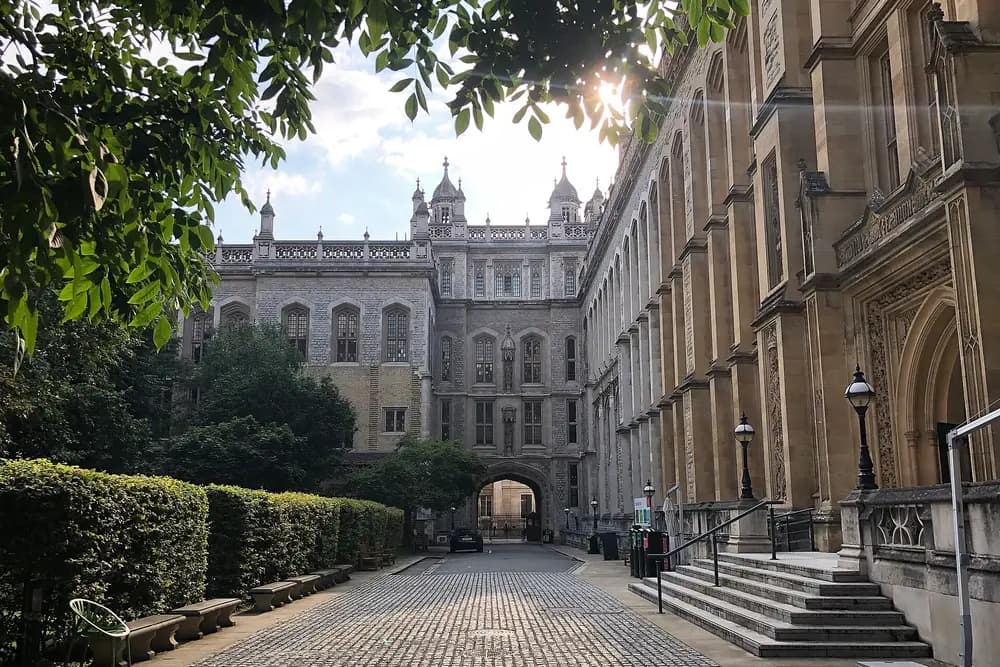
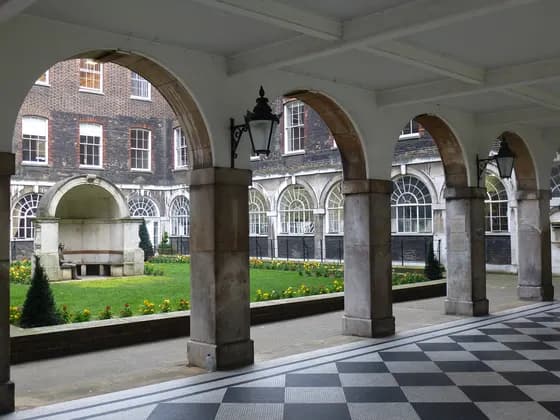
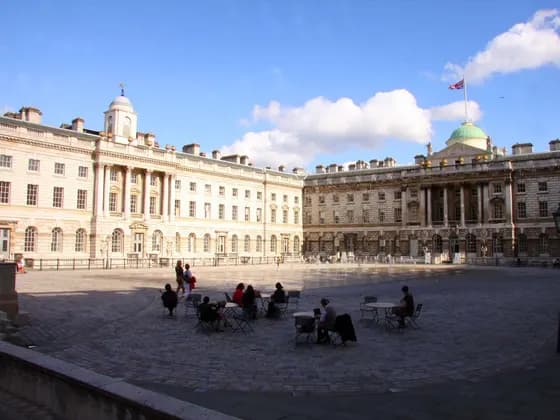
Photo: K Ulysses-Ono · CC BY-SA 4.0 · cropped
Photo: Ввласенко · CC BY-SA 3.0 · Photo: Jim Osley · CC BY-SA 2.0 · Photo: Steve Daniels · CC BY-SA 2.0
The King's College London (KCL) dentistry course at a glance (2027 entry)
King's College London's five-year dentistry degree is the BDS, short for Bachelor of Dental Surgery, with the UCAS code A205. It is run by the Faculty of Dentistry, Oral & Craniofacial Sciences, which has more than a thousand dental students across its courses, and around 150 dentists graduate from the BDS each year. The General Dental Council (GDC), which regulates dentists and the rest of the dental team in the UK, inspects and accredits the course.
Your clinical training happens in the NHS. Up to the end of year 4, all of it takes place on the London sites of two hospital trusts: Guy's and St Thomas' NHS Foundation Trust and King's College Hospital NHS Foundation Trust. Most students are based at the dental hospital at Guy's, next to London Bridge. In final year the cohort splits between south London sites and the University of Portsmouth Dental Academy.
The course is integrated. The science you learn is tied to what you will do in clinic, and clinical teaching is explained through the science behind it. King's also puts weight on whole-patient care: instead of thinking one tooth or one filling at a time, you learn to plan around a patient's complete dental and medical needs. A run of modules called Integrated Care carries this through, making up a quarter of year 2 and half of each year after that.
The first two years are mostly science and simulation. You practise on phantom heads, which are mannequin heads with jaws that hold plastic or real human teeth. You also use haptic simulators: machines with a real dental handpiece that give you the feel of drilling while you work on a 3D image of a mouth. From year 3, placements take up more than half of your time.
You also learn with other members of the dental team. Students on King's three-year Dental Therapy & Hygiene degree are taught with you. In final year you treat patients alongside them at West Norwood, or at Portsmouth alongside students training as dental care professionals. That is the GDC's name for team members such as dental nurses, hygienists and therapists.
| Degree | BDS (Bachelor of Dental Surgery) |
|---|---|
| Course length | Five years, full time, taught in person |
| UCAS code | A205 |
| Graduates each year | Around 150 dentists |
| Main clinical base | The dental hospital at Guy's, next to London Bridge |
| Teaching style | Integrated: science linked to clinical practice throughout |
| Treating patients | Direct treatment from year 3, as described by the GDC in 2021 |
| Simulation | Phantom heads with human teeth, plus augmented reality haptic simulators |
| Final-year placement | Denmark Hill and West Norwood, or Portsmouth Dental Academy |
| Intercalation | Optional one-year iBSc, normally after passing year 2 first time |
What makes King's College London (KCL) dentistry different
A digital chain from patient scan to simulator
A real patient's mouth can be scanned in clinic and loaded into a haptic simulator in the labs at Guy's Hospital. Students can rehearse the procedure on that exact anatomy, then design the crown or bridge in computer-aided design and manufacturing (CAD/CAM) software, which plans a restoration on screen and mills it. The same treatment can then be carried out on the patient.
Real human teeth in the phantom heads
The floor 20 simulation labs hold 90 phantom heads, and King's lets you mount real human teeth in them, so practice feels closer to treating a patient than working on plastic alone. Surgical microscopes that magnify up to 35 times show fine detail such as the root canals inside real teeth, and help you learn to work sitting upright to protect your posture.
A large dental hospital covering every specialty
The dental hospital at Guy's has about 240 dental chairs and offers clinical training in all the recognised dental specialties. You are taught by King's clinical teachers, King's honorary consultants and consultants employed by the NHS trust.
A final year that works like a real practice
Both final-year routes include primary care, the everyday dentistry of high-street practices. At West Norwood you work in an outreach centre, meaning a clinic away from the main dental hospital, treating patients in teams with dental hygiene and therapy students. At the Portsmouth Dental Academy you join one of four practice teams working under an NHS contract, much as a real dental practice does.
Two NHS trusts and several London sites
Besides Guy's, you train at King's College Hospital's Dental Institute at Denmark Hill, which has 168 dental chairs. Dental students also attend the same trust's Gillies Unit in Sidcup, opened in 2022. Its clinics cover surgery of the mouth, jaws and face, children's dentistry, and oral medicine, the non-surgical care of mouth diseases. They also cover orthodontics, which straightens teeth, and restorative dentistry, which repairs and replaces teeth.
How King's College London (KCL) teaches dentistry
The BDS is divided into modules worth 600 credits in total, 120 in each of the five years. King's counts one credit as roughly 10 hours of work, so each year represents about 1,200 hours of teaching, clinics and study. Every module is a core module, meaning compulsory. Two strands run through the course: a professionalism module in each of years 1 to 4, and the Integrated Care modules from year 2 to year 5.
How you spend your time changes sharply. In year 1, 30% is timetabled teaching, 66% is guided independent study and 4% is on placement. Year 2 is similar, at 34% teaching, 56% independent study and 10% placement. From year 3 placements dominate, at 55% of your time, then 57% in year 4 and 62% in year 5. By final year, independent study has dropped to 7%.
In year 1 lectures are given in person, supported by online resources. From year 2 they become blended, with part of the teaching delivered online. Seminars, workshops and practical laboratory classes expect you to prepare beforehand. You also get chances to take part in research across the faculty and the wider university.
The course is built around the GDC's learning outcomes for new dentists, now set out in its Safe Practitioner framework, which describes what every new UK dental professional must be able to do. It groups these outcomes into four areas: clinical knowledge and skills, interpersonal skills, professionalism, and self-management. By the end of year 5 you must show that you meet all of its learning outcomes, so that you are safe to start practising.
The ways you will learn
| Lectures | Large-group teaching on the science and clinical topics. In year 1 they are given in person with online resources to support them; from year 2 part of the teaching moves online. |
|---|---|
| Seminars, workshops and laboratory classes | Smaller sessions where you discuss a topic or practise a technique. They require preparation, so you arrive having already worked through the material rather than meeting it for the first time. |
| Low- and high-fidelity simulation | Low-fidelity simulation means phantom heads in the labs, where you practise procedures on real or plastic teeth. High-fidelity simulation means augmented reality haptic machines, which combine a 3D image of a mouth with the feel of a real handpiece. Both give you a safe place to build skills before and alongside real patients. |
| Clinical observation and clinics | Watching qualified clinicians consolidates and broadens what you have been taught. When you take part in clinics yourself, you practise reasoning through a patient's care and learn to tell healthy tissue from diseased or treated tissue. |
| Self-directed online learning | Narrated presentations, recorded online tutorials and online formative assessments, which are practice tests that do not count towards your marks. They let you study at your own pace and check your understanding before the real exams. |
| Student-led peer teaching | Sessions in which students teach other students, giving you another way to revisit a topic with people at a similar stage of training. |
How anatomy is taught at King's College London (KCL)
Anatomy has its own module in year 1. Oral Biology, Body Systems & Craniofacial Anatomy, worth 30 credits, covers how the tissues of the mouth and the structures of the skull and face develop, how they are built and how they work. It sits beside Body Systems, the biggest module of the year at 45 credits.
You also meet tooth anatomy in the simulation labs. Students can scan real human teeth and teaching models, then practise on 3D versions that model each layer separately. These layers are the enamel, the dentine, the pulp and the periodontal tissues, meaning the gum and bone that support each tooth.
When you start treating patients at King's College London (KCL)
In year 1, the module Foundations of Clinical Practice & the Relevance of Biological Science introduces basic clinical skills, infection control and how to assess a patient. The GDC's 2021 inspection report summarised year 1 as clinic attendance and shadowing, which means watching qualified staff treat patients.
Year 2 is when simulation training begins in earnest. The 30-credit module Simulated Clinical Skills & Dental Materials teaches procedures, dental materials and instruments on phantom heads and haptic simulators before you treat patients. Year 2 is not simulation alone, though. About a tenth of the year is on placement, and the 30-credit Integrated Care module covers diagnosis, treatment planning and patient care.
Simulation continues in year 3 with a larger 45-credit module, Simulated Clinical Skills & Dental Materials II, which introduces more complex procedures. The GDC's 2021 report placed the start of direct patient treatment in year 3, when placements rise to more than half your time. By the end of year 3 the aim is that you can manage a patient's care on your own, under supervision.
Year 4 adds children's dentistry, orthodontics, oral surgery and community-based work. Year 5 is designed to prepare you for dental foundation training (DFT). This is a year working in a training practice under supervision, and King's says it is how most new graduates enter practice.
Guy's and St Thomas' NHS Foundation Trust runs student clinics on the 21st, 25th and 26th floors of Tower Wing at Guy's Hospital. Students there carry out routine treatment supervised by a senior member of staff: fillings, simple gum treatment, selected crowns and bridges, dentures and root canal treatment. Complex work such as implants, orthodontics and treatment under sedation is not offered. Care is free for adult patients judged suitable to be seen by students, and runs in term time only.
When the GDC inspected in 2019, under the curriculum King's replaced from 2020, the school told it that GDC-registered staff supervised all clinical work by students. Registered dental nurses also supported students in the Dental Hospital. During its 2021 visit, which focused on final-year students, the GDC noted ratios of one supervisor to four students, and one to two in some cases.
Year by year at King's College London (KCL)
- Year 1
Foundations: the body, the mouth and the evidence
Year 1 builds your science base in the human body, oral health and public health, and introduces professionalism. Lectures are given in person, supported by online resources, and much of your week is independent study.
- Body Systems (45 credits), the largest module of the year.
- Oral Biology, Body Systems & Craniofacial Anatomy (30 credits): how the tissues of the mouth and the skull and face develop, are built and work.
- Foundations of Clinical Practice & the Relevance of Biological Science (15 credits): first clinical skills, infection control and patient assessment.
- Evidence-Based Dentistry & Research (15 credits): judging scientific papers critically and using evidence in clinical decisions.
- Public Health & Epidemiology (15 credits): disease prevention and the part dentistry plays in the health of whole populations.
- Sustainable Healthcare Education, Lifelong Learning & Professionalism (0 credits): ethics, sustainability in healthcare and ongoing professional development.
- Year 2
Disease, people and the simulation labs
Year 2 adds disease, behaviour, law and ethics to the science, and simulation training begins in earnest. Lectures become blended, and the first Integrated Care module brings in diagnosis and treatment planning.
- Human Biology & Disease for Dentistry (30 credits).
- Simulated Clinical Skills & Dental Materials (30 credits): procedures, materials and instruments practised in the labs before clinical work.
- Integrated Care (30 credits): the first whole-patient module, covering diagnosis, treatment planning and team approaches to care.
- Sociology & Psychology applied to Oral Health (15 credits): patient behaviour, communication and the social factors that shape oral health.
- Law, Ethics, Communication & Professionalism (15 credits): ethical decisions, legal duties and communication skills.
- Professionalism, Behaviours & Lifelong Learning II (0 credits): reflective practice and leadership.
- Year 3
Into the clinic
Year 3 is the turning point, with placements taking over from timetabled teaching. The aim is that by the end of the year you can manage a patient's care on your own under supervision, and you must pass a competence assessment to move on.
- Integrated Care II (60 credits), half the year: managing whole patient cases, planning treatment and carrying it out.
- Simulated Clinical Skills & Dental Materials II (45 credits): more complex procedures in simulation, focused on restorative and preventive care.
- Dental Elective I (15 credits): a specialised area of dentistry you choose to explore.
- Professionalism, Behaviours and Lifelong Learning III.
- Competence Assessment (Y3): checks clinical skills, professional behaviour and knowledge before progression.
- Year 4
Specialties and community dentistry
Year 4 widens your clinical range and brings more complex treatment. You begin rotating to outreach clinics, all still on the two London trusts' sites, and travel between Guy's and Denmark Hill.
- Integrated Care III (60 credits): comprehensive treatment that draws on several disciplines at once.
- Paediatrics & Orthodontics (15 credits): dental care for children and teenagers, growth and development, planning orthodontic treatment to straighten teeth, and managing behaviour.
- Oral Medicine, Pathology, Radiology & Surgery I (15 credits): diagnosing and managing diseases of the mouth, dental imaging and surgical procedures.
- Dental Public Health in Action (15 credits): health promotion, prevention and tackling inequalities in oral health in real settings.
- Dental Elective II (15 credits): a second chosen specialist area.
- Competence Assessment Y4 (0 credits): confirms you are ready for final year.
- Year 5
Preparing for practice
Final year has the most placement time of the course. The cohort is split between Denmark Hill with West Norwood, and the Portsmouth Dental Academy. By the end you must show you meet every GDC Safe Practitioner learning outcome.
- Integrated Care IV (60 credits): the final whole-patient care module, again half the year.
- Oral Medicine, Surgery, Radiology & Pathology II (15 credits).
- Paediatrics, Special Care & Sedation (15 credits). Special care dentistry treats people whose disability or medical or social situation makes routine care hard; sedation uses medicines to help anxious patients through treatment.
- BDS Finals (30 credits).
- Competence Assessment IV (0 credits).
How you are assessed at King's College London (KCL)
You are assessed through coursework plus written and practical exams, and together these make up 100% of your final mark. Alongside them run competence assessments, in simulation and on clinic, which check that you can carry out procedures safely. You must pass these to move up a year, but they add nothing to your mark. Years 3, 4 and 5 each have a dedicated competence assessment module.
Formats include short-answer written papers, online multiple-choice exams, poster presentations, special projects and reports. There is also an Objective Structured Clinical Examination (OSCE), a circuit of short timed stations where examiners mark you on a practical or communication task. A structured clinical reasoning examination tests how you think through a patient's case. Final year includes BDS Finals, a 30-credit module.
In 2021 the GDC made a targeted inspection of the King's BDS, prompted by the pandemic's effect on clinical training. It visited because the evidence it gathered beforehand had not yet satisfied it that the final-year students would be safe beginners, meaning new dentists ready to register and practise safely. After the visit it concluded that the 2021 graduates would meet that standard.
The report also described how final-year students were assessed at that time. Case presentations followed a real patient's care over one to two years. Tutor-marked assessments of clinical work needed a satisfactory or outstanding rating, and a Competence Assessment Form combined the student's own reflection, peer feedback and a tutor's sign-off. A Progress Committee then reviewed each student's clinical record before signing them up for finals.
Where you will actually be at King's College London (KCL)
All clinical work on the BDS is compulsory and happens with three partners: Guy's and St Thomas' NHS Foundation Trust (GSTT), King's College Hospital NHS Foundation Trust (KCH) and the University of Portsmouth. Up to and including year 4, everything takes place on GSTT and KCH sites. In years 4 and 5 you also rotate to outreach clinics, where you treat patients much as a general dentist would.
The dental hospital at Guy's is the base for just over 80% of BDS students, split into three main teams. It provides secondary and tertiary care, meaning specialist treatment for patients referred by other dentists and doctors, as well as training in every recognised dental specialty. Across KCH's dental services, undergraduate placements are mainly in oral surgery, children's dentistry, orthodontics and primary dental care.
In year 5 the cohort is split in two. One group is based at KCH's Denmark Hill site and the West Norwood Health & Leisure Centre. The other goes to the University of Portsmouth Dental Academy, set up by the University of Portsmouth, King's and the NHS. There you work in the academy and in a range of community settings.
Expect to travel. In years 4 and 5 you travel between Guy's and Denmark Hill. In final year you pay your placement travel costs upfront, whether you go to Portsmouth or West Norwood, and claim them back afterwards.
About 240 dental chairs in the dental hospital, with the simulation labs in the hospital's Tower Wing.
- Dental hospital, Guy's Hospital
- Student treatment clinics, floors 21, 25 and 26 of Tower Wing
- Dental simulation labs, floors 18 and 20 of Tower Wing
168 dental chairs run by KCH. You travel here from Guy's in years 4 and 5, and one final-year group is based here.
- King's College Hospital Dental Institute
Opened in 2022 with 17 consultation rooms and dental surgeries, a dental laboratory and a radiology suite. Both dental students and dental hygiene and therapy students attend.
- Gillies Unit, Queen Mary's Hospital
Opened in 2014 with 12 dental surgeries, some with ceiling-mounted microscopes. Final-year dental students and dental hygiene and therapy students treat patients together as teams.
- Dental Outreach Centre, West Norwood Health & Leisure Centre
The other final-year base: the year 5 cohort is split between here and Denmark Hill, and the placement is compulsory. You work in one of four practice teams under an NHS contract, alongside Portsmouth's dental care professional students.
- University of Portsmouth Dental Academy
Electives and chosen modules at King's College London (KCL)
The BDS includes two elective modules, each worth 15 credits, or roughly 150 hours of work. Dental Elective I comes in year 3 and Dental Elective II in year 4. In each one you choose a specialised area of dentistry that interests you and study it with an emphasis on independent learning.
Intercalation at King's College London (KCL)
To intercalate means to take a year out of your dental degree to complete a separate one-year degree, here an intercalated BSc (iBSc), before returning to the BDS. It is optional. King's iBSc programmes include your own experimental research project, and the university presents them as a way to explore an area you might want to specialise in later.
To be eligible, BDS students normally need to have passed year 2 at the first attempt, and year 3 or 4 as well if they apply later in the course. King's says a pass at the second attempt may still be considered, at the admissions tutor's discretion. Its current list of iBSc programmes includes Anatomy, Developmental & Human Biology; Cardiovascular Medicine; Global Health; Healthcare Genetics and Genomics; Neuroscience; Physiology; Primary Care; Regenerative Medicine & Innovation Technology; and Women's Health.
The Regenerative Medicine & Innovation Technology iBSc is taught jointly by the dental faculty and the Faculty of Life Sciences & Medicine at Guy's Campus. It covers the repair, replacement and regeneration of tissues and organs, and how microbial communities affect human disease, with opportunities for laboratory research.
Facilities and support at King's College London (KCL)
Where you will learn
The dental simulation labs are on floors 18 and 20 of the Tower Wing at Guy's Hospital. The floor 18 suite has twelve augmented reality stations made by SIMtoCARE. Each has a real handpiece and mirror handle, a 3D screen showing a virtual mouth inside a mannequin jaw, a foot pedal and an adjustable chair. Staff follow your work on a linked iPad and can send any station's view to a large screen for demonstrations.
The floor 20 labs, known as Fidelity Labs A to D, hold 90 A-dec phantom heads, 10 intra-oral scanners and five milling machines. An intra-oral scanner is a handheld camera that builds a 3D model of the teeth. Every student station can scan, design and mill digital restorations such as crowns, and you can watch a teacher's live demonstration on your own screen.
Both floors have surgical microscopes with camera links, so a procedure under the microscope can be streamed live, and a lecture capture system that records sessions run across the two labs.
Support while you study
When the GDC inspected in 2019, under the previous curriculum, each student had a personal tutor and could track their clinical progress online. A Progress Committee reviewed students' results and contacted anyone struggling to offer support or extra teaching. Students could also turn to a Director of Student Welfare, and older students could train as peer supporters for younger years.
Both the 2019 and 2021 inspections described Student Liaison Officers on the clinics. Their job was to steer patients who needed particular treatments towards students who still needed that experience, so that everyone could complete the range of work required. Students told the inspectors in 2021 that they valued this role.
According to the 2019 report, how to raise concerns about patient safety was taught in the first week of the course, and students could also report concerns anonymously through the online student portal.
Is the King's College London (KCL) course right for you?
This course may suit you if
- You want to train in a large NHS dental hospital that covers every recognised dental specialty, taught partly by NHS consultants.
- You are keen on digital dentistry, from intra-oral scanning and haptic simulation to designing crowns on screen before treating the patient.
- You are comfortable organising your own learning, since about two-thirds of year 1 is guided independent study.
- You like the idea of a final year that works like a general dental practice, treating patients in a team with hygiene, therapy or dental care professional students.
- You would enjoy a big year group, with around 150 dentists graduating each year.
Things to think about
- The first two years are mostly science and simulation, with little placement time. The GDC's 2021 report placed the start of direct patient treatment in year 3.
- Your final year may be in Portsmouth rather than London, and you pay the placement travel costs upfront before claiming them back.
- Training is spread across several sites, including Guy's and Denmark Hill, so expect to travel across London, especially in years 4 and 5.
- Competence assessments must be passed to progress, so strong exam marks cannot make up for clinical skills that are not yet at the required standard.
King's College London (KCL) dentistry course — frequently asked questions
Applying to King's College London (KCL)?
How to get into King's College London (KCL)
Entry requirements, UCAT, personal statement and interview, step by step.
Open the guide →King's College London (KCL) UCAT cut-offs and offers
UCAT cut-offs, A-level offers, interview format and decision dates.
See the requirements →Compare King's College London (KCL) with other schools
Put the teaching style, anatomy teaching and placements next to another school.
Open the comparison →Prepare for the King's College London (KCL) interview
Format breakdown, school-specific sample questions and prep tips from tutors who interviewed here.
Read the guide →Where this King's College London (KCL) course guide came from
This guide was written from 16 official sources — King's College London Dental Institute's own course pages and programme documents, plus the regulator and NHS placement partners where they publish detail — read on 2026-09-24, then checked claim by claim against those sources.
- Dentistry BDS course page, King's College London
- Dentistry BDS teaching and modules, King's College London
- Dentistry BDS fees and additional costs, King's College London
- Dentistry BDS careers, King's College London
- NHS partners, Faculty of Dentistry, Oral & Craniofacial Sciences
- Dental treatment by undergraduate students, Guy's and St Thomas' NHS Foundation Trust
- Simulation in Dental Education, Faculty of Dentistry, Oral & Craniofacial Sciences
- Undergraduate courses, Faculty of Dentistry, Oral & Craniofacial Sciences
- About the Faculty of Dentistry, Oral & Craniofacial Sciences
- Dentistry Graduate/Professional Entry Programme BDS teaching and modules, King's College London
- Enhanced Support Dentistry Programme BDS course page, King's College London
- Enhanced Support Dentistry Programme BDS teaching and modules, King's College London
- Intercalated BSc programmes, King's College London
- Regenerative Medicine & Innovation Technology iBSc, King's College London
- GDC education quality assurance inspection report, King's College London BDS, January 2019
- GDC targeted inspection report, King's College London BDS, 2021
Courses are restructured between cycles. Anything here that decides your application — an anatomy offer, a placement city, a compulsory intercalated year — should be confirmed against the official page for your entry year.
Applying to King's College London (KCL)?
We have helped hundreds of applicants turn their UCAT, personal statement and interview prep into offers from King's College London (KCL) and other UK dentistry schools.