
The Plymouth Dentistry course
What you actually study, and where you will be
Plymouth's BDS is a 5-year course taught through enquiry-based learning in an integrated, spiral curriculum, with patient treatment from Year 1 and placements in Devon and Cornwall (2027 entry). A geographically mobile dental course: patient contact in term 2 of year 1, Exeter clinics twice a week in year 3, and the whole of year 4 based in Truro. Plan for relocation, not commuting.
- Degree
- BDS
- Length
- 5 years
- Teaching
- Integrated + Enquiry-based learning + Spiral
- First patients
- Year 1
- UCAS code
- A206
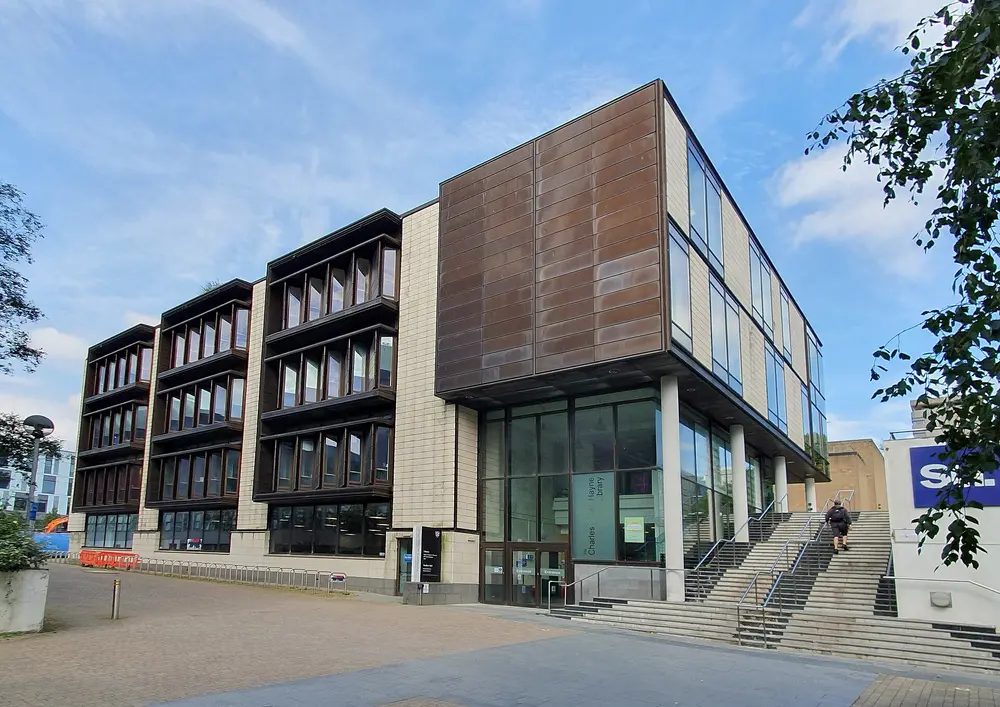
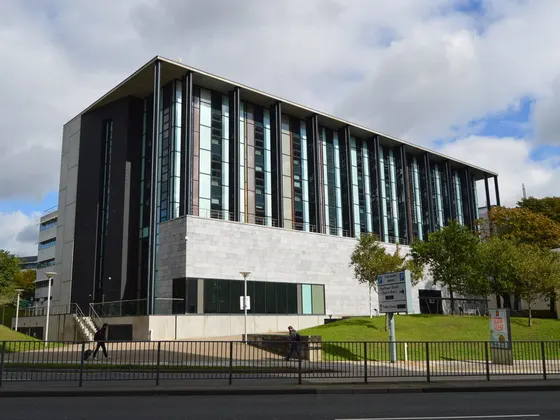

Photo: Mutney · CC BY 4.0 · cropped
Photo: N Chadwick · CC BY-SA 2.0 · Photo: Nilfanion · CC BY-SA 3.0 · Photo: Stephen Richards · CC BY-SA 2.0
The Plymouth dentistry course at a glance (2027 entry)
Plymouth's dentistry degree is the BDS, short for Bachelor of Dental Surgery. It is taught by the Peninsula Dental School, part of the University of Plymouth's Faculty of Health, and runs for five years full time. The General Dental Council (GDC), which regulates dentists and the rest of the dental team in the UK, approves it as a qualification that leads to registration as a dentist.
Patients are part of the course from the first year. From your first week you practise in the Simulated Dental Learning Environment (SDLE), a simulation clinic where you work on phantom heads: mannequin heads fitted with model teeth and jaws. You first go into the clinics in the second term of year 1. After a safety review in early May, and once you pass the matching skills tests, you may carry out simple treatments on patients before the year is out.
Most of your clinical training happens in the school's Dental Education Facilities, NHS training clinics in Plymouth, Exeter and Truro. They are run with Peninsula Dental Social Enterprise (PDSE), a community interest company, meaning a company set up to serve the community rather than to make profit for shareholders. The school says the clinics treat more than 10,000 NHS patients a year, and PDSE says students provide most of that treatment under supervision.
The training is aimed at primary care, the everyday dentistry people get from a local practice rather than a hospital. It also moves you around the South West. You are based in Plymouth for years 1 to 3, with clinic days in Exeter in year 3. Year 4 is spent living in Truro, in Cornwall, and year 5 brings you back to Plymouth.
Teaching runs along four strands: dental science, clinical practice, professional development and inter-professional engagement. Much of the science is learned through enquiry-based learning (EBL), in which a small group works through patient scenarios and decides what it needs to find out. The Inter-Professional Engagement strand has a module in each of years 1 to 4, starting with visits to local community organisations.
| Degree | BDS (Bachelor of Dental Surgery) |
|---|---|
| Course length | Five years full time |
| UCAS code | A206 |
| Students on the course | 350 BDS students across the five years in 2025/26 |
| Where you study | Plymouth, Exeter and Truro |
| Teaching style | Enquiry-based learning in small groups, plus large-group plenaries and science practicals |
| Clinic in year 1 | From term 2, with patient work set at an early-May safety review |
| Year 4 | Whole academic year living and training in Truro, Cornwall |
| Clinics | NHS training clinics run with Peninsula Dental Social Enterprise |
| Optional extra year | One-year MSc between years 3 and 4, for selected students |
What makes Plymouth dentistry different
Treating patients before the end of year 1
You first go into the clinics in term 2 of year 1. A safety review in early May then sets what you may do with patients, from assisting at the chairside to simple preventive treatments. Each treatment is unlocked only when you pass the matching competency test on phantom heads, so your range grows step by step.
NHS clinics run as a social enterprise
Your clinical teaching happens in clinics run with PDSE, a community interest company that works with the school. They are NHS services for local people, and treatment by students is free to patients. PDSE says students deliver most of the care, supervised by qualified dentists and supported by dental nurses and hygiene therapists.
Teaching clinics in Plymouth, Exeter and Truro
Your training moves between clinics in three places rather than staying on one campus. Exeter and Truro each have a full teaching clinic with its own simulation room, so you keep practising skills wherever you are based. Each clinic has its own clinical lead and team.
Community projects in years 1-2, then teamwork and audit
Inter-Professional Engagement has a module in each of years 1 to 4. In year 1 you study a local community organisation. In year 2 your group designs and delivers a health project for a group such as homeless people or people recovering from addiction. Year 3 brings joint learning with other health students, and year 4 a clinical audit, which checks real practice against an agreed standard.
A final year that feels like general practice
In year 5 you spend four days a week in primary care clinics. These include a simulated general practice clinic at Derriford and a city-centre teaching practice set up like a high street dental surgery. You are also taught the business side of running an NHS practice.
How Plymouth teaches dentistry
The curriculum is a spiral: topics come back each year in more depth, and science, clinical skills and professional development are taught together rather than in separate blocks. The programme specification says that since September 2025 it has followed the GDC's Safe Practitioner framework, published in 2023. The framework sets out the skills and behaviours you must show by the time you qualify, so it shapes what you are taught and assessed on.
Each year is worth 120 credits, split into full-year modules that run from September to July. Years 4 and 5 are set at level 7, the same academic level as a master's degree. Dental science is taught as Integrated Dental Science in years 1 and 2, then as Applied Dental Knowledge in years 3 to 5. Alongside it sit Clinical Dental Practice, Professional Development and Lifelong Learning, and Inter-Professional Engagement. The clinical module grows from 40 credits in year 1 to 70 in year 5.
The course page also lists Interprofessional Learning 1, 2 and 3 as core modules in years 1 to 3. This strand is shared with other Plymouth health and social care courses, such as nursing, midwifery and social work, and students from different professions learn together and about each other's roles.
Most of your learning happens in small groups. In enquiry-based learning your group works through patient scenarios set out in study guides and works out the knowledge and clinical reasoning each case needs. You then fill the gaps through tutorials, e-learning, plenaries (large-group sessions led by experts in different fields) and private study, which is built into the timetable. You are expected to manage a good share of your own learning.
The balance shifts as the course goes on. Years 1 and 2 lay the scientific and technical groundwork, and by the end of year 2 you have been introduced to the core clinical and technical skills a dentist needs. Year 3 brings more self-directed project work, and clinical time then grows to three days a week in year 4 and four in year 5.
The ways you will learn
| Enquiry-based learning groups | Your small group works through patient scenarios using study guides, identifying what you need to know and how to reason about each case. Your EBL group is also the team you work with on community projects. |
|---|---|
| Plenaries | The school also calls these large-group expert sessions theatre events. They sit alongside the smaller group work each week. |
| Science for Dentistry practicals | Hands-on sessions in the Life Sciences Resource Centre, where you study the biomedical sciences behind dentistry. |
| Simulation clinic (SDLE) | You practise procedures on phantom heads set up like a real dental chair, starting in your first week. You must pass a competency test here before doing each type of treatment on patients. From year 2 the SDLE is where you build skills for more advanced procedures. |
| Supervised clinics | You treat NHS patients in the Dental Education Facilities, with clinical time rising year by year. At Derriford, the school lists general dental practitioners, dental therapist and hygienist tutors, clinical academics and dental technicians among the supervisors. |
| Forum theatre and role play | In year 1 you practise judging clinical situations through role play and forum theatre. In forum theatre a short scene is acted out, and the audience can stop it to try different responses. |
A typical week on the Plymouth course
The school publishes one example week, for year 2. It mixes group learning, science practicals, simulation and two full days of treating patients.
- Six plenaries, large-group sessions with experts in different fields.
- Two days of clinical work in a healthcare setting in the community.
- Two structured enquiry-based learning sessions with your small group.
- Workshops and simulated dental sessions in the SDLE.
- Three interactive life sciences practicals on the biomedical sciences.
- Extra clinical skills training in the Clinical Skills Resource Centre, covering anything from basic life support to giving an injection into a muscle.
How anatomy is taught at Plymouth
There is no separate anatomy module. Anatomy is part of the science you study in Integrated Dental Science in years 1 and 2, and it returns as applied knowledge in later years. The programme specification maps the GDC outcome on dental, oral, head and face, and general anatomy to assessments from year 1 to year 5.
Your Science for Dentistry practicals take place in the Life Sciences Resource Centre (LSRC) in the Portland Square Building, which serves several of the university's health courses. It has Anatomage tables, large touchscreens on which you build or virtually dissect body structures and link them to scans, tissue seen under the microscope and how the body works. You can use the tables whenever the centre is open, not only in timetabled sessions.
The centre also has anatomical models that fit together like 3D jigsaws, and imaging simulators that give realistic ultrasound pictures with body landmarks. A team of people act as surface anatomy models, and the centre describes them as its students' first patients. Working with them, you learn to find landmarks on the body by touch while practising how to talk to a patient.
When you start treating patients at Plymouth
You first go into the clinics in term 2 of year 1, where the course page says you build your communication skills under close supervision from dentists. Everything you do there is controlled by the Patient Safety Pathway, a set of checks every year 1 student goes through. A review in mid-February decides whether you can attend clinic induction, your introduction to how the clinics run.
A second review in early May gives you a level, 1 or 2, and you are told your level before you start working with patients. Level 1 needs two of your three hepatitis B vaccinations, a Disclosure and Barring Service (DBS) criminal record check, and clearance from Occupational Health, the service that screens students' health before patient work.
You also complete training in safeguarding, which means protecting children and vulnerable adults from harm. You are trained in Prevent too, the government programme that teaches health staff to spot people at risk of being drawn into terrorism. All clinic work depends on Occupational Health clearing you for exposure-prone procedures, where an injury to you could expose a patient's open tissues to your blood. This clearance includes blood tests for hepatitis B, hepatitis C and HIV.
At level 1 you can attend clinic workshops, use the clinic phantom heads and practise X-rays in simulation. With patients, you can assist at the chairside, working as a dental nurse for senior students. You can also triage patients, meaning assess how urgently they need care, under the direct supervision of a GDC-registered professional.
Level 2 needs passes in skills-lab assessments on clinical examination and clinical IT, plus an assessment on decontamination, the cleaning and sterilising of instruments. It adds full clinical examinations and preventive care, such as oral hygiene instruction, advice on diet, alcohol and smoking, and fluoride application. Each simple treatment then needs its own year 1 skills test first. These cover fissure sealants (protective coatings in the grooves of back teeth), scaling to remove hardened deposits, and tooth-coloured fillings in back teeth.
When the GDC inspected the course in 2019, students said they enjoyed managing their own list of patients. The inspectors noted that students took responsibility for each patient's whole course of care rather than doing isolated procedures, and that students worked in pairs on clinic.
Year by year at Plymouth
- Year 1
Foundations, simulation and first clinics
Year 1 covers the normal structure, function and behaviour of the body and the science behind them, with a focus on dental health and preventing dental disease. You join the SDLE in week one and start going to clinic in term 2. By the end of the year you should feel at home in both the clinic and the simulation clinic.
- Integrated Dental Science 1 (40 credits): the basic and clinical sciences behind dentistry, including disease prevention, the safe use of ionising radiation such as X-rays, and the properties of dental materials.
- Clinical Dental Practice 1 (40 credits): an introduction to clinical dentistry and to handling medical emergencies, with a checkpoint that confirms you are ready to treat patients safely.
- Inter-Professional Engagement 1 (20 credits): you visit a community organisation, meet a key worker and study how it supports people's health, then write a report and a reflective paper.
- Professional Development and Lifelong Learning 1 (20 credits): reflective learning and the professional behaviour expected in dentistry.
- Patient Safety Pathway reviews in February and May decide what you may do on clinic.
- Year 2
Common dental problems and two clinic days a week
Year 2 moves on to common dental problems and looks at how disease develops in much more depth. Simulation training steps up to more advanced procedures, and you care for patients in Plymouth clinics two days a week. Working alongside other members of the dental team shows you how much dental care depends on teamwork.
- Integrated Dental Science 2 (40 credits): continues the core sciences, with the focus still on knowledge and understanding.
- Clinical Dental Practice 2 (40 credits): builds the range of basic dental skills and the medical emergency management needed for safe primary care dentistry.
- Inter-Professional Engagement 2 (20 credits): your group designs and delivers a health project for one community organisation in Devon or Cornwall. Projects have included oral cancer awareness for young people and oral health work with older people.
- You present the project at a symposium, where an expert panel assesses each group, and also submit a poster and a reflective paper.
- Professional Development and Lifelong Learning 2 (20 credits): further reflective learning and professional development.
- Learning to take feedback from peers, colleagues and staff and use it to improve your clinical work.
- Year 3
Applied knowledge and clinics in Exeter
Year 3 brings more self-directed learning through project assignments and clinical cases. You stay based in Plymouth, with transport provided to the Exeter clinic two days a week, where you consolidate advanced procedures. Years 3 and 4 also build your understanding of medical conditions that affect safe dental treatment.
- Applied Dental Knowledge 1 (20 credits): tests how you apply science and clinical knowledge to realistic cases, interpreting information and justifying the best treatment as a new dentist would.
- Its topics span restorative dentistry, diagnosis and surgery, community dentistry, professionalism, care from childhood to old age, and future skills such as digital dentistry and sustainability.
- Clinical Dental Practice 3 (60 credits): more complex care for patients of all ages, more simulation training and medical emergency management.
- Inter-Professional Engagement 3 (20 credits): small groups of dental students work with students from other health professions to learn about each other's roles and create learning activities for them.
- A scoping review, a study that maps what research exists on a question, which you write up for publication and present at a local scientific conference.
- Professional Development and Lifelong Learning 3 (20 credits): adds the skills of evidence-based practice.
- Year 4
A year in Truro
You live in Truro for the whole academic year, and clinical work rises to three days a week. Your treatment now covers everything expected of a qualified dentist, including advanced restorative work, and you start preparing clinical cases for finals. Time in specialist clinics shows you what specialists do in primary care and in secondary care, meaning the hospital and specialist services that patients are referred to.
- Applied Dental Knowledge 2 (20 credits): the next stage of the applied knowledge test.
- Clinical Dental Practice 4 (60 credits): a widening range of primary care treatment, with more independence in assessing patients and making safe decisions about their care.
- Specialist clinics such as restorative dentistry (repairing and replacing teeth), oral surgery and orthodontics (straightening teeth and correcting bites). The university's pages also list oral diseases and maxillofacial surgery, which treats the face and jaws.
- Inter-Professional Engagement 4: Quality Improvement (20 credits): you run a clinical audit, checking real clinical practice against an agreed standard. You write it up using the evidence and scientific writing skills built in earlier years.
- Professional Development and Lifelong Learning 4 (20 credits): continues reflective and professional development, with more focus on critical skills.
- Year 5
Preparing for practice
The final year consolidates everything you have learned and prepares you for your first job as a dentist. You spend four days a week in primary care clinics, learning how practice works in both the NHS and private sectors. The aim is to move from supervised student to independent practitioner.
- Clinical Dental Practice 5 (70 credits): reports on visits to specialist services, OSCE-style stations with unseen cases, exit case presentations and minimum standards in clinical assessments. An Objective Structured Clinical Examination (OSCE) is a circuit of timed stations, each testing a set task.
- Case presentations, in which you present patients you have treated to show you can diagnose, plan and carry out all the care they need.
- Clinic time in the simulated general practice clinic at Derriford, working with a qualified dental nurse, and at the city-centre Dental Education Practice.
- Delegating clinical work to junior dental therapy and hygiene students, which lets you share your treatment planning and practise leading the dental team.
- Applied Dental Knowledge 3 (20 credits) and Professional Development and Lifelong Learning 5 (30 credits). You critically appraise research relevant to primary care and write a personal development plan.
- Careers events and guidance on applying for Dental Foundation Training (DFT), your first year as a qualified dentist in a supervised NHS training post, including interview preparation.
How you are assessed at Plymouth
Knowledge tests change as you progress. In years 1 and 2, Integrated Dental Science tests recall and understanding of the core sciences. From year 3, Applied Dental Knowledge gives you clinical information and asks you to weigh up the options and justify the best course of action. It is pitched at the standard expected of a new dentist in general practice. The programme specification calls it a progress test, a type of exam set at graduate level that students sit at intervals through a course.
Clinical skills are checked before and during patient work. In year 1 you pass skills-lab competency assessments before each new treatment on patients, and the clinical modules include proficiency and capability assessments of your work on clinic.
Your clinical finals sit in Clinical Dental Practice 5, which has four parts. They are reports on your specialist visits, an OSCE-style exam with unseen cases, exit case presentations, and reaching minimum standards in clinical proficiency and capability assessments. The programme specification calls the unseen-case exam the Unseen Case Safe Practitioner Examination. In year 5 you also sit the final Applied Dental Knowledge progress test and submit a critical appraisal report.
There is no compensation, so a strong mark in one module cannot make up for a fail in another. If you fail any one module you repeat the whole year, and failing more than one can mean being asked to leave. You can repeat any one year only once, and no more than two different years in total. You normally have seven years to finish, and formal exams fall at set points that may not match the university's usual exam periods.
The standard award is the BDS. A BDS with Honours is normally open only to students who passed every year at the first attempt. You also need an excellent grade in year 5 in two areas: the case presentation or the unseen-case exam, and the progress test or a critical appraisal report. If you leave after passing year 3, you receive a Bachelor of Oral Health Studies (Hons), which does not let you register with the GDC.
When the GDC inspected in 2019, supervisors graded students and wrote feedback after every patient contact on the school's own electronic record. If a supervisor saw a procedure fall below standard, the student stopped doing it on clinic until a remediation session within two weeks and a retest in the skills lab.
- Inter-Professional Engagement: a report and reflective paper in year 1; a poster, reflective paper and assessed symposium presentation in year 2; a clinical audit in year 4.
- Professional development: written critical reflections, discussed with your Academic Tutor each term.
- Year 5 research skills: a critical appraisal report on research relevant to primary care dentistry.
Where you will actually be at Plymouth
Your clinical training takes place in the school's Dental Education Facilities. They were designed and built for dental students and are linked into local NHS dental care, so you see both routine and specialist cases in a primary care setting. The university's locations page sets out where each year of the course is taught.
In years 1 and 2 you are taught at Portland Square on the main campus and at the Devonport and Derriford clinics in Plymouth. In year 3 you still live in Plymouth but travel to the Exeter clinic two days a week, on transport the school provides. In year 4 you move to Truro for the whole academic year. Year 5 brings you back to Plymouth, at Derriford and the city-centre practice.
The City Centre Dental Education Practice at 71 New George Street opened on 9 February 2026. Final-year BDS and dental therapy and hygiene students use its 13 single surgeries on rotation, treating patients alongside specialists and dentists in foundation training. It also offers urgent care, booked by appointment rather than as walk-ins.
The Faculty of Health lists the initial outlay for travel and accommodation on placement among the costs that tuition fees do not cover. Budget for a year's rent in Truro when you plan your finances.
Beyond the dental clinics, the university has agreements with local NHS trusts for specialist visits in dental and medical hospital services. The agreements set out the learning outcomes, teaching hours, supervision and assessment for each placement. In years 3 and 4 you learn about medical conditions relevant to dentistry in patient-based demonstrations, hospital outpatient clinics and emergency departments.
Base for years 1, 2, 3 and 5. Devonport has 40 student chairs.
- Portland Square, main city-centre campus
- Devonport Dental Education Facility, Damerel Close, Madden Road
- Derriford Dental Education Facility, Plymouth Science Park, near Derriford Hospital
- City Centre Dental Education Practice, 71 New George Street
- Clinical Skills Resource Centre, John Bull Building, Plymouth Science Park
Year 3 clinics. It has 40 dental chairs in five open bays, three single surgeries, three seminar rooms and its own SDLE.
- Exeter Dental Education Facility, Veysey Close, off Topsham Road
Year 4 base. It has 32 chairs, a dental technical laboratory, its own decontamination unit, clinical skills and life sciences resource centres, and an SDLE.
- Truro Dental Education Facility, Knowledge Spa, Royal Cornwall Hospital
Intercalation at Plymouth
Intercalating means taking a year out of your dental degree to study for a separate qualification, then returning. At Plymouth a small number of selected students do this between years 3 and 4, taking a one-year MSc in the university's research laboratories in Plymouth. The school names the MSc Biomedical Science as the intercalation option for dental students.
You then rejoin the course for year 4. Because the degree normally has to be finished within seven years, any change to that limit caused by intercalating is decided case by case by the faculty.
Facilities and support at Plymouth
Where you will learn
The largest SDLE is in the Portland Square Building on the main campus. It spreads across three rooms and holds 68 phantom heads, set out in pods that copy a real dental surgery. Across Plymouth, Exeter and Truro the university has 93 phantom heads in total.
Portland Square also houses the Life Sciences Resource Centre and a library. The Clinical Skills Resource Centre, in the John Bull Building at Plymouth Science Park, is where you do extra clinical skills training such as basic life support. Library and e-learning resources, including electronic journals, are available both on the main campus and at the clinics.
Digital dentistry has become part of clinical teaching. In 2025/26 PDSE introduced intraoral scanners, which take a digital 3D scan of the teeth in place of a traditional impression in putty-like material. Eight were in use at Derriford and Truro, with five more due to be introduced across all sites.
Support while you study
Each student has an Academic Tutor. You meet every term to review your progress on professionalism across the course, using the written critical reflections you prepare for the Professional Development and Lifelong Learning module.
Students have a say in how the course runs. EBL group representatives meet year leads regularly, a Student Staff Liaison Committee collects feedback from every year group, and student representatives sit on the school's Dental Committee.
If you have a disability or health condition, the school asks the university's Disability Inclusion Services and Health and Wellbeing Service to assess the support you need. Where possible it makes reasonable adjustments to your programme.
The Peninsula Dental Society, known as DentSoc, offers revision sessions, volunteering and social events through the year, including a Christmas dinner and a summer ball.
Is the Plymouth course right for you?
This course may suit you if
- You want to be in clinic in year 1 and, once cleared, carrying out simple treatments on patients before the year ends.
- You learn well in small groups working through patient cases, with plenty of time for independent study.
- Community and public health work appeals to you. In years 1 and 2 you study a local community organisation, then design a health project for one with your group; later years add joint work with other health students and a clinical audit.
- You would enjoy training in different places, including a year living in Cornwall.
- You want your final year to feel like working in a busy general dental practice.
Things to think about
- All of year 4 is spent living in Truro, and the Faculty of Health says tuition fees do not cover the initial outlay for placement accommodation, so plan for a year's rent there.
- In year 3 you travel from Plymouth to Exeter two days a week, which adds regular travel to your week.
- Failing any one module means repeating the whole year, with no compensation between modules.
- Clinical training is based in primary care clinics, with hospital settings reached through specialist visits rather than a hospital base.
- Enquiry-based learning expects you to direct much of your own study, and year 3 adds more self-directed project work.
Plymouth dentistry course — frequently asked questions
Applying to Plymouth?
How to get into Plymouth
Entry requirements, UCAT, personal statement and interview, step by step.
Open the guide →Plymouth UCAT cut-offs and offers
UCAT cut-offs, A-level offers, interview format and decision dates.
See the requirements →Compare Plymouth with other schools
Put the teaching style, anatomy teaching and placements next to another school.
Open the comparison →Prepare for the Plymouth interview
Format breakdown, school-specific sample questions and prep tips from tutors who interviewed here.
Read the guide →Where this Plymouth course guide came from
This guide was written from 23 official sources — Peninsula Dental School (Plymouth)'s own course pages and programme documents, plus the regulator and NHS placement partners where they publish detail — read on 2026-09-24, then checked claim by claim against those sources.
- BDS Dental Surgery - University of Plymouth
- Bachelor of Dental Surgery (BDS) Programme Specification 2026/27 - University of Plymouth
- Bachelor of Dental Surgery curriculum overview - University of Plymouth
- Bachelor of Dental Surgery: Where will I be based? - University of Plymouth
- Dental Education Facilities - Peninsula Dental School, University of Plymouth
- Dental Outreach Team - Peninsula Dental School, University of Plymouth
- Peninsula Dental School - University of Plymouth
- Simulated Dental Learning Environment (SDLE) - University of Plymouth
- Clinical Skills Resource Centre, John Bull Building - University of Plymouth
- Faculty of Health additional costs - University of Plymouth
- Student Conduct and Fitness to Practise - University of Plymouth
- Life Sciences Resource Centre (LSRC) - University of Plymouth
- Interprofessional learning - Faculty of Health, University of Plymouth
- BSc (Hons) Nursing (Adult Health) - University of Plymouth (lists the shared Interprofessional Learning modules)
- GDC Education Quality Assurance Inspection Report: University of Plymouth BDS, March 2019
- Peninsula Dental Social Enterprise - home page
- Undergraduate Dental Student Training in 2025/26 - Peninsula Dental Social Enterprise
- Inter-Professional Engagement module - Peninsula Dental Social Enterprise
- Derriford clinic - Peninsula Dental Social Enterprise
- Devonport clinic - Peninsula Dental Social Enterprise
- Plymouth City Centre Dental Education Practice - Peninsula Dental Social Enterprise
- Exeter clinic - Peninsula Dental Social Enterprise
- Truro clinic - Peninsula Dental Social Enterprise
Courses are restructured between cycles. Anything here that decides your application — an anatomy offer, a placement city, a compulsory intercalated year — should be confirmed against the official page for your entry year.
Applying to Plymouth?
We have helped hundreds of applicants turn their UCAT, personal statement and interview prep into offers from Plymouth and other UK dentistry schools.