
The Queen's University Belfast Dentistry course
What you actually study, and where you will be
Queen's University Belfast's BDS is a 5-year course taught through case-based learning in an integrated curriculum, with patient treatment from Year 1 and placements in Belfast (2027 entry). Based at the Royal Victoria Hospital in Belfast, with 90 dental chairs for undergraduate teaching and NHS clinical service. Students can undertake clinical practice from year 1, treat their own patients in the Restorative Clinic from year 3, and attend outreach dental clinics in years 4 and 5.
- Degree
- BDS
- Length
- 5 years
- Teaching
- Integrated + Case-based learning
- First patients
- Year 1
- UCAS code
- A200
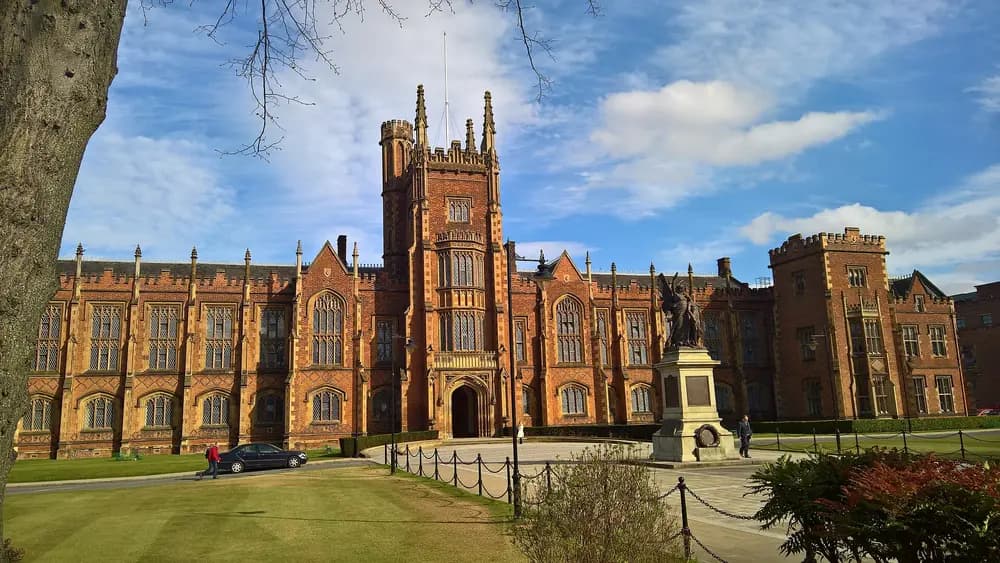



Photo: Nick Birse · CC BY-SA 4.0 · cropped
Photo: Tom Parnell from Scottish Borders, Scotland · CC BY-SA 2.0 · Photo: Slowtech2000 · CC BY-SA 4.0 · Photo: Adam Jones from Kelowna, BC, Canada · CC BY-SA 2.0
The Queen's University Belfast dentistry course at a glance (2027 entry)
Dentistry at Queen's University Belfast is a five-year degree leading to the BDS, the Bachelor of Dental Surgery. It is taught by the Centre for Dentistry, part of the university's School of Medicine, Dentistry and Biomedical Sciences. The General Dental Council (GDC), which regulates dentists across the UK, recognises the degree, so graduates can apply to register as dentists. About 60 students start each year: 45 places are for UK and Republic of Ireland applicants and 15 for international and EU students.
Your clinical home is the School of Dentistry on the Royal Victoria Hospital site on Grosvenor Road, Belfast, where both the Centre for Dentistry and the dental hospital are based. It has 90 dental chairs, used both for student teaching and for National Health Service (NHS) patient care. Queen's says it has taught dentistry in Northern Ireland since 1920 and describes the centre as the region's only dental school.
The first two years build foundations. You study anatomy, biomedical science, physiology, pharmacology, disease and behavioural science, and each of these years includes a clinical and professional skills module in which you practise on models and simulators. In year 3 you start assessing and treating your own patients under supervision, and teaching begins in the dental specialties. In years 4 and 5 you carry out the full range of treatment for adults and children, in the dental school and in outreach clinics, which are dental clinics away from the main hospital.
Day to day, lectures introduce topics to the whole year and often lead into case-based seminars built around clinical scenarios. Tutorials run in groups of about 10 to 12, and clinical seminars come before clinical sessions, so you know what you are about to do before you do it.
The course is being mapped to the GDC's Safe Practitioner framework, which took effect in August 2025 and sets out what every new dental professional must know and do. The module details published for applicants are those for 2025/26 and are reviewed each year.
| Degree | BDS (Bachelor of Dental Surgery) |
|---|---|
| UCAS code | A200 |
| Course length | 5 years full time |
| Intake | About 60 a year: 45 UK and Republic of Ireland, 15 international and EU |
| Main clinical base | School of Dentistry, Royal Victoria Hospital site, Grosvenor Road, Belfast |
| Dental chairs | 90, used for student teaching and NHS care |
| Anatomy | Full-year module in year 1, with dissection where specimens allow |
| First patient contact | Clinical practice from year 1; your own patients from year 3 |
| Outreach clinics | Mainly years 4 and 5; year 3 paediatric module also lists outreach sessions |
| Intercalation | Optional: BSc after year 2, or a taught Master's after year 3 |
What makes Queen's University Belfast dentistry different
A full year of anatomy with real specimens
Anatomy for Dentistry is one of three 40-credit modules in year 1 and runs all year, with most of the detail on the head and neck. The module works with cadavers and anatomical specimens, and you build dissection skills where specimens allow, which also trains the hand skills you will need in clinic.
A toothache clinic staffed by supervised students
The Urgent Student Clinic in the School of Dentistry gives daytime emergency appointments to people who are not registered with a dentist. Belfast Health and Social Care Trust (Belfast Trust), which runs the clinic, says supervised dental students provide the treatment, Monday to Friday during term. Patients apply online and are phoned with an appointment, so you meet people who come in with pain, not only planned cases.
Finals split into three parts over two years
Final exams are not all saved for the end. Queen's module list divides finals into three parts. Final BDS Part 1 comes in year 4 and Part 2 in the autumn of year 5. Part 3 is the year-long Practice of Dentistry module. The GDC's 2025 inspection report confirms that finals run in three blocks across years 4 and 5.
Whole-patient care in final year
Final year centres on Practice of Dentistry, a 75-credit module. In Total Patient Care clinics you investigate, diagnose, plan and deliver a patient's overall care rather than a single treatment. You also work in consultant clinics and in adult and paediatric outreach clinics.
How Queen's University Belfast teaches dentistry
The course is modular: each year is made up of modules with published credits and assessment weightings. Years 1 and 2 pair science modules with a clinical and professional skills module each year. From year 3 the modules follow the dental disciplines. These are conservation (fillings, crowns and root canal treatment), periodontics (gum disease), prosthetics (dentures), orthodontics (straightening teeth), oral surgery and oral medicine, and paediatric and special care dentistry.
Special care dentistry means treating people with disabilities, mental health conditions or complex medical needs. It is taught alongside paediatric dentistry in years 3, 4 and 5, with a case study of a patient with special needs in year 4.
The balance shifts as you go. In years 1 and 2 you study the biomedical and behavioural sciences alongside core clinical skills, which you practise in the Clinical Techniques Laboratory. From year 3 more of your learning happens in supervised clinics, and final year centres on patient care in the dental school and outreach clinics. Feedback on practical and clinical work is given face to face and recorded on an e-portfolio, a running digital record of your progress.
The ways you will learn
| Lectures | Large-group sessions that introduce the core facts of a new topic and give you a starting point for your own reading. They are often tied to case-based seminars that apply the same material to a clinical scenario. |
|---|---|
| Case-based tutorials and clinical seminars | Small groups of typically 10 to 12 students work through clinical scenarios with a member of staff. You practise clinical reasoning, ask questions and reflect with your peers. Clinical seminars in this format come before the clinical sessions they prepare you for. |
| Practicals | Smaller-group lab classes in which you see principles from lectures at work in living tissue and in dental materials, and build technical skills. You get formative feedback, meaning comments on your progress that do not count towards your marks. |
| Simulation in the Clinical Techniques Laboratory | The Clinical Techniques Laboratory (CTL) is used throughout the course. You work on phantom heads, which are model heads fitted with artificial teeth, and have extra sessions on haptic simulators, computer training units that give you the feel of cutting into a tooth. |
| Supervised clinics | From year 3 you assess and treat your own patients under the supervision of clinical teachers. You start in the Restorative Clinic, which covers restorative dentistry: repairing and replacing damaged or missing teeth. You then move across the specialties. Clinics you meet during the course include consultant-led sessions, outreach clinics and the Urgent Student Clinic. |
| Online and self-directed learning | Canvas, the university's virtual learning environment, holds lecture materials, assignments and the details of how each module is assessed. The timetable also leaves time to study on your own, work through learning resources and act on feedback. |
How anatomy is taught at Queen's University Belfast
Anatomy is taught as a full-year, 40-credit module in year 1 called Anatomy for Dentistry. It starts with anatomical language and an overview of bones, muscles and joints, then covers the chest, the abdomen and the nervous system in general terms. Most of the detail is on the head and neck, which is where you will work as a dentist.
Head and neck topics include the bones of the skull, face and neck, the brain, spinal cord and cranial nerves, and the blood vessels and lymph nodes of the region. You also study the throat, voice box and thyroid, the jaw joint and chewing muscles, the eye socket, nose, sinuses, mouth and salivary glands, the ear, and how the face develops in the embryo. The module is assessed 40% by coursework and 60% by exam.
The module works with cadavers and anatomical specimens, and you are expected to treat them with respect and keep their identity confidential. You build dissection skills where specimens allow, which also trains the manual dexterity you need for clinical work. The Centre for Dentistry lists two refurbished gross anatomy laboratories in the Medical Biology Centre among its facilities.
Microscopic anatomy sits in the year 1 Biomedical Sciences for Dentistry module. It covers the fine structure of body tissues, the oral mucosa (the lining of the mouth) and how teeth form and grow. In year 2 you return to anatomy when you learn the nerves and structures involved in giving local anaesthetic injections.
When you start treating patients at Queen's University Belfast
Queen's says you have the chance to take part in clinical practice from year 1. The year 1 skills module teaches communication and history-taking in a simulated clinical setting, including how to advise patients on cleaning their teeth. You practise pulse, blood pressure, resuscitation (CPR) and hand-washing, and start basic operative work, such as polishing and cutting simple cavities, in the Clinical Techniques Laboratory.
Year 2 moves on to phantom heads. You prepare and fill each standard type of cavity, known as Class I to Class V, using silver-coloured amalgam and tooth-coloured composite and glass-ionomer fillings. You also learn to place a rubber dam, a thin sheet that isolates the tooth being treated, and to avoid injuring the cheeks, lips and tongue. After practical demonstrations you join a clinical attachment in which you give local anaesthetic in a clinical setting.
Every UK dental school must make sure you have shown the necessary skills in a pre-clinical setting, such as the simulation lab, before you treat patients. This is one of the requirements in the GDC's Standards for Education. The GDC's 2025 report describes how Queen's does it. Before you move onto patients you must pass Structured Clinical Operative Tasks (SCOTs), tests of set dental procedures carried out in simulation, along with other practical competencies. From year 3 you must also pass simulation tests in professional tooth cleaning and root canal treatment before doing either on a patient.
In year 3 the patients become your own, starting in the Restorative Clinic. By years 4 and 5 you provide the full range of treatment for your own adult and child patients, in the dental school and in outreach clinics. Final year adds consultant-led clinic rotations and more complex cases.
The school described its safety routine to the GDC in 2025: structured clinical induction, daily safety huddles and regular training in infection control, sharps safety and protective equipment. You are trained in Encompass, Northern Ireland's electronic health record system, and sign a confidentiality agreement covering its use. Staff check where your experience has gaps and work with clinic administrators to allocate suitable patients.
Students told GDC inspectors in March 2025 that they were generally confident across key treatments and happy with their amount of clinical experience. The panel suggested the school review its minimum numbers for some treatment types, which it considered low.
Year by year at Queen's University Belfast
- Year 1
Foundations: anatomy, biomedical science and first clinical skills
Year 1 is made up of three full-year modules worth 40 credits each. Two build the science behind dentistry and one starts your clinical and professional training. The GDC's 2025 inspection report lists the year as 31 weeks long.
- Clinical and Professional Skills 1 (40 credits): history-taking, oral hygiene advice, dental charting and recording gum health, plus pulse, blood pressure, CPR and hand-washing practised in simulation. Assessed 100% by exam.
- The same module covers tooth shapes, how tooth decay (caries) starts and is prevented, dental pain, instruments, posture at the chair, basic radiography, ethics and professionalism, and scientific writing.
- Your first operative work in the Clinical Techniques Laboratory: working safely in the lab, polishing teeth and cutting basic cavities.
- Anatomy for Dentistry (40 credits): a whole-body overview, then detailed head and neck anatomy, neuroanatomy and how the face develops. Assessed 40% coursework, 60% exam.
- Biomedical Sciences for Dentistry (40 credits): cells and genes, body tissues under the microscope, the lining of the mouth and saliva, how teeth form, and the basics of disease such as inflammation and healing. Assessed 40% coursework, 60% exam.
- Year 2
How the body works, how drugs act, and hands-on restorative skills
Year 2 has five modules. Four deepen the medical science a dentist needs, from physiology to microbiology, and one takes your practical skills to the level needed for patients. The year runs for 32 weeks.
- Clinical and Professional Skills 2 (35 credits): preparing and filling Class I to V cavities on phantom heads, rubber dam, ultrasonic scaling, dental materials science and dental assisting. Assessed 60% exam, 40% practical.
- Local anaesthetic teaching: the anatomy, physiology and drugs involved, practical demonstrations, then a clinical attachment in which you give local anaesthetic under supervision.
- A practical radiography course on radiation protection and on positioning patients for periapical x-rays, which show a whole tooth including its root, and bitewings, which show the upper and lower back teeth together.
- Physiology for Dentistry (30 credits): the body's systems, including blood, heart, lungs, kidneys, hormones, nerves, pain, taste, smell and digestion, with practical classes.
- Pharmacology for Dentistry (20 credits): the drugs dentists prescribe, medicines that affect dental treatment, handling medical emergencies and writing prescriptions.
- Disease Mechanisms for Dentistry (20 credits): immunology, microbiology, infection control and pathology, with microscope work and Gram staining, a lab test that sorts bacteria into two broad groups.
- Dental Public Health and Behavioural Science (15 credits): patterns of disease, dental anxiety, evidence-based dentistry, a group presentation on health promotion, and a behaviour-change conversation with a simulated patient.
- Year 3
Treating your own patients and starting the specialties
Year 3 is the move into clinic. You assess and treat your own patients in the Restorative Clinic under supervision and begin core training in oral surgery, orthodontics, paediatric dentistry and special care dentistry. You also learn how medical conditions affect dental care. The year runs for 41 weeks.
- Conservation (30 credits): fillings, root canal treatment on teeth with one or several roots, and assessing and treating patients in the Restorative Clinic. Assessed 70% exam, 30% practical.
- Periodontics (15 credits): gum disease, periodontal examination and treatment planning, and scaling and cleaning root surfaces. You also learn infiltration injections, which numb one or a few teeth, and nerve block injections, which numb a whole area of the jaw.
- Prosthetics (15 credits): designing and providing removable partial dentures for patients who still have some teeth, including the laboratory stages. Assessed 50% exam, 50% practical.
- Oral Surgery, Oral Medicine and Oral Pathology (15 credits): assessing teeth for extraction, choosing instruments, patient and operator positioning, the role of sedation, and your first practical oral surgery skills.
- Orthodontics (10 credits): eleven lectures plus a practical techniques course on records, tooth movement, materials, retainers and removable and fixed braces, assessed through Liftupp, the digital system that records your clinical work.
- Paediatric Dentistry and Special Care Dentistry (15 credits, spring): children's growth, baby teeth, local anaesthetic for children, disability and barriers to care. Systemic Disease and Dentistry (20 credits): medical conditions that matter in dental practice, plus surgery and pathology of the head and neck.
- Year 4
Advanced treatment and Final BDS Part 1
Year 4 builds advanced skills across the specialties and brings the first block of final exams. You take on more complex work such as crowns, bridges, complete dentures and minor oral surgery, for adults and children. Teaching happens in the dental school and in outreach clinics. The year runs for 41 weeks.
- Final BDS Part 1: Conservation (30 credits): fillings placed directly in the mouth, cast restorations such as crowns, conventional root canal treatment and fixed bridges to replace single missing teeth. Assessed 50% exam, 50% practical.
- Final BDS Part 1: Prosthetics (20 credits): complete dentures for patients with no natural teeth, taught through clinical and laboratory sessions, plus one patient needing a partial denture.
- Final BDS Part 1: Periodontics (20 credits): a full lecture programme, case-based tutorials and treatment of patients with a range of gum conditions, including cleaning below the gum line.
- Paediatric Dentistry and Special Care Dentistry (20 credits): behaviour management, fillings, pulp treatments and extractions for children, and sedation and general anaesthetic. It also covers injured front teeth, child protection and a case study of a patient with special needs.
- Oral Surgery, Oral Medicine and Oral Pathology (20 credits): diagnosing diseases of the mouth lining, facial pain and salivary gland problems, basic minor oral surgery and CPR.
- Orthodontics (10 credits) with clinics and an outreach placement, and Evidence Based Dentistry (10 credits), where you learn research design and statistics and critically appraise journal articles.
- Year 5
Whole-patient care, outreach and final exams
Final year consolidates everything across restorative, paediatric, orthodontic and oral surgery care, with more complex cases. Most of it sits in one large module, Practice of Dentistry, alongside three shorter finals modules in the autumn. The year runs for 39 weeks.
- Final BDS Part 3: Practice of Dentistry (75 credits, 37 weeks): consultant clinics and Total Patient Care clinics, where you take charge of a patient's overall care. Assessed 50% coursework, 50% exam.
- Paediatric dentistry outreach clinics, adult outreach clinics, and consultant orthodontic and oral surgery attachments.
- Workshops on law and ethics, treatment planning, occlusion (how the teeth meet when you bite), implants, CPR, enterprise and infection control.
- Communication in hard situations, such as an aggressive patient or breaking bad news, plus leadership, delegation and working within referral networks.
- Final BDS Part 2 in the autumn, each 15 credits and split evenly between exam and practical. The three modules are Orthodontics; Oral Surgery, Oral Medicine and Oral Pathology, including simple extractions for adults; and Paediatric and Special Care Dentistry, covering children with cleft lip and palate or missing teeth.
How you are assessed at Queen's University Belfast
Each module publishes its own split between exams, coursework and practical work. Formats include written exams, multiple-choice questions (MCQs), case studies, group projects, Objective Structured Clinical Examinations (OSCEs) and clinical procedures on patients. An OSCE is a circuit of short, timed stations, each testing one skill against a set marking scheme. In the published breakdowns most modules are weighted entirely or mainly to exams, and coursework counts in only a handful.
Alongside exams you must complete compulsory elements, the practical and clinical tasks required to progress. Your clinical work is recorded on Liftupp, a digital assessment and feedback system used at every clinical site, including outreach clinics. It logs the procedures you carry out and how staff rate your clinical skills, communication and professionalism. Staff use it to give you feedback as you go and to support decisions about your progress.
Two groups, the Clinical Progress Monitoring Committee and the Compulsory Elements Committee, meet regularly to review each student's clinical targets and professionalism. They judge when each student is ready to move on to the next stage or to graduate. If you fall behind, extra teaching or catch-up work is timetabled.
Finals run in three blocks. Final BDS Part 1 is in year 4 and covers conservation, prosthetics and periodontics. Final BDS Part 2 comes in the autumn of year 5 and covers orthodontics, oral surgery and oral medicine, and paediatric and special care dentistry. Final BDS Part 3 is the year-long Practice of Dentistry module. You graduate only once every assessment and compulsory element is passed.
Summative assessments, the ones that count, use standard-setting methods such as the modified Angoff method and borderline regression, in which examiners' judgements of a borderline student help fix the pass mark. External examiners review exam papers in advance and attend exam boards.
At its March 2025 inspection the GDC found every requirement it reviewed met except one, which was partly met. The panel was not assured that data on how exam questions performed was used consistently, and it found similar multiple-choice questions reused across cohorts. The school accepted this and began reviewing how it tracks and retires questions. The GDC is following up through its 2026/27 annual monitoring.
Where you will actually be at Queen's University Belfast
Your clinical base throughout the course is the School of Dentistry on the Royal Victoria Hospital site in Belfast. There, Belfast Trust runs specialist clinics in oral surgery, oral medicine, orthodontics, restorative dentistry, prosthetics, periodontics and conservation for patients referred by dentists, family doctors (GPs) and hospital consultants. It also runs the student teaching clinics, among them the Urgent Student Clinic. The Trust's paediatric dental clinic is separate, in the Children's Hospital on the main Royal Victoria Hospital site.
Most outreach teaching comes in years 4 and 5. The year 4 orthodontics module includes an outreach placement, and in final year the Practice of Dentistry module has separate adult and paediatric outreach clinics. The three paediatric and special care dentistry modules, in years 3, 4 and 5, each also list clinical sessions in outreach clinics among their teaching.
The GDC's 2025 report says outreach clinics are supported by staff who also teach in the main school. Module co-ordinators oversee teaching and assessment there, and your clinical work is logged on Liftupp as it is in the hospital. The school collects feedback from students and patients on outreach placements. You pay your own travel costs to outreach clinics.
Your main clinical base for the whole course.
- School of Dentistry and dental hospital (Centre for Dentistry)
- Restorative and specialist clinics run by Belfast Trust
- Urgent Student Clinic
- Mulhouse building, with the medical and dental library
A separate site from the Royal Victoria Hospital. The Centre for Dentistry lists these buildings among its facilities, including lecture theatres, anatomy laboratories and the Biomedical Library.
- Medical Biology Centre
- Whitla Medical Building
Mainly in years 4 and 5, supported by clinicians who also teach in the dental school.
Intercalation at Queen's University Belfast
Intercalation means taking an extra year out of the dental course to earn an additional degree, usually in research, before rejoining the course. At Queen's it is optional. The dentistry course page says some students take a BSc year between years 2 and 3, while others join a taught Master's course after finishing year 3.
The course page names the Master's options within the school: the Master of Public Health (MPH), the MPH in Global Health and the MSc (Res) in Cancer Medicine. There are also MSc courses in Experimental Medicine, Bioinformatics and Computational Genomics, and Clinical Anatomy. The School of Psychology adds an MSc in Applied Developmental Psychology and an MSc in Clinical Health Psychology.
The school also has a general intercalation page for both medical and dental students. It says the extra year can come after year 2, 3 or 4 and can lead to a BSc, a Master's or a PhD. Intercalated study is mainly research-based. The page names four centres at the heart of the school's research. They are the Patrick G Johnston Centre for Cancer Research, the Wellcome-Wolfson Institute for Experimental Medicine, the Centre for Public Health and the Centre for Medical Education.
If you want research experience without adding a year, the school runs summer studentships. These are full-time projects, usually lasting 6 to 8 weeks between June and September, in one of the school's research or education centres, including the Centre for Dentistry. You work in a team of academic staff and research students, and dentistry students can apply.
Facilities and support at Queen's University Belfast
Where you will learn
The School of Dentistry at the Royal Victoria Hospital holds the Centre for Dentistry and the dental hospital, with recently refurbished clinics, a clinical skills laboratory and 90 dental chairs. Next door, the Mulhouse building has the medical and dental library and teaching rooms.
You use the Clinical Techniques Laboratory throughout the course, with extra sessions on haptic dental simulators. A refurbished prosthetics teaching laboratory, where denture work is taught, opened in 2023. Queen's says it has recently brought digital dentistry techniques into the course.
The Centre for Dentistry says you will take part in high-fidelity simulation, meaning realistic practice scenarios, in the KN Cheung SK Chin InterSim Centre. The centre has run since 2021 and is used for simulation teaching in dentistry, nursing, midwifery, medicine and pharmacy.
The Medical Biology Centre, on the Health Sciences campus on Lisburn Road, has three large lecture theatres and the Biomedical Library. It also holds two refurbished gross anatomy laboratories, a Virtual Histology Microscopy suite for studying tissue slides on screen, and two physiology teaching laboratories. The Whitla Medical Building next door houses the school's main office.
GDC inspectors in March 2025 found the clinics generally well equipped and maintained. The school told them Belfast Trust has 15 dental chairs to replace across its dental clinics within five years, as part of a wider renovation plan. Concerns about Wi-Fi and drinking water in the school's clinics had been raised, and bottled water was being provided while the plumbing was sorted out with the Trust.
Support while you study
Every dental student has a personal tutor, and the student wellbeing team offers pastoral, academic and study skills advice. Academic staff and senior clinicians in the Centre for Dentistry also provide pastoral support. The GDC's 2025 report describes a Wellbeing Lead and regular support meetings that track each student's wellbeing, behaviour and academic progress.
Reasonable adjustments, such as extended deadlines, changes to clinical arrangements and rest breaks, are set out in Individual Student Agreements. GDC inspectors saw examples of these working well while keeping patient safety first.
Students can raise problems through the Student Voice Committee, module evaluations and course groups that cover the foundation years, the dental specialties and restorative dentistry. The QUB BDSA, the dental students' society, runs social and sporting events through the year.
Because you are training for a regulated profession, you sign a Student Agreement every year that commits you to professional behaviour and to declaring any convictions or cautions. The school acts on low-level concerns, and serious ones go to its Student Professionalism Committee.
Is the Queen's University Belfast course right for you?
This course may suit you if
- You want a full year of anatomy and biomedical science, working with real specimens, before you start treating your own patients in year 3.
- You want to treat people who arrive in pain as well as planned cases: supervised students provide the treatment at the Urgent Student Clinic for people without a dentist.
- You want a single clinical base, the dental hospital on the Royal Victoria Hospital site, for your clinical training, with outreach clinics added in the later years.
- You like learning in a year group of about 60, with tutorials in groups of 10 to 12.
- You are curious about research and might want an intercalated BSc or Master's year, or a summer research project that does not add a year.
Things to think about
- The clinical years are long: the GDC lists years 3 and 4 at 41 weeks and year 5 at 39, against 31 and 32 weeks in years 1 and 2.
- Final exams begin in year 4, so the pressure of finals is spread across your last two years rather than saved for the end.
- Most modules are weighted entirely or mainly to exams, with coursework counting in only a handful, which matters if you do your best work in assignments.
- You pay your own travel costs to outreach clinics, mainly in years 4 and 5.
Queen's University Belfast dentistry course — frequently asked questions
Applying to Queen's University Belfast?
How to get into Queen's University Belfast
Entry requirements, UCAT, personal statement and interview, step by step.
Open the guide →Queen's University Belfast UCAT cut-offs and offers
UCAT cut-offs, A-level offers, interview format and decision dates.
See the requirements →Compare Queen's University Belfast with other schools
Put the teaching style, anatomy teaching and placements next to another school.
Open the comparison →Prepare for the Queen's University Belfast interview
Format breakdown, school-specific sample questions and prep tips from tutors who interviewed here.
Read the guide →Where this Queen's University Belfast course guide came from
This guide was written from 13 official sources — Queen's University Belfast School of Medicine, Dentistry and Biomedical Sciences's own course pages and programme documents, plus the regulator and NHS placement partners where they publish detail — read on 2026-09-24, then checked claim by claim against those sources.
- Dentistry (BDS), Queen's University Belfast course page with the full module list
- General Dental Council inspection report, Queen's University Belfast BDS, March 2025
- General Dental Council, learning outcomes and behaviours (the Safe Practitioner framework)
- Centre for Dentistry, Queen's University Belfast
- About the Centre for Dentistry, Queen's University Belfast
- Centre for Dentistry facilities, Queen's University Belfast
- Study dentistry at Queen's, Centre for Dentistry
- KN Cheung SK Chin InterSim Centre, Queen's University Belfast
- Intercalated degrees, School of Medicine, Dentistry and Biomedical Sciences
- Admission Policy Statement for Dentistry for 2027 entry, Queen's University Belfast
- Dental services, Belfast Health and Social Care Trust
- Summer studentships, School of Medicine, Dentistry and Biomedical Sciences, Queen's University Belfast
- General Dental Council, key facts about registration
Courses are restructured between cycles. Anything here that decides your application — an anatomy offer, a placement city, a compulsory intercalated year — should be confirmed against the official page for your entry year.
Applying to Queen's University Belfast?
We have helped hundreds of applicants turn their UCAT, personal statement and interview prep into offers from Queen's University Belfast and other UK dentistry schools.