
Queen's University Belfast Dentistry Interview
Format, Questions & Prep Tips
Queen's University Belfast dentistry interviews for 2027 entry are multiple mini interviews (MMI). Published figures: Places (2027 entry) 45 UK/ROI + 15 international.
- Institution
- Queen's University Belfast School of Medicine, Dentistry and Biomedical Sciences
- Interview (2027 entry)
- Not published on the course page for 2027 entry
- Decisions (2027 entry)
- Not published — offers follow interview outcomes
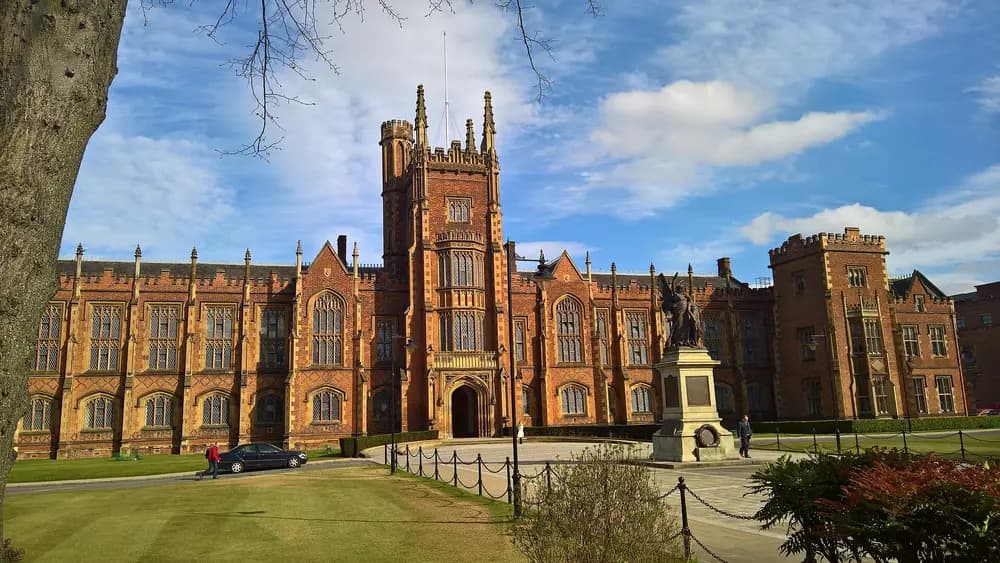



Photo: Nick Birse · CC BY-SA 4.0 · cropped
Photo: Tom Parnell from Scottish Borders, Scotland · CC BY-SA 2.0 · Photo: Slowtech2000 · CC BY-SA 4.0 · Photo: Adam Jones from Kelowna, BC, Canada · CC BY-SA 2.0
Still deciding where to apply? Hear it from a student who's there
Queen's University Belfast Centre for Dentistry is Northern Ireland's only dental school, and that regional uniqueness shapes both its applicant pool and its interview process. For 2027 entry there are 45 places for applicants from the UK and Republic of Ireland, who are ranked on academic ability and UCAT and interviewed in person, and 15 places for international and EU (non-ROI) applicants, who are ranked on academic ability alone and interviewed online. For both groups, offers are made solely on the outcome of the interview.
Queen's does not publish the interview's station structure on its course page. The school maintains very strong ties to the Belfast Health and Social Care Trust and trains the majority of Northern Ireland's future dental workforce. Interviewers therefore probe carefully whether applicants understand and are committed to the realities of practising in NI.
For UK and ROI applicants, UCAT is scored and combined with an academic score to rank for interview. At interview, Queen's looks for genuine commitment to dentistry, sustained motivation, strong communication, initiative, professional responsibility, teamwork, resilience, reflection and an understanding of the ethical standards of safe dental practice.
Queen's University Belfast interview key facts (2027 entry)
| Places (2027 entry) | 45 UK/ROI + 15 international |
|---|---|
| Interview | In person (UK/ROI); online (international) |
| Offers | Made solely on interview outcome |
Interview Format
- Interview for applicants ranked highly enough — Queen's does not publish the station structure
- In person for UK and Republic of Ireland applicants; online for international and EU (non-ROI) applicants
- Offers are made solely on the outcome of the interview
- Stations span motivation, ethics, communication, teamwork, NI healthcare awareness
- UK/ROI shortlisting: UCAT score combined with academic score; international shortlisting on academic ability alone
- Northern Ireland's only dental school — regional commitment is probed
- Small cohort (45 UK/ROI + 15 international places) so interview performance is decisive
Sample Interview Questions
Why dentistry, and why Queen's Belfast specifically?
Reference QUB's integrated 5-year BDS, the Centre for Dentistry on the Royal Hospitals site, the clinical placements across the Belfast Trust, and the unique position of being NI's only dental school. Distinguish from medicine clearly.
Queen's trains the majority of Northern Ireland's future dentists. Why is that significant?
Discuss workforce planning, retention in NI, the social-determinants relevance of training local applicants, and the responsibility that comes with being the only NI dental school. QUB values regional commitment.
A patient asks you not to share their dental records with their GP. They have capacity. What do you do?
Respect autonomy. Confidentiality is paramount. Explore why — is there a safeguarding concern? Document. Don't share without explicit consent. Reference GDC Standards and data-protection law.
Should NHS dental treatment in Northern Ireland be funded at the same level as the rest of the UK?
Engage with the devolved funding picture — NI has its own Department of Health, distinct dental contracts and persistent workforce challenges. Discuss equity, devolution and the political realities.
How would you explain a root canal procedure to a patient who is fearful of needles?
Acknowledge fear directly. Use plain language. Walk through the steps. Offer control signals (hand-raise pause). Discuss what they'll feel vs what they'll see. Avoid escalating language.
Tell me about a time you had to communicate difficult information to someone.
STAR framework. Focus on how you adjusted your communication style to the person. Reflect on what you learned about delivering hard news.
(Possible station) A parent is reluctant to consent to their child's extraction. Speak to them.
Listen first. Understand the concern (cost, fear, alternative options). Provide clear information about risks of delay. Don't pressure. Reference parental responsibility and Gillick competence if age-relevant.
A friend asks you to give them dental advice over WhatsApp. What do you do?
Decline informal clinical advice — you're not yet qualified, you can't examine them, and informal advice undermines safe practice. Encourage them to see a dentist. Reference professional boundaries (GDC Standards principle 9).
Describe a meaningful work experience and what it taught you about dentistry.
Pick one moment to go deep on. QUB wants reflection over volume — what did you actually learn about the daily reality of dentistry?
What concerns you most about a career in dentistry in Northern Ireland?
NI-specific workforce pressures, the NHS dental contract challenges, retention difficulties, and the geographic distribution of practices. Show informed awareness and a realistic stance.
(Possible station) Here is a chart showing oral-health inequalities across NI postcodes. What does it suggest?
Describe what you see before interpreting. Note correlations with deprivation. Discuss preventative interventions (supervised toothbrushing, fluoride varnish, school-based programmes). Avoid overgeneralising from limited data.
What manual dexterity skills have you developed?
Concrete examples — sewing, painting, model-making, musical instruments, surgery shadowing. Reflect on how dexterity improves with deliberate practice.
Is it ethical for a dentist to advertise cosmetic treatments to teenagers on social media?
Engage with vulnerability, informed consent, parental consent and the GDC's advertising standards. Discuss the body-image and self-esteem implications. Take a reasoned position.
Tell me about a time you received critical feedback. How did you respond?
Genuine example. Focus on how you processed the feedback and what you changed. QUB values reflective practice.
Why prevention over treatment in modern dentistry?
Most dental disease is preventable. Cost-effectiveness, oral-cancer screening, the shift from drill-and-fill to risk-assessed care. Reference NI-specific oral health programmes if you know them.
Practise the Queen's University Belfast interview
Rehearse the real format before the day — on demand with our AI interviewers, or live with a tutor.
Sit a mock with photoreal AI interviewers — any time
A timed MMI or panel interview on video — British & international voices — with interviewers who listen, react and press with follow-ups. Rubric-scored feedback and a replay the moment you finish.





Live mocks with a tutor who’s been in the room
A full Queen's University Belfast-style mock with a medic or dentist tutor — honest scoring against real marking criteria, a station-by-station debrief and a written action plan.
Book a mock interviewHow to Prepare
Research the Centre for Dentistry and QUB's NI workforce mission — it shapes interview questions.
Read about NI's devolved dental contract and the workforce crisis — QUB applicants are expected to be aware.
Have specific reasons for dentistry vs medicine — QUB tests dentistry-specific motivation.
Read GDC "Standards for the Dental Team" — QUB anchors ethical reasoning against it.
Practise concise, structured answers on motivation, teamwork, ethics and reflection — the qualities Queen's says it values at interview.
Prepare reflection on at least two distinct work experiences.
If applying from outside NI, prepare honest reflection on why you want to train (and possibly stay) there.
Invited to interview at Queen's University Belfast? Say your first answer out loud today with the free two-minute warm-up drill, then sit a timed mock set up for Queen's University Belfast.
Common Pitfalls
Frequently Asked Questions
Related guides
Free, evidence-based guides from current UK medical and dental students.
Free Interview Resources
Worked-through MMI stations, ethics scenarios, and panel questions.
Read guideNHS Core Values Guide
The 6 NHS values examiners listen for in every interview answer.
Read guideMedical School Rankings
See interview format (MMI vs panel) for each UK medical school.
Read guideUCAS 2026 Personal Statement
The new three-question format your interviewer will reference.
Read guideContextual Offers for Medicine
Every UK medical school's widening-access scheme in one place.
Read guideSources & official admissions information
We cross-check every interview guide against the school’s own admissions guidance and the UK regulators.
- Queen's University Belfast — Dentistry BDS (A200), 2027/28 entry — 45 UK/ROI places (in-person interviews) and 15 international places (online); offers made solely on interview.
- UCAT Consortium — Official UCAT registration, test format, scoring methodology and free practice materials.
- General Dental Council (GDC) — recognised UK dental qualifications — Statutory regulator. Recognised dental qualifications and registered-dentist register.
- Dental Schools Council — Coordinated body of UK dental schools. Entry-requirements comparison and widening-participation initiatives.
Ready to nail your Queen's University Belfast interview?
Book a mock interview with a current dental student who recently went through the same process, or practise on demand with the AI interviewer.