
The UCLan (Graduate Dentistry) Dentistry course
What you actually study, and where you will be
UCLan's BDS is a 4-year (graduate entry, direct into 2nd BDS) course taught through problem-based learning in an integrated curriculum, with patient treatment from Year 2 and placements in Lancashire and Cumbria (2027 entry). A graduate-entry course of 29 students a year. Year one is in Preston; from 3rd BDS onwards you are placed at one of four community Dental Education Centres, in Blackpool, Morecambe, Accrington or Carlisle, where you start treating patients.
- Degree
- BDS
- Length
- 4 years (graduate entry, direct into 2nd BDS)
- Teaching
- Integrated + Problem-based learning
- First patients
- Year 2
- UCAS code
- A202
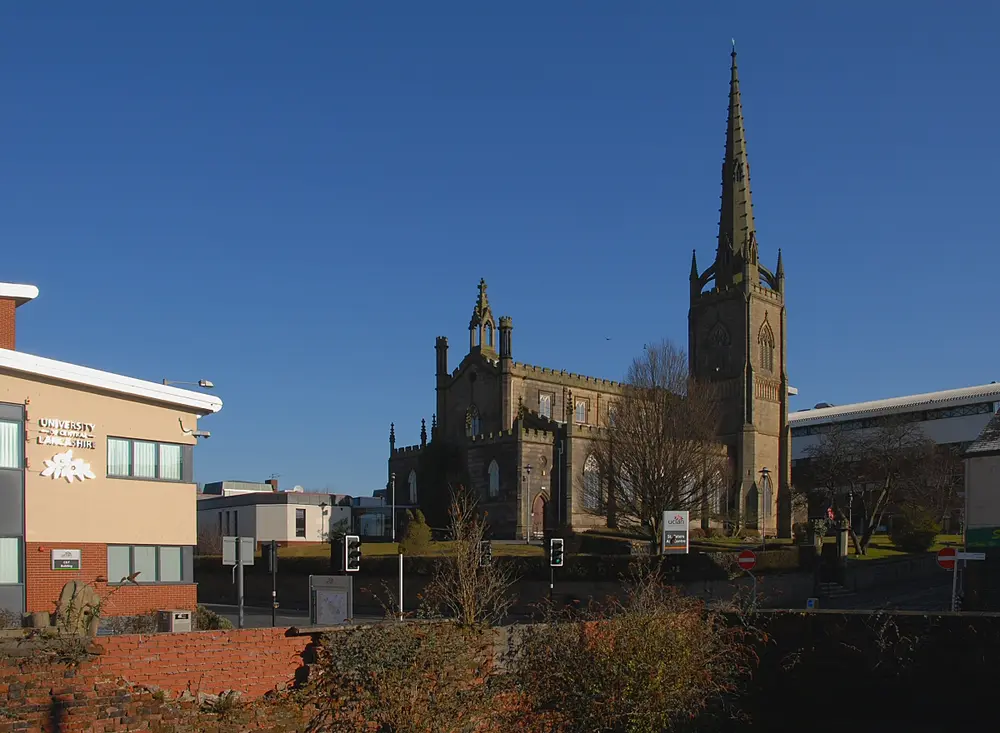
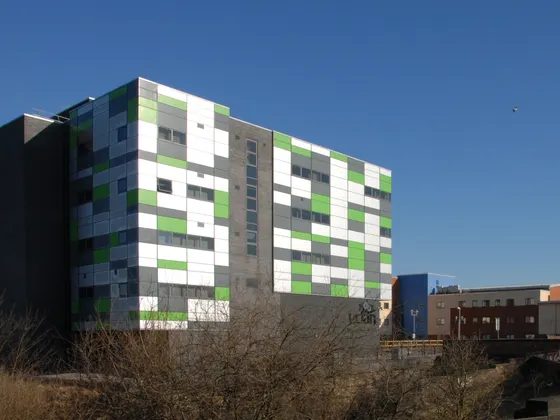

Photo: Galatas · CC BY-SA 2.0 · cropped
Photo: Galatas · CC BY-SA 2.0 · Photo: Stephen McKay · CC BY-SA 2.0 · Photo: Francis C. Franklin · CC BY-SA 3.0
The UCLan (Graduate Dentistry) dentistry course at a glance (2027 entry)
The Bachelor of Dental Surgery (BDS) at the University of Lancashire is a four-year, full-time degree for people who already have a degree in a biomedical subject. It is run by the School of Medicine and Dentistry on the Preston Campus. Its Universities and Colleges Admissions Service (UCAS) code is A202. The university was called the University of Central Lancashire (UCLan) until December 2024, when the Office for Students, which regulates universities in England, approved an official change of name. The General Dental Council (GDC), which regulates UK dentists, still lists the degree under the older name.
A standard BDS lasts five years. Here your earlier degree takes the place of the first year, so you join at the second year, called 2nd BDS, and finish at 5th BDS. When the GDC inspected the course in 2024, it recorded an intake of 29 students a year and confirmed that graduates can still apply to register as dentists.
What defines the course is where you train. You spend 2nd BDS on campus in Preston, learning the science and practising on phantom heads, which are mannequin heads fitted with artificial teeth. You then move to one of four community Dental Education Centres (DECs), in Accrington, Blackpool, Carlisle and Morecambe Bay, for the remaining three years.
A DEC is a clinical teaching centre where you treat members of the public, under supervision, for the kinds of problems a high-street dentist deals with. The course is built around this primary care model, meaning everyday dentistry outside hospital. You look after each patient through their whole course of treatment. From 4th BDS you also go to hospital clinics in specialist areas such as orthodontics, the straightening of teeth.
The year group is small, so teaching can be more discussion-based and interactive. Teamwork runs through the course. You learn alongside students training as dental therapists and clinical dental technicians, and in the final semester you work in a general practice with your own surgery and dental nurse.
| Degree | Bachelor of Dental Surgery (BDS) |
|---|---|
| Course length | 4 years full time, joining at 2nd BDS |
| UCAS code | A202 |
| Intake | 29 students a year (GDC, 2024) |
| First-year base | Preston Campus |
| Clinical years | 3rd to 5th BDS at one Dental Education Centre |
| DEC towns | Accrington, Blackpool, Carlisle and Morecambe Bay |
| Teaching style | Lectures, tutorials and problem-based learning, plus phantom-head simulation |
| Hospital placements | From 4th BDS, in specialist areas such as orthodontics |
| Training practice | Last semester of 5th BDS, with your own surgery and nurse |
What makes UCLan (Graduate Dentistry) dentistry different
Three clinical years in community teaching centres
After 2nd BDS your clinical training moves out of the university to one of four DECs in Lancashire and Cumbria. For three years you treat the kinds of patients you are most likely to see after you qualify. The GDC describes the centres as serving areas of high dental need.
Following each patient from start to finish
Because the course is based in primary care, you take a patient through their whole treatment, from assessment and diagnosis to the final appointment, supported by experienced practitioners. This is how a general dental practitioner works. By the final year you are drawing up integrated treatment plans that combine prevention with more advanced dentistry.
Small groups and close supervision
With an intake of 29 split across four centres, each DEC takes only a handful of students from each year. In 2021, on a visit prompted by COVID-19 to check final-year clinical experience, the GDC counted around eight at each location. It said this helped staff keep a close eye on each student. In 2024 inspectors saw supervisors give one-to-one support and record feedback in clinic.
Your own surgery in a training practice
From the last semester of the final year you also work in an enhanced training practice (ETP), a general dental practice the School uses to train students. You have your own surgery and a dental nurse assigned to you, close to how you will work as a new dentist. The GDC saw the step from DEC to ETP as a gradual move towards independent practice.
Training with the whole dental team
Some of your teaching is shared with students on the School's dental therapy and clinical dental technology degrees. Dental therapists provide treatments such as fillings and cleaning, and clinical dental technicians make and fit dentures. Learning together as students gets you used to the dental team you will work in after you qualify.
How UCLan (Graduate Dentistry) teaches dentistry
Teaching mixes several formats. Core knowledge comes from lectures and tutorials, and from problem-based learning (PBL), explained below. Clinical skills start on simulators and move on to real patients. You also practise communication with actors playing patients. Professionalism is taught in every year, and from 2nd BDS you write reflections on your own practice.
The balance shifts after the first year. 2nd BDS is the most campus-based part of the course. From 3rd BDS your clinical learning happens mainly at your DEC, and you come back to Preston for short courses on more complex procedures.
Independent study is a large part of the degree, and each module descriptor sets out how your study time is split. Course materials sit on Blackboard, the university's online learning platform. Chair-side computers in the Preston skills area and at the DECs let you view a procedure during clinical teaching and go back to it later.
The course page lists a single compulsory module for each year. When the GDC inspected in 2024, each year was split into several smaller modules, and the School told inspectors it was planning a course restructure. The module names in the Years section below are the current ones.
The ways you will learn
| Lectures and tutorials | Lectures cover the science and dental knowledge the whole year group needs. Tutorials are smaller sessions where you discuss topics and check your understanding with a tutor. |
|---|---|
| Problem-based learning (PBL) | You work in a small group on a scenario, agree what you need to find out, research it, then bring it back to the group. Here PBL is used to build a joined-up understanding of how the body works in health and disease. |
| Phantom-head simulation | At a workstation in the Dentistry Clinical Skills Training Area you drill, fill and treat artificial teeth in a mannequin head. The GDC requires students to show they are competent in simulation before treating patients, and you keep using simulation for some new skills in later years. |
| Communication practice with actors | Actors play patients so you can build communication skills in a safe setting, before and alongside real clinics. Actors also played the patients in the final treatment-planning exam (GDC, 2024). |
| Supervised clinics at your DEC | From 3rd BDS you treat patients while a clinical supervisor oversees your work and gives feedback. Students told the GDC in 2024 that they received a high level of feedback from their DEC supervisors. |
| Practical workshops | Short hands-on workshops, some of them back in Preston, let you practise selected procedures in simulation before you use them on patients. The Years section gives examples from each stage. |
A typical week on the UCLan (Graduate Dentistry) course
The clearest account of the week comes from the GDC's 2024 inspection report. It was written before the modules were reorganised, so check at an open day that the pattern still holds. In 2nd BDS you are on the Preston campus, combining lectures, tutorials, PBL and clinical skills sessions.
In 3rd and 4th BDS, students spent two days a week treating patients at their DEC. The other days were timetabled for theory, taught either face to face or online, along with practical simulation workshops. Hospital placements were added from 4th BDS.
In the final year, students were still at the DEC two days a week and spent one more day treating patients at an enhanced training practice. The current course page says ETP work begins in the last semester of the final year, so this extra day may now apply only to that semester. The same report puts the whole course at 168 weeks over four years, an average of 42 weeks of study a year.
How anatomy is taught at UCLan (Graduate Dentistry)
Anatomy is taught in the Human Anatomy and Resource Learning Centre (HARLC) in Preston. There is particular focus on the head and neck, the region a dentist works in every day. Knowing where nerves and blood vessels run matters each time you give a local anaesthetic injection or remove a tooth.
Anatomy staff teach you with anatomical models, written guides and videos of dissections carried out by professionals. While you are based in Preston in 2nd BDS, you can also use the centre outside timetabled sessions to go back over the models and videos. The university gives different opening hours on different pages, so check the current hours at an open day.
In 2024 the GDC recorded that 2nd BDS included a module on oral development and anatomy. Oral development is how the teeth, jaws and mouth form.
When you start treating patients at UCLan (Graduate Dentistry)
2nd BDS prepares you to treat patients. On phantom heads you learn preventive treatments and simple fillings, including cavity preparation, which means shaping a decayed tooth ready for a filling. You also learn periodontal treatment, which is care of the gums and the tissues that support the teeth. Five replica surgeries on campus make the DEC set-up familiar before you arrive.
You begin treating your own patients in 3rd BDS at your DEC. The GDC describes students seeing a range of patients and giving care that matches their level of knowledge and skill. Some new skills, such as root canal treatment, are practised first in simulation workshops (GDC, 2024).
Responsibility grows each year. In 4th BDS you take on patients with more complex needs and start specialist hospital clinics. In the last semester of 5th BDS you also treat patients at an enhanced training practice, working more independently while still supervised.
Year by year at UCLan (Graduate Dentistry)
- 2nd BDS (year 1 of 4)
Preston: science and simulated clinical skills
You spend the year on the Preston campus building the knowledge, clinical skills and professional behaviour needed for safe, patient-centred care. The single compulsory module is Health Prevention and Early Disease (DG1012). It introduces routine primary care in simulation before you meet patients.
- Learn the basic science of diseases of the mouth, and of the wider body, that matter in clinical dentistry.
- Study dental caries (tooth decay): how it develops and how it can be prevented.
- Practise preventive care, cavity preparation, direct restorations (fillings placed straight into the tooth) and gum treatment on phantom heads.
- Learn the properties and chemistry of dental materials.
- Start the reflective record of your practice that you keep throughout the course.
- In 2024 the GDC also listed communication skills and removable prosthodontics, meaning dentures, as part of this year.
- 3rd BDS (year 2 of 4)
Your DEC and your first patients
You move to your Dental Education Centre and start treating patients under supervision. The compulsory module is Dental Prevention and Disease Management (DG2027). It develops the clinical skills, clinical judgement and professional behaviour you need for dental practice.
- Carry out dental procedures on your own patients, choosing treatment based on evidence.
- Build a thorough understanding of how to prevent dental disease.
- Develop communication and teamwork within the dental team and with health professionals outside it.
- Learn endodontics (root canal treatment) in practical simulation workshops, as described in the GDC's 2024 report.
- In 2024 this year also covered diagnosing general and oral disease, pharmacology (how medicines work) and population health.
- 4th BDS (year 3 of 4)
Complex care and hospital placements
You continue at your DEC and take on patients with more complex needs. The compulsory module is Dentistry within Complex Patients (DG3015). This is also the year you begin clinics in local hospitals.
- Hospital placements in paediatric (children's) dentistry, orthodontics, maxillofacial surgery (surgery of the face, jaws and mouth) and special care dentistry for people with disabilities or complex health needs.
- Plan and provide periodontal care and indirect restorations such as crowns, which are made outside the mouth and then fitted.
- Learn about occlusion (how the teeth meet when you bite) and more advanced prosthodontics, the replacement of missing teeth.
- Learn minor oral surgery, which includes the surgical removal of teeth, and deepen your knowledge of oral disease.
- Learn how patients are treated under sedation and how they are assessed for treatment under general anaesthetic.
- Practise indirect restorations in simulation workshops before doing them on patients (GDC, 2024).
- 5th BDS (year 4 of 4)
Consolidation and general practice
The final year brings your skills together so you are ready to work as a new dentist. The compulsory module is Health Prevention and Complex Dentistry (DG4005). It centres on integrated treatment plans and on working in multidisciplinary dental teams.
- Critically evaluate dental research and your professional responsibilities.
- Combine advanced treatment with prevention in an integrated treatment plan for each patient.
- Continue at your DEC and, from the last semester, treat patients at an enhanced training practice.
- Return to campus for workshops on advanced procedures such as re-root treatment, which means redoing a root canal treatment (GDC, 2024).
- In 2024 the GDC recorded a detailed module on the law and ethics of practising dentistry in the UK in this year.
- In 2024, finals were written exams plus a practical treatment-planning exam with actors as patients (GDC).
How you are assessed at UCLan (Graduate Dentistry)
Your knowledge is tested in formal exams at the end of 2nd, 3rd and 4th BDS, and in a final exam at the end of 5th BDS. Written papers use short answer questions, short notes and single best answer questions, where you choose the best of several options. The GDC's 2024 report says each year mixes formative assessments, which are for practice and feedback, with summative ones that count.
Clinical skill is assessed continuously. Supervisors grade your clinical work as you go, and you keep a reflective logbook alongside those grades. Since July 2024 clinical experience has been recorded on LiftUpp, an online system that replaced the older Leopard system. The GDC asked the School to keep checking that LiftUpp records student data accurately.
When the GDC inspected in 2024, finals included written exams and a practical treatment-planning exam in which actors played patients with different clinical problems. The portfolio also counted towards the final assessment. This is the running log of your learning and reflections that you build up over the course.
You also need enough clinical experience to graduate. When the GDC inspected in 2021, students had target numbers for each type of treatment, and a Clinical Assessment Panel reviewed progress each term. You could sit finals before meeting every target. You still had to complete them all to a competent standard to finish, or extend your studies into the next year.
During the recovery from COVID-19 in 2021, the GDC recorded that for targets of four or more treatments, no more than a quarter could be met in simulation. Smaller targets had to be met on real patients. Ask whether a similar rule still applies. Each DEC also runs authentic assessments, simulated tasks that let you show you are ready for practice when clinic time is free (GDC, 2024).
Where you will actually be at UCLan (Graduate Dentistry)
After 2nd BDS you relocate to one of four DECs for the rest of the course: Accrington, Blackpool, Carlisle or Morecambe Bay. The university places students in community dental services across Lancashire and Cumbria so they get to know the communities they are most likely to serve. It hopes more of its graduates will then stay and work in the area.
Each DEC has surgeries, tutorial rooms and study space set aside for student teaching, and is linked to the university by IT so you can reach the course intranets on site. The GDC's 2024 inspectors said the centres serve areas of high dental need, which gives students a wide mix of patients by age, background and medical history.
On its 2021 COVID-era visit, the GDC noted a process that let students swap between DECs if they needed more experience with a particular type of patient. Supervisors could also refer a student to another clinical setting to complete work they were missing.
From 4th BDS you attend clinics in local National Health Service (NHS) hospitals. The course page lists these as covering oral and maxillofacial surgery, orthodontics, restorative dentistry, paediatric dentistry and special care dentistry. Restorative dentistry is specialist work to repair and replace teeth. In 2019 the GDC recorded hospital placements with five NHS trusts across Lancashire and Cumbria; ask at an open day which hospitals your year will use. From the last semester of the final year you add an enhanced training practice.
Your base for 2nd BDS, and where you come back for short courses and workshops on more complex procedures.
- Dentistry Clinical Skills Training Area and Clinical Training Bays, Preston Campus
- Human Anatomy and Resource Learning Centre (HARLC)
- Dental Clinic, Preston Campus
One of the four DECs. The GDC visited it in September 2024 to see the LiftUpp recording system in use.
- Accrington DEC
One of the four DECs where you can spend 3rd to 5th BDS.
- Blackpool DEC
- Morecambe Bay DEC
The most northerly DEC. In 2019 the GDC described it as more isolated than the other centres and praised the support from its supervisors. The GDC visited it in September 2024.
- Carlisle DEC
Facilities and support at UCLan (Graduate Dentistry)
Where you will learn
The Dentistry Clinical Skills Training Area in Preston has 44 workstations, each with a phantom head. Each workstation is linked to the tutor's station, so you can follow a demonstration in close-up. It also has audio-visual equipment for clinical teaching.
Next to the simulator lab are the Clinical Training Bays: five fully working dental surgeries set up almost exactly like the surgeries at the DECs. You practise every part of a dental appointment there before you move out to a centre.
The Dental Clinic on the Preston campus is a working clinic that supports the School's teaching. Its own page describes it mainly as a place where postgraduate dentists gain clinical experience. The GDC listed it among the sites involved in the BDS in 2019.
In September 2025 the university reported adding eight treatment bays to its Preston dental clinic, taking the total from 16 to 24. It named students on its international route, a course for dentists who qualified overseas, among those who would use them.
Support while you study
Because the year group is spread across four towns, much of your day-to-day support comes from the clinical teachers at your DEC. The GDC's 2024 inspectors found final-year students felt supported in both their clinical progress and their personal welfare. Students told them staff were approachable and usually the first people they turned to.
If you fall behind on clinical experience, staff step in early. In 2024 the GDC noted that DEC tutors identify students who need more experience and find suitable patients for them.
The GDC also found that the School had appointed an achievement coach, whose job was to spot students who needed extra help to keep up and to work with them. It had replaced its Fit to Study process with the university's Support to Study process, which helps students whose health or wellbeing is affecting their studies. The inspectors called both changes good practice.
In 2019 the GDC recorded regular personal tutor sessions that students were positive about, and noted that every staff member is trained as an academic adviser. Some senior clinical teachers at the DECs also act as year leads, which helps communication between the centres and Preston.
Dental foundation training is a 12-month supervised training post, which NHS England describes as the first step in training after you qualify. When you graduate you receive a transcript of your clinical experience to pass to your foundation trainer, the dentist who supervises you during that year. It lets them focus their support on the areas where you have had less practice.
Is the UCLan (Graduate Dentistry) course right for you?
This course may suit you if
- You already have a biomedical degree and want to qualify as a dentist in four years rather than five.
- You want to learn in community clinics like those where, as the course page notes, most dentists go on to work.
- You would like to train in a small group at your centre, where supervisors get to know you well.
- You want to follow patients through their whole treatment and finish with your own surgery and nurse in a training practice.
- You would be happy to live and work in Lancashire or Cumbria for three years, and perhaps stay afterwards.
Things to think about
- After 2nd BDS you relocate for three years to Accrington, Blackpool, Carlisle or Morecambe Bay, possibly far from family and friends.
- Carlisle is well north of the other centres, and in 2019 the GDC described it as more isolated.
- The academic year is long: the GDC's 2024 report gives 168 weeks of study over four years.
- Specialist experience comes through hospital placements from 4th BDS rather than daily work in a dental hospital.
- In 2024 the GDC found feedback styles varied between DECs, so your experience may depend partly on your centre. The School added staff training to even this out.
UCLan (Graduate Dentistry) dentistry course — frequently asked questions
Applying to UCLan (Graduate Dentistry)?
How to get into UCLan (Graduate Dentistry)
Entry requirements, UCAT, personal statement and interview, step by step.
Open the guide →UCLan (Graduate Dentistry) UCAT cut-offs and offers
UCAT cut-offs, A-level offers, interview format and decision dates.
See the requirements →Compare UCLan (Graduate Dentistry) with other schools
Put the teaching style, anatomy teaching and placements next to another school.
Open the comparison →Prepare for the UCLan (Graduate Dentistry) interview
Format breakdown, school-specific sample questions and prep tips from tutors who interviewed here.
Read the guide →Where this UCLan (Graduate Dentistry) course guide came from
This guide was written from 15 official sources — University of Central Lancashire Graduate Dentistry's own course pages and programme documents, plus the regulator and NHS placement partners where they publish detail — read on 2026-09-24, then checked claim by claim against those sources.
- Dental Surgery, BDS course page, University of Lancashire (September 2026 and 2027 entry)
- Study Dentistry at the University of Lancashire, subject page
- Dentistry Clinical Skills Training Area, University of Lancashire facilities
- Clinical Training Bays, University of Lancashire facilities
- Human Anatomy and Learning Suite, University of Lancashire facilities
- Dental Clinic, University of Lancashire facilities
- GDC approved dentistry programmes: University of Central Lancashire
- GDC Education Quality Assurance Inspection Report, University of Central Lancashire BDS (inspected February and September 2024)
- GDC Targeted Inspection Report, University of Central Lancashire BDS (May 2021)
- GDC Education Quality Assurance Inspection Report, University of Central Lancashire BDS (April 2019)
- Dental Foundation Training recruitment, NHS England (national context)
- Office for Students approves University of Lancashire name change, university news (19 December 2024)
- University of Lancashire increases dentistry teaching facilities, university news (15 September 2025)
- Support to Study Policy and Procedure 2025/26, University of Lancashire
- University Student Handbook for Taught Courses 2024/25, University of Lancashire (Achievement Coaches)
Courses are restructured between cycles. Anything here that decides your application — an anatomy offer, a placement city, a compulsory intercalated year — should be confirmed against the official page for your entry year.
Applying to UCLan (Graduate Dentistry)?
We have helped hundreds of applicants turn their UCAT, personal statement and interview prep into offers from UCLan (Graduate Dentistry) and other UK dentistry schools.