
2027 Entry · 6 schools
UK Dental Schools That Use Panel Interviews
Panel interviews are a single-room format where 2-4 interviewers ask a structured sequence of questions over 20-40 minutes. In UK dentistry they are used by a handful of schools — including King's College London and Newcastle — and reward applicants who develop a coherent answer under follow-up rather than darting between stations.
- Schools
- 6Schools
- Interviewers
- 2–4Interviewers
- Duration
- 20–40 minDuration
- Themes
- 4–6Themes
What to expect at a panel interview
You sit opposite a panel of 2-4 interviewers — typically a clinical dentist, an academic, and sometimes a current dental student. The lead interviewer usually opens with a motivation question ("why dentistry rather than medicine?"), and each panellist takes turns over the next 20-40 minutes covering different themes — manual-dexterity interests, work-experience reflection, dental ethics and consent, NHS-versus-private awareness, and how you would handle an anxious patient. King's College London runs a shorter two-interviewer remote panel. Discussion is more conversational than an MMI but still scored against a fixed mark scheme.
Typical structure
- 2-4 interviewers in a single room (clinical dentist + academic, sometimes a dental student)
- 20-40 minute total duration, structured around 4-6 themes
- Themes: motivation for dentistry, manual dexterity, work experience, dental ethics & consent, NHS dentistry, handling anxious patients
- King's College London runs a shorter two-interviewer remote panel
- Scored against a fixed mark scheme but allows more conversational follow-up than an MMI
What assessors look for
Panel interviewers value coherence — your answers should build on each other across the interview, showing a consistent motivation for dentistry specifically (not medicine) and growing self-insight. Strong candidates pause briefly before answering, link new points back to earlier experiences, reference the manual precision and long-term patient relationships that define dentistry, and engage every panellist with eye contact rather than only the lead questioner.
What the panel will explore
A panel ranges widely but predictably across four to six themes. Select a theme to see what it is really testing and how to develop an answer that survives follow-up questioning.
Motivation theme
What it tests
Whether your reasons are genuine, specific and realistic — and whether they hold up when the panel pushes on them twice.
How strong candidates handle it
Evidence every claim with an experience and what it changed in your thinking. Expect "but you could do that as a paramedic too" and have an honest answer ready.
“Why medicine, and why did you not change your mind after your work experience?”
Work experience theme
What it tests
What you learned rather than what you saw — the panel is listening for reflection, not a placement diary.
How strong candidates handle it
Pick two or three specific moments and run them through Gibbs. Say what surprised you and what you now understand about the job that you did not before.
“Tell us about a moment on placement that changed how you think about medicine.”
Ethics theme
What it tests
Balanced reasoning under follow-up, and whether you will change your position when given new information.
How strong candidates handle it
Argue both sides before you land. When a panellist presses, say what would change your mind — intellectual flexibility scores; digging in does not.
“Should a patient who continues to smoke be given the same priority for surgery?”
NHS awareness theme
What it tests
That you understand how the system works and the pressures on it, at a level deeper than headlines.
How strong candidates handle it
Explain why an issue matters and who it affects, give both sides, and connect it to what it would mean for you as a junior doctor.
“What do you understand by health inequality, and where have you seen it?”
Teamwork & leadership theme
What it tests
Your genuine contribution and self-insight — including how you handle being wrong or being led.
How strong candidates handle it
Use STAR with a clear "I" in the Action, and pick an example where something went imperfectly so you have something real to reflect on.
“Describe a time you disagreed with a team decision. What did you do?”
Resilience theme
What it tests
Whether you have realistic coping strategies and can discuss a setback without either minimising it or collapsing into it.
How strong candidates handle it
Be specific about a genuine failure, brief about the feelings, and concrete about what you changed afterwards. Name the support you actually use.
“Tell us about a significant setback and what you did next.”
Your statement theme
What it tests
That you actually engaged with everything you wrote — panels commonly open a thread from a book, paper or activity you mentioned.
How strong candidates handle it
Re-read your statement the week before and be ready to expand on every claim in it, especially anything you have not thought about since writing.
“You mention a book in your statement. What did you disagree with in it?”
How the Panel is scored
Panellists usually score you independently against a shared, confidential mark scheme and then pool their scores. The crucial difference from the MMI: the whole panel hears every answer, so there is no clean reset — consistency across the full 20 to 40 minutes is itself being assessed.
Independent, then pooled
Each panellist scores you separately against the same domains before the scores are combined — which is why the quiet note-taker matters exactly as much as the lead questioner.
Domains, not trivia
Typical domains are communication, motivation, teamwork, problem-solving, resilience, ethics and reflection. They reward how you reason, not facts you have memorised.
Coherence across the hour
Because one panel hears everything, contradicting yourself is visible in a way it never is at an MMI. Strong candidates link new answers back to experiences already mentioned.
Follow-ups carry the marks
The opening answer often just opens the door. Most of the discriminating marks are awarded on the second and third follow-up, where a rehearsed script runs out.
Which UK dental schools use the Panel?
6 UK dental schools use the Panel for 2027 Entry. Every card links to that school's full how-to-get-in guide — UCAT cut-offs, selection methodology and Panel-specific prep — and the purple badge opens its NGMP TrueScore prediction.
Showing 6 of 6 schools
 TrueScore2280Bristol — how to get in
Bristol
Bristol · est. 1828
Structured panel-style interview (Zoom, remote)
UCAT 2280+How to get in TrueScore2050King's College London (KCL) — how to get in
King's College London (KCL)
London · est. 1829
Two-interviewer panel, remote (no longer 6-station MMI)
UCAT 2050+How to get in TrueScore2080Newcastle — how to get in
Newcastle
Newcastle · est. 1834
Online semi-structured panel interview with two selectors (~20 min)
See guideHow to get in TrueScore2070Queen Mary (QMUL) — how to get in
Queen Mary (QMUL)
London · est. 1843
Two-interviewer panel, online (January–February)
UCAT 2070+How to get in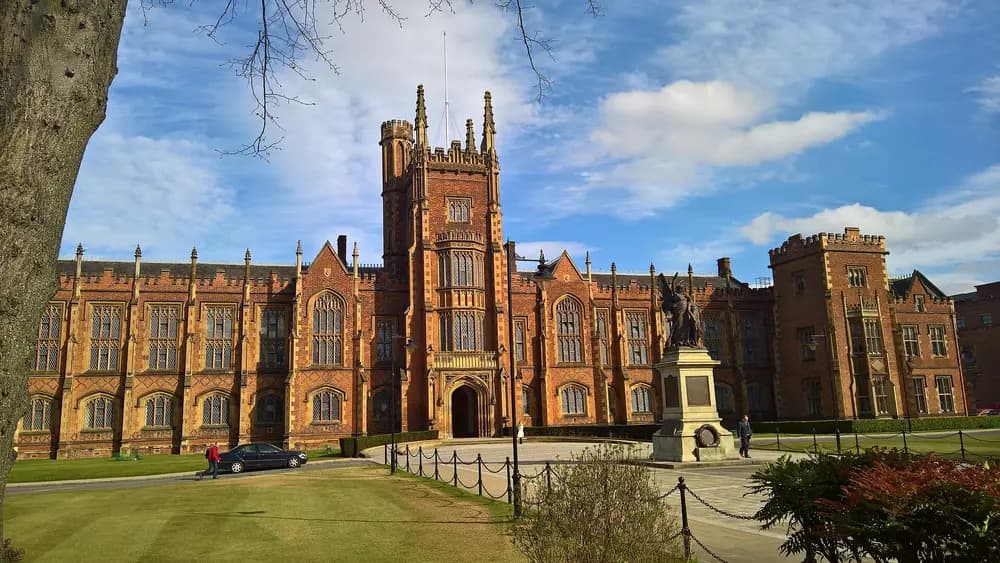 TrueScore1750Queen's University Belfast — how to get in
Queen's University Belfast
Belfast · est. 1845
MMI / panel format
UCAT 2025+How to get in TrueScore2050Sheffield — how to get in
Sheffield
Sheffield · est. 1898
Semi-structured face-to-face 15 min in-person panel + group task (Feb 20–27)
UCAT 2050+How to get in
Campus photo credits
Campus photographs are used under free Creative Commons or public-domain licences and have been resized and cropped for display.
- Bristol: photograph by Suicasmo — CC BY-SA 4.0, via Wikimedia Commons
- King's College London (KCL): photograph by K Ulysses-Ono — CC BY-SA 4.0, via Wikimedia Commons
- Newcastle: photograph by Sarah Cossom — CC BY-SA 3.0, via Wikimedia Commons
- Queen Mary (QMUL): photograph by Paul the Archivist — CC BY-SA 4.0, via Wikimedia Commons
- Queen's University Belfast: photograph by Nick Birse — CC BY-SA 4.0, via Wikimedia Commons
- Sheffield: photograph by Chanpeter — CC BY-SA 4.0, via Wikimedia Commons
How does the Panel differ from the other UK interview formats?
Most applicants sit more than one format across their four choices. Knowing which you face changes how you prepare — and which of your practice habits transfer.
| Aspect | MMI | PanelThis page | Traditional |
|---|---|---|---|
| Shape | 6–10 short stations on a timed circuit | One continuous interview in a single room | 2–3 separate academic interviews, often on different days |
| Who assesses you | A different assessor at every station | The same 2–4 panellists throughout | 1–2 academics per interview, subject specialists |
| Length | 5–8 minutes per station, 80–120 minutes total | 20–40 minutes in total | 20–30 minutes each |
| Recovery from a bad moment | Excellent — each station is scored in isolation | Limited — the same people hear everything | Good across interviews, limited within one |
| What it rewards | Breadth, structure and quick recovery | Depth, coherence and rapport under follow-up | Reasoning aloud, curiosity and teachability |
| Preparation that works | Timed single stations plus full mock circuits | Mock panels with hostile follow-up questioning | Supervised practice on unseen academic problems |
- Shape
- One continuous interview in a single room
- Who assesses you
- The same 2–4 panellists throughout
- Length
- 20–40 minutes in total
- Recovery from a bad moment
- Limited — the same people hear everything
- What it rewards
- Depth, coherence and rapport under follow-up
- Preparation that works
- Mock panels with hostile follow-up questioning
The other UK interview format guides
- UK medical schools that use the MMIWhich medical schools run MMI circuits, and what the stations cover.
- UK medical schools that use panel interviewsSingle-room panel schools, panel size and how the questioning runs.
- UK medical schools that use traditional interviewsOxbridge-style academic and college interviews, and how they differ.
- UK dental schools that use the MMIDental MMI circuits, including manual-dexterity and role-play stations.
How should I prepare for the Panel?
Invitations often arrive with only a week or two's notice, so the early weeks of this plan are best started as soon as you submit your application.
- 01
8–12 weeks out
Research each panel school’s published format and domains. Start a story bank of work-experience and competency examples, and begin reading around healthcare.
- 02
4–6 weeks out
Rehearse a 90-second motivation answer aloud until it sounds like speech, not recitation. Build three or four deeply reflective examples and learn the four pillars properly.
- 03
2–3 weeks out
Do mock panels with someone briefed to ask hostile follow-ups. Record yourself once — most people are startled by how much they ramble.
- 04
1 week out
Re-read your personal statement and prepare to expand on every line of it. Prepare two or three genuine questions to ask the panel at the end.
- 05
Day before
Sort the logistics — outfit, travel, or a full tech test for an online panel. Review bullet points only, never a script.
- 06
On the day
Arrive early, greet everyone in the room, and distribute eye contact deliberately as you answer. Then think on your feet.
Mistakes that cost strong candidates marks
- Sounding over-rehearsed — scripts fall apart under the second follow-up.
- Making claims with no evidence or example behind them.
- Thin "why this school" research that could apply to any medical school.
- Only engaging the panellist who asked the question.
- One-sided ethics answers with no acknowledgement of the other view.
- Refusing to move position when given genuinely new information.
- Not knowing your own personal statement well enough to expand on it.
- Describing work experience rather than reflecting on what it taught you.
- Having no questions at all to ask at the end.
Frequently asked questions
Master the Panel with NextGen MedPrep
Structured prep, mock circuits with current dental-student tutors, and a question bank covering every common station type.