
UCL Medicine Interview
Format, Questions & Prep Tips
UCL medicine interviews for 2027 entry are multiple mini interviews (MMI), held December 2026 – end of March 2027 (rolling invitations). Published figures: Applications per year ~2,800–3,000; Interviewed per year ~900–1,000; Places (2027 entry) 337 (313 Home, 24 overseas).
- Institution
- University College London
- Interview (2027 entry)
- December 2026 – end of March 2027 (rolling invitations)
- Decisions (2027 entry)
- As soon as possible after interview — may wait until all candidates are interviewed (via UCAS and the UCL Applicant Portal)


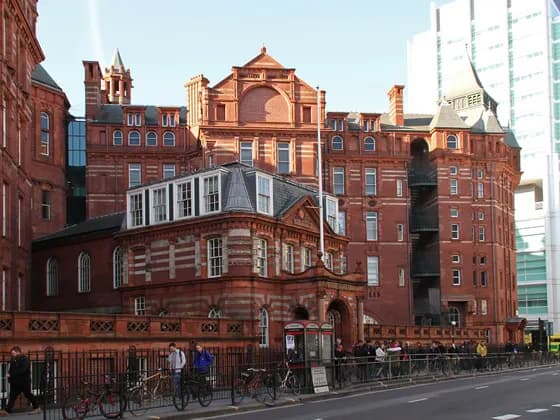

Photo: Diliff (David Iliff) · CC BY-SA 3.0 · cropped
Photo: Jim Osley · CC BY-SA 2.0 · Photo: Tony Hisgett from Birmingham, UK · CC BY 2.0 · Photo: Ham II · CC BY 3.0
Still deciding where to apply? Hear it from a student who's there
UCL Medicine uses a Multiple Mini Interview (MMI) of up to 8 stations, lasting approximately 45–50 minutes in total, with invitations sent on a rolling basis from December through to the end of March. UCL is looking for evidence that you'll thrive in their integrated BSc model, that you can reason ethically, and that you've reflected meaningfully on your work experience.
At each station you get one minute to read the instructions, followed by 5 minutes in which the interviewer asks 2–3 questions. Interviewers score qualities such as professional attitudes and values (flexibility, integrity, empathy, honesty, conscientiousness and compassion), teamwork, leadership, resilience and individual strengths. For 2027 entry, Home fee paying candidates interview on campus and overseas candidates interview online.
Selection for interview is driven by UCAT: the total of the three cognitive subtests ranks applicants, with the SJT used to separate candidates on the same score. UCL normally interviews 900–1,000 applicants and does not score personal statements when selecting for interview.
UCL interview key facts (2027 entry)
| Applications per year | ~2,800–3,000 |
|---|---|
| Interviewed per year | ~900–1,000 |
| Places (2027 entry) | 337 (313 Home, 24 overseas) |
| Interview format | MMI — up to 8 stations, ~45–50 minutes |
Interview Format
- Multiple Mini Interview (MMI) of up to 8 stations, approximately 45–50 minutes in total
- One minute to read each station's instructions, then 5 minutes in which the interviewer asks 2–3 questions
- May include a short data-interpretation or current-affairs task
- Rolling invitations from December to the end of March — on campus for Home fee paying candidates, online for overseas candidates
- Scored on professional attitudes and values, teamwork, leadership, resilience and individual strengths
- No advantage to being invited at a particular point in the cycle
- Personal statements are not scored when selecting for interview
Sample Interview Questions
Why UCL specifically? What attracts you to the integrated BSc model?
Reference the mandatory iBSc year (3rd year), the breadth of clinical placements across multiple London trusts, and the central-London teaching base. Avoid prestige or ranking answers.
Why medicine, and why now?
UCL wants to see considered reflection, not a lifelong-dream narrative. Be honest about how your view of medicine evolved through your experiences.
Tell me about a work experience placement that changed your view of medicine.
Choose one experience and dig deep, rather than listing several. Articulate what you specifically learned about being a doctor — communication, uncertainty, multidisciplinary teamwork.
A 15-year-old refuses life-saving treatment for cancer. Her parents disagree. How should the team approach this?
Apply the four pillars: autonomy (does Gillick competence apply?), beneficence, non-maleficence, justice. Acknowledge the role of the courts in disputed cases. Avoid black-and-white answers.
A patient declines a recommended treatment because they read on the internet that it causes harm. How do you respond?
Autonomy is paramount, but doctors have a duty to provide accurate information. Discuss shared decision-making and the difference between persuasion and coercion.
Should the NHS fund treatments for self-inflicted conditions (e.g. lifestyle-related lung disease, alcohol-related liver disease)?
Engage with both sides. Justice as a pillar argues against rationing by lifestyle; pragmatic resource-allocation argues for. UCL wants nuanced reasoning, not a fixed position.
Explain to me what informed consent means.
Capacity, voluntary, information, understanding. Mention common scenarios where consent is complicated (children, emergencies, mental capacity).
Describe a complex concept from your A-Level work to me as if I had never studied science.
UCL loves this. Avoid jargon, use analogies, check the listener's understanding as you go. Pick something you genuinely understand well.
Here is a graph showing 5-year survival rates for cancer across deciles of deprivation. What does this tell us, and what could a doctor do about it?
Discuss social determinants of health, access to screening, late presentation, and the role of the doctor at individual + system level.
What concerns you most about the medical profession today?
NHS workforce burnout, retention crisis, junior-doctor pay disputes, the move toward private practice. Show awareness without being doom-laden.
Walk me through what you understand about the role of an FY1 doctor.
Reference the realities: long hours, broad responsibilities, on-call rotations, the learning curve. UCL want to know you understand what you're signing up for.
Should doctors strike?
Topical given recent UK industrial action. Engage with both sides: patient safety vs systemic pressure for workforce reform. The BMA's position is a good frame.
If you weren't accepted into medicine this year, what would you do?
Show you've thought beyond a single application cycle. Honest answer is fine — graduate entry, work in healthcare, reapply, etc.
Tell me about a time you received critical feedback. How did you respond?
Pick a genuine example, not a polished one. UCL wants evidence of self-reflection and growth, not perfection.
A junior colleague comes to you and confides they made a clinical error that no one has noticed. What do you do?
Duty of candour (GMC), patient safety paramount. Discuss the steps: ensure patient is safe, encourage colleague to escalate, support them through the process.
Practise the UCL interview
Rehearse the real format before the day — on demand with our AI interviewers, or live with a tutor.
Sit a mock with photoreal AI interviewers — any time
A timed MMI or panel interview on video — British & international voices — with interviewers who listen, react and press with follow-ups. Rubric-scored feedback and a replay the moment you finish.






Live mocks with a tutor who’s been in the room
A full UCL-style mock with a medic or dentist tutor — honest scoring against real marking criteria, a station-by-station debrief and a written action plan.
Book a mock interviewHow to Prepare
Know UCL Medical School USPs cold: integrated iBSc (third year), central London teaching, breadth of clinical placements (UCLH, Royal Free, Whittington, Great Ormond Street).
Practise medical ethics scenarios using the four-pillars framework — interviewers assess professional attitudes and values such as integrity, honesty and compassion.
Reflect on every work-experience entry in your statement; UCL probes "what did you learn?" deeply.
Read 2–3 NHS hot topics weekly from BMJ, The Guardian Health, or HSJ — UCL routinely asks current-affairs questions.
Practise the "explain X to a non-scientist" exercise out loud; this is a near-guaranteed question.
Watch a recent UCL Medical School open-day talk on YouTube to absorb the vocabulary they use to describe themselves.
Time your answers — each station is 5 minutes with 2–3 questions, so keep each answer concise. Don't over-elaborate.
Invited to interview at UCL? Say your first answer out loud today with the free two-minute warm-up drill, then sit a timed mock set up for UCL.
Common Pitfalls
Frequently Asked Questions
Related guides
Free, evidence-based guides from current UK medical and dental students.
Free Interview Resources
Worked-through MMI stations, ethics scenarios, and panel questions.
Read guideNHS Core Values Guide
The 6 NHS values examiners listen for in every interview answer.
Read guideMedical School Rankings
See interview format (MMI vs panel) for each UK medical school.
Read guideUCAS 2026 Personal Statement
The new three-question format your interviewer will reference.
Read guideContextual Offers for Medicine
Every UK medical school's widening-access scheme in one place.
Read guideSources & official admissions information
We cross-check every interview guide against the school’s own admissions guidance and the UK regulators.
- UCL Medical School — MBBS Interviews — MMI of up to 8 stations (1 min reading + 5 min), ~45–50 min; Home on campus, overseas online; Dec–Mar.
- UCL Medical School — Selection Procedure — Total UCAT ranks for interview (SJT breaks ties); ~900–1,000 interviewed; PS not scored; Access UCL.
- UCL Medical School — 2027 Entry requirements — 337 places for 2027 entry (313 Home, 24 overseas); UCAT required in year of application.
- UCL Medical School — Admissions FAQs — Around 2,800–3,000 applications each year; outcomes shown on UCAS and the UCL Applicant Portal.
- UCL — official admissions page — Programme overview, entry requirements, interview format and timeline straight from the school.
- UCAT Consortium — Official UCAT registration, test format, scoring methodology and free practice materials.
- General Medical Council (GMC) — Statutory regulator. Approved medical schools, the registered-doctor register, and fitness-to-practise standards.
- Medical Schools Council — Selecting-for-excellence guidance, MMI principles, and an A–Z of UK medical schools.
Ready to nail your UCL interview?
Book a mock interview with a current medical student who recently went through the same process, or practise on demand with the AI interviewer.