
The Cambridge Medicine course
What you actually study, and where you will be
Cambridge's MB BChir is a 6-year course taught through a traditional, lecture-led structure, with patient contact from Year 1 and placements in Cambridge and the East of England (2027 entry). A classically pre-clinical course that includes full-body dissection. Years 1–3 are science and supervisions, year 3 is an intercalated year in a subject of your choice, and years 4–6 are clinical across the East of England.
- Degree
- MB BChir
- Length
- 6 years
- Teaching
- Traditional / lecture-led
- Clinical contact
- Year 1
- UCAS code
- A100

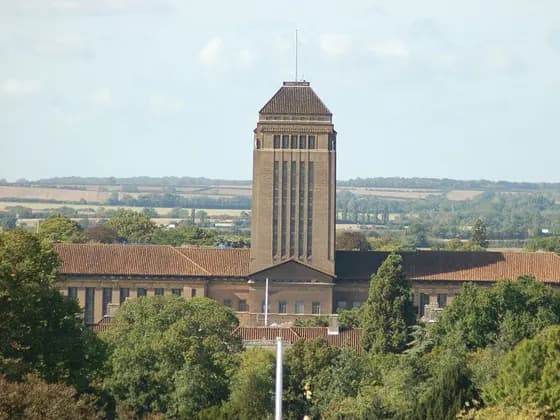
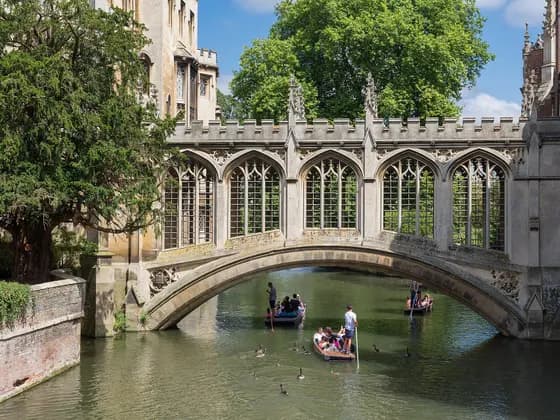
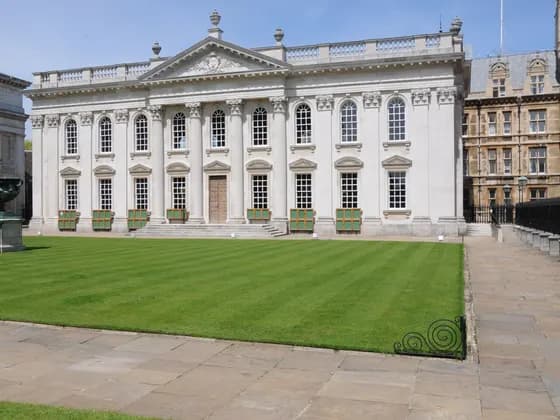
Photo: Dmitry Tonkonog (User:Heuschrecke) · CC BY-SA 3.0 · cropped
Photo: Unknown · Public domain · Photo: Diliff · CC BY-SA 3.0 · Photo: Philip Halling · CC BY-SA 2.0
The Cambridge medicine course at a glance (2027 entry)
Medicine at Cambridge is a six-year course leading to the MB, BChir, the Bachelor of Medicine and Bachelor of Surgery. For the first three years you study the science behind medicine, with a clinical strand alongside. The science years are run by the University's biological sciences departments, with the Clinical School teaching the clinical strand alongside them. For the last three years you are a clinical student with the School of Clinical Medicine, learning from patients in hospitals and GP surgeries.
The science years are taught mainly through lectures, practical classes and small-group sessions arranged by your College, and in year 1 you dissect a donated human body yourself. Year 3 is a compulsory year studying one subject in depth, which earns you a BA (Hons) before clinical school begins.
Patients appear early but in small doses, through a strand called Preparing for Patients. Regular clinical placements start in year 4, based around Addenbrooke's Hospital in Cambridge, with spells at partner hospitals across the East of England. The clinical years end with a six-week apprenticeship.
One change is under way. At the July 2026 open day, the Clinical Dean said the pre-clinical course is being reviewed to put more weight on clinically relevant science and to use more clinical examples. The course names in this guide are the ones in the 2026-27 programme specification, unchanged from this year, so they are what you would meet on entry.
| Degree | MB, BChir, with a BA (Hons) after year 3 |
|---|---|
| Course length | 6 years; 5 for affiliated students who already hold a degree |
| UCAS code | A100 |
| Cohort | 270 students accepted in the 2025 admissions cycle |
| Pre-clinical teaching | Lectures, practicals, College supervisions; 20 to 25 hours weekly in years 1 and 2 |
| Anatomy | Year 1: your own dissection plus prosections (staff-dissected specimens); year 2: prosections only |
| First patient contact | Year 1, meeting patients in general practice |
| Intercalation | Built in: year 3 is a compulsory year on one subject you choose |
| Clinical base | Addenbrooke's Hospital, Cambridge University Hospitals NHS Foundation Trust |
| Placement area | Partner hospitals and GP practices across the East of England |
What makes Cambridge medicine different
You dissect a donated human body in year 1
The first-year anatomy course is taught mainly by dissecting a donated body yourself, alongside prosections, which are specimens that staff have already dissected.
A whole year studying one subject in depth
Year 3, known as Part II, is compulsory. You can take one science in depth, a broad biomedical course with a dissertation, or something further from medicine, such as philosophy or management studies.
Following one pregnancy before clinical school
In year 3 you visit a pregnant woman and her family at home, again and again through the year. Talking with the same person repeatedly shows you how a relationship between patient and doctor builds, in a way one meeting cannot.
Weekly bedside teaching in a stable College group
In Cambridge your bedside teaching group, usually four to eight students, is formed from College affiliations, and it generally stays together for all three clinical years, so you learn alongside the same people throughout.
An MB/PhD route with funded research years
About 10 students a year pause after year 4 for a funded, full-time PhD, usually lasting three years and sometimes four. You apply in year 3, stay a medical student throughout, then return for years 5 and 6.
How Cambridge teaches medicine
In years 1 and 2, each course is run by a University department. The 2025-26 programme specification shows Biochemistry running Molecules in Medical Science, Pathology running Biology of Disease and Pharmacology running Mechanisms of Drug Action. Physiology, Development and Neuroscience runs the physiology, histology, anatomy, reproduction and neurobiology courses. The Clinical School runs the clinical strand.
You work towards two qualifications at once. The Medical Sciences Tripos is Cambridge's honours degree course, and the 2nd MB is the professional qualification you need to continue in medicine. Most science papers count for both, but essay papers count only for the Tripos, and the clinical strand counts only for the 2nd MB.
Year 3 is less timetabled. It asks for more in-depth reading, research and critical analysis of your subject, and includes a research project or dissertation.
From year 4, learning moves to the wards, outpatient clinics and GP surgeries, and on placement there are generally no lectures. You join a clinical team, follow up a group of patients and watch special investigations. You also present patients on ward rounds and in multidisciplinary team meetings, where doctors, nurses and other professionals plan care together.
The clinical course is a spiral curriculum, meaning you revisit the same areas in more depth each year. Communication skills, practical skills, prescribing, professionalism, ethics and law, public health and palliative care run through all three years. Placements are backed by online resources and by seminars and tutorials on topics such as clinical pharmacology, radiology and communication skills.
The ways you will learn
| Lectures and practical classes | Lectures cover the core science in years 1 and 2, and practical classes put it to work. In physiology practicals you sometimes act as the experimental subject yourself. In histology, you first work through an online self-study guide and quiz, then examine tissue under the microscope and on digital slides in a practical class. |
|---|---|
| College supervisions | A small-group discussion, usually one to three students with a supervisor who specialises in the subject. It normally lasts an hour and is arranged by your College. You prepare beforehand by reading, writing an essay or working through set problems. Supervisors review your progress each week and each term, so gaps are picked up early. |
| Undergraduate Clinical Supervisions | One-hour bedside sessions on medical and surgical wards, led by doctors who have finished their first working year and are fully registered with the General Medical Council (GMC). They rotate through the standard adult examinations, such as the heart, lungs, abdomen and nervous system, and your supervisor reports on your progress each term. |
| Simulated patients | Trained actors play patients so you can practise consultations. The GMC's 2024 report describes formative sessions, meaning practice that does not count towards results, where you are filmed talking to a role player and then given feedback. |
| Review and integration weeks | Weeks when the whole year comes back together between placements, for topics best taught to everyone at once and time with your year group. They include the Patient's Voice programme, where patients talk with you about their illness and their experience of the health service. There is also a regular Schwartz round, a facilitated meeting where people talk about how caring for patients feels, not the clinical detail. |
| Clinico-pathological conferences | Whole-year sessions built around patient cases, which run through the review and integration weeks. They show how the science, pathology (the study of disease in the body's tissues) and radiology (medical imaging) you have learned feed into working out a diagnosis. Some are recorded so you can watch them on placement. |
| Professional Practice Groups | Regular small-group discussions, led by a facilitator, about the professional issues you meet on placement. They run through all three clinical years and help you develop reflective practice, the habit of thinking back over your own work to learn from it. |
A typical week on the Cambridge course
In years 1 and 2 the week is heavily timetabled, typically with 20 to 25 hours of teaching. It mixes lectures, practical classes including dissection, seminars and College supervisions, plus occasional short clinical visits. On top of that, the University expects every undergraduate to put in at least about 35 hours a week of teaching and independent study combined, and often more. The year is split into 18 sets, each with its own timetable of lectures and practicals, so your week will not match every friend's.
Teaching runs in three eight-week terms a year, so term time is dense. In 2026-27 those teaching weeks run from 6 October to 4 December, from 19 January to 19 March, and from 27 April to 18 June. The vacations carry some academic work too, such as further reading, revision and set assignments, though the University says this should not take up all of your break.
On a clinical placement you spend your time with your team rather than in lectures. The Clinical School expects about 48 hours of work a week, counting both clinical time and your own study. The usual pattern is 9am to 5pm on weekdays, but some placements need earlier starts, later finishes, evenings or weekends.
Shift work alongside your team starts on year 4 placements, year 5 hospital placements include nights, and in year 6 you may be rostered for evenings, nights and weekends. Friday afternoons can be flexible when there is no clinical work, but regularly missing Fridays means failing the placement. You must attend at least 80% of a placement's days, and you keep a weekly log of what you did and learned.
In years 4 and 6 you normally have a one-hour bedside supervision each week, wherever you are on placement; in year 5 these run whenever you are based in Cambridge. The published minimums are a floor rather than the norm. Supervisors at Cambridge University Hospitals give at least eight sessions a term, and on a regional placement the minimum is three in four weeks, or four in six weeks. The clinical year runs almost all year, with short holidays between blocks.
Placement blocks are broken up by review and integration weeks back at the Clinical School, when the whole year is taught together again. In the 2024/25 timetable year 4 had four of them plus a formative review week in November, year 5 had four, and year 6 had two. Exam preparation weeks come before each Final MB, with two separate spells in year 6, one before the written papers and one before the clinical exams.
How anatomy is taught at Cambridge
Anatomy is taught by the Department of Physiology, Development and Neuroscience. In year 1, Functional Architecture of the Body covers the chest, abdomen, pelvis and limbs. You learn it mainly by dissecting a donated body, cutting through the tissues yourself to find each structure. You also study prosections, which are specimens that staff have already dissected.
Lectures, applied anatomy seminars and clinical demonstrations support the dissection. The course also covers living anatomy, which means identifying structures on a living person, and medical imaging, with ultrasound scanning and 3D digital software used in teaching. At Addenbrooke's, consultants present patients with relevant signs, and ultrasound sessions show abdominal anatomy on volunteers in real time.
Functional Architecture of the Body is examined in June. A 90-minute paper counts for both the Tripos and the 2nd MB, and a two-hour essay paper counts for the Tripos only. The 2025-26 programme specification says the exam is taken online, with questions based on images of prosected specimens and clinical cases.
In year 2, Head and Neck Anatomy is taught in the Michaelmas term, the first term of the academic year, through prosections, lectures and applied anatomy sessions. It is examined by a 90-minute paper, which the 2025-26 specification says is taken online and mixes questions on images of specimens and clinical cases with short answer questions.
Students write tributes for the donors' committal service, and the department holds a yearly thanksgiving service for donors' relatives and friends. In the Easter term, the third term of the year, online sessions discuss the cause of death of the donors you have worked on.
The anatomy department's web page on links with clinical medicine describes clinical students coming back to the dissection room for revision sessions built on case scenarios and prosections. It lists the chest and peripheral joints in year 4, the abdomen and pelvis in year 5, and the head and neck in year 6.
When you first meet patients at Cambridge
Before clinical school, patient contact comes through Preparing for Patients, which has four strands spread across your first three years. Each builds communication skills and needs written coursework, and you must pass all four before you start year 4.
In year 1, strand A takes you to a GP surgery. The 2025-26 specification describes conducting a simple medical interview there and learning how consent and confidentiality work. In year 2, strand B moves to a hospital, where the interviews are more complex and cover why patients were admitted.
Strand C, in the summer between years 2 and 3, has you visit a statutory, voluntary or other organisation that supports people with health problems, at times you arrange. A College supervision in year 3 reviews it. Strand D runs through year 3, when you follow a pregnant woman and her family at home.
Regular patient contact begins in year 4, with a two-week introductory course and then Core Clinical Method placements. The focus shifts gradually from history taking and examination to practical skills, ending with the final-year apprenticeship.
Year by year at Cambridge
- Year 1
Medical Sciences Tripos Part IA
Your first year lays the science foundations: how the body is built, how its cells and molecules work and how it keeps its internal conditions steady. Most exams are in June, but the evidence-based practice exam comes at the end of the Lent term, the second of three terms.
- Functional Architecture of the Body: anatomy of the trunk and limbs, through dissection.
- Homeostasis, with experimental physiology practicals, and Histology, the microscopic structure of cells and tissues.
- Molecules in Medical Science: the principles of biochemistry and medical genetics.
- Foundations of Evidence-Based Practice: epidemiology and statistics, examined by a 45-minute multiple-choice paper.
- Social and Ethical Context of Health and Illness, assessed by two 3,000-word essays.
- Preparing for Patients A in general practice.
- Year 2
Medical Sciences Tripos Part IB
The second year moves from the healthy body to disease, drugs and the brain. In April, a Part II subject fair helps you choose your year 3 subject.
- Biology of Disease: the causes and effects of disease and the body's response to it.
- Mechanisms of Drug Action: how drugs act on receptors and on whole body systems.
- Neurobiology and Human Behaviour, the most heavily weighted subject in the second-year exams.
- Human Reproduction, including its social context and its influence on population trends.
- Head and Neck Anatomy, taught through prosections.
- Preparing for Patients B in hospital, then strand C in the summer vacation.
- Year 3
Part II: one subject in depth
You study one subject of your choice, advised by your College Director of Studies, the academic who oversees your studies. The year leads to a BA (Hons) with an overall degree class.
- Choose a Natural Sciences single subject, Biological and Biomedical Sciences, or another Tripos.
- Complete a dissertation or research project, depending on the course.
- Continue with Preparing for Patients D, whatever subject you study.
- Pass all 2nd MB exams and reach honours level to enter clinical school.
- Year 4
Core Clinical Practice
Your first clinical year teaches history taking, examination, choosing investigations and forming a list of possible diagnoses. It ends with Final MB Part I, the first of the three professional exams that close each clinical year. In the 2024/25 example timetable the year ran from 9 September to exams in the week of 7 July.
- A two-week introductory course in communication, examination, procedures, resuscitation and palliative care, with peer teaching from a more senior student, your Associate Clinical Supervisor.
- Core Clinical Method: four weeks at Addenbrooke's and four weeks at one of eight partner hospitals, with radiology and maternal and child health teaching. A formative review follows, to spot anyone who needs extra support.
- At the end of Core Clinical Method you sit a single best answer written paper, where you pick the best of several options. You also sit a practice Objective Structured Clinical Examination (OSCE), a circuit of timed clinical tasks that does not count towards your results.
- Four 6-week blocks: general medicine with elderly care, emergency care, elective surgery with peri-operative care, and a student-selected research block. The three clinical blocks include shift work with your team.
- Four Friday visits to a GP practice in the autumn, in a group of four, then two 2-week general practice placements, one inside the medicine block and one inside the emergency care block.
- Three clinical writing and presentation tasks marked by your supervisor, which you must complete before you can sit Final MB Part I.
- Year 5
Specialist Clinical Practice
Year 5 introduces specialist practice at Cambridge University Hospitals and how disease looks at different life stages and in different communities. In 2024/25 it began on 12 August, ran as four eight-week blocks and ended with Final MB Part II from 26 May to 13 June.
- Four 8-week rotations: neurosciences and mental health, specialist surgery, specialist medicine, and maternal and child health. Three of them include a 2-week placement at the same GP practice, so you meet the same health problems in the community and in hospital.
- In specialist medicine and specialist surgery you choose the specialty you want to explore. Most of these placements are on the Cambridge Biomedical Campus, with a few at Royal Papworth Hospital and Cambridgeshire and Peterborough NHS Foundation Trust.
- Everyone also covers specialist heart and lung care at Royal Papworth Hospital, and cancer care and infectious diseases at Addenbrooke's.
- The hospital placements in maternal and child health (8 weeks) and in neurosciences and mental health (6 weeks) are based at Cambridge University Hospitals, at a regional partner hospital, or both. Both include shift work alongside your team, including nights.
- Portfolio cases on disease across a lifetime, and experience of clinical or translational research, which turns laboratory findings into patient care.
- Be signed off as competent, under supervision, on the practical procedures in the General Medical Council's Practical skills and procedures list, such as taking blood. The Clinical School counts 32 of them and judges you by repeated observation and feedback.
- The elective, a seven-week placement you choose, in the summer between year 5 and year 6.
- Year 6
Applied Clinical Practice
The final year prepares you to work as a Foundation Year 1 doctor. Graduates gain provisional GMC registration and start the two-year Foundation Programme, and full registration follows once you complete Foundation Year 1. You apply for the Foundation Programme in the Michaelmas term of year 6. In 2024/25 the year ran from 19 August to mid-June.
- Four 6-week senior placements in medicine, surgery, acute care and general practice. Everyone does at least one of the ward-based medicine or surgery placements before the written finals.
- Senior medicine and senior surgery: you clerk patients, which means taking their history and examining them when they arrive, then follow them up, present them on ward rounds and carry out practical procedures.
- These ward placements also build skills in dermatology, rheumatology, orthopaedics, ear, nose and throat (ENT), elderly care, eye care, palliative care and radiology.
- Acute care: your time is split between emergency departments, intensive care and operating theatres, learning to assess and manage seriously ill patients. During year 6 you gain the Intermediate Life Support (ILS) certificate, a recognised qualification in resuscitating patients.
- Senior general practice: you and another student join a practice you have not been to before. You see patients on your own under GP tutors, make supported decisions and follow patients up, including someone with a terminal illness.
- Final MB Part III written papers in January, including the Applied Knowledge Test, the written part of the national licensing exam.
- Final MB Part III clinical exams over about two weeks from late April into early May, 21 April to 2 May in the 2024/25 timetable.
- The Prescribing Safety Assessment, a national test of safe prescribing that you must pass to be awarded your degree, plus a portfolio, an experience log and an assessed elective report.
- A six-week apprenticeship after the clinical exams, working semi-independently on in-patient wards under named consultants. It includes night shifts, a day in a hospice, and seminars on ward skills and on liaison psychiatry, the mental health care of patients on general wards.
- The apprenticeship is signed off through a handbook of supervised learning events, with reports from your senior and junior mentors. You must complete it to be awarded your degree.
How you are assessed at Cambridge
In years 1 and 2, most science subjects are examined in June through a lecture paper, a practical paper and an essay paper. The first two count for the Tripos and the 2nd MB, the essay for the Tripos only. You get two attempts at each 2nd MB exam, with resits in September. Apart from professional qualifying exams like these, the course page says you usually cannot resit exams.
In the clinical years, placements are assessed through observation by the team, written tests, OSCEs and Mini-Clinical Evaluation Exercises, where a clinician watches you with a patient and gives feedback. Each placement ends with a record grading your attendance, your knowledge and skills, and your professionalism, plus an overall grade of outstanding, pass, borderline or fail. A failed placement must be made up and passed before you can sit Final MB, and two or more borderline grades may also stop you being entered.
Each clinical year ends in a Final MB exam, with two attempts at each. Part I in year 4 is a three-hour written paper and a clinical exam of about 10 stations. Those stations mix OSCE tasks with simulated clinical encounters, where you consult a trained actor playing a patient, plus one practical skills station.
Part II in year 5 has two written papers and two circuits of six 11-minute stations, on paediatrics and obstetrics and gynaecology. Part III in year 6 has the national licensing tests below, plus a two-hour paper of five or six short answers on public health, ethics and law.
All UK medical students must pass the GMC's Medical Licensing Assessment (MLA) as part of their degree. At Cambridge its Applied Knowledge Test (AKT) is two computer-based papers of 100 single best answer questions, each two hours long, sat on consecutive days. Its Clinical and Professional Skills Assessment (CPSA) is split over two years at Cambridge, a design the GMC found compliant with its requirements in February 2024. The year 5 stations count towards it, with a September resit, and year 6 adds two circuits of seven 15-minute stations.
You also sit the Prescribing Safety Assessment (PSA), a national two-hour online test of 60 questions, with the online British National Formulary, the standard reference on medicines, to hand. At Cambridge you must pass it before you can be awarded your medical degree. It builds on Practical Prescribing, a strand taught partly online across all three clinical years, covering dose calculations, reporting harmful reactions to drugs and spotting unsafe prescriptions.
Where you will actually be at Cambridge
Your clinical years are based on the Cambridge Biomedical Campus, with much of your time at Addenbrooke's Hospital. The School's main hospital partner is Cambridge University Hospitals NHS Foundation Trust, which runs Addenbrooke's and the Rosie Hospital for women's and maternity care. At least a third of your clinical learning happens in regional hospitals and GP practices across the East of England, and you also gain experience in community and mental health trusts in the region.
The 2025-26 programme specification names eight partner hospitals: Royal Papworth in Cambridge, and hospitals in Bedford, Huntingdon, Ipswich, Bury St Edmunds, King's Lynn, Stevenage and Peterborough. Everyone spends four weeks of year 4 Core Clinical Method at one of them, and year 4 and year 6 placements can be there or at Addenbrooke's. Placements vary between students, and each block follows your own schedule.
The School pays for accommodation near your placement hospital and for one return journey per placement, while you cover everyday living costs. On regional placements, supervision groups may be smaller and change with each placement. The Medical Library gives you access to hospital libraries across the region.
General practice teaching runs through all three clinical years. In year 4 you visit a practice in a group of four on four Fridays between October and December, learning history taking and examination with selected patients. After Christmas come two 2-week GP blocks: four days a week in the surgery, seeing patients who have come in with a problem that day, and a fifth day of seminars.
In year 5 you go back to the same practice for all three 2-week placements. You meet community carers and organisations that support people living with illness. You also complete an audit, which checks how well the practice's care measures up to an agreed standard, and follow two patients through the year.
In year 6 you spend six weeks at a practice in the East of England. Once your GP tutor has assessed you, you take histories, examine patients, make a management plan and present it to the tutor. Teaching focuses on eye, ear, nose and throat, and skin problems, and during the year you also do one out-of-hours shift.
Home of the Clinical School, where the introductory course and review weeks take place. Royal Papworth, also on the Cambridge Biomedical Campus, is a partner hospital for year 4 and year 6 placements, and year 5 heart and lung teaching happens there.
- Addenbrooke's Hospital (Cambridge University Hospitals NHS Foundation Trust)
- The Rosie Hospital, women's and maternity care (Cambridge University Hospitals NHS Foundation Trust)
- Royal Papworth Hospital
Partner hospital for placements in years 4 and 6.
- Lister Hospital
Partner hospital for placements in years 4 and 6.
- Bedford Hospital
Both part of North West Anglia NHS Trust, and both partner hospitals for placements in years 4 and 6.
- Peterborough City Hospital
- Hinchingbrooke Hospital
Partner hospital for placements in years 4 and 6.
- Queen Elizabeth Hospital
Partner hospital for placements in years 4 and 6.
- Ipswich Hospital
Partner hospital for placements in years 4 and 6.
- West Suffolk Hospital
Offers a small number of the year 5 specialist placements that students choose.
- Cambridgeshire and Peterborough NHS Foundation Trust
Electives and chosen modules at Cambridge
Student-selected components (SSCs) are blocks where you choose what to study. The Clinical Dean's 2026 open day talk describes four: one in year 4 and three in year 5, including the elective. They come with research skills training, from literature searching to writing an abstract and presenting. A supervisor assesses each one, and your SSC portfolio must be complete before you can sit Final MB Part III.
The elective lasts seven weeks, between years 5 and 6. You can spend it in the UK or abroad, on a clinical or research area of your own choice, and College and national grants may help with the cost. In the 2024/25 timetable it ran from 30 June to 18 August.
In year 6 you write a detailed report on your elective, which is assessed and considered for a best elective report award.
Intercalation at Cambridge
Intercalation means spending a year studying one subject in depth outside the medical curriculum. At Cambridge it is built in as year 3 for every standard-entry student. Affiliated students, who already have a degree, skip it and finish in five years.
Biological and Biomedical Sciences lets you combine a major and a minor subject, with a dissertation of up to 6,000 words instead of a lab project. A Natural Sciences single subject goes deep into one science, though some have limited places and their own selection. Choices beyond science that have been popular with medical students include anthropology, management studies, philosophy and geography.
The MB/PhD programme adds a longer research stage, and about 10 students a year are offered places. You apply in year 3 and need to be in the top half of your year in Final MB Part I. You then spend usually three years, sometimes four, on a full-time PhD, keeping up clinical skills through weekly supervisions and monthly seminars. Your thesis must be submitted before you return for years 5 and 6.
MB/PhD projects can be in a Clinical School or biological sciences department, or an affiliated institute such as the Gurdon Institute, the Medical Research Council (MRC) Laboratory of Molecular Biology or the Sanger Institute.
- Natural Sciences single subjects open to medical students: Biochemistry; Genetics; Pathology; Pharmacology; Physiology, Development and Neuroscience; Plant Sciences; Zoology; History and Philosophy of Science.
Facilities and support at Cambridge
Where you will learn
The Medical Library offers reading-list books, help with literature searches and a 60-computer study room. It provides clinical tools such as the British National Formulary and BMJ Best Practice. At the start of year 4 it registers you for NHS OpenAthens, a login for NHS e-journals and e-books.
The Clinical School is on the Cambridge Biomedical Campus. Much formal teaching happens in the School building and in the Deakin Centre next door, a purpose-built training centre with skills laboratories, rooms equipped for practising clinical skills. In the 2024/25 timetable the final clinical exams were held there. Addenbrooke's and every partner hospital also have a clinical skills unit with its own tutors.
Pre-clinical courses use Moodle, the University's online learning site, and clinical students have a Clinical School Moodle with year guides, assessment information and a Clinical Examination Handbook. Like every Cambridge student, you can also use the Cambridge University Library.
Support while you study
Your College adds teaching, pastoral and financial support. In the early years your Director of Studies guides your academic choices. In the clinical years you also have a Director of Clinical Studies, the College academic who oversees your clinical studies. Your Cambridge bedside supervisor contacts them if there are concerns about your attendance or welfare.
The Clinical Dean's 2026 open day talk describes welfare support in tiers: your College, a Sub-Dean for Welfare and the Clinical School Mental Health Service. The School funds that service so that students with serious mental health difficulties can see a psychiatrist quickly, and a psychologist if needed. A Medical and Veterinary Student Progress Panel also keeps an overview of student progress across the course.
In years 5 and 6 you have a one-to-one progress review, either with your College's Director of Clinical Studies or with a senior member of the Clinical School teaching team.
The GMC's 2024 report describes what happens if a final-year student fails the written exam. The assessment team gets in touch within 48 hours, an assessment lead helps plan revision, and the student is excused from placement for remedial teaching. Students returning from time out or preparing for a clinical resit can have six extra one-hour bedside supervisions.
In years 1 to 3, your College and the Accessibility and Disability Resource Centre arrange most disability support. In the clinical years, the School of Clinical Medicine's Student Academic Support Lead takes on that role.
Is the Cambridge course right for you?
This course may suit you if
- You want a thorough grounding in biomedical science first, since the first three years are science-led and heavily timetabled.
- You would like to learn anatomy hands-on, by dissecting a donated body yourself in year 1.
- You have an academic interest you want to follow properly, because year 3 can be anything from pathology to philosophy.
- You learn well in small groups, through College supervisions in the early years and weekly one-hour bedside teaching in groups of four to eight later.
- You are curious about research, with student-selected research blocks and the option of an MB/PhD.
Things to think about
- Before year 4, patient contact is limited to the Preparing for Patients strands, so most of your first three years is spent in lectures, labs and supervisions.
- The standard course takes six years because the Part II year is compulsory, and longer if you take the MB/PhD.
- Placements can take you to hospitals in towns such as King's Lynn, Ipswich and Stevenage, living in School-funded accommodation away from Cambridge.
- Progression is strict. You must pass every 2nd MB exam and reach honours level in year 3, and each clinical-year exam gives you only two attempts. Failing a Final MB Part I or II resit normally ends your place on the clinical course.
- The clinical years run almost all year round, with about 48 hours of work a week expected and years 5 and 6 starting in mid-August in the 2024/25 timetable.
Cambridge medicine course — frequently asked questions
Applying to Cambridge?
How to get into Cambridge
Entry requirements, UCAT, personal statement and interview, step by step.
Open the guide →Cambridge UCAT cut-offs and offers
UCAT cut-offs, A-level offers, interview format and decision dates.
See the requirements →Compare Cambridge with other schools
Put the teaching style, anatomy teaching and placements next to another school.
Open the comparison →Prepare for the Cambridge interview
Format breakdown, school-specific sample questions and prep tips from tutors who interviewed here.
Read the guide →Where this Cambridge course guide came from
This guide was written from 30 official sources — University of Cambridge's own course pages and programme documents, plus the regulator and NHS placement partners where they publish detail — read on 2026-09-21, then checked claim by claim against those sources.
- University of Cambridge: Medicine, MB and BChir course page
- School of Clinical Medicine: Medicine, MB and BChir course information
- School of Clinical Medicine: example clinical course timetable, 2024/25
- Clinical Medicine: Standard Course programme specification, 2025-26
- Faculty of Biology: the pre-clinical course, years 1 and 2
- Faculty of Biology: the Part II year 3 options for 2026-27
- Faculty of Biology: Preparing for Patients
- Faculty of Biology: MedST timetables and sets
- Faculty of Biology: MedST examination structure and papers
- Medical Sciences Tripos programme specification, 2025-26
- Medical Sciences Tripos programme specification, 2026-27
- University of Cambridge: how you are taught, supervisions and study hours
- University of Cambridge: supervisions and assessment
- University of Cambridge: term dates and calendars
- The Cambridge Medicine Course: Clinical Dean's open day slides, July 2026
- School of Clinical Medicine: Undergraduate Clinical Supervisors programme
- School of Clinical Medicine: Undergraduate Clinical Supervisors programme details
- School of Clinical Medicine: MB/PhD course information
- Department of Public Health and Primary Care: GP teaching on the clinical course
- Department of Physiology, Development and Neuroscience: Human Anatomy Centre
- Human Anatomy Centre: integration with clinical medicine
- Department of Physiology, Development and Neuroscience: Functional Architecture of the Body
- Department of Physiology, Development and Neuroscience: Head and Neck Anatomy
- Cambridge Medical Library: support for clinical students
- Cambridge University Hospitals: the Rosie Hospital
- GMC: the Medical Licensing Assessment
- GMC: Cambridge MLA CPSA compliance report and decision, February 2024
- GMC: Cambridge MLA AKT compliance decision report, June 2024
- GMC: full registration for UK graduates moving from F1 to F2
- Prescribing Safety Assessment: overview from MSC Assessment and the British Pharmacological Society
Courses are restructured between cycles. Anything here that decides your application — an anatomy offer, a placement city, a compulsory intercalated year — should be confirmed against the official page for your entry year.
Applying to Cambridge?
We have helped hundreds of applicants turn their UCAT, personal statement and interview prep into offers from Cambridge and other UK medicine schools.