
The Edinburgh Medicine course
What you actually study, and where you will be
Edinburgh's MBChB with BMedSci (Hons) is a 6-year course with an integrated curriculum, with patient contact from Year 2 and placements in Lothian and the south of Scotland (2027 entry). A six-year MBChB. Year 3 is a full research year leading to an honours BMedSci, and the clinical years run across Lothian and the south of Scotland. Clinical method — history taking and examination — starts in year 2.
- Degree
- MBChB with BMedSci (Hons)
- Length
- 6 years
- Teaching
- Integrated
- Clinical contact
- Year 2
- UCAS code
- A100
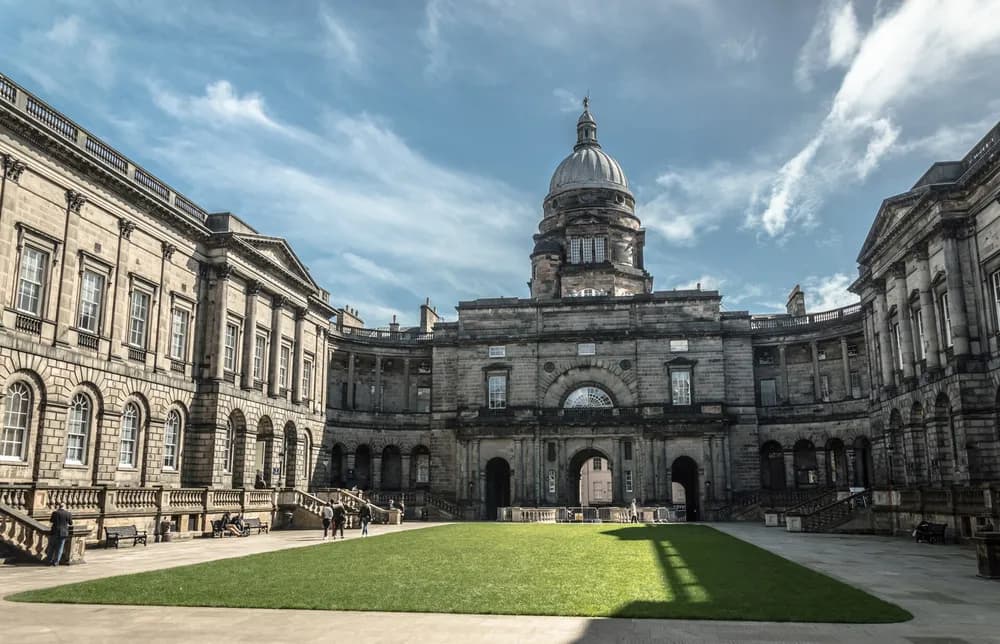
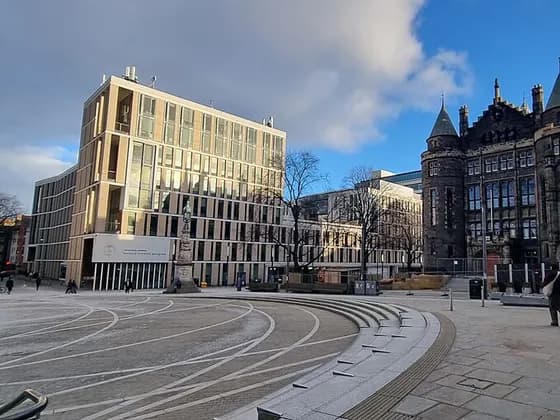


Photo: Chrysi Chrysochou · CC BY-SA 3.0 · cropped
Photo: Stinglehammer · CC BY-SA 4.0 · Photo: Nilfanion · CC BY-SA 3.0 · Photo: Ad Meskens · CC BY-SA 3.0
The Edinburgh medicine course at a glance (2027 entry)
Edinburgh's medicine course runs for six years under UCAS code A100 and leads to an MBChB, which stands for Bachelor of Medicine and Bachelor of Surgery. The extra year compared with most UK courses is year 3, a full year of research that earns a degree in its own right: a BMedSci with honours. Everyone who joins without a degree takes it and finishes with two qualifications. Graduate entrants can skip it and go straight from year 2 to year 4.
Years 1 and 2 are based on the central campus around George Square and Teviot Place. They are built from five strands taught side by side: biomedicine, the social and ethical side of medicine, research and evidence-based medicine, Knowledge to Clinical Practice, and clinical and professional skills. Knowledge to Clinical Practice pulls the first three together around the way patients present with illness, so the science is tied back to how people actually become unwell.
Year 3 is unlike anything else in the degree. You spend a full academic year of research-based study on one honours subject, assessed by the honours programme rather than the medical school.
Years 4, 5 and 6 are placement years, spent in hospitals and general practices mostly in Edinburgh and across south and central Scotland. Each of those years is divided into fixed blocks, set out year by year below.
The MBChB is a primary medical qualification, which lets you apply for provisional registration with the General Medical Council (GMC), the body that licenses doctors in the UK. Part of that is passing the Medical Licensing Assessment, or MLA, also written UKMLA, which Edinburgh builds into the year 6 finals. Professional behaviour and attendance are assessed every year.
Once you graduate you start the UK Foundation Programme, two years of paid and supervised work as a foundation doctor. You apply during year 6 through a national selection scheme. Completing the first of those two years earns a Certificate of Experience, which makes you eligible to apply for full registration with the GMC.
| Degrees awarded | MBChB, plus a BMedSci (Hons) earned in year 3 |
|---|---|
| Course length | 6 years, including one full research year that graduate entrants can skip |
| UCAS code | A100 |
| Students placed | 290 for 2025 entry |
| Years 1 and 2 base | Central campus: George Square and Teviot Place, Edinburgh |
| Clinical skills base | Clinical Skills Centre, Chancellor's Building, BioQuarter |
| Teaching style | Integrated strands with group based learning tutorials and lectures |
| Anatomy | Lectures, lab practicals and must-pass identification exams (spot tests) in years 1 and 2 |
| First patient contact | Year 1 GP teaching; history taking and examination from year 2 |
| Placement area | Lothian hospitals, GP practices, and south and central Scotland |
| Elective | Six weeks after finals in year 6, in the UK or abroad |
What makes Edinburgh medicine different
A research year built into the degree
Year 3 is a full academic year of research leading to a BMedSci honours degree. Every student who joins without a degree takes it, so there is no separate application and no competition for a place.
Patients who volunteer to be examined
The Edinburgh Patient Partnership Supporting Assessment and Teaching service, set up in 2006, keeps a pool of around 350 patient volunteers living with real conditions. They join year 4 teaching in neurology, cardiology, rheumatology and psychiatry. In the year 4 and year 6 clinical exams they help with respiratory, neurology, cardiovascular and abdominal stations.
A finals exam you can finish early
In the design the GMC approved in 2024, the final clinical exam is two sequences of twelve short timed stations, each one a single clinical task watched by an examiner. Clear the first sequence with enough margin and you are excused the second.
Final year run as an apprenticeship
Year 6 has few lectures. You work alongside clinical teams, and after finals you spend six weeks doing the tasks of a first-year foundation doctor under close supervision and six weeks on your elective, in either order.
How Edinburgh teaches medicine
The degree is organised around twelve outcome themes, which set out what you should be able to do by graduation. Among them are clinical communication, emergency care and resuscitation, clinical pharmacology and therapeutics, and your legal and professional duties as a doctor.
Years 1 and 2 are taught mainly on campus, through lectures, seminars, tutorials, online material and practical sessions. The school describes the MBChB as a spiral curriculum, meaning you come back to the same themes in later years rather than finishing with them, each time with harder cases and more responsibility.
Year 1 carries about 279 hours of lectures, 207 hours of seminars and tutorials and 44 hours of supervised practicals inside a notional 1,200-hour year, with the rest left to your own reading. Year 2 cuts lectures to about 90 while keeping the tutorial load. By year 4 there are about 85 lecture hours against 746 hours on placement, and year 6 lists no lecture hours at all.
The course is assessed on how you behave as well as what you know. Every year has a professionalism requirement covering attendance, engagement and conduct, judged against the GMC's four domains of good practice, and concerns are dealt with supportively unless they are serious or repeated.
The ways you will learn
| Group based learning tutorials | Small-group tutorials, known as GBL, that run through years 1 and 2. They are used to explore topics, and how you learn them, in more depth than a lecture allows. Handing in your GBL feedback is part of the professionalism requirement. |
|---|---|
| Clinical and communication skills sessions | Practical sessions in the Clinical Skills Centre where you learn to take a history, examine a patient and practise procedures on manikins before doing any of it for real. |
| Simulated patients | Trained volunteers who act out a patient's story so you can practise consultations safely. Edinburgh's programme started in 2001, and the scenarios become harder as you move up the years. |
| General practice teaching | From year 1 you travel out to a GP surgery for tutorials on the social and ethical strand. General practice returns in year 4 as a block shared with psychiatry, and in year 6 as a block of its own. |
| Ward and clinic teaching | From year 4 most learning happens by being part of a team. You clerk patients, which means taking a full history from someone newly admitted and examining them. You also join ward rounds, sit in on clinics and go into theatre. Tutors observe you doing tasks and sign them off. |
A typical week on the Edinburgh course
Edinburgh publishes a sample week from the first semester of year 1. Monday is campus-based: an anatomy lecture in the morning, a short lecture at lunchtime, then a research and evidence-based medicine tutorial and a group based learning tutorial.
Tuesday you travel out to a general practice for a tutorial on the social and ethical strand, then come back for a clinical communication tutorial and an anatomy practical. Wednesday afternoon is a three-hour clinical skills session. Thursday brings an ethics lecture, a tutorial and another group based learning slot, and Friday two anatomy lectures and a lecture linking knowledge to clinical practice.
That is a little under twenty hours of timetabled teaching, with the rest of the year given to directed and independent study. The school says the course leaves little room for a part-time job, and that years 4 to 6 demand more time again.
How anatomy is taught at Edinburgh
Anatomy sits inside the biomedicine strand in years 1 and 2. You learn the structure of each body system alongside its physiology and the common diseases that affect it. It is taught through lectures and practical sessions in the anatomy teaching laboratory at Teviot Place.
You are examined on it separately. Both year 1 and year 2 end with an anatomy spot test held in that laboratory. A spot test is a timed circuit in which you move from station to station identifying what is in front of you. It is worth 15 per cent of the year and is a standalone hurdle: you have to pass it on its own to move up.
The anatomy department teaches using bodies donated by members of the public, under the Anatomy Act 1984 and the Human Tissue (Scotland) Act 2006. Anatomical examination of a donation can take up to three years, and the university holds a memorial service each April at the McEwan Hall.
When you first meet patients at Edinburgh
You meet patients in year 1, though in small amounts and in structured settings rather than on wards. You travel to a general practice for tutorials, you do community-based practicals, and patient volunteers come in to talk to first years about living with their condition.
Year 2 is where you start doing rather than watching. The strand linking knowledge to clinical practice introduces history taking and physical examination, and you need your own stethoscope from the start of the year. The year ends with your first Objective Structured Clinical Examination, or OSCE: a circuit of short timed stations, each watched by an examiner.
Year 4 then puts you into hospitals and GP surgeries full time, embedded in a team rather than visiting one, and the expectation rises each year after that.
Year by year at Edinburgh
- Year 1
Whole body health 1
A single 120-credit course across the whole year, introducing health, illness and the science underneath them. Biomedicine is grouped into three themes: the body in motion, sustaining life, and integrity. Alongside it you study ethics, research methods and clinical skills.
- Anatomy, physiology and the other biomedical sciences taught system by system, with lectures and lab practicals
- The social and ethical strand covers what causes illness in populations, medical ethics and public health; the research strand teaches critical appraisal and statistical reasoning
- A student selected component worth 5 per cent, plus three social and ethical strand essays worth 30 per cent, of which at least two must pass
- Progress tests in December and March, which are practice papers that do not count towards your marks
- Two knowledge test papers in April or May, worth 50 per cent together, plus the anatomy spot test. Knowledge tests are the school's name for its computer-based written exams
- Year 2
Whole Body Health 2
The same five strands, a new set of body systems and a step up in what you are asked to do. Biomedicine covers command and control, transitions, renal and urology, and nutrition and digestion. The clinical strand moves from understanding patients to examining them.
- History taking and physical examination are taught for the first time, and you need your own stethoscope
- Ethics teaching turns to new medical technologies, climate change and planetary health, and the doctor-patient relationship
- The research strand moves from appraising other people's work to designing and running your own
- A group project on the social and ethical strand, with a portfolio and a presentation
- Assessment weighting: knowledge tests 50 per cent, anatomy spot test 15, the group project 15, research strand work 10 and your first OSCE 10
- Year 3
BMedSci honours research year
A full academic year away from clinical medicine, spent on one honours subject and leading to a Bachelor of Medical Sciences with honours. Many students take a science discipline in depth, gain research experience and write a dissertation.
- Places are allocated at random from the programmes you rank, so you may not get your first choice
- Around 25 programmes are offered, including neuroscience, immunology, pharmacology, epidemiology and reproductive biology
- Less science-heavy options exist too, such as global health policy, bioethics law and society, and literature and medicine
- Where you are based depends on your honours subject: it could be any of the University's campuses, including King's Buildings as well as the central area and BioQuarter
- Two semesters with exams running into late May, then a return to the medical course
- Year 4
Process of Care 1: the generalities of practice
The first full clinical year, worth 180 credits and organised as ten four-week blocks with exams at the end. The aim is breadth rather than depth: how patients present, how a clinical team works and how management plans get made.
- Blocks in general medicine, medicine of the elderly, cardiology, respiratory, neurosciences, diabetes and endocrinology, rheumatology, gastrointestinal and liver medicine, and infection
- A combined general practice and psychiatry block, plus introductions to orthopaedics and surgical principles
- You assess patients yourself: taking histories, examining, proposing and interpreting investigations, and drafting management plans
- A clinical ePortfolio becomes a must-pass element. It holds your clinical skills sign-offs and a set of Entrustable Professional Activities, records covering the core parts of clinical practice. You are expected to ask to be observed and to store the feedback you get in it.
- End-of-year exams after the tenth block: two written knowledge test papers worth 70 per cent together and an OSCE worth 30 per cent. In 2026/27 the year 4 revision and exam period runs from mid-June into early July.
- Year 5
Process of Care 2: the specialties
Seven five-week blocks that take you from the general clinical practice of year 4 into the individual specialties, again worth 180 credits. By the end you should be able to assist a doctor in delivering care. You also carry out an individual research project with a clinical tutor.
- Allocated placements in psychiatry, child life and health (paediatrics), and obstetrics and gynaecology
- Smaller modules in haematology, oncology, palliative care, breast disease, urology, renal medicine, dermatology, ophthalmology and ENT (ear, nose and throat), plus anaesthetics and critical care
- A broadening medical experience block you shape yourself, to develop clinically, professionally or academically in an area you care about
- Around 750 hours on placement, working in hospital wards as part of a team
- Year 6
Preparation for Practice
Four four-week blocks from August, then finals in January, then twelve weeks split between an assistantship and an elective. The year is broad rather than specialised, covering medicine, surgery and primary care, and is taught as an apprenticeship.
- Blocks in medicine, general practice, medicine of the elderly, surgery and emergency medicine. In NHS Lothian the surgery block runs at the Western General Hospital together with anaesthesia and critical care.
- You are expected to be proactive: clerking patients, joining in with care and completing portfolio activities that show you are working at the level of a first-year foundation doctor
- After finals come twelve weeks split into a six-week assistantship, working alongside a foundation year 1 doctor under close supervision, and a six-week elective. The timetable allows either to come first.
- A separate version of year 6 exists for students heading to a Canadian residency. They spend the summer before year 6 in Canada, doing the general practice and general medicine attachments in Alberta plus their elective, then do the assistantship after finals.
How you are assessed at Edinburgh
Written papers at Edinburgh are called knowledge tests and are sat on university computers. They mix single best answer questions, where you pick one option from a list, with very short answer questions where you type a brief response.
In years 4, 5 and 6 you also sit two practice knowledge tests online each year, known as progress tests. You must sit them, but you do not have to pass them and they do not count towards your result.
Practical exams are OSCEs, and years 2, 4 and 5 each end with one. From year 5 you must pass at least half the individual stations as well as reaching the overall pass mark. In years 4 and 5 the written papers carry 70 per cent of the year and the OSCE 30. In year 6 the written and clinical finals count for half each.
Finals are the Medical Licensing Assessment, or MLA, which every UK medical student must now pass to get a licence to practise. It has two parts, both run by your own medical school. Edinburgh's applied knowledge test is the version shared between UK medical schools: two computer papers of 100 single best answer questions, sat on consecutive days, two hours each. The pass mark is set nationally at the standard of a doctor in their first week of work.
The clinical half of the MLA is Edinburgh's final OSCE, which the GMC judged compliant with its requirements in April 2024. It is a 24-station exam split into two sequences of twelve, each taken as six stations a day over two days. Stations last ten minutes with two minutes of reading time.
In that design, every station is marked on the same four equally weighted areas, one of which is professionalism. To pass you need the overall pass mark, a pass in at least half of the stations, and at least 50 per cent in each of the four areas across the whole exam.
- Anatomy spot tests in years 1 and 2 must each be passed on their own, whatever your other marks
- Fail the knowledge test in year 1 or year 2 and you can resit it in August. If you still do not meet the progression rules, you can repeat the year once.
- Fail finals and there is one resit: April for the written papers, May for the clinical exam. Fail a resit and you can repeat year 6 in full as a second attempt.
- In the finals design the GMC approved in 2024, students resitting the clinical exam had their assistantship and elective cut from six weeks to four each, to leave time for revision.
Where you will actually be at Edinburgh
Clinical teaching happens in the Edinburgh teaching hospitals, in GP surgeries across south-east Scotland and in hospitals further afield. Edinburgh Medical School names four teaching hospitals: the Royal Infirmary of Edinburgh, the Western General Hospital, the Royal Hospital for Children and Young People, and St John's Hospital in Livingston.
Placements away from the city are called peripheral placements. The school pays a travel subsidy in years 1, 2, 4, 5 and 6 and provides accommodation at most peripheral sites. If you travel 20 miles or more each way with no accommodation on site, you can claim travel expenses through NHS funding for teaching.
The school publishes the dates of every clinical block for the year: ten four-week blocks in year 4, seven five-week blocks in year 5, and four four-week blocks before finals in year 6.
Year 4 hosts include medicine of the elderly and stroke, gastrointestinal, respiratory and acute medicine, and clinical neurosciences. Year 5 adds obstetrics and gynaecology, renal medicine, oncology and paediatrics.
- Royal Infirmary of Edinburgh
- Western General Hospital
- Royal Hospital for Children and Young People
- Department of Clinical Neurosciences
- Royal Edinburgh Hospital
The one Edinburgh Medical School teaching hospital outside the city. It hosts acute medicine in year 4, obstetrics and gynaecology in year 5, and general and emergency medicine in year 6.
- St John's Hospital, Livingston
GP teaching starts in year 1 with tutorials, returns as a block with psychiatry in year 4, and becomes a block of its own in year 6. In the clinical years your practice may be anywhere in Scotland, not only in Lothian.
- NHS Lothian GP training practices
- NHS Lothian community sites and community hospitals
- GP practices elsewhere in south-east Scotland and across Scotland
NHS Forth Valley takes students from Edinburgh, Glasgow and Dundee on placements in a range of specialties. The blocks it runs for medical students include general medicine, surgery and anaesthetics, intensive care, obstetrics and gynaecology, paediatrics, psychiatry and emergency medicine.
- Forth Valley Royal Hospital
The other boards the school names as hosting its students. Places in the Highlands and Islands are limited.
- NHS Fife
- NHS Borders
- NHS Dumfries and Galloway
- NHS Lanarkshire
- NHS Highland
- NHS Western Isles
- The State Hospital
Electives and chosen modules at Edinburgh
Student selected components, usually shortened to SSCs, are parts of the course you choose yourself. Year 1 has one: a group project that ends in a poster and a scientific abstract. Year 5 has a Broadening Medical Experience block, which you use to develop clinically, professionally or academically in an area that interests you.
Year 5 also carries student selected component 5, a teaching project every student does. With other students, you plan and deliver a piece of teaching to fellow medical students or to a group outside the university. You then write a 1,000-word reflection, which three other students grade as pass or unsatisfactory before a member of staff confirms or changes the grade.
The largest is the elective, student selected component 6. It is compulsory, sits at the end of year 6 after finals, lasts six weeks, and you arrange it yourself. Many students go abroad and are attached to a hospital; the school lists Ghana, Ethiopia, South Africa, Australia, the Caribbean, India, Samoa and the United States among the common destinations.
There are also formal exchange partnerships, with the University of Sydney, Kyoto Prefectural University of Medicine, Nagoya University Graduate School of Medicine, Columbia University's Vagelos College of Physicians and Surgeons, and Weill Cornell Medicine.
Intercalation at Edinburgh
Intercalation means pausing medicine to take a separate degree. At Edinburgh it is not an add-on you apply for. It is simply year 3: every student who joins without a degree takes a Bachelor of Medical Sciences honours year as part of the MBChB.
You rank the honours programmes in order of preference after year 2, and places are then allocated randomly among the students who want them. Around 25 programmes run. Laboratory options include biochemistry, cell biology, genetics and immunology. Others are clinical or population-based, such as epidemiology and health sciences, or humanities-leaning, such as bioethics law and society and literature and medicine.
A separate route exists for students who want research at the centre of their career. At the end of year 4 a few are selected to leave the MBChB for a three-year PhD, then return to finish the degree, so it runs to nine years. This is the TRACC programme, short for To Train and Retain Academic Cancer Clinicians. It is funded by Cancer Research UK and run jointly by Edinburgh and Glasgow.
Edinburgh also takes intercalating students from other medical schools onto a subset of its BMedSci programmes.
Facilities and support at Edinburgh
Where you will learn
The medical school's headquarters is the Chancellor's Building on the BioQuarter campus at Little France, next door to the Royal Infirmary of Edinburgh. It holds lecture theatres, seminar rooms, library and computing space, and the Clinical Skills Centre on its first floor.
The Clinical Skills Centre is where most hands-on practice happens. It has a four-bedded simulated ward with manikins on clinical monitoring, and a separate simulation room with a full-body SimMan manikin, a drug cupboard, piped gas and a surgical scrub sink. Cameras let sessions be observed, and further rooms are set aside for debriefs and communication skills teaching.
Two large teaching rooms hold part-task trainers, which are models of a single body part used to practise one procedure at a time. There is also a Harvey cardiopulmonary trainer, a full-size manikin that simulates many different heart conditions.
Beyond the city centre, the Medical Education Centre at the Western General Hospital has its own clinical skills area and computer labs, and hospital libraries are open to you on most sites.
Support while you study
You are assigned a student adviser who stays your named contact for the whole degree, which matters on a six-year course where you move between campuses and hospitals. They are the first person to go to with a problem, and they can open direct access to university counselling. If you would rather not speak to your own adviser, you can email the Student Support Manager.
Day to day, your programme administrator handles attendance, absence, timetables and teaching materials, and can point you towards special circumstances or an interruption of studies. Six administrators work on the MBChB inside the Medical Teaching Organisation, the office that runs the programme.
A Student Support team sits behind both, running wellbeing initiatives and a student ambassador scheme alongside the university-wide wellbeing services.
Is the Edinburgh course right for you?
This course may suit you if
- You want research to be a real part of your training, because year 3 here is a full research year that every student who joins without a degree takes
- You are content to build the science first, since full-time clinical placements do not start until year 4
- You would like finals behind you early in year 6, because the written and clinical finals run in January and early February, leaving twelve weeks for the assistantship and elective
- You are comfortable learning mostly from lectures at first, since year 1 carries about 279 lecture hours before that falls to about 90 in year 2
- You are drawn to Scotland, since placements run across Lothian and south and central Scotland
Things to think about
- The course runs for six years because the research year is built into it, so unless you are a graduate entrant you qualify a year later than on a five-year course
- You rank honours subjects but do not simply pick one: places on the year 3 programmes are allocated at random
- Peripheral placements mean time living away from Edinburgh, although accommodation is provided at most of them
- Anatomy is a separate hurdle in years 1 and 2, with a spot test you must pass on its own to progress
- Attendance and conduct are formally assessed every year, so the professionalism requirement is not a formality
Edinburgh medicine course — frequently asked questions
Applying to Edinburgh?
How to get into Edinburgh
Entry requirements, UCAT, personal statement and interview, step by step.
Open the guide →Edinburgh UCAT cut-offs and offers
UCAT cut-offs, A-level offers, interview format and decision dates.
See the requirements →Compare Edinburgh with other schools
Put the teaching style, anatomy teaching and placements next to another school.
Open the comparison →Prepare for the Edinburgh interview
Format breakdown, school-specific sample questions and prep tips from tutors who interviewed here.
Read the guide →Where this Edinburgh course guide came from
This guide was written from 42 official sources — University of Edinburgh's own course pages and programme documents, plus the regulator and NHS placement partners where they publish detail — read on 2026-09-23, then checked claim by claim against those sources.
- MBChB Medicine (6-year programme) degree finder entry
- What you will study - Edinburgh Medical School
- Location and facilities - Edinburgh Medical School
- MBChB semester and block dates 2026/27
- Student support - Edinburgh Medical School
- Professionalism and fitness to practise - Edinburgh Medical School
- Clinical Skills Centre - Edinburgh Medical School
- Simulated Patient programme - Edinburgh Medical School
- Edinburgh Patient Partnership Supporting Assessment and Teaching
- Medical Teaching Organisation - Edinburgh Medical School
- Clinical Educator Programme FAQs, listing the NHS boards that take Edinburgh students
- Intercalating at Edinburgh Medical School
- Medical electives programme, including the list of teaching hospitals
- Intercalated Honours Programmes: list of BMedSci programmes
- TRACC Programme for Clinicians and Medical Students (MB-PhD)
- Donating your body - Anatomy at Edinburgh
- Use of donated bodies - Anatomy at Edinburgh
- MBChB Admissions Statistics 2025
- Degree Programme Table: Medicine (Pre-Clinical) MBChB, 2026/27
- Degree Programme Table: Medicine (Clinical) MBChB, 2026/27
- Course catalogue: Whole body health 1 (MBCH08013), 2026/27
- Course catalogue: Whole Body Health 2 (MBCH09021), 2026/27
- Course catalogue: Year 4 Process of Care 1 (MBCH10020), 2026/27
- Course catalogue: Year 5 Process of Care 2 (MBCH10021), 2026/27
- Course catalogue: Year 6 Preparation for Practice (MBCH11010), 2026/27
- Course catalogue: Preparation for Practice (Alberta route) (MBCH10022), 2026/27
- GMC MLA clinical and professional skills assessment compliance decision, Edinburgh, April 2024
- GMC MLA applied knowledge test compliance decision, Edinburgh, June 2024
- Taking the MLA - General Medical Council
- Undergraduate teaching in NHS Lothian
- NHS Lothian: Year 4 undergraduate placements
- NHS Lothian: Year 5 undergraduate placements
- NHS Lothian: Year 6 undergraduate placements
- NHS Lothian: general practice and community settings
- Royal Edinburgh Hospital: undergraduate teaching
- Royal Hospital for Children and Young People and Department of Clinical Neurosciences: undergraduate teaching
- St John's Hospital, Livingston: undergraduate teaching
- Forth Valley Medical Education: medical students
- TRACC Programme MB-PhD: entry at the end of year 4 and eligibility
- Outcome of the course: provisional registration and the Foundation Programme
- SSC5 teaching module: the year 5 peer-assisted learning project
- Graduate and mature applicants: graduates can bypass the year 3 research year
Courses are restructured between cycles. Anything here that decides your application — an anatomy offer, a placement city, a compulsory intercalated year — should be confirmed against the official page for your entry year.
Applying to Edinburgh?
We have helped hundreds of applicants turn their UCAT, personal statement and interview prep into offers from Edinburgh and other UK medicine schools.