
The Keele Medicine course
What you actually study, and where you will be
Keele's MBChB is a 5-year course taught through problem-based learning and case-based learning in a spiral, integrated curriculum, with patient contact from Year 1 and placements in Staffordshire, Shropshire and neighbouring counties (2027 entry). A spiral, highly integrated curriculum with dissection in years 1 and 2 and a placement estate concentrated on Royal Stoke and the Shropshire and Staffordshire trusts.
- Degree
- MBChB
- Length
- 5 years
- Teaching
- Spiral + Integrated + Problem-based learning + Case-based learning
- Clinical contact
- Year 1
- UCAS code
- A100

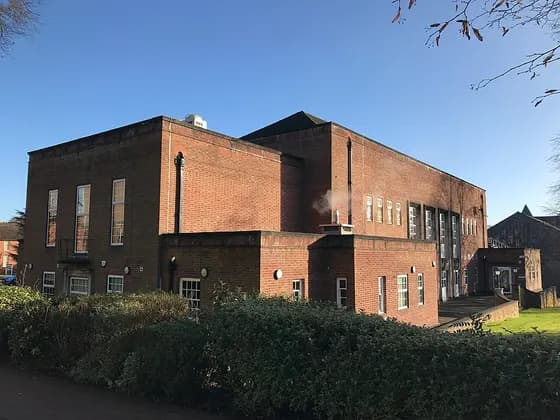
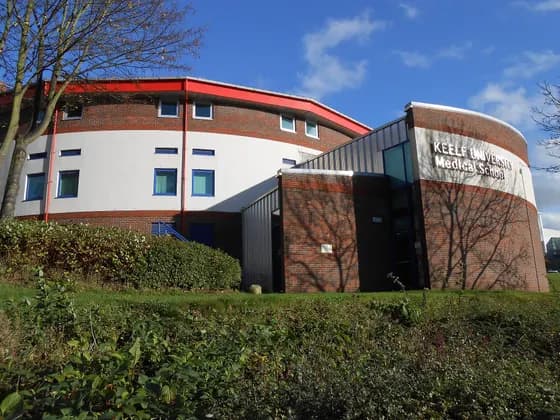
Photo: Jonathan Hutchins / Geograph Britain and Ireland · CC BY-SA 2.0 · cropped
Photo: Jonathan Hutchins · CC BY-SA 2.0 · Photo: Rept0n1x · CC BY-SA 2.0 · Photo: Tanya Dedyukhina · CC BY 3.0
The Keele medicine course at a glance (2027 entry)
Keele's Medicine MBChB is a five-year, full-time degree run by Keele University School of Medicine. MBChB stands for Bachelor of Medicine and Bachelor of Surgery. About 170 students start each year, and there were 171 places for 2026 entry. For your first two years you are based mainly in the David Weatherall building on Keele's rural campus in Staffordshire. The campus sits just off the M6, roughly midway between Birmingham and Manchester.
The course uses what Keele calls a spiral curriculum. You meet the core topics more than once, going deeper each time and linking them more closely to real patients. Science, communication, clinical skills and professionalism are taught together in integrated units rather than as separate subjects. Each year counts as a single compulsory 120-credit module, so there are no optional modules to choose.
Much of the learning is led by you. In Years 1 and 2 you work through written clinical cases in small tutorial groups, and from Year 3 the cases increasingly come from patients you have met on placement. You also learn at points alongside students of nursing, midwifery, paramedic science, physiotherapy and radiography.
Patients appear early. Clinical placements start in Year 1, in general practice, hospital and community settings. Year 3 is spent mostly at Royal Stoke University Hospital in Stoke-on-Trent. Under current arrangements you should expect to spend one of Years 4 and 5 based in Shropshire and the other in Staffordshire. More than a fifth of your teaching in Years 3 to 5 takes place in general practice.
The timing of the final exams shapes the course. You sit the written half of the Medical Licensing Assessment (MLA), which the General Medical Council (GMC) requires of every UK medical graduate, at the end of Year 4. Year 5 then has no written university exams. It is built around assistantships, where you work as a junior member of the clinical team, including some evening, night and weekend shifts.
| Degree | MBChB (Honours), UCAS code A100 |
|---|---|
| Course length | 5 years full time; 6 with the Health Foundation Year (A104) |
| Cohort size | About 170 a year; 171 places for 2026 entry |
| Base in Years 1 and 2 | David Weatherall building, Keele campus, Staffordshire |
| Teaching style | Spiral curriculum; small-group case work, then case-based learning on placement |
| Anatomy | Dissecting room teaching, plus prosections, models and bones |
| First patient contact | Clinical placements in general practice and hospital from Year 1 |
| Clinical bases | Royal Stoke in Year 3; Staffordshire and Shropshire for Years 4 and 5 |
| Licensing exams | Knowledge test at end of Year 4; final skills exam in Year 5 |
| Elective | Eight weeks in Year 5, which you arrange; UK or overseas |
| Intercalation | Optional: bachelor's after Year 2, bachelor's or master's after Year 4 |
What makes Keele medicine different
A year in Staffordshire and a year in Shropshire
Under current arrangements you should expect one of your last two years to be based in Shropshire and the other in Staffordshire. Between them you see care in a very large teaching hospital, Royal Stoke, and in district general hospitals in Shrewsbury and Telford. These are local hospitals that serve a town and the area around it.
Final written exam at the end of Year 4
You sit the Applied Knowledge Test (AKT), the written part of the MLA, at the end of Year 4, and must pass it to enter Year 5. Year 5 has no written university exams. You spend most of it on assistantships, working as part of the clinical team, before your final skills exam and an elective you organise yourself (see Year 5).
Anatomy in the dissecting room
Anatomy is taught in the School's dissecting room (see Anatomy). You also study prosections, body parts already dissected by experts to show key structures. Keele's module specifications set aside about 120 hours of anatomy teaching across Years 1 to 3.
General practice and community work from Year 1
General practice placements start in Year 1, with a GP tutor who helps you build your consultation skills, the skills of running an appointment with a patient. Year 2 adds the Community Partnership Placement: 21 hours with a local organisation that provides health or social care. In Years 3 to 5, more than a fifth of your teaching happens in general practice.
One consultation framework from first OSCE to finals
Keele marks clinical skills against its Generic Consultation Skills (GeCOS) framework, which has 11 domains, such as building the relationship with the patient. The GMC's 2024 review found these domains are used in teaching, placement assessments and every Objective Structured Clinical Examination (OSCE), a practical exam where you rotate through timed clinical tasks. It also found that examiners record personal audio feedback on your final OSCE.
How Keele teaches medicine
Three themes run through all five years: professional values and behaviours, professional skills, and professional knowledge. They come from Outcomes for Graduates, the GMC's list of what every new UK doctor must be able to do. Each theme is taught and assessed in every year, at a higher level each time round the spiral.
In Years 1 and 2 the core of each week is small-group, self-directed learning, which the School also calls problem-based learning (PBL). Your tutorial group is given a written clinical case or scenario. You work out what you need to learn, study it on your own, then share and discuss it as a group. Lectures, seminars, lab practicals, anatomy and clinical skills sessions supply the rest of what you need.
From Year 3 this grows into case-based and case-illustrated learning, where written scenarios are mixed with discussion of patients you have met on placement. Most of your learning now happens as part of a clinical team, which Keele treats as a core requirement of the course.
In skills sessions you sometimes role-play and practise examinations on each other, which can mean changing into shorts and a t-shirt. Staff supervise these sessions and follow a set protocol.
The ways you will learn
| Small-group case learning (PBL) | A tutorial group meets to work through a written clinical case. Each of you researches what the case raises, then the group pools and discusses what it has found. This is the backbone of Years 1 and 2. |
|---|---|
| Case-based and case-illustrated learning (CBL) | From Year 3, a weekly group session combines written scenarios with patients you and your group have seen on placement, so the discussion is tied to real people and real decisions. |
| Lectures and seminars | Lectures to the whole year group and smaller seminars cover core science and clinical knowledge. They take up less of your week as you move into the clinical years. |
| Clinical skills sessions | You practise examinations, communication and practical procedures using manikins, simulation and each other. A clinical skills session is part of the weekly timetable in each of Years 1 to 4. |
| Laboratory practicals | In the multi-user labs on campus you do histology, physiology, pharmacology, biochemistry and microbiology practicals. You use microscopes, record ECGs (heart traces) and computerised spirometry (breathing tests), work out drug dilutions and practise basic life support on manikins. |
| Clinical placements | You spend time in general practices, hospitals and community settings from Year 1. Placements grow from 3% of your study hours in Year 1 to more than 70% in Years 4 and 5, when you learn mainly by working with the clinical team. |
A typical week on the Keele course
Keele publishes an indicative weekly timetable for each year in its programme specification. A Year 1 week starts with small-group case sessions all day Monday. Tuesday has lectures and seminars, then an early clinical placement in the afternoon. Wednesday morning is clinical skills and lab practicals, and Wednesday afternoon is kept free for sport.
Thursday brings lectures and experiential learning sessions, where you learn by doing, followed by anatomy in the afternoon. Friday has lab practicals and seminars and ends with a wrap-up of the week. Year 2 keeps the same ingredients in a different order, with anatomy on Tuesday morning, two clinical skills sessions and a placement on Thursday afternoon.
From Year 3 the balance flips. Alongside placement, a Year 3 week has one case-based learning session, one clinical skills session and a block of lectures and seminars. There is also a session of anatomy and pathology, the study of how disease changes the body. In Year 4, placements fill six of the ten half-days. In a Year 5 general practice week, every day is placement, with one day including group learning and a group project linked to your GP placement.
The academic year also gets longer. Years 1 and 2 run from September to June, and Year 3 from September to July. Years 4 and 5 start in August. Year 4 ends in late June or early July, and Year 5 in June, with graduation normally in July.
The hours grow too. Keele's 2026/27 module specifications give 1,200 hours of study for each of Years 1 and 2. The clinical years are longer: 1,443 hours in Years 3 and 4 and 1,854 in Year 5, when you are on placement and studying full time, about 37 hours a week. The programme specification splits each year's study time roughly as below.
- Year 1: 32.2% scheduled teaching, 64.8% independent study, 3% placement
- Year 2: 28.9% scheduled teaching, 64.8% independent study, 6.3% placement
- Year 3: 19.2% scheduled teaching, 24.8% independent study, 56% placement
- Year 4: 19.8% scheduled teaching, 9.2% independent study, 70.9% placement
- Year 5: 8.6% scheduled teaching, 17.8% independent study, 73.7% placement
How anatomy is taught at Keele
Anatomy is taught in the anatomy suite of the David Weatherall building, and the programme specification says anatomy teaching is based in the dissecting room. Keele's course page lists dissection among the practical activities on the course. The dissecting room is a large lab where several student groups can examine anatomical material at the same time.
Timetabled anatomy teaching runs through the first three years. The 2026/27 module specifications set aside about 60 hours of anatomy in Year 1, 40 in Year 2 and 20 in Year 3. In Years 1 and 2 anatomy has its own slots in the weekly timetable, and in Year 3 it is taught together with pathology.
The room has display areas for prepared specimens, models and posters, several screens and an overhead HD camera, so a demonstration can be shown to the whole room. The premises are licensed under the Human Tissue Act 2004 and regulated by the Human Tissue Authority. The teaching depends on people who chose to donate their bodies after death so that doctors can learn.
The anatomy suite also has a resource room for self-study. It holds prosections, models, bones, microscopes with histology (tissue) slides, pathology pots and computer-aided learning material. You also get online access to an anatomy learning package called Acland's Anatomy.
When you first meet patients at Keele
You start clinical placements in Year 1, and you are taught the skills to make the most of each type of placement before it begins. In Years 1 and 2 they are half-day placements in general practice, in hospitals and with third-sector organisations, meaning charities and voluntary groups. The indicative Year 1 timetable has one early clinical placement each week.
Both years include a longitudinal GP placement, which runs through the year rather than in one block. There a GP tutor gives you personal support as you build your consultation skills.
Early placements are not only in medical settings. Keele uses community services such as schools, pharmacies, workplaces, residential homes, gyms and drop-in centres to show you where people's health and care are shaped. This links to a thread that runs from Year 1: thinking about the community and social side of illness, not only the biology.
Year 2 adds regular clinical skills sessions at Royal Stoke University Hospital. From Year 3, placements become most of your week: 56% of your study hours in Year 3, rising to more than 70% in Years 4 and 5.
Year by year at Keele
- Year 1
Foundations of health and disease
Year 1 is the first half of Phase 1 and is based mainly on Keele campus. It introduces the biomedical, behavioural and social sciences behind health and illness, along with study skills, communication, basic clinical skills and professionalism. Teaching is organised into integrated units, with early clinical placements running alongside them.
- Integrated units including Health and Disease, Immunology and Infection, Emergencies, Life Course, Brain and Mind, Pregnancy, and Lifestyle
- A Scholarship unit, which looks at how medical knowledge is built through research
- The Academic Mini Review, your first student-selected component (SSC), a piece of work where you choose the topic. With a staff supervisor you review the published research on a medical topic in 1,300 to 1,500 words, then give a five-minute presentation on it
- Longitudinal placements in general practice and hospital, plus time with community services
- Hours in the 2026/27 module specification include 66 of PBL, 60 of anatomy, 50 of lab sessions, 25 of skills sessions and 36 of placements. Independent study takes 777 of the 1,200 hours
- Three knowledge tests, in January, March or April, and May, which make up 90% of the year's mark. Together with your coursework, they decide whether you move into Year 2 (see Assessment)
- Year 2
How disease works
Year 2 goes back over the science of Year 1 with more focus on complexity and pathology. You are still based mainly at Keele, but clinical skills teaching now takes place regularly at Royal Stoke University Hospital. This is also the first year with OSCEs that count towards whether you progress.
- Integrated units including Mechanism of Disease, Inputs and Outputs, Movement and Trauma, Circulation, Breath of Life and Sensory Motor Systems, plus a second Scholarship unit
- Longitudinal general practice and hospital placements, again with personal support from a GP tutor
- The Community Partnership Placement: 21 hours with a local health or social-care organisation. You write a 500-word placement summary and two 500-word reflections, log your hours, and give a five-minute talk on a poster about the organisation's services
- Ranking your options for a student-selected component, with places allocated using your ranking
- A sign-off in taking blood (venepuncture) in simulation, and two meetings with your Professional Development Tutor, your personal tutor, including an appraisal you must attend to progress
- Hours in the module specification include 66 of PBL, 40 of anatomy, 37 of lab sessions, 48 of skills sessions and 76 of placements, out of 1,200
- Knowledge tests in November, January and May or June, and OSCEs in January and June (see Assessment), with a resit in the reassessment period if you fall short
- After Year 2 you can apply to take a year out for an intercalated bachelor's degree
- Year 3
Into the hospital
Year 3 opens Phase 2, which immerses you in clinical placements while you revisit the science in more depth. Your hospital base this year is University Hospitals of North Midlands NHS Trust (UHNM), and most of your time is at Royal Stoke University Hospital. You return to Keele campus one day a week.
- Placement-based units in medicine, surgery, elderly care, mental health, paediatrics and general practice
- A four-week general practice placement and some placements in other local hospitals
- A weekly case-based learning session, plus clinical skills, anatomy and pathology, and lectures and seminars
- Hours in the module specification include 512 of placements, 296 of student-selected components, 58 of case-based learning, 39 of skills teaching and 20 of anatomy, out of 1,443
- The Longitudinal Patient assignment: you follow several patients through their care over a long period, then write a 2,000-word reflective report with a record of your contact with them
- A compulsory student-selected component, marked pass or fail, which you must pass before you can start Year 5
- Assessment is split equally between three written papers and a 14-station OSCE, plus a portfolio of workplace-based assessments of tasks you do on placement (see Assessment). Resits come in the reassessment period
- Year 4
Widening your clinical experience
Year 4 revisits many Year 3 topics and adds new specialties. It starts in August, and your base is either UHNM in Staffordshire or Shrewsbury and Telford Hospital NHS Trust (SaTH) in Shropshire. The year ends with the Applied Knowledge Test, your final written exam.
- Placement-based units in medicine, surgery, women's health, mental health, paediatrics, neurology and musculoskeletal medicine, and general practice
- About 100 hours of case-illustrated learning, where group discussion is built around patients you have seen, plus bedside teaching on the wards, lectures and seminars
- Placements and student-selected components take up about 1,076 of the year's 1,443 hours
- A 14-station OSCE spread over three days, and workplace-based assessments during the year (see Assessment)
- The AKT at the end of the year, which you must pass to enter Year 5
- After Year 4 you can apply to intercalate a bachelor's or master's degree
- Year 5
Preparing for practice
Year 5 is Phase 3, which prepares you to start work as a Foundation Year 1 (FY1) doctor, the first year of paid work after graduating. The 2026/27 module specification sets out the order. You spend 10 weeks on a general practice assistantship and 20 weeks on hospital assistantships, working as a junior member of the team. Then come an assessment week for your final OSCE, your elective and a week of elective presentations.
- Assistantships in general practice, acute and critical care (including emergency medicine, intensive care and anaesthesia), medicine and surgery
- Placements based across North Staffordshire, Mid and South Staffordshire, and Shropshire and Mid-Wales
- Some evening, night and weekend full shifts on your hospital placements
- An eight-week elective you organise yourself, in the UK or overseas (see Electives)
- The Clinical and Professional Skills Assessment (CPSA), your final OSCE, and the national Prescribing Safety Assessment
- A portfolio of evidence that you can care for patients safely (see Assessment)
- Help with applying for the UK Foundation Programme, and a Preparation for Professional Practice week
How you are assessed at Keele
Keele assesses all three course themes in every year. Some assessments are formative, meaning they are for practice and feedback only. Others are summative, meaning they decide whether you progress. Written exams use single best answer (SBA) questions, where you pick the best of several options, and short-answer questions, where you write a brief answer.
Practical skills are tested through OSCEs and workplace-based assessments (WBAs), which assess real tasks you carry out on placement. From Year 2 you are typically assessed on practical skills two or three times a year. Coursework includes written reviews, case reports, presentations and posters, and tasks that test how you appraise research data and reflect on your practice.
You also keep a learning portfolio with reflective summaries and appraisals, and your professional behaviour is assessed through the Team Assessment of Behaviour (TAB). In Years 1 and 2 your Academic Mentor goes through your assessment feedback with you at regular meetings. Full attendance is required throughout the course.
The Applied Knowledge Test is your final written exam, taken at the end of Year 4. It is set nationally through the Medical Schools Council. Keele's Year 4 module specification describes two two-hour papers of 100 SBA questions each, worth half of the Year 4 mark. In the format the GMC approved in 2024, they are computer-based and sat on consecutive days. Since the 2024-25 academic year, every UK medical degree must include a pass in both parts of the MLA.
The Clinical and Professional Skills Assessment (CPSA) is your final OSCE, sat in an assessment week after the Year 5 assistantships. In the design the GMC approved in April 2024, it has 14 stations of nine and a half minutes, seven a day over two days. It is held in the clinical education centres of Keele's two main teaching hospitals, with one day at each. You must pass at least 11 of the 14 stations and also score above an overall pass mark.
Stations use real patients, actors and high-fidelity manikins, which are computer-controlled patient dummies that breathe and react to treatment. One is a teaching station where you help a junior colleague. In the same design, you first sit a practice OSCE of the same length and difficulty, with marks and audio feedback.
- Year 1: three knowledge tests, in January, March or April, and May, using SBA and short-answer questions, make up 90% of the year's mark. The Academic Mini Review counts for 9% and its five-minute presentation for 1%.
- Year 2: knowledge tests in November, January and May or June carry 65% of the mark. They have 275 marks of SBA questions and 75 of short answers, sat on computers under exam conditions. OSCEs carry 25%, and the Community Partnership Placement portfolio and poster 10%.
- Year 2 OSCEs have 4 stations in January and 8 in June. To pass you need at least 8 of the 12 stations, and your total score must beat the combined station pass marks plus a small margin for measurement error. Keele says this is the same double rule the CPSA uses.
- Year 3: three written papers of two and a half hours, each with 125 SBA questions, make up half the mark. The other half is a 14-station OSCE, where you need to pass at least 10 stations and clear the same total-score rule.
- Year 4: a 14-station OSCE over three days makes up half the mark, and you need to pass at least 11 stations and clear the total-score rule. The AKT makes up the other half.
- Years 3 and 4 also have a portfolio of workplace-based assessments, sign-offs for each placement block and for skills, and an appraisal. It carries no marks, but you must complete it.
- Year 5: the CPSA carries the whole mark. You also need a complete portfolio. It includes the Practical Procedural Skills assessment, supervised learning events, which are workplace-based assessments, and multi-source feedback, where peers and supervisors comment on your work.
- Year 5 also includes the national Prescribing Safety Assessment (PSA), a test of safe prescribing. Keele says passing it is not currently a condition of graduating, but you must pass it during FY1 to move on to FY2, the second foundation year.
- Years 1 and 2: each assessment has a pass mark, but your weighted marks also count towards a distinction in your final degree. Keele says they may also be used for ranking in later decisions about foundation placements.
- Resits: if you fail a component, you resit it in the university reassessment period. Any attempts you still need after that come through repeating the year.
Where you will actually be at Keele
Keele's placements are mainly in Staffordshire and Shropshire, with a few in neighbouring counties. The sites range from Royal Stoke University Hospital, a very large teaching hospital and tertiary referral centre, to busy district general hospitals, specialist psychiatric hospitals, small community hospitals and general practices. A tertiary referral centre takes patients sent on from other hospitals for specialist care.
In Years 3, 4 and 5 you are given a hospital base for each year, and Year 3 is at UHNM. In Years 4 and 5 your base is either UHNM or SaTH. Under current arrangements you should expect to spend one of those two years based in Shropshire and the other in Staffordshire. Keele's course pages say all students do this, while the programme specification says most do. Even within a base, you move between hospitals to see services that are delivered in different places.
Placements are first allocated at random. After that, the School tries not to send you to the same placement twice and takes account of how far you have already travelled. You cannot choose your own placements. In Years 3 to 5 you can ask for a particular area for your general practice placement to help with travel or accommodation, and you can propose a swap with another student.
The School can take account of special circumstances, such as caring for a child or a disabled relative, or a medical condition that needs follow-up in a particular place. You need to provide evidence every year. Most placements can be reached by public transport, and students who say they have a car may be sent to the harder-to-reach sites.
Travel is a real part of this course. Among 2025 graduates, placement travel across Years 3 to 5 averaged about 4,189 miles, and the highest total was 7,781 miles. Keele measures these figures from each student's base hospital. They leave out student-selected component placements and travel between UHNM's own hospitals, such as from Royal Stoke to County Hospital in Stafford.
You mostly pay for placement travel yourself. Keele cannot promise help, but when outside bodies agree travel funding, usually year by year, the School shares it out at the end of the year. This funding does not currently go to students in Years 1 and 2. Students receiving an NHS bursary may be able to claim back extra travel and, where needed, extra accommodation costs. Student accommodation is available at the Royal Shrewsbury Hospital site.
Royal Stoke, three miles from campus, is your Year 3 base. Its specialist services include cardiothoracic surgery, neurosurgery, cancer care and neonatal and paediatric intensive care. Harplands is the centre of mental health services in North Staffordshire, and the Haywood provides rheumatology and specialist rehabilitation.
- Royal Stoke University Hospital (University Hospitals of North Midlands NHS Trust)
- Harplands Hospital, Stoke-on-Trent (North Staffordshire Combined Healthcare NHS Trust)
- Bradwell Community Hospital, Stoke-on-Trent (Midlands Partnership University NHS Foundation Trust)
- Haywood Hospital, Burslem (Midlands Partnership University NHS Foundation Trust)
County Hospital is a district general hospital with teaching rooms and library facilities. St George's is a specialist psychiatric hospital with dedicated space for Keele medical students.
- County Hospital, Stafford (University Hospitals of North Midlands NHS Trust)
- St George's Hospital, Stafford (Midlands Partnership University NHS Foundation Trust)
Royal Shrewsbury serves a large rural area reaching into Powys and currently handles acute surgery and trauma. Princess Royal mainly serves Telford and east Shropshire. The trust plans to make Royal Shrewsbury its emergency hospital, and Princess Royal its planned-care hospital for booked operations and treatment, from 2028.
- Royal Shrewsbury Hospital (Shrewsbury and Telford Hospital NHS Trust)
- Princess Royal Hospital, Telford (Shrewsbury and Telford Hospital NHS Trust)
- The Redwoods Centre, Shrewsbury (Midlands Partnership University NHS Foundation Trust)
General practice placements run through the whole course, alongside community and voluntary sector placements.
A small number of students have some placements in Herefordshire, Cheshire, Worcestershire or Powys.
Electives and chosen modules at Keele
Student-selected components (SSCs) are parts of the course where you choose the topic. They let you study an area of medical science, clinical medicine or public health in more depth and see how medical knowledge is built through research. You choose a component in several years of the course, and each one has its own objectives and assessment.
In Year 1 your component is the Academic Mini Review (see Year 1). In Years 2 and 3 you rank the SSC options on offer and are allocated using your ranking. The Year 3 SSC is compulsory and marked pass or fail. It does not count towards your marks or ranking, but you must pass it, in Year 3 or if needed in Year 4, before you can start Year 5.
Near the end of Year 5 you take an eight-week elective, a placement you organise yourself, in the UK or overseas. It comes after the 30 weeks of assistantships and the CPSA assessment week. Your Year 5 portfolio includes your elective plan, a risk assessment and a poster about your elective project. You then present the project to other students in Student Elective Presentation Week.
Keele's programme specification says the course has no Study Abroad options because of GMC accreditation rules. At Keele, Study Abroad means spending a semester or a year at a partner university overseas. The rule does not stop you taking your elective abroad.
Intercalation at Keele
Intercalating means taking a year out of medicine to study one subject in depth and earn an extra degree, then returning to the course. At Keele it is optional. You can take a bachelor's degree after Year 2, or a bachelor's or master's degree after Year 4. The break from the MBChB lasts 12 months.
You need permission from the School of Medicine and an offer of a place on the course you choose, at Keele or at another university. Permission comes after a short interview with an intercalation panel, which looks at your academic record and your motivation. You send an expression of interest by 31 October of the year before, and you lose permission if you do not pass that year's end-of-year exams at the first attempt. For a course elsewhere, you apply to that university yourself.
Keele's own bachelor's options are a BSc in Medical Humanities, which looks at medicine through literature, film and history, and a BSc in Natural Sciences. The Natural Sciences degree has named routes in Neuroscience, Biochemistry and Studies in Biomedical Sciences.
Its taught master's options are MScs in Clinical Education, Biomedical Engineering, and Cell and Tissue Engineering, and MAs in Medical Ethics and Law, and in Medical Ethics and Palliative Care. Three MSc Biomedical Science pathways are offered too: Blood Science, Medical Microbiology and an online route. For research, there is a Clinical or Laboratory MPhil.
Keele points to research skills, the chance to publish papers and present at conferences, and a possible boost to your Foundation Programme application as the main benefits. The main drawbacks are time and money: it adds a year to your training. Students who intercalate at Keele are preferred for any funding support the School can arrange.
Facilities and support at Keele
Where you will learn
On campus, the David Weatherall building has a large lecture theatre, seminar rooms, the anatomy suite, three multi-user laboratories and an IT lab with more than 50 networked PCs and extended opening hours. In the labs you also practise sterile technique, drug delivery, and examining the eye and ear with an ophthalmoscope and otoscope. The main campus library is open 24 hours a day during semesters.
At Royal Stoke there are two teaching buildings: the School's hospital campus building and the Clinical Education Centre. The Centre's clinical skills labs include resuscitation and paediatric areas, intermediate and advanced skills labs and SimMan, a computer-controlled patient manikin. It also houses the Health Library, open seven days a week, which you use in Years 3 to 5. Doctors in postgraduate training share the building.
Other sites have their own space. Royal Shrewsbury Hospital has seminar rooms, a clinical skills lab, a student common room and a health library. Harplands Hospital has a student common room with computers, seminar rooms and a small skills lab.
The Keele Anatomy and Surgical Training Centre, opened in 2013 as an extension to the anatomy suite, has two wet labs with nine surgical workstations. It is used mainly for surgical training and postgraduate courses, but can be used alongside the undergraduate dissecting room.
Support while you study
Each student has a Professional Development Tutor (PDT), who acts as your personal tutor across the course and appraises your professional development. In the early years you also have an Academic Mentor for academic and personal support. On placement, clinical tutors support you, and a year lead handles academic issues for each year.
Students in later years act as peer mentors for those in earlier years. A team of pastoral tutors sees any student confidentially and runs workshops on study skills and managing your health. There is particular support for disabled students and those with long-term health conditions.
Student representatives from all five years sit on the Student Staff Voice Committee, and the Medical Student Council gives students a say in how the curriculum develops. Through the course you build a portfolio to support later job applications.
Is the Keele course right for you?
This course may suit you if
- You like working through cases in a small group and teaching yourself, since about two thirds of your hours in Years 1 and 2 are independent study.
- You want anatomy taught in a dissecting room, with prosections and specimens to study, rather than mainly on screens.
- You are interested in general practice and community health, which feature from Year 1 and take up over a fifth of teaching in Years 3 to 5.
- You would like to see both a very large teaching hospital and smaller district general hospitals serving rural areas before you qualify.
- You would rather finish the national written exam in Year 4 and spend your final year mostly working with clinical teams.
Things to think about
- You should expect one of your last two years to be based in Shropshire, so you may need to move or commute for that year.
- Placement travel averaged about 4,189 miles over Years 3 to 5 for 2025 graduates, and you mostly pay for it yourself.
- You cannot choose your placements; allocation starts at random, with only limited requests and swaps.
- Years 4 and 5 start in August, and Year 5 includes some evening, night and weekend shifts.
- You cannot spend a semester or year at a partner university abroad, although your Year 5 elective can be overseas.
Keele medicine course — frequently asked questions
Applying to Keele?
How to get into Keele
Entry requirements, UCAT, personal statement and interview, step by step.
Open the guide →Keele UCAT cut-offs and offers
UCAT cut-offs, A-level offers, interview format and decision dates.
See the requirements →Compare Keele with other schools
Put the teaching style, anatomy teaching and placements next to another school.
Open the comparison →Prepare for the Keele interview
Format breakdown, school-specific sample questions and prep tips from tutors who interviewed here.
Read the guide →Where this Keele course guide came from
This guide was written from 22 official sources — Keele University's own course pages and programme documents, plus the regulator and NHS placement partners where they publish detail — read on 2026-09-23, then checked claim by claim against those sources.
- Medicine MBChB course page, Keele University
- Medicine MBChB, Keele University School of Medicine
- Medicine: how to apply and admissions FAQs, Keele University
- Programme Specification 2026/27: Medicine MBChB Single Honours
- Keele module catalogue 2026/27: Medicine MBChB
- School of Medicine facilities, Keele University
- Anatomy facilities, Keele University School of Medicine
- Keele Anatomy and Surgical Training Centre
- Intercalated degrees, Keele University School of Medicine
- Medicine Health Foundation Year (A104), Keele University
- GMC: MLA Clinical and Professional Skills Assessment compliance decision, Keele University School of Medicine (April 2024)
- GMC: MLA Applied Knowledge Test compliance decision, Keele University School of Medicine (June 2024)
- Keele module specification 2026/27: MED-10008 UG Medicine Year 1
- Keele module specification 2026/27: MED-20001 UG Medicine Year 2
- Keele module specification 2026/27: MED-30001 Medicine Year 3
- Keele module specification 2026/27: MED-30002 Medicine Year 4
- Keele module specification 2026/27: MED-30003 Medicine Year 5
- Intercalated bachelor's courses, Keele University School of Medicine
- Intercalated master's courses, Keele University School of Medicine
- Intercalated degrees: how and when do I apply, Keele University School of Medicine
- Global Opportunities (study abroad), Keele University
- Hospitals Transformation Programme, The Shrewsbury and Telford Hospital NHS Trust
Courses are restructured between cycles. Anything here that decides your application — an anatomy offer, a placement city, a compulsory intercalated year — should be confirmed against the official page for your entry year.
Applying to Keele?
We have helped hundreds of applicants turn their UCAT, personal statement and interview prep into offers from Keele and other UK medicine schools.