
The Oxford Medicine course
What you actually study, and where you will be
Oxford's BA / BM BCh is a 6-year (3 pre-clinical + 3 clinical) course taught through a traditional, lecture-led structure, with patient contact from Year 1 and placements in Oxford and district general hospitals in Reading, Swindon, Northampton, Buckinghamshire, Milton Keynes and Slough (2027 entry). Oxford runs a traditional course. The first three years are science, taught through lectures, labs and college tutorials, with a small number of GP visits in years 1 and 2, and every student takes a BA in Medical Sciences along the way. Years 4 to 6 are clinical, mainly in Oxford's hospitals and GP practices, with blocks at district general hospitals across the region.
- Degree
- BA / BM BCh
- Length
- 6 years (3 pre-clinical + 3 clinical)
- Teaching
- Traditional / lecture-led
- Clinical contact
- Year 1
- UCAS code
- A100

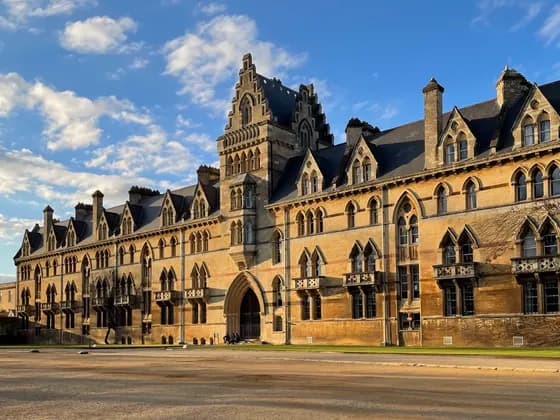

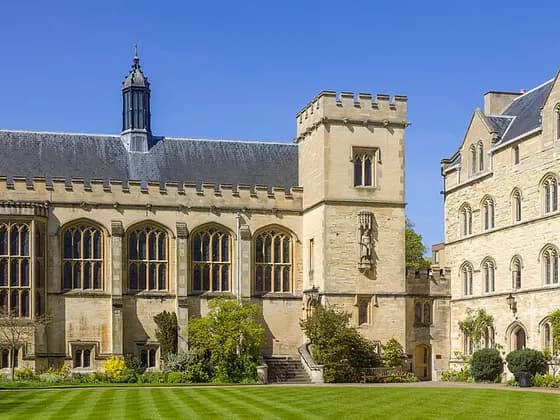
Photo: Julian Herzog · CC BY 4.0 · cropped
Photo: JM Lystad · CC BY-SA 4.0 · Photo: Michael D Beckwith · CC0 · Photo: Godot13 · CC BY-SA 4.0
The Oxford medicine course at a glance (2027 entry)
Oxford's standard medicine course, UCAS code A100, lasts six years in two stages. Years 1 to 3 are pre-clinical: you study the science medicine rests on and earn a BA in Medical Sciences. Years 4 to 6 are clinical, spent with patients in hospitals and GP surgeries, and lead to the BM BCh, Oxford's Bachelor of Medicine and Bachelor of Surgery. About 155 students start each year.
The pre-clinical years are science-heavy. The first five terms are the First BM, named after the first set of exams towards the medical degree. Four terms on the Final Honour School follow, where you specialise and run your own research project.
Patients appear early but in small doses: a few visits a year to GP tutors. Full-time clinical training starts in year 4, mostly in the Oxford hospitals and local general practices. You also spend blocks at district general hospitals, busy local hospitals rather than specialist centres, in towns such as Reading, Swindon and Milton Keynes.
You belong to an Oxford college for all six years, and graduate-entry students join your year for the final two. The BM BCh is a primary medical qualification. It lets you apply for provisional registration with the General Medical Council (GMC), the regulator that licenses UK doctors, and start a Foundation Year 1 post. That is the first paid training year after medical school. The GMC's Medical Licensing Assessment (MLA) is built into years 5 and 6.
| Degrees awarded | BA in Medical Sciences after year 3, then BM BCh |
|---|---|
| Course length | 6 years: 3 pre-clinical, 3 clinical |
| UCAS code | A100 |
| Yearly intake | About 155 (average for 2023 to 2025) |
| Pre-clinical base | Medical Sciences Teaching Centre, Science Area, Oxford |
| Small-group teaching | Weekly college tutorials, in groups that can be as small as two |
| Anatomy | Ready-dissected specimens (prosections), living anatomy and computer-based learning; no dissection |
| First patient contact | Year 1 GP visits on the Learning with Patients course |
| Clinical base | Oxford University Hospitals, plus district general hospitals in the region |
| Elective | 10 weeks in year 6, in the UK or abroad |
What makes Oxford medicine different
A science honours degree built into the course
Every A100 student spends four terms on the Final Honour School and gains a BA in Medical Sciences before clinical training starts. You study eight themes in depth and learn to judge research for yourself, without applying separately for a year out.
Your own research project
Every student runs an experimental research project on a topic they propose, in laboratories across the university's Medical Sciences Division, in primary care research groups, or beyond Oxford.
Weekly tutorials in groups as small as two
Through years 1 to 3 your college arranges a weekly tutorial, normally about an hour, with a tutor and one or two other students. You bring prepared work, discuss it in depth and get detailed feedback.
Your college stays part of clinical training
You belong to a college for all six years and can stay or move for years 4 to 6. Colleges add clinical teaching of their own, such as bedside tutorials and mock exams. Clinical students also share Osler House, a club on the John Radcliffe site.
How Oxford teaches medicine
In years 1 to 3 you learn through lectures, practical classes and college tutorials. Lectures take up to 200 students, while classes and seminars usually have between 10 and 50. Teaching comes from university academics, research staff and NHS clinicians, usually consultants, with some classes taken by doctoral students.
For each body system you learn structure and development alongside physiology and pharmacology, and you study scientific method, experimental technique and how to read data. In the Final Honour School you work mainly from original research papers and test your own ideas against published results.
From year 4 most teaching comes from clinicians at Oxford University Hospitals NHS Foundation Trust, local GPs and university staff. Weeks mix structured teaching, supervised work with patients and self-directed study. A core curriculum prepares everyone for Foundation training, and student-selected components, parts where you pick the topic, let you follow your interests.
Patients and carers, known as Patient Experience Partners, help teach, give students feedback and sit on school committees. The school is also building education for sustainable healthcare, meaning care that is good for patients without harming the environment, into every stage.
The ways you will learn
| Lectures and practical classes | Lectures introduce each topic and laboratory practicals run alongside them in years 1 and 2, including anatomy classes with prosections, specimens already dissected by staff. Attendance at some practicals counts towards passing each half of the First BM. |
|---|---|
| Clinical attachments and bedside teaching | From year 4 you join hospital and GP teams for blocks of several weeks, taught largely at the bedside, meaning at the patient's side on the ward, alongside clinics and theatre lists. Case-based sessions also run, where a group works through one patient together. |
| Communication skills with simulated patients | A clinician leads a small group working with a simulated patient, an actor trained to play a patient. You practise consultations, get feedback and meet harder scenarios as you go, with the core course in year 4. |
| Skills labs and simulation | Practice in a safe setting before you use a skill on a real patient, including the compulsory skills-lab week in year 5 and emergency simulation at the OxSTaR centre. |
A typical week on the Oxford course
During the First BM, lectures and practicals take up roughly half your time. The rest goes on tutorial preparation, private study and life outside the course. Oxford expects at least 40 hours a week of academic work in term, and pre-clinical terms are eight weeks long.
In the Final Honour School there are few lectures. Your weeks centre on your research project, reading papers and preparing for tutorials and seminars.
Clinical weeks depend on the block. On the year 5 community block, three days a week are spent in a GP surgery seeing patients under supervision and two in the university's primary care department.
How anatomy is taught at Oxford
Oxford does not teach anatomy by having students dissect a body. You learn from prosections: parts of donated bodies that staff and surgeons from nearby hospitals have already dissected, so the structures are laid out ready to study.
Two other methods sit alongside the specimens. In living anatomy classes you and your classmates act as the subjects, exploring how the body's structures work in a living person. Computer-assisted exercises let you work through anatomy on screen.
The specimens come from the anatomy department's body donation programme, regulated by the Human Tissue Authority. Classes run in the department's Demonstration Room, led by medical tutors, researchers, anatomy prosectors and clinicians, and also use imaging and microscope slides.
When you first meet patients at Oxford
Your first patients come in year 1 through the Learning with Patients course. GP tutors host you in their practices, where you talk with patients about their conditions and how illness affects their lives. There are currently five sessions in year 1 and four in year 2, on themes such as heart disease, diabetes and mental health.
In year 3, Learning with Patients 3 lets you follow the same patient or patients through the year, supervised by a GP tutor, with a seminar each term. It is optional at present but is due to become compulsory for all third-years from 2027.
Year 4 puts patients at the centre. It opens with introductory weeks covering basic life support, clinical skills, ethics and law, and communication. A two-week GP placement follows, where you practise with real patients and visit someone at home. By year 5 you run consultations yourself, still supervised.
Year by year at Oxford
- Year 1
First BM Part I: the healthy body
Your first three terms cover the major body systems in health, the molecular and cell biology behind them, and the basics of medical sociology. You must pass Part I of the First BM, the First Examination for the Degree of Bachelor of Medicine, to reach year 2.
- Four courses, each with its own exam: Organisation of the Body; Physiology and Pharmacology; Biochemistry and Medical Genetics; and Population Health 1: Medical Sociology.
- Learning with Patients 1, taught by GP tutors in their practices. Taking part satisfactorily is a formal requirement for passing Part I.
- Compulsory medical statistics you must pass: describing data, the Normal distribution, inference, comparing two groups, correlation and categorical data.
- Year 2
First BM Part II, then the start of the BA
Terms 4 and 5 finish the First BM, moving on to disease, the nervous system and psychology. In the third term you begin the Final Honour School (FHS), the four-term honours course that leads to your BA, and project work can start then too.
- Four courses: Applied Physiology and Pharmacology; The Nervous System; Principles of Pathology; and Psychology for Medicine.
- Part II exams: one per course plus a synoptic paper, which asks you to draw together ideas from across the whole course.
- Learning with Patients 2, and more statistics: study design, non-Normal data, linear regression and graphical methods.
- The FHS option list comes out in the second term, and you choose your research project during the year. Some stay on in Oxford after term to push it forward, at their own cost.
- Year 3
Final Honour School: the BA in Medical Sciences
This is an honours science year. You pick eight themes to study in depth from twelve advanced options, each covering three themes. The course page lists Systems Neuroscience, Cardiovascular Science, Pharmacology and Signalling, Molecular Pathology and Cancer. The medical school adds Metabolism and Endocrinology, Infection, Immunity and cellular or cognitive and behavioural neuroscience. Oxford says the published list is illustrative and can change.
- Your research project report is due by the end of the second term, followed by a short presentation to two markers who question you on it.
- A submitted essay on a topic within the FHS themes, handed in just before the third term begins.
- Learning with Patients 3, following one or more patients through the year with a GP tutor.
- A qualifying examination in the Principles of Clinical Anatomy for students moving on to the clinical stage, assessed during the course rather than by one paper.
- Year 4
First clinical year: core skills, medicine and surgery
The year is about the practical skills of being a doctor. After introductory weeks and a two-week GP placement you take Laboratory Medicine, then rotate through medicine, surgery and a block at a hospital outside Oxford. By the end you should be competent at taking a history, examining patients and doing basic procedures.
- The regulations list six components you must complete alongside the exams: Patient Centred Clinical Practice, clinical communication skills, medical ethics and law, primary health care, population health, and a special study. The first, known until recently as the Patient Doctor course, introduces clinical methods, history taking and examination.
- Laboratory Medicine: how pathology and investigation apply to human disease, covering histopathology, microbiology and infection, clinical biochemistry, immunology and haematology.
- Core rotations in medicine and surgery. On the surgery block you get a tutor for bedside teaching, a lecture course on the core topics and a chance to join the team when emergency patients arrive.
- A block at a Local Education Provider, meaning a partner hospital outside Oxford, plus three teaching sessions from a local GP. Most students also spend a block on medical specialties.
- Exams at the end of the third term: two multiple-choice papers and an Objective Structured Clinical Examination (OSCE), where you rotate round timed stations that each test a practical task.
- Year 5
Specialty rotations
You rotate through six eight-week blocks covering the major specialties, which is part of why the year runs so long. The gaps between lectures and clinics are for self-directed study, so time management matters. The year ends with the Integrated Summative Assessment, a multiple-choice paper and an OSCE covering all six blocks.
- Clinical Neurosciences, ENT and Ophthalmology: two weeks building knowledge and skills, then wards, clinics and community work, with Fridays kept for case-based sessions.
- Community Based Medicine: general practice, dermatology and palliative care, which is care focused on comfort for people with serious illness. It includes a seven-week GP placement and a thread on health inequalities.
- Orthopaedics, Rheumatology and Emergency Medicine: a compulsory skills-lab week, then clinics at the Nuffield Orthopaedic Centre and emergency shifts at the John Radcliffe. You also ride with ambulance paramedics.
- Paediatrics: history taking from parents and children, examining children, common and rarer childhood conditions, growth and development, and how family and society shape a child's health.
- Psychiatry: an introductory seminar series, then two three-week attachments. Settings can include general adult, old age, child and adolescent, forensic and perinatal care.
- Women's and Reproductive Health: gynaecology, sexual health and pregnancy, taught through a two-week lecture series and a five-week attachment, with expert patients helping to teach and assess.
- Year 6
Final year: consolidation and preparing for practice
The first six months bring senior attachments in medicine and surgery, in Oxford and at district general hospitals, plus options in clinical specialties. The last six months are for the student assistantship, special study modules and the ten-week elective.
- Senior attachments to medical firms, the consultant-led teams that look after hospital patients, plus further surgical teaching at partner hospitals outside Oxford.
- Final exams in medicine and surgery: a multiple-choice paper and an OSCE, with sittings in January and in March or May.
- About twelve weeks across the year for clinical options and special study modules you choose.
- A student assistantship, working closely with a clinical team to build the practical and teamwork skills of a new doctor. At the Oxford hospitals it runs in six three-week cohorts between February and June.
- Preparation for Practice, normally in June: lectures on ward work, on-call shifts, practical prescribing and career progression, many given by current Foundation Year 1 doctors.
How you are assessed at Oxford
Part I of the First BM has one exam for each of its four courses, and Part II has one per course plus the synoptic paper. Learning with Patients, practical work and statistics must also be certified as satisfactory. If you fail some units you normally get one further attempt at just those.
The Final Honour School is assessed by three written papers covering themes from at least two options, plus synoptic questions and the critical reading of published research. Your project, its oral presentation and your submitted essay are also assessed. You must pass both parts of the First BM, the FHS and the Principles of Clinical Anatomy examination to start clinical training.
In the clinical years you must pass written and clinical exams and be judged satisfactory on every rotation. Coursework includes posters, essays and logbooks. The GMC's 2024 report adds that you must perform every procedure on the national MLA list on real patients, observed and signed off in an electronic logbook.
The MLA has two parts. The Applied Knowledge Test (AKT) is a multiple-choice exam written nationally and delivered by each medical school. The Clinical and Professional Skills Assessment (CPSA) is a clinical exam each school runs to GMC standards. At Oxford the AKT is your year 6 written paper, and the year 5 and year 6 OSCEs together make up the CPSA.
You have 49 months to finish both MLA parts, counted from 1 June of the year you are due to sit the year 5 OSCE. Anyone who runs past that takes extra remedial assessment agreed with the Director of Clinical Studies. That matters most if you interrupt your studies or resit.
When the GMC approved Oxford's CPSA in April 2024, the final-year OSCE had 14 eight-minute stations and the year 5 OSCE had 12, each with two minutes of reading time. Real patients take part alongside trained actors. You must pass both exams, because a strong result in one cannot make up for the other.
Where you will actually be at Oxford
The pre-clinical years are based in Oxford. From year 4 most teaching happens in hospitals and general practices in and around the city. Oxford University Hospitals NHS Foundation Trust runs the John Radcliffe, the Churchill, the Nuffield Orthopaedic Centre and the Horton General Hospital in Banbury. In 2025-26 it hosted 541 clinical medical students.
Much clinical teaching happens at district general hospitals in the Oxford Teaching Network. For year 6 senior rotations the school names the Royal Berkshire in Reading, the Great Western in Swindon, Milton Keynes, Buckinghamshire Hospitals NHS Trust and Northampton General. The year 4 list adds Slough, and the graduate-entry list adds Abingdon.
Clinical years run far longer than Oxford's normal terms. They are roughly 38 to 40 weeks in year 4, 45 to 48 weeks in year 5 and 46 to 48 weeks in year 6, including the ten-week elective. Your clinical offer guarantees a college place but not accommodation, and some colleges reduce or waive rent while you are away on placement.
Emergency medicine is taught at the John Radcliffe and orthopaedics and rheumatology at the Nuffield Orthopaedic Centre. Psychiatry is based at the Warneford, with other year 5 psychiatry placements across Oxfordshire, Buckinghamshire and Swindon.
- John Radcliffe Hospital
- Churchill Hospital
- Nuffield Orthopaedic Centre
- Warneford Hospital
- General practices in Oxford
Used for the year 4 block and for year 6 senior medicine and surgery rotations.
- Royal Berkshire Hospital
Used for year 4, for year 6 senior rotations, and for some year 5 psychiatry placements.
- Great Western Hospital
Named for year 6 senior rotations and for graduate-entry placements.
- Milton Keynes University Hospital
Year 4 blocks and year 6 rotations, with primary care teaching at High Wycombe or Stoke Mandeville.
- Buckinghamshire Hospitals NHS Trust
Used for the year 4 block and year 6 senior rotations.
- Northampton General Hospital
Electives and chosen modules at Oxford
Alongside the core curriculum, the clinical course includes student-selected components. In year 4 this is the Special Study Theme: seminars and small-group teaching plus an independent project.
In year 6, about twelve weeks across the year go on options you choose: clinical options first, then special study modules. Subjects range from ethics and philosophy to mathematics, global health and evidence-based medicine. On the evidence-based medicine module you spend three weeks at the university's Centre for Evidence-Based Medicine reviewing published research with a supervisor.
The elective is a ten-week period in the final six months. You can study any topic relevant to medicine, in Oxford, elsewhere in the UK or abroad, as long as the Director of Clinical Studies approves it. Most students travel overseas. Anyone who fails a final assessment may lose part or all of it to extra clinical training.
Intercalation at Oxford
Intercalating means taking an extra degree during a medical course. At Oxford there is no separate year out, because an honours science degree is built in for every A100 student. The four-term Final Honour School leads to your BA before clinical training begins.
If you want a further qualification, the regulations let you apply for time out for a postgraduate degree, either between the two stages or during the clinical years. The whole course should still finish within ten years.
Facilities and support at Oxford
Where you will learn
Medical Sciences Teaching Centre: the building in the University Science Area where most pre-clinical lectures, classes and tutorials take place.
OxSTaR (Oxford Simulation, Teaching and Research): a simulation centre at the John Radcliffe, part of the Nuffield Department of Clinical Neurosciences. It has adult and paediatric patient simulators, lifelike computer-controlled manikins, and runs emergency training for groups that include final-year students.
Osler House: the club for all Oxford clinical students, on the John Radcliffe site. It is both a building and a common room, run by a 22-strong student committee, with gardens, a gym, a kitchen and a bar.
Education centres: the hospital trust runs one at each main site. They are the George Pickering Centre at the John Radcliffe, the Robb-Smith Centre at the Churchill and the Terence Mortimer Centre at the Horton. Each has a medical education manager and administrative staff. The trust also runs practice OSCEs for final-year students and, since 2025, for year 4.
Support while you study
In years 1 to 3 your college tutors see you every week, so problems get picked up early. College tutors stay part of your support for the whole course.
For years 4 to 6 the medical school gives you an Educational Supervisor. They do not teach you, but review your learning portfolio, act as a mentor and meet you at least once a term. Pastoral support is coordinated by an Associate Director of Clinical Studies.
Osler House runs a Peer Support Network of clinical students trained to give confidential, informal help. At the Oxford hospitals a Director of Undergraduate Medical Education oversees academic progress and wellbeing, and every student gets an induction before their first clinical placement.
For years 4 to 6 you can apply to any of the 28 colleges that take undergraduates, or to a graduate college. Some colleges do not actively take clinical students and offer them fewer facilities, so check each college's entry on the medical school's college details page before naming your first and second choices. Green Templeton lists weekly case-based seminars and bedside teaching, Christ Church organises mock OSCEs, and St Hugh's lets you reclaim the cost of a stethoscope and a basic examination kit.
Is the Oxford course right for you?
This course may suit you if
- You want three years to understand the science of the body in depth, and a BA, before full-time clinical training.
- You enjoy preparing work and defending your reasoning in weekly tutorials with one or two other students.
- You are curious about research and would enjoy running your own project and working from original papers.
- You like a college community that continues into the clinical years, with its own teaching and a clinical students' club.
Things to think about
- Before year 4, patient contact is a handful of GP sessions in years 1 and 2 and following patients through year 3.
- There is no dissection: anatomy is taught with prosections, living anatomy and computer-based exercises.
- Clinical years run for 38 to 48 weeks, with blocks at hospitals away from Oxford.
- Some science teaching refers to experiments that used living animal tissue.
- Your clinical offer guarantees a college place but not accommodation, and it may not be at the college you chose.
Oxford medicine course — frequently asked questions
Applying to Oxford?
How to get into Oxford
Entry requirements, UCAT, personal statement and interview, step by step.
Open the guide →Oxford UCAT cut-offs and offers
UCAT cut-offs, A-level offers, interview format and decision dates.
See the requirements →Compare Oxford with other schools
Put the teaching style, anatomy teaching and placements next to another school.
Open the comparison →Prepare for the Oxford interview
Format breakdown, school-specific sample questions and prep tips from tutors who interviewed here.
Read the guide →Where this Oxford course guide came from
This guide was written from 42 official sources — University of Oxford's own course pages and programme documents, plus the regulator and NHS placement partners where they publish detail — read on 2026-09-21, then checked claim by claim against those sources.
- University of Oxford: Medicine (A100) undergraduate course page
- University of Oxford: Personalised learning (tutorial length and group size)
- University of Oxford: Medicine Course Information Sheet for 2026 entry
- Medical Sciences Division: Medicine course structure (pre-clinical)
- Medical Sciences Division: Medicine course structure description
- Medical Sciences Division: Does the Medical School offer dissection and/or prosection
- Medical Sciences Division: Am I guaranteed a place at the Oxford Clinical School
- Examination Regulations 2026/27: First BM Parts I and II
- Examination Regulations 2024/25: Honour School of Medical Sciences
- Examination Regulations 2026/27: Second BM
- Examination Regulations 2024/25: Principles of Clinical Anatomy qualifying examination
- Examination Regulations 2025/26: Regulations for Degrees in Medicine and Surgery
- Medical Sciences Division: Clinical Medicine overview
- Medical Sciences Division: Clinical Medicine course structure
- Medical Sciences Division: Clinical Medicine Year 4
- Medical Sciences Division: Clinical Medicine Year 5 specialty rotations
- Medical Sciences Division: Clinical Medicine Year 6
- Medical Sciences Division: Clinical Medicine assessment
- Medical Sciences Division: Clinical Medicine support
- Medical Sciences Division: Clinical Medicine colleges
- Medical Sciences Division: Clinical Medicine college details
- Medical Sciences Division: Do Oxford pre-clinical students get an automatic clinical place
- Medical Sciences Division: Eligibility for the Oxford clinical school
- Medical Sciences Division: Can I study for an intercalated degree at Oxford (clinical FAQ)
- Medical Sciences Division: Osler House Club
- Medical Sciences Division: Oxford hospitals
- Medical Sciences Division: Graduate Entry Medicine outline of the course
- Medical Sciences Division: Patient involvement in medical education
- Medical Sciences Division: Education for Sustainable Healthcare and Planetary Health
- Nuffield Department of Primary Care Health Sciences: contribution to the undergraduate curriculum
- Nuffield Department of Primary Care Health Sciences: Years 1 and 2
- Nuffield Department of Primary Care Health Sciences: Year 3 Final Honours School
- Nuffield Department of Primary Care Health Sciences: Year 4 teaching
- Nuffield Department of Primary Care Health Sciences: Year 5 community block
- Nuffield Department of Primary Care Health Sciences: Year 6 special study modules and electives
- Department of Physiology, Anatomy and Genetics: body donation programme
- OxSTaR: Oxford Simulation, Teaching and Research home page
- OxSTaR: about the simulation centre
- General Medical Council: MLA CPSA compliance decision and report, University of Oxford (April 2024)
- Oxford University Hospitals NHS Foundation Trust: Medical Education Annual Report (Trust Board, March 2026)
- Centre for Evidence-Based Medicine: Clinical Medicine special study module
- Milton Keynes University Hospital NHS Foundation Trust: about the trust
Courses are restructured between cycles. Anything here that decides your application — an anatomy offer, a placement city, a compulsory intercalated year — should be confirmed against the official page for your entry year.
Applying to Oxford?
We have helped hundreds of applicants turn their UCAT, personal statement and interview prep into offers from Oxford and other UK medicine schools.