
The UCL Medicine course
What you actually study, and where you will be
UCL's MBBS BSc is a 6-year (integrated BSc built in) course with an integrated curriculum (2027 entry). Six years, with an integrated BSc in year 3 that every student takes. The clinical years are built from 12-week placement blocks, and year 6 ends with an eight-week elective anywhere in the world.
- Degree
- MBBS BSc
- Length
- 6 years (integrated BSc built in)
- Teaching
- Integrated
- UCAS code
- A100

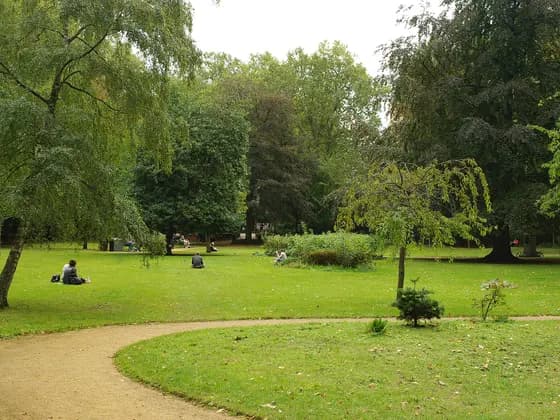
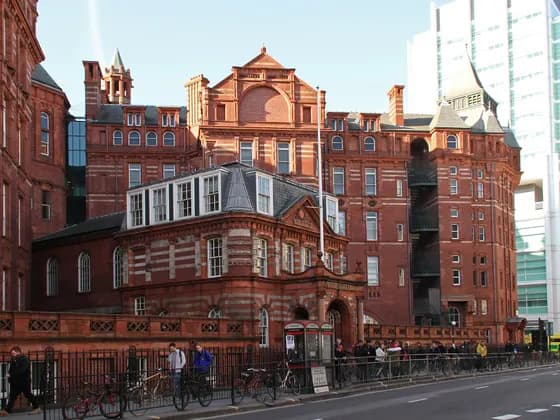

Photo: Diliff (David Iliff) · CC BY-SA 3.0 · cropped
Photo: Jim Osley · CC BY-SA 2.0 · Photo: Tony Hisgett from Birmingham, UK · CC BY 2.0 · Photo: Ham II · CC BY 3.0
The UCL medicine course at a glance (2027 entry)
Medicine at UCL is a six-year course leading to two degrees. The MBBS is the medical degree the General Medical Council (GMC) recognises for provisional registration as a doctor. The BSc comes from a compulsory year of in-depth study in the middle. UK graduates skip that year and finish in five.
Years 1 and 2 teach how the body works, one system at a time. Year 3 is the intercalated BSc (iBSc), a year on a single subject with a research project. Years 4 to 6 are built around placements in and around London, taught from three campuses: Bloomsbury, the Royal Free and the Whittington.
You do not wait until Year 4 to meet patients. Every body-system module in Years 1 and 2 includes a Patient Journey, which links what you are learning to real patients and their care. Weekly Clinical and Professional Practice (CPP) sessions build communication, teamwork and reflection.
If you start in September 2027 your year group is the first to take UCL's new curriculum from Year 1. It keeps the six years but simplifies the modules and adds general practice. The 2024 review behind it followed the Medical Licensing Assessment (MLA), the exam UK medical students must now pass to be licensed.
| Degree | MBBS BSc, with the BSc earned in Year 3 |
|---|---|
| Course length | 6 years; 5 years for UK graduates, who skip the iBSc |
| UCAS code | A100 |
| Year group | About 334 places a year, including 24 for international students |
| Main campuses | Bloomsbury, Royal Free (Hampstead) and Whittington (Archway), London |
| Anatomy | Dissection of donated bodies, prosection (specimens dissected for you) and computer simulation |
| First patient contact | Year 1, through a Patient Journey in every module |
| Intercalation | Compulsory iBSc in Year 3, from 19 programmes |
| Placement area | Central and north London, plus hospitals in Hertfordshire, Bedfordshire and Essex |
What makes UCL medicine different
A research-based BSc year in the middle
Year 3 is an honours BSc chosen from 19 programmes across seven UCL faculties, from Global Health and Oncology to Medical Anthropology. Each includes a dissertation or research project, and you must be awarded it to enter Year 4.
A new curriculum starting with the 2027 intake
The 2027 intake is the first to take the redesigned course from Year 1. Years 1 and 2 each have three seven-week body-system modules. The clinical years add more general practice: a GP block in every Year 4 module and longer GP placements in Years 5 and 6.
Clinical years built on London teaching hospitals
Training centres on University College Hospital, the Royal Free and the Whittington. Specialist hospitals such as Great Ormond Street Hospital for Children and Moorfields Eye Hospital teach students too, as do district general hospitals, the local hospitals that treat everyday conditions, in Hertfordshire, Bedfordshire and Essex.
A final year spent working as part of the team
Year 6 opens with 20 weeks of assistantships, where you share the work of a junior doctor under supervision: 15 weeks in a district general hospital and five in general practice.
How UCL teaches medicine
UCL's course is integrated. Rather than separate courses in physiology, biochemistry or anatomy, the science is organised around the body's systems, and each module brings in the sciences it needs. The whole year group takes the modules one after another, so everyone studies the same system at the same time.
Two strands run through the whole MBBS under the name The UCL Future Doctor. Applied Clinical Sciences covers anatomy and imaging, pathology, pharmacology, genetics, cancer, psychiatry, population health and artificial intelligence (AI) in health. Clinical and Professional Practice covers communication, clinical skills, ethics and law, patient safety and professionalism. Both are spiral: topics return each year at a more clinical level.
As the course goes on, learning moves from the lecture theatre to the workplace. From Year 4 you learn mainly on placement, alongside doctors, other health professionals and patients. CPP small groups move to Wednesday mornings in Year 4, so you can spend full days on placement.
The ways you will learn
| Clinical and Professional Practice small groups | Small groups in every year, weekly in Years 1 and 2, on communication, teamwork, inclusion and reflection. In Year 4 you often practise with actors playing patients. |
|---|---|
| Clinical placements | From Year 4 most learning happens on wards, in clinics and in GP practices. Doctors watch you work with patients and record feedback in your portfolio. |
A typical week on the UCL course
UCL plans the course around a 40-hour week. In Years 1 and 2 about 20 to 30 hours are timetabled teaching, depending on the module, and the rest is independent study. At least ten hours a week are expected on top. Most sessions run between 9am and 5pm, and outside exam terms teaching finishes at lunchtime on Wednesdays.
All MBBS teaching is compulsory, with a 100% attendance requirement, because the degree leads to a regulated profession. In Years 4 to 6 you are at your placement from 9am to 5pm on most weekdays and 9am to 1pm on Wednesdays. Some placements include earlier starts, nights, weekends or on-call shifts.
The clinical years are longer: Years 1 to 3 last 30 weeks each, Years 4 and 5 last 45 weeks and Year 6 lasts 40. Over the six years that adds up to about 7,600 hours of training, including 104 weeks on placement, plus 1,200 hours for the iBSc.
How anatomy is taught at UCL
Anatomy and imaging sit in the Applied Clinical Sciences strand and return through the course, but they are largest in the early years. UCL's 2026-entry course page describes a mix of dissection, which means cutting into donated bodies to expose the structures inside, prosection, where you study specimens experts have already dissected, and computer simulation. The 2027-entry page names dissection with computer-assisted learning and simulation.
Teaching happens in the Anatomy Laboratory in the Rockefeller Building in Bloomsbury. The main room is open-plan, with space for up to 40 donor tables and 180 students, and a smaller room takes small groups and holds anatomical models. You need your own white lab coat and safety goggles.
The teaching depends on people who donate their bodies after death, and each year students and staff attend a service of thanksgiving for them. If you enjoy the subject, a Clinical Anatomy dissection student selected component (SSC), a short block on a topic you choose, gives you more lab time.
When you first meet patients at UCL
Patient contact starts in Year 1. Under the new curriculum every module in Years 1 and 2 has its own Patient Journey, with clinical contact tied to the system you are studying.
In 2026/27 each student in Years 1 and 2 had one half-day visit to a GP practice, in a group of four to six. It was built around a 30 to 45 minute interview with a patient about living with illness. The new curriculum increases time in primary care, meaning general practice and community services.
The 2026/27 timetable also ends Year 1 with a compulsory half-day shadowing a Foundation doctor, a newly qualified doctor in the first two years of work. By the Year 6 GP assistantship you lead at least ten consultations of your own under supervision.
Year by year at UCL
- Year 1
The scientific basis of clinical practice
Year 1 is the first half of The Scientific Basis of Clinical Practice, which teaches how the body works in health and disease. It opens with a week on scientific principles, then three seven-week body-system modules. Summative exams in term 3 decide whether you move up.
- Introduction to Year 1, a week covering the scientific basics the modules build on.
- Blood, Immunity and Infection; Cardiovascular and Respiratory Systems; and Gastrointestinal and Renal Systems.
- A Patient Journey in each module, weekly Clinical and Professional Practice sessions and Year 1 Applied Clinical Sciences teaching.
- An SSC after exams, and a portfolio of professional tasks including UCL's online academic integrity module.
- Year 2
Three more systems and getting ready for the wards
Year 2 follows the same pattern: three more seven-week body-system modules, each with its own Patient Journey. After exams you take a second SSC, then a two-week block that prepares you for full-time placements. The new Year 2 first runs in 2028/29.
- Introduction to Year 2, then Endocrine System and the Life Cycle; Musculoskeletal System; and Nervous System.
- Year 2 Applied Clinical Sciences and CPP teaching, with CPP moving to Thursday afternoons.
- Your first Objective Structured Clinical Examination (OSCE), a practical exam of timed stations testing clinical and communication skills.
- The OSCE and a skills portfolio make up your Year 2 Clinical and Professional Skills Assessment (CPSA).
- Choosing your iBSc: you attend an online fair and rank five programmes.
- Year 3
Intercalated BSc
Year 3 sits outside the MBBS itself. You join one of UCL's honours BSc programmes, study a single subject in depth and learn how research is done, finishing with a classified honours BSc before returning in Year 4.
- 120 credits of core and optional modules set by your chosen programme.
- A dissertation, or a laboratory, clinical or literature-based research project worth 30 or 45 credits.
- Project work that may run a day or more a week all year, or in a block of six weeks or more.
- The chance to apply for the MBPhD, which adds three years of research after Year 4.
- Year 4
Clinical Care
Year 4 moves you into placement-based learning. After an introductory module your group rotates through three 12-week modules, each combining hospital specialties with a GP and community block. The new Year 4 first runs in 2027/28.
- Module A, Medical Placement and the Community: acute medicine, endocrinology, gastroenterology, hepatology and respiratory medicine.
- Module B, Surgical Placement and the Community: gastrointestinal surgery with anaesthetics, trauma and orthopaedics, rheumatology and urology.
- Module C, Speciality Rotations and the Community: cardiology and vascular surgery, neurology and ophthalmology, and renal medicine.
- A GP and community block in each module, where your clinical skills sessions also take place.
- The Person-Centred Journey, and a stethoscope of your own from the start of the year.
- An end-of-year Applied Knowledge Test (AKT), a written exam, an OSCE, and a portfolio of workplace-based assessments.
- Year 5
Lifecycle
Year 5 covers patients across the whole of life, from birth to old age and the end of life. You rotate through three 12-week placement modules, with six-week placements in child health, psychiatry and reproductive health. The new Year 5 first runs in 2028/29.
- Module A, Child and Adolescent Health and General Practice, including a six-week GP placement.
- Module B, Reproductive Health and Specialist Rotations: obstetrics and gynaecology, sexual health, haematology, infectious diseases, dermatology, breast disease and ear, nose and throat.
- Module C, Ageing, Oncology, Palliative Care and Psychiatry, including care of the older person.
- The Cancer Patient Journey, which carries the Patient Journey approach into cancer care.
- An end-of-year AKT and OSCE, then a two-week clinical SSC. Your elective block is allocated in term 1.
- Year 6
Preparation for Practice
The final year prepares you to start work as a Foundation Year 1 (FY1) doctor. It was redesigned first and has run in its new form since 2026/27. You spend 20 weeks on assistantships and sit finals in term 2, then take an eight-week elective and a four-week Preparation for FY1 block.
- Hospital Assistantship: five-week attachments in medicine, surgery and emergency care at a district general hospital, with obstetrics and gynaecology, paediatrics and psychiatry included.
- General Practice Assistantship: five weeks in a GP practice, including a referral letter and a project to improve one part of the practice's care.
- A named educational supervisor, a senior doctor who oversees your progress, for the whole assistantship period.
- The Prescribing Safety Assessment (PSA), a national test of safe prescribing, followed by both parts of the MLA.
How you are assessed at UCL
Your end-of-year exams are summative, meaning they decide whether you progress. In the new module list the Year 1 skills assessment is a portfolio, and Year 2 adds your first OSCE. Years 4, 5 and 6 each have an AKT plus a CPSA, made up of an OSCE and a portfolio.
Written papers are online and computer-marked, with no negative marking, using single best answer questions where you pick the best of five options. Years 2, 4 and 5 each sat 200 questions across two papers in 2026/27. OSCEs had eight to 12 stations of 12 minutes, and you must pass 55% of them.
You must pass every component within the same academic year, because you cannot carry a fail. Resits for Years 1, 2, 4 and 5 fall in the late summer, and in Years 4 to 6 you may instead repeat the whole year. You must qualify within nine years of starting.
Your Year 6 finals are the MLA. The AKT is a national written paper of 200 questions mapped to the GMC's content map. The CPSA is 12 stations covering examination, focused history, disease management, clinical skills and professional skills such as ethics. The GMC confirmed in April 2024 that it meets its requirements.
Alongside exams you keep a portfolio every year. In the clinical years it holds workplace-based assessments: the mini clinical evaluation exercise (mini-CEX), where a doctor watches you with a patient; the case-based discussion; and direct observation of procedural skills (DOPS). The portfolio is a graded part of the CPSA in Years 4, 5 and 6.
- You must also complete all portfolio and coursework requirements to move up a year and to be awarded the degree.
- Falling behind on one module normally brings a learning agreement, a written plan for catching up. Failing to keep to it, or falling behind again, can stop you entering exams.
- The MBBS is pass or fail. The top 10% of each year group earn a Distinction in Medical Sciences (Years 1 and 2), Clinical Science (Years 4 and 5) or Clinical Practice (Year 6), shown on the degree certificate.
- A Certificate of Merit goes to the next 10%: the top 20% by exam score in Years 1, 2, 4 and 5, and the second tenth in Year 6. It appears on the Medical School transcript, not the degree certificate.
- Both awards need first-attempt passes in every contributing exam and all in-course and portfolio work finished before you enter the exams.
- The PSA is a pass or fail test of prescribing skills, run jointly by the British Pharmacological Society and MSC Assessment, part of the Medical Schools Council. UCL scheduled it for late January of Year 6 in 2026/27.
Where you will actually be at UCL
Years 4 to 6 run across NHS hospitals, GP practices and community services in and around London. The core teaching sites are UCL's three campuses at University College Hospital, the Royal Free and the Whittington, and UCL lists the Barnet and North Middlesex trusts as central clinical sites too.
In Years 4, 5 and 6 you submit preferences for your placement sites. Modules A and B in Year 4 cover specialties taught at any of the central sites, while Module C includes specialties taught only at particular hospitals. The new structure keeps you at one site for longer.
The Year 6 hospital assistantship is based at a district general hospital. As well as Barnet and North Middlesex, UCL's partners are Watford General, Lister Hospital in Stevenage, Luton and Dunstable University Hospital and Basildon University Hospital.
You pay your own travel between the three campuses and to most placements. The primary care department helps with travel to certain GP practices, and from Year 5 students who receive an NHS Bursary can reclaim some travel and accommodation costs.
Two notes below come from the school's summary of placement returns for 2023/24, so they may have changed by the time you get there.
The UCLH placement office is at 250 Euston Road.
- University College Hospital
- National Hospital for Neurology and Neurosurgery, Queen Square
- Great Ormond Street Hospital for Children
Has a placement office in the Undergraduate Centre and the primary care office.
- Royal Free Hospital
The Undergraduate Centre and placement office are here.
- Whittington Hospital
North Middlesex hosts OSCEs for Years 4 to 6. In 2023/24 it reported letting every UCL Year 6 student carry the cardiac arrest bleep, the pager that calls the resuscitation team, and attend arrests with it.
- Barnet Hospital
- North Middlesex University Hospital
Luton is one of the sites where Year 6 OSCEs are held.
- Watford General Hospital (West Hertfordshire Teaching Hospitals NHS Trust)
- Lister Hospital, Stevenage (East and North Hertfordshire Teaching NHS Trust)
- Luton and Dunstable University Hospital
Basildon is one of the sites where Year 6 OSCEs are held.
- Basildon University Hospital
In 2023/24 Moorfields reported running a microsurgery course for 18 to 20 medical students three times a year.
- Moorfields Eye Hospital
- North London NHS Foundation Trust
- Central and North West London NHS Foundation Trust
- The Priory Group, Roehampton
In 2026/27 the Year 5 Core General Practice placement ran for 18 days, 36 half-day sessions, over six weeks in London practices, with one student per GP tutor. Year 6 students were placed alone or in pairs, almost always outside London.
Electives and chosen modules at UCL
Student selected components are the parts of the course where you choose what to study. You take one after the exams in each of Years 1 and 2, with options including taught medical topics, humanities and social sciences. Year 5 ends with a two-week clinical SSC.
The elective is an eight-week block after finals in Year 6, in the UK or abroad. At least six weeks must be an on-site placement supervised by a senior doctor, and up to two weeks can go on travel and writing your report. You can split it into two placements of at least three weeks each. Both must be at the same institution or in the same country, though one placement overseas plus one in the UK is allowed.
Hands-on clinical work is the usual choice, but you can pick a non-patient-facing specialty such as radiology or histopathology. Clinically relevant research, public health placements including World Health Organization internships, medical education and healthcare management are also accepted. Laboratory-only research is not.
Your elective block is allocated in the first term of Year 5, when a four-stage approval process begins. UCL assesses each destination for clinical and personal safety, and will not approve a placement where the Foreign, Commonwealth and Development Office (FCDO) advises against travel.
Intercalation at UCL
The iBSc is compulsory unless you already hold a UK undergraduate degree. It is a full honours degree of 120 credits, and its classification comes from the iBSc year alone, so marks from Years 1 and 2 do not count. UCL says about 90% of iBSc students gain a first or upper second.
You choose during Year 2. After an online fair in the autumn you rank five programmes and write personal statements for your top two. Where a programme is oversubscribed, the leads select using anonymised personal statements, and you cannot switch once places are confirmed.
The MBPhD adds three years of full-time research between Years 4 and 5, with clinical teaching to keep your skills current. You apply during your iBSc year and need a first or upper second and a first-attempt pass in Year 4.
- Brain Sciences: Clinical Neurology and Brain Sciences; Psychology.
- Life Sciences: Anatomy, Cell and Developmental Biology; Neuroscience. Engineering Sciences: Medical Physics and Biomedical Engineering.
- Mathematical and Physical Sciences: History and Philosophy of Science and Medicine; Sociology and Politics of Medicine.
- Medical Sciences: Clinical Sciences; Immunology, Infection and Cell Pathology; Maths, Computers and Medicine; Oncology; Sports and Exercise Medical Sciences; Surgical Sciences.
- Population Health Sciences: Cardiovascular Science; Global Health; Paediatrics and Child Health; Primary Care Research and Clinical Practice; Women's Health. Social and Historical Sciences: Medical Anthropology.
Facilities and support at UCL
Where you will learn
In Bloomsbury the Medical School's offices are at 74 Huntley Street and in the Rockefeller Building, which also houses the Anatomy Laboratory. The Cruciform Hub, below the Cruciform Building, combines a medical library with quiet study space, group work areas and computer clusters.
The Royal Free campus shares a building with the hospital and has lecture theatres, seminar rooms, a Clinical Skills Centre, a medical library and a student hub. At the Whittington, the Undergraduate Centre on level 3 of the Highgate Wing has study space and seminar rooms.
The clinical skills centres are where you train in basic and paediatric life support and in infection control. Before finals you sit a mock OSCE and can attend practice sessions in the skills centres, working through sample stations with classmates. Outside teaching hours and at weekends you can also ask to book a room there for revision sessions organised by the medical students' society.
Every student is given an iPad, which you use to record portfolio feedback on placement.
Support while you study
Every medical student has a personal academic tutor, a member of staff who meets you each term and can write references for you later. Their details are in the Academic Student Record, the school's online record system, and each year has an academic year lead as well.
Two specialist teams back that up. The Programme and Progression Support Team advises on course rules, health problems affecting your studies, taking time out, elective planning and fitness to practise. The Student Support and Personal Tutoring team offers pastoral care, study skills, careers and money advice.
On placement every site gives you a named educational supervisor. Anything that worries you can be reported through UCL's Report and Support system, and placement concerns go to the school's Quality Assurance and Enhancement Unit. In your first term you also meet weekly with a Transition Mentor, a student from a later year.
Is the UCL course right for you?
This course may suit you if
- You want a BSc and hands-on research experience built into your medical training.
- You like to understand each body system properly before working full time on the wards.
- You want patient contact from Year 1, through a Patient Journey in every early module.
- You want to train in London teaching hospitals, with specialist sites such as Great Ormond Street and Moorfields in the mix.
Things to think about
- The course takes six years unless you already hold a UK undergraduate degree.
- Years 4 and 5 last 45 weeks, so holidays get much shorter once clinical training starts.
- Placements can take you well beyond central London, to Watford, Stevenage, Luton and Basildon.
- Attendance at every timetabled session is compulsory, and a year's components must all be passed together.
UCL medicine course — frequently asked questions
Applying to UCL?
How to get into UCL
Entry requirements, UCAT, personal statement and interview, step by step.
Open the guide →UCL UCAT cut-offs and offers
UCAT cut-offs, A-level offers, interview format and decision dates.
See the requirements →Compare UCL with other schools
Put the teaching style, anatomy teaching and placements next to another school.
Open the comparison →Prepare for the UCL interview
Format breakdown, school-specific sample questions and prep tips from tutors who interviewed here.
Read the guide →Where this UCL course guide came from
This guide was written from 42 official sources — University College London's own course pages and programme documents, plus the regulator and NHS placement partners where they publish detail — read on 2026-09-21, then checked claim by claim against those sources.
- Medicine MBBS BSc, 2027 entry course page
- Medicine MBBS BSc, 2026 entry course page
- UCL Medical School MBBS Programme overview
- MBBS Curriculum Review overview
- New curriculum structure and phased implementation
- MBBS Curriculum Review updates and FAQs
- UCLMS MBBS Curriculum map 2028/29 (new curriculum)
- MBBS Student Handbook 2026/27
- MBBS Overall Timetable 2026/27
- Medical School Assessment Dates 2026/27
- Year 1 Format of Assessments 2026/27
- Year 2 Format of Assessments 2026/27
- Year 4 Format of Assessments 2026/27
- Year 5 Format of Assessments 2026/27
- Year 6 Format of Assessments 2026/27
- Years 1 to 6 MBBS Mark Scheme and Boards of Examiners 2026/27
- Community-Based Teaching Opportunities Booklet 2026/27
- Medical Education Providers Annual Return analysis 2025 (2023/24 academic year)
- Medical Education Opportunities and teaching sites
- GMC compliance decision on UCL Medical School's MLA CPSA, April 2024
- Prescribing Safety Assessment, British Pharmacological Society and MSC Assessment
- Prescribing Safety Assessment, British Pharmacological Society
- Year 3 iBSc Programme
- MBPhD programme
- Your Final Year Elective
- MBBS Year 6 Programme
- Student Selected Components
- Year 1 Student Selected Component (MBBS0078), UCL Module Catalogue
- MBBS Portfolio
- MBBS Student Support
- UCL Medical School campuses
- Bloomsbury campus
- Royal Free campus
- Whittington campus
- The Anatomy Laboratory, Centre for Integrative Anatomy
- Anatomy Laboratory study opportunities
- Anatomy Laboratory facilities
- MBBS Selection Procedure, number of places
- MBBS A to Z Policies and FAQs
- Year 6 GP Assistantship, UCL Primary Care Medical Education
- West Hertfordshire Teaching Hospitals NHS Trust
- Lister Hospital, East and North Hertfordshire Teaching NHS Trust
Courses are restructured between cycles. Anything here that decides your application — an anatomy offer, a placement city, a compulsory intercalated year — should be confirmed against the official page for your entry year.
Applying to UCL?
We have helped hundreds of applicants turn their UCAT, personal statement and interview prep into offers from UCL and other UK medicine schools.