
The Belmont Frist College of Medicine MD program
What you actually study, and where you will be
Belmont Frist College of Medicine's MD is a 4-year program taught through case-based learning in an integrated curriculum, with patient contact from Year 1 and clinical rotations in Nashville, mostly at HCA TriStar hospitals and community clinics (2027 entry). A four-year MD in Nashville that took its first students in 2024. Organ-system courses built around patient cases, taught in large and small groups, fill most of Years 1 and 2, with a weekly half-day in a clinical practice. Core clerkships start in mid-May of Year 2. In summer 2026 the Liaison Committee on Medical Education continued the program's preliminary accreditation and placed it on probation.
- Degree
- MD
- Length
- 4 years
- Teaching
- Integrated + Case-based learning
- Clinical contact
- Year 1

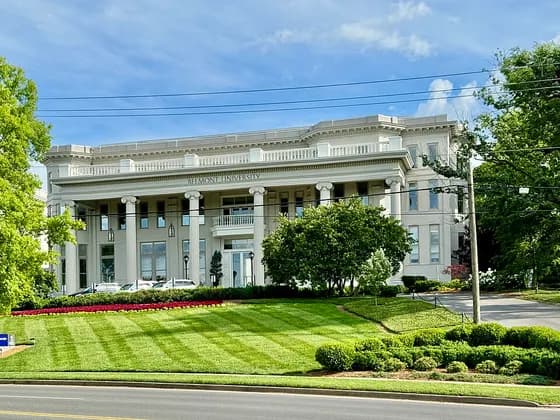
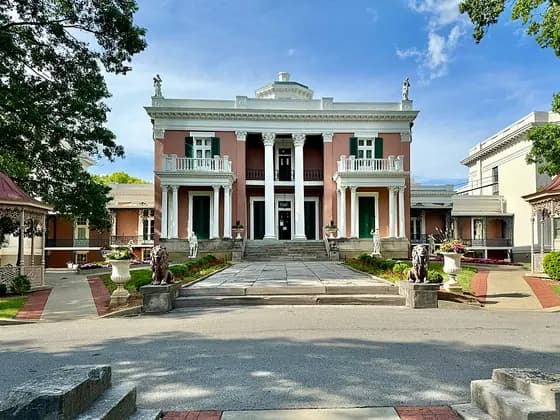

Photo: Lahti213 · CC BY-SA 4.0 · cropped
Photo: Warren LeMay from Chicago, IL, United States · CC BY-SA 2.0 · Photo: Warren LeMay from Chicago, IL, United States · CC BY-SA 2.0 · Photo: Kaldari · CC0
The Belmont Frist College of Medicine MD program at a glance (2027 entry)
The Thomas F. Frist, Jr. College of Medicine at Belmont University (Belmont Frist, or FCoM) runs a four-year MD program on Belmont's campus in Nashville, Tennessee. It welcomed its first class of 50 students in July 2024, the year its building opened. The college is named after Dr. Thomas Frist, Jr., who co-founded Hospital Corporation of America, now HCA Healthcare, in 1968. HCA Healthcare is one of the college's major clinical affiliates.
The program has three phases. The Foundation Phase, from August of Year 1 to March of Year 2, is the pre-clerkship stage, before full-time clinical work. Six weeks of independent study follow for Step 1, the first exam in the United States Medical Licensing Examination (USMLE) series. The 12-month Clerkship Phase of core clinical rotations, known as clerkships, then starts in mid-May of Year 2. The Individualization Phase, when you personalize your education around your career goals, runs from the end of the clerkships to graduation in May of Year 4.
Most Foundation courses take one organ system at a time. The 2025-26 handbook calls integrated patient cases the centerpiece of the curriculum, including the social, spiritual and cultural factors that shape health. Alongside these courses, Integrated Clinical Practice (ICP) places you in a clinical practice for a half-day each week from Year 1. A second parallel course, Wonder and Wisdom in the World of Medicine (W3M), covers ethics, health systems and professional formation. Belmont is a Christian university, and the college ties its focus on whole-person care to that faith.
The Liaison Committee on Medical Education (LCME), which accredits MD programs in the United States, granted the program preliminary accreditation in October 2023. Preliminary accreditation is the LCME stage that lets a new school admit students, ahead of provisional and then full accreditation. In summer 2026, after a survey visit in February 2026, the LCME continued the program's preliminary accreditation and placed the program on probation. Probation is an action the LCME can take while a program stays accredited, when it finds that some standards are not yet met.
The LCME's directory, updated November 13, 2026, lists the school as Preliminary, on probation, with its next survey due in 2027-28. The school says the LCME's findings covered student resources and responsiveness, governance and policies, and the academic experience and learning environment. It says its next site visit, in 2028, is the earliest chance to lift probation. The first MD class graduates in May 2028.
| Degree | MD |
|---|---|
| Program length | 4 years, with the degree conferred each May |
| Accreditation | LCME preliminary, on probation since summer 2026; next survey 2027-28 |
| Class size | 75 students entered in 2026, up from 50 in 2024 |
| Curriculum | Foundation, Clerkship and Individualization phases |
| Anatomy | Cadaver dissection, plus digital anatomy tables and virtual reality |
| First patient contact | Year 1: a half-day each week in a clinical practice |
| Clinical sites | HCA TriStar hospitals and community clinics across Nashville |
| Step 1 timing | After Year 2 classes, before clerkships begin in mid-May |
| Grading | Letter-graded science courses; clerkships graded Honors to Fail |
What makes the Belmont Frist College of Medicine MD program different
Core clerkships in three 12-week paired blocks
The Clerkship Phase runs as three 12-week blocks. In each you complete a dyad, two core clerkships taken together, such as pediatrics with obstetrics and gynecology. A longitudinal family medicine clerkship runs through all three blocks in community clinics across Nashville, giving you continuity with patients and preceptors (supervising clinical faculty) across the year.
A weekly half-day in a clinical practice from Year 1
Through ICP, clinical faculty host you in their own practices for a half-day each week, starting in Year 1. The main aim is to build your history-taking and physical examination skills on real patients long before clerkships begin.
Impact Weeks for teamwork, service and rest
Impact Weeks fall between courses, on a lighter schedule. A 2024 university story described three-day programs of wellness retreats, community service and interprofessional training with nursing, occupational therapy and physical therapy students. Between clerkship blocks they give time to reflect on health systems and whole-person care. Attendance is required.
A 50,000-square-foot simulation center in your building
The Center for Interprofessional Engagement & Simulation fills the third and fourth floors of the medical school building. Its 24-room simulated clinic uses standardized patients, paid professionals who portray patients and give you feedback. Hospital-style rooms hold high-fidelity manikins that show lifelike symptoms.
Health systems science, backed by an HCA Healthcare gift
The Belmont Collaborative for Health Systems Innovation (BCHSI) brings health systems science, the study of how care is organized, paid for and improved, into your training. The school says its curriculum covers payment models, value-based care and health policy. In May 2025 HCA Healthcare committed $5 million to support BCHSI, half of it creating an endowed chair in health systems science.
How Belmont Frist College of Medicine teaches medicine
Scientists and clinicians plan and teach the Foundation Phase courses together, and the 2025-26 handbook's guiding principle is to integrate the basic sciences with clinical medicine as far as possible. You begin with Molecular & Cellular Foundations, a six-week course that builds on your pre-med science. Nine organ-system courses of five to nine weeks follow.
Teaching mixes large-group sessions with small-group case-based and problem-based learning, flipped classrooms, team exercises and simulation. The school's teaching philosophy stresses self-directed, peer-supported learning built around solving problems. Under the 2025-26 handbook, many sessions are mandatory and tracked, while some are recorded for you to watch in your own time.
ICP and W3M run through both years of the Foundation Phase. ICP teaches clinical skills, professionalism and teamwork with other health professions through your weekly preceptorship, simulation, service learning and Objective Structured Clinical Examinations (OSCEs). An OSCE is a structured exam in which you see standardized patients while your history-taking, examination and communication are scored. Some school pages call ICP Introduction to Clinical Practice. W3M covers professional formation, biostatistics, ethics, health equity and health care systems.
Each student gets an iPad and pencil, which replace printed textbooks and are used for notes, course materials, question banks and exams. From the Clerkship Phase on, you learn as part of hospital and clinic teams.
The ways you will learn
| Case-based and problem-based learning | Small groups work through patient cases, sharing iPad screens. In case-based learning a facilitator steers the group toward set objectives; in problem-based learning the group decides what it needs to find out. You are assessed both as a group and individually. |
|---|---|
| Large-group sessions and flipped classrooms | Two learning theaters host large-group teaching, with seating that switches to small-group discussion. In a flipped classroom you study the material first and use class time to apply it. |
| Anatomy and pathology labs | Dissection of donor bodies in the anatomy lab, and experiential pathology labs with microscopes and whole specimens in the histology lab. |
| Standardized patients | In the simulated clinic you take histories and examine standardized patients, who then give you feedback. Cameras and microphones in every room let you watch the encounter back with faculty straight afterward, in nearby debriefing suites. |
| Simulation and interprofessional learning | High-fidelity manikins in hospital-style rooms let you practice tasks such as reading vital signs and giving IVs. A May 2026 university story about a second-year student describes medical students training with nursing, pharmacy and physical therapy students on a regular basis, much of it in the simulation center. In Year 2 you can also work with students across several Nashville campuses on team care for older patients. |
A typical week on the Belmont Frist College of Medicine program
The 2025-26 handbook limits required Foundation Phase activities to an average of 24 hours a week, not counting exams and make-up sessions. In most five-day weeks you also get at least 12 hours free of required teaching between 8 am and 5 pm, kept for self-directed study, research, service or personal needs.
Each week also has clinical time: a half-day in your ICP preceptor's practice, and at least a half-day in the simulation center, which the school says continues throughout the Foundation Phase. No new testable material is introduced in the week of a comprehensive exam or in the 24 hours before a required quiz.
Under the 2025-26 handbook, you can miss at most two days of required activities in a course of five weeks or less, and three in a longer one, unless more absences are approved. For a longitudinal course such as ICP or W3M the cap is five days a semester.
How anatomy is taught at Belmont Frist College of Medicine
Anatomy is taught in donor-body labs, using bodies donated for teaching, and the school describes the approach as cadaver-based full dissection. Digital anatomy tables and virtual reality in the simulation center supplement the dissection.
The anatomy lab sits near the student lounge and medical library. A respite room next to it gives you a quiet place to settle before and after each session. Under the 2025-26 handbook, gross anatomy lab practicals, where you identify structures on specimens, count toward the summative score (the part of the course score from graded tests) in courses that include anatomy.
When you first meet patients at Belmont Frist College of Medicine
Your first patients are standardized patients. You start in the simulation center in your first week on campus, practicing consultations in the simulated clinic and getting feedback from the standardized patients and faculty.
Real patients follow soon after, during your weekly ICP half-day in a clinical practice. In a May 2026 university story, a second-year student said her class was placed in clinics within its first couple of weeks. In the 2025-26 handbook, preceptor evaluations count toward ICP grades in Year 1 and the fall of Year 2, and service learning is a required part of the course.
Separately, the university's Center for Abundance, Resilience, Excellence and Spirituality (CARES) launched the Flourish Mobile Clinic in June 2025. It was set up to give faculty and students from medicine, nursing, pharmacy and health sciences a way to serve the community directly. Licensed professionals and student clinicians staff its two exam rooms, offering easy-to-access services such as health screenings, health education, recovery support and referrals.
Full-time clinical work starts with the Clerkship Phase in mid-May of Year 2. During clerkships you can also try rotations in subspecialties to explore careers.
The Belmont Frist College of Medicine curriculum, year by year
- Year 1
Foundations and the first organ systems
Year 1 opens with an orientation week and the White Coat Ceremony; the Class of 2030's ceremony was set for July 31, 2026, with classes starting on August 3. In the 2025-26 handbook the year has 39 teaching weeks: six courses back to back, with ICP and W3M alongside and three Impact Weeks.
- Fall: Molecular & Cellular Foundations (6 weeks), then Immunology, Microbiology & Dermatology (6 weeks) and Hematology & Basic Principles of Oncology (5 weeks).
- Spring: Cardiovascular (8 weeks), Pulmonary (6 weeks) and Musculoskeletal (5 weeks).
- ICP 1A and 1B: clinical skills, your weekly preceptorship, OSCEs and required service learning.
- W3M 1A and 1B: professional formation, ethics, health equity, health systems, biostatistics and epidemiology.
- An optional summer term: up to eight weeks of non-clinical electives (courses you choose), such as two four-week electives in June and July or the eight-week research elective.
- Year 2
The remaining systems, then Step 1
Four more organ-system courses fill the fall and winter, followed by a two-week Foundation Capstone course that closes the phase. Six weeks of independent Step 1 study come next. In the 2025-26 calendar they ran from March 23 to May 1, with a week's break before clerkships began on May 11.
- Fall: Gastrointestinal (5 weeks), Renal (5 weeks) and Neurology & Behavioral Science (8 weeks).
- Winter: Endocrinology & Reproduction (9 weeks), then the Foundation Capstone in March.
- ICP 2A and 2B and W3M 2A and 2B, with one Impact Week in the fall.
- You must take Step 1 before the Clerkship Phase starts.
- Clerkship Phase (Years 2 to 3)
Seven core clerkships in three blocks
The 12-month Clerkship Phase has three 12-week blocks, and in each you complete one dyad. The curriculum page, full schematic and 2025-26 handbook pair surgery with neurology, internal medicine with psychiatry, and pediatrics with obstetrics and gynecology. One of the school's schedule PDFs pairs them differently, so the pairings may change.
- Surgery (8 weeks): surgical care from preoperative assessment to postoperative management, assisting in procedures. Neurology (4 weeks): neurologic exams and lesion localization, inpatient and outpatient.
- Internal medicine (8 weeks): adult illness in inpatient and outpatient settings. Psychiatry (4 weeks): psychiatric interviewing, mental status exams and treatment planning.
- Pediatrics (6 weeks): infants, children, adolescents and their families. Obstetrics and gynecology (6 weeks): prenatal visits, labor and delivery and gynecologic procedures.
- Family medicine: a longitudinal outpatient clerkship in community clinics, running through all three blocks, with a focus on prevention and chronic disease.
- National Board of Medical Examiners (NBME) subject exams, the standardized national tests known as shelf exams, at the end of each dyad.
- An optional two- or four-week elective, or a break, over the Year 3 winter.
- Individualization Phase (Years 3 to 4)
Your own schedule, then residency
After the clerkships end in spring of Year 3, you build a schedule around your career goals, with help from career advisors. The focus is on preparing for residency, the specialty training after medical school. The 2025-26 handbook gives Year 4 between 32 and 40 instructional weeks, and the MD is conferred in May.
- Four weeks of preparation for Step 2 Clinical Knowledge (CK), the USMLE exam on clinical medicine, in the Year 3 summer.
- A four-week sub-internship, which the handbook calls an acting internship: under close supervision you write notes, place orders and coordinate care, much as a first-year resident does.
- Four weeks each of emergency medicine, focused on triage and rapid assessment, and critical care in the intensive care unit.
- Electives to complete the required 24 weeks, up to six of four weeks each, at Belmont or as away rotations at other medical schools or institutions.
- Transition to Residency, a required month in March that prepares you for residency and brings the class back together for Match Week. That is when the Match, the national residency matching process, tells you where you will train.
How you are assessed at Belmont Frist College of Medicine
Under the 2025-26 handbook, Foundation Phase science courses are graded rather than pass/fail. Molecular & Cellular Foundations and each organ-system course are scored out of 100 and given a letter grade from A to F. Summative assessments (graded quizzes, a gross anatomy practical where relevant and a comprehensive exam) make up 80% of the course score, and case learning the other 20%. Formative quizzes, which are for feedback only, do not count.
You pass with a C, which means at least 70% overall, plus at least 70% on the comprehensive exam itself. A score of 63% to 69% on that exam can allow one retake, with the score capped at 70%, and you can retake no more than three exams across the phase. Failed Year 1 courses are remediated in the summer, and failed Year 2 courses before Step 1.
Faculty-written exams include nationally normed NBME questions. In Year 2 you also sit the Comprehensive Basic Science Subject Exam (CBSE) several times, as a measure of your readiness for Step 1. ICP and W3M are pass/fail, with 70% needed to pass. ICP combines a written exam, an OSCE or practical, preceptor evaluations, clinical reasoning, interprofessional work and service learning. W3M uses a portfolio, discussion boards and biostatistics and epidemiology work.
Under the 2025-26 handbook, clerkships are graded Honors, High Pass, Pass or Fail, and preceptor evaluations make up 35% of the grade. Direct observations by a Master Clinician (a designated clinical faculty member), an end-of-clerkship OSCE and the shelf exam count for 20% each, and a weekly Individual Learning Plan for 5%. You must meet the minimum for every major component, including a shelf score at or above the 5th national percentile. Honors needs at least 90% overall and a shelf score at or above the 70th percentile.
Step 1 has been reported only as pass or fail since January 2022. The 2025-26 handbook requires you to take it before the Clerkship Phase and to pass it to go beyond your first dyad, with up to three attempts. You can sit Step 2 CK once you have passed the Clerkship Phase, and you are encouraged to pass it before fall residency interviews. You must pass it by February 15 of Year 4 (for a 2027 entrant on the current schedule, February 15, 2031) to enter that year's Match, and you must pass it to graduate.
In August 2026 the USMLE program announced a move to designated testing dates from January 2029, with Step exams offered less often each year. A June 2026 announcement had named 2028, so the date has already moved once. On the current schedule, projected from the 2025-26 calendar, a 2027 entrant would sit Step 1 around April or May 2029, within a few months after the switch. On the same schedule, Step 2 CK preparation would fall in the spring or summer of 2030.
- Under the 2025-26 handbook, a failed Step 1 leaves you 16 weeks to pass, not counting any time in your first dyad, and Step 2 CK must be passed within three attempts.
- OSCEs at several points in the program test communication, history-taking, physical examination and clinical reasoning. Failing the clerkship OSCE, scored out of 50 with 35 needed to pass, means failing the whole clerkship.
- Under the 2025-26 handbook, if the shelf exam is the only part of a clerkship you fail, your grade is Incomplete and you get one retake. Passing it, at or above the 5th percentile, earns a Remediated Pass; failing it again fails the clerkship.
- Electives, including away electives, are graded pass/fail.
- Final grades and narrative comments must be posted within 28 days of the end of each course or clerkship.
- The 2025-26 handbook gives you three years from enrolling to finish the Foundation Phase and six to complete the whole MD, not counting approved leaves of absence.
Belmont Frist College of Medicine clinical rotations: where you will actually train
Core clerkships are based in Nashville. The curriculum page says clerkship sites are throughout the city, typically within HCA Healthcare's TriStar system, so you can keep the same housing. A May 2025 university story named TriStar Centennial, TriStar Skyline and TriStar Southern Hills medical centers among the TriStar facilities for rotations, with expansion to other local HCA hospitals planned. Internal medicine covers inpatient and outpatient care across HCA's TriStar Division.
Family medicine works differently. Its longitudinal outpatient clerkship spans three semesters in community clinics across Nashville. Under the 2025-26 handbook, clinical teams must release you for these clinics and for OSCEs, simulations and required teaching sessions.
The handbook also requires your supervisors to hold a faculty appointment with the college and to be credentialed at the site. Residents, fellows and other licensed staff can supervise you under their oversight, and you may not perform procedures without direct supervision. Duty hours are capped at 80 a week, averaged over four weeks. Schedules are planned for no more than 72, with a day off each week and in-house call no more often than every fourth night.
Under the 2025-26 handbook you are expected at every scheduled clinical activity, from shifts and rounds to preceptor visits and teaching sessions. Any absence needs approval, and residency interviews are among the reasons the handbook lists. You can miss at most two days of a four- or six-week clerkship or elective, or three of an eight-week one, unless the Office of Student Affairs and Belonging approves more.
HCA TriStar hospitals named in May 2025 for clinical rotations, with expansion to other local HCA hospitals planned.
- TriStar Centennial Medical Center
- TriStar Skyline Medical Center
- TriStar Southern Hills Medical Center
Host the longitudinal family medicine clerkship.
Electives, selectives and away rotations at Belmont Frist College of Medicine
The 2025-26 handbook requires 24 weeks of electives to graduate. They can be clinical, non-clinical (such as ethics, business, education or research) or hybrid, and last two to eight weeks. There are three windows. In the optional summer after Year 1, up to eight weeks of non-clinical electives count toward the total. The Year 3 winter break is the second, and the Individualization Phase allows up to six four-week electives.
Away electives open in the Individualization Phase if you are in good academic standing. You apply through the Visiting Student Learning Opportunities (VSLO) service, or outside it only to HCA facilities with an affiliation agreement, through a system called Clinician Nexus. Each needs at least 30 hours of activity a week, none can fall in the March Transition to Residency month, and you pay your own travel and living costs.
There is also a global strand. In summer 2025, 11 Belmont students from medicine and other programs spent three weeks on a global health elective. They combined United Nations training on disaster risk reduction in South Korea with community health work in Bangalore, India, including house calls with nurses from Bangalore Baptist Hospital. At the 2026 research symposium, faculty said the college has networks in 18 countries for electives and research abroad.
Dual degrees and research years at Belmont Frist College of Medicine
The school's Scholarly Productivity & Innovation team supports a wide range of scholarship, from lab and clinical research to case reports, quality improvement projects, curriculum development and literature reviews. It helps you find a mentor and a project, and you can choose mentored scholarly work in the Individualization Phase.
The main structured route is the Research Elective (MDD 5895), an eight-credit summer course after Year 1, running for eight weeks from early June. You spend about 40 hours a week on biomedical, evidence-based medicine or humanities research with a mentor at Belmont, a hospital or a national research institution. It is graded pass/fail and ends with an abstract, a poster and a plan for continuing the work. Applications open on December 15.
Work is presented at an annual research symposium. The second, on August 21, 2026, featured more than 30 summer research projects, with student talks on diabetic eye disease, glaucoma and liver cancer. Students can also join BCHSI projects, such as using large data models to improve outcomes for people with high blood pressure.
The 2025-26 handbook lets students in good standing request a leave of absence of up to a year for reasons that include research or a dual degree.
Facilities and support at Belmont Frist College of Medicine
Where you will learn
The college's building on Belmont's campus opened in 2024, a block from the Gordon E. Inman Center and McWhorter Hall, home to the university's nursing, pharmacy, physical therapy, occupational therapy and social work programs. The first floor has two learning theaters. The second has three learning studios for small-group work, with large screens and modular furniture, and a histology lab for pathology and histology specimens.
The simulation center spans the third and fourth floors. The third floor mimics a hospital, with eight inpatient simulation rooms, one set up as a labor and delivery suite, and two assessment labs of eight beds each with bedside monitors. The inpatient rooms hold high-fidelity manikins that breathe, sweat and seize. Staff also make artificial skin, blood and wounds to fit the manikins.
The fourth floor is an outpatient setting with the simulated clinic, debriefing suites and a simulated pharmacy. The fifth and sixth floors hold rooms for the Frist Houses, the learning communities described below. They also have the medical library, study rooms, faculty offices and a student lounge opening onto the Tom and Judy Foster Sun Terrace. The building has vending but no formal dining, with food nearby, and its 650-space underground garage is free for medical students.
Support while you study
Each student is placed in a Frist House, named after a figure from medical history, such as Virginia Apgar, Alexander Fleming or Andreas Vesalius. A May 2026 university story described each house as supported by two faculty advisors, with regular meetings on professionalism, burnout and available resources, and a House Olympics each October. Under the 2025-26 handbook, house faculty leaders help write the summary in your Medical Student Performance Evaluation (MSPE), the school's letter for residency applications.
Learning specialists offer academic coaching, help you build an Individualized Learning Plan at key points such as board preparation and clerkships, and give tailored Step 1 and Step 2 support. The Peer-Academic Leader (PAL) program connects you with upperclass students for study help and mentoring. Career Compass, the career advising program, offers individual advising, specialty panels, specialty interest groups and help with residency applications and interviews.
For well-being, you meet the Director of Student Engagement and Wellness once a semester for a check-in, and each class has its own wellness retreats. Imperfect Rounds are monthly lunch talks with deans and faculty about issues such as imposter syndrome. The Ecumenical Roundtable holds monthly dinner discussions for students of different faiths about where faith meets medicine. After the LCME review, the school says it added a dedicated career-advising leadership role and 20 advising groups.
Is the Belmont Frist College of Medicine program right for you?
This program may suit you if
- You want patients early, with a weekly half-day in a clinical practice from Year 1 and clerkships from mid-May of Year 2.
- You would like your core clerkships in one city, at Nashville sites that let you keep the same housing between rotations.
- You learn well in small case-based groups and want plenty of simulation.
- You want ethics, faith and whole-person care built into your training, through W3M and a college that ties its mission to Christian faith.
- You are curious about how health care is organized and paid for, which BCHSI brings into the program.
Things to think about
- The LCME placed the program on probation in summer 2026 while continuing its preliminary accreditation. The school says its 2028 site visit is the earliest chance to lift probation.
- Under the 2025-26 handbook, Foundation science courses are letter-graded from A to F and clerkships graded Honors to Fail, so grades are recorded from your first course.
- You must pass Step 1 to move beyond your first dyad. On the current schedule, a 2027 entrant would sit it within a few months after the USMLE's January 2029 switch to designated testing dates.
- Most clerkship sites are in one health system, HCA's TriStar hospitals, so consider whether you want training spread across several systems.
- The first MD class graduates in May 2028, so a 2027 entrant would join the school's fourth class.
Belmont Frist College of Medicine MD program — frequently asked questions
Applying to Belmont Frist College of Medicine?
How to get into Belmont Frist College of Medicine
Prerequisites, MCAT, AMCAS personal statement, secondaries and interview, step by step.
Open the guide →Belmont Frist College of Medicine admissions profile
MCAT and GPA profile, acceptance rate, interview format and key dates.
See the profile →Compare Belmont Frist College of Medicine with other schools
Put the teaching style, anatomy teaching and clinical sites next to another school.
Open the comparison →Prepare for the Belmont Frist College of Medicine interview
Format breakdown, school-specific sample questions and prep tips for this interview.
Read the guide →Where this Belmont Frist College of Medicine program guide came from
This guide was written from 48 official sources — Thomas F. Frist Jr. College of Medicine at Belmont University's own program pages and curriculum documents, plus the accreditor and the hospitals and health systems the school trains students in where they publish detail — read on 2026-11-12, then checked claim by claim against those sources.
- Thomas F. Frist, Jr. College of Medicine home page
- Curriculum: Foundation, Clerkship and Individualization phases
- FCoM Curriculum Schematic, full curriculum (PDF, December 2025)
- FCoM Curriculum Schematic, clerkship phase (PDF, December 2025)
- FCoM Curriculum Schematic, foundation phase (PDF)
- FCoM Curriculum Schematic, individualization phase (PDF)
- FCoM Student Handbook 2025-2026, revised December 2025
- Assessment & Evaluation
- Teaching Philosophy
- Simulation Learning
- Interprofessional Education
- Medical Education Resources: student iPads
- Student Scholarly Productivity & Innovation
- Research Elective Course (MDD 5895)
- MDD 5895 Research Elective syllabus, Summer 2025 pilot
- Accreditation status
- Accreditation Status Frequently Asked Questions
- LCME: Accredited Programs directory (updated November 13, 2026)
- LCME: About School Directory
- LCME: Accreditation Process Overview
- About the college: mission and namesake
- Facilities and virtual tour
- Center for Interprofessional Engagement & Simulation
- White Coat Ceremony 2026
- Student Success
- Wellness and learning communities
- Career Advising: Career Compass
- Class of 2029 profile
- Class of 2030 profile
- Inaugural Class of 2028 profile
- Belmont welcomes 50 future physicians in inaugural class (July 2024)
- Impact Weeks foster wellness and collaboration (December 2024)
- HCA Healthcare commits $5M to Frist College of Medicine (May 2025)
- Belmont launches Flourish Mobile Clinic (June 2025)
- Students circle the globe for a global health elective (August 2025)
- Reyana Kaji reflects on Year Two (May 2026)
- Catching up with Katie Pursley (May 2026)
- 2026 Research Symposium (September 2026)
- Clinical Faculty Open House (September 2026)
- Clinical Faculty: teaching needs by phase
- Belmont Collaborative for Health Systems Innovation
- BCHSI: students and current projects
- BCHSI: The Business of Healthcare
- USMLE Designated Testing Dates Information Hub (August 6, 2026 update)
- USMLE: Updated Timeline, Transition Will Take Place in January 2029
- USMLE: Transition to Limited Testing Dates Each Year Starting in 2028 (June 23, 2026, later updated)
- USMLE Designated Testing Dates FAQs
- USMLE: Examination Results and Scoring
Curricula are restructured between cycles. Anything here that decides your application — how anatomy is taught, a clinical campus assignment, a required research year — should be confirmed against the official page for your entry year.
Applying to Belmont Frist College of Medicine?
We help US applicants with MCAT strategy, the AMCAS personal statement, secondary essays and interview prep — everything you need for a competitive Belmont Frist College of Medicine application.