Albert Einstein College of Medicine (MD) Medical School - 2027 Entry Requirements & Interview Format
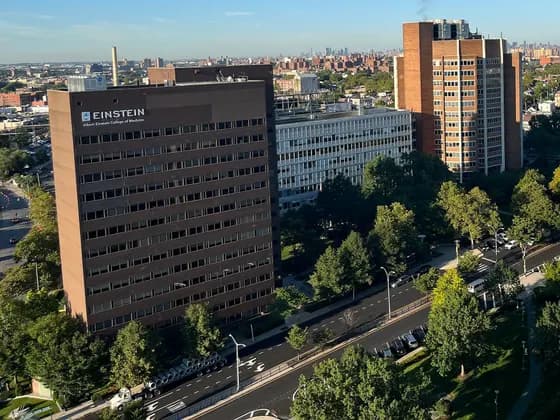
Albert Einstein College of Medicine, founded in 1955 by Yeshiva University (now an independent institution), is one of the leading research-focused medical schools in the United States. Located in the Morris Park neighbourhood of the Bronx, Einstein trains physicians and scientists in a uniquely dual context: one of the highest-funded biomedical research environments in the country, and one of the most medically underserved and ethnically diverse urban populations in America. Einstein's training hospitals — including Montefiore Medical Center, a major academic medical centre — provide extraordinary clinical breadth and acuity.
Entry Requirements
What you need to apply to Albert Einstein College of Medicine (MD).
Admission overview
Bachelor's degree and MCAT required. National applicant pool; no geographic preference. Einstein strongly values research experience and intellectual curiosity alongside clinical exposure and service. Applications via AMCAS; secondary required.
MCAT median
518 (range 513–522)
GPA median
3.85 overall / 3.82 science (BCPM)
Acceptance rate
1.6%
Class size
180
In-state preference
None
CASPer
Not required
Holistic review emphasis
Research experience, intellectual curiosity, urban health commitment, clinical exposure, diversity, MCAT/GPA.
Notes
Estimates from public AAMC FACTS / AACOMAS / ADEA AADSAS / class-profile; verify current cycle.
Specialities offered
Biomedical Research, Infectious Disease & HIV, Aging Research, Internal Medicine, Urban & Community Health
Interview Format
How Albert Einstein College of Medicine (MD) interviews applicants.
Format
Traditional panel interview (faculty and/or student, ~30–45 min sessions)
Interview window
September–March
Decision date
Rolling; most decisions by March 30
Post-interview chances
Estimated 20–30% of interviewed candidates receive an offer. High applicant volume and small acceptance rate mean significant competition post-interview. Estimates approximate — verify with Einstein admissions.
What to expect at a Albert Einstein College of Medicine (MD) interview
Albert Einstein College of Medicine uses a traditional interview format with one or two sessions of approximately 30–45 minutes each. Interviewers review the application in advance and probe motivation for medicine, research experience, commitment to urban health in the Bronx, and ethical reasoning. Einstein places significant weight on research background — the school has one of the largest funded research portfolios of any US medical school. The interview day includes a campus tour, informal student interaction over lunch, and a financial aid session. Student perspectives are gathered and contribute to the holistic admissions evaluation.
What makes Albert Einstein College of Medicine (MD) different
One of the most research-intensive private medical schools in the US; consistently ranks in the top tier for NIH research funding. Located in the Bronx — one of the most medically underserved and diverse urban counties in America. Strong community health mission alongside elite research training. Offers the Bronx Community Health Leaders programme. Home to the Institute for Aging Research and major HIV/AIDS research infrastructure.
Tutor insight
Einstein is a research powerhouse in a profoundly underserved urban setting — the combination is genuinely unusual and should be the centre of your "why Einstein" narrative. If research is a significant part of your identity, articulate your intellectual interest area and how Einstein's specific facilities (ageing, HIV, cancer genomics) connect to it. The Bronx community health mission is equally important — do not ignore it in favour of pure research narrative. Traditional interviews at Einstein reward intellectual depth and authenticity; avoid broad claims you cannot support with specific examples. The large class (~180) is a strength for peer diversity and residency matching breadth.
PrometheusQuestion Bank
595 medicine questions inside
Interview questions matched to Albert Einstein College of Medicine (MD)
Two questions our tutors flagged as a strong fit for Albert Einstein College of Medicine (MD)’s interview style. Try answering them out loud, then open Prometheus for the model answers and follow-up tips.
Medium·PanelQ1
Holistic Review: Overcoming Financial Hardship as a Pre-Med
Your path to medical school has included working 30 hours a week throughout your undergraduate years to support yourself and contribute to your family's finances. Your GPA reflects some semesters where you were managing a family health crisis while taking 18 credit hours. You did not participate in some extracurricular opportunities because you could not afford to volunteer without pay. How do you present this context to an admissions committee?
Likely follow-up · The AAMC's holistic review explicitly asks committees to contextualise academic metrics within an applicant's circumstances. How do you bring up financial hardship without sounding like you are making excuses?
3 expert tips in Prometheus
Hard·PanelQ2
Research and Critical Thinking: AI in Diagnostic Medicine
Artificial intelligence tools are being deployed in radiology, pathology, and primary care for diagnostic decision support. Some studies show that AI matches or exceeds human performance on specific tasks such as skin cancer detection and diabetic retinopathy screening. A colleague suggests that widespread AI adoption will reduce the need for physicians over the next 20 years. How do you evaluate this claim, and what are the opportunities and risks of AI integration into clinical medicine?
Likely follow-up · What types of clinical tasks are AI tools currently well-suited for, and which are beyond their near-term capabilities?
Apply to Albert Einstein College of Medicine (MD) with confidence
We've helped students get into Albert Einstein College of Medicine (MD) and other US medicine schools. Get tailored support for each stage of the application.
Albert Einstein College of Medicine (MD) - Frequently asked questions
Bachelor's degree and MCAT required. National applicant pool; no geographic preference. Einstein strongly values research experience and intellectual curiosity alongside clinical exposure and service. Applications via AMCAS; secondary required.
Traditional panel interview (faculty and/or student, ~30–45 min sessions). Albert Einstein College of Medicine uses a traditional interview format with one or two sessions of approximately 30–45 minutes each. Interviewers review the application in advance and probe motivation for medicine, research experience, commitment to urban health in the Bronx, and ethical reasoning. Einstein places significant weight on research background — the school has one of the largest funded research portfolios of any US medical school. The interview day includes a campus tour, informal student interaction over lunch, and a financial aid session. Student perspectives are gathered and contribute to the holistic admissions evaluation.
Albert Einstein College of Medicine (MD) typically interviews in September–March.
Decisions are released Rolling; most decisions by March 30.
One of the most research-intensive private medical schools in the US; consistently ranks in the top tier for NIH research funding. Located in the Bronx — one of the most medically underserved and diverse urban counties in America. Strong community health mission alongside elite research training. Offers the Bronx Community Health Leaders programme. Home to the Institute for Aging Research and major HIV/AIDS research infrastructure.