
The Quinnipiac Netter School of Medicine MD program
What you actually study, and where you will be
Quinnipiac Netter School of Medicine's MD is a 4-year program taught through case-based learning in an integrated curriculum, with patient contact from Year 1 and clinical rotations in Connecticut, plus network partners in Massachusetts, Maine and Florida (2027 entry). Years 1 and 2 follow organ-system blocks on the North Haven Campus, which the school shares with Quinnipiac's nursing and health sciences schools, and Year 2 adds problem-based learning. From your first term you work regularly in a community physician's practice through the Medical Student Home (MeSH) program. Year 3 is a 44-week Longitudinal Multi-specialty Clerkship at community hospitals and practices. Year 4 adds a sub-internship, where you work at the level of a first-year resident, plus a selective and at least 28 weeks of electives.
- Degree
- MD
- Length
- 4 years
- Teaching
- Integrated + Case-based learning
- Clinical contact
- Year 1

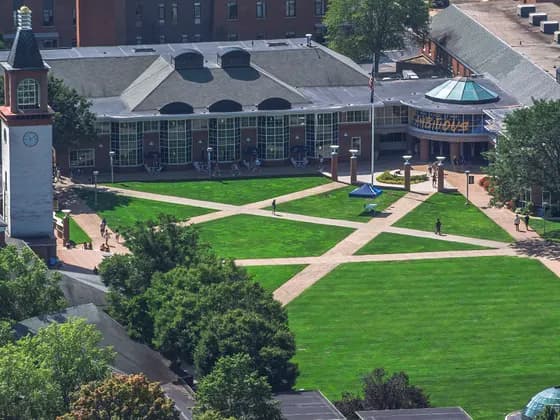

Photo: Wasted Time R · CC BY-SA 3.0 · cropped
Photo: Ethan Long · CC BY-SA 2.0 · Photo: Morrowlong · CC BY-SA 4.0 · Photo: StAkAr Karnak at English Wikipedia · CC BY-SA 3.0
The Quinnipiac Netter School of Medicine MD program at a glance (2027 entry)
The Frank H. Netter MD School of Medicine at Quinnipiac University, known as Quinnipiac Netter or QU Netter, runs a four-year MD program on Quinnipiac's North Haven Campus in Connecticut. It shares a building with Quinnipiac's Schools of Nursing and Health Sciences, and the Schools of Law and Education are on the same campus. The school is named after Frank H. Netter, MD, a physician and medical illustrator whose anatomy drawings became a staple of medical education. Its first class graduated in 2017.
Years 1 and 2 form the pre-clerkship phase, the classroom-based stage before full-time clinical work. On the 2026-27 calendar it runs from August of Year 1 to April of Year 2, followed by study for Step 1, the first of the national licensing exams explained below. Science is taught in organ-system blocks, with three courses running side by side. Foundations of Medicine (FOM) teaches the medical sciences and Clinical Arts and Sciences (CAS) clinical skills. Scholarly Reflection and Concentration/Capstone (SRCC) covers research methods and reflection, and guides a project of your own.
Patients come early. In September of Year 1, CAS pairs you with a community physician through the Medical Student Home (MeSH) program. The school calls MeSH a centerpiece of the first two years: a mentored, supervised place in a working practice to use the skills you learn on campus with real patients. The aim, the school says, is for every graduate to see patients through the eyes of a primary care physician, whatever specialty they choose.
Years 3 and 4 make up the clerkship phase. Clerkships are the core clinical rotations, and Year 3 runs them as one 44-week Longitudinal Multi-specialty Clerkship (LMC). The school calls itself community-hospital-based, with St. Vincent's Medical Center in Bridgeport and Saint Francis Hospital in Hartford as its principal partners. Year 4 brings an emergency medicine or critical care selective, at least 28 weeks of electives and a four-week sub-internship, in which you work at the level of a first-year resident.
To graduate you must pass Step 1 and Step 2 CK (Clinical Knowledge) of the United States Medical Licensing Examination (USMLE), and meet the school's interprofessional education and community service requirements. The Liaison Committee on Medical Education (LCME), which accredits MD programs in the United States, lists the program as fully accredited, with its next survey in 2029-30.
| Degree | MD |
|---|---|
| Program length | 4 years; all requirements must be met within six years |
| Class size | 95 in each of the Classes of 2027, 2028 and 2029 |
| Main campus | North Haven Campus, shared with Quinnipiac's nursing and health sciences schools |
| Teaching style | Organ-system blocks; case-based groups in Year 1, problem-based learning in Year 2 |
| Anatomy | Dissection-based anatomy through the Year 1 organ-system blocks |
| First patient contact | Year 1, through MeSH afternoons with a community physician |
| Clinical sites | St. Vincent's (Bridgeport), Saint Francis (Hartford) and a Connecticut-wide network |
| Step 1 timing | Six-week study period at the end of Year 2; required before Year 4 |
| Grading | Satisfactory/Unsatisfactory in Years 1 and 2; Honors to Fail in clerkships |
What makes the Quinnipiac Netter School of Medicine MD program different
Two years with the same community physician
Through MeSH you join a community practice in Year 1 and keep returning through Year 2, and the clinical partners page says your preceptor comes to know you well over those two years. The school tries to line up what you learn on campus with what you see there.
Year 3 as one 44-week clerkship in two clusters
The LMC groups the six core areas into two 22-week clusters: internal medicine, primary care and surgery in Cluster A, and obstetrics-gynecology, pediatrics and psychiatry in Cluster B. Each cluster ends with two weeks of protected study before the National Board of Medical Examiners (NBME) subject exams, also called shelf exams: national multiple-choice exams in each specialty.
A capstone you design over four years
SRCC runs through all four years. You choose a concentration, from medical humanities and health policy to clinical research, set your own learning objectives, manage a budget and work with a mentor. You present the finished project at Capstone Scholars Day.
Training beside nursing and health sciences students
Nursing and health sciences students share your building, anatomy lab and standardized patient center. Interprofessional education, in which students from different health professions learn together and from each other, is a graduation requirement. Much of it runs through the Center for Interprofessional Healthcare Education, which ran 78 interprofessional programs for 1,800 Quinnipiac health professions students over the past year, its director said in August 2026.
How Quinnipiac Netter School of Medicine teaches medicine
Teaching in Years 1 and 2 follows integrated organ-system blocks, and the three courses are linked block by block. The course pages give FOM 18 hours a week, CAS 6 and SRCC 4; the catalog puts CAS at up to 6 to 8. When you learn cardiac physiology in FOM, for example, you also learn the cardiac examination and history in CAS and practice them at your MeSH site.
FOM covers anatomy, histology, physiology, cell and molecular biology, genetics, human development, nutrition, behavioral and social science, pathology and pathophysiology. Five longitudinal themes are woven through the blocks: pharmacology, nutrition, behavioral and social sciences, biomedical ethics and epidemiology.
Year 1 mixes lectures, team-based learning and case-based small groups; in Year 2, self-directed learning grows and problem-based learning (PBL) becomes a major part of FOM II. Year 1 also opens with Coaching for Adaptive Learning, a course on managing your own learning: spotting gaps, setting goals, using feedback and balancing your time.
From Year 3, teaching moves to hospitals and practices, backed by academic half days and small-group teaching attending sessions. The 2026-27 catalog's program objectives include knowing the main types of artificial intelligence and using AI learning tools responsibly.
The ways you will learn
| Lectures, team-based learning and case-based groups (Year 1) | FOM I combines lectures with team-based learning, in which you prepare before class and then work through problems in teams, and with small-group events built around patient cases. |
|---|---|
| Problem-based learning (Year 2) | Five hours a week, groups of eight work through one written patient case with a faculty facilitator, in a way the school likens to a team-based clinical encounter. You reason from histories, symptoms, signs and lab results, and direct your own learning on what each case raises. |
| Foundations of Clinical Care (FCC) | The skills section of CAS. Groups of eight students with two clinical faculty practice interviewing, history taking, examination, clinical reasoning, documentation and oral presentations, with standardized patients in most sessions. FCC also covers basic procedures, telemedicine and interprofessional ultrasound training, with video review and feedback from peers, standardized patients and faculty. |
| Medical Student Home (MeSH) | The clinical section of CAS: you interview and examine patients in a community physician's office while the physician watches, and get feedback through a workplace-based assessment program. |
| Physicianship and ethics | CAS also carries Physicianship, which joins medical ethics with the humanities to build professionalism. The faculty page describes ethics case discussions in small and medium-sized groups, after lectures and readings. |
A typical week on the Quinnipiac Netter School of Medicine program
Much of this pre-clerkship timetable comes from a 2025 faculty recruitment page. All direct FOM teaching takes place on weekday mornings, Monday to Friday between 8 a.m. and noon, adding up to 18 hours a week.
In Year 1, FCC small groups meet on Thursdays from 8 to 10 a.m., and anatomy lab typically runs on Monday and Wednesday mornings from November to May. In Year 2, FCC moves to Thursdays from 10 a.m. to noon, and PBL groups meet on Monday, Wednesday and Friday mornings.
Four hours of SRCC a week fit around these sessions, along with your MeSH afternoons (see Meeting patients, below, for how often). Ethics groups take four or five Thursday afternoons, and the faculty page lists optional FCC sessions on Tuesday afternoons from August to October. Pre-clerkship sessions end 10 minutes before the hour, and under the Code of Conduct, arriving late to a required session is a violation.
How anatomy is taught at Quinnipiac Netter School of Medicine
Anatomy is taught in FOM I. The course pages describe dissection-based anatomy integrated across all the Year 1 organ-system blocks, and the FOM page says it runs through most of the first year. The faculty page puts lab teaching from November to May: musculoskeletal in November and December, then neuroscience and head and neck in January and February.
The thorax (lung, heart and kidney) follows in February and March, then the abdomen and pelvis in April and May. Instructors help student teams identify structures, biological variation and disease, and link them to clinical practice. Each organ-system block ends with a practical anatomy exam alongside the block's summative exam.
Bodies come through the school's Anatomical Gift Program, which accepts whole-body donations, and each year students and staff hold a Ceremony of Gratitude for donors and their families. The lab, on the third floor of the Medicine, Nursing and Health Sciences building, also serves the Schools of Health Sciences and Nursing. The facilities page lists 48 prosection stations in the building; a prosection is a specimen dissected in advance for study.
When you first meet patients at Quinnipiac Netter School of Medicine
Clinical skills start on campus with standardized patients (SPs), people trained to portray patients and to give consistent feedback on your history taking, examination technique and interpersonal skills. The CAS course page says one-on-one interviews with SPs begin in your first month.
Real patients come through MeSH. Students and preceptors are surveyed on their preferences in the spring before Year 1, and the school tries to give you one of your top five choices. Most preceptors practice internal medicine, family medicine or pediatrics, some in subspecialties such as cardiology or neurology. Their practices are rural, suburban and urban sites across Connecticut, including some that care for underserved communities.
At your MeSH site you observe your preceptor with patients and staff, and take part in the care of a few patients each session: taking histories, examining, presenting and helping with diagnoses and plans. By the end of Year 1 you should manage at least three common office procedures under supervision. By the end of Year 2 you should write a full history and physical with your own assessment and plan.
The catalog describes MeSH as one afternoon a week, four hours at a time, and the curriculum page also says one afternoon a week. Other school pages put it differently. The CAS course page says one day a week from October, and the home page calls it biweekly. The faculty recruitment page says weekly or every other week, for up to 15 to 20 afternoons a year, from October to May in Year 1 and August to March in Year 2.
Year 2 CAS prepares you for clerkships, with sessions on each specialty and on harder conversations, such as sharing medical information and delivering unwelcome news. Full-time clinical work begins with the LMC in June after Year 2.
The Quinnipiac Netter School of Medicine curriculum, year by year
- Year 1
Foundations of Medicine I
On the 2026-27 calendar, Year 1 runs from orientation in early August to late May. FOM I spends 37 weeks on how the body works, with an emphasis on common illnesses. CAS I builds clinical skills and starts your MeSH afternoons in a community practice.
- Coaching for Adaptive Learning, at the start of the year.
- FOM I blocks, as the FOM page lists them: Foundations of Science I and II (six weeks each), Musculoskeletal and Integument (five), Neuroscience and Head and Neck Anatomy (seven), Heart-Lung-Kidney (seven) and Gastrointestinal-Endocrine-Genitourinary-Reproductive (six).
- CAS I: Foundations of Clinical Care, MeSH and Physicianship, with clinical reasoning and advanced communication introduced in the second semester.
- SRCC I: research methodology, biostatistics, responsible research practice, journal club, medical informatics and narrative medicine, plus choosing your concentration, capstone mentor and project proposal.
- Optional: the eight-week Summer Research Fellowship in the summer after Year 1.
- Year 2
Foundations of Medicine II and Step 1
Year 2 starts in August and turns from normal function to disease. FOM II spends 30 weeks on the pathophysiology, epidemiology and treatment of common disorders, with PBL as a major part, while CAS II sharpens clinical reasoning and readies you for clerkships. On the 2026-27 calendar, the Class of 2029 sits its final block exam on April 5, 2027.
- FOM II blocks on the Rev. 5/25 curriculum map: Fundamentals; Hematology-Oncology; Heart-Lung-Kidney; Breast-GU-Reproduction; Gastrointestinal-Endocrine-Liver; Neurology-Psychiatry; and Musculoskeletal and Integument.
- CAS II: hypothesis-driven history taking and examination, advanced examination techniques, sessions on each clerkship specialty, and notes with your own assessment and plan.
- SRCC II: concentration selectives and seminars, narrative medicine and capstone work; you finish your six credits of selectives.
- MED 830, USMLE Step 1 Self-Study Review: a dedicated six-week period with no other courses. It follows the final block exam and ends before Year 3 starts in June.
- Year 3
Longitudinal Multi-specialty Clerkship
Year 3 is the 44-week LMC, covering six core areas in two 22-week clusters. Each cluster has 20 weeks of clinical work, then two weeks of focused study and NBME subject exams. On the 2026-27 calendar, the Class of 2028's Year 3 runs from orientation on June 1-5, 2026 to April 30, 2027.
- Cluster A: four five-week blocks covering internal medicine, primary care, surgery, and medical and surgical electives.
- The elective block holds two two-week rotations in areas such as anesthesiology, radiology or neurology. Between them, a week of virtual sessions on imaging, reflective writing and health equity includes two free days for wellness and self-directed learning.
- Cluster B: four five-week blocks covering obstetrics-gynecology, pediatrics, psychiatry, and a block with a week in the newborn nursery, a subspecialty week and three weeks for your capstone.
- Academic half days in each specialty block, some shared across the cluster, and small-group teaching attending sessions on clinical reasoning.
- On the 2026-27 calendar, the LMC I exam block runs from October 26 to November 6, and the LMC II exam period from April 19 to 30.
- Year 4
Sub-internship, selective and electives
On the 2026-27 calendar, Year 4 for the Class of 2027 runs in 13 four-week blocks from orientation on May 4-8, 2026 to May 9, 2027. Besides the selective, sub-internship and electives, you complete and present your capstone and take Step 2 CK, with time to meet career advisers and work on residency applications and interviews.
- A four-week selective in emergency medicine, covering problems such as chest pain, sepsis, trauma and stroke, or in critical care, covering shock, respiratory failure, ventilator management, resuscitation and intubation.
- A four-week sub-internship (sub-I), also called an acting internship, in family medicine, internal medicine, obstetrics-gynecology, pediatrics, psychiatry or surgery. You work at the level of an intern, a first-year resident.
- In the internal medicine sub-I, for example, you take part in admissions, transfers, sign-outs and discharges. The pediatric sub-I is three weeks of days and one of nights, and the obstetrics-gynecology sub-I is on maternal-fetal medicine or gynecologic oncology.
- At least 28 weeks of electives, at the school's sites or as away rotations, which are electives at another institution.
- Presenting your capstone at Capstone Scholars Day, and an optional residency prep course at the end of the year.
How you are assessed at Quinnipiac Netter School of Medicine
Courses in Years 1 and 2 are graded Satisfactory or Unsatisfactory, so the pre-clerkship years are pass/fail. To pass FOM you must pass every block exam, which mixes NBME and faculty-written questions, and in Year 1 every practical anatomy exam. You also need passing individual evaluations, which include professionalism, and a consistent attendance record at mandatory events.
Clinical skills are tested in OSCEs (Objective Structured Clinical Examinations): structured encounters with standardized patients, scored against a faculty checklist, covering skills such as history taking, examination and communication. In CAS you sit formative OSCEs, practice exams that do not count toward your grade, every month, and a summative OSCE at the end of each year. Encounters are recorded for video and numerical feedback.
Required clerkships and sub-internships are graded Honors (H), High Pass (HP), Pass (P), Remediated Pass (RP) or Fail (F), and Year 4 clinical electives are pass/fail. LMC grades draw on preceptor evaluations, direct observation, teaching attending evaluations, OSCEs and NBME subject exams; you also take practice shelf exams. An exceptional capstone can earn High Distinction.
The USMLE is the licensing exam series for MD students. Step 1 tests the sciences behind medicine and has been reported pass/fail only since January 26, 2022; Step 2 CK tests clinical knowledge. For MD students, attending an LCME-accredited school is what makes you eligible to sit them, while DO students and international graduates qualify through other routes.
To graduate you need a satisfactory grade in every course, the SRCC capstone, the Year 3 and 4 clerkships and electives, and passes in Step 1 and Step 2 CK. You must also meet the school's interprofessional education, community service and service learning requirements. Each year must be completed within two years and the whole curriculum within six, not counting approved leaves of absence.
- Step 1: MED 830 gives you a dedicated six-week study period at the end of Year 2, and you must take the exam before Year 4 rotations begin.
- Step 2 CK is taken in Year 4; the Rev. 5/25 curriculum map shows Step 2 CK preparation at the end of Year 3 and the start of Year 4.
- On the current schedule, an August 2027 entrant would have the Step 1 study period in the spring of 2029, before Year 3 begins that June. Step 2 CK preparation would fall around May and June 2030. That follows the 2026-27 calendar and the Rev. 5/25 curriculum map.
- In August 2026 the USMLE program announced a move to designated testing dates from January 2029, with Step exams offered less often each year. A June 2026 notice had named 2028. Both of your Step exams would fall after the change.
- USMLE says testing dates will be published more than a year ahead, and it has urged schools to review policies that restrict when students take the Step exams.
- The LCME directory, updated October 14, 2026, lists the program as fully accredited, with an initial year of 2012 and its next survey in 2029-30, matching the school's own statement.
Quinnipiac Netter School of Medicine clinical rotations: where you will actually train
Quinnipiac Netter describes itself as a community-hospital-based medical school. Its clinical partners include urban and community hospitals, long-term care and rehabilitation facilities, community health centers, and solo and group physician practices, with network partners elsewhere in New England and in Florida. The school says rotating through them shows you how different places organize and deliver care.
The principal partners are St. Vincent's Medical Center in Bridgeport, part of Hartford HealthCare, and Saint Francis Hospital in Hartford, the anchor of Trinity Health Of New England. The school's pages call it St. Francis Hospital and Medical Center. St. Vincent's says Netter students rotate there in third-year clerkships, fourth-year sub-internships and electives. Trinity Health Of New England says Saint Francis also teaches UConn School of Medicine students.
The school also names Connecticut Children's Medical Center in Hartford as a primary partner. Its partner list, last updated in 2023, adds other Trinity Health and Hartford HealthCare sites, community hospitals, hospice and senior care providers, and community health centers. The school's Rural Family Medicine Residency FAQ (last updated in June 2024) adds that third- and fourth-year students rotate through inpatient medicine at Charlotte Hungerford Hospital in Torrington and a Winsted outpatient clinic.
MeSH preceptors practice across Connecticut, so where you spend your MeSH afternoons in Years 1 and 2 depends on your match.
Principal partner for clerkships, sub-internships and electives.
- St. Vincent's Medical Center (Hartford HealthCare)
Saint Francis is the other principal partner; Connecticut Children's is a primary partner.
- Saint Francis Hospital (Trinity Health Of New England)
- Connecticut Children's Medical Center
- Saint Mary's Hospital
- Mercy Medical Center
- Johnson Memorial Hospital
- Mount Sinai Rehabilitation Hospital
- The Hoffman Heart and Vascular Institute of Connecticut
- MidState Medical Center
- Natchaug Hospital
- Rushford
- Bristol Hospital, Bristol
- Griffin Hospital, Derby
- Middlesex Hospital, Middletown
- Waterbury Hospital, Waterbury
- Eastern Connecticut Health Network, Manchester
- Connecticut Hospice, Branford
- Cornell Scott Hill Health Center, New Haven
- Fairhaven Community Health Care, New Haven
- Gaylord Specialty Healthcare, Wallingford
- Masonicare, Wallingford
- Jewish Senior Services, Fairfield
- ProHealth Physicians, Farmington
- United Community & Family Services, Norwich
Named on the school's Rural Family Medicine Residency FAQ (last updated in June 2024) as inpatient and outpatient sites for third- and fourth-year students.
- Charlotte Hungerford Hospital
- Outpatient clinic, Winsted
The Oxford link is the neurology elective exchange.
- Mercy Hospital, Springfield, Massachusetts
- Northern Maine Medical Center, Fort Kent, Maine
- Sacred Heart Health System, Pensacola, Florida
- University of Oxford Neuroscience, United Kingdom
Electives, selectives and away rotations at Quinnipiac Netter School of Medicine
Electives fill most of Year 4: at least 28 weeks, in blocks of two to four weeks according to the faculty page. You can take them at the school's affiliated sites or as away rotations. The catalog lists a four-week QU Affiliated Elective and a four-week Away Elective.
Choices include clinical, research, teaching and leadership electives. The catalog lists home electives in surgery, internal medicine, primary care, psychiatry, pediatrics, obstetrics-gynecology, pathology and emergency medicine, plus Advanced MeSH, physical medicine and virtual electives. You can design a custom elective with the Year 4 Electives Director, and career advisers, specialty advisers and the Student Affairs deans help you plan.
Global health electives are available, including a neurology exchange with Oxford University in the UK. Some electives grow out of student work: a fourth-year adaptive fitness elective began as a student's capstone. On average, six to eight students a year now work with people with disabilities at the YMCA of Greater Hartford, learning to prescribe exercise, recognize unconscious bias and advocate for patients and caregivers.
Dual degrees and research years at Quinnipiac Netter School of Medicine
Scholarly work at Quinnipiac Netter runs through SRCC, a required four-year course. The catalog lists eight concentrations: basic, translational and clinical research; global, community and public health; health communications; health policy and advocacy; and health care management and organizational leadership. The others are interprofessional education and practice, medical education and medical humanities, and the course page adds a self-designed option.
You design the capstone yourself, setting learning objectives, managing a budget and working with a mentor you identify in Year 1. Across Years 1 and 2 you take six graduate credits of selectives in your concentration. The school's own list runs from clinical trials and machine learning to creative writing and forensic anthropology. You can also take courses alongside graduate students in Quinnipiac's other schools, from business and law to nursing.
Year 3 gives you three capstone weeks in Cluster B, and the catalog says many capstones lead to publications. One past project produced a cheaper forensic facial-recognition method, and its author went on to help law enforcement identify a missing Connecticut woman. A Class of 2026 capstone used photovoice, in which participants' photos prompt group discussion, to explore belonging among adolescent junior staff at The Hole in the Wall Gang Camp.
The Summer Research Fellowship is optional. Between Years 1 and 2 you propose an eight-week project with a mentor; if selected, you receive a stipend for living expenses and present at Summer Research Poster Day. Recent sites range from the National Institutes of Health and Yale New Haven Hospital to projects in Kenya, Malawi and Nepal.
The Master of Medical Sciences recognizes students who complete Years 1 and 2 of the MD but are unable to finish it. You can apply within three years of leaving the medical school; it cannot be applied to directly.
Facilities and support at Quinnipiac Netter School of Medicine
Where you will learn
The school is in the Medicine, Nursing and Health Sciences building on the North Haven Campus, at 370 Bassett Road. The facilities page lists 24 teaching labs, 26 seminar and team-study rooms and 48 prosection stations, plus a research lab.
The Standardized Patient and Assessment Center (S-PAC) has 16 exam rooms set up like outpatient offices, a demonstration room and a classroom. Quinnipiac employs 100 standardized patients, plus gynecologic and urologic teaching associates who teach breast, pelvic, genital, hernia and prostate examinations. You record findings in a simulated electronic health record. A 2025 school story describes an ongoing partnership that trains Special Olympics Connecticut athletes as expert and standardized patients.
The MD program page describes an operating suite with two high-fidelity simulation rooms and a SimMan suite of lifelike manikins; the older facilities page counts seven simulation suites, including two operating rooms. Task trainers cover skills from heart, lung and eye examination to intubation, central lines, suturing and lumbar punctures, and portable ultrasound devices are used for point-of-care training.
The Edward and Barbara Netter Library, in the same building, is the main library for medical students, with about 14,000 printed volumes, 542 journal subscriptions and one-on-one research help.
Support while you study
When you arrive you are assigned an academic adviser and a second-year Big Sib, a student who helps you settle into Year 1. The Office of Student Affairs guides you from the White Coat Ceremony to Commencement.
The faculty page says each student is assigned a career adviser at the midpoint of Year 2, to help with clerkships, career goals, Year 4 planning, CVs and personal statements. The Student Life page describes career advisers working with you in Years 3 and 4. Specialty advisers in your field of interest are paired with you in the middle of Year 3.
Counseling comes through outside partners: two free, confidential services, one by phone that your family can also use, and one in person at one of three local practices. Other services include budget and debt consultation, legal counseling and new parent transition coaching, and every student interest group runs at least one wellness event a year.
There are more than 40 student groups. The Bobcat Community Health Alliance's own page describes student street medicine, health screenings at warming centers and shelters, and health education at a low-income senior community, all in Connecticut. In Science Fridays, about 20 medical and graduate student volunteers run weekly hands-on science sessions at St. Martin de Porres Academy in New Haven.
The Office of Inclusive Excellence runs outreach in which medical students mentor and teach young people in grades 5 to 12. It also runs PEARLS, a faculty-mentored symposium series in which student-designed inclusive excellence projects compete for seed grants and mentorship.
Is the Quinnipiac Netter School of Medicine program right for you?
This program may suit you if
- You want real patients from Year 1, with the same community physician through Years 1 and 2.
- You would rather train across community hospitals and practices than in one academic medical center.
- You want to learn beside nursing and health sciences students, with interprofessional education required to graduate.
- You want a scholarly project in a field you choose, from medical humanities to clinical research, with dedicated capstone time in Years 3 and 4.
- You like the idea of two Year 3 exam periods, each with two weeks of dedicated study for the subject exams.
Things to think about
- Sites run from Bridgeport to Hartford and beyond, and MeSH practices are spread across Connecticut, so expect to travel.
- Year 2 leans on problem-based learning, five hours a week of self-directed group work on cases; if you learn best from lectures, weigh that.
- In Years 3 and 4, required clerkships and sub-internships are graded from Honors to Fail rather than pass/fail; only Year 4 clinical electives are pass/fail.
- On the current schedule, a 2027 entrant would sit both Step exams under USMLE's designated testing dates, which start in January 2029.
- Community service and interprofessional education are graduation requirements on top of coursework.
Quinnipiac Netter School of Medicine MD program — frequently asked questions
Applying to Quinnipiac Netter School of Medicine?
How to get into Quinnipiac Netter School of Medicine
Prerequisites, MCAT, AMCAS personal statement, secondaries and interview, step by step.
Open the guide →Quinnipiac Netter School of Medicine admissions profile
MCAT and GPA profile, acceptance rate, interview format and key dates.
See the profile →Compare Quinnipiac Netter School of Medicine with other schools
Put the teaching style, anatomy teaching and clinical sites next to another school.
Open the comparison →Prepare for the Quinnipiac Netter School of Medicine interview
Format breakdown, school-specific sample questions and prep tips from tutors who interviewed here.
Read the guide →Where this Quinnipiac Netter School of Medicine program guide came from
This guide was written from 37 official sources — Frank H. Netter MD School of Medicine at Quinnipiac University's own program pages and curriculum documents, plus the accreditor and the hospitals and health systems the school trains students in where they publish detail — read on 2026-10-18, then checked claim by claim against those sources.
- Quinnipiac Netter: MD Program overview
- Quinnipiac Netter: Medical Doctor Curriculum (program of study by year)
- Foundations of Medicine Course for the MD Program
- Clinical Arts and Sciences Course for the MD Program, including MeSH
- Scholarly Reflection and Concentration/Capstone Course for the MD Program
- Frank H. Netter MD School of Medicine curriculum map, Rev. 5/25
- Frank H. Netter MD School of Medicine Academic Calendar 2026-27
- Quinnipiac Academic Catalog 2026-2027: Medical Doctor (overview, curriculum, accreditation, graduation requirements)
- Quinnipiac Academic Catalog 2026-2027: Medicine (MED) course descriptions
- Quinnipiac Academic Catalog 2026-2027: Frank H. Netter MD School of Medicine educational program objectives
- Quinnipiac Academic Catalog 2026-2027: Grading System, School of Medicine scale of grades
- Quinnipiac Academic Catalog 2026-2027: Master of Medical Sciences
- Quinnipiac Academic Catalog 2026-2027: Netter School Code of Conduct
- Frank H. Netter MD School of Medicine home page
- Netter Faculty Partners: Mentoring and Teaching Opportunities (timetable and adviser details)
- Frank H. Netter MD School of Medicine: Facilities and Resources
- The Standardized Patient and Assessment Center (S-PAC)
- Human Anatomy Laboratory and Anatomical Gift Program
- Frank H. Netter MD School of Medicine: Clinical Partners
- Netter Rural Family Medicine Residency: Frequently Asked Questions (medical student rotations)
- Frank H. Netter MD School of Medicine: Student Life
- The Bobcat Community Health Alliance
- Frank H. Netter MD School of Medicine: Office of Inclusive Excellence
- Frank H. Netter MD School of Medicine: Class Profile (class size)
- Frank H. Netter MD School of Medicine: Accreditation
- Quinnipiac University: Center for Interprofessional Healthcare Education
- Quinnipiac Today, August 13, 2026: the three health professions schools and interprofessional education
- Quinnipiac Today, August 25, 2026: fourth-year adaptive fitness elective
- Quinnipiac Today, August 27, 2026: a Class of 2026 capstone at The Hole in the Wall Gang Camp
- St. Vincent's Medical Center (Hartford HealthCare): graduate medical education FAQs on Quinnipiac students
- Trinity Health Of New England: Academic Affairs (medical students at Saint Francis Hospital)
- LCME: Accredited Programs directory (updated October 14, 2026)
- USMLE: Designated Testing Dates Information Hub
- USMLE, August 6, 2026: Updated Timeline for Designated Testing Dates, transition in January 2029
- USMLE, June 23, 2026: Transition to Limited Testing Dates Each Year Starting in 2028 (since updated)
- USMLE: Designated Testing Dates FAQs (updated August 6, 2026)
- USMLE: Step 1 Transition to Pass/Fail Only Score Reporting
Curricula are restructured between cycles. Anything here that decides your application — how anatomy is taught, a clinical campus assignment, a required research year — should be confirmed against the official page for your entry year.
Applying to Quinnipiac Netter School of Medicine?
We help US applicants with MCAT strategy, the AMCAS personal statement, secondary essays and interview prep — everything you need for a competitive Quinnipiac Netter School of Medicine application.