
The UC Riverside School of Medicine MD program
What you actually study, and where you will be
UC Riverside School of Medicine's MD is a 4-year program taught through case-based learning in an integrated curriculum, with patient contact from Year 1 and clinical rotations in Riverside and San Bernardino counties and the Coachella Valley (2027 entry). UC Riverside's four-year MD switches to the new EVOLVE curriculum in June 2027, so August 2027 entrants start on it. Years 1 and 2 are ten systems-based block courses on the Riverside campus, and from Year 1 the Longitudinal Ambulatory Care Experience (LACE) places you with a community primary care physician. Year 3 clerkships run at hospitals and clinics across Riverside and San Bernardino counties and the Coachella Valley, and Year 4 adds a sub-internship, critical care and 24 weeks of electives.
- Degree
- MD
- Length
- 4 years
- Teaching
- Integrated + Case-based learning
- Clinical contact
- Year 1

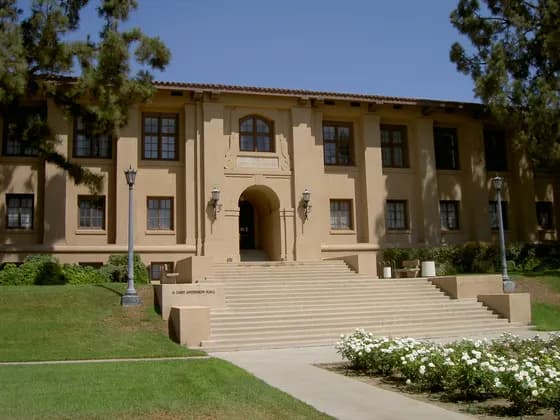
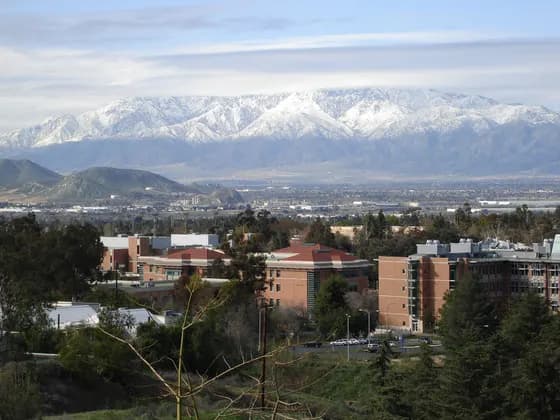
Photo: University of California, Riverside · Public domain · cropped
Photo: Americanist · Public domain · Photo: Arvind Ramanandan Arvindleela · Public domain · Photo: Maliagould · CC BY-SA 4.0
The UC Riverside School of Medicine MD program at a glance (2027 entry)
The University of California, Riverside School of Medicine (UC Riverside School of Medicine, or UCR SOM) runs a four-year MD program on the UC Riverside campus in Riverside, California. The school says it was created to address the shortfall of health care professionals in Inland Southern California. Its first class of 50 arrived in 2013. The school grew out of a UCR/UCLA program, begun in 1974, whose students spent two years of medical school at UC Riverside before transferring to UCLA.
A new curriculum, EVOLVE (Expanding Vision, Optimizing Learning, Valuing Excellence), goes live in June 2027, so August 2027 entrants follow it from day one. So far the school has described it through principles and phase outlines. The detailed block descriptions, hours and rules on its pages describe the current curriculum, and this guide says which is which.
Years 1 and 2 form the pre-clerkship (pre-clinical) phase, the classroom-based stage before full-time clinical work. On the current calendar it runs from early August of Year 1 to early June of Year 2. From Year 1 the Longitudinal Ambulatory Care Experience (LACE) also takes you into the practice of a community primary care physician, your preceptor.
Years 3 and 4 center on clerkships, the core clinical rotations, at hospitals and clinics across the region. To graduate you must pass Step 1 and Step 2 CK (Clinical Knowledge) of the United States Medical Licensing Examination (USMLE). You must also pass the Clinical Performance Examination (CPX), a California exam with people trained to play patients. The Liaison Committee on Medical Education (LCME), which accredits MD programs in the United States, lists the school as fully accredited.
Two programs shape each class. The Thomas Haider Program reserves seats for students who attend UC Riverside for at least six consecutive quarters and earn their bachelor's degree there. The Student Affairs page says at least 24 seats a year; the 2026-27 catalog says up to 24. The Haider Early Assurance Program guarantees selected in-state UCR students a seat, with entry one year after selection. PRIME (Program in Medical Education) admits six students a year.
| Degree | MD |
|---|---|
| Program length | 4 years; all requirements must be completed within six years |
| Curriculum | EVOLVE, live from June 2027, so it applies to August 2027 entrants |
| Class size | 94 enrolled in the Class of 2030; new building allows up to 125 |
| Anatomy | Cadaver dissection in Year 1, with ultrasound taught alongside |
| First patient contact | Year 1, through LACE half-days with a community primary care preceptor |
| Clinical sites | Riverside and San Bernardino counties, the Coachella Valley and a few beyond |
| Step 1 timing | Before Year 3; on current calendars, late April to early June of Year 2 |
| Grading | Current policy: pass/fail in Years 1 and 2; Honors to Fail in clerkships |
| Accreditation | LCME, Full; initial year 2012; next survey 2029-30 (directory updated October 14, 2026) |
What makes the UC Riverside School of Medicine MD program different
Three years with one community primary care physician
Through LACE you join a community primary care practice in Year 1 and stay with your preceptor through Year 3. Sites include practice groups, community clinics such as federally qualified health centers (federally funded clinics) and hospital clinics. Returning for three years lets you follow patients and see the longer-term results of their care.
A research project that every student completes
The Health Systems Science Project is a team research course run through LACE in Years 1 to 3. Projects aim to improve the quality and equity of care in Inland Southern California.
PRIME, a track for African, Black and Caribbean communities
PRIME admits six students a year to train for the African, Black and Caribbean communities of Inland Southern California; you need not belong to them to apply. It adds a two-week summer immersion before Year 1, mentors, case conferences, a preference for clerkship sites serving those communities and an optional master's.
Four-year emphases in medical Spanish and ultrasound
The HABLAMoS (Hispanic and Bilingual Longitudinal Ambulatory Medical Studies) Medical Spanish emphasis asks for at least 200 hours of Spanish-language learning. It ends in Year 4 with a rotation in a clinic serving Spanish-speaking patients, with an optional family homestay, or with work on Latinx immigrant health. The ultrasound emphasis builds on the scanning taught in Year 1 anatomy and ends with a CITrUS (Core Integrated Training in Ultrasound) certificate.
How UC Riverside School of Medicine teaches medicine
Years 1 and 2 combine the basic, clinical, behavioral and health systems sciences. The school describes instruction as driven by cases explored in small groups, labs, conferences, clinical skills workshops and independent study. Policy requires at least half of each pre-clerkship block's teaching time to be active learning rather than lectures.
Under EVOLVE each of the ten blocks has five modules: Foundational Sciences, LACE, Integrated Doctoring, Health Systems Sciences and Professional Identity Formation. Disease states come into Year 1 earlier. Health Systems Sciences covers topics such as biostatistics, epidemiology, evidence-based medicine, value-based care, public health, health disparities, medical economics, quality and safety, and law.
Integrated Doctoring combines doctoring and clinical skills, case-based learning (CBL) and clinical reasoning. It expands CBL through a planned learning communities model, which in medical schools usually means smaller groups of students who learn together over time.
The current curriculum's modules are Foundational Sciences, Case-based Learning, Doctoring, Clinical Skills and LACE, plus Biostatistics in Block 1. Current school pages call the small-group case sessions CBL; the 2026-27 catalog's second-year course descriptions and an older faculty page call them problem-based learning (PBL).
Required threads, themes taught across two to four years, cover clinical reasoning, health systems science, palliative care, pediatrics, public health and social medicine, and health equity, social justice and anti-racism. An interprofessional education thread has you learn with other health professions students, and EVOLVE adds substance abuse management and LGBTQIA+ health. Community physicians teach as clinical faculty: more than 1,000 volunteer clinicians, says one school page, or more than 1,300, says the faculty list updated in September 2026.
The ways you will learn
| Lectures and labs | The Foundational Sciences module carries the core science, from histology and physiology to anatomy, genetics and pathology. Lecture attendance is optional but strongly encouraged; attendance at active learning sessions is required. |
|---|---|
| Case-based learning | Small groups work through clinical cases with a faculty or clinician facilitator, who evaluates your performance. An older faculty page describes two Friday morning sessions per case, with facilitators asking questions that help you find the limits of your knowledge. |
| Doctoring and clinical skills | In small groups with faculty and standardized instructors you practice history taking, communication and physical examination, skills you then use with real patients in LACE. |
| Standardized patients and simulation | At the Center for Simulated Patient Care, standardized patients, people coached to portray a patient's history, personality and physical findings, let you practice safely and can give feedback. Mannequin simulators respond to your decisions in real time, with video review afterwards. |
A typical week on the UC Riverside School of Medicine program
In a pre-clerkship week, school policy caps required in-class instruction at 26 hours, with no more than 11 hours of lectures on average. Required teaching and exams are scheduled only between 8am and 5pm.
Each week also protects 4 hours for assigned independent learning, such as preparing for cases, and 10 hours of weekday self-study time. Optional electives and Designated Emphasis sessions (multi-year programs in areas such as medical Spanish and ultrasound) fit into self-study time, evenings or weekends. Every other week, one afternoon goes to your LACE practice; the 2023 LACE handbook set these on Tuesday, Wednesday or Thursday afternoons, from 1:30 to 5pm.
On the current calendar, blocks last five to nine weeks, each followed by an integrated examination period of up to a week. Low-stakes quizzes come every one to three weeks in between.
How anatomy is taught at UC Riverside School of Medicine
Anatomy is taught by dissection. In the gross anatomy lab, first-year students work at assigned dissection tables on bodies from the Donated Body Program at UC Irvine. The school's 2026-27 lab instructions ask you to treat each donor with the respect given to a living patient, and they protect donors' anonymity: no visitors or photography are allowed.
The lab, in the original School of Medicine Education Building, is open around the clock except during exam periods, but you never enter alone after hours. You complete safety training first and wear full protective equipment, including a face shield and gown, in the lab. Models, skeletons and radiographs support the dissections.
Each block covers the anatomy of its body systems; on the current first-year page, gross anatomy lectures and labs in Block 5 focus on the head and neck. Under the current grading policy, Year 1 block exams combine lecture, anatomy, histology and radiology or ultrasound content, and may include a lab practical. EVOLVE keeps anatomy and ultrasound integrated in Years 1 and 2.
Ultrasound is part of the gross anatomy program, taught by second-year instructors from the Ultrasound Student Instructor Cadre under a faculty advisor. Sessions follow the organ systems in lectures, moving from machine controls to the heart and lungs, kidneys and bladder, gut, muscles and joints, and the eye and thyroid. Instructors are chosen after summer training and the Ultrasound Games, held on the first weekend of Block 6.
When you first meet patients at UC Riverside School of Medicine
Patient contact starts in Year 1 through LACE, which the school calls its three-year longitudinal clerkship. A Year 1 survey asks where you live, how you travel, which languages you speak and what interests you. The LACE team uses your answers to match you with a community primary care preceptor.
In Years 1 and 2 you spend one half-day every other week in your preceptor's practice, and in Year 3 one half-day every week alongside your clerkships. The 2023 LACE handbook set 16 sessions in Year 1, 15 in Year 2 and 39 in Year 3. In that handbook the first session falls in week 5 of Block 1, with tasks such as taking vital signs, a history and a skin exam.
The same handbook lists skills to practice in each block. They build from vital signs and examinations in Year 1 to differential diagnoses and management plans, for conditions such as diabetes and heart failure, in Year 3. You log your patient encounters, and each LACE year includes at least one observed encounter and a mid-year feedback meeting, both led by your preceptor in that handbook.
Outside the curriculum, students run two free clinics. The Riverside Free Clinic serves underserved people across the Inland Empire, and the Coachella Valley Free Clinic serves the Eastern Coachella Valley, where patients are mainly migrant, uninsured farm workers.
The UC Riverside School of Medicine curriculum, year by year
- Year 1
An integrated approach to human biological systems
Year 1 works through the body system by system in five block courses, from August to early June on the current calendar. It opens with an orientation week, Introduction to the Profession, and the White Coat Ceremony. EVOLVE keeps these block names; the topic summaries below come from the current curriculum pages.
- Block 1, Foundations of Medicine I: genetics and molecular, cellular and developmental biology in relation to disease, plus a biostatistics and epidemiology module in the current curriculum.
- Block 2, Cardiovascular, Renal and Respiratory Medicine I: how the heart, kidneys, lungs and autonomic nervous system work and respond to stress and disease.
- Block 3, Gastrointestinal, Endocrine and Reproductive Health I: digestive physiology, medical biochemistry and molecular endocrinology, with an emphasis on metabolic disorders and human nutrition.
- Block 4, Musculoskeletal Medicine, covers the peripheral nervous and musculoskeletal systems; Block 5, Clinical Neurosciences I, covers the central nervous system, including vision and hearing.
- Year 2
An integrated approach to the pathophysiology of disease
Year 2 revisits the body systems with the focus on disease, diagnosis and treatment, in four block courses followed by Block 10. EVOLVE keeps these block names; the topic summaries for Blocks 7 to 9 below come from the current curriculum pages. EVOLVE redesigns Block 10 as Step 1 preparation, a change already underway as an early initiative. LACE 2 continues every other week.
- Block 6, Foundations of Medicine II: infectious diseases, host defense and immunity, immune disorders, hematology and oncology, epidemiology and clinical reasoning.
- Blocks 7 and 8 return to the cardiovascular, renal and respiratory systems and to gastrointestinal, endocrine and reproductive health, adding therapeutics, imaging, common cancers, infections and prevention.
- Block 9, Clinical Neurosciences II: neurology, neuropathology, psychiatry and neuropharmacology, coordinated with physical and psychological clinical skills.
- In the current Block 10 you get board review presentations and sit the National Board of Medical Examiners (NBME) Basic Science Comprehensive Exam. It also requires you to pass an Objective Structured Clinical Examination (OSCE), a circuit of timed clinical stations.
- On the current calendar, Block 10 falls in mid-April and dedicated Step 1 study runs to early June.
- Year 3
Patient-centered clinical experiences
Year 3 starts in June with the two-week Transition to Clerkships Course (T2C2), covering onboarding, safety and the clinical workplace. Then come the clerkships, in which you work on hospital and clinic teams under supervision. LACE 3 continues weekly, and the year ends with the CPX and your research capstone.
- Eight core clerkships: internal medicine and surgery (8 weeks each), pediatrics and obstetrics and gynecology (6 weeks each), family medicine and psychiatry (4 weeks each), and emergency medicine and neurology (2 weeks each).
- On the current schedule the year runs in two 24-week halves. Internal medicine and surgery alternate in four-week stretches, and pediatrics and obstetrics and gynecology in three-week stretches.
- On the current third-year page, internal medicine is mostly inpatient. In surgery you scrub in on open and laparoscopic operations and practice knot tying and skin closure in the simulation lab.
- Pediatrics mixes clinic and inpatient care, from newborns to adolescents. Obstetrics and gynecology covers clinic, labor and delivery and the gynecologic operating room.
- Psychiatry splits two weeks inpatient and two outpatient, and neurology one week each. Family medicine is four weeks in a local outpatient clinic, and emergency medicine is in a nearby emergency department.
- Three 2-week electives. The current year also has a two-week Community-based Experience at two community sites, while EVOLVE's outline lists a new two-week Community Advocacy Course, with chances to work alongside Master of Public Health students.
- EVOLVE adds intersessions linking topics across clerkships, such as depression in primary, emergency and mental health care, plus Balint groups, where trained facilitators help you talk through emotionally difficult cases.
- EVOLVE also plans new observed patient encounters and simulation within clerkships, some for practice and some graded, plus extra teaching in high-impact Step 2 CK areas.
- Year 4
Individualization and exploration
Year 4 has 11 four-week periods, starting in late June or early July on recent calendars. It combines required courses with 24 weeks of electives, which you plan with residency, the specialty training after medical school, in mind. Match Day, when residency places are announced, falls in mid-March.
- Sub-internship (an acting internship): four consecutive inpatient weeks at one site, working at the level of an intern, a first-year resident, as the main provider for your own patients.
- Critical care: four weeks in a medical, surgical, pediatric, neonatal, neurological or cardiac intensive care unit, with four hours of faculty-led teaching each week.
- Radiology: a four-week course taught entirely online, with faculty-led teaching, image reviews and a final exam.
- Transition to Residency: four weeks in March of simulation, lectures and small groups. After two shared weeks you join a procedural or medicine track based on your matched specialty.
- Four flex weeks with no duties: two taken between July and December, for example for residency interviews, and two reserved for January to May.
- Under EVOLVE you also complete graduation assessments tied to the school's mission, such as advocacy, value-based care and culturally responsive care skills.
How you are assessed at UC Riverside School of Medicine
Under the school's current grading policy (July 2026), written for the curriculum EVOLVE replaces, each Year 1 and 2 block course is graded Pass or Fail. Passing needs at least 70% in every module and on the Foundational Sciences final exam, with no rounding up. That exam is worth 75% of the module grade and low-stakes quizzes up to 20%.
Under the same policy, Year 1 final exams are written by UCR faculty; Year 2 uses NBME exams customized to what was taught. Each block also ends with an individual clinical skills assessment, with formative OSCEs for practice. Where it can, the school releases target scores rather than class averages or rankings.
Under the current policy, third-year clerkships are graded Honors, High Pass, Pass or Fail, weighted 35% knowledge, 45% clinical performance and 20% professionalism. Most test knowledge with an NBME shelf exam, a national subject exam; passing needs the 6th percentile nationally, and failing a first attempt limits that clerkship to a Pass. Emergency medicine and neurology set their own final exams.
In the current Year 3, formative OSCEs in the fall and spring, each with four patient encounters, do not affect grades; a color code tells you if you are on track. At the end of Year 3, the CPX, designed by clinicians and educators from 10 California medical schools, has you see eight patients with a broad range of outpatient problems. If you do not pass, a workshop and a retest follow.
Under the current policy, in Year 4 the sub-internship, critical care, radiology and electives are graded Honors to Fail, and Transition to Residency is pass/fail. Your Medical Student Performance Evaluation (MSPE), the dean's letter residency programs read, places you in one of five categories, from Distinguished to Good, with no set share of the class in each.
In the USMLE licensing exams, Step 1, on the sciences behind medicine, has been pass/fail since January 26, 2022, and Step 2 CK covers clinical medicine. For MD students, attending an LCME-accredited school is what makes you eligible to sit them, while DO students and international graduates qualify through other routes.
- Step 1 must be sat before Year 3 and passed for you to continue in clerkships (policy 950-07-015, April 2026). If you are not consistently passing NBME practice exams, you can be approved for four more weeks of study, delaying Year 3 by four weeks.
- Later deadlines exist. To start Year 3 in January, you must sit Step 1 by October 1 and pass by November 1. Otherwise you rejoin in June the following year, sitting by February 1 and passing by April 1.
- Step 2 CK is taken at the end of Year 3 or the start of Year 4.
- On the current schedule, an August 2027 entrant, the Class of 2031 by the calendar's labeling, would sit Step 1 in dedicated study ending in early June 2029. Step 2 CK would follow around June to late summer 2030.
- That projection follows the 2025-26 and 2026-27 calendars, the latest the school has published.
- In August 2026 the USMLE program announced a move to designated testing dates from January 2029, with Step exams offered less often each year. A June 2026 notice had named 2028. Both of your Step exams would fall after the change.
- USMLE says it will publish testing dates more than a year ahead and has urged schools to revisit policies that restrict when students test, so UC Riverside's Step deadlines may change.
UC Riverside School of Medicine clinical rotations: where you will actually train
For Years 1 and 2 you are based on the UC Riverside campus, apart from your LACE practice, which can be anywhere in Inland Southern California. From Year 3 you train across the school's network of community hospitals and regional medical centers.
That network includes the public safety-net hospitals of Riverside and San Bernardino counties, private acute care centers, community hospitals and a nonprofit integrated health plan. There are also two behavioral health centers, a Veterans Administration facility, a state-operated forensic psychiatric hospital and clinics of UCR Health, the school's clinical practice.
An optional third-year clerkship lottery places you in one of eight tracks, each with a fixed rotation order, and lets you request clinical sites. If you skip it, the Office of Medical Education builds your schedule, and final assignments depend on curriculum requirements and site availability.
You are expected to travel to any assigned site, so you need reliable transportation. Students on required third-year clerkships in Palm Springs and the Coachella Valley, in towns such as Palm Desert, Rancho Mirage, La Quinta and Indio, are given housing. In the 2023 LACE handbook, students based in the desert for 16 or more weeks switched to a LACE preceptor there.
RUHS Medical Center has 439 beds and more than 60 clinics. Riverside Community Hospital is a Level I trauma center and comprehensive stroke center, and Pacific Grove Hospital treats psychiatric and substance use disorders.
- Riverside Community Hospital
- Riverside University Health System Medical Center, Moreno Valley
- Kaiser Permanente Riverside and Moreno Valley
- Pacific Grove Hospital
- Riverside Medical Clinic
- UCR Health Citrus Tower and Silver Oaks clinics
St. Bernardine is a 342-bed nonprofit acute care hospital, and Arrowhead Regional is the county's own hospital. Patton State Hospital is a 1,500-bed state psychiatric hospital for patients committed through criminal or civil proceedings.
- St. Bernardine Medical Center, San Bernardino
- Arrowhead Regional Medical Center
- Kaiser Permanente Fontana and Ontario
- San Antonio Regional Hospital, Upland
- Patton State Hospital
Eisenhower is a 463-bed hospital in the not-for-profit Eisenhower Health system.
- Eisenhower Medical Center
- UCR Health La Quinta
Anaheim is in Orange County and Pomona in Los Angeles County.
- Kaiser Permanente Anaheim
- Pomona Valley Medical Center
From the third-year page and onboarding list. Corona Regional pairs a 160-bed acute care hospital with a 78-bed rehabilitation campus.
- Corona Regional Medical Center
- Temecula Valley Hospital
- Rancho Springs Medical Center
- Inland Valley Hospital
Electives, selectives and away rotations at UC Riverside School of Medicine
In Years 1 and 2, electives are optional small-group courses for students in good academic standing, on topics such as medical Spanish, humanities, ultrasound and nutrition. They start no earlier than November 1 of Year 1. Most carry 10 to 18 hours, you can take two at once, and you need 80% attendance.
Year 3 has three 2-week clinical electives in nearly every field, assigned by lottery and subject to capacity; you can even propose a new elective subject. In Years 3 and 4, students in good standing can also take Scholarly Activities Electives, protected time for about 30 hours a week of research and writing.
Year 4 holds 24 weeks of electives, or up to 28 if you give up flex time. At least 12 weeks must be clinical, meaning 20 or more hours of direct patient contact a week, including at least 4 weeks in a second specialty. Up to 12 weeks can be non-clinical, such as research, online modules, reading, teaching or wilderness medicine.
Electives can be at UCR core sites or away. Away rotations at other US medical schools and academic medical centers are booked through Visiting Student Learning Opportunities (VSLO), a service of the Association of American Medical Colleges (AAMC). You request your Year 4 schedule in April from a catalog of approved home and away sites.
Designated Emphasis programs are optional, pass/fail programs lasting up to four years, built partly from electives and selectives. You can join from November 1 of Year 1 if you are in good academic standing, hold at most two at once, and must attend at least 80% of sessions. Completed emphases appear on your transcript. There are five:
- Community Health, with the Inland Empire Area Health Education Center (AHEC) Scholars Program: 189 hours, including 120 hours of clinical training at a federally qualified health center. You also complete a community project by February of Year 4 and earn a California AHEC certificate.
- Healthcare Leadership: 15 students a year complete 300 contact hours over four years through workshops, community engagement and projects they lead, such as improving patient flow at the Riverside Free Clinic. It earns a distinction on your MSPE.
- Medical and Health Humanities: at least 180 hours of courses, research, a capstone and a public presentation, joinable any time in your first three years. Courses range from history of medicine to graphic medicine.
- Medical Spanish (HABLAMoS): open to all language levels until the end of Block 1 of Year 2, with conversation workshops and free-clinic encounters from Year 1.
- Point of Care Ultrasound (POCUS): you teach in the instructor cadre in Year 2 and log clerkship scans in a CITrUS passport in Year 3. Year 4 adds a four-week ultrasound elective, a two-week capstone and a POCUS OSCE, finished by May for the certificate.
Dual degrees and research years at UC Riverside School of Medicine
Research is built in for everyone through the Health Systems Science Project, the school's main inquiry course, run within LACE in Years 1 to 3. Working in teams, you move from literature review and a research question to review by the Institutional Review Board (IRB), the panel that approves research on people, then to data collection and analysis.
You present your work at the annual Dean's Research Day; the fourth was scheduled for April 3, 2026. Everyone takes human subjects research training in Year 1 and renews it in Year 3.
Optional research comes on top. After Year 1 you can apply for a summer project with a faculty mentor, with a stipend and one unit of credit. The Student Affairs research page describes a six-week fellowship, while the 2026 Summer Research Program ran eight weeks, June 8 to July 31. In Year 4 you can earn credit for up to two four-week research electives with a faculty mentor and a written report.
The MD/PhD adds a PhD in Biomedical Sciences: you normally complete the first two years of medical school, spend about three years on the PhD, then return to finish the MD. The MD/MPP (Master of Public Policy) with UC Riverside's School of Public Policy is open once you have entered Year 3. You apply that fall or winter, spend a full academic year there, then finish the MD with a health policy capstone.
Current UCR medical students can also add an MS in Biomedical Sciences, a research master's with a thesis or comprehensive exam. The school pitches it at students who want a year away from the MD for research. PRIME students may take a master's, such as in public health, public policy or business, before their final year.
Facilities and support at UC Riverside School of Medicine
Where you will learn
Teaching happens in two education buildings on the east side of campus, next to the Orbach Science Library. Education Building II, which opened in September 2023, has four large classrooms, 15 case-based learning rooms and study space. Two of its large classrooms combine into one room for more than 300, and it also has a 136-seat tiered lecture hall.
The original Education Building, opened in 2012 and refurbished in 2023, houses the anatomy lab, a 100-seat lecture hall, small-group rooms and 10 patient examination rooms.
The Clinical Skills and Simulation Suite, part of the Center for Simulated Patient Care, opened in 2021 in the basement of the Orbach Science Library. Its 11,000 square feet hold mock exam rooms, emergency room and intensive care simulation spaces and small lecture rooms, used for both training and testing.
Support while you study
Academic advising is kept separate from grading: it comes only from faculty and peers with no role in assessing or promoting you. The Director of Academic Success runs supplemental instruction, peer tutors and Step Coaches, students chosen for how they prepared for Step 1 and passed it. Academic counseling also offers individual study plans and workshops, including on preparing for the USMLE.
The Office of Student Support and Wellness offers wellness planning, mental health trainings, workshops and weekly group meditation, with a mental health professional who mainly supports first-year students. The school also contracts an off-campus psychiatrist with no clinical affiliation to the school, keeping counseling separate from your education.
Four full wellness days a year in Years 1 to 3, and three half-days in Year 4, are fixed in the calendar for appointments and rest. On clerkships you follow the duty-hour limits set for residents: no more than 80 hours a week averaged over four weeks, with 10 hours off between shifts.
Every first-year student gets a second-year mentor through the Big Sib/Little Sib program. Under EVOLVE, the Professional Identity Formation module adds leadership, wellness, career advising and extra support for students who are the first in their family to attend medical school.
Is the UC Riverside School of Medicine program right for you?
This program may suit you if
- You want to follow patients with one community primary care physician for three years, from Year 1.
- You are committed to primary care and underserved communities in Inland Southern California, the mission behind LACE, PRIME and the Community Health emphasis.
- You learn well through small-group cases and active sessions, with lecture attendance optional.
- You want research training built into the core course, ending in a project you present at Dean's Research Day.
- You would use medical Spanish or bedside ultrasound, each offered as a multi-year emphasis.
Things to think about
- You would start on EVOLVE, live from June 2027 and so far published as an outline, so details may still change.
- Clerkships spread across two counties and the desert, so you need reliable transportation; required third-year clerkships in the Coachella Valley come with housing.
- You must pass Step 1 to continue in clerkships, and USMLE designated testing dates begin in January 2029, before you would sit it.
- Under the current policy, clerkships are graded Honors to Fail with shelf exams, and failing a first shelf exam caps that clerkship at Pass.
UC Riverside School of Medicine MD program — frequently asked questions
Applying to UC Riverside School of Medicine?
How to get into UC Riverside School of Medicine
Prerequisites, MCAT, AMCAS personal statement, secondaries and interview, step by step.
Open the guide →UC Riverside School of Medicine admissions profile
MCAT and GPA profile, acceptance rate, interview format and key dates.
See the profile →Compare UC Riverside School of Medicine with other schools
Put the teaching style, anatomy teaching and clinical sites next to another school.
Open the comparison →Prepare for the UC Riverside School of Medicine interview
Format breakdown, school-specific sample questions and prep tips from tutors who interviewed here.
Read the guide →Where this UC Riverside School of Medicine program guide came from
This guide was written from 97 official sources — University of California, Riverside School of Medicine's own program pages and curriculum documents, plus the accreditor and the hospitals and health systems the school trains students in where they publish detail — read on 2026-10-15, then checked claim by claim against those sources.
- UCR School of Medicine Undergraduate Medical Education: home and curriculum overview
- Medical Education and Curriculum
- EVOLVE Curriculum: Expanding Vision. Optimizing Learning. Valuing Excellence.
- EVOLVE Years 1 and 2: Systems-Based Integrated Sciences Phase
- EVOLVE Year 3: Patient-Centered Clinical Experiences Phase
- EVOLVE Year 4: Individualization and Exploration Phase
- EVOLVE Longitudinal Curricula: threads, scholarly activities and Designated Emphasis programs
- School of Medicine News: Announcing the EVOLVE Curriculum (March 23, 2026)
- First-Year Curriculum
- Second-Year Curriculum
- Third-Year Curriculum: clerkships, clinical teaching sites, grading and OSCEs
- Fourth-Year Curriculum
- Longitudinal Ambulatory Care Experience (LACE)
- LACE Student Handbook, last updated August 1, 2023
- Four-Year Threads
- Interprofessional Education thread
- MS1 and MS2 Elective Opportunities
- Designated Emphasis Programs
- Community Health Designated Emphasis
- Healthcare Leadership Designated Emphasis
- Healthcare Leadership Program projects
- Medical and Health Humanities Designated Emphasis
- Medical Spanish Designated Emphasis (HABLAMoS)
- Designated Emphasis in Point of Care Ultrasound
- Ultrasound Education
- First Year Ultrasound Curriculum
- Ultrasound Student Instructor Cadre
- Program in Medical Education (PRIME), UME page
- UC Riverside General Catalog 2026-2027: School of Medicine, MDCL courses, Thomas Haider Program, MD/PhD and MD/MPP
- 2026-2027 Medical Education Academic Calendar
- 2025-2026 Medical Education Academic Calendar
- Human Gross Anatomy: Laboratory Safety Instructions 2026-2027
- Policy 950-07-015: Student Deferment of USMLE 1
- Policy 950-07-021: Evaluation, Promotion and Graduation Standards
- Policy 950-06-012: Grading Scales, Grading Criteria and Grade Reporting
- Policy 950-06-001: Required Developmental Assessment Plans for All Pre-Clerkship Courses
- Policy 950-06-008: CQI for Promoting Active Learning in Pre-Clerkship Courses
- Policy 950-06-028: Amount of Time per Week in Student Required Activities
- Policy 950-06-035: Student Assignment (site selection)
- Policy 950-06-042: MS4 Scheduling
- Policy 950-06-044: Y1 and Y2 Electives
- Policy 950-06-047: Designated Emphases Operations
- Policy 950-07-005: Academic Advising at UCR SOM
- Policy 950-07-004: Medical Student Performance Evaluations (MSPE)
- Policy 950-07-022: Wellness Days for Medical Students
- Policy 950-06-015: Duty Hours
- Policy 950-06-019: Required Observed Clinical Encounter in the Clinical Years
- Policy 950-06-018: Required Mid-clerkship Feedback
- Policy 950-06-020: Requisite Diagnoses and Procedures in the Required Clinical Rotations
- Policy 950-06-016: Medical Student Research
- Third Year Compliance and Clinical Onboarding Requirements (clinical sites)
- UCR Health Riverside Downtown (Primary Care), at Citrus Tower in downtown Riverside
- UCR Health Riverside South, Silver Oaks Business Park, Riverside
- Arrowhead Regional Medical Center, San Bernardino County's hospital (home page)
- Arrowhead Regional Medical Center: Medical Student Rotations
- San Antonio Regional Hospital, Upland (home page)
- California Department of State Hospitals: DSH-Patton
- Information for Incoming Students
- Admission to Medical School: Class of 2030 profile
- Thomas Haider Program at the UCR School of Medicine
- Haider Early Assurance Program
- EAP Program Requirements
- Program in Medical Education (PRIME), Student Affairs page
- Research Opportunities
- Research Schedule
- MS4 Research Rotations
- Scholarly Activities Portal: Health Systems Science Project
- Scholarly Activities Portal: Scholarly Activities Electives
- Scholarly Activities Portal: Summer Research Program 2026
- Scholarly Activities Portal: home (Dean's Research Day 2026)
- Office of Student Support and Wellness
- Student Support Services
- Campus Health and Wellness Resources
- Student Activities: Big Sib/Little Sib mentoring
- Student Interest Groups, including the student-run free clinics
- UC Riverside School of Medicine home page (official course page on file)
- Mission, Vision, Diversity and Values Statements
- About the School of Medicine and LCME accreditation statement
- History of the UCR School of Medicine
- School of Medicine Facilities
- Standardized Patients in Medical Education
- About the Center for Simulated Patient Care
- Simulation Center
- Becoming Community-Based Faculty
- Community-Based Clinical Faculty list (updated September 2026)
- MD/MPP Concurrent Degree Program
- MD/PhD Combined Degree
- Our Degree Programs
- Master's Curriculum, Biomedical Sciences (MD/MS dual degree)
- UCR Magazine, Fall 2023: 10 Years and Counting
- School of Medicine Education Building II project
- LCME directory of accredited programs (updated October 14, 2026)
- USMLE Designated Testing Dates Information Hub
- USMLE: Updated Timeline for Designated Testing Dates, Transition in January 2029 (August 6, 2026)
- USMLE: Transition to Limited Testing Dates Each Year Starting in 2028 (June 23, 2026)
- USMLE Designated Testing Dates FAQs
- USMLE Exam Results and Scoring
Curricula are restructured between cycles. Anything here that decides your application — how anatomy is taught, a clinical campus assignment, a required research year — should be confirmed against the official page for your entry year.
Applying to UC Riverside School of Medicine?
We help US applicants with MCAT strategy, the AMCAS personal statement, secondary essays and interview prep — everything you need for a competitive UC Riverside School of Medicine application.