
The TCU Burnett Marion School of Medicine MD program
What you actually study, and where you will be
TCU Burnett Marion School of Medicine's MD is a 4-year program with an integrated curriculum, with patient contact from Year 1 and clinical rotations in Fort Worth and nearby North Texas cities (2027 entry). You start with about 15 months of integrated science in a flipped classroom, where you prepare before class and spend class time on cases and group work. You also see patients with a primary care physician from the first weeks. The next phase runs eight clinical specialties side by side for 38 weeks, and every student completes a four-year research thesis.
- Degree
- MD
- Length
- 4 years
- Teaching
- Integrated
- Clinical contact
- Year 1

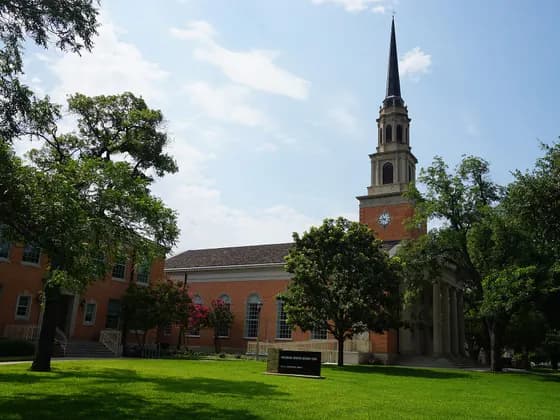
Photo: Michael Barera · CC BY-SA 4.0 · cropped
Photo: Michael Barera · CC BY-SA 4.0 · Photo: Renelibrary · CC BY-SA 4.0 · Photo: Kgredi76 · CC BY-SA 4.0
The TCU Burnett Marion School of Medicine MD program at a glance (2027 entry)
The Anne Burnett Marion School of Medicine at Texas Christian University (TCU Burnett School of Medicine), in Fort Worth, Texas, awards the MD (Doctor of Medicine) after four years. Its first students started in July 2019, and its class size is 60. The Liaison Committee on Medical Education (LCME), which accredits MD programs in the United States, lists the program with full accreditation and its next survey in 2027-28, in a directory updated November 13, 2026. The school has that visit scheduled for January 2028.
The school calls its design the Empathetic Scholar curriculum, after the physician it wants to train: strong in the science, a careful listener and able to see illness from the patient's side. Communication teaching runs through the whole program. Three phases replace the usual academic years. Phase 1 lasts about 15 months, Phase 2 about 13 and Phase 3 about 18.
Phase 1 is the pre-clerkship stage, before full-time clinical rotations. Five courses called Mechanisms of Health and Disease (MHD) take you through the body's systems, mainly in structured small groups. Beside them you learn clinical skills and spend regular time with a primary care preceptor (a physician who teaches you in clinic) and a panel of patients you see more than once. The phase ends with preparation for Step 1 of the United States Medical Licensing Examination (USMLE), the national licensing exams.
Phase 2 is a longitudinal integrated clerkship (LIC). Clerkships are the core clinical rotations, and in a block system you finish one before starting the next. Here you begin with 12 weeks in the hospital, then see patients in eight specialties in parallel for 38 weeks, paired with a preceptor in each, at sites around Fort Worth. That lets you follow people over time, for example through a pregnancy to the delivery.
Every student also plans, carries out and writes up a four-year research project, the Scholarly Pursuit and Thesis. Phase 3 combines advanced hospital rotations, critical care, at least 28 weeks of electives (options you choose) and a final course that prepares you for residency, the specialty training that follows the MD.
| Degree | MD (Doctor of Medicine), 4 years |
|---|---|
| Curriculum | Empathetic Scholar curriculum, in phases of about 15, 13 and 18 months |
| Class size | 60 per class; 61 students started in July 2026 |
| Main building | Arnold Hall, Medical Innovation District, Fort Worth |
| Anatomy | Cadaveric anatomy plus augmented reality with HoloLens headsets |
| First patient contact | Primary care clinic from the first weeks of Phase 1 |
| Clerkships | Eight, run together as a longitudinal integrated clerkship in Phase 2 |
| Clinical sites | Nine listed hospital and health-system partners, seven with Fort Worth addresses |
| USMLE Step 1 | Six-week preparation course at the end of Phase 1 |
What makes the TCU Burnett Marion School of Medicine MD program different
A clinic and patient panel in Phase 1
Phase 1 has its own clinical course, the LIC Foundational Experience. You are assigned a primary care preceptor, have regular sessions in that clinical setting and follow a panel of patients you see more than once. Your role at this stage is communication, patient education and advocacy, so you learn to talk with patients while you are still learning the science of their conditions.
Eight specialties in parallel for 38 weeks
After opening blocks in the hospital, you work in emergency medicine, family medicine, internal medicine, neurology, obstetrics and gynecology, pediatrics, psychiatry and surgery over the same months. The school's LIC page describes a half day a week, or every other week, with each preceptor. Staying with the same physicians lets you see what happens to your patients next.
A four-year research thesis for every student
The Scholarly Pursuit and Thesis course runs through all three phases. You choose a mentor and write a prospectus, the plan for your study, in Phase 1. You gather and analyze data in Phases 2 and 3, then submit a thesis and present a poster. Mentors and projects can come from any field, as long as the project can be researched effectively.
Each first-year week opens with a patient
In weekly content framing sessions, a patient tells the class about a condition linked to that week's learning objectives. The first speaker for the classes that entered in 2025 and 2026 was a retired police officer badly burned in a 2001 crash. Faculty choose the patients on purpose, so that when you memorize the science you can think back to a person.
Communication training in all three phases
Communication teaching starts in the first two weeks and finishes in the last course, Transition to Residency. It includes a framework from the Academy of Communication in Healthcare and bystander training, which prepares you to step in on your own behalf or for others. Medical Spanish is built into Phase 1 at every level from beginner to advanced.
Weeks on AI, genomics and design
The Future Accelerators of Medicine and Beyond (FAB) course runs in weeklong blocks on artificial intelligence, genomics, lab tests of the future and design thinking. Design thinking is a method that builds solutions around the people who will use them. In a week reported in June 2026, twelve teams of five pitched preventive health ideas to guest judges called sharks.
How TCU Burnett Marion School of Medicine teaches medicine
Phase 1 teaches basic, clinical and behavioral sciences together, organized around organ systems. A foundations course comes first, then the systems follow in four more MHD courses. For each system you study normal and abnormal structure and function and the reasoning behind tests and treatments.
The classroom is flipped: you do the assigned reading first, then use the session to apply it to cases with your group and faculty. A December 2025 article describes first-year students building models of the hypothalamus and pituitary gland, the control center for hormones. One from January 2024 shows them bending pool noodles and molding Play-Doh to follow how an embryo develops.
In Phase 2 the clinic becomes the main classroom. You learn from the patients you follow, with one afternoon a week kept for group teaching during the ambulatory, or outpatient, months.
The ways you will learn
| Patient-Centered Inquiry-Based Learning (PIBL) | A small group receives a patient case in stages. You pick out clues, suggest explanations, decide what you need to learn, research it and teach each other. The faculty facilitator guides this process rather than teaching the content, according to the 2023-24 facilitator guide. |
|---|---|
| Content Application Sessions (CAS) | Flipped-classroom sessions on one content area. After pre-reading, you work through cases or other active tasks with a content expert, often alongside a basic scientist and a clinician. |
| Clinical Skills | Small groups, averaging about three students per faculty member, practice histories, examinations, documentation and case presentations. Every session now includes an encounter with a standardized patient, a person trained to play a patient, who also gives feedback. |
| Simulation and mixed reality | Life-sized manikins breathe, speak and have a heartbeat, so you can rehearse emergencies without risk to patients. Skills training covers techniques such as intubation, ultrasound, IVs and suturing. A manikin described in February 2026, HAL S5301, answers questions using artificial intelligence and shows signs of neurological emergencies. |
| Learning, Application and Pondering Sessions (LeAPS) | Thursday-afternoon teaching during the ambulatory part of Phase 2. The sessions are built across all the clerkships and use active learning to cover foundational material. |
A typical week on the TCU Burnett Marion School of Medicine program
In Phase 1 the school limits structured classroom time to about 20 hours in a given week, according to its undated curriculum page. You have the flexibility to arrange 20 additional hours a week for self-directed and independent study.
A first-year week starts with a content framing session. In the 2023-24 facilitator guide, PIBL groups opened a case on Monday and finished it on Friday, rotating roles such as leader, scribe and timekeeper. Exams are on Friday mornings, and PIBL is dropped in MHD exam weeks.
In the ambulatory part of Phase 2, a sample two-week schedule on the curriculum page has family medicine, surgery, internal medicine, pediatrics and LeAPS in both weeks. Psychiatry and emergency medicine appear in the first, neurology and obstetrics and gynecology in the second. The school also says it reworked the schedule to give students a full day in the operating room.
The 2026-27 calendar gives first-years a week off at Thanksgiving, two weeks in winter and a week in March. Phase 1 then runs through the summer: the 2025-26 spring term ended on July 2, 2026, and the next fall term began on July 6.
The 2026-27 handbook expects you at every mandatory session and clinical experience, but lets you request an absence in specific situations. It also expects you to tell faculty, staff and classmates about a delay or absence ahead of time. If your LIC schedule changes, you tell your preceptor, the course or clerkship director and the LIC coordinators. In the Phase 2 LIC, the school says, you have the option of one excused absence to attend a conference where you are presenting.
How anatomy is taught at TCU Burnett Marion School of Medicine
The school describes its anatomy teaching as cadaveric plus augmented reality (AR). MHD I includes a section called Introduction to Anatomical Sciences. MHD II and IV tie anatomy and embryology to their organ systems, and MHD V begins by building an anatomic foundation for the nervous system. The technical standards, which set out abilities every student must have with or without reasonable accommodation for a disability, include observing cadaveric dissection.
The AR part uses the Microsoft HoloLens, a headset that places a 3-D model in the room so you can work with it and still see your surroundings. The software is called HoloAnatomy.
When you first meet patients at TCU Burnett Marion School of Medicine
Patients appear almost at once. In Introduction to Medicine, the two-week opening course, you meet standardized patients and are introduced to the LIC. News articles from 2023 and 2025 say new students are paired with a preceptor and start seeing patients in their first weeks. The 2026-27 handbook says patient care begins when you enter the program.
Outside class, students volunteer at the student-run clinic at Mercy Clinic of Fort Worth. A December 2023 article said the clinic gives free care to uninsured, low-income people in two ZIP codes, and described students drawing blood, checking blood pressure and giving assessments under faculty supervision. The 2026-27 handbook says programming in service learning (learning through community service) is being reevaluated but that the Mercy volunteer clinic continues.
From Phase 2 most of your learning is clinical, and you build a panel of patients in each discipline. Throughout the program, the 2026-27 handbook says, you are supervised at all times when caring for patients, with responsibility matched to your level of training. What you do must also be within the scope of practice of the health professional supervising you.
The TCU Burnett Marion School of Medicine curriculum, year by year
- Phase 1: first two weeks
Introduction to Medicine
The program opens in early July (July 6 in 2026) with a two-week course instead of an orientation week. It gives you a low-stakes way to get used to the flipped classroom, the LIC model and communication training before the main courses begin.
- You meet standardized patients, use a HoloLens headset and handle ultrasound equipment.
- Sessions introduce research, service learning and student resources, and TCU Police and other staff give safety training.
- Your first content framing patient also speaks in these opening weeks.
- Phase 1: year 1 to summer of year 2
Organ systems, clinical skills and an early clinic
Five MHD courses run in sequence while five longitudinal courses continue beside them, so science, clinical skills, clinic and research overlap throughout. The order below comes from the 2026-27 handbook.
- MHD I lays the foundations: Introduction to Anatomical Sciences, Health and Wellness, and When Things Go Wrong.
- MHD II covers hematology (blood), then the musculoskeletal system and skin, then the endocrine (hormone) system.
- MHD III covers the cardiovascular, pulmonary and renal systems and how the heart, lungs and kidneys work together.
- MHD IV covers the gastrointestinal system with the fundamentals of nutrition, then the reproductive system.
- MHD V covers the nervous system in two parts and ends with behavior and psychiatry.
- Clinical Skills teaches history-taking, physical examination, communication, documentation, oral presentation and clinical reasoning.
- The LIC Foundational Experience puts you with a primary care preceptor; the undated curriculum page lists it as 21 course weeks.
- Preparation for Practice I covers health care delivery and financing, ethics, policy, patient safety, population and global health, and team-based care. The school says the team-based care theme includes training opportunities shared with students of other disciplines.
- Scholarly Pursuit and Thesis I and the FAB weeks complete the phase's longitudinal courses.
- Phase 1: August to September of year 2
Step 1 preparation
Phase 1 closes with six weeks of directed independent study for Step 1, the USMLE's basic science exam, whose results have been reported only as pass or fail since January 2022. The course began on August 10 in 2026 and was followed by a four-week recess.
- The course offers test-taking techniques, extra study materials and faculty support.
- Learning specialists help you build a study plan and assess your readiness for the exam.
- The school says it gives each student a free UWorld question bank subscription and runs Saturday School review sessions.
- Phase 2: October of year 2 to November of year 3
Longitudinal integrated clerkship
Phase 2 (from October 19 in 2026) opens with Transition to LIC, which includes hands-on practice such as suturing. Then come 12 weeks of inpatient (hospital) immersions and 38 ambulatory weeks in eight clerkships, with short inpatient clusters called Bursts and outpatient ones called Experiences.
- Immersions come in internal medicine, obstetrics and gynecology, pediatrics and surgery. Surgery lasts four weeks; obstetrics and gynecology lasts three, in the hospital and on labor and delivery.
- In surgery you then spend most of your time paired with a surgeon, in both the clinic and the operating room.
- In obstetrics and gynecology you follow your panel patients into the hospital for births and gynecologic surgery, and complete two half days in subspecialties.
- Psychiatry has biweekly half-day sessions for 38 weeks, plus two 2-day Bursts in an inpatient unit or the Psychiatric Emergency Center.
- Emergency medicine shifts take place in local emergency departments, with critically ill patients and people whose diagnosis is not yet known.
- Family medicine centers on outpatient primary care; neurology is mainly outpatient; internal medicine and pediatrics span hospital and clinic.
- The curriculum page, undated and in places older than the handbook, adds a weekend of inpatient call each month and flexible time to explore fields such as anesthesiology, pathology and radiology.
- Scholarly Pursuit and Thesis II continues your research, and you log required patient encounters and skills.
- Phase 3: from late November of year 3
Advanced rotations, electives and residency preparation
Phase 3 starts at the end of November (November 30 in 2026) with Preparation for Practice II, clinical skills review, an observed clinical exam and thesis time. Rotations in two- and four-week blocks follow from February (February 1 in 2027). This is the 2026-27 handbook's plan, which moved two four-week inpatient rotations into the block schedule, so the blocks run 14 months instead of 12 and electives stay at 28 weeks.
- You complete two four-week Advanced Inpatient Experiences, one focused on medicine and one on procedures, making initial evaluations of patients under faculty supervision.
- You choose a four-week sub-internship, working much like a first-year resident, in family medicine, internal medicine, obstetrics and gynecology, pediatrics or surgery.
- Four weeks of critical care can be medical, neurological, pediatric, neonatal or surgical/trauma.
- Electives take at least 28 weeks, and 12 discretionary weeks can go to exam study, residency interviews and rest.
- Transition to Residency, an on-campus course (from April 12 in 2027), covers advanced procedures, communication, leadership and team management.
- You submit your thesis and present it at the research symposium before commencement in May.
How you are assessed at TCU Burnett Marion School of Medicine
MHD exams use questions from NBME (an exam organization that co-sponsors the USMLE), chosen to match course objectives and checked by an exam review committee. The school says shelf exams, which are standardized specialty tests, now finish by winter break. It also moved the Phase 2 OSCE (observed structured clinical examination, in which you are watched carrying out clinical tasks) earlier so the two do not overlap. You must pass the school's final OSCE to graduate.
Your progress toward 20 educational objectives in seven domains, such as patient-centered care and professionalism, is assessed regularly. To move on, you must meet the competency expectations for each phase by the end of it. A Student Progression and Promotion Committee, acting for the faculty, makes the final decisions on progression or dismissal, and you can appeal them. Wherever the teaching allows, required courses and clerkships include formative feedback, on your strengths and what to improve, and narrative assessment, which describes your performance in words.
Your final grade in a course depends on successfully completing every component its syllabus requires. To reach a passing grade you may have to complete an approved remediation plan (extra work to make up the shortfall) or repeat the whole course. All requirements must be finished within six years of starting, not counting leaves of absence.
To graduate you must pass Step 1 and Step 2 Clinical Knowledge (Step 2 CK), which tests clinical science, on the timelines set in the school's USMLE policy. The 2025-26 handbook also required passing scores to be submitted at least 14 calendar days before graduation. Step 1 preparation closes Phase 1, and Phase 3 sets aside time to prepare for and take Step 2 CK.
In August 2026 the USMLE program announced a move to designated testing dates from January 2029, with Step exams offered less often each year. Its June 2026 notice had said 2028. On the current schedule, projected from the 2025-26 and 2026-27 calendars, a July 2027 entrant, in the Class of 2031, would finish the Step 1 course by about mid-to-late September 2028. Step 1 taken then would fall a few months before the switch, while Step 2 CK, taken in Phase 3 from about late November 2029, would fall after it.
TCU Burnett Marion School of Medicine clinical rotations: where you will actually train
Clinical training is distributed across hospitals, physician offices and clinics in and around Fort Worth, with a focus on outpatient care. The technical standards say you must have reliable transportation to reach your assigned sites on time, and that the school cannot accommodate all requests for specific sites. Arnold Hall is within walking distance of many clinical partners.
Partner hospitals describe some of the rotations. Texas Health Fort Worth says its internal medicine and general surgery residencies host TCU students for those clerkships. It adds that fourth-year TCU students come for sub-internships in medicine, surgery, intensive care and surgical intensive care. Baylor Scott & White All Saints, which is affiliated with the school, offers four-week sub-internships in critical care and inpatient medicine, open to applications from fourth-year students at accredited medical schools.
A 2024 school article gives another example: a leader at JPS Health Network, the county hospital, said it takes a significant number of the students. The technical standards also expect you to take part in patient care on weekdays and weekends, at any hour of the day or night.
Hospitals with Fort Worth addresses on the school's undated Clinical Partners page, which is a partner list rather than a rotation schedule. It names the surgical hospital as Baylor Surgical Hospital at Fort Worth.
- Baylor Scott & White All Saints Medical Center
- Texas Health Fort Worth
- Cook Children's Health Care System
- JPS Health Network
- Baylor Scott & White Surgical Hospital Fort Worth
- Texas Health Harris Methodist Hospital Southwest Fort Worth
- Texas Health Harris Methodist Hospital Alliance
Listed on the same page under Clinical Training.
- Eight Avenue Obstetrics and Gynecology Management
- KidCare
- Mercy Clinic of Fort Worth
Also listed under Clinical Training.
- Pittman Psychiatry and Recovery
- Kid Docs Pediatrics - Arlington
Listed under Hospitals.
- Baylor Scott & White Grapevine
- Methodist Health System (Dallas address)
Listed under Ambulatory Practices.
- HealthTexas Provider Network
- Privia Medical Group - North Texas
- Texas Health Physicians Group
- Medical Associates of North Texas
Electives, selectives and away rotations at TCU Burnett Marion School of Medicine
Phase 3 includes at least 28 weeks of electives, which you choose from more than 120 courses in clinical specialties and non-clinical subjects. Together with the required rotations they run over 14 months in two- and four-week blocks. Career advisors meet you individually to discuss your choices.
At least 20 of the 28 weeks must be patient care outside global health. Up to 16 weeks can be away rotations (electives at institutions outside the university's affiliates), and you cannot repeat an elective at the same institution.
Global health is one option. In a March 2026 article, five fourth-year students had spent four weeks in Bengaluru, India, and a 2024 article described students in India and Kenya. The school has also listed a two-week medical Spanish elective, and runs programs that teach basic medical terms in Arabic, Vietnamese and American Sign Language.
Dual degrees and research years at TCU Burnett Marion School of Medicine
The Scholarly Pursuit and Thesis is required for the MD and takes up four courses. You train in literature searching and critical appraisal before choosing a mentor and topic. The school's research page puts that choice at about the end of your first semester and the thesis at about the end of the seventh. It estimates an hour a week with your mentor on average.
Finished projects are presented at the annual Esch Family research summit; in 2026 six were selected, three by classmates' votes and three by faculty votes. The 2026-27 handbook says each student has a defined amount of funding to advance the project and to help present its findings, including possible travel.
The MD/PhD in biomedical engineering, run with the University of Texas at Arlington, is laid out over seven years. You finish Phase 1 and Step 1 in years 1-2, then work full-time on the PhD in years 3-5, with a one-credit clinical course to keep your skills going. Phases 2 and 3 fill years 6-7. The first students were due to begin in July 2025.
The school's Graduate Programs page also lists an MD/MPH (Master of Public Health). A flier created in 2023 and uploaded in 2024 describes a partnership with the University of Mary Hardin-Baylor in which MD courses supply 9 of the 42 MPH credits. It says students can receive both degrees in May of year 4. That university now describes its MPH as online.
Shorter options are an online graduate certificate in health professions education from the TCU College of Education and a nine-credit health policy and management certificate from the Neeley School of Business. If you do not apply for residency, you may also be granted an extra year for research or other approved work, within the six-year limit.
Facilities and support at TCU Burnett Marion School of Medicine
Where you will learn
The program is based in Arnold Hall, a four-story, 95,000-square-foot building at 1100 West Rosedale Street that opened in 2024 in Fort Worth's Medical Innovation District. Its two-story learning studio, the Amon G. Carter Foundation Inspiration Commons, splits into two classrooms or opens into one for 120 students. The 2026-27 handbook also lists TCU's main campus as a place where teaching happens.
The third floor holds the Anatomy Lab, simulation, Clinical Skills and a student lounge. Besides manikins and HoloLens headsets, the simulation team has a virtual reality eye simulator, OcuSim, introduced to students in 2023.
The medical library, a quiet space with five individual study rooms, is in the same building, and you can also use the main TCU library. From October 16, 2026, Arnold Hall has been open to students from 6 a.m. to midnight on weekdays and 8 a.m. to 6 p.m. on weekends.
Support while you study
Each student is assigned a physician coach, who stays with you through medical school. You have mandatory meetings every quarter to review progress across courses and clerkships, professionalism and your goals, and the coach points you to other services when you need them.
Learning specialists meet students one-on-one about study skills, time management and exams. Upper-level students tutor others at no cost, in person or by Zoom, and cover MHD content, Step 1, Step 2 and shelf exams. Career advising runs for four years and moves from understanding yourself, to exploring careers, to choosing a specialty, to preparing for residency.
The wellness program, Frog Balance, combines social events, held monthly when schedules permit, with mental health check-ins called Frog Checks, academic support and community service. The 2026-27 handbook lists counseling appointments in Arnold Hall from noon or 1 p.m. on Monday to Thursday, running into the evening on Wednesday and Thursday. The TCU health center is also open to you.
TCU's Student Access and Accommodation office handles disability accommodations, which you can request at any time. The 2026-27 handbook advises seeking and using them early, because the USMLE relies heavily on records of functional impairment when it considers accommodation requests. Having accommodations in medical school does not guarantee them on the USMLE.
A student Senate of 16 gathers feedback and helps decide funding for student groups, and the school lists its responses on a You Said, We Did page. First-year students can join student organizations after their first exam, and must stay in good academic standing to take part.
Is the TCU Burnett Marion School of Medicine program right for you?
This program may suit you if
- You learn best by preparing on your own and then working through cases in a group, with structured classroom time limited to about 20 hours a week in Phase 1.
- You want to follow the same patients and preceptors for months rather than move through one specialty at a time.
- You would like a mentored research project to run through the whole program, ending in a thesis and a poster.
- Communication matters to you, including medical Spanish in Phase 1 and practice with standardized patients from the first two weeks.
- You prefer a class of about 60 and one physician coach who stays with you.
Things to think about
- You will travel between sites around Fort Worth, need reliable transportation and may not get the site you ask for.
- Phase 2 asks you to keep eight specialties going at once, and clinical time can fall on weekends and overnight.
- Phase 1 continues through the summer and ends with six weeks of Step 1 preparation, which begin about 13 months after you start on the current schedule.
- The thesis is required, so you need to fit research around exams and clinic every year.
- Phase 3 changed in the 2026-27 handbook, which also says service learning is under reevaluation, so ask which plan your class will follow.
TCU Burnett Marion School of Medicine MD program — frequently asked questions
Applying to TCU Burnett Marion School of Medicine?
How to get into TCU Burnett Marion School of Medicine
Prerequisites, MCAT, AMCAS personal statement, secondaries and interview, step by step.
Open the guide →TCU Burnett Marion School of Medicine admissions profile
MCAT and GPA profile, acceptance rate, interview format and key dates.
See the profile →Compare TCU Burnett Marion School of Medicine with other schools
Put the teaching style, anatomy teaching and clinical sites next to another school.
Open the comparison →Prepare for the TCU Burnett Marion School of Medicine interview
Format breakdown, school-specific sample questions and prep tips for this interview.
Read the guide →Where this TCU Burnett Marion School of Medicine program guide came from
This guide was written from 68 official sources — Anne Burnett Marion School of Medicine at Texas Christian University's own program pages and curriculum documents, plus the accreditor and the hospitals and health systems the school trains students in where they publish detail — read on 2026-11-25, then checked claim by claim against those sources.
- Curriculum, Burnett School of Medicine at TCU
- Student Handbook and Academic Catalog, Academic Year 2026-27
- Student Handbook and Academic Catalog, Academic Year 2025-26 (for comparison)
- Important Dates, Academic Year 2025-2026
- Educational Program Objectives (approved June 2025)
- Empathetic Scholar overview
- Longitudinal Integrated Clerkship
- Clinical Skills
- Physician Communication
- Preparation for Practice
- Future Accelerators of Medicine and Beyond
- Scholarly Pursuit and Thesis
- Simulation and Technology
- Active Learning Facilitator Resources (CAS and LeAPs)
- Patient-Centered Inquiry-Based Learning Standard Operating Procedure, 2023-2024
- Clinical Partners
- Texas Health Fort Worth: visiting medical students, internal medicine residency
- Texas Health Fort Worth: visiting medical students, general surgery residency
- Baylor Scott & White Health: undergraduate medical education, Fort Worth
- Baylor Scott & White All Saints: critical care sub-internship
- Baylor Scott & White All Saints: inpatient medicine sub-internship
- Baylor Scott & White Surgical Hospital Fort Worth
- Matriculation Requirements, including the Technical Standards Policy
- Student Access and Accommodation
- You Said, We Did
- Student Physician Coaching
- Student Academic Support, Success and Excellence
- Student Interest Groups
- Graduate Programs
- MD, PhD in Biomedical Engineering
- MD/MPH flier, University of Mary Hardin-Baylor partnership
- University of Mary Hardin-Baylor: Online Master of Public Health
- TCU Graduate Catalog 2026-2027: Health Policy and Management Certificate
- Accreditation, Burnett School of Medicine at TCU
- Mission LCME 2028
- FAQs and school timeline
- Our Campus
- Arnold Hall Fact Sheet, September 2024
- Admissions FAQ (Class of 2031)
- News: 8th cohort White Coat Celebration (July 2026)
- News: first weeks of medical education (July 2026)
- News: Introduction to Medicine and Phase 1 (July 2025)
- News: Introduction to Medicine (2023)
- News: content framing sessions (August 2025)
- News: interactive learning (December 2025)
- News: 3-D embryology teaching (January 2024)
- News: FAB week (June 2026)
- News: design thinking in FAB (2023)
- News: AI manikin HAL S5301 (February 2026)
- News: OcuSim virtual reality (2023)
- News: Class of 2028 and HoloAnatomy (July 2024)
- News: students at Mercy Clinic (December 2023)
- News: JPS Health Network and the LIC (April 2024)
- News: global health rotation in India (March 2026)
- News: global health elective in India and Kenya (June 2024)
- News: SPT Research Summit (July 2026)
- News: MD/PhD launch (October 2024)
- News: Health Professions Education Certificate (February 2025)
- News: Neeley health policy certificate (May 2025)
- News: opening of Arnold Hall (September 2024)
- LCME Accredited Programs directory (updated November 13, 2026)
- About the LCME
- USMLE: Updated Timeline for Designated Testing Dates (August 2026)
- USMLE Designated Testing Dates Information Hub
- USMLE notice of June 23, 2026 (with August 6, 2026 update)
- USMLE: Examination Results and Scoring
- USMLE: Step 1
- USMLE: Step 2 CK
Curricula are restructured between cycles. Anything here that decides your application — how anatomy is taught, a clinical campus assignment, a required research year — should be confirmed against the official page for your entry year.
Applying to TCU Burnett Marion School of Medicine?
We help US applicants with MCAT strategy, the AMCAS personal statement, secondary essays and interview prep — everything you need for a competitive TCU Burnett Marion School of Medicine application.