
The Dell Medical School UT Austin MD program
What you actually study, and where you will be
Dell Medical School UT Austin's MD is a 4-year program taught through problem-based learning in an integrated curriculum, with patient contact from Year 1 and clinical rotations in Austin and community clinics across Central Texas (2027 entry). Dell Med fits its classroom science into one 12-month year, taught through weekly patient cases in small teams, whole-class sessions and labs. The core hospital and clinic rotations come in year 2. Year 3 gives you nine months for an in-depth project or a master's degree, and year 4 brings advanced rotations and electives. Clinical skills run through all four years in teams of five students with one faculty mentor.
- Degree
- MD
- Length
- 4 years
- Teaching
- Integrated + Problem-based learning
- Clinical contact
- Year 1

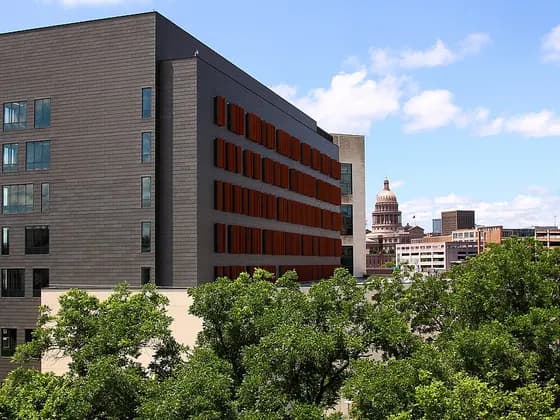

Photo: Ajay Suresh · CC BY 4.0 · cropped
Photo: Larry D. Moore · CC BY 4.0 · Photo: Utexas · Public domain · Photo: Rish0203 · CC0
The Dell Medical School UT Austin MD program at a glance (2027 entry)
Dell Medical School at The University of Texas at Austin, usually called Dell Med or UT Austin Dell Med, runs a four-year MD based on the UT Austin campus. The university catalog says the school was established in 2013; its first class of 50 started in June 2016, and classes are still 50 students. The Liaison Committee on Medical Education (LCME) accredits MD programs in the United States. Its directory, updated November 13, 2026, lists the school with full accreditation and a next survey in 2032-33.
The curriculum is called Leading EDGE, after its four years: Essentials, Delivery, Growth and Exploration. Essentials is the pre-clerkship (pre-clinical) phase, the classroom and lab stage before you work full time with patients, and it takes 12 months. Delivery, in year 2, is for clerkships, the core rotations in hospitals and clinics in fields such as internal medicine, surgery and pediatrics.
Growth, in year 3, sets aside nine months for a project or a second degree. A distinction is an in-depth project in research, social entrepreneurship or clinical biodesign (medical design); a dual degree is a master's earned alongside the MD. Exploration, in year 4, brings advanced rotations, electives (rotations you choose yourself) and preparation for residency, the paid specialty training that follows medical school.
Much of the learning happens in small teams and in your own time. In year 1, scheduled classroom and small-group time is kept under 20 hours a week, and each week you work through patient cases in a team of six to eight. For all four years you also belong to a five-student clinical skills team with one faculty mentor, in a course called Developing Outstanding Clinical Skills (DOCS).
The school also teaches you to look at the system around the patient. Leadership and interprofessional education, which means learning with students of other health professions, run beside the rest of the program. A theme throughout is value-based care: getting the results that matter to patients for the money spent. The two parts of the United States Medical Licensing Examination (USMLE) taken in medical school, Step 1 and Step 2 Clinical Knowledge (CK), usually come after the core clerkships.
| Degree | MD |
|---|---|
| Program length | 4 years, starting in late June, based at UT Austin |
| Curriculum | Leading EDGE: Essentials, Delivery, Growth, Exploration |
| Class size | 50 students per class |
| Teaching style | Year 1: weekly problem-based cases in teams of six to eight; integrated courses |
| Anatomy | Cadaver lab with prosection (pre-dissected parts) and dissection, plus imaging, ultrasound and 3-D tools |
| First patient contact | Year 1, in the DOCS clinical skills course |
| Clinical sites | Three Austin hospitals, plus community clinics across Central Texas |
| Licensing exams (USMLE) | Step 1 usually after year 2; both Steps passed by December 31, year 4 |
| Grading | Pass/fail; Honors possible in longer clinical courses and the Growth block |
What makes the Dell Medical School UT Austin MD program different
Clerkships in year 2, after one science year
Because the pre-clerkship science fits into 12 months, you finish six core clerkships by the end of year 2. Your third-year project or degree, and on the usual schedule USMLE Step 1, come after a year of caring for patients.
Nine months of year 3 that you shape yourself
The Innovation, Leadership and Discovery (ILD) block is required, but what goes into it is up to you: research, social entrepreneurship, medical design or a master's degree. Your primary care clinic and clinical skills sessions continue, so you keep seeing patients.
A five-student team with its own mentor
DOCS groups of five meet with a faculty mentor throughout the four years. Each team has its own small-group room in the Health Learning Building, and the mentor, an experienced practitioner, teaches history-taking, examination and communication.
Two years in a community clinic
The Primary Care, Family and Community Medicine clerkship runs through years 2 and 3. You train in a continuity practice, one you keep returning to, where you care for people of all ages and can build long-term relationships with patients.
Health systems and leadership as core subjects
Leadership runs through the program, and its second-year part is health systems science: how care is organized, paid for and improved. In year 1 you also train every third Friday with nursing, pharmacy and social work students, partly in the community and partly in team simulations.
How Dell Medical School UT Austin teaches medicine
The main small-group format in year 1 is PILLARS, short for professionalism, inquiry, learning and leadership through active reasoning and synthesis. It is problem-based learning, where a case comes before the teaching. Each week your team reviews patient cases, works out the science behind the disease, researches its own questions in self-directed time, then meets again to discuss what it found.
Most first-year courses pair PILLARS with large-group interactive sessions, where the whole class applies the material together. Courses mix disciplines and tie them to patients. Cells to Populations, for example, teaches genetics, biochemistry, cell biology and pharmacology through the diseases they explain. Mechanisms of Disease follows the organ systems and pairs each disease process with the way it shows up in patients.
From year 2 most teaching moves to hospitals and clinics. On internal medicine, for example, you learn on rounds (seeing patients with the team), at the bedside and in weekly classes. DOCS, interprofessional education and Leadership continue beside the rotations, partly in required intersessions, set times for core teaching in these multi-year courses.
Year 3 is the most independent: you work with a faculty mentor or take classes in your master's program. In year 4 you do acting internships, taking on much of the work of an intern, a first-year resident. A course called ILIAD (Integrating Leadership, Interprofessional Education and DOCS) joins the last year of all three into one.
The ways you will learn
| Large-group interactive sessions | The whole class works through new problems together, so you practice clinical reasoning as well as learning content. Attendance is strongly encouraged; small groups and labs are required. |
|---|---|
| DOCS small groups | Year 1 covers interviewing, physical examination, patient write-ups and clinical reasoning. Later years add advanced communication, medical humanities, ethics and law, and the social determinants of health, meaning the living conditions that shape it. |
| Interprofessional sessions | In Foundations for Interprofessional Collaborative Practice, small groups from medicine, nursing, pharmacy and social work learn as teams. Topics include team communication, moving patients between care settings and disclosing errors. |
| Simulation and skills workshops | The emergency medicine clerkship includes simulation training in starting an IV, splinting, managing an airway emergency and suturing. The surgery clerkship uses simulation workshops too. |
| Bedside teaching and feedback | On clerkships you learn from residents and faculty while caring for patients. In required courses and clerkships of four weeks or longer, a faculty member must give you individual feedback by the midpoint. |
A typical week on the Dell Medical School UT Austin program
A year 1 week is built around your own study. School policy caps required scheduled activities at 20 hours a week and assumes about two hours of assigned preparation for each scheduled hour. Total work for an average student must stay within 60 hours, and the same average applies in year 3.
Within those limits you meet your PILLARS team for the week's cases and join large-group sessions, and DOCS sessions run alongside through the year. During Structure and Function there is a weekly lab, and every third Friday is interprofessional education.
Clinical weeks are longer: duty hours in years 2 and 4 are capped at 80 a week, counting time on DOCS and the other multi-year courses. In-house call, an on-call shift spent in the hospital, comes no more than every third night on average. Continuous duty stops at 24 hours, plus up to four for patient handoffs or education, with at least 14 hours free of clinical duty afterward. The catalog's internal medicine acting internship, for example, runs from about 6:30 a.m. to 5:30 p.m. on weekdays, with weekend rounds and evening call every sixth day.
Breaks between years are short. On the published calendars about four weeks separate years 1 and 2, about ten days separate years 2 and 3, and a few days separate years 3 and 4. All students have about two weeks between the fall and spring terms, around New Year.
How anatomy is taught at Dell Medical School UT Austin
Anatomy is part of Structure and Function, a year 1 course on how the body is built and how it works, from molecules to whole organ systems. Its weekly labs look at anatomy and physiology together, so you study a structure and what it does side by side.
The cadaver lab is set up as stations. They include prosection (studying a part that has already been dissected), dissection, digital histology (tissue under a virtual microscope), radiographic imaging, ultrasound and 3-D work with tools such as Sectra technology. A faculty member makes models for the gross anatomy lab with CT scans and 3-D printing. You also test your own physiological function and design experiments with human subjects.
Medical Neuroscience adds the structure of the brain and spinal cord. Later, the catalog lists an anatomy elective for senior students, who dissect one region in depth, such as the abdomen, pelvis or head and neck. It is meant to prepare them for residencies such as surgery or obstetrics and gynecology.
When you first meet patients at Dell Medical School UT Austin
You meet patients in year 1 through DOCS. You learn to take a medical history from, and examine, a variety of patients with different conditions, and you write up your clinical encounters. Before seeing patients you are trained in universal precautions, the standard steps that prevent the spread of infection.
Milestone 0, a one-week course you must pass to move up to year 2, bridges the science courses and the clerkships. In every required clerkship a faculty member must then watch you take a history and carry out a physical examination on a patient, and you both sign the record.
Under the school's supervision policy you can interview and examine patients with their consent, a supervisor reviews your notes, and decisions and orders always involve a supervisor. Procedures are directly supervised. In year 4 a supervisor may let you draw blood, place an IV line or do simple suturing with direct supervision immediately available and the patient's consent.
You can also volunteer at the C.D. Doyle Clinic, a free student-run clinic in east Austin staffed with volunteer physicians. It cares for uninsured and underinsured people, particularly those experiencing homelessness.
The Dell Medical School UT Austin curriculum, year by year
- Year 1
Essentials: the science year
Year 1 runs from late June to early June. Five integrated courses carry the science, and three courses that continue in later years start alongside them: DOCS, interprofessional education and Leadership.
- Cells to Populations: genetics, biochemistry, cell biology, physiology and pharmacology, with a focus on congenital, blood and cancer diseases. Half the work is PILLARS cases and half is whole-class sessions with faculty.
- Structure and Function: normal anatomy and physiology from molecules to organ systems, with some pharmacology and the disruptions that cause illness.
- Medical Neuroscience: the nervous system in health and disease, from stroke, pain and epilepsy to memory, language and motivation.
- Foundations of Disease: microbiology, immunology, pharmacology and infectious disease, as groundwork for the study of how disease develops.
- Mechanisms of Disease, the longest course: how disease arises and presents in 12 areas of medicine, from cardiology and pulmonology to psychiatry and reproductive health.
- Course lengths vary. A 2022 catalog table, at one credit hour per week of teaching, gives Cells to Populations 7, Structure and Function 10, Medical Neuroscience 6, Foundations of Disease 7 and Mechanisms of Disease 15.
- You take the Comprehensive Basic Science Examination (CBSE), a national test of readiness for Step 1, in December and at the end of the year.
- Year 2
Delivery: the clerkship year
Year 2 runs from about July 1 to the second half of June. After Milestone 0, the one-week bridging course, six core clerkships fill 44 weeks. The primary care clerkship runs beside them, and so do DOCS, interprofessional education and Leadership.
- Internal medicine, eight weeks: adult inpatients at Dell Seton Medical Center, the school's primary teaching hospital.
- Surgery, eight weeks: four on acute care surgery at Dell Seton (trauma, emergency surgery, burns and critical care), then four with a team you choose. The school's Year 2 page names pediatric, elective general and oncology surgery; the department's list adds urology, vascular, cardiothoracic, transplant and pediatric congenital heart surgery.
- Pediatrics, eight weeks: four with inpatients at Dell Children's Medical Center and two in an outpatient clinic. One more week is split between urgent care and a subspecialty, and one is in the newborn nursery at Ascension Seton Medical Center Austin.
- Women's health (obstetrics and gynecology), eight weeks: labor and delivery, high-risk obstetrics, gynecologic surgery and cancer, pelvic floor surgery and outpatient clinics. A faculty preceptor, a supervising doctor, advises you throughout.
- Neurology and psychiatry, four weeks each in the catalog. The school's Year 2 page presents them as one eight-week clerkship at inpatient and outpatient sites, with a focus on team care, ethics and managing pain.
- Emergency medicine, four weeks: mainly at Dell Seton and Ascension Seton Medical Center Austin, learning to assess patients before the diagnosis is known and to stabilize the very ill.
- Primary Care, Family and Community Medicine begins. You can also add up to four weeks of two-week electives, which the school's 2022 credit-hour table counts toward the elective weeks you need to graduate.
- Year 3
Growth: your own project or degree
Year 3 runs from about July 1 to late June, with nine months reserved for the ILD block. You pursue a distinction or a dual degree while your primary care clerkship continues.
- 36 weeks of independent study or dual-degree courses, depending on your route.
- A scholarly project whichever route you take, with an abstract and a presentation at ILD Scholarship Day.
- Eight weeks for clinical electives or vacation, with room for two four-week electives to keep your clinical skills current and explore careers.
- Monthly DOCS and interprofessional sessions and periodic Leadership meetings. You apply leadership skills to your project and to community work.
- A week-long clinical skills immersion at the end of the year.
- Year 4
Exploration: advanced clinical training
Year 4 runs from about July 1 to early May. You take senior clinical roles, explore specialties and apply for residency, and the school builds time into the year for applications and interviews.
- Two four-week acting internships, where you do an intern's work under supervision. At least one must be a designated core acting internship.
- Four weeks of critical care. The catalog lists medical, surgical, neonatal, pediatric, pediatric cardiovascular and cardiothoracic intensive care options.
- 22 weeks of electives under the 2026-27 graduation policy, some of which you may have finished in years 2 and 3.
- ILIAD, the combined final-year course.
- Milestone 1, a course (one week under the graduation policy) that prepares you for residency, with clinical skills practice and assessment.
How you are assessed at Dell Medical School UT Austin
Year 1 is pass/fail, which the school says encourages collaboration. Under the 2026-27 grading policy the standard grades are Pass and Fail, and Honors is available only in clinical courses of four weeks or longer and in the ILD course. A temporary Z grade covers work still to be made up, then becomes a Pass or Fail; a Fail stays on your transcript, and the course must be taken again and passed. Courses in a dual degree keep the partner school's grading system.
In year 1 you take the CBSE, set by the National Board of Medical Examiners (NBME), in December and at the end of the year. The school's USMLE policy makes both a condition for moving into year 2; the promotion policy asks for the CBSE or the CBSSA, the NBME's Comprehensive Basic Science Self-Assessment. If your results show gaps you may be offered help with content, test-taking skills or tutoring. A low score at the end of the year brings required academic support before year 2.
Other formats come with the labs and clinical work. School policies refer to lab practical exams and to Objective Structured Clinical Examinations (OSCEs), where you complete set tasks at timed stations. The attendance policy counts shelf exams, the NBME subject tests used at the end of clerkships, among the work required to pass a clerkship. You must also pass the Clinical Performance Examination (CPX), a comprehensive test of clinical skills, to graduate; NBME exams and the CPX are repeated until passed.
Step 1 of the USMLE tests the sciences basic to medicine and has been pass/fail since January 26, 2022. Step 2 CK tests clinical science for patient care under supervision. For an MD program, LCME accreditation is what makes its students eligible to take them. Dell Med's usual point for Step 1 is between years 2 and 3.
The school's 2026-27 USMLE policy sets checkpoints: you meet the associate dean of student affairs to plan if you have not taken Step 1 by July 1 at the start of year 3. The same goes if you have not completed both Steps by January 1 of year 3, or want to take Step 2 CK first. To graduate you must take and pass both by December 31 of year 4. Three failing grades across the two lead to consideration for dismissal.
In August 2026 the USMLE program announced a move to designated testing dates from January 2029, with Step exams offered less often each year. Its June 2026 notice had said 2028. On the current schedule, a 2027 entrant would sit Step 1 around June 2029, within a few months after the switch, and Step 2 CK during year 3 (about July 2029 to June 2030). A student who takes Step 1 in the middle of the clerkship year, as one described in an October 2024 school story, would be close to the switch itself.
- The curriculum is built around eight core competencies: leadership and innovation, patient care, medical knowledge, communication, practice-based learning and improvement, systems-based practice, professionalism and health equity.
- The Medical Student Academic Standing Committee reviews progress at five points: after years 1, 2 and 3, and in December and April of the final year. It can promote you provisionally if there is a clear, timely plan to finish a missing requirement.
- Graduation requirements must be met within six years of starting. Exceptions are rare and need committee approval.
Dell Medical School UT Austin clinical rotations: where you will actually train
The core clerkships are in Austin. A school report from about 2025 says students rotate mainly at Dell Seton Medical Center at The University of Texas, Ascension Seton Medical Center Austin and Dell Children's Medical Center. Dell Seton is the primary teaching hospital. It is operated by Ascension, is a Level I trauma center for adults (equipped for the most severe injuries) and stands on Red River Street, as does the school's Health Learning Building.
Students are assigned to clinical sites. The school's general obstetrics and gynecology division does its inpatient obstetrics mainly at Ascension Seton Medical Center Austin and its gynecology mainly at Dell Seton.
Primary care takes you into the community. The Department of Family Medicine works with partners and practices throughout Central Texas to place students, and each student spends two years in a continuity practice at a community clinic. The clerkship also includes classroom learning and community engagement, and you can join community-engaged research projects.
The wider setting is changing. In October 2026 the university named its academic health system UT Dell Medicine, a name the school's clinical practice, previously UT Health Austin, is also taking. A 406-bed hospital, UT Dell Medical Center, is planned to open in North Austin in 2030, with cancer care from The University of Texas MD Anderson Cancer Center.
Eight weeks of internal medicine, four of acute care surgery, and part of emergency medicine.
- Dell Seton Medical Center at The University of Texas
Ascension Seton Medical Center Austin takes emergency medicine students and the newborn nursery week. Dell Children's hosts four weeks of inpatient pediatrics.
- Ascension Seton Medical Center Austin
- Dell Children's Medical Center
Sites for the two-year Primary Care, Family and Community Medicine clerkship.
- Community clinics and practices
Named in 2026-27 catalog descriptions of the rheumatology, public mental health and camp medicine electives.
- CommUnityCare Southeast Health and Wellness Center
- Integral Care
- Camp Longhorn, Burnet
Optional global health rotations in year 4, through the Academic Model Providing Access to Healthcare (AMPATH), listed by the Division of Global Health.
- AMPATH Kenya, Eldoret
- AMPATH Mexico, Puebla
Electives, selectives and away rotations at Dell Medical School UT Austin
Electives start in year 2 with two-week blocks for career exploration; the catalog's program page names geriatrics and palliative care, internal medicine and surgery. The 2026-27 graduation policy asks for 22 weeks of electives in all, most of them usually in year 4. No more than eight weeks can be in two-week electives, and no more than four can be professional development. The separate electives policy in the same catalog says 20 weeks, taken in years 3 or 4, so confirm the current figure with the Office of Student Affairs.
Acting internships are in addition to the elective weeks. The catalog lists acting internships in fields from inpatient internal medicine, pediatrics and family medicine to neurology, labor and delivery, psychiatry, emergency medicine and several kinds of surgery.
The graduation policy lets up to 12 elective weeks be away rotations, meaning electives at another institution; the electives policy says no more than eight. The host must be accredited by the LCME or by the Accreditation Council for Graduate Medical Education, which accredits residencies, or be approved by the school's curriculum committee. You need approval at least a month ahead. In a field without a Dell Med acting internship, one four-week acting internship at another LCME-accredited institution may, with approval, count as your second; under the graduation policy it reduces the 12-week limit.
Global health is an option in year 4, through AMPATH, a partnership the school belongs to. The Division of Global Health lists clinical rotations in Kenya and Mexico, and eligible students who want an elective abroad must apply through it before course registration. An older description still in the catalog refers to 2019-20. It gives four to eight weeks at Moi Teaching and Referral Hospital in Eldoret, Kenya, mainly on internal medicine or pediatric wards, paired with a senior Kenyan medical student.
The points below are examples from the 2026-27 catalog, so check which ones run in your year.
- Musculoskeletal Institute: two weeks in integrated practice units, teams that treat one group of conditions together and use patients' own reports of their results to guide care.
- Rural emergency medicine: four weeks at a critical access hospital, a small rural hospital, in the Ascension Seton network.
- Camp Medicine: a week of self-study with chances to work in the Dell Children's emergency department, then a week living at Camp Longhorn in Burnet and working in its health center. Lodging and meals are provided.
- Health policy: four weeks that can include visits to legislative committees and think tanks, ending with an op-ed and a policy brief.
- Primary care sports medicine: two weeks in clinics and training rooms with UT athletics.
- Enrichment electives are extra, non-credit courses, open in year 1 to students in good standing. The catalog's list includes medical Spanish, culinary medicine, artificial intelligence in health care, and anatomy and figure drawing.
Dual degrees and research years at Dell Medical School UT Austin
Every student must complete a distinction or a dual degree to graduate. The distinction routes are listed below. All students are expected to reach the same competencies whichever route they take.
The school's Year 3 page lists dual master's degrees in humanities, health and medicine (MA); business administration; education; public affairs; public health; biomedical engineering (MS); and business technology and artificial intelligence (MS). The 2026-27 catalog also lists design (MA). UT Austin's own dual degrees are awarded simultaneously with the MD.
Dell Med lets you declare an interest after you start medical school, and you must be accepted by both programs. The catalog expects dual degrees to be finished within year 3, although some run into year 4. The MBA at UT's McCombs School of Business is one: 41 credit hours across years 3 and 4, with applications from second-year Dell Med students. You also apply to biomedical engineering in year 2.
The public health degree (MPH) comes from The University of Texas Health Science Center at Houston (UTHealth Houston) School of Public Health; each institution awards its own degree, usually in the same semester. The partner school says most students who apply to both programs at the same time can finish in four years, and it encourages them to start the MPH the summer before medical school. You apply separately to each and can join as late as the fall of year 2, with both programs running together in year 3. The MPH takes 45 credits, 12 of them shared from Dell Med.
A summer 2025 McCombs magazine story says students seeking a second degree can earn both in four years. It counted 335 Dell Med students graduating between 2020 and 2026, of whom 87 chose the MBA and 60 the Master of Public Health. In the Class of 2024, 83% pursued a dual degree.
For an MD/PhD, the graduation policy allows eight years. A May 2026 school story describes a graduate who created his own MD/PhD path, advised at Dell Med and UT's Cockrell School of Engineering. Students who want more time can ask for an enrichment leave of absence, of one semester up to a year, for outside study or research.
- Research: design and carry out a basic, clinical or translational project with a faculty mentor, at UT Austin or a clinical partner. Translational research turns laboratory findings into treatments.
- Social entrepreneurship: take an idea for social impact from concept to reality, learning program design, management, fundraising and how to measure results.
- Clinical biodesign: nine months teamed with biomedical engineering students, finding an unmet clinical need and building a prototype and business plan. It can also be part of biomedical engineering's MD/MS. One team's Drain+, a clip-on device meant to keep surgical drains from clogging, won a 2026 UT pitch competition award.
Facilities and support at Dell Medical School UT Austin
Where you will learn
The Health Learning Building, opened in June 2016 on the UT Austin campus, is the students' main home. An open stairway links its first to fifth floors, and rooms switch between small-group and large-lecture layouts. There are meeting rooms, study terraces and a café, as well as the DOCS team rooms. The school's other main buildings are the Health Transformation Building, for clinical operations, and the Health Discovery Building, for research.
The Dell Medical School Library is an electronic library, and you can also use all of UT Austin's library resources, including print. It helps with database searches and literature reviews, and its librarian is based in the Health Learning Building. Its online guide lists books for year 1 courses and for the clerkships, and links to practice exams for Step 1 and Step 2.
The Simulation Center at Dell Children's Medical Center, a partnership with the hospital, offers simulation-based learning to medical students. It has more than a dozen full-body manikins, from infant to adult, and rooms set up as an emergency department, an intensive care unit and an operating and trauma suite. It also has virtual reality ultrasound, trainers for skills such as IV placement, and standardized patients, people trained to play patients or relatives.
Support while you study
The Office of Student Affairs covers orientation, academic and career advising, well-being, professional development and residency applications, with one-on-one advising when you need it. It also handles requests for help with the cost of presenting research at conferences. Disability accommodations are arranged through UT's Disability and Access office, and the school asks for at least 10 business days' notice of testing accommodations for shelf exams, OSCEs and lab practical exams.
If your studies or professionalism raise concern, the academic standing committee can arrange academic coaching with the associate dean of student affairs and your DOCS mentor. Coaching is not reported in the performance evaluation sent with residency applications, and you stay in good standing.
A counselor from the university's Counselors in Academic Residence (CARE) program has an office in the Health Learning Building. Medical and nursing students can get confidential short-term counseling, crisis support and drop-in help there. Student groups include interest groups in global health and psychiatry, and Prosody, a student-run literary and arts magazine.
Is the Dell Medical School UT Austin program right for you?
This program may suit you if
- You want to start clerkships in year 2, after 12 months of pre-clerkship science.
- You learn well by solving cases in a small team and planning much of your own study.
- You want nine months for research, medical design, social entrepreneurship or a master's degree inside the four-year program.
- You care about how health systems work, and want leadership and value-based care taught alongside clinical medicine.
- You like the idea of returning to one community clinic over two years.
Things to think about
- Year 1 moves fast: five science courses plus DOCS, interprofessional education and Leadership, with up to 60 hours of work a week.
- The Growth year is required, with a scholarly project, and dual degrees have their own admission process.
- Core clerkships run mainly at three Austin hospitals, so expect most of your required training in one city.
- Step 1 usually falls after the clerkships. On the current schedule a 2027 entrant would sit it around June 2029, within a few months after the USMLE moves to designated testing dates.
- With 50 students in a class and small teams for cases and clinical skills, you will work closely with the same people for a long time.
Dell Medical School UT Austin MD program — frequently asked questions
Applying to Dell Medical School UT Austin?
How to get into Dell Medical School UT Austin
Prerequisites, MCAT, AMCAS personal statement, secondaries and interview, step by step.
Open the guide →Dell Medical School UT Austin admissions profile
MCAT and GPA profile, acceptance rate, interview format and key dates.
See the profile →Compare Dell Medical School UT Austin with other schools
Put the teaching style, anatomy teaching and clinical sites next to another school.
Open the comparison →Prepare for the Dell Medical School UT Austin interview
Format breakdown, school-specific sample questions and prep tips for this interview.
Read the guide →Where this Dell Medical School UT Austin program guide came from
This guide was written from 71 official sources — Dell Medical School – University of Texas at Austin's own program pages and curriculum documents, plus the accreditor and the hospitals and health systems the school trains students in where they publish detail — read on 2026-11-25, then checked claim by claim against those sources.
- Leading EDGE Curriculum
- Year 1: Essentials
- Year 2: Delivery
- Year 3: Growth
- Year 4: Exploration
- Curriculum Core Competencies
- Medicine, Doctor of Medicine (MD), UT Austin Medical School Catalog 2026-2027
- Academic Policies (workload, attendance, grading, graduation, USMLE, supervision), Medical School Catalog 2026-2027
- Courses, Medical School Catalog 2026-2027
- Degrees, Medical School Catalog 2026-2027
- Dual Degrees, Medical School Catalog 2026-2027
- Doctor of Medicine/Master of Public Health (MD/MPH), Medical School Catalog 2026-2027
- Dual Degrees (MD/MPH with Dell Medical School), UTHealth Houston School of Public Health
- Academic Calendar 2026-2027, Medical School Catalog
- Academic Calendar 2024-2025, archived Medical School Catalog
- Facilities, Medical School Catalog 2026-2027
- Dell Medical School Library Orientation, UT Libraries, updated October 19, 2026
- Medicine guide, Dell Medical School Library (year 1, clerkship and test prep pages), updated October 23, 2026
- Health Policies, Medical School Catalog 2026-2027
- About Dell Med, Medical School Catalog 2026-2027
- M.D. Program
- Frequently Asked Questions (class size, dual degrees)
- Admissions Criteria (class size, 12-month pre-clinical phase)
- Education Programs, Department of Surgery and Perioperative Care
- Division of Acute Care Surgery
- Division of Emergency Medicine
- Education Programs, Department of Women's Health
- Division of General Obstetrics and Gynecology
- Department of Family Medicine
- Division of General Internal Medicine (primary care clerkship, C.D. Doyle Clinic)
- Division of Global Health
- Education Programs, Department of Psychiatry and Behavioral Sciences
- Simulation Center at Dell Children's Medical Center
- Foundations of Interprofessional Collaborative Practice course, Center for Health Interprofessional Practice and Education
- Faculty profile: B. Alan Rampy (Mechanisms of Disease course)
- Faculty profile: Rachel Wallace (anatomy models)
- Faculty profile: Travis Crook, Associate Dean of Student Affairs
- Student Resources
- CARE Counselor for Dell Medical School, UT Counseling and Mental Health Center
- Contact Us (buildings and addresses)
- About Dell Med (C.D. Doyle Clinic, primary teaching hospital)
- History of Dell Medical School
- Progress and Impact report
- Why Dell Med? (Prosody magazine)
- Lessons From the Bedside, October 21, 2024
- Celebrating the Class of 2026, May 4, 2026
- Celebrating the Class of 2024, May 3, 2024
- Student-designed device story, August 24, 2026
- UT introduces UT Dell Medicine, October 27, 2026
- UT Dell Medical Center, The University of Texas at Austin
- Clinical Biodesign Program, Texas Biomedical Engineering
- MD/M.S. Dual Degree Program, Texas Biomedical Engineering
- MBA/MD at Dell Medical School, McCombs School of Business
- The M.D. Has an MBA, McCombs magazine, summer 2025
- Academic Calendar 2025-2026, archived Medical School Catalog
- Professional Licensure Disclosures
- Visiting Students (acting internships and four-week electives)
- Story on the Leading EDGE curriculum's associate dean, August 19, 2026
- UT News on UT Dell Medical Center, April 21, 2026
- Dual Degree Programs, UT Austin Office of Graduate and Postdoctoral Studies
- LCME directory of accredited programs, updated November 13, 2026
- About the LCME
- USMLE announcement: designated testing dates from January 2029
- USMLE Designated Testing Dates Information Hub (announcement dated August 6, 2026)
- USMLE notice of June 23, 2026 (first timeline, 2028)
- USMLE examination results and scoring (Step 1 pass/fail)
- USMLE Step 1
- USMLE Step 2 CK
- NBME Clinical Science Subject Exams (shelf exams)
- NBME Comprehensive Subject Exams (CBSE)
- NBME Comprehensive Basic Science Self-Assessment (CBSSA)
Curricula are restructured between cycles. Anything here that decides your application — how anatomy is taught, a clinical campus assignment, a required research year — should be confirmed against the official page for your entry year.
Applying to Dell Medical School UT Austin?
We help US applicants with MCAT strategy, the AMCAS personal statement, secondary essays and interview prep — everything you need for a competitive Dell Medical School UT Austin application.