
The Paul L. Foster School of Medicine TTUHSC El Paso MD program
What you actually study, and where you will be
Paul L. Foster School of Medicine TTUHSC El Paso's MD is a 4-year program with an integrated curriculum, with patient contact from Year 1 and clinical rotations in El Paso hospitals and community clinics (2027 entry). Foster is a four-year MD program in El Paso, on the U.S.-Mexico border, where you learn medicine through common patient problems and everyone takes medical Spanish. It opens with a three-week community Immersion shared with dental students. Every student completes a mentored scholarly project, and in year 3, eight clerkships (core hospital and clinic rotations) are combined into two 23-week blocks.
- Degree
- MD
- Length
- 4 years
- Teaching
- Integrated
- Clinical contact
- Year 1

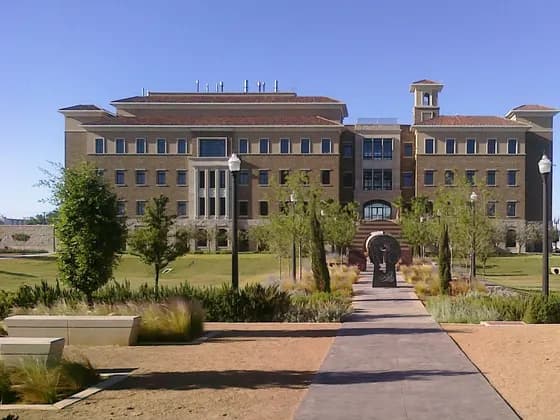
Photo: CDonn3 · Public domain · cropped
Photo: CDonn3 , Dicklyon · Public domain · Photo: David · CC BY-SA 2.0 · Photo: B575 · CC BY-SA 3.0
The Paul L. Foster School of Medicine TTUHSC El Paso MD program at a glance (2027 entry)
The Paul L. Foster School of Medicine is the MD school of Texas Tech University Health Sciences Center El Paso (TTUHSC El Paso), which its website now calls Texas Tech Health El Paso. The school shortens its own name to Foster School of Medicine, FSOM or PLFSOM, and this guide says Foster. The MD takes four years, and the first class of 40 students started in July 2009. Foster is a separate school from Texas Tech's medical school in Lubbock.
You learn the body through the problems that bring people to a doctor. The 2026-27 syllabi list 42 clinical presentations in year 1 and 37 in year 2, from sore throat and jaundice to headache and infertility. A clinician lays out how an experienced doctor sorts the possible causes of each one, science sessions explain them, and a weekly case discussion asks you to use both. In skills sessions you practice on standardized patients, people trained to act out symptoms.
Years 1 and 2 are the pre-clerkship phase, the mainly campus-based stage before full-time hospital training. It opens with Immersion, three weeks in July spent studying a local community, doing service work and taking intensive conversational Spanish alongside first-year dental students. The school's Spanish program says nearly 70 percent of El Pasoans speak Spanish, and every student takes Medical Spanish in a group matched to ability.
Clerkships, the supervised core rotations in hospitals and clinics, fill year 3. Foster runs them as a blended longitudinal integrated clerkship: concentrated hospital weeks are mixed with stretches in which you work in several specialties at once. There are two 23-week blocks. Year 4 is flexible and prepares you for residency, the paid specialty training after medical school.
The Liaison Committee on Medical Education (LCME) accredits MD programs in the United States. Its accreditation makes students eligible for the United States Medical Licensing Examination (USMLE), the national exams, called Steps, used for a medical license. The LCME directory, updated November 13, 2026, lists Foster with full accreditation and a next survey in 2027-28.
| Degree and length | MD, 4 years |
|---|---|
| Class size | 138 places for the class that entered in 2026 |
| Main campus | South-Central El Paso, Texas, shared with University Medical Center of El Paso |
| Curriculum | Integrated organ-system units built around 79 clinical presentations |
| Medical Spanish | Required: about 30 hours in Immersion, then weekly for four semesters |
| Anatomy | Prosections (pre-dissected specimens), 3D models and medical imaging |
| First patient contact | Year 1: standardized patients, community clinic visits and patient panel discussions |
| Year 3 | Two 23-week integrated blocks covering eight clerkships |
| Grading | Pass/fail before clerkships; most clerkships Honors, Pass or Fail |
| Step 1 timing | After second-year courses and before third-year orientation |
What makes the Paul L. Foster School of Medicine TTUHSC El Paso MD program different
Medical Spanish is a required course for everyone
You take about 30 hours of conversational Spanish in Immersion, then one hour of Medical Spanish a week for four semesters, in small groups set by a placement test. Lessons follow the science, so you learn to ask about chest pain in Spanish while you study it. The syllabus calls fluency unrealistic; the aims are useful conversation and knowing when to call an interpreter.
Three weeks in the community before the body systems
Your Immersion team assesses an assigned community through a windshield survey (observing the area firsthand), interviews, surveys of community members and existing data, then proposes a public health intervention. You also do service at the El Paso Food Bank.
Third year in two integrated blocks
Medicine and the Mind concentrates on internal medicine, psychiatry, family medicine and neurology. The other block, OPSEF, is named for obstetrics and gynecology, pediatrics, surgery, emergency medicine and family medicine. Emergency and family medicine run through both. Half the class starts in each and swaps after the fall semester, and each clerkship is graded separately.
Following one mother from pregnancy to newborn
In OPSEF you follow one pregnant patient who is due during your block. The 2025-26 block description has you attend her appointments and the delivery, whatever rotation you are on. You then examine the newborn, go to follow-up visits if they are at the university's clinics, and write a reflection. If a birth or visit is missed, you do another activity instead.
Tankside Grand Rounds closes the science years
In this second-year capstone, teams investigate a donor cadaver or an assigned clinical case, including the listed cause of death and other conditions. Each student sets personal learning goals, researches them in the medical literature and presents as part of the team to classmates and faculty in the spring.
How Paul L. Foster School of Medicine TTUHSC El Paso teaches medicine
The main pre-clerkship course is Scientific Principles of Medicine (SPM), which runs for four semesters. Units follow body systems and combine anatomy, physiology, biochemistry, genetics, immunology, microbiology, pathology, pharmacology and behavioral science. Within a unit you move through a chain of clinical presentations, arranged so that each one builds on the last.
A clinician opens each presentation with a diagnostic scheme (a map of the possible causes) and a worksheet showing how an experienced doctor would work through them. Faculty then teach the science behind it through lectures, flipped classes (prepared beforehand, applied in class), labs and online modules. Each week's content ends with a Clinical Reasoning Case Discussion, where your team works through a patient's history, examination and test results.
Other courses are timed to match. In Medical Skills you practice the week's history taking and physical examination, Medical Spanish teaches the questions to ask, and Society, Community, and the Individual (SCI) covers health systems, epidemiology and biostatistics. College Colloquium, a weekly two-hour discussion within your college (one of five learning communities), covers ethics and professionalism, with 2026-27 topics from medicine on the border to treating undocumented immigrants and refugees. Nutrition runs through all four years, with more than 40 hours required.
In year 3 teaching moves to hospitals and clinics. The 2025-26 block descriptions call the mixed outpatient stretches parallel streaming and link them to interleaving, the idea that mixing subjects makes learning stick.
The ways you will learn
| Clinical Reasoning Case Discussions | Required weekly sessions that open with a ten-question individual quiz. Your team then reasons through a case. In year 2 you also submit your own diagnostic exercises and get feedback on them. |
|---|---|
| Team-based learning | You prepare, take a short test alone, retake it as a team, then apply the ideas. SCI uses this for research methods and biostatistics, and some other sessions use it too. |
| Labs | Specified anatomy and microbiology labs are required in year 1. The cardiovascular and respiratory unit adds labs on how the heart and lungs work. |
| Standardized patients and simulation | In Medical Skills you interview and examine standardized patients, debrief as a group, and practice procedures such as suturing, splinting and drawing blood on task trainers, models built to teach one skill. |
| Self-directed learning | After a clinical visit you choose a question it raised, research it in credible sources and present the answer in College Colloquium. |
A typical week on the Paul L. Foster School of Medicine TTUHSC El Paso program
A school rule, last revised in June 2023, protects at least three free half-days a week in years 1 and 2 for independent study. Immersion is an exception, with full days. A community visit may use one of the free half-days each month, and rarely two.
The week template in that rule and the days given in the 2026-27 syllabi produce the pattern below. Medical Skills sessions last about two hours, and Medical Spanish about one. Attendance is required and recorded at case discussions, specified labs, Medical Skills, SCI, Medical Spanish and College Colloquium, and unexcused absences count as professionalism concerns.
- Year 1, Monday: SPM in the morning and afternoon.
- Year 1, Tuesday and Wednesday: SPM in the morning; afternoons are free or used for community visits.
- Year 1, Thursday: Medical Skills, Medical Spanish and SCI in smaller groups through the day.
- Year 1, Friday: case discussion and College Colloquium in the morning; afternoon free or used for a visit.
- Year 2, Monday: Medical Skills, Medical Spanish and SCI.
- Year 2, Tuesday: case discussion and College Colloquium in the morning; afternoon free.
- Year 2, Wednesday to Friday: SPM on Wednesday and Thursday afternoons and Friday morning; the other half-days are free or used for community visits.
- Year 3: full-time clinical work, with shared teaching generally from 1 to 5 p.m. on Wednesdays (Medicine and the Mind) or Fridays (OPSEF) in the 2025-26 block descriptions.
How anatomy is taught at Paul L. Foster School of Medicine TTUHSC El Paso
Gross anatomy is taught inside SPM. The 2026-27 first-year syllabus uses prosections, human specimens that have been dissected in advance, with 3D models, X-rays, CT and MRI scans, angiograms, ultrasound and histology (tissue) images. In the gastrointestinal unit, for example, anatomy sessions cover the structures behind each clinical presentation.
The Gross Anatomy Lab is in the Medical Education Building. Second-year anatomy uses the jigsaw method, in which classmates each master one part and teach it to the others. The school runs its own Willed Body Program, through which people donate their bodies for teaching.
Year 1 also includes sessions called Autopsy Grand Rounds. In the spring of year 2, Tankside Grand Rounds asks teams to link gross and microscopic findings to a donor's cause of death, or to work from an assigned clinical case.
When you first meet patients at Paul L. Foster School of Medicine TTUHSC El Paso
Patient contact builds in steps. Medical Skills uses standardized patients from year 1, and once a semester that year a faculty member and a small group review a recording of one of your encounters. First-years also visit DaVita dialysis centers, where they interview patients and write up the conversation.
Community Health Experiences take you into real clinics. They include visits to a preceptor (a community clinician who supervises you) and patient panel discussions, such as one in year 1 on living with chronic illness. An undated school FAQ for preceptors gives five visits to a primary care preceptor in year 1 and two in year 2, and 2 to 4 hours a month in community settings.
In year 2 you take a full history from, and examine, standardized patients in two complex hospital scenarios. You must also complete an encounter with a real hospitalized patient and write a reflection on it. Other visits that year include the newborn nursery.
Students can volunteer at the Medical Student Run Clinic in Sparks, a far East El Paso community where access to care can be limited. It has offered free primary care since 2013. Volunteers help coordinate care and run the clinic under physician supervision, and can practice speaking Spanish with patients. First-years also attend two hours of the annual Service-Learning Symposium, and students who log more than 100 hours of service-learning are recognized at graduation.
The Paul L. Foster School of Medicine TTUHSC El Paso curriculum, year by year
- Year 1
Immersion, then six units
For the class that entered in 2026, year 1 began on July 6 with Immersion. SPM I and II then cover six units, with unit exams from early September to early May and a comprehensive end-of-year exam on May 21-22, 2027. Medical Skills, Medical Spanish, SCI and College Colloquium run alongside in both semesters. In the current calendar, about ten weeks separate the end of year 1 from the start of year 2.
- Immersion, shared with Hunt School of Dental Medicine students: the team community assessment, service-learning, conversational Spanish, clinical communication skills and writing a student oath.
- SPM I (fall): Introduction to Health and Disease (5 weeks), Gastrointestinal System (5 weeks), and Integumentary, Musculoskeletal and Introduction to the Nervous System (7 weeks).
- SPM II (spring): Hematologic System (4 weeks), Cardiovascular and Respiratory Systems (7 weeks) and Renal System (4 weeks).
- Medical Skills I and II: communication, focused histories and examinations, clinical notes, ultrasound modules, procedures on task trainers, and simulated emergencies.
- SCI I: patient safety, behavior change, health insurance and a simulation of finding care in the U.S. health system. SCI II: epidemiology, research methods and TeamSTEPPS teamwork training.
- Part one of the Scholarly Activity and Research Program (SARP): online research training, finding a mentor and a project plan, due April 12, 2027 for the class that entered in 2026.
- Year 2
Four units, then Step 1
In the current calendar, second-year terms run from August 3, 2026 to March 26, 2027, and the last of four units ends on February 19. Life support training, the exam that shows you are ready for Step 1, and Step 1 itself come before third year starts in mid-May.
- SPM III (fall): Central Nervous System and Special Senses, Endocrine System and Reproductive System.
- SPM IV (spring): Mind and Human Development, which runs from newborns to old age and ends with mental health conditions.
- Medical Skills III and IV: neurological, pelvic and genital examinations, simulated stroke and cardiac resuscitation, and the hospital encounters described above.
- Certification in Advanced Cardiovascular Life Support (ACLS), training for emergencies such as cardiac arrest, as part of Medical Skills IV.
- SCI III: biostatistics and how to judge a research paper. SCI IV: occupational medicine, substance use, trauma-informed care and prevention.
- College Colloquium: you join a team of three or four that leads at least one session for your college.
- Medical Spanish III and IV: a weekly hour, levels two and three of Canopy (an online medical Spanish course) and an exit exam.
- Year 3
Two integrated clerkship blocks
The current third year runs from May 18, 2026 to May 14, 2027. One week of intersession (shared orientation and skills training) comes before each block, and a two-week intersession closes the year. The block details below come from 2025-26 descriptions that the current syllabi page still links, and small groups rotate in different orders.
- Medicine and the Mind, sample schedule: five weeks on internal medicine wards and one in a medical specialty, three weeks of psychiatry (inpatient or consulting on other wards) and one of inpatient neurology.
- OPSEF: concentrated time in surgery, gynecologic surgery, labor and delivery, and on pediatric inpatient wards.
- Outpatient stretches in Medicine and the Mind mix internal medicine, neurology, psychiatry and family medicine, and in OPSEF they are integrated across its specialties in the same way.
- Emergency medicine: adult shifts during Medicine and the Mind, with a goal of four lasting eight to nine hours each, and shifts at El Paso Children's Hospital during OPSEF.
- Individualized Learning Plan: one week per block to work on three or four goals you set, discuss with assigned faculty (or a resident or fellow in Medicine and the Mind) and present.
- Open space: flexible time built into both blocks for study, following up with patients you see over time, or personal time.
- Intersession skills include electronic records, scrubbing in, suturing, bladder catheterization and simulated deliveries.
- Year 4
Electives and getting ready for residency
The 2026-27 calendar has twelve four-week blocks from June 8 to May 20. You complete required courses and 22 weeks of electives, with flexible time for study, extra electives, vacation and residency interviews.
- A sub-internship, in which you work much as a first-year resident would. The 2026-27 list is family medicine, internal medicine, obstetrics and gynecology, orthopedic surgery, pediatrics, psychiatry and surgery.
- Critical care in a cardiovascular, medical, neonatal, neurological or surgical intensive care unit, plus online critical care modules.
- Longitudinal Ultrasound: self-paced online modules, 28 in the fall and 20 in the spring.
- Boot camp: two weeks of simulation, offered four times between February and April 2027. Teams practice emergencies and patient handovers, and you run a simulated clinic day and a Night on Call of about four hours.
- At least ten credits of continuing medical education, the courses practicing doctors take, in at least three disciplines by March 1.
How you are assessed at Paul L. Foster School of Medicine TTUHSC El Paso
Pre-clerkship courses are graded pass/fail. Each SPM unit exam has two equally weighted parts, one written by Foster faculty and one drawn from questions of the National Board of Medical Examiners (NBME), which writes national exams. You must pass every unit, and the passing score is 65 percent. The weekly case discussion quiz can only raise a unit grade, by up to half a point a week.
Weekly formative tests are for feedback and are not graded, and in year 2 weekly flashback tests revisit older units. If you fail one or two units, the semester grade is deferred until you pass a remediation exam for each. Failing one of those exams, or failing three units in a year even if they are spread over both semesters, means a Fail and referral to the Grading and Promotions Committee. Eligible students can remediate up to two items a year: SPM unit exams, SCI semesters, or one of each.
Clinical skills are tested in Objective Structured Clinical Examinations (OSCEs), where you move through stations, some with a standardized patient. Medical Skills has one per unit. It counts for 85 percent of the unit grade, and you need 75 percent overall and 90 percent on any physical exam skill check.
In year 3 you take NBME subject exams, often called shelf exams, in internal medicine, psychiatry, family medicine, obstetrics and gynecology, surgery and pediatrics. Most clerkships are graded Honors, Pass or Fail on eight competencies, the shelf exam and an OSCE, with no cap on Honors. Emergency medicine, the longitudinal family medicine part of OPSEF and intersession are pass/fail. Each block ends with an OSCE, typically of five or six cases.
Step 1, the first national licensing exam, has been reported as pass/fail since January 2022, and you must take it before third-year orientation. To be eligible you need 63 or higher on the NBME Comprehensive Basic Science Exam (CBSE) in the spring of year 2. The 2026-27 syllabus lists six CBSE dates from February 26 to May 7, and NBME rules let you use at most five. You can stop once you reach 63; if you have not by the last date, the Grading and Promotions Committee reviews your plan.
In August 2026 the USMLE program announced a move to designated testing dates from January 2029, with Step exams offered less often each year. Its June 2026 notice had given 2028. On the current schedule, a student entering in July 2027 would sit Step 1 between about March and mid-May 2029, within a few months after the switch. Step 2 CK, the clinical knowledge exam, comes after year 3, with the first attempt due before October 31 of year 4, which would be 2030.
- Step 2 CK: missing the October 31 deadline suspends you from year 4 courses until you take the exam, and a pass is required to graduate.
- Shelf exams: held in a two-week period at the end of each block. You may take one or two of the three early, on set Mondays in your outpatient weeks.
- End of third year: a six-case OSCE you must pass to start year 4, and the NBME Comprehensive Clinical Sciences Examination, a check on readiness for Step 2 CK.
- Class rank: calculated after third year from competency grades (40 percent), shelf exams (40 percent), block OSCEs (10 percent) and professionalism (10 percent). It goes in the Medical Student Performance Evaluation, the school's summary for residency programs.
- Honors in year 3: you need the shelf exam's honors score and a pass on the OSCE, where the clerkship has them, both on the first attempt. At least four of eight competencies must be rated Honors and none rated needs improvement; three or more needs-improvement ratings fail the clerkship.
- Retakes in year 3: you get two attempts at each shelf exam and block OSCE, and a second failure fails the clerkship. Failing three shelf exams or two OSCEs on the first attempt means referral to the Grading and Promotions Committee and a note in your Medical Student Performance Evaluation.
- Absences in year 3: more than six days in a block or 12 in the year, excused days included, are reviewed by the associate dean for student affairs.
- Off-cycle entry: under special circumstances, such as a delay in passing Step 1, you may start third year with the second block.
- SCI: the first and last semesters are judged on completing assignments, projects and activities. The two in between need 65 percent, from a final exam (60 percent) and a problem set (40 percent), plus up to five bonus points for team sessions. Every semester also requires the Community Health Experiences.
- College Colloquium: passed on participation, professionalism and completed assignments. These include short essays handwritten in class, eight in year 1 and five in year 2, and in year 2 the session your team leads.
- Medical Spanish: pass/fail each semester and judged against your own level. Online Canopy levels I, II and III are due by the end of semesters two, three and four, and failing the course after remediation means repeating the year.
Paul L. Foster School of Medicine TTUHSC El Paso clinical rotations: where you will actually train
Clerkships are based in El Paso. The main campus is shared with University Medical Center of El Paso (UMC), which was named Texas Tech's primary teaching site in 1973. UMC describes itself as the only Level 1 trauma center, the top level of trauma care, within a 270-mile radius of El Paso.
El Paso Children's Hospital, on Alameda Avenue like UMC, has 148 beds and recorded 27,917 emergency visits in its 2024-25 fiscal year. The Hospitals of Providence Transmountain Campus, a 106-bed hospital in Northwest El Paso, was built in 2017 as a teaching site and takes third- and fourth-year Foster students.
Some students are assigned to William Beaumont Army Medical Center. They complete credentialing that includes fingerprinting, and they work Military Training Days that are not school holidays. If their clinic there is closed, they are given duties on another campus.
Clinical duties are capped at 80 hours a week and normally 16 hours in a row, with a day off each week averaged over a month. Fourth-year sub-internships may include overnight call of up to 24 hours. You log every patient you see hands-on, and each clerkship lists conditions you must encounter or cover through an alternate assignment.
UMC hosts the psychiatry sub-internship and the orthopedic trauma service that orthopedic sub-interns join. Pediatric emergency shifts are at El Paso Children's in the 2025-26 block description. The psychiatry department's undated clinical page says medical students rotate at El Paso Psychiatric Center, a state hospital that Texas Health and Human Services says provides adult psychiatric services.
- University Medical Center of El Paso
- El Paso Children's Hospital
- El Paso Psychiatric Center
A multispecialty clinic stands next to the hospital. The fourth-year emergency medicine elective also uses its emergency department.
- The Hospitals of Providence Transmountain Campus
- William Beaumont Army Medical Center
Community preceptors teach first- and second-years, and the family medicine clerkship also works with community-based preceptors.
- Family Medicine Center at Kenworthy
- Community preceptor clinics in greater El Paso
- Medical Student Run Clinic, Sparks (volunteer)
Electives, selectives and away rotations at Paul L. Foster School of Medicine TTUHSC El Paso
Year 4 requires 22 weeks of electives, at Foster or elsewhere, and one must be in the basic sciences or research. Two-week electives earn two credits and four-week electives earn four, and they are graded Honors, Pass or Fail.
Department pages, mostly undated, show some of the range: surgery lists month-long electives such as ear, nose and throat (ENT), ophthalmology and plastic surgery for one to three students at a time. Psychiatry offers four-week electives, and pediatrics includes a border health curriculum. Emergency medicine combines 98 hours of emergency department shifts with a nine-hour ambulance shift and visits to the 911 dispatch and poison centers. New electives in obesity medicine and lifestyle medicine were added for 2026-27.
With approval from the associate dean for student affairs, you can take electives at other institutions (away rotations), including through Visiting Student Learning Opportunities (VSLO), an Association of American Medical Colleges application service. For global health, the school currently approves three programs for elective credit: Floating Doctors, Child Family Health International and IMA Helps Ecuador. Paperwork starts six months to a year ahead.
Dual degrees and research years at Paul L. Foster School of Medicine TTUHSC El Paso
The Scholarly Activity and Research Program (SARP) is a required three-credit course. SARP I, in the spring of year 1, is the project plan; SARP II is the final report; and SARP III is a poster at a SARP symposium. Three tracks let you finish in year 2, 3 or 4, and everything must be done by May 1 of year 4. A research elective block in year 4 cannot be used to meet the requirement.
Topics fall into three areas: basic, clinical and translational research; epidemiology, community, behavioral and public health; and medical humanities, qualitative and medical education research. Systematic reviews count, but case reports and narrative reviews do not. Projects at other institutions need a second mentor at Foster's university, and international projects are not currently allowed.
The MD/MPH is shared with UTHealth Houston School of Public Health in El Paso. You apply to and enroll at both universities, and you are encouraged to start public health courses in the summer before medical school. The MD/MBA with Texas Tech's Rawls College of Business adds 42 credit hours over about 18 months within the four years. Classes fall in the summers before and after year 1, then online until December of year 2.
A 2024 policy lets students in good standing request a one-year leave for structured outside research, after year 2 (with Step 1 taken before the research begins) or after year 3. The MD must be finished within six years, leaves included. The school's degree list also names distinctions in Anatomy and in Research and Scholarship, and first-years can apply for a Global Health Distinction Track.
The Red Raider Research Fellowship, funds permitting, supports four to eight weeks of full-time research. Students finishing year 1 can apply for a June to July project once they have passed SARP I. AHEC Scholars is an optional two-year program of the Desert Mountain Area Health Education Center (AHEC). Each year involves 40 hours of community or clinical training in rural or underserved areas and 40 hours of instruction (undated page).
Facilities and support at Paul L. Foster School of Medicine TTUHSC El Paso
Where you will learn
Pre-clerkship teaching centers on the Medical Education Building (MEB) and Medical Science Building II. MEB holds the Gross Anatomy Lab, basic science labs, Spanish classrooms, the five colleges and the health sciences library.
The Training and Educational Center for Healthcare Simulation (TECHS) has more than 24,000 square feet on two sites. TECHS South, on MEB's third floor, has 16 standardized patient exam rooms, and TECHS North, in the nursing school building, has eight-bed practice labs and a simulated apartment. The Society for Simulation in Healthcare accredits TECHS.
The Laboratory for Education in Molecular Medicine (LEMM) hosts mentored student research and is part of the curriculum: students collect specimens and run tests the way hospital laboratories do.
Support while you study
The admissions office places every student in one of five learning communities, called colleges: Agave, Chaparral, Desert Sage, Ocotillo and Prickly Pear. You stay in yours for all four years. The 2026-27 first-year syllabus lists two faculty for each college. College mentors write an evaluation of your professional growth each semester in years 1 and 2, and meet with you if absences build up.
In year 1, optional and ungraded Open Learning Studio sessions let you go over hard concepts and practice questions with faculty. Weekly formative tests taken on time return a list of the learning objectives you missed. In the 2025-26 block descriptions, clerkship directors meet once or twice a semester to spot third-years who are struggling and plan help early. Each clerkship also holds an in-person mid-clerkship feedback meeting, and the descriptions list Online MedEd, Aquifer, UWorld and CoreUltrasound as online resources for students.
Student Counseling Services is free and confidential, with weekday walk-in hours. University Health Services runs a campus clinic three days a week that is free to enrolled students, apart from prescriptions, lab tests and imaging. The Office of Student Affairs supports you from orientation to graduation.
Is the Paul L. Foster School of Medicine TTUHSC El Paso program right for you?
This program may suit you if
- You want to study medical Spanish seriously, with a required weekly class through years 1 and 2.
- You like learning science from patient problems and talking through a case with a team every week.
- You would rather mix several specialties over 23 weeks than finish one rotation before starting the next.
- You want community work early, from the Immersion project to preceptor visits and the volunteer clinic in Sparks.
- You want to train in El Paso, on the U.S.-Mexico border, with a Level 1 trauma center on the shared campus.
Things to think about
- Medical Spanish has to be passed: failing the course after remediation means repeating the year.
- Many pre-clerkship sessions have required, recorded attendance, and unexcused absences count as professionalism concerns.
- Pre-clerkship grades are pass/fail, but class rank is calculated after third year and shelf exams make up 40 percent of it.
- The spring of year 2 is built around exams: you need 63 on the CBSE, then Step 1, before third-year orientation in mid-May.
- First-year anatomy is taught with prosections, models and scans. If doing your own dissection matters to you, ask the school about it.
Paul L. Foster School of Medicine TTUHSC El Paso MD program — frequently asked questions
Applying to Paul L. Foster School of Medicine TTUHSC El Paso?
How to get into Paul L. Foster School of Medicine TTUHSC El Paso
Prerequisites, MCAT, AMCAS personal statement, secondaries and interview, step by step.
Open the guide →Paul L. Foster School of Medicine TTUHSC El Paso admissions profile
MCAT and GPA profile, acceptance rate, interview format and key dates.
See the profile →Compare Paul L. Foster School of Medicine TTUHSC El Paso with other schools
Put the teaching style, anatomy teaching and clinical sites next to another school.
Open the comparison →Prepare for the Paul L. Foster School of Medicine TTUHSC El Paso interview
Format breakdown, school-specific sample questions and prep tips for this interview.
Read the guide →Where this Paul L. Foster School of Medicine TTUHSC El Paso program guide came from
This guide was written from 72 official sources — Paul L. Foster School of Medicine Texas Tech at El Paso's own program pages and curriculum documents, plus the accreditor and the hospitals and health systems the school trains students in where they publish detail — read on 2026-11-25, then checked claim by claim against those sources.
- Foster School of Medicine, Texas Tech Health El Paso: home page
- Foster School of Medicine: Academics
- Office of Medical Education: Clerkship Phase (third- and fourth-year curriculum)
- Curriculum and Educational Policy Committee: Medical Program Syllabi
- Scientific Principles of Medicine I and II syllabus, 2026-27
- Scientific Principles of Medicine III and IV syllabus, 2026-27
- Medical Skills I and II syllabus, 2026-27
- Medical Skills III and IV syllabus, 2026-27
- Society, Community, and the Individual I and II syllabus, 2026-27
- Society, Community, and the Individual III and IV syllabus, 2026-27
- Medical Spanish I and II syllabus, 2026-27
- Medical Spanish III and IV syllabus, 2026-27
- Scholarly Activity and Research Program (SARP) syllabus, 2026-27
- College Colloquium I and II syllabus, 2026-27
- College Colloquium III and IV syllabus, 2026-27
- Medicine and the Mind block description, 2025-26
- OPSEF block description, 2025-26
- Common Clerkship Policies, 2026-27
- Fourth-year Boot Camp syllabus, 2026-27
- Orthopaedic Surgery Sub-Internship syllabus, 2026-27
- Psychiatry Sub-Internship syllabus, 2026-27
- Pre-Clerkship Phase Instructional Week Templates and the Three Half-Day Rule (June 2023)
- Pre-Clerkship Phase Student Attendance and Participation Policy (October 2025)
- Off-cycle Entry Into Year 3 policy
- Student Leave of Absence and Delay of Graduation for Research policy (May 2024)
- Oversight of Extramural Electives policy (August 2024)
- Nutrition Curriculum, 2026-27
- Registrar: Foster School of Medicine Academic Calendar, 2026-27
- Foster School of Medicine: About
- Foster School of Medicine: Degree Programs
- Foster School of Medicine: Admissions (class size, curriculum and grading)
- Foster School of Medicine: Admissions FAQ (history)
- M.D. and M.B.A. Option
- M.D./M.P.H. Dual-Degree Option
- Spanish Program
- SCI community preceptor FAQ
- Willed Body Program
- Laboratory for Education in Molecular Medicine (LEMM)
- SARP: Important Dates
- Red Raider Research Fellowship
- Emergency Medicine: Clerkship Program (fourth-year elective)
- Department of Family Medicine
- Family Medicine Clerkship
- Pediatrics: Message from the Chair
- Psychiatry: Medical Students
- Psychiatry: Clinical Care
- Surgery: 4th Year Rotation
- Graduate Medical Education - El Paso Transmountain Campus
- Transmountain: Welcome
- Transmountain: Collaboration with Tenet
- The Medical Student Run Clinic
- MS4 Global Health Elective
- Global Health Distinction Program
- AHEC Scholars, Desert Mountain AHEC
- AHEC Scholars flyer, Cohort 9 (2026)
- TECHS: The Center
- Training and Educational Center for Healthcare Simulation (TECHS)
- Texas Tech Health El Paso: Campus Map
- About Texas Tech Health El Paso
- Student Counseling Services
- University Health Services
- Foster School of Medicine: Student Affairs
- University Medical Center of El Paso: Affiliations
- University Medical Center of El Paso: home page
- El Paso Children's Hospital: About Us
- Texas Health and Human Services: El Paso Psychiatric Center
- LCME: Accredited Programs (updated November 13, 2026)
- LCME: About the LCME
- USMLE: Designated Testing Dates Information Hub
- USMLE: Updated Timeline for Designated Testing Dates (August 6, 2026)
- USMLE: Transition to Limited Testing Dates (June 23, 2026 notice, since updated)
- USMLE: Examination Results and Scoring
Curricula are restructured between cycles. Anything here that decides your application — how anatomy is taught, a clinical campus assignment, a required research year — should be confirmed against the official page for your entry year.
Applying to Paul L. Foster School of Medicine TTUHSC El Paso?
We help US applicants with MCAT strategy, the AMCAS personal statement, secondary essays and interview prep — everything you need for a competitive Paul L. Foster School of Medicine TTUHSC El Paso application.