
Dental schools in Northern Ireland
Queen's Belfast BDS: entry, interviews and fees
Northern Ireland has one dental school: Queen's University Belfast, which runs the five-year BDS (A200). For 2027 entry it has 45 places for UK and Republic of Ireland applicants and 15 for international students. Home applicants are shortlisted on GCSE points plus a UCAT score, and offers then depend on the interview alone. In 2026/27, NI and Irish students pay £4,985 a year and students from Great Britain £9,790.
- Dental schools in NI
- 1: Queen's University Belfast
- UK and ROI places, 2027
- 45
- International places, 2027
- 15
- NI and ROI fee, 2026/27
- £4,985 a year
- GB fee, 2026/27
- £9,790 a year
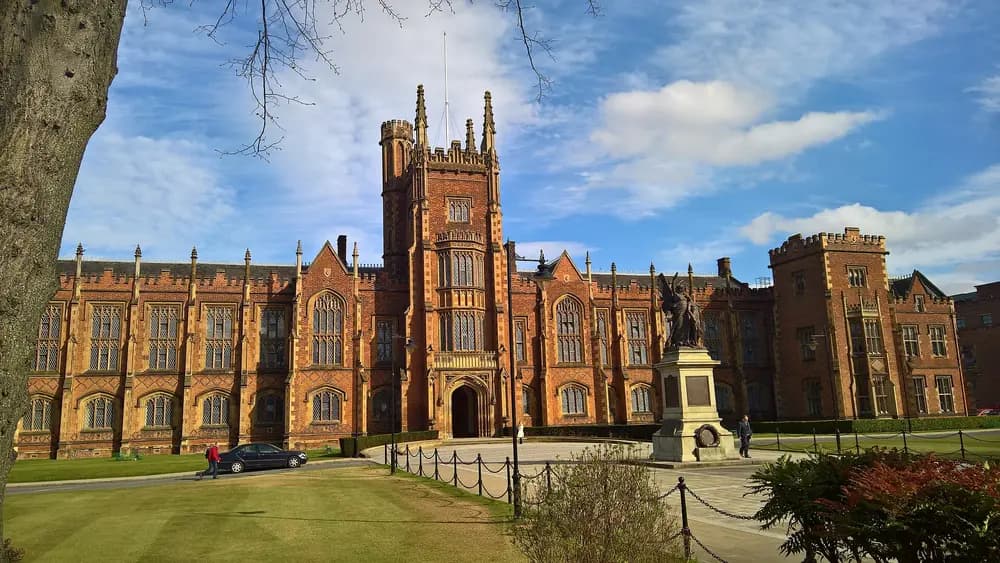



Photo: Nick Birse · CC BY-SA 4.0 · cropped
Photo: Tom Parnell from Scottish Borders, Scotland · CC BY-SA 2.0 · Photo: Slowtech2000 · CC BY-SA 4.0 · Photo: Adam Jones from Kelowna, BC, Canada · CC BY-SA 2.0
Dentistry in Northern Ireland at a glance
Queen's University Belfast (QUB) is the only university in Northern Ireland with a dental school. Its BDS (Bachelor of Dental Surgery) takes five years and is open to school leavers and graduates. The General Dental Council (GDC), which regulates dentists in the UK, accredits it as a registrable qualification.
QUB selects home applicants in two stages. First it scores your best nine GCSEs and your UCAT (the University Clinical Aptitude Test, an online admissions test) and invites the top of that ranking to interview. Then it ranks everyone it interviewed on interview performance alone and makes offers in that order.
Applicants from Northern Ireland, Great Britain and the Republic of Ireland share one pool of 45 places. International applicants have 15 places, do not sit the UCAT, and are interviewed online.
| School and course | Queen's University Belfast, BDS Dentistry (UCAS code A200), five years full time |
|---|---|
| Places, 2027 entry | 45 for UK and Republic of Ireland applicants; 15 for international and non-Irish EU applicants |
| Standard offer | AAA at A-level including Chemistry and Biology or Human Biology |
| Admissions test | UCAT for home applicants, sat in the summer before you apply; not required from international applicants |
| Interview | Multiple mini interviews: in person in Belfast for home applicants, online for international applicants |
| UCAS deadline, 2027 entry | 15 October 2026 at 18:00 UK time (now passed) |
| Fees, 2026/27 | £4,985 a year for NI and Irish students; £9,790 for students from England, Scotland or Wales |
| International fee | £52,509 a year, listed for 2027/28 entry |
Queen's University Belfast dentistry: the BDS course year by year
The card links to our full QUB dentistry guide. Below is how the five years are organised, from QUB's 2027/28 course page.
- Years 1 and 2
Foundations of clinical practice
You study the biomedical and behavioural sciences alongside the basics of managing dental patients, dental ethics, health promotion and core clinical skills. QUB says students can start clinical practice from Year 1.
- Year 1 modules include Anatomy for Dentistry and Biomedical Sciences for Dentistry
- Year 2 adds Pharmacology, Physiology and Disease Mechanisms for Dentistry
- Year 3
Treating your own patients
The clinical side grows. You assess and treat your own patients in restorative dentistry and begin oral surgery, orthodontics and paediatric dentistry, while learning how illness elsewhere in the body affects dental care.
- Years 4 and 5
The full range of treatment
You carry out the full range of dental treatment for your own adult and child patients, in the Dental School and in outreach clinics. The Final BDS is assessed in parts across Years 4 and 5, finishing with the Practice of Dentistry module.
Tutorials and case-based learning happen in small groups of about 10 to 12 students, with clinical seminars before clinical sessions. You practise in the Clinical Techniques Laboratory throughout the course, with extra sessions on haptic dental simulators (simulators that give touch feedback), before and alongside treating patients. Assessment ranges from written exams and multiple-choice questions to OSCEs (timed clinical skills stations) and procedures on patients.
Some students add an intercalated degree: a BSc taken between years 2 and 3, or a taught Master's after Year 3. After graduating you can apply for full registration with the GDC. QUB says most graduates then complete a one-year Dental Foundation Training scheme, which the Dental Schools Council says you need to work in the NHS.
QUB dentistry entry requirements for 2027: A-levels, GCSEs, IB and Leaving Cert
Offers are conditional on these grades, but on the standard route home school leavers are shortlisted on GCSEs and the UCAT, not on predicted A-levels.
| A-levels | AAA including Chemistry and Biology or Human Biology. A-level Critical Thinking and General Studies are not accepted |
|---|---|
| GCSEs | English Language and Maths at grade C/4, unless Maths is taken at AS or A-level. Your best nine GCSEs are scored for shortlisting |
| International Baccalaureate | 36 points with 6, 6, 6 at Higher Level including Biology and Chemistry, plus GCSE Maths at C/4 or equivalent |
| Irish Leaving Certificate | H1 H1 H1 H1 H2 H2 including H1 in Biology and Chemistry; your best nine Junior Certificate subjects are scored for shortlisting |
| Scottish qualifications | At least ABBBB in Highers at the first sitting, then AA to AAA in Advanced Highers, including A in Chemistry and Biology |
| Graduates | At least a 2:1 in your first degree, plus BBB or ABC at A-level at the first attempt (BBC with a First, or a PhD and a 2:1), including Chemistry and Biology |
| Mature applicants without a degree | Considered individually, but the normal A-level requirements apply and Access courses are not accepted |
| English language (international applicants) | IELTS 7.5 with at least 7.0 in Speaking and Listening and 6.0 in the other parts, or an accepted equivalent |
How QUB shortlists dentistry applicants: GCSE points plus UCAT deciles
For 2027 entry, home applicants are ranked out of 45 points: up to 36 for academic background (GCSEs, for school leavers taking A-levels) and up to 9 for the UCAT. The line for interview changes every year.
Your best nine GCSEs are scored
QUB gives 4 points for an A* or 9, 3 for an A, 7 or 8, 2 for a B or 6 and 1 for a C*, C, 5 or 4, counting your first attempt. Short-course GCSEs earn half points. Only GCSEs taken in Years 11 and 12 in Northern Ireland (Years 10 and 11 in England and Wales) count.
Your UCAT total adds up to 9 points
QUB converts your UCAT total for Verbal Reasoning, Decision Making and Quantitative Reasoning into 0 to 9 points by decile, using results from the 2026 UCAT. Each band covers 10% of candidates, from 0 points at or below the 10th percentile to 9 points above the 90th.
The top of the ranking is interviewed
Applicants are ranked on the combined score and a proportion are invited to interview. Extra GCSE grade As can split applicants on the same score, and the UCAT Situational Judgement Test (SJT) can be used for borderline cases.
Offers follow the interview ranking
Everyone interviewed is ranked on interview performance alone, and offers go to those ranked highest. If places come free in August, QUB goes back to the same ranking.
| Entry year | Interview threshold |
|---|---|
| 2022 | 33 out of 42 |
| 2023 | 37 out of 42 |
| 2024 | 38 out of 42 |
| 2025 | 36 out of 42 |
| 2026 | 38 out of 45 (first year scored out of 45) |
From 2022 QUB began scoring GCSE grades B and C, so earlier years are not comparable. QUB says the threshold depends on competition and cannot be predicted in advance.
| QUB points | UCAT 2026 total score |
|---|---|
| 0 | 1,590 or below |
| 1 | Above 1,590, up to 1,700 |
| 2 | Above 1,700, up to 1,780 |
| 3 | Above 1,780, up to 1,850 |
| 4 | Above 1,850, up to 1,920 |
| 5 | Above 1,920, up to 1,980 |
| 6 | Above 1,980, up to 2,050 |
| 7 | Above 2,050, up to 2,140 |
| 8 | Above 2,140, up to 2,250 |
| 9 | Above 2,250 |
Points bands from QUB's 2027 dentistry admissions policy; scores are the UCAT Consortium's final 2026 decile points (42,359 tests; mean 1,918). QUB uses the centile UCAT records for you, so treat a score right on a boundary as approximate.
A student has eight 9s and one 7 at GCSE and scored 2,100 in the 2026 UCAT. How would QUB dentistry score them?
Eight 9s give 32 points and a 7 gives 3, so 35 of 36 for GCSEs. A UCAT of 2,100 falls between the 2026 seventh and eighth decile scores, worth 7 points. That is about 42 out of 45, comfortably above the 2026-entry line of 38.
Another student has five 9s, three 8s and one 6, and a UCAT of 2,200.
Five 9s give 20 points, three 8s give 9 and a 6 gives 2, so 31 for GCSEs. A UCAT of 2,200 is worth 8 points, making about 39. That would have cleared the 2026-entry line of 38 by a single point, which shows how much the GCSEs decide.
QUB dentistry interviews: what the multiple mini interview tests
QUB uses multiple mini interviews (MMIs) for dentistry: a series of short, separately marked stations. The offer decision rests on interview performance alone.
Awareness of the course and profession
Show you understand what studying dentistry and working as a dentist really involve. QUB does not require dental work experience, but it expects insight into the profession.
Interpersonal skills
How you talk to and listen to people. QUB says it values strong communication skills, teamwork and a commitment to patient care.
Professionalism
Professional responsibility and a clear understanding of the professional and ethical standards that safe dental practitioners work to.
Self-management
Organising yourself, coping under pressure and learning from experience. QUB says successful applicants show resilience and the ability to reflect.
| Home applicants | Interviewed in person in Belfast |
|---|---|
| International and non-Irish EU applicants | Interviewed online; no travel to Belfast needed |
| Dates | Not published on QUB's dentistry pages for 2027 entry |
| If you are ill | Contact the Centre for Dentistry school office straight away. Marks cannot be adjusted afterwards, so declare any extenuating circumstances when you book |
| Tie-breaks | The UCAT SJT can be used for borderline applicants with similar interview scores |
What have you done to find out what studying dentistry and working as a dentist involve?
This targets the first thing QUB assesses. A strong answer names specific steps, such as shadowing, talking to a dental team, virtual work experience or reading, and says what each one taught you. Link each point to a real demand of the job, such as precise manual work or reassuring an anxious patient.
You are helping on reception at a dental clinic. A patient whose appointment is running 40 minutes late is getting angry. Speak to them.
This tests interpersonal skills and professionalism. A strong candidate stays calm, acknowledges the frustration, apologises without blaming colleagues and explains what they can. They offer real options, such as waiting or rebooking, and know when to involve a senior member of staff.
Tell us about a time you had too much to do. How did you manage it?
This is about self-management. A strong answer gives one real example, explains how you prioritised and when you asked for help, and reflects honestly on what you would do differently next time.
Dentistry fees in Northern Ireland for NI, GB, Irish and international students
Your fee depends on your fee status, mainly where you normally live. Home figures are for 2026/27; QUB has not yet published its 2027/28 home rates.
| Fee status | QUB BDS (A200), per year |
|---|---|
| Northern Ireland | £4,985 (2026/27) |
| Irish citizens living in the Republic of Ireland | £4,985 (2026/27) |
| England, Scotland or Wales | £9,790 (2026/27) |
| International and non-Irish EU | £52,509, listed for 2027/28 entry |
QUB describes the international BDS fee as a composite fee charged each year of the five-year course. Irish citizens living in Great Britain pay the GB fee.
NI students: loans for fees
Student Finance NI (SFNI) lends up to £4,985 for a public university in Northern Ireland, or up to £9,790 in England, Scotland or Wales, for 2026/27. You start repaying only after you leave your course and earn over £26,900 a year.
NI students: Department of Health support from Year 4
SFNI's 2026/27 guide says years 1 to 3 of a first degree in dentistry use the standard support package. From the fourth year, depending on whether you intercalate, NI dental students anywhere in the UK may get a means-tested Department of Health bursary and have their fees paid in full by the Department.
Travel to clinical training
SFNI's income-assessed Travel Grant can help NI students with reasonable travel costs for clinical training away from their usual place of study, after the first £309 in 2026/27. QUB says students pay their own transport to outreach clinics.
Republic of Ireland students
nidirect says ROI residents starting a degree in Northern Ireland in 2026/27 pay at most £4,985, and can apply for a loan of up to £4,985 to cover it through student finance for EU students.
| Criminal record check | An AccessNI enhanced check, currently £32, paid at the start of the course |
|---|---|
| Year 1 uniform | A clinical uniform, about £25 to £30 |
| Years 3 to 5 | Clinical scrubs, about £25, plus suitable shoes for the clinic |
| Books and printing | Texts cost £30 to £100 each if you buy rather than borrow, plus £30 to £75 a year for printing |
Applying to QUB dentistry from the Republic of Ireland or overseas
QUB's 45 home places for 2027 entry are one pool for applicants from Northern Ireland, Great Britain and the Republic of Ireland. All of them must sit the UCAT in the year they apply. Leaving Certificate applicants are scored on their best nine Junior Certificate subjects: 4 points for an A or Distinction, 3 for a B or Higher Merit and 1 for a C or Merit.
International and non-Irish EU applicants compete for 15 places in a different way. They do not take the UCAT and are not scored. Instead QUB looks at their academic record, predicted grades, English language evidence, reference and personal statement together, without weighting any one factor, and interviews shortlisted applicants online.
Places are fixed for each fee status. If your fee status changes after you receive an offer, QUB warns that the offer may have to be withdrawn.
Contextual admissions for dentistry at Queen's University Belfast
QUB's dentistry policy for 2027 entry sets out these routes for applicants from Northern Ireland.
Pathway Opportunity Programme
A QUB programme across Years 13 and 14 with events, assessed work and a one-week residential summer school. Successful students on the Medicine, Dentistry and Biomedical Sciences pathway get a guaranteed interview and a possible offer one A-level grade below the normal target. It is open only to students with a BT postcode at a school in Northern Ireland.
Secondary school route
If you were educated at a qualifying secondary school in Northern Ireland to at least Year 12, QUB shortlists you on AS-level grades, UCAT and predicted A-levels instead of GCSEs. QUB links to the Department of Education's schools list so you can check.
Other Pathway programmes
Students who complete any other QUB Pathway Opportunity Programme get a guaranteed interview if they can meet the normal academic requirements. The normal offer still applies.
Health clearance, age and criminal record checks for QUB dentistry
Dental students carry out exposure-prone procedures, where an injury to the dentist could expose a patient to their blood. Before you start at QUB you must show you are not infectious for HIV, hepatitis B and hepatitis C, and provide evidence of BCG vaccination or a Mantoux test for tuberculosis. QUB expects offer holders to complete their hepatitis B vaccinations as a priority.
A blood-borne virus does not rule you out for good. QUB's policy says applicants who are successfully treated and properly monitored become eligible to perform these procedures, and so to apply.
Checks and rules before you start at QUB
- A satisfactory AccessNI enhanced criminal record check, or a Certificate of Good Conduct for international students.
- A check against the excluded student database for fitness to practise concerns.
- Health clearance from the University's Occupational Health Service.
- Being at least 16 when you start: the Dentists Act 1984 means a dental degree cannot be awarded before the age of 21.
Mistakes to avoid when applying for dentistry in Northern Ireland
Dental schools in Northern Ireland: your questions answered
Where this guide's facts come from
Checked against these sources on 19 October 2026. Rules change between cycles, so confirm anything that decides your application on the official page for your entry year.
Applying for dentistry at Queen's?
QUB makes dentistry offers on interview performance alone. Practise MMI stations with a tutor, or plan your choices with our free dentistry strategy tool.