
Dentistry in Wales
How to get into Cardiff dentistry
Cardiff University runs the only BDS dentistry course in Wales for 2027 entry: five years, about 74 Year 1 places, AAA including Biology and Chemistry, the UCAT and a multiple mini interview. Cardiff scores achieved GCSEs rather than predicted grades and treats Welsh-domiciled applicants as a contextual group. Welsh students can borrow up to £9,790 a year for tuition (2026/27), and NHS Wales funds year 5 with no duty to work in Wales.
- BDS courses in Wales
- 1: Cardiff (UCAS A200)
- Year 1 places
- About 74, incl. 4 to 5 overseas
- Applications a year
- 1,500+ for about 100 offers
- Home fee, 2027 entry
- £9,790 a year
- NHS Wales funding
- Year 5, Welsh-domiciled


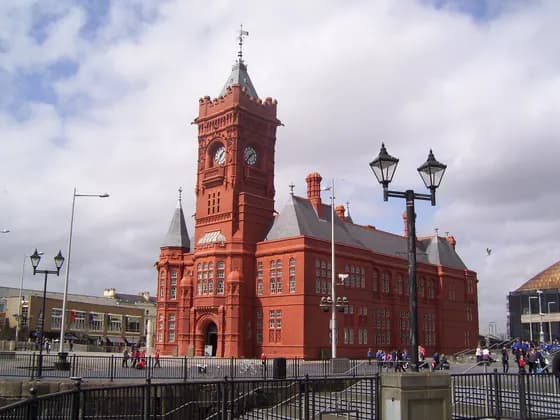
Photo: Jeremy Segrott (from Cardiff, Wales, UK) / Wikimedia Commons · CC BY 2.0 · cropped
Photo: Colin Smith · CC BY-SA 2.0 · Photo: Martin Speck · CC BY-SA 2.0 · Photo: Athena's Pix (Back, but give me time!) profile at Flickr website · CC BY 2.0
Dentistry in Wales for 2027 entry: the short answer
If you want to study dentistry in Wales, there is one course to apply to: the five-year Bachelor of Dental Surgery (BDS, UCAS code A200) at Cardiff University's School of Dentistry. It is the only Welsh dentistry course on the UCAT Consortium's list for 2027 entry. Graduates can register with the General Dental Council (GDC), the UK regulator for dentists.
Competition is stiff. Cardiff reports over 1,500 applications a year for about 74 Year 1 places. It interviews roughly 280 to 300 applicants and now makes about 100 offers, with a reserve list. Selection runs on achieved GCSE and A-level grades, then the UCAT (University Clinical Aptitude Test) if needed, then a multiple mini interview (MMI).
Bangor and Aberystwyth universities proposed a new dental school for north and mid Wales in November 2025, and in July 2026 the Welsh Government said it was committed to supporting the proposal. Neither has given an opening date, so it is not a course you can apply to yet.
| Course | Dental Surgery (BDS), UCAS code A200, five years full time at Cardiff University |
|---|---|
| Year 1 places | About 74, including about 4 to 5 for overseas students |
| Typical offer | AAA including Biology and Chemistry |
| Admissions test | UCAT, sat before you apply |
| Interview | Multiple mini interviews: in person for home applicants, online for overseas applicants |
| UCAS deadline | 18:00 UK time on 15 October 2026 for 2027 entry |
| Home tuition fee | £9,790 a year for 2027 entry, charged at the government maximum |
| Overseas tuition fee | £31,700 in Year 1, then £48,950 a year (2027 entry) |
| Graduate entry | Cardiff has no graduate-entry BDS; graduates apply to A200 with a 2:1 |
| Later-year funding | NHS Wales Bursary for Welsh-domiciled students from year 5 |
Cardiff: the only BDS dentistry course in Wales
The card opens our full Cardiff dentistry guide. Below it: what the course is like, from Cardiff's own 2027-entry pages.
Cardiff's School of Dentistry is based at the University Dental Hospital on the Heath Park campus. You learn clinical skills first in a simulation suite, on mannequins known as phantom heads. Year 1 also covers dental anatomy, physiology and the pathology of oral and dental disease, taught in the School of Dentistry and the School of Biosciences.
You see your first patient in Year 2, under close supervision, and then build your own list of patients. From Year 4 you spend time on placement in primary care settings in and around Cardiff and across Wales. Cardiff says its NHS links and outreach clinics across Wales give you a wide range of patients. Cardiff is reviewing the curriculum with its students and expects to finish by August 2027, so check the course page for the final structure.
The Cardiff BDS course year by year
This is Cardiff's current outline. The school says the final 2027/28 modules will be published by September 2027.
- Year 1
Science foundations and phantom heads
Dental anatomy, physiology and the pathology of oral and dental disease, alongside introductory clinical skills in the dental simulation suite.
- Year 2
Your first patient
Lectures, seminars and clinical skills sessions on diseases of the teeth and face and how to prevent them. You treat your first patient under close supervision, then start building your own patient list.
- Year 3
A growing patient list
More professionalism, communication and clinical skills through lectures, seminars and simulated clinical work, while your own list of patients grows.
- Year 4
Placements across Wales
Time on placement in primary care settings in and around Cardiff and across Wales, managing a range of patients and building treatment planning and prevention skills.
- Year 5
Ready for practice
More work in the simulation suite and out on placement. Once you graduate you can register with the GDC, and Dental Foundation Training follows if you want to work in the NHS.
You are assessed across the four areas the GDC sets out in its Safe Practitioner framework: clinical knowledge and skills, interpersonal skills, professionalism, and self-management. Assessments can include written exams, case reports, practical skills tests, portfolios and clinical oral exams.
Entry requirements for Cardiff dentistry (2027 entry)
| A-levels | AAA including Biology and Chemistry, with a pass in any science practical element |
|---|---|
| GCSEs | English Language at grade 6 or B, plus six other GCSEs including 7 or A in Biology and Chemistry, or 7-7 in double award science |
| International Baccalaureate | 36 overall or 666 at Higher Level, including 6 in HL Biology and HL Chemistry |
| Welsh Baccalaureate | The Advanced Skills Baccalaureate Wales can replace one A-level, but not Biology or Chemistry |
| Admissions test | UCAT, taken before you apply, with no published minimum score |
| Graduates | A 2:1 or higher, awarded by A-level results day in the year you apply, plus the minimum GCSE and A-level requirements |
| Not accepted | BTECs, T levels and Access courses for the BDS; A-level resits, unless you hold an honoured offer from Cardiff |
| Work experience | Not required, but your personal statement must show commitment to dentistry and knowledge of the profession |
| Personal statement and reference | Must be satisfactory for you to be considered for interview; the statement is screened but not formally scored |
| Health checks | Blood-borne virus screening, hepatitis B immunisation if you are not immune, and a tetanus vaccination within the last 10 years |
How Cardiff scores dentistry applications
Cardiff scores what you have already achieved, then uses the UCAT to separate applicants with top scores.
You are placed in an applicant group
Cardiff classifies BDS applicants as Welsh-domiciled, rest of UK, contextual rest of UK, widening participation (WP) or overseas. Cut-offs can differ between the groups so that each one is represented.
Your GCSEs earn points
Cardiff typically scores seven GCSEs, including Biology and Chemistry. An A*, 8 or 9 earns 4 points, an A or 7 earns 3, a B or 6 earns 2, and a C, 4 or 5 earns 1, up to a maximum of 28.
Achieved A-levels can top you up
If your GCSEs fall short of 28, up to three achieved A-levels are scored the same way until you reach the maximum. A suitable honours degree, with the minimum GCSEs and A-levels, also gives the maximum score.
The UCAT separates top scorers
If more applicants in a group reach a high academic score than there are interviews, Cardiff uses the UCAT as a cut-off. The cut-off is not set in advance, is unrelated to the previous year's and can differ between groups.
The MMI decides offers
The highest scorers in each group usually get offers, but a low Suitability for the Profession score can stop an offer even after strong stations. If interview scores tie, the UCAT decides. Reserve lists are ranked the same way.
Cardiff's dentistry MMI: format and practice
Cardiff makes no BDS offer without an interview. Its multiple mini interview (MMI) is a series of short, timed stations that you rotate around. Cardiff says most stations are mapped to the attributes the GDC expects of dental professionals, and that the MMI shows whether you can think on your feet, appraise information critically and communicate ideas clearly.
Cardiff's current admissions information says interviews are in person for home fee status applicants, and online only for overseas BDS applicants. Cardiff does not pay interview travel costs, but applicants who cannot afford to attend can contact the school to discuss it. If you have not heard about an interview by the end of December, Cardiff asks you to get in touch.
Any applicant can sit the MMI in Welsh or bilingually, switching language at any point. There are a set number of these slots, so contact Cardiff once you are invited. Using Welsh earns no extra points and loses none.
Practice prompt: Why dentistry rather than medicine, and what do you know about the work of a general dental practitioner?
Cardiff wants evidence of commitment to dentistry and knowledge of the profession. Talk about the dental team, long-term care of patients and prevention, using what you have seen, done or read. Do not run medicine down: explain what draws you to dentistry itself.
Practice prompt: Explain to an anxious patient, in plain words, why they need a filling.
This tests whether you can communicate an idea clearly and check it has landed. Find out what worries the patient, explain in short steps without jargon, invite questions and agree what happens next. A calm, kind manner matters as much as accuracy.
Practice prompt: A classmate on clinic tells you they skipped an infection-control step to save time.
Put patient safety first. Speak to your classmate, explain why the step matters, and say you would tell a supervisor if the risk continued. Show you would act fairly and follow the school's procedures rather than ignore it or rush to blame.
Welsh applicants, contextual data and guaranteed interviews
Dental education in Wales is funded by the Welsh Government, and Cardiff says that public money should improve the health of Wales as well as the wider UK. Because Welsh applicants are under-represented, Cardiff's School of Dentistry treats Welsh-domiciled applicants (those who normally live in Wales) as one of its contextual groups. Dental student numbers are capped in line with the funding available.
Contextual status at Cardiff does not lower the BDS offer. It gives you extra weight in the scoring used to decide interviews. You count as contextual if your UCAS form shows, for example, care experience, free school meals, caring responsibilities or estrangement from your parents. Postcode and school data can also qualify you, if they give a score of 100 or more on Cardiff's 0 to 330 scale.
Guaranteed interviews
WP applicants who took part in Step Up, the Sutton Trust Dental Summer School, the North Wales Dentistry Widening Participation programme, Deintyddion Yfory or the International Foundation Year are eligible for a guaranteed BDS interview. Cardiff receives lists of applicants who attended within the last year.
What counts towards Cardiff's contextual score
Postcode data: average household earnings, how many young people go to university, and the Welsh, English, Scottish or Northern Irish deprivation index. School data: sixth-form results and free school meal rates. From your UCAS form: whether your parents have a higher education qualification.
Fees and funding for dentistry in Wales
Cardiff publishes its 2027-entry BDS fees for every year of the course. Who lends or pays the money depends on where you normally live.
| Year | Home fee status | Overseas fee status |
|---|---|---|
| Year 1 | £9,790 | £31,700 |
| Years 2 to 4 | £9,790 a year | £48,950 a year |
| Year 5 | £9,790; eligible Welsh-domiciled students get a Welsh Government tuition contribution | £48,950 |
Home fees are charged at the government maximum each year and may rise if the cap changes. Cardiff has about 4 to 5 overseas places in Year 1.
| Wales, years 1 to 4 | Student Finance Wales: fee loan up to £9,790 a year (2026/27), plus a grant and loan for living costs that depend on household income |
|---|---|
| Wales, year 5 | Welsh Government tuition contribution and the NHS Wales Bursary, with no duty to work in Wales afterwards |
| England, Scotland or Northern Ireland | Loans from your own funder. Ask it how year 5 in Wales is paid: England's NHS Bursary only covers courses inside the Office for Students intake target |
| Outside the UK | The overseas fees above, with about 4 to 5 Year 1 places |
Welsh-domiciled dental students apply to NHS Wales Student Awards Services for the year their NHS funding starts, normally year 5, not at the start of the course. NHS Wales funds Welsh-domiciled dental students even if they study in England. Part of the bursary is means-tested, it is paid in three instalments (September, January and April), and you can claim travel costs for clinical placements.
| Total support, away from home outside London | £12,590 a year in grant and loan combined |
|---|---|
| Away from home, household income £18,370 or less | £8,260 grant plus £4,330 loan |
| Away from home, household income £59,200 or more | £1,020 grant plus £11,570 loan |
| Cardiff estimate, university halls | £11,743 for a 40-week year, including rent and bills |
| Cardiff estimate, private shared house | £13,511 for a 52-week year |
Other ways into a dental career in Wales
Cardiff: BSc Dental Therapy and Dental Hygiene (B752)
About 29 places a year. For 2027 entry the typical offer is BBB including Biology or Medical Science, and selection uses an MMI. The UCAT is not currently required. Cardiff accepts some Access, BTEC and T level qualifications for this course, unlike the BDS.
Cardiff: DipHE Dental Hygiene (B750)
About 18 places a year. The typical 2027-entry offer is CC including Biology or Medical Science, again with an MMI and no UCAT. Neither of Cardiff's hygiene and therapy courses currently accepts overseas fee-paying students.
Bangor: dental hygiene and dental therapy
Bangor's dental hygiene and therapy courses are approved by the GDC, with clinical training alongside NHS partners across North Wales. It also runs a one-year BSc Dental Therapy (B753) for qualified dental hygienists, which Bangor says is the only course of its kind in Wales.
After the BDS: Dental Foundation Training
To work in the NHS, new dentists complete one more year in a Dental Foundation Training scheme. The Dental Schools Council says there is one scheme for England, Wales and Northern Ireland and another for Scotland, and you can apply to both.
Applying to Cardiff dentistry for 2028 entry: a checklist
Dates marked as 2027-entry dates come from the current cycle. Check UCAS, the UCAT Consortium and Cardiff for the 2028-entry dates when they are published.
For Year 12 students applying in autumn 2027
- Now: work out your GCSE points out of 28 on Cardiff's scale. GCSE resits only count if you have the result before you apply.
- Summer 2027: sit the UCAT before you apply, and check the UCAT Consortium's 2027 test dates.
- Before you apply: build real knowledge of dentistry for your personal statement. Cardiff does not require dental work experience.
- September: tell Cardiff about any extenuating circumstances, with evidence. The 2027-entry deadline was 1 October.
- By the October UCAS deadline (15 October for 2026 and 2027 entry): submit a complete, accurate application.
- After you apply: if invited, ask straight away for a Welsh or bilingual MMI if you want one, and contact Cardiff if you have heard nothing by the end of December.
Mistakes that cost applicants a place at Cardiff dentistry
Dental schools in Wales: your questions answered
Where this guide's facts come from
Checked against these sources on 19 October 2026. Rules change between cycles, so confirm anything that decides your application on the official page for your entry year.
Ready for Cardiff's dentistry MMI?
Rehearse timed stations with a tutor who knows UK dental interviews, or start with our free six-station dental mock.