
The Queen Mary (QMUL) Dentistry course
What you actually study, and where you will be
Queen Mary's BDS is a 5-year course with an integrated curriculum, with patient treatment from Year 1 and placements in East London (2027 entry). Taught at the Institute of Dentistry in the Royal London Dental Hospital in Whitechapel, a £78 million building the Institute moved into in 2014, with rotations through three outreach dental clinics on the Isle of Dogs, in Stratford and in Hackney.
- Degree
- BDS
- Length
- 5 years
- Teaching
- Integrated
- First patients
- Year 1
- UCAS code
- A200

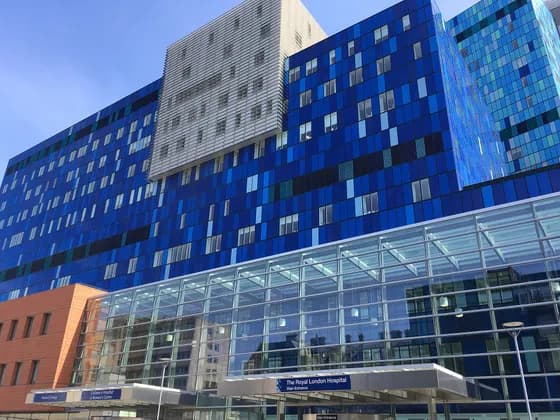


Photo: Paul the Archivist · CC BY-SA 4.0 · cropped
Photo: ClippednPinned · CC BY-SA 4.0 · Photo: Ввласенко · CC BY-SA 3.0 · Photo: ClemRutter · CC BY-SA 4.0
The Queen Mary (QMUL) dentistry course at a glance (2027 entry)
Queen Mary's Bachelor of Dental Surgery (BDS) is a five-year degree that trains you to become a dentist. It is run by the Institute of Dentistry, part of Queen Mary University of London's Faculty of Medicine and Dentistry. The Institute opened in 1911, and the course has about 70 places a year. It is accredited by the General Dental Council (GDC), which regulates dentists and the rest of the dental team in the UK.
You are based in Whitechapel, east London. The Institute moved in 2014 into a five-storey building in the Alexandra Wing of the Royal London Hospital, which is also home to the Royal London Dental Hospital, run by Barts Health NHS Trust. As the course goes on, you also treat patients at three outreach clinics near Canary Wharf, in Stratford and in Hackney. An outreach clinic is a community clinic away from the main hospital.
The local population shapes the training. The borough around the Whitechapel site has about 300,000 residents who speak 92 languages between them. Queen Mary says this means you meet a wide range of disease, including some of the less common oral cancers. You also study the sociology and psychology of health, so you understand how patients feel about looking after their mouths and about visiting a dentist.
The curriculum is new. In 2025/26 Queen Mary began teaching year 1 on a redesigned course built around the GDC's Safe Practitioner framework, published in 2023. The framework sets out what every new dental professional must know and be able to do. Students who started earlier stay on the older course, so if you start in 2027 you join the new one. It was designed with current students and recent graduates.
Day to day, the early years mix lectures and small-group teaching with practice on mannequin heads and computer simulators in the clinical skills laboratory. You get a brief first taste of clinic in year 1. Clinical work then grows each year and, from year 3, takes up most of your study time.
| Degree | BDS (Bachelor of Dental Surgery) |
|---|---|
| Course length | Five years, full time |
| UCAS code | A200 |
| Places for 2027 entry | 67 home and up to 4 overseas |
| Main base | Institute of Dentistry and Royal London Dental Hospital, Whitechapel |
| Teaching style | Integrated spiral curriculum built on four core modules |
| First patient contact | Year 1, brief clinic sessions giving preventive advice |
| Planned hours on clinic | About 10 in year 1, 530 in year 3, 865 in year 5 |
| Outreach clinics | Isle of Dogs near Canary Wharf, Stratford and Hackney |
| Intercalation | Optional iBSc after year 2, 3 or 4; MSc after 3 or 4 |
What makes Queen Mary (QMUL) dentistry different
A gradual build-up from classroom to clinic
Year 1 covers the groundwork every dentist needs before treating anyone, such as infection control, taking a medical history and giving oral hygiene advice, with only a brief first step into clinic. Year 2 centres on practical skills classes. From year 3, treating patients under supervision becomes your main activity.
Three outreach clinics across east London
Outreach clinics give you experience at the level of a general dental practice. Queen Mary uses three: Barkantine on the Isle of Dogs with 10 chairs, the Sir Ludwig Guttmann Centre in Stratford with 24, and Kenworthy Road in Hackney with 20. Each runs student treatment clinics four days a week.
Simulation from mannequin heads to virtual reality
The clinical skills laboratory has facilities for 72 phantom heads, which are mannequin heads fitted with teeth that you work on as if they were a patient. You also train on haptic simulators, which let you feel the resistance of a virtual tooth through a handpiece, and on virtual and augmented reality systems. You must pass a practical test before doing each treatment on patients.
Learning alongside dental hygiene and therapy students
Dental hygienists and therapists are members of the dental team who clean teeth, treat gum disease and, in the case of therapists, carry out some fillings. You learn with Queen Mary's dental hygiene and therapy students in year 1, and the Kenworthy Road clinic in Hackney has 20 chairs used by both groups.
Clinical progress tracked in real time
Your clinical work is logged on LiftUpp, a tracking system that shows your progress and blocks any treatment you have not yet been cleared to do.
How Queen Mary (QMUL) teaches dentistry
The course is organised around four themes: Basic Sciences for Dentistry, Human Health and Disease, Population Oral Health and Evidence Based Dentistry, and Clinical Practice and Professionalism. Each year is worth 120 credits. In year 1, 80 of your 120 credits are basic science, but from year 3 the whole year sits in Clinical Practice and Professionalism.
That clinical theme spans every dental subject. It covers restorative dentistry, which means repairing and replacing damaged teeth with fillings, crowns and bridges, as well as gum care, orthodontics and children's dentistry. It also includes special care dentistry, the care of people with disabilities or complex medical needs.
The design is a spiral. Topics you meet early come back later in more depth, so the human health and disease teaching from the early years is expanded in later years. The science is laid down mainly in year 1 and stays as a thread through the course. Professionalism, teamwork and social responsibility run through every year, alongside ethics, law and the psychology of changing patients' habits.
Teaching happens in weekly sessions of three sizes: small groups of up to 10, larger groups of 20 or more, and one-to-one teaching at the dental chair. Lectures are recorded and posted on QMPlus, the university's online learning site. Some topics use flipped learning, where you watch short videos or read beforehand and use class time to apply what you learned. Attendance at every timetabled session and clinic is compulsory.
The balance shifts as you move up. Year 1 is mostly science with a clinical introduction focused on prevention. Year 2 builds core technical skills in the clinical skills laboratory, year 3 moves you into outreach clinics, and years 4 and 5 are advanced clinical practice in several settings. On clinic you are supervised by university clinical staff and by general dental practitioners who work as clinical supervisors.
The ways you will learn
| Lectures, seminars and symposia | Lectures give core content to the whole year group, and seminars are smaller discussion sessions. Symposia, used in years 4 and 5, pull several dental subjects together around one topic so you see how they connect. |
|---|---|
| Small-group teaching | Groups of up to 10 students meet both on and off the clinic. Besides teaching, these groups are where much of your academic and pastoral support is organised. |
| Clinical skills laboratory | You practise procedures on phantom heads and on haptic simulators before you touch a patient. Here, one tutor supervises at most eight students. |
| Virtual and augmented reality | Immersive technology puts you in realistic digital scenarios where your actions change the outcome. You can repeat a technique as often as you need with no risk to a patient, and your improvement is measured each time. |
| Communication role play | You practise talking to patients through role play before you meet them as a clinician. There are also sessions on how dentists, patients and the rest of the dental team communicate with each other. |
| Chairside teaching on clinic | A supervisor watches your work with patients and steps in when needed, with at most six students per supervisor. After each clinical session you and your tutor discuss how it went, covering teamwork, professionalism and clinical skill. |
A typical week on the Queen Mary (QMUL) course
Queen Mary publishes the planned study hours for every module. Each year adds up to about 1,200 hours, split between lectures, seminars, practical classes, independent study and work-based learning, which here means learning on clinic. These are planning figures rather than a timetable, but they show how your week changes as the course goes on.
Year 1 is mostly independent study. About 250 of its 1,200 hours are scheduled teaching: 142 hours of lectures, 68 of practical classes and workshops, 30 of seminars and just 10 of work-based learning. The other 950 hours are for studying on your own.
Year 2 has more practical classes than any other year. Practical classes and workshops rise to 340 hours, most of them in the clinical practice module, alongside 190 hours of lectures, 100 of seminars and 40 of demonstrations. Independent study falls to 530 hours.
From year 3 the balance moves to the clinic. Planned work-based learning is about 530 hours in year 3, 780 in year 4 and 865 in year 5. Lectures take 107 to 110 hours a year in years 3 and 4 and 50 in year 5, and independent study is 160 to 200 hours a year. Year 3 also plans 250 hours of practical classes and 100 of project supervision.
When you start treating patients at Queen Mary (QMUL)
Contact with patients starts in year 1. You are introduced to the clinical environment, its equipment and materials, and you observe patients being treated. You also attend clinics to give patients advice on preventing dental disease, which is your first direct part in patient care.
In year 1 this is a small part of the timetable. Queen Mary plans about 10 hours of work-based learning in the year 1 clinical module, compared with more than 500 hours a year from year 3.
Before you treat anyone, you practise in the clinical skills laboratory on phantom heads and haptic simulators. For each type of treatment you then sit a gateway test, a practical check that you are competent. Only after passing it may you carry out that treatment on patients. If you fail, you get a remediation plan and a resit date, and LiftUpp blocks that procedure until you pass.
Responsibility builds year by year. Year 2 expands your clinical knowledge and treatment skills while you keep seeing patients. From year 3 you treat adults and children, and third-year students often do their first fillings, extractions or denture work at the Barkantine outreach clinic. Years 4 and 5 bring more complex cases, including treatment in the hospital.
The patients are members of the public treated free of charge by Barts Health NHS Trust. Students provide fillings, extractions, deep cleaning, dentures, crowns and root canal treatment. Appointments last 1.5 to 2.5 hours and run on Mondays, Tuesdays, Thursdays and Fridays in term time. A patient may see more than one student during a course of treatment.
Year by year at Queen Mary (QMUL)
- Year 1
Fundamentals of clinical practice
Year 1 lays the scientific foundations and introduces you to the clinic. Most of your credits, 80 of 120, come from two Basic Sciences for Dentistry modules, with smaller clinical and public health modules alongside. When the GDC inspected in 2026, year 1 ran for 35 weeks.
- Basic Sciences for Dentistry 1 and 2, one per semester and worth 40 credits each: cell biology, oral biology, physiology, pharmacology and the main body systems. This includes head and neck anatomy and the structure of the mouth's soft and hard tissues, covered in more depth in semester 2.
- How general health and medicines affect the mouth, and how a patient's medical history can influence their oral health.
- Dental materials science, taught within the same two modules: how ceramics, metals and polymers respond to heat, light, electricity and force, their risks and limits, and how dentists choose between them.
- Clinical Practice and Professionalism 1, worth 30 credits across the year: infection control, taking a patient's history, examining the face and mouth, checking gum health and giving oral hygiene and diet advice. You practise in the skills laboratory and on haptic simulators, with a brief first step into clinic.
- Population Oral Health and Evidence Based Dentistry 1, worth 10 credits across the year: preventing oral disease across whole communities and how environmental and social factors shape health. You also learn to search medical databases and judge research evidence.
- Critical thinking, interpersonal and professional skills, and the effect of illness on patients and their families.
- Shared learning with students on the dental hygiene and therapy course.
- Each Basic Sciences module is marked 75% on a two-hour written exam and 25% on scenario-based coursework, where you apply the science to realistic situations.
- Clinical Practice and Professionalism 1 is marked 60% on a two-hour Objective Structured Clinical Examination (OSCE), a circuit of practical stations, and 40% on a written paper. The public health module is 70% short-answer exam and 30% in-class quizzes.
- Year 2
Health, disease and core clinical skills
Year 2 applies first-year science to the body in health and disease and builds the technical skills you need before treating patients. Clinical Practice and Professionalism rises to half your credits, and practical classes take up more of your time than in any other year.
- Human Health and Disease, worth 45 credits: microbiology, pathology, immunology, haematology and cancer biology, so you understand common medical conditions and how they affect safe dental care.
- The same module links general medicine and surgery to the signs you will see in the dental chair. It aims to prepare you to talk to medical teams about patients, whether they are hospital in-patients or at general and specialist out-patient clinics.
- Clinical Practice and Professionalism 2, worth 60 credits, readies you to start supervised treatment of patients. Its focus is plaque-related disease, such as tooth decay and gum disease, and tooth surface loss, which is wear of the teeth from grinding, acid or brushing.
- Its clinical topics are adult cariology (the study of tooth decay), children's dentistry, periodontology (gum health), dental materials, removable prosthodontics (dentures) and dental radiology (X-rays). A series of planned steps then moves you from the skills laboratory to the clinic.
- Its professionalism strand covers ethics and law, sociology and psychology, so you understand how people think about health and illness and how to help them change habits.
- Population Oral Health and Evidence Based Dentistry 2, worth 15 credits: epidemiology, which is the study of how common diseases are and who they affect, plus dental public health, health inequalities and prevention.
- Across years 2 and 3 you study diseases and abnormalities of the mouth. You also cover specialist areas: restorative dentistry for adults and children, prosthodontics (replacing teeth), endodontics (root canals), oral medicine (soft-tissue disease), oral surgery and orthodontics (straightening teeth).
- Human Health and Disease is marked on two written papers (30% and 40%), an OSCE (20%) and in-course work (10%). The public health module is a single two-hour written paper.
- Clinical Practice and Professionalism 2 is marked on a written paper (40%), a professionalism presentation (20%) and an OSCE (20%). Adult and child clinical skills tests add 5% each, and a dental materials problem-based learning task, where you research a set problem, adds 10%.
- Year 3
Clinical practice in outreach
From year 3, clinical work takes up most of your study time. The whole year is one 120-credit module, Clinical Practice and Professionalism 3, and you move from the skills laboratory to supervised treatment of adults and children. The aim is to get the basics of primary dental care, the everyday dentistry done in high-street practices, right before year 4. The outreach rotas below are how the clinics run for current students.
- A full day every two weeks at the Barkantine outreach clinic near Canary Wharf, with a morning and an afternoon session, adding up to about 20 days in the year.
- Each Barkantine session starts with a huddle, a short meeting where you discuss your patient's treatment with tutors, followed by two hours of treatment.
- Because Barkantine runs like a local practice, you arrive for each session without knowing which patient or treatment you will have.
- Fortnightly clinics at the Sir Ludwig Guttmann Centre in Stratford, with separate sessions for adult and child patients.
- Simulated practice of advanced clinical skills and teaching in applied clinical sciences, alongside clinic.
- More complex patients through special care dentistry, and public engagement to build your communication skills, including visits to local primary schools.
- Teaching at the Institute of Dentistry in Whitechapel as well as at the outreach clinics.
- Year 3 is marked on two written papers (20% and 25%), an OSCE (20%), a Structured Clinical Reasoning viva (30%) and a student-selected component on a topic you choose (5%). In the viva, examiners question you in person on how you think through a patient's case.
- Years 4–5
Preparation for practice
The last two years consolidate your skills for professional practice. Each is a single 120-credit module, Clinical Practice and Professionalism 4 and 5, taught through symposia, small groups and wide clinical experience. You see a greater range of cases, including treatment in the hospital.
- In year 4 you manage more complex cases and learn more advanced techniques. These include implantology (replacing missing teeth with implants fixed in the jaw), rotary endodontics (root canal treatment using powered instruments) and periodontal surgery (surgery on the gums).
- You also study how the face and jaws grow and develop, so you can make a basic orthodontic assessment and refer patients to a specialist when needed.
- Fortnightly adult and child clinics at the Sir Ludwig Guttmann Centre continue in year 4 for current students. In the autumn term of year 5 they go there for child patients only.
- Digital scanning: 3D images of a patient's mouth are used to plan and carry out restorative care such as fillings, crowns and bridges.
- Year 5 is about moving from supervised student to a registered dentist working in a team. You treat children, adults, older people and patients with special care needs, and take part in case-based discussions about how you managed a patient.
- Talks from recent graduates about applying for jobs, and from dentists in specialist fields about different career routes.
- Sign-up to final exams, which needs a minimum amount of clinical activity as well as passes in the required modules.
- Year 4 is marked on two written papers (20% each), an OSCE (30%) and Structured Clinical Reasoning on two patient cases (30%).
- In year 5 your module mark comes from two written papers and three Structured Clinical Reasoning vivas, each worth a fifth.
How you are assessed at Queen Mary (QMUL)
Every module is core, so you must pass all of them to move into the next year. Some assessments are formative, meaning they do not count towards your marks but show where you need help. Others are summative and do count. Assessments take place in the clinical skills laboratory or with patients.
Year 1 is examined mainly through written papers and OSCEs. The papers use single best answer questions, where you pick the best of several options, very short answer questions, where you give a word or phrase, and short answer questions. In an OSCE you move round timed stations, carrying out clinical tasks and talking to real or simulated patients.
Later years lean towards practical skills and clinical reasoning. You meet Structured Clinical Reasoning exams, which test how you think through a patient's case, case presentations and viva voce exams, where examiners question you in person. Work on clinic is assessed through workplace-based assessments called clinical course units. Professionalism is assessed through a reflective portfolio.
Your clinical work is recorded on LiftUpp, which logs each activity, how it was assessed and the feedback you received, and shows your progress with a traffic-light display. If you have not yet passed the gateway test for a procedure, supervisors see an alert and will not let you do it on a patient. Progress Review Panels look at every year group three times a year.
Skills are re-checked rather than tested once. Since 2025, students have revalidated their endodontic (root canal) and fixed prosthodontic (crown and bridge) skills in the clinical skills laboratory every year. Students in years 1 to 4 who are short of clinical experience get extra clinic time, simulation practice and targeted support.
If your clinical performance is not good enough, you may have to follow a remedial programme or repeat part of the course. Students who leave without finishing may receive a certificate, diploma or ordinary degree in Dental Sciences, but these do not allow you to register as a dentist.
Where you will actually be at Queen Mary (QMUL)
Your clinical training takes place in east London with Barts Health NHS Trust, Queen Mary's NHS partner for the course. Your home base is the Royal London Dental Hospital in Whitechapel. You also rotate around three outreach centres, community clinics that give you experience at the level of a general dental practice.
The rotation depends on your year. In year 3 you spend a day every two weeks at Barkantine. In years 3 and 4 you also attend the Sir Ludwig Guttmann Centre every fortnight, with separate adult and child clinics. In the autumn of year 5 you return there for children only. These patterns come from the clinics' own pages, which describe the course as it runs for current students.
Every site Queen Mary names is in east London and close to a Tube, DLR or Overground station. When the GDC inspected in March 2026, it heard of plans to open a new outreach centre in Barking in about two years' time.
Your main base. The student treatment clinics on the ground floor have between 31 and 46 dental chairs open each day. The hospital is opposite Whitechapel station.
- The Royal London Dental Hospital, Turner Street (home of the Institute of Dentistry)
Ten chairs on the first floor of a medical centre that also offers GP, maternity and mental health services. Used for year 3 teaching, with two clinical tutors at each session and three dental nurses. It reopened in January 2026.
- Barkantine Dental Outreach Centre, 121 Westferry Road
Twenty-four chairs on the third floor of a health centre that opened shortly after the 2012 Olympic Games, with digital X-ray and sedation facilities. Run with Barts Health; it also trains dental hygiene and therapy students.
- Sir Ludwig Guttmann Centre dental clinic, 40 Liberty Bridge Road
Queen Mary's newest outreach clinic, opened in January 2024 with 20 chairs for dental students and dental hygiene and therapy students. It provides around 7,000 appointments a year and is a seven-minute walk from Homerton Overground station.
- Kenworthy Road Dental Clinic, Kenworthy Road Health Centre
Electives and chosen modules at Queen Mary (QMUL)
Student-selected components let you study an area in more depth, based on your own interests. Current options include audit, quality improvement projects, research, clinical and communication skills, dental materials science, pathology, pharmacology and prevention of oral diseases. An audit checks whether care meets an agreed standard, while a quality improvement project tests a change designed to make care better. The list may change.
In year 3 your student-selected component counts for 5% of the year's module mark, and the year 3 module plans about 100 hours of project supervision. How well you do in these components counts towards your continuous assessment.
Eligible students may also get the chance of observational placements in the UK or abroad, where you watch dentists at work. These are self-funded, so you would pay for flights, accommodation and any fees the host charges.
Intercalation at Queen Mary (QMUL)
Intercalating means taking a year out of dentistry to complete a separate degree, then returning to the BDS. At Queen Mary it is optional. You can apply for an intercalated BSc (iBSc) after year 2, 3 or 4, or an intercalated master's (MSc) after year 3 or 4. You must have passed every year so far, and selection is based on your exam results and an interview.
Queen Mary's own iBSc courses include Experimental Pathology, Global Medical Humanities, Global Public Health, Neuroscience, Pharmacology and Innovative Therapeutics, and Sports and Exercise Medicine. Each includes a research project supervised by a member of staff. The Medical Education iBSc is suspended for 2026/27, and the options may change.
Several master's degrees on Queen Mary's intercalation list are dental: Dental Materials, Dental Technology, Experimental Oral Pathology (Oral Sciences) and Oral Biology. An MSc needs at least three years of the BDS behind you and lasts 12 months. A small number of students intercalate at other universities instead.
Facilities and support at Queen Mary (QMUL)
Where you will learn
Every treatment surgery in the Whitechapel building has a computer with a second screen at the chair, so you can show patients their images and talk them through the results.
The clinical skills laboratory is set up to feel like a real clinic and has facilities for 72 phantom heads. It sits alongside haptic, virtual reality and IT labs. Extra supervised sessions are available if you want more time to practise a technique or need to catch up.
The building also has digital imaging, two cone beam CT machines, which take 3D X-rays of the teeth and jaws, and facial-scanning equipment. There are 92 production laboratory spaces, the workshop area where items such as dentures and crowns are made, plus dedicated seminar rooms and a student learning centre.
Elsewhere on the Whitechapel campus, the Blizard Building has research laboratories and a 400-seat lecture theatre. The Garrod Building, reopened in January 2024 after a refurbishment, is home to Barts and The London Students' Association. You can also use the Queen Mary Library at Mile End, the medical archives at the Royal London and Barts hospitals, and the University of London Library.
Support while you study
Every student has an Academic Advisor who looks after a group of 8 to 14 students. Your advisor runs two reflective practice sessions a year with the group, where you look back on how your learning is going, and can help you explore options if you are struggling academically.
The Student Support Office gives confidential advice on personal, academic and financial matters. Handbooks setting out learning outcomes, clinical requirements and deadlines are kept up to date on QMPlus. When the GDC inspected in March 2026, it found strong and effective support systems for students.
If you have dyslexia or another specific learning difficulty, the Disability and Dyslexia Service can arrange support. Examples include lecture notes in advance and permission to record clinical skills sessions on phantom heads and haptic simulators. Clinics and labs are accessible, with ground-floor clinics, lifts and ramps.
Is the Queen Mary (QMUL) course right for you?
This course may suit you if
- You want early, if brief, clinic experience from year 1, with most patient treatment starting in year 3.
- You would like to train on a diverse east London population, with a wide range of disease including some less common oral cancers.
- You enjoy learning with technology, from haptic simulators and virtual reality to 3D digital scanning of patients' mouths.
- You want experience of the everyday dentistry done in general practice, through community outreach clinics from year 3.
- You would value a relatively small intake of about 70 places a year and an Academic Advisor who looks after a group of 8 to 14 students.
Things to think about
- Year 1 is mostly independent study: about 950 of its 1,200 planned hours are for working on your own, so you need to organise your time well.
- The year gets longer after year 1. In 2026 the GDC recorded 35 weeks for year 1 but 43 to 44 weeks for years 2 to 5, which were still on the older course.
- Attendance at every timetabled session is compulsory and is logged, including lectures.
- Every module is core and must be passed to progress, and key clinical skills are re-tested every year rather than signed off once.
- The curriculum is new, first taught to year 1 in 2025/26, so each later year will have run only twice before a 2027 starter reaches it.
- You travel between Whitechapel and three outreach clinics in east London on a set rotation.
Queen Mary (QMUL) dentistry course — frequently asked questions
Applying to Queen Mary (QMUL)?
How to get into Queen Mary (QMUL)
Entry requirements, UCAT, personal statement and interview, step by step.
Open the guide →Queen Mary (QMUL) UCAT cut-offs and offers
UCAT cut-offs, A-level offers, interview format and decision dates.
See the requirements →Compare Queen Mary (QMUL) with other schools
Put the teaching style, anatomy teaching and placements next to another school.
Open the comparison →Prepare for the Queen Mary (QMUL) interview
Format breakdown, school-specific sample questions and prep tips from tutors who interviewed here.
Read the guide →Where this Queen Mary (QMUL) course guide came from
This guide was written from 25 official sources — Queen Mary University of London (Barts and The London Institute of Dentistry)'s own course pages and programme documents, plus the regulator and NHS placement partners where they publish detail — read on 2026-09-24, then checked claim by claim against those sources.
- Dentistry BDS, Queen Mary University of London course finder, 2027 entry
- Dentistry BDS, Queen Mary Programme and Module Directory, 2027
- Basic Sciences for Dentistry 1 (BDS4013U), Queen Mary Programme and Module Directory, 2026
- Basic Sciences for Dentistry 2 (BDS4014U), Queen Mary Programme and Module Directory, 2026
- Clinical Practice and Professionalism 1 (BDS4015U), Queen Mary Programme and Module Directory, 2026
- Population Oral Health and Evidence Based Dentistry 1 (BDS4012U), Queen Mary Programme and Module Directory, 2026
- Human Health and Disease (BDS5008), Queen Mary Programme and Module Directory, 2026
- Clinical Practice and Professionalism 2 (BDS5007), Queen Mary Programme and Module Directory, 2026
- Population Oral Health and Evidence Based Dentistry 2 (BDS5006), Queen Mary Programme and Module Directory, 2026
- Clinical Practice and Professionalism 3 (BDS6301), Queen Mary Programme and Module Directory, 2026
- Clinical Practice and Professionalism 4 (BDS6401), Queen Mary Programme and Module Directory, 2026
- Clinical Practice and Professionalism 5 (BDS6501), Queen Mary Programme and Module Directory, 2026
- Dentistry BDS (A200) overview, Faculty of Medicine and Dentistry
- Dentistry BDS (A200) course structure, Faculty of Medicine and Dentistry
- Dentistry BDS (A200) selection criteria and places for 2027, Faculty of Medicine and Dentistry
- Programme Specification: Bachelor of Dental Surgery (BDS), 2025-26
- General Dental Council inspection report, Queen Mary University of London BDS, March 2026
- Whitechapel clinical facilities, Institute of Dentistry
- Barkantine Dental Outreach Clinic, Institute of Dentistry
- Sir Ludwig Guttmann Dental Outreach Centre, Institute of Dentistry
- Student dental clinics, Barts Health NHS Trust
- Intercalated degrees, Faculty of Medicine and Dentistry
- Dental workforce expansion and contract reforms, written ministerial statement HCWS1392, Department of Health and Social Care, 10 March 2026
- Proposal for a tie-in to NHS dentistry for graduate dentists, Department of Health and Social Care consultation, 2024
- More NHS dentistry for those who need it most, Department of Health and Social Care press release, 8 July 2025
Courses are restructured between cycles. Anything here that decides your application — an anatomy offer, a placement city, a compulsory intercalated year — should be confirmed against the official page for your entry year.
Applying to Queen Mary (QMUL)?
We have helped hundreds of applicants turn their UCAT, personal statement and interview prep into offers from Queen Mary (QMUL) and other UK dentistry schools.