
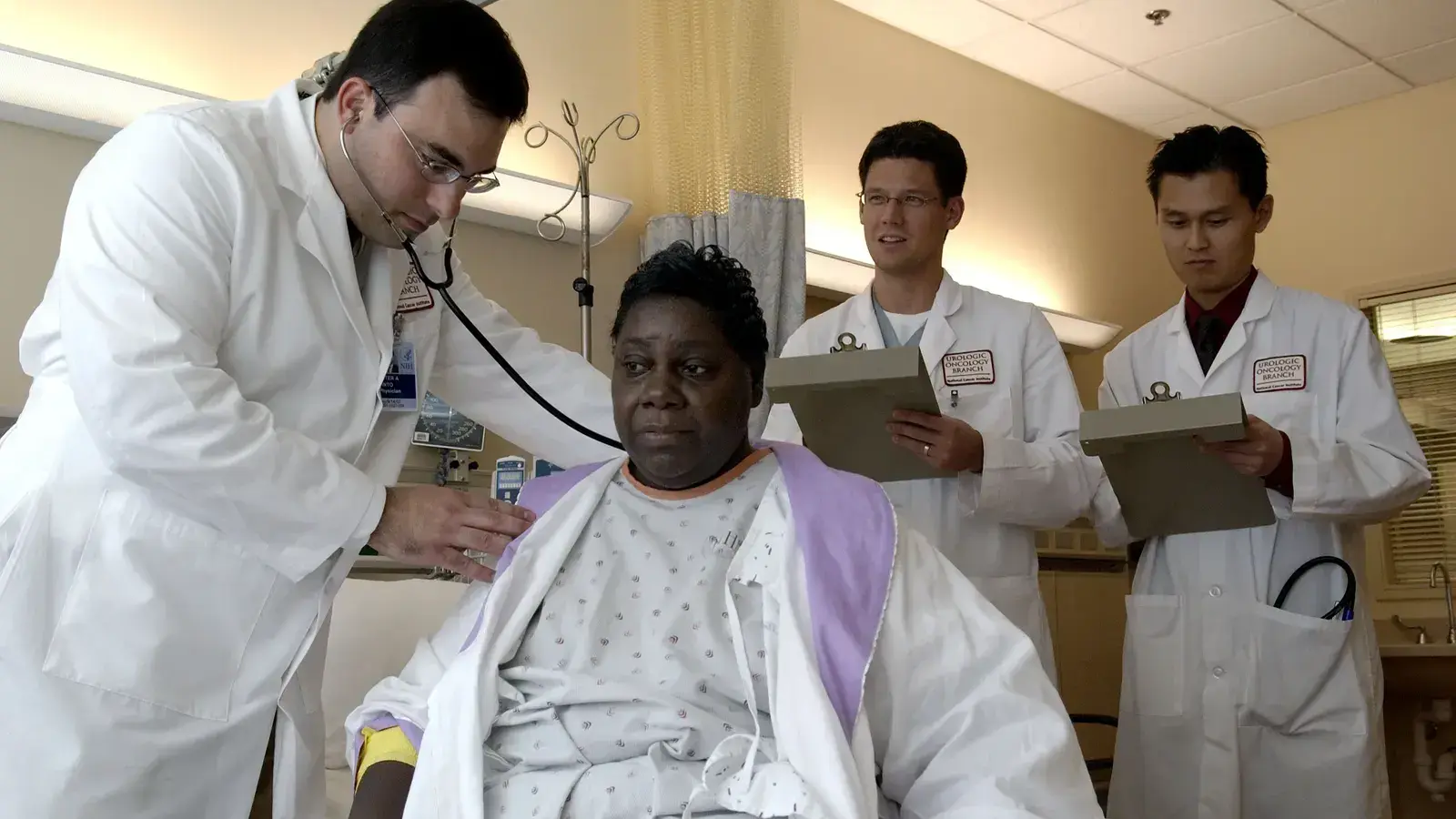
Ask a panel what separates a candidate who has been inside a hospital from one who has only read about one, and the multidisciplinary team is where it shows. Weak answers use MDT as a token word. Strong answers name roles, say what each decides, and describe a decision a doctor would have got wrong alone.
This is the roster and the machinery: who is in the room, how MDT meetings run, why flat hierarchy is a safety intervention rather than good manners, and how to discuss physician associates without walking into the NHS’s most contested workforce argument. It assumes how the NHS actually works.
01
Who is actually in the room
Nursing is by a wide margin the largest professional group in the NHS, and it is not one job. Advanced nurse practitioners are trained to master’s level to assess, diagnose, manage and often prescribe within a defined scope, and many run their own clinics. Specialist nurses hold a disease and a pathway: the heart failure nurse, the cancer clinical nurse specialist who is the number a patient actually rings.
Say the consequence out loud in an interview. Resident doctors — the grades until recently called junior doctors — rotate every few months, so continuity and the induction of each new arrival sit with the nurse who has been there for nine years.
Pharmacists own medicines: interactions, renal dosing, and reconciling what the patient was actually taking at home against what the admitting doctor wrote down. They can qualify as independent prescribers, and after reform of the pharmacy degree in Great Britain those registering from 2026 qualify as independent prescribers at the point of registration, so a pharmacist running a GP polypharmacy clinic is ordinary.
Beyond nursing and pharmacy sit the allied health professions, healthcare science, social care and the support workforce.
- Physiotherapists — movement, respiratory care and rehabilitation. Whether a patient can safely mobilise often sets the discharge date.
- Occupational therapists — function, not diagnosis: can this person wash, dress, cook, manage stairs? Their home assessment often unblocks a discharge.
- Speech and language therapists — communication after stroke or brain injury, and swallowing: a dysphagia assessment decides whether a patient may eat at all.
- Dietitians — the only UK nutrition professionals with a legally protected title. Enteral feeding, refeeding risk, renal and diabetic diets.
- Radiographers — diagnostic radiographers acquire the imaging, and reporting radiographers issue the report on defined studies; therapeutic radiographers plan and deliver whole courses of radiotherapy.
- Healthcare scientists — biomedical scientists, clinical scientists and physiologists. A great deal of diagnosis and monitoring rests on results they produce and validate.
- Paramedics — the first clinician most acutely unwell patients meet, now in urgent care and general practice too. Advanced paramedics can prescribe.
- Healthcare assistants — personal care, feeding and observations, with more bedside hours than anyone. They notice first when a patient changes, and they are not statutorily regulated.
- Social workers — separately regulated and usually local-authority employed: needs assessments (under the Care Act 2014 in England), safeguarding and care packages. Those who train as approved mental health professionals also make the application to detain someone under the Mental Health Act.
Name the decision, not just the role
The mark is not for listing professions but for showing that real decisions sit outside medicine: the speech and language therapist decides whether the patient can swallow, the occupational therapist whether the home is safe. Attach a decision to every role you name.
Who is in the multidisciplinary team?
Do not machine-gun a list. Group it — nursing, pharmacy, allied health professions, healthcare science, social care, support staff — then go deep on one group you have seen. "On the stroke unit the MDT had the consultant, a stroke nurse specialist, physio, OT, a speech and language therapist and a social worker, and the therapists set the discharge plan between them." One room beats twelve job titles.
02
The MDT meeting is a real institution
Candidates often use MDT to mean a general atmosphere of cooperation. It is more concrete: a scheduled, chaired, minuted meeting where a defined group reviews named patients and records an agreed recommendation. Since the national cancer reforms of the late 1990s and 2000s, a new cancer diagnosis is normally discussed by a tumour-specific MDT of surgeon, oncologist, radiologist, pathologist, clinical nurse specialist and coordinator.
Note the word recommendation. The MDT does not consent the patient; it produces a proposal that a clinician then discusses with the person it belongs to, who may decline it. Making that distinction unprompted shows the reasoning covered in consent and capacity.
The second MDT to describe is discharge planning. A daily board round brings nursing, therapies, pharmacy and medicine together to ask what each patient is waiting for. "Medically fit for discharge" hides a great deal: the patient may be ready and still stuck for want of a care package or a stair assessment. Discharge to assess moves that assessment out of hospital and into the person’s home or a community setting.
- MDT meeting
- A scheduled, chaired meeting where a defined group reviews named patients and records an agreed recommendation.
- Allied health professions
- The umbrella term for fourteen professions in England, including physiotherapy, occupational therapy, speech and language therapy, dietetics and radiography.
- Advanced clinical practitioner
- A registered professional — a nurse, pharmacist or paramedic, for example — trained to master’s level to assess, diagnose and manage patients within an agreed scope.
- Graded assertiveness
- A rehearsed escalation of language for raising a concern, from a gentle check to an explicit stop.
03
Flat hierarchy is a safety mechanism
Healthcare borrowed the idea of the authority gradient from aviation. Where the perceived status gap is steep, the junior person does not raise the concern, or raises it so softly it is not heard: they hint, the hint is missed, and nobody escalates. One case that shaped UK safety teaching involved an anaesthetic crisis in which experienced theatre nurses saw what was happening and could not get it heard by the senior doctors present.
Because hinting fails, explicit escalation is taught rather than assumed. Graded assertiveness tools such as PACE (probe, alert, challenge, emergency) and the two-challenge rule give people scripted rungs to climb, as does the CUS wording: I am concerned, I am uncomfortable, this is a safety issue.
- Check rather than accuse: "I read 5mg and the chart says 15 — can I confirm?" Most catches end here, as honest slips.
- Say the concern explicitly if the hint does not land. Assuming your discomfort was received is the commonest failure mode.
- Name the risk to the patient, not the disagreement: "I am worried this will harm him" is harder to wave away.
- Stop the process if the patient is in immediate danger; safety standards assume anyone present can call a halt.
- Escalate if you are still not heard — registrar, on-call consultant, or a Freedom to Speak Up Guardian.
Every NHS trust in England is required to have a Freedom to Speak Up Guardian, a role recommended by Sir Robert Francis’s Freedom to Speak Up review in 2015, which followed his public inquiry into failures at Mid Staffordshire. Theatre teams introduce themselves by name and role under the surgical safety checklist, so a stranger can be addressed directly in a crisis. And Good Medical Practice requires doctors to raise safety concerns and to treat colleagues who raise them fairly.
The "I would tell my consultant" reflex
Candidates asked about an error jump straight to escalation and stop there. That is one rung of a ladder, not an answer. Show the first move — a direct, specific, unhostile check with the person involved — then what you would do if it failed, and make clear the patient’s safety comes before the conversation. Claiming you would overrule a consultant is not assertiveness either.
A nurse tells you the consultant’s plan for a patient is wrong. What do you do?
Ask what they have seen: the usual answer is that they hold information the consultant did not have, such as that the patient vomited overnight. If acting on the plan would harm the patient now, it does not proceed while the question is open. Take it back to the consultant as new information rather than a challenge, and escalate if you remain worried. Their expertise in their own field may exceed yours, and the question is not who is right but what is safe. This scenario also runs as a role-play station.
04
What the doctor actually brings
"The doctor decides" fails on two counts. It is factually wrong — nurse practitioners discharge patients, pharmacists change prescriptions, physiotherapists halt mobilisation, a speech and language therapist’s assessment can stop oral intake, and social workers hold statutory duties no doctor can discharge for them. It is also a warning sign: a candidate who reaches for rank at eighteen is a plausible foundation doctor who does not listen at twenty-four.
The overcorrection costs as much: panels mark down the candidate who cannot say what a doctor is for. The distinctive contribution has three parts. Diagnostic responsibility for undifferentiated illness, because a medical degree and foundation training are built around the patient who arrives with no label. Breadth before depth, which lets one person hold the whole picture when four specialists each own a part. And accountability: you may delegate a task, but under GMC standards you remain responsible for the patient’s overall management. That is a difference of training and legal responsibility, not of rank.
Tell me about a time you worked in a team.
Choose an occasion when the team nearly failed, because a story with no friction has nowhere to go. Set it up in two sentences, name your own contribution rather than "we", then do what most candidates skip: name what someone else did better and what you took from it. Finish with a concrete change — confirming who was doing what in writing, or asking the quietest member first. That reflective move is the one in turning experience into insight.
05
The physician associate debate
A physician associate is a graduate, usually from a bioscience background, who completes an intensive two-year postgraduate programme built on the medical model and then works to a defined scope under a named supervising doctor. PAs clerk patients, examine, request and interpret investigations, perform procedures and run defined clinics. They cannot prescribe or request ionising radiation, which was still the position when this article was last updated in August 2026.
The GMC began regulating physician associates and anaesthesia associates in December 2024, under the Anaesthesia Associates and Physician Associates Order 2024, bringing statutory registration, standards and fitness-to-practise procedures to roles that previously had only a voluntary register. Supporters called that overdue safety infrastructure; critics argued the GMC was the wrong regulator, because one body for doctors and associates blurs a distinction patients already struggle with.
The argument widened from there. The BMA has pressed for nationally defined limits on what associates may do, royal colleges have been divided, and an inquest into the death of a young woman seen by a physician associate she believed to be a GP focused public concern. An independent review led by Professor Gillian Leng reported in July 2025 and recommended tighter boundaries: associates should not be the first clinician to assess undifferentiated patients, identification to patients should be clearer, and the job title should change. Implementation was still in progress when this article was last updated, so check where it has got to in the week before your interview.
Physician associates: the argument on both sides
The case for the role
- The NHS cannot be staffed by doctors alone on any realistic timescale; associates add clinical capacity.
- Associates do not rotate, so they hold continuity, local knowledge and the induction of each new intake.
- Well supervised, they absorb defined high-volume work — clerking, follow-up clinics, procedures — releasing doctors for complex cases.
- GMC regulation gives patients a register, an enforceable standard and a complaints route.
The case for caution
- Two years of postgraduate training is not a medical degree plus foundation training, and the work allocated has sometimes outrun that gap.
- Supervision is only as good as the supervising doctor’s time, which an overstretched department cannot guarantee.
- Patients frequently do not distinguish an associate from a doctor, which undermines their consent to who treats them.
- Doctors in training report competing for procedures and clinic slots; some argue the funding should expand medical school places.
This is a genuine professional disagreement between people who all want patients to be safe, not doctors defending territory or managers cutting corners.
What do you think about physician associates?
Do not open with a verdict. Define the role in one sentence, including supervision and prescribing limits, then give the workforce case and the safety case at equal strength. Land on the shared ground: patients should know who is treating them, scope should be defined nationally rather than improvised locally, and supervision must be resourced. If pushed for a view, it is legitimate to find the case for clear national scope persuasive while recognising the capacity problem the role addresses. Avoid calling the role dangerous, and avoid dismissing its critics as protectionist.
One framing travels across every version of this question: the team exists because no single profession sees the whole patient, and the doctor’s job is not to have the last word by default but to hold the diagnosis, carry the accountability, and make sure the most relevant expertise in the room is heard.