
The Glasgow Medicine course
What you actually study, and where you will be
Glasgow's MBChB is a 5-year course taught through problem-based learning in a spiral curriculum, with patient contact from Year 1 and placements in Glasgow and the west of Scotland (2027 entry). A spiral curriculum with problem-based learning in the mix and clinical contact from year 1. The placement network covers 25 hospitals and 150 GP practices across Glasgow and the west of Scotland.
- Degree
- MBChB
- Length
- 5 years
- Teaching
- Spiral + Problem-based learning
- Clinical contact
- Year 1
- UCAS code
- A100

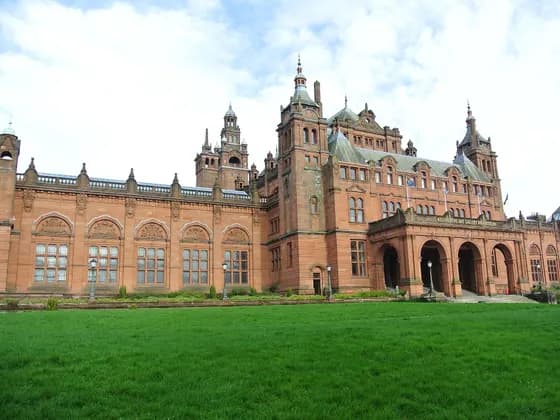


Photo: Clem_nat · CC BY-SA 4.0 · cropped
Photo: Suicasmo · CC BY-SA 4.0 · Photo: WeeHolly · CC BY-SA 4.0 · Photo: Pacifier · CC BY-SA 4.0
The Glasgow medicine course at a glance (2027 entry)
Medicine at Glasgow is a five-year course leading to the MBChB. The degrees of Bachelor of Medicine and Bachelor of Surgery are always awarded together. The MBChB is a primary medical qualification. That is what lets you apply for provisional registration with the General Medical Council (GMC), the regulator that decides who may practise as a doctor in the UK. Provisional registration allows you to work in an approved Foundation Year 1 post, the first paid year after graduating, and nothing else.
The course is built as a spiral. You meet a subject, then come back to it later with more depth and more clinical focus, rather than finishing with it and moving on. The first two years are based on the Gilmorehill campus in the west end of Glasgow, mostly in the Wolfson Medical School Building. From the middle of year 3 you are mainly in hospitals and general practices.
Patient contact starts in year 1. You have clinical skills sessions and a weekly small-group session called vocational and professional studies, led by a tutor who is usually a GP, a family doctor. That group takes you out to a general practice and into hospital during your first two years. Teaching then shifts steadily from campus to clinical placement across the five years.
Clinical teaching runs across Glasgow and the west of Scotland, using about 25 hospitals and well over a hundred general practices. Attachments range from national referral services to single-handed rural general practices, so two students in the same year can have very different weeks.
Glasgow is part-way through rewriting the MBChB. Year 3 moved to the new curriculum in 2025-26 and year 4 in 2026-27, with years 1 and 5 following in 2027-28 and year 2 in 2028-29. The new version keeps the spiral and keeps two elective periods, and it is built around the Medical Licensing Assessment, the national exam every UK medical student now has to pass.
| Degree | MBChB, the Bachelor of Medicine and Bachelor of Surgery |
|---|---|
| Course length | 5 years |
| UCAS code | A100 |
| Places a year | Around 300 to 350, on the school admissions pages |
| Main campus | Gilmorehill, Glasgow, based in the Wolfson Medical School Building |
| Teaching style | Spiral curriculum, problem-based learning early, case-based learning in year 3 |
| Anatomy | Dissection of donated bodies, starting in year 1 |
| First patient contact | Year 1, through clinical skills, GP visits and a hospital visit |
| Full-time placement from | January of year 3, and for the rest of the course |
| Placement area | Glasgow and the west of Scotland, about 25 hospitals and 150 practices |
| Intercalation | Optional extra year after year 3, with more than 20 options |
What makes Glasgow medicine different
Two separate elective periods
Glasgow builds in two separate elective periods. The junior elective falls in the summer after year 4 and runs from two to eight weeks, with four weeks recommended. The senior elective comes in year 5 after preparation for practice and lasts four weeks. You normally have to complete both to graduate.
COMET, a general practice track with 30 places
The Community Orientated Medical Experience Track is funded by the Scottish Government and takes 30 students a year, chosen in the first semester of year 2. It steers choices you already have rather than adding blocks. What it does add is one practice you return to one day a month from year 3 to finals, and five days of primary care teaching in final year.
Dissection through the first two years
Anatomy is taught with bodies donated to the university, and you dissect from year 1 through to the end of year 2. The school has said it has no plans to move away from dissection under the new curriculum.
Small groups carry most of the teaching
You have problem-based learning twice a week in year 1 and a vocational studies group of eight or nine with your own tutor. Year 3 adds case-based learning groups of about eleven and communication skills sessions with professional actors. Lectures exist, but they are the frame rather than the whole picture.
Placements spread across the west of Scotland
You will not spend five years in one hospital. The school uses about 25 hospital sites across Glasgow and the west of Scotland, and a good share of clinical teaching happens outside its own health board, reaching Ayrshire and beyond. That means variety, and it also means travel and sometimes hospital accommodation.
Year 3 gains 40 to 50 direct entrants
Each year the medical school admits 40 to 50 students straight into year 3. They come from St Andrews, the International Medical University in Malaysia and Universiti Brunei Darussalam, under an arrangement set up by the Scottish Government. They join an introductory week and a student buddy scheme called MedFamily before phase 3 starts.
How Glasgow teaches medicine
Teaching mixes whole-year lectures with a lot of small-group work. Lectures usually run for an hour, and some are recorded so you can watch them again. Around them sit problem-based learning groups, laboratory and dissection classes, clinical skills sessions and, from year 3, case-based learning with a clinical tutor.
The balance shifts as you move up. In years 1 and 2 you are on campus for most of the week, with occasional sessions in a GP practice or a hospital. Year 3 starts with a campus semester of pathology and clinical science, then turns into full-time placement in January. Years 4 and 5 are almost entirely placement.
Academic days are timetabled teaching days inside the clinical years. In year 4 in 2026-27 each four-week specialty block has one, usually a Friday. They exist because a short block cannot cover a specialty by chance alone, so a lecture and small-group programme fills the gaps that the wards leave.
Online material carries part of the load. Moodle, the university virtual learning environment, holds lecture recordings, self-test quizzes and coursework submission. Clinical skills podcasts and filmed examination teaching back up the practical sessions, and year 2 timetables about two hours of live online teaching and two to three hours of recorded material each week.
The ways you will learn
| Lectures | Delivered to the whole year group by university and NHS staff, usually an hour on one topic. Attendance is expected, and some lectures are recorded and put on the virtual learning environment. Interactive feedback sessions use a classroom response system, so you answer questions in the room and see how the year did. |
|---|---|
| Problem-based learning (PBL) | A small group works through a clinical scenario with a facilitator who deliberately does not lecture. You work out what you need to find out, research it in your own time, then report back to the group at the next session. In year 1 that is two one-hour sessions a week. |
| Vocational and professional studies | A weekly three-hour session in a group of eight or nine with your own tutor, usually a GP. It covers communication skills, ethics, professional behaviour and clinical examination, and it takes you out to a GP practice and to hospital for the first time. |
| Case-based learning (CBL) | Used in year 3. A clinical tutor takes a group of about eleven students through a case history written the way a real one is. With it come the investigations that belong to the case: blood results, microscope slides and scans. The tutor guides the discussion rather than delivering answers. |
| Simulated patients and actors | Volunteers from the public and professional actors play patients so you can practise safely. Volunteers help with everyday consultations and basic examination of the heart, lungs, abdomen, nerves and joints. From year 3, actors take on harder ground such as breaking bad news, a complaint or an ethical dilemma. |
| Clinical attachments | On placement you are attached to a named hospital with a base ward and an educational supervisor. Each attachment has its own short curriculum and learning outcomes agreed in advance, and ends with an assessment your supervisor completes in your electronic portfolio. |
A typical week on the Glasgow course
Year 1 is timetabled at about 13 hours of direct contact a week. That is three to five one-hour lectures, two one-hour problem-based learning sessions, one three-hour laboratory or seminar session and one three-hour vocational studies session. Clinical skills sessions are added on top and last one to one and a half hours.
The year group is split into three cohorts for small-group teaching, labs and clinical skills, and comes back together for lectures. Your individual timetable therefore differs from your friends. The rest of the week is yours, for reading, preparing PBL objectives and working through Moodle workbooks.
Year 2 is timetabled differently. A week holds about five to six hours of lectures and labs on campus, two hours of live online teaching and two to three hours of recorded online material. Add one two-hour PBL session and one three-hour vocational skills session.
In the first semester of year 3 a week is built from lectures and case-based learning tutorials. Hospital half days and general practice days fall at set points in the term rather than every week. The 2018 programme guide also describes a weekly conference where pathologists, microbiologists and biochemists pull one case apart together, so treat that detail as dated.
- The school says it expects most Wednesday afternoons to be kept free, in whole or in part, for sport and other activities.
- In year 1 in 2026-27, teaching runs from 21 September, with exam weeks in mid-December and early June and resits in late July.
How anatomy is taught at Glasgow
Glasgow teaches anatomy with donated bodies. Dissection means your group works on a body yourselves; prosection means studying parts that someone else has already dissected for teaching. Glasgow runs dissection classes in the Laboratory of Human Anatomy, and the school has said it has no plans to move away from cadaveric dissection under the new curriculum.
It starts in year 1. After three weeks on tissues, cells, immunology and basic physiology, the first semester follows an anatomy core from weeks 4 to 11. That means one anatomy laboratory session a week, a workbook to complete in your own time and a feedback session each week to check you are keeping up.
In phase 2, which runs from the second half of year 1 through year 2, anatomy follows the body systems and dissection classes are weekly. Embryology and development are taught alongside, and three-dimensional imaging is used to show what normal looks like.
Imaging runs as a thread beside the dissection. Year 1 covers anatomical terms, the normal chest x-ray and cross-sectional scans. Year 3 moves on to interpreting plain films through the same kind of image viewing system the hospitals use, and the clinical years add the imaging that belongs to each specialty.
Bodies come from a donation programme run under the Anatomy Act 1984 and the Human Tissue (Scotland) Act 2006, and the university holds an annual memorial service for donors and their families. The Anatomy Facility also houses the Clinical Anatomy Skills Centre and the Museum of Anatomy.
When you first meet patients at Glasgow
You meet patients in your first year, but in small doses. Vocational and professional studies takes your group out to a GP practice with your tutor: five such sessions in year 1 and four in year 2, with four to eight students on each visit. The same group goes into hospital four times, to a non-acute ward and to an emergency department, twice in November and twice around the turn of April and May. Each visit lasts about two hours, and you talk in pairs to patients about what being in hospital is like.
Clinical skills start at the same time. Year 1 covers pulse, blood pressure, temperature and breathing rate, handwashing, taking blood, giving injections and basic life support. It also has two three-hour sessions on examining the heart and lungs, in groups of four or five in the Wolfson Medical School Building, in late February and mid-March. Year 2 works through examination of the heart, chest, abdomen, nervous system and joints, and adds blood glucose and insulin, urine testing and peak flow, in sessions of the same length and size.
Year 1 coursework pushes you towards real people rather than textbooks. The Life History Project follows one patient over time. The Community Diagnosis Project sends a team to investigate a health issue in an allocated community. In year 2 the Family Project runs across both semesters.
Year 3 is the step up. In the first semester the school's 2026-27 placement guide gives you three half days in hospital, each with a clinical teaching fellow, a doctor in a post built around teaching students. Every half day is split between teaching at the bedside and small-group work on chest pain, breathlessness or abdominal pain. The systems covered are the heart, the lungs and the gut.
General practice in that semester is four days between September and December, in a group of two to four. You run student-led surgeries, take blood, give injections, and talk to at least one patient living with several long-term conditions.
From January of year 3 you are on full-time clinical placement, and you stay there for the rest of the course.
Year by year at Glasgow
- Year 1, first semester
Phase 1: introduction to biomedical principles
Phase 1 brings everyone to a common level in biomedical science, whatever you studied at school. Teaching is organised around an anatomy core, with the other sciences woven around it. Real exams start early: a one-hour paper in December carries a fifth of the year 1 written mark. Year 1 moves to the new curriculum in 2027-28, so the detail published today is the version being replaced.
- Integration week opens the course. In 2026 it runs from 14 to 18 September and includes meeting your PBL group, meeting your peer mentor group, a talk from the GMC and signing the student agreement.
- Before you arrive you work through an online induction course called Becoming a Medical Student.
- Weeks 1 to 3 cover the organisation of tissues, cell biology, immunology, molecular biology, physiology and metabolism.
- Weeks 4 to 11 follow the anatomy core, with a weekly anatomy laboratory session and a Moodle workbook to complete in your own time.
- Problem-based learning runs twice a week through weeks 1 to 11; weeks 12 and 13 turn to revision and feedback.
- Your first clinical skills sessions, and a weekly three-hour vocational and professional studies session in a group of eight or nine with your own tutor.
- Hospital visits with that group: a non-acute ward and an emergency department in November, and both again in the spring, each lasting about two hours.
- The Medical Independent Learning Exercise (MILE) tests how well you find and judge sources. The 2026-27 catalogue puts its main assessment in April or May. You must pass it on its own, alongside the written exam and the coursework, to reach year 2.
- The year 1 written exam is three papers: one hour in December worth 20 per cent, then two of two hours in May worth 40 per cent each. The three are marked as one result, so they compensate.
- Year 1, second semester, and Year 2
Phase 2: clinical biomedical science
Phase 2 works through the body system by system, covering the anatomy, physiology, pharmacology and biochemistry of each in turn. Vocational studies, communication and clinical skills are matched to the system you are studying wherever the timetable allows. Your first student selected component, a block where you choose the subject, falls in year 2. Year 2 is the last year to change, in 2028-29, so treat the detail below as indicative rather than fixed.
- The body-system blocks run cardiovascular and respiratory for five weeks, then limbs and back for six. Gastrointestinal and endocrine take four weeks each, head, neck and central nervous system six, and reproduction, nephrology and urology four.
- Two further four-week blocks, keeping people healthy and people and illness, sit alongside the body systems.
- Dissection classes follow the same system sequence, week by week.
- Problem-based learning runs twice a week for an hour through the phase 2 blocks taught in year 1. For year 2 the 2026-27 catalogue timetables one two-hour session a week. The 2018 guide gives two-hour sessions in the head, neck and neurological block.
- Two clinical examination sessions of three hours in groups of four or five: gastrointestinal and renal in November, musculoskeletal and neurology in March.
- A five-week student selected component in year 2, chosen from a menu offered by the medical school, the wider college and the NHS.
- Year 2 coursework is a critical analysis of a scientific paper plus the Family Project essay.
- Year 2 is examined by three multiple-choice papers: one of an hour at the end of semester 1, then two of an hour and a half at the end of semester 2. Marks compensate between those three papers.
- The coursework and the student selected component are marked separately, and you need grade D3 or better in each of the three to reach year 3.
- Year 3, first semester
Phase 3: foundations of clinical medicine
Phase 3 runs back through the body systems with a pathology lens, so you learn what goes wrong and why. Lectures come from pathologists, microbiologists, haematologists, clinical biochemists and clinical pharmacologists. Small-group teaching switches from problem-based learning to case-based learning with a clinical tutor.
- The last published block-by-block list, in the school's 2018 programme guide, ran week-long blocks through general pathological mechanisms, genetics, haematology, microbiology and infection and then the body systems. Year 3 has since moved to the new curriculum, so the order may differ.
- Three half days in hospital with a clinical teaching fellow, at the Queen Elizabeth University Hospital, Glasgow Royal Infirmary or Hairmyres Hospital, mixing bedside teaching with small-group clinical reasoning.
- Case-based learning tutorials in groups of about eleven. In 2026-27 they are taught in person in the Wolfson Medical School Building.
- Communication skills with professional actors over five sessions from September to December: giving information, ethical dilemmas, breaking bad news and assessing mental health.
- Clinical examination teaching in cranial nerve and cerebellum, mental state, peripheral vascular, breast and thyroid, and regional musculoskeletal examination.
- Clinical Practice in the Community, four days in a GP practice between September and December in a group of two to four students.
- Eleven virtual GP tutorials on Wednesday or Friday mornings in groups of about eight, built around recorded real consultations.
- The year 3 written exam sits in December: two papers of 75 single best answer questions.
- A longitudinal portfolio on a community patient with complex needs, made up of a referral letter, a reflection on multimorbidity, an oral case presentation to the practice team and acute case reflections.
- Year 3, second semester
Phase 4: junior clinical practice
In January, year 3 turns clinical. You rotate through four five-week blocks, and each block is run four times so that the whole year group passes through all of them. In 2026-27 the placements run from 18 January to 11 June. Mid-June is OSCE week: an objective structured clinical examination is a circuit of short stations, each with a different practical task and its own examiner.
- A transition week sits between the year 3 written exam and your first placement, starting 11 January 2027. Lectures and small groups cover what is expected of you on the wards and how you are assessed. A Moodle wiki has a page for each hospital used.
- Junior medicine and junior surgery blocks, based in hospital with a base ward and an educational supervisor. One week inside junior surgery is spent in anaesthesia.
- A student selected component block, and a systems block that follows patients through the systems of care.
- In the systems block, one day a week for five weeks in a general practice in a group of two to four, with teaching surgeries and student-led surgeries.
- Two mini clinical evaluation exercises during that GP block, where your supervisor watches you with a patient and feeds back, plus an end of block assessment.
- Four Friday-morning online tutorials in groups of about ten, a general practice out-of-hours session and a workshop on consulting by telephone.
- An academic day at the end of most blocks, and an end of block assessment you must pass for every placement.
- The year finishes with an OSCE of eight stations, each ten minutes long.
- Optional extra year
Intercalated degree after year 3
Between years 3 and 4 you can apply to spend a year taking a BSc. Entry is competitive and ranked on your results so far, and it adds a year to the five. The one-year intercalated BSc has more than 20 options, and a two-year BSc (Hons) is also offered.
- BSc (Med Sci) in Clinical Medicine, built from a core research methods course, statistics, a specialist subject and a research project.
- Life sciences options including anatomical sciences, biochemistry, genetics, microbiology, molecular and cellular biology and pharmacology.
- Medical humanities in the College of Arts and Humanities, which takes between one and ten students.
- Year 4
Phase 5: clinical specialties
Year 4 is a run of four-week blocks with academic days built in. In 2026-27 there are nine of them, starting in mid-August and finishing in May. The year ends with an OSCE week and a written exam week, and then the junior elective.
- Specialty blocks in child health, emergency medicine, frailty and oncology, general practice, musculoskeletal medicine, neurology and cardiology, obstetrics and gynaecology, and psychiatry.
- In the general practice block you are the only student in the practice for four weeks. A usual week has four teaching surgeries with extra time for discussion, one surgery you run yourself with feedback, and an hour reviewing progress with your supervisor. Two portfolio cases are due.
- A second student selected component, either proposed by you or chosen from a menu.
- One academic day inside each block, usually a Friday.
- The written exam is two papers of 100 single best answer questions.
- An OSCE covering history taking, communication, examination, procedures, data interpretation and clinical reasoning.
- The junior elective follows the exams. In 2026-27 the window runs from 31 May to 13 August 2027.
- Year 5, up to finals
Phase 6: senior clinical practice
Under the new curriculum the first part of year 5 is two ten-week blocks, senior medicine and senior surgery, both hospital based. The year group finishing in 2026-27 is still on the older pattern of five-week specialty blocks. Finals are the national Medical Licensing Assessment.
- Ten weeks of senior medicine and ten weeks of senior surgery, with an end of block assessment for each.
- The Prescribing Safety Assessment, an exam on prescribing safely, sat in January on the 2026-27 final-year timetable.
- The Applied Knowledge Test: two computer-delivered papers of 100 single best answer questions on consecutive days, two hours each.
- The Clinical and Professional Skills Assessment, an OSCE that Glasgow described to the GMC in 2024 as 16 stations spread over four days.
- Year 5, after finals
Phase 7: preparation for practice
Once finals are done you shadow the foundation doctor whose job you are about to take, ideally in the hospital where you will work. A lecture programme on practical and medico-legal matters runs alongside it. You cannot graduate without completing this block.
- In 2026-27 the campus part runs from 26 April, and the hospital part from 10 May to 11 June.
- Assessment is by clinical assessments on the ward and a completed clinical portfolio.
- COMET students go back to their own general practice for five more days of student-led surgeries.
- Under the new curriculum the senior elective follows preparation for practice.
How you are assessed at Glasgow
Every year has exams you must pass to move up. You need a grade D or better in every course, there is no compensation between courses, and some courses contain components you must pass separately. In year 1 that means passing the written exam, the coursework and the MILE each on their own.
Written papers are mostly single best answer questions, where you choose the one best option from a short list. Year 3 has two papers of 75 questions and year 4 has two of 100. OSCEs run in years 3, 4 and 5, with actors and volunteer patients playing the parts so that every student meets the same case.
Finals are the Medical Licensing Assessment (MLA), which every UK medical school now has to include. It has two parts: the Applied Knowledge Test, which is written, and the Clinical and Professional Skills Assessment, which is practical. The GMC judged both of the Glasgow parts compliant with its requirements in June 2024.
Glasgow described its clinical exam to the GMC as an OSCE of 16 stations, each ten minutes long with a minute of reading time, taken four stations a day across four days. You have to reach the pass standard overall and pass at least three quarters of the stations. The resit runs as eight stations a day over two days. Under the new curriculum the school plans to hold both MLA parts in February, which leaves room for a resit without delaying graduation.
On placement, assessment never stops. Your educational supervisor watches you with a patient (a mini clinical evaluation exercise), discusses a case you were involved in (a case-based discussion) and signs an end of block assessment. The placement guide sets a minimum of two of those exercises and one discussion per block, though its own table asks for fewer in musculoskeletal medicine, oncology, frailty, cardiology and neurology. It all goes into the Glasgow Undergraduate Medical ePortfolio, modelled on the portfolio that foundation doctors keep.
Attendance is not optional. The regulations require full attendance at every part of the programme, and persistent absence can become a fitness to practise matter. If you do not pass the MLA at the end of year 5, one repeat of the final year is granted automatically, and four unsuccessful attempts at the final-year assessments means exclusion.
- To graduate you must also complete every clinical attachment in years 3 to 5, finish the preparation for practice block, normally complete both electives, and be assessed as competent in resuscitation.
- Resuscitation competence normally has to be reached within two attempts by the end of year 5, and missing the training without an approved reason counts as a failed attempt.
- The ten-week medicine block uses an objective long case instead of the mini clinical evaluation exercise and case-based discussion for the second half of the attachment. The school's guidance for supervisors still places that block in year 4; under the new curriculum it sits in year 5.
- In that long case your assessor watches you take a history and examine a patient for up to 40 minutes. You then spend 15 to 20 minutes on your summary, differential diagnosis, investigations and management plan, and 5 to 10 minutes on feedback.
- Resit weeks are timetabled every year, and in 2026-27 the final-year resits for both MLA parts fall in late May and early June.
- Several blocks also need written portfolio cases: junior medicine, junior surgery, general practice, psychiatry, obstetrics and gynaecology, and musculoskeletal medicine. Each is a full history, examination and plan plus a reflective piece of 500 to 1500 words, checked for plagiarism.
- A block lead or supervisor can award a certificate of merit for strong work on the ward rather than in the library. It does not change your degree, and merits are handed over at graduation.
- If you miss part of a block, or fall short on it, you remediate, usually in the summer vacation. Finishing a failed block comes before an elective, so a bad block can cost you elective time.
Where you will actually be at Glasgow
From the middle of year 3 you are attached to a specific hospital. You get a base ward, an educational supervisor and a short curriculum for that attachment, and the block ends with an assessment your supervisor completes. Placement timetables and allocations are issued to you by the medical school rather than chosen by you.
The network is wide. The course page counts around 25 hospitals and 150 general practices across Glasgow and the west of Scotland. An older school page, last updated in 2018, puts the practice figure nearer 200 and says more than 30 per cent of clinical teaching happens outside NHS Greater Glasgow and Clyde.
That means travelling, and sometimes staying away. NHS Ayrshire and Arran offers student accommodation at University Hospital Crosshouse and University Hospital Ayr. Places are limited and need at least two weeks notice, and students who commute instead can claim travel costs. Some teaching only happens outside Glasgow: the clinical skills programme lists the acutely ill patient course and simulation training as running at Kirklands and the Ayrshire hospitals.
General practice is not a token block. For the early-year teaching the school recruits tutors and practices from NHS Ayrshire and Arran, NHS Forth Valley, NHS Greater Glasgow and Clyde and NHS Lanarkshire. For the four-week general practice block in year 4 it also uses NHS Highland and NHS Dumfries and Galloway. Practices host students in every year of the course.
None of this starts until you are cleared. The university's rules say you cannot register for the year, enrol on classes or go on clinical placement until the school's requirements are met. Those include membership of the Protection of Vulnerable Groups Scheme, which is the Scottish criminal records check, plus health screening and immunisation including hepatitis B.
There are rules before you set foot on a ward. Clinical areas run a bare below the elbows policy: short sleeves, no watch, no jewellery, no tie, no white coat, hair tied back and short clean nails. The school recommends buying the university medical student scrubs to wear on every placement. Ten short online infection prevention modules, part of a national Scottish pathway, have to be done before year 3 placements begin.
The school's 2026-27 placement guide uses two of these, the Queen Elizabeth University Hospital and Glasgow Royal Infirmary, for year 3 hospital teaching. The health board runs its medical education team from all four acute sites.
- Queen Elizabeth University Hospital, including its Teaching and Learning Centre
- Glasgow Royal Infirmary, including the New Lister Building
- Royal Alexandra Hospital
- Inverclyde Royal Hospital
The health board's undergraduate pages list student placements at these two hospitals in critical care, emergency medicine, general internal medicine, musculoskeletal, obstetrics and gynaecology, ophthalmology, paediatrics, psychiatry, and surgery and anaesthetics. Its pharmacists teach prescribing to students in years 3 to 5.
- University Hospital Crosshouse
- University Hospital Ayr
Hairmyres is the third of the hospitals the 2026-27 placement guide uses for year 3 teaching. Lanarkshire practices also teach Glasgow students, and the board and the university signed a teaching and research partnership in May 2025.
- Hairmyres Hospital, East Kilbride
Glasgow recruits general practice teachers here too. Highland and Dumfries and Galloway practices are listed for the four-week general practice block in year 4, and Highland practices for student selected components and general practice electives.
Electives and chosen modules at Glasgow
Glasgow builds in three student selected components (SSCs) and two electives. An SSC is a block of four or five weeks where you choose the subject. It can be a research project, a deeper look at something from the core course, or something outside medicine such as a language. They fall in years 2, 3 and 4.
In year 2 you pick from a menu. From year 3 you can propose your own, and many students do. A general practice SSC places you in a practice two days a week for five weeks, with a self-directed learning package and a presentation to the practice at the end. The year 4 component has to carry at least 60 per cent written assessment.
Electives are different in purpose: they are about experience rather than study in depth. The junior elective sits in the summer after year 4 and can run from two to eight weeks, with four recommended. The senior elective comes in year 5 after preparation for practice, lasts four weeks and must contain 16 to 20 teaching days.
You can go anywhere offering a recognised clinical specialty, including general practice and public health. The school programme guide published in 2018 says about half of each year group takes an elective abroad. Students arrange their own placements: the school states this plainly for general practice electives, and an overseas senior elective often needs planning a year ahead. Both electives are normally needed to graduate.
- The year 3 general practice menu covers deep end patients, frailty and care of the elderly, multimorbidity and treatment burden, realistic medicine, and LGBTQI and intersectionality. Deep end means the practices serving Scotland's most deprived areas. COMET labels the last option equality, diversity, inclusion and intersectionality.
- The year 4 general practice menu covers adolescent health, clinical reasoning, deep end general practice, gender based violence and leadership.
Intercalation at Glasgow
Intercalating means pausing medicine for a year to take a degree in something else, then returning. At Glasgow it is optional and competitive, and it happens after year 3. Selection uses your exam results so far, and popular subjects fill up, so you are asked to name alternatives.
The one-year BSc (Med Sci) in Clinical Medicine has the same shape whatever subject you pick: a core course in research methods, a statistics course, a specialist course and a research project. Specialist subjects include oncology, cardiovascular studies, critical care and perioperative medicine, global health, inflammation medicine, ear nose and throat surgery, psychological medicine, public health, and women's and children's health.
Life sciences options include anatomical sciences, biochemistry, genetics, microbiology, molecular and cellular biology and pharmacology. The College of Arts and Humanities runs medical humanities, which takes between one and ten students a year. A two-year honours degree is also available.
The project is the heart of it, and the pattern depends on the route. On the clinical medicine BSc it takes one day a week before Christmas, then at least three days a week from Christmas to Easter. You write it up as a research paper with an abstract, a poster and a talk. A life sciences project instead runs three days a week across ten weeks of semester one, with the report assessed in semester two.
For the clinical medicine BSc the school suggests you should normally be in the top half of the year with good academic progress. Places on particular specialist courses are limited and go on performance so far.
Intercalating at another university is possible, but only with permission from the head of the undergraduate medical school and only if your ranking would have won you a Glasgow place anyway. Scottish funding treats the year as your one spare year of tuition support, which matters if you later need to repeat a year.
Facilities and support at Glasgow
Where you will learn
The Wolfson Medical School Building on University Avenue is home for the first two years. It holds lecture theatres, teaching rooms, the Walton Library and Resource Centre, which is open around the clock, a cafe and the MicroMuseum of two hundred years of health care.
The clinical skills area is a purpose-built space for practising clinical and communication skills. It includes a fully equipped ward where you work in a simulated setting before meeting real patients. Dissection happens in the Laboratory of Human Anatomy, part of the university's Anatomy Facility.
Clinical teaching has two hubs. The New Lister Building at Glasgow Royal Infirmary is the refurbished teaching centre in the city centre. The Teaching and Learning Centre at the Queen Elizabeth University Hospital serves the hospital that opened on that site in 2015, and its rooms are also used for timetabled university teaching.
Support while you study
Every student has an Adviser of Studies, named on the student record system, and the medical school runs its own student support team you can email or ring. On placement your educational supervisor is the first person to take a timetable or academic problem to, and your year lead comes after that.
Peer support is built in from the start. You are allocated a peer mentor before you arrive and meet your mentor group during integration week. A student support poster the school published in 2022 also lists a student-run peer support network, the British Medical Association doctor adviser service and the MedChir Glasgow society.
The support team's office is in the Wolfson building, off the library, and it offers meetings in person or by video four days a week. Time with them counts as an authorised absence from a placement. Every student has to be registered with a GP.
The school's wellbeing pages point you to university counselling and psychological services, which you can refer yourself to. They also list Glasgow University Nightline, a student-run listening service, plus Breathing Space, NHS 24 and the Samaritans. The university runs a separate service for sexual violence and harassment.
If you need adjustments on placement, university disability services can write a study support plan. The school can also give you a wallet-sized adjustment passport that sums it up for the staff you meet on a ward. The placement guide adds that if you see anything putting patients, staff or students at risk, you have a professional duty to report it. You take that to your educational supervisor, or to the nearest responsible qualified NHS staff member if it is urgent.
Direct entrants into year 3 get extra help. There is a transition coordinator, an effective learning adviser and an introductory week before phase 3. A scheme called MedFamily pairs each new arrival with a current student who helps them settle in.
Is the Glasgow course right for you?
This course may suit you if
- You want to meet patients in first year without giving up two years of solid science on campus first.
- Small groups suit you: PBL twice a week, a vocational studies group of eight or nine, and case-based learning groups of about eleven in year 3.
- You want to dissect rather than learn anatomy only from prepared specimens or screens.
- General practice interests you. GP teaching appears in every year, and COMET gives 30 students a much deeper version of it.
- Choosing your own path appeals: two of the three student selected components can be your own proposal, and you find your own elective placements.
Things to think about
- Years 3 and 4 already run on the new curriculum, but years 1, 2 and 5 change between 2027-28 and 2028-29. The detail published today for first and second year is the version being replaced.
- Placements are spread over about 25 hospitals. Expect travel, and note that hospital accommodation in Ayrshire is limited and not guaranteed.
- The rules are strict: full attendance, a pass in every course, and no compensating a weak course with a strong one.
- The year group is large at roughly 300 to 350 places, and it grows again when 40 to 50 direct entrants join in year 3.
- Finals are the national licensing exam. Resit weeks are timetabled, but if you still do not pass you repeat the whole final year.
Glasgow medicine course — frequently asked questions
Applying to Glasgow?
How to get into Glasgow
Entry requirements, UCAT, personal statement and interview, step by step.
Open the guide →Glasgow UCAT cut-offs and offers
UCAT cut-offs, A-level offers, interview format and decision dates.
See the requirements →Compare Glasgow with other schools
Put the teaching style, anatomy teaching and placements next to another school.
Open the comparison →Prepare for the Glasgow interview
Format breakdown, school-specific sample questions and prep tips from tutors who interviewed here.
Read the guide →Where this Glasgow course guide came from
This guide was written from 44 official sources — University of Glasgow's own course pages and programme documents, plus the regulator and NHS placement partners where they publish detail — read on 2026-09-21, then checked claim by claim against those sources.
- Medicine MBChB undergraduate course page
- Undergraduate Medical School home page
- MBChB Curriculum Transformation, including the rollout timeline and FAQs
- MBChB Programme Guide for students, tutors and clinical staff, published 2018
- University course catalogue, MBChB course entries for 2026-27
- Course catalogue entry for MBChB Year 2, 2026-27
- Regulations for Clinical Undergraduate Awards 2026-27
- MBChB session dates for 2026-27, years 1 to 5
- Integration week timetable, September 2026
- Year 1 MBChB information for new students 2026-27
- Clinical attachments and block dates 2026-27
- MBChB educators opportunities, describing CBL and clinical examination teaching
- General practice teaching opportunities, year by year
- Year 3 systems block GP clinical attachment, 2026-27
- Year 3 systems block virtual GP tutorials, 2026-27
- Community Orientated Medical Experience Track (COMET)
- Student selected components
- The Clinical Skills Programme, year by year skills breakdown
- Simulated Patient Programme, volunteer patients and actors
- Glasgow Undergraduate Medical ePortfolio
- Role of an educational supervisor
- Formative long case in the ten-week medicine block
- Intercalated degrees overview
- Intercalated degrees in clinical medicine
- Intercalated degrees in life sciences
- Intercalated degree in medical humanities
- Teaching facilities, including the Wolfson Medical School Building
- Teaching hospitals and the scale of the placement network
- Anatomy Facility
- Body donation to the University of Glasgow
- Partner medical schools, direct entry to year 3
- Undergraduate Medical School admissions FAQs, including places per year
- Student support and welfare resources for medical students
- GMC compliance decision on the Glasgow Applied Knowledge Test, June 2024
- GMC compliance decision on the Glasgow Clinical and Professional Skills Assessment, June 2024
- NHS Greater Glasgow and Clyde medical education
- NHS Ayrshire and Arran undergraduate medical education
- NHS Ayrshire and Arran student travel and accommodation
- NHS Lanarkshire partnership agreement with the University of Glasgow, May 2025
- MBChB Clinical Years Clinical Practice and Placement Guide 2026-27
- Partner medical schools for direct entry to year 3
- MBChB Student Wellbeing
- Course catalogue entry for the MBChB Year 1 written paper, 2026-27
- Course catalogue entry for the Medical Independent Learning Exercise, 2026-27
Courses are restructured between cycles. Anything here that decides your application — an anatomy offer, a placement city, a compulsory intercalated year — should be confirmed against the official page for your entry year.
Applying to Glasgow?
We have helped hundreds of applicants turn their UCAT, personal statement and interview prep into offers from Glasgow and other UK medicine schools.