
The Zucker School of Medicine at Hofstra/Northwell MD program
What you actually study, and where you will be
Zucker School of Medicine at Hofstra/Northwell's MD is a 4-year program taught through case-based learning in an integrated curriculum, with patient contact from Year 1 and clinical rotations in New York City and Long Island (2027 entry). The first two years, the First 100 Weeks, are seven pass/fail courses built around PEARLS small-group patient cases. They open with eight weeks of emergency medical technician (EMT) training on Northwell ambulances, then add a weekly afternoon with community doctors. The Second 100 Weeks, years 3 and 4, bring paired clerkships, a six-month continuity clinic, three acting internships and electives, with core training at Northwell hospitals in New York City and on Long Island.
- Degree
- MD
- Length
- 4 years
- Teaching
- Case-based learning + Integrated
- Clinical contact
- Year 1

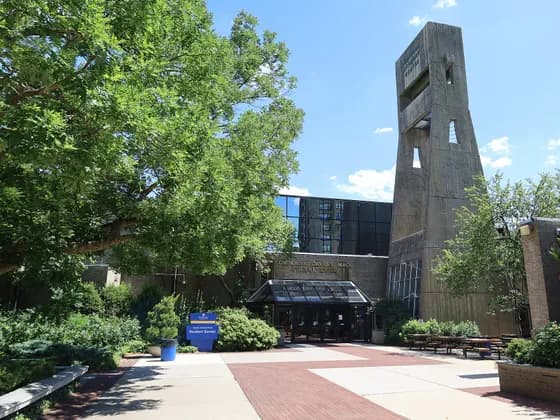
Photo: Antony-22 · CC BY-SA 4.0 · cropped
Photo: Antony-22 · CC BY-SA 4.0 · Photo: XanderAi · CC BY-SA 4.0 · Photo: Dmadeo · CC BY-SA 3.0
The Zucker School of Medicine at Hofstra/Northwell MD program at a glance (2027 entry)
The Donald and Barbara Zucker School of Medicine at Hofstra/Northwell, usually shortened to the Zucker School of Medicine, runs a four-year MD program in Hempstead, Long Island, New York. It sits on Hofstra University's North Campus. Hofstra and Northwell Health founded it in 2008 as equal partners, and it took its first students in 2011. Your core clinical training takes place in Northwell, which the school's 2026 brochure says has 28 hospitals and more than 1,000 outpatient facilities.
The curriculum has two named halves. The First 100 Weeks, years 1 and 2, are the pre-clerkship (pre-clinical) phase: seven integrated courses mixing biomedical, clinical and social science, taught mainly through PEARLS small-group patient cases. The Second 100 Weeks, years 3 and 4, bring core clerkships, the required rotations on hospital and clinic teams in each main specialty. Then come acting internships (often called sub-internships), where you do an intern's work under supervision, and electives, rotations you choose.
Patients come early. The opening course is built on New York State's emergency medical technician (EMT) curriculum, and you spend its first eight weeks training as an EMT on Northwell ambulances. After that, the Initial Clinical Experience (ICE) gives you one afternoon a week in community practices for two years, with five physician preceptors, the doctors who supervise and teach you.
Teaching is student-led, with capped class hours to leave time for independent study. The first two years are pass/fail, with written feedback instead of numerical scores, and clerkships are graded Honors to Fail. Clinical training in years 3 and 4 takes place across three Northwell tertiary hospitals, which provide specialist care, in New York City and on Long Island.
The Liaison Committee on Medical Education (LCME), which accredits MD programs in the United States, granted the school full accreditation in 2015 and a full eight-year term in 2020. Its next survey is due in 2027-28. The school's Curriculum Renewal page says a review is in Phase III, working through feedback on a draft structure from April 2024; its latest listed newsletter is from September 2024. The 2026-27 calendar, current policies and June 2026 brochure all describe the design set out here.
| Degree | MD (Doctor of Medicine) |
|---|---|
| Program length | 4 years: First 100 Weeks, then Second 100 Weeks |
| Class size | About 100 students per entering class |
| Main campus | Hofstra University's North Campus, Hempstead, Long Island |
| Teaching style | PEARLS small-group patient cases, three sessions a week in years 1 and 2 |
| First patient contact | First eight weeks: EMT training on Northwell ambulances |
| Anatomy | Focused dissections of body donors, plus specimens, imaging and ultrasound |
| Main clinical sites | Lenox Hill, North Shore University Hospital, Long Island Jewish Medical Center |
| Step 1 timing | End of year 2; by May 2029 for 2027 entrants, on the current schedule |
| Grading | Pass/fail in years 1 and 2; Honors to Fail in clerkships |
What makes the Zucker School of Medicine at Hofstra/Northwell MD program different
EMT training in your first eight weeks
You ride Northwell ambulances, respond to 911 calls and follow patients into the emergency room. The school's aim is a usable clinical skill set from the start and a view of illness in patients' homes and communities.
An afternoon a week with community doctors
The Initial Clinical Experience pairs you with five physician preceptors over two years, from general medicine to psychiatry, each timed to match what you study in class. You build continuing relationships with your preceptors and some of their patients.
Essay-based exams and no scores in years 1 and 2
A school news story from April 2026 says the school replaced traditional multiple-choice exams with essay assessments and high-fidelity simulations. That applies to years 1 and 2, which are graded pass/fail; the June 2026 brochure says results are reported without numerical scores to reduce competition and promote teamwork. Clerkships later add national subject exams from the National Board of Medical Examiners (NBME).
Paired clerkships and a six-month continuity clinic
In year 3, the Advanced Clinical Experience (ACE), clerkships run in pairs that link related science: internal medicine with surgery, pediatrics with obstetrics and gynecology, and neurology with psychiatry. Every student also spends six months in the ACE Continuity Clinic, an outpatient practice where you follow patients over time and see problems before they are diagnosed.
One lab for anatomy, pathology, imaging and ultrasound
In the Structure lab, small groups rotate through stations using donors, specimens, tissue slides, scans, ultrasound and physical examination. You sample tissue from your donor with pathology staff to build that donor's pathology report, and in year 3 you return to the lab before each core clerkship.
How Zucker School of Medicine at Hofstra/Northwell teaches medicine
The school was designed around self-directed learning, favoring small-group work on cases and applying concepts over memorizing facts. A policy last updated in September 2021 caps required class and clinical time at an average of 22 hours a week, or 24 in the opening course, which includes EMT training. Classes run five days a week.
PEARLS (Patient-centered Explorations in Active Reasoning, Learning and Synthesis) is the core of years 1 and 2. The school calls it a hybrid of case-based and problem-based learning: the cases have learning objectives built in, but your group has to find and research them. You stay with eight or nine classmates and one faculty facilitator for a whole course.
At the first session of the week the group works through two patient cases and sets learning objectives. Everyone researches them, and at the second and third sessions you explain what you found and pull it together.
Each course has three components. Mechanisms of Health, Disease and Intervention covers physiology, pathophysiology, pharmacology and therapeutics. Structure joins anatomy, embryology, histology, pathology, imaging, physical diagnosis and ultrasound. Patient, Physician and Society covers social and behavioral science and clinical skills through twelve threads, such as health equity, ethics, patient safety and health care financing.
In years 3 and 4 learning moves onto clinical teams, with structured exercises that keep science tied to patient care and week-long Core Learning sessions back in the classroom.
The ways you will learn
| Structure lab | Small groups rotate through stations while faculty facilitators use Socratic questioning, leading you by questions to connect normal and diseased structure with function. |
|---|---|
| Large group sessions | Interactive whole-class sessions cover science and topics from ethics to epidemiology. Some bring patients into the classroom to talk about their illness and care. |
| Physical diagnosis and Clinical Learning Sessions | Examination is taught from day one as hypothesis testing: you choose the parts of the exam that tell competing diagnoses apart. In Clinical Learning Sessions you reason through cases, then present them aloud and write them up. |
| Simulation | At the end of each course your team manages a simulated patient at Northwell's Center for Learning and Innovation and Patient Safety Institute, using high-fidelity mannequins and standardized patients, actors trained to play patients. A physician and a basic scientist debrief you together. |
A typical week on the Zucker School of Medicine at Hofstra/Northwell program
Each week of the First 100 Weeks has a theme set by its PEARLS cases, with three PEARLS sessions anchoring it. Structure labs, physical diagnosis, large group sessions and Patient, Physician and Society small groups follow the same theme. Once ICE starts, one afternoon a week is spent in a preceptor's office.
The school's sample of the EMT course shows how it fits together. In week 2, To Breathe or Not to Breathe, the EMT side covers burns, inhalation injury, bag-valve-mask ventilation and oxygen delivery. The physician side adds lung physiology, chronic obstructive pulmonary disease (COPD), pneumonia and pharmacology principles, plus a hypothesis-driven lung exam with ultrasound of the diaphragm and pleura.
How anatomy is taught at Zucker School of Medicine at Hofstra/Northwell
Anatomy is part of the Structure component of every course in years 1 and 2. The Structure lab puts gross anatomy, histology and embryology alongside pathology, imaging, ultrasound and physical diagnosis, and Northwell's hospital-based doctors join the sessions.
You meet your anatomical donors, given through the school's Anatomical Gift Program, in the first course. You then explore clinical cases through several focused dissections, each ending in a presentation to peers and faculty. Course descriptions place the pelvis in The Biologic Imperative, the abdomen in Fueling the Body, and the heart, lungs and kidneys in Homeostasis.
Year 2 covers the limbs in Interacting with the Environment, and neuroanatomy, the special senses and the head and neck in The Human Condition. Besides donors, the lab uses prosections (specimens already dissected to display key structures), pathology specimens, models, task trainers and 3D virtual anatomy programs.
You also practice procedures there with standard kits, surgical instruments, laparoscopy and endoscopy, and build suturing skills. An annual student-led memorial service thanks the donors and their families. In year 3 you return before each core clerkship for sessions on its key structures and procedures, and year 4 offers a four-week Structure elective.
When you first meet patients at Zucker School of Medicine at Hofstra/Northwell
Real patients arrive within weeks. The EMT part of the first course follows the New York State Department of Health curriculum, with physician-level science added. You ride ambulances with certified Northwell EMTs, help stabilize patients before they reach the hospital and follow patients through the emergency room, meeting medical, traumatic and behavioral emergencies.
EMT training culminates in Mass Casualty Incident Day at the Nassau County Fire Service Academy. In September 2026, first-years triaged and treated actors in staged disasters, from an active shooter to a Long Island Rail Road derailment. The school says roughly 1,500 students have trained as medical student EMTs.
ICE begins in the second course. Year 1 brings preceptors in general medicine (internal or family medicine), surgery, and obstetrics and gynecology, and year 2 adds pediatrics and psychiatry. You take an active part in patient care. Two flex sessions in year 1 and three in year 2 let you try settings such as the emergency room, house calls or eICU telemedicine.
The school's 2021-22 ICE student handbook describes afternoons of about four hours. You aim to take a full history and examination from at least one patient, see others for shorter visits, and follow longitudinal patients over the two years. Each ICE clerkship includes a written narrative assessment of your performance.
Outside the curriculum, students run a free clinic in Rego Park, Queens, with faculty physicians, offering physicals, sick visits, vaccines and blood work to patients in need.
The Zucker School of Medicine at Hofstra/Northwell curriculum, year by year
- Year 1
EMT training, then four integrated courses
Year 1 starts with orientation in late July and runs from early August to early June on the 2026-27 calendar. It holds four of the seven First 100 Weeks courses, each followed by a Reflection, Integration and Assessment (RIA) week. The summer after year 1 is open for optional research or other experiences.
- From the Person to the Professional: Challenges, Privileges and Responsibilities (CPR): EMT training and certification, foundational physiology, structure and pharmacology, history taking, physical examination and bedside ultrasound. You meet your donors and start PEARLS.
- The Biologic Imperative (BI): how control of cell growth shapes the body and reproduction, and how errors cause disease, especially cancer. Pelvic dissection, embryology, and male genitourinary and female pelvic examinations; ICE starts in medicine and obstetrics and gynecology.
- Continuity and Change: Fueling the Body (FTB): nutrition, metabolism and the gastrointestinal system, with the abdomen studied by dissection, CT and bedside ultrasound. ICE adds surgery.
- Continuity and Change: Homeostasis (HOM): how the heart, lungs and kidneys keep the body stable, with vascular biology and thrombosis, and dissection of all three.
- The White Coat Ceremony comes in October, after the EMT course: October 16 in 2026.
- Year 2
Three more courses, Step 1 and Transitions
Year 2 runs from late August to late May on the 2026-27 calendar; the school's wellness program calls it short and dense. Three courses come first, with ICE II alongside. Then comes about six weeks of independent study for Step 1 of the United States Medical Licensing Examination (USMLE), with no attendance requirement. Last is Transitions, a required two-week course that prepares you for clerkships.
- Interacting with the Environment (IE): immune function and dysfunction, immunosuppressive and anti-inflammatory drugs, rheumatology with the musculoskeletal system and limb anatomy, and dermatology. You meet your pediatrics preceptor.
- Host-Microbe Interactions (HMI): bacteria, viruses, fungi and parasites, the microbiome, infectious diseases system by system and antimicrobial drugs.
- The Human Condition (HC): the nervous system from cell to whole person, sensory and motor disorders and psychiatry, with neuroanatomy and the complete neurologic exam. Psychiatry is your last ICE specialty.
- Before year 2 ends you meet your career advisor to plan an individualized third-year schedule.
- Year 3
Advanced Clinical Experience
Year 3 starts in late May, straight after Transitions, and runs to early May: May 26, 2026 to May 7, 2027 on the current calendar. Six core clerkships run as three pairs, in inpatient and outpatient settings, alongside the ACE Continuity Clinic, selectives (short rotations you choose) and Core Learning weeks.
- Pairs: internal medicine and surgery, pediatrics and obstetrics and gynecology, neurology and psychiatry. The May 2022 curriculum card gave medicine 8 weeks, including a two-week subspecialty selective, and the other five clerkships 6 weeks each, with a one-week subspecialty selective inside surgery. It also shows two 2-week selectives between clerkships.
- Six months of ACE Continuity Clinic in a community outpatient practice.
- Selectives: four weeks, as two 2-week rotations in specialties you choose.
- Core Learning weeks between trimesters: a topic such as the opioid epidemic, plus clerkship orientation, such as suturing and knot-tying before surgery or practicing capacity assessment on a standardized patient before psychiatry.
- Reflection: three times a year you write about a clerkship experience that raised questions or concerns and debrief it in a small facilitated group.
- Communication sessions with standardized patients during medicine, and teaching on brain death during neurology.
- To move into year 4 you must complete the Comprehensive Clinical Skills Exam (C-CSE) and Step 1.
- Year 4
Preparation for Residency
Year 4 runs from May to late April: May 11, 2026 to April 25, 2027 for the current class. Match Day, when residency results arrive, is March 19, and commencement is May 14, 2027. Schedules are individual, so for the first time you are not rotating with your class.
- Three 4-week acting internships (AIs). The medicine AI, in internal medicine, pediatrics, family medicine or surgery, gives you primary responsibility for patients under supervision, from notes and orders to calls to consultants.
- Critical care AI in a medical, cardiac, surgical, pediatric, neonatal or neurosurgical intensive care unit.
- Emergency medicine AI in a pediatric, adult or combined adult and pediatric emergency department.
- A formative (practice) EPA exercise during one AI checks core entrustable professional activities, the tasks a new intern must be trusted with, such as orders, handovers and informed consent.
- Twenty weeks of electives and three 4-week Professional Development blocks for residency interviews or study for USMLE Step 2 CK (Clinical Knowledge).
How you are assessed at Zucker School of Medicine at Hofstra/Northwell
Every First 100 Weeks course is graded pass/fail, with written narrative feedback. Under the grading policy posted in August 2026, parts of each course are rated Meets Expectations, Marginal Performance Without Remediation or Does Not Meet Expectations. Formative assessments and summative ones (which count) run through each course and come together in its RIA week.
A school news story from April 2026 says traditional multiple-choice exams were replaced with essay assessments and high-fidelity simulations. That applies to years 1 and 2, whose formats the June 2026 brochure lists as short-answer essay exams, clinical skills exams, lab practicals, project-based presentations and narrative feedback from faculty and preceptors. Clerkships in years 3 and 4 use NBME subject exams, covered below. School policies name a final essay exam and Structure exams, and you can review an exam by appointment twice a year.
Clinical skills are tested in objective structured clinical examinations (OSCEs), where you see standardized patients and are scored against checklists on skills such as communication, examination and interpreting results. You sit practice OSCEs as well as assessed ones, and some clinical skills assessments take place at Northwell's Center for Learning and Innovation.
In years 3 and 4, core clerkships and acting internships are graded Honors, High Pass, Pass or Fail; the Continuity Clinic, Core Learning, selectives and electives are pass/fail. Clerkships use NBME subject exams, often called shelf exams, which are national tests in each specialty. They also use short-answer essay exams in surgery, clinical skills exams, faculty and resident feedback, write-ups and professionalism.
Step 1 has been reported pass/fail since January 2022; Step 2 CK comes next. LCME accreditation is what makes the school's MD students eligible to sit the USMLE. To sit Step 1 you must have passed every First 100 Weeks course except Transitions, and you must take it before Transitions and pass it to stay in the Second 100 Weeks.
In August 2026 the USMLE program announced a move to designated testing dates from January 2029, with Step exams offered less often each year. Its June 2026 announcement had named 2028. On the current schedule, a 2027 entrant would study for Step 1 from about late March to early May 2029 and sit it before Transitions that May, a few months after the switch. Step 2 CK, required before graduation, falls after the switch.
- Final grades are posted within six weeks of the end of a course or clerkship.
- A first Step 1 failure means joining the school's independent-study Step 1 preparation course. Under the August 2026 Policy on Academic Standing, which covers the Class of 2029 onward, including 2027 entrants, it also puts you on Academic Warning, an internal support status, with a remediation plan.
- A second failure, or a first one while already on Warning or probation, goes to the Student Advancement Committee, which oversees student progression, and can lead to probation or dismissal.
Zucker School of Medicine at Hofstra/Northwell clinical rotations: where you will actually train
In years 1 and 2 your base is the school building on Hofstra's North Campus in Hempstead, about 25 miles from Manhattan. You leave it for EMT shifts, ICE afternoons in community practices, and simulation at Northwell's training centers.
The school's Second 100 Weeks page says clinical training takes place across three tertiary campuses in New York City and on Long Island. They are Lenox Hill Hospital in Manhattan, North Shore University Hospital and Long Island Jewish Medical Center, which includes Cohen Children's Medical Center and Zucker Hillside Hospital. The third-year page also lists South Oaks Hospital, used with Zucker Hillside for psychiatry, and Southshore Hospital. The school's June 2026 brochure names one more, Katz Women's Hospital, among the Northwell hospitals where students train.
The school's Clinical Experiences Team assigns clinical sites. Under a policy last updated in June 2019, you can ask for a different site only on grounds of mistreatment, a conflict of interest or other exceptional circumstances. Otherwise you can look for a classmate willing to swap.
Getting around is your responsibility. The transportation policy, last updated in April 2018, says public transportation is limited, so you must have a valid driver's license and access to a car, with possible exceptions for recognized disabilities. Site assignments are not made around transportation preferences.
On clerkships you follow the work-hour rules of Northwell's residency programs, under a policy last updated in February 2019. These allow no more than 80 hours a week averaged over four weeks, with at least one day off in seven and in-house call no more often than every third night.
Base for classes, PEARLS and the Structure lab in years 1 and 2.
- Zucker School of Medicine building, Hofstra University North Campus
One of three tertiary campuses for clinical training.
- Lenox Hill Hospital
One of three tertiary campuses for clinical training.
- North Shore University Hospital
Tertiary campus including the children's hospital and Zucker Hillside, a psychiatry site.
- Long Island Jewish Medical Center
- Cohen Children's Medical Center
- Zucker Hillside Hospital
South Oaks is used for psychiatry.
- South Oaks Hospital
- Southshore Hospital
- Katz Women's Hospital
Simulation and skills training, and some clinical skills assessments.
- Center for Learning and Innovation
- Patient Safety Institute
- Bioskills Education Center
Electives, selectives and away rotations at Zucker School of Medicine at Hofstra/Northwell
Selectives come in year 3: four weeks, as two 2-week rotations chosen from approved specialty options within Northwell. They let you explore careers outside the core clerkships before you plan year 4.
Year 4 has 20 weeks of electives, in two-week or four-week rotations, at Northwell or other LCME-accredited institutions; others need special committee approval. Options include research, external and global electives, an extra acting internship, and clinical preceptorships, where you find a mentor and design a two- or four-week experience that a committee approves.
The school encourages you to spend at least half of your elective time in areas related to, but distinct from, your main field. You can apply for away rotations, electives at other institutions, from January of year 3. The Office of Student Records helps through the Visiting Student Learning Opportunities service of the Association of American Medical Colleges (AAMC). You must submit each away rotation to the school for credit at least four weeks before it starts; later requests earn no credit except in extenuating circumstances.
Global electives run through Northwell's Center for Global Health. Its flagship site, Georgetown Public Hospital Corporation in Guyana, usually takes students for four weeks with free Northwell housing. Universidad San Francisco de Quito in Ecuador takes students fluent in Spanish. Through Nuvance Health, which joined Northwell in 2025, further partner sites range from Botswana and Uganda to Vietnam, usually for six weeks.
Some options start earlier. The Surgical Skills course for second-year students, accredited by the American College of Surgeons, takes 16 students per cohort. Over seven weeks, a one-hour discussion and a 90-minute lab each week cover suturing, laparoscopy, endoscopy and robotics, and the course ends with a day in the operating room with a Northwell surgeon.
In year 4 up to ten students a year can earn the SONICS certificate in point-of-care ultrasound. It combines a four-week ultrasound elective, a faculty-reviewed scan passport, an image portfolio, an exam, co-teaching and a capstone. Medical Spanish is offered as an elective and a certificate.
Dual degrees and research years at Zucker School of Medicine at Hofstra/Northwell
Research is optional but encouraged. The Medical Student Summer Research Program runs from June to August after year 1. Projects can be at Hofstra, Northwell, the Feinstein Institutes for Medical Research or Cold Spring Harbor Laboratory, under a faculty mentor, with stipends by application. The school's June 2026 brochure says at least 90% of students do research that summer.
Later you can take research electives of 4 to 12 weeks in year 4 or apply for a research year away from the MD. Students who complete a hypothesis-testing study and submit a manuscript to a peer-reviewed journal can be considered for Graduation with Distinction in Research.
Scholarly concentrations are optional tracks that run alongside the MD and end in a capstone project. Humanities in Medicine looks at medicine through the arts and humanities. IMPACcT trains you in primary care alongside nutrition, pharmacy, physician assistant, psychology and social work trainees. Medical Education covers teaching and educational research. Health Economics and Clinical Effectiveness places you in an outcomes research program at the Feinstein Institutes.
The Klar Leadership Development and Innovation Management program, which marked ten years in 2026, admits first-year students to a summer project inside Northwell, then mentoring and seminars. A May 2026 school news story says 31 fourth-year students completed a concentration that year, in leadership, medical education, humanities, interprofessional primary care or point-of-care ultrasound.
Joint degrees open to enrolled students include the MD/MPH with Hofstra's School of Health Sciences, the MD/MBA and the MD/MA in Clinical Bioethics. Most students take a one-year leave after year 3 for the graduate coursework, aiming to finish both degrees in five years. The MD/MS in Translational and Clinical Research is a one-year research program for students who have finished the First 100 Weeks and taken Step 1.
MD/PhD students are admitted during the application process. They earn a PhD in The Molecular Basis of Medicine at the Feinstein Institutes or Cold Spring Harbor Laboratory over seven to eight years; the brochure says four join each year. After the First 100 Weeks and Step 1, in May of year 2, they spend about four years on research before returning for the Second 100 Weeks.
- MD/PhD students must apply for a National Institutes of Health F30 grant and can stay clinically active during the PhD, for example with 16 hours a month in Northwell emergency departments.
- MD/OMS: a six-year oral and maxillofacial surgery residency pathway at Northwell for dentists with a DDS or DMD, including the MD.
- Hofstra 4+4 BS-BA/MD: high school seniors apply to Hofstra as first-time, full-time freshmen, and a class of 10 to 15 moves into the MD if they meet the program's grade and MCAT conditions.
Facilities and support at Zucker School of Medicine at Hofstra/Northwell
Where you will learn
The school building on Hofstra's North Campus has 113,000 square feet. It grew from a 48,000-square-foot building that, according to the school's 2024 fact sheet, was formerly the New York Jets football team's training facility. It has 25 small-group rooms for eight to ten students, two medical education theaters seating more than 200 with lecture capture, clinical skills rooms and a health sciences library.
The Structure Laboratory covers 7,300 square feet and holds more than 125 people, with built-in computers, large monitors and surgical lighting. The brochure says on-campus graduate housing and parking are available.
Support while you study
The Office of Academic Success helps with studying in a student-centered curriculum, board exam preparation, academic difficulty and disability accommodations. During the Step 1 study period it advises taking about three Comprehensive Basic Science Self-Assessments at roughly two-week intervals. In years 3 and 4 it helps with NBME subject exams, clinical skills exams and write-ups.
Career advising starts in the First 100 Weeks with the AAMC's Careers in Medicine tools, then adds career advisors and departmental advisors for residency applications and the Match. Your Patient, Physician and Society small groups also run as continuity groups led by faculty mentors, where you reflect on becoming a professional.
The Office of Student Affairs runs a wellness program with sessions for each year. Hofstra's Student Counseling Services, a five-minute walk away, offers free counseling and a 24/7 crisis line. Northwell's Behavioral Health College Partnership at Zucker Hillside Hospital gives access to psychologists and psychiatrists, and TimelyCare adds free 24/7 virtual care.
If you hit difficulty, the Learner Remediation Committee draws up a remediation plan. Academic Warning, which signals a pattern of difficulty, does not appear on your transcript or your Medical Student Performance Evaluation (MSPE), the school's letter for residency applications. A four-week Summer Pre-Matriculation Program before year 1 is open to all incoming students.
Is the Zucker School of Medicine at Hofstra/Northwell program right for you?
This program may suit you if
- You want real clinical work within weeks: EMT shifts on Northwell ambulances, then an afternoon a week with community preceptors for two years.
- You learn well by setting questions with a small group and researching them yourself, with capped class hours and plenty of independent study.
- You would rather be tested through essays and clinical skills exams, with pass/fail grades and no numerical scores, in years 1 and 2.
- You want your clinical years in a large health system, at Lenox Hill in Manhattan and the North Shore and Long Island Jewish campuses.
- You are weighing an extra degree or concentration, from the MD/PhD to an MPH, MBA, bioethics MA, research MS or leadership program.
Things to think about
- You need a driver's license and access to a car: the 2018 transportation policy says public transportation is limited and you get yourself to every site.
- PEARLS puts the onus on you to find and research learning objectives. If you want lectures to set out what to learn, expect an adjustment.
- You must pass Step 1, at the end of year 2, to stay in the Second 100 Weeks. For 2027 entrants, on the current schedule, it falls a few months after the USMLE switch to designated testing dates.
- After two pass/fail years, clerkships and acting internships are graded Honors to Fail, with NBME subject exams in the mix.
- The school's curriculum renewal is in Phase III, so ask which design your entering class will follow.
Zucker School of Medicine at Hofstra/Northwell MD program — frequently asked questions
Applying to Zucker School of Medicine at Hofstra/Northwell?
How to get into Zucker School of Medicine at Hofstra/Northwell
Prerequisites, MCAT, AMCAS personal statement, secondaries and interview, step by step.
Open the guide →Zucker School of Medicine at Hofstra/Northwell admissions profile
MCAT and GPA profile, acceptance rate, interview format and key dates.
See the profile →Compare Zucker School of Medicine at Hofstra/Northwell with other schools
Put the teaching style, anatomy teaching and clinical sites next to another school.
Open the comparison →Prepare for the Zucker School of Medicine at Hofstra/Northwell interview
Format breakdown, school-specific sample questions and prep tips from tutors who interviewed here.
Read the guide →Where this Zucker School of Medicine at Hofstra/Northwell program guide came from
This guide was written from 84 official sources — Donald and Barbara Zucker School of Medicine at Hofstra/Northwell's own program pages and curriculum documents, plus the accreditor and the hospitals and health systems the school trains students in where they publish detail — read on 2026-10-31, then checked claim by claim against those sources.
- Zucker School of Medicine: MD Program
- First 100 Weeks curriculum (years 1 and 2)
- First 100 Weeks courses
- EMT training and sample CPR course
- PEARLS
- First 100 Weeks: Structure
- Patient, Physician and Society
- Initial Clinical Experiences I and II
- Physical Diagnosis
- Clinical Learning Sessions
- Simulation in the First 100 Weeks
- Ultrasound Program (SONICS) certificate
- Surgical Skills course for second-year students
- Assessment in the First 100 Weeks
- Assessment in the Second 100 Weeks
- Second 100 Weeks (years 3 and 4)
- Advanced Clinical Experience (third-year clerkships)
- Core Learning
- Preparation for Residency (fourth year)
- Entrustable Professional Activity exercise
- Second 100 Weeks electives and clinical preceptorships
- 2026-27 Academic Calendar (revised October 2026)
- 2025-26 Academic Calendar
- Policy on Academic Advancement and Graduation (October 2025)
- Grading and Appeals Policy (August 2026)
- Policy on Academic Standing (August 2026)
- Academic and Student Affairs policies, with the classes each standing policy covers
- Policy on Assessments (August 2025)
- Policy on Examination Review (June 2021)
- Policy on Narrative Assessment
- Policy on Scheduled Time During the First 100 Weeks (September 2021)
- Policy on Selectives and Electives, including extramural electives
- Policy on Alternative Clinical Site Assignment (June 2019)
- Student Transportation policy (April 2018)
- Clinical and Educational Work Hours policy (February 2019)
- Curriculum Overview card (May 2022)
- Transforming Medical Education: school brochure (June 2026)
- Zucker School of Medicine At a Glance fact sheet (December 2024)
- Initial Clinical Experience Student Handbook 2021-22
- MD+ joint degree programs
- MD/MPH program
- MD/MBA program
- MD/MA in Clinical Bioethics
- MD/MS in Translational and Clinical Research
- MD/OMS program
- MD/PhD Program: The Molecular Basis of Medicine
- MD/PhD FAQs
- MD/PhD clinical opportunities during the PhD years
- Curricular Initiatives: joint degrees, scholarly concentrations and certificates
- Humanities in Medicine scholarly concentration
- IMPACcT interprofessional primary care program
- Klar Leadership Development and Innovation Management program
- Scholarly Concentration in Medical Education
- Health Economics and Clinical Effectiveness scholarly concentration flyer
- Engagement and Excellence: Medical Spanish programs
- Global Health electives
- Away Electives
- Medical Student Summer Research Program
- Office of Medical Student Research FAQs
- Fourth Year Research Electives
- Graduation with Distinction in Research
- Independent Study in Medicine (research year)
- Office of Academic Success
- Academic Support by phase
- Office of Academic Success FAQs (Step 1 study period)
- Career Advising and Residency Preparation
- First 100 Weeks career advising
- Wellness Program
- Mental Health Services
- MD admissions FAQs: general information
- Hofstra University: 4+4 Program BS-BA/MD
- History and Milestones
- Curriculum Renewal
- LCME accreditation at the Zucker School of Medicine
- Centers and Institutes (Northwell training centers)
- School news, October 2026: students put EMT training to the test
- School news, October 2026: White Coat Ceremony
- School news, April 2026: Revolutionizing Medical Education
- School news, May 2026: scholarly concentration capstone event
- LCME directory of accredited MD programs
- USMLE: Designated Testing Dates transition will take place in January 2029
- USMLE Designated Testing Dates Information Hub
- USMLE Step 1 transition to pass/fail only score reporting
- USMLE Bulletin of Information: eligibility
Curricula are restructured between cycles. Anything here that decides your application — how anatomy is taught, a clinical campus assignment, a required research year — should be confirmed against the official page for your entry year.
Applying to Zucker School of Medicine at Hofstra/Northwell?
We help US applicants with MCAT strategy, the AMCAS personal statement, secondary essays and interview prep — everything you need for a competitive Zucker School of Medicine at Hofstra/Northwell application.