
The University of Louisville School of Medicine MD program
What you actually study, and where you will be
University of Louisville School of Medicine's MD is a 4-year program with an integrated curriculum, with patient contact from Year 1 and clinical rotations in Louisville hospitals, Kentucky community practices and rural Madisonville (2027 entry). Years 1 and 2 are integrated courses that start with anatomy taught alongside physical examination and then cover the organ systems, with Introduction to Clinical Medicine throughout. Year 3 is seven core clerkships at UofL Health, Norton and VA hospitals in Louisville, with four weeks of family medicine in a Kentucky community practice, and year 4 is mostly electives. Up to 12 students a year take their clinical years at the rural Trover Campus in Madisonville.
- Degree
- MD
- Length
- 4 years
- Teaching
- Integrated
- Clinical contact
- Year 1
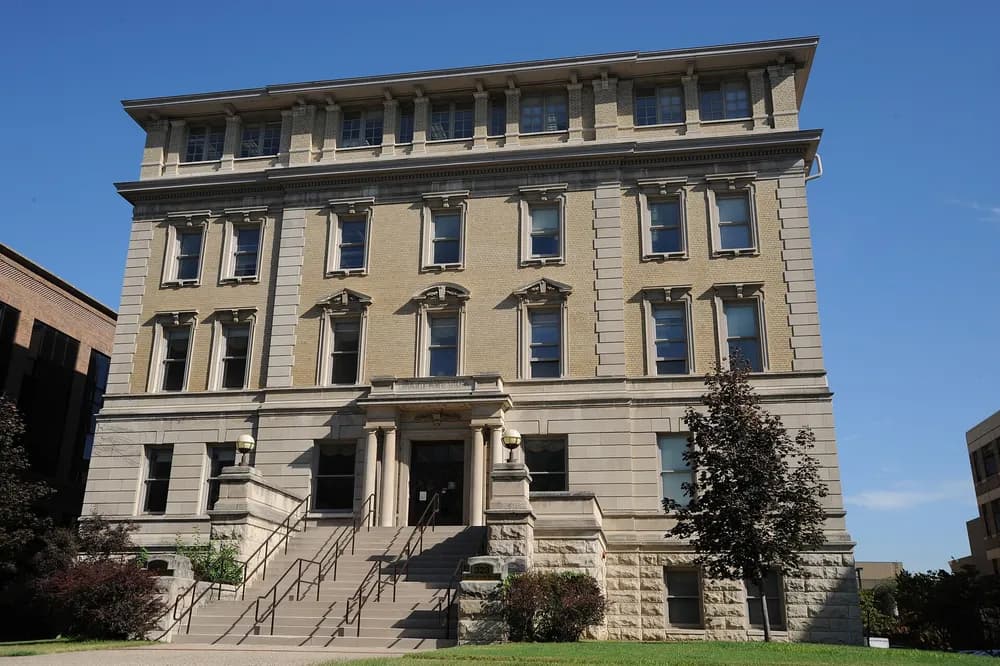
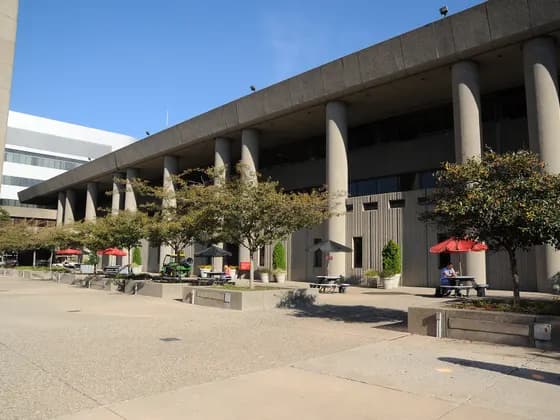

Photo: Photos by S. Harrison University of Louisville · Public domain · cropped
Photo: Photos by S. Harrison University of Louisville · Public domain · Photo: Abbie Myers · CC BY-SA 4.0 · Photo: Antony-22 · CC BY-SA 4.0
The University of Louisville School of Medicine MD program at a glance (2027 entry)
The University of Louisville School of Medicine (UofL School of Medicine) runs a four-year MD program at its Health Sciences Center in downtown Louisville, Kentucky. The school dates from 1837, when the Louisville Medical Institute opened with seven faculty members and 80 students. It now admits a class of 175 each year.
Years 1 and 2 are the pre-clerkship, or preclinical, phase. The Bulletin, the school's official catalog, describes a core curriculum that integrates the sciences across subjects and from year to year. Year 1 covers the body's structure and then the molecules behind health and disease, year 2 the organ systems, and Introduction to Clinical Medicine (ICM) runs through both.
Years 3 and 4 are the clinical phase. Year 3 is seven clerkships, the core clinical rotations in each major specialty, taken in a set sequence called a track. Year 4 adds a sub-internship, called an acting internship here, where you do much of an intern's work, plus intensive care, palliative medicine and 26 to 28 weeks of electives.
Clinical training centers on UofL Hospital, Jewish Hospital, Norton Children's Hospital and Norton Hospital, all within two blocks of the school, and the Robley Rex Veterans Affairs (VA) Medical Center. For rural training, the Trover Campus in Madisonville takes up to 12 students a year for the clinical years and hosts the three-year Rural Medicine Accelerated Track (RMAT).
The program is accredited by the Liaison Committee on Medical Education (LCME), which accredits MD programs in the United States. The LCME directory lists it as fully accredited, first accredited on or before 1942, the year the LCME was founded, with its next survey in 2028-29. That accreditation makes its students eligible to sit the United States Medical Licensing Examination (USMLE).
| Degree | MD, four years; three-year rural track for up to two students |
|---|---|
| Class size | 175 students a year |
| Main campus | Health Sciences Center, downtown Louisville, Kentucky |
| Teaching style | Integrated courses with problem-based and team-based learning; lectures capped at half |
| Anatomy | Donor dissection in a 19-week fall anatomy course in year 1 |
| First patient contact | Year 1: community shadowing and standardized patients |
| Preclinical grading | Honors, High Pass, Pass, Fail; Introduction to Clinical Medicine is pass/fail |
| Step 1 timing | Ideally May or June after year 2, before clerkships |
| Rural option | Trover Campus, Madisonville: up to 12 students per clinical year |
| Accreditation | LCME, full accreditation; next survey 2028-29 |
What makes the University of Louisville School of Medicine MD program different
Rural clinical years at the Trover Campus
Since 1998 the Trover Campus in Madisonville has let UofL students take years 3 and 4 in a rural community, with room for up to 12 in each year. You enroll in Trover before you matriculate, and the campus also runs the three-year RMAT for up to two students a year.
Four weeks of family medicine in a Kentucky community
Four of the six weeks of the family medicine clerkship are spent with a family physician at a Kentucky Area Health Education Center (AHEC) site, rural or urban, serving an underserved area.
Dissecting a donor while learning to examine
Clinical Anatomy, Development and Physical Examination (CADE) covers the body region by region, so you learn how each part is built and how to examine it in the same weeks. As UofL described it in 2025, you dissect in teams of six from the first week.
Seven Distinction Tracks with a scholarly project
About a fifth of students join one of seven optional tracks, such as Research, Medical Education or Urban Primary Care. Each offers mentors and ends in a scholarly project, noted on your transcript and in the Medical Student Performance Evaluation (MSPE) sent to residency programs.
Teaching hospitals within two blocks of class
UofL Hospital stands immediately east of the school, and UofL Health describes it as the region's only Level I trauma center for adults. Jewish Hospital, Norton Hospital and Norton Children's Hospital, the school's primary pediatric teaching site, are within two blocks.
How University of Louisville School of Medicine teaches medicine
Rather than separate classes in anatomy, biochemistry or pharmacology, each preclinical course blends several disciplines. UofL began this redesign in 2011. In October 2015 it reported that the LCME had lifted the school's probation after reforms that included moving to this integrated model and renovating its teaching building.
In year 1, CADE pairs anatomy with physical examination, and the spring course turns to molecules, cells and the body's defenses. Year 2's Human Systems courses take each organ system from normal function to disease, pathology, infection and drug treatment.
Policy caps lecture at half of years 1 and 2, and every course must include engaged learning. Graded problem-based learning (PBL) sessions run through both years to build self-directed learning. You work out what a case requires you to learn, find and judge the evidence, and get feedback on how well you did it.
ICM runs alongside the science courses, covering interviewing, examination, professionalism, ethics, health systems and health law. As described in 2025, its Interdisciplinary Clinical Cases small groups kept the same faculty member for both years and met monthly, joined by members of community advocacy groups.
The ways you will learn
| Lectures and online modules | Lectures may be live or recorded. Online SoftChalk modules with quizzes count toward the low-stakes share of your grade. |
|---|---|
| Problem-based learning (PBL) | In a small group with a faculty tutor, you research a patient case and present what you found, including how reliable your sources are. Tutors give written feedback on teamwork and professionalism. |
| Team-based learning | You prepare before class, take a short quiz alone and then the same quiz with your team, and both scores count. Teams then apply the material to harder problems. |
| Anatomy lab | Dissection of donated bodies in CADE, with practical exams. As the school described it in 2025, teams shared one donor. |
| Standardized patients and simulation | You interview and examine people trained to portray patients with set histories and symptoms, and encounters are watched live or recorded. Teaching associates guide gynecological and urogenital exams, and computer-driven manikins reproduce disease states. |
| Clerkship teams | From year 3 you take histories, examine patients, present cases and assist in procedures on clinical teams, with formal feedback from attending physicians by the midpoint of each clerkship. |
A typical week on the University of Louisville School of Medicine program
In years 1 and 2 you are expected to be available from 8 a.m. to 5 p.m. on weekdays. The scheduling guideline averages 20 hours of contact time a week, counting classes and required assignments set outside class but not exams. The Bulletin's credit-hour policy also assumes an average of 40 hours a week of your own study.
A fall week in year 1 centers on CADE; as the school described it in 2025, you are in the anatomy lab three times a week. Around it sit PBL and team-based learning, online modules, ICM small groups, standardized patient sessions and shadowing. The same description stresses weekly team-based learning in year 2.
Clerkship weeks are longer. The credit-hour policy puts clinical work at 40 to 80 hours a week, depending on specialty, season and patient needs. Duty hours are capped at 80 a week averaged over four weeks. You spend no more than 24 hours on site at a stretch, plus up to four for handover and teaching, and get on average one day off in seven.
How anatomy is taught at University of Louisville School of Medicine
Anatomy is concentrated in CADE, the 19-week course that fills the fall of year 1. It integrates gross anatomy, embryology and physical examination by body region, and it includes practical exams as well as written ones.
Teaching uses bodies given through the Willed Body Program, the university's whole-body donation program, studied in the gross anatomy lab in the Instructional Building. The technical standards that every student attests to, approved in May 2026, list dissection of cadavers among the lab activities you must be able to take part in.
UofL's former teaching-methods page, last archived in October 2025, gave more detail; its address now redirects to the school's new website. That page said students met their assigned donor in orientation week and began dissecting in the first week. It described teams of six sharing a donor and working in the lab three times a week through the fall. It said students were assessed on evidence-based presentations of their findings and on identifying structures on every donor in the lab.
An anatomy faculty profile also describes Anatomy in the Evening sessions for first-year students, with fresh-tissue prosections (specimens dissected in advance) and demonstrations. Each spring, students from medicine, dentistry and audiology honor the donors at a public ceremony with speeches, poetry, letters and music.
When you first meet patients at University of Louisville School of Medicine
You start working with standardized patients in year 1. They give feedback on your history-taking, examination and communication, and encounters can be recorded for review with faculty. First- and second-year students wear white coats whenever they meet patients.
ICM 1 adds real clinical settings through required community-based shadowing or preceptorship experiences, where you follow a working physician. You also begin practicing motivational interviewing and behavior-change counseling, including conversations with patients about weight.
In year 2, ICM 2 ends with an OSCE, an exam in which you rotate through timed stations with standardized patients. A pilot Longitudinal Ambulatory Clinic course places about half the class with community physicians at free clinics, diagnosing and treating patients.
Full-time clinical work starts in late June on the current calendar. In each clerkship you log a required list of diagnoses and procedures at least weekly. Each has a minimum level of involvement, from observing to performing under direct supervision.
The University of Louisville School of Medicine curriculum, year by year
- Year 1
Structure, molecules and first clinical skills
On the current calendar, year 1 starts with orientation in late July and classes in early August, and ends in late May. CADE fills the fall and the molecular basis of disease the spring, with ICM 1 throughout.
- CADE, 19 weeks: gross anatomy, embryology and physical examination taught together by body region.
- Molecular Basis of Life, Defense and Disease, 16 weeks: biochemistry, genetics, immunology, physiology, histology, pathology, pharmacology and microbiology, and the mechanisms, diagnosis and treatment of cancers and blood diseases. Year 1 includes about 30 hours of nutrition content, starting in this course.
- Introduction to Biostatistics and Evidence-Based Medicine, 2 weeks: research design, statistics, informatics and applying evidence to patient care, taught through lectures, team-based learning, flipped classes and online modules.
- ICM 1, both semesters: interviewing, professionalism and ethics, health systems, health disparities and preventive care, with community shadowing.
- The summer after year 1 can hold the 10-week Summer Research Scholar Program or the MD/MPH's online public health certificate.
- Year 2
The organ systems and Step 1
Year 2 teaches the body organ system by organ system in two long courses, with ICM 2 alongside. It ends with a dedicated study period, and policy names May or June, before third-year orientation, as the ideal time to sit Step 1.
- Human Systems in Health and Disease 1, 19 weeks in fall: the cardiovascular, respiratory, renal, gastrointestinal, hepatobiliary, nutritional and metabolic, and endocrine systems, from normal function to disease and treatment.
- Human Systems in Health and Disease 2, 14 weeks in spring: the reproductive, skin, musculoskeletal and behavioral systems and diseases of the nervous system.
- ICM 2: advanced communication, specialized examination techniques, advanced ethics, medical socioeconomics and health law, ending with an OSCE.
- The National Board of Medical Examiners (NBME) Comprehensive Basic Science Self-Assessment, a required practice exam paid for by the school, highlights gaps before Step 1 study.
- Optional electives include Procedure Skills, practicing procedures on simulators, and a bilingual Spanish-English standardized patient course.
- Year 3
Seven core clerkships
On the current calendar, year 3 begins in late June with orientation and Basic Life Support training. You rotate through seven clerkships, 44 weeks in all, in the order your track sets, and each includes an NBME subject (shelf) exam, a national multiple-choice test in that specialty.
- Family medicine, 6 weeks: four with a family physician at an AHEC site in Kentucky and two with UofL faculty, mostly outpatient, with a service-learning project.
- Internal medicine, 8 weeks: a general medicine hospital rotation plus two subspecialty rotations.
- Surgery, 8 weeks in the operating rooms and clinics of affiliated hospitals, ending with a week alongside multi-specialty surgeons in private group practice.
- Pediatrics, 6 weeks at sites including Norton Children's Hospital, UofL Hospital, three UofL Pediatrics clinics and Home of the Innocents.
- Psychiatry, 6 weeks on one service, such as child psychiatry, the Norton Psychiatric Clinic, emergency psychiatry, the VA or the Trover Clinic in Madisonville.
- Neurology, 4 weeks, at least two of them on the wards at UofL Hospital or the VA.
- Obstetrics and gynecology, 6 weeks: lectures and conferences, assigned ward and clinic patients, and taking part in procedures.
- Six weeks for electives or vacation, up to four of them for career exploration.
- For 2026-27 only, the school shortened surgery and internal medicine to six weeks and neurology to three, which it says supports the transition of the curriculum. The 2026-27 calendar also ends year 3 on May 21, 2027.
- Year 4
Acting internship, electives and Step 2 CK
On the current calendar, year 4 runs from early July to late April, ahead of commencement in May. Required rotations add up to seven weeks, and most of the year is electives, planned with your intended specialty in mind.
- Acting internship, 4 weeks at UofL, managing your own patients at an intern's level and taking call with your team; catalog options include family medicine, internal medicine, pediatrics and emergency medicine.
- Intensive care, 2 weeks, in a medical, surgical or pediatric unit.
- Palliative medicine, 1 week with a multidisciplinary team, including consultations, daily teaching rounds and a weekly conference.
- Topics in Clinical Medicine, covering topics the clerkships leave out, and an advanced cardiac life support course.
- 26 to 28 weeks of electives.
- USMLE Step 2 CK, which you must attempt before your final semester.
How you are assessed at University of Louisville School of Medicine
Under the policy revised in August 2026, students from the Class of 2030 onward, including 2027 entrants, get Honors, High Pass, Pass or Fail in preclinical courses of four or more credit hours. ICM 1 and 2 stay pass/fail. The 2025-26 Bulletin graded all first- and second-year courses pass/fail.
High-stakes assessments, such as exams, NBME custom exams and clinical skills exams, make up 70 to 80 percent of a preclinical course grade. Low-stakes work such as PBL, team-based learning, online modules and quizzes makes up the rest. You need 70 percent overall and a 70 percent exam average to pass. No final is must-pass, and every required course counts toward class rank.
Clerkships are graded Honors, High Pass, Pass or Fail. The NBME shelf exam and clinical evaluations each make up 40 percent of the grade, administrative tasks such as case logs 5 percent and other components 15 percent. Passing needs at least the 4th percentile on the shelf, passing evaluations and a 70 percent average; a failed shelf is retaken at the end of year 3.
USMLE Step 1, the licensing exam on the basic sciences, has been reported only as pass or fail since January 26, 2022. You must pass it before progressing in year 3. You submit two timed NBME practice exams: reach that year's cutoff and you test before third-year orientation; otherwise you may be allowed a Directed Studies elective that delays your first clerkship. You have up to three attempts in 12 months.
Step 2 CK, the clinical knowledge exam, comes once all year 1 to 3 courses and rotations are complete. It must be attempted before the last semester of year 4 and passed to graduate. In August 2026 the USMLE program announced a move to designated testing dates from January 2029, with Step exams offered less often each year. Its June 2026 announcement had named 2028.
On the current schedule, a student entering in 2027 would sit Step 1 in about May or June 2029, after the switch. Step 2 CK would fall between the end of year 3 in mid-2030 and January 2031, so both exams come under the new model. These are projections from the school's calendar and policies, not published dates.
- Fail one major preclinical course and you may remediate it in a six-week summer block ending in an NBME custom exam, with 70 percent the best grade possible. Only one major course can be remediated in years 1 and 2.
- Scoring more than one standard deviation below the mean on two clerkship OSCEs means remediation with the standardized patient program director.
- The NBME Comprehensive Clinical Science Examination, required at the end of year 3, helps you plan your Step 2 CK study.
- Your MSPE covers preclinical coursework, clerkship evaluations and three noteworthy characteristics you write yourself; electives and fourth-year coursework are left out.
- All degree requirements must be completed within six years of enrolling.
University of Louisville School of Medicine clinical rotations: where you will actually train
Years 1 and 2 are on the Health Sciences Center campus, and the main clerkship hospitals are nearby in the Louisville Medical Center. UofL Hospital, the main teaching hospital, is immediately east of the school. Jewish Hospital, home to the Heart Hospital and Trager Transplant Center, is a block away, and Norton Children's Hospital and Norton Hospital are within two blocks. The Robley Rex VA Medical Center is about three miles east.
You rank the sites or services you prefer within each clerkship and can ask the clerkship director for a change, with priority for health, accommodation and mistreatment concerns. Each February and August the school compares shelf scores, evaluations, grades, patient logs and work hours across sites to keep each clerkship comparable.
Family medicine includes four weeks with a family physician at a Kentucky AHEC site, rural or urban, in an underserved area. The AHEC network links UofL, the University of Kentucky and eight regional centers. You request a region after a spring orientation; regional coordinators arrange housing if needed, and eligible students get a stipend.
The Trover Campus in Madisonville has offered UofL students their third and fourth years in a rural community since 1998, with room for up to 12 students in each year. Clinical training is based at Baptist Health Deaconess Madisonville. You apply through a separate Trover Rural Track application, and enrollment is settled before you matriculate. An enrolled student can ask to withdraw by contacting the Senior Associate Dean for Student Affairs, who makes the final decision after consulting the medical education deans.
Trover also hosts RMAT, the three-year track for up to two students a year. RMAT students meet all the core objectives of the four-year program in at least 130 weeks of instruction. RMAT-only courses replace the third-year family medicine clerkship and the fourth-year acting internship, palliative care and intensive care rotations.
In July of year 2, RMAT students give free school physicals to sixth graders in two counties near Madisonville designated as health professional shortage areas. Later come four weeks at a free clinic in Hopkins and Webster counties and a six-week rural acting internship.
The core teaching hospitals, with rehabilitation and cancer centers nearby. According to UofL, a UofL surgical team implanted the first fully implantable replacement heart, the AbioCor, at Jewish Hospital in 2001.
- UofL Hospital
- Jewish Hospital
- Norton Children's Hospital
- Norton Hospital and Norton Psychiatric Clinic
- Frazier Rehabilitation Institute
- James Graham Brown Cancer Center
The VA, at 800 Zorn Avenue, hosts neurology and psychiatry rotations; a new VA hospital was under construction in September 2026. The other sites are affiliated facilities listed in the Bulletin or pediatric clerkship sites.
- Robley Rex VA Medical Center
- Norton Audubon Hospital
- Norton Brownsboro Hospital
- Norton Women's & Children's Hospital
- Norton Children's Medical Center
- UofL Health Mary and Elizabeth Hospital
- UofL Health Medical Centers East, Northeast, South and Southwest
- Home of the Innocents
Four weeks of the family medicine clerkship.
- Family physicians' practices at approved AHEC sites
Clinical years for Trover students, and the RMAT base.
- Baptist Health Deaconess Madisonville
- Trover Clinic (psychiatry clerkship)
- Free clinic for Hopkins and Webster counties (RMAT)
Electives, selectives and away rotations at University of Louisville School of Medicine
Electives are not required in years 1 and 2 and do not count toward later requirements, but several are offered for credit. Examples include Mind-Body Medicine, the student-run Hope Clinic for homeless women and children, an evening Elective in Rural Medicine, Street Medicine and Career Exploration, up to four weeks in a specialty you are considering. Approved research and other UofL classes can also earn credit.
Year 4 is largely yours: 26 to 28 weeks of electives, approved by a residency program director, clerkship director, advisory dean or UofL faculty mentor. The Bulletin says roughly 12 to 14 of those weeks usually relate directly to your intended specialty. Up to six weeks of third-year electives can count toward the total, and registration order is set by lottery.
Away rotations, electives at other institutions, can fill up to 16 weeks if you are in good standing, and up to 8 weeks can be online. Global health electives cover clinical work or research abroad and study at a foreign medical school; clinical trips require pre-departure training. Home options include Culinary Medicine and Medical Students as Teachers. The 2026-27 catalog lists AHEC electives, mostly four-week fourth-year rotations in rural Kentucky practices, in 14 specialties, including family medicine, internal medicine, surgery, anesthesiology, radiology and ophthalmology.
Dual degrees and research years at University of Louisville School of Medicine
UofL offers four dual degrees, and admission to each depends on admission to the MD program. The MD/PhD, run as the Medical Scientist Training Program (MSTP), takes about seven to eight years: two preclinical years, Step 1, typically three to four years of PhD research, then the clinical years. The program reports a 10-year average of 7.7 years, with full tuition remission and a stipend.
The PhD can be in anatomical sciences and neurobiology, pharmacology and toxicology, microbiology and immunology, biochemistry and molecular genetics, or physiology. You can rotate through labs you are considering for your dissertation before and after year 1, and current UofL students can join after year 2.
The five-year MD/MBA adds a full-time MBA year, placed between years 2 and 3 in the Bulletin's plan, with the application made in year 2. The Bulletin also allows the MBA after year 3. The MD/MPH begins with a 12-credit online public health certificate in the summer after year 1 and finishes with the MPH in a gap year between years 3 and 4.
The MD/MA adds a 33-credit master's in bioethics and medical humanities, which the Bulletin lists under applied philosophy and healthcare ethics. It takes five years, with one year away from the MD before year 1 or after year 3, and includes an individualized capstone internship.
Without a second degree, you can join the Summer Research Scholar Program, a 10-week, full-time mentored project of about 350 hours between years 1 and 2. You can also join one of seven Distinction Tracks: Research, Physician-Scientist Development, Medical Education, Business and Leadership, Global and Public Health, Urban Primary Care, or Medicine and Social Impact.
You apply in spring of year 1, or in the summer after it for the Research track. Each track runs for several years with a mentor and ends in a scholarly product. You can join only one and must stay in good academic standing, including passing Step 1 on the first attempt. About 20 percent of students are enrolled.
Facilities and support at University of Louisville School of Medicine
Where you will learn
Preclinical life centers on the three-story Instructional Building, with three auditoriums, two collaborative lecture halls, 20 small-group rooms, study space and the gross anatomy lab. It underwent significant renovations in 2014.
On its third floor, the Alumni Center for Medical Education houses the John M. and Dorothy S. Paris Patient Simulation Center. Its computer-driven manikins can reproduce a patient of any age and realistic disease states. The same center holds the Standardized Patient Clinic, whose 12 equipped exam rooms are used for teaching and high-stakes exams.
The Kornhauser Health Sciences Library, connected to the complex, is open 24 hours. A new six-story Health Sciences Building with extensive simulation space, shared with dentistry, nursing and public health, broke ground on April 21, 2026, with completion expected in 2029.
Support while you study
At matriculation you join one of six Advisory Colleges (Moore, Bodine, Fitzbutler, Gross, Ganzel or Pickett), each named for a past dean or historical figure tied to the school. You also get a mentor from the class above. Events such as the College Cup, Dinner with the Deans and ULSOM Outreach Day mix students across the four years.
Since 2007-08 each student has had an Advisory Dean for advice on wellness, study skills, Step preparation, interviews and specialty choice, and advisory deans play no part in grading their advisees. You keep the same Advisory Dean through medical school unless that dean leaves the role.
The Learning Team in Medical Student Affairs offers learning coaching and tracks every student's progress. It also supports students with learning difficulties and a tutoring program called LEAD Tutor, and it runs board preparation workshops and peer-led programs.
Career planning runs from year 1 to Match Day and includes required sessions of Careers in Medicine, the career-planning program of the Association of American Medical Colleges (AAMC). You also meet one to one with an associate dean in year 3 and have mock interviews in year 4. Alpha Omega Alpha elects students in years 3 and 4, and the Gold Humanism Honor Society in the spring of year 3.
Is the University of Louisville School of Medicine program right for you?
This program may suit you if
- You want hands-on anatomy: donor dissection taught alongside how to examine each body region.
- You are drawn to rural medicine and ready to commit before you start, to clinical years in Madisonville or a three-year MD.
- You learn well in small groups, since graded PBL and team-based learning run through years 1 and 2.
- You would value four weeks with a family physician in a Kentucky community as part of the core program.
- You want a structured route into research, teaching or leadership through a Distinction Track or the summer research program.
Things to think about
- Most preclinical courses carry Honors, High Pass, Pass or Fail grades, not pass/fail, and every required course counts toward class rank.
- You must pass Step 1 before progressing in year 3, and practice-exam cutoffs decide whether you sit it before clerkships or may take Directed Studies first.
- The Trover decision comes before matriculation, so think early about whether rural clinical years suit you; withdrawing later takes a request and a dean's approval.
University of Louisville School of Medicine MD program — frequently asked questions
Applying to University of Louisville School of Medicine?
How to get into University of Louisville School of Medicine
Prerequisites, MCAT, AMCAS personal statement, secondaries and interview, step by step.
Open the guide →University of Louisville School of Medicine admissions profile
MCAT and GPA profile, acceptance rate, interview format and key dates.
See the profile →Compare University of Louisville School of Medicine with other schools
Put the teaching style, anatomy teaching and clinical sites next to another school.
Open the comparison →Prepare for the University of Louisville School of Medicine interview
Format breakdown, school-specific sample questions and prep tips from tutors who interviewed here.
Read the guide →Where this University of Louisville School of Medicine program guide came from
This guide was written from 63 official sources — University of Louisville School of Medicine's own program pages and curriculum documents, plus the accreditor and the hospitals and health systems the school trains students in where they publish detail — read on 2026-10-24, then checked claim by claim against those sources.
- UofL School of Medicine: MD Academics and Programs
- 2026-27 Medical Bulletin: MD Requirements, including dual degree plans and RMAT
- 2026-27 Medical Bulletin: School of Medicine Policies (grading, Step exams, curriculum, workload)
- 2026-27 School of Medicine Bulletin: About the Bulletin
- 2026-27 Medical Bulletin: Courses and Programs
- 2026-27 Medical Bulletin: Interdepartmental (IDEP) course catalog
- 2026-27 Medical Bulletin: Family Practice (FMED) courses, including RMAT courses
- 2026-27 Medical Bulletin: Medicine (MED) courses
- 2026-27 Medical Bulletin: Neurology (NEUR) courses
- 2026-27 Medical Bulletin: Obstetrics and Gynecology courses
- 2026-27 Medical Bulletin: Pediatrics (PEDI) courses
- 2026-27 Medical Bulletin: Psychiatry and Behavioral Sciences (PSY) courses
- 2026-27 Medical Bulletin: Surgery (SURG) courses
- 2026-27 Medical Bulletin: Emergency Medicine (EMED) courses
- 2026-27 Medical Bulletin: Anesthesiology (ANES) courses
- 2026-27 Medical Bulletin: Pathology (PATH) courses
- 2026-27 Medical Bulletin: Orthopaedic Surgery (ORPD) courses
- 2026-27 Medical Bulletin: Diagnostic Radiology (RADI) courses
- 2026-27 Medical Bulletin: Urology (UROL) courses
- 2026-27 Medical Bulletin: Ophthalmology (OPHT) courses
- 2026-27 Medical Bulletin: MD course index (23 subject pages)
- 2026-27 Medical Bulletin: Baptist Health Deaconess (Trover) Rural Track
- 2026-27 Medical Bulletin: Affiliated Facilities
- 2026-27 Medical Bulletin: Facilities
- 2026-27 Medical Bulletin: History of the School of Medicine
- 2026-27 Medical Bulletin: Accreditation
- 2026-27 Medical Bulletin: Distinction Tracks
- 2026-27 Medical Bulletin: Technical Standards
- 2026-27 Medical Bulletin: Honor Societies
- 2026-27 Medical Bulletin: Ethical and Professional Requirements
- 2025-26 School of Medicine Bulletin (previous catalog year, for comparison)
- UofL: MD Program Academic Calendar 2026-27
- UofL School of Medicine: Teaching Methods (former UME page, archived October 16, 2025)
- UofL School of Medicine: Medical Student Affairs (Advisory Colleges, Learning Team, career planning)
- UofL School of Medicine: MD Program Admissions (class size)
- UofL School of Medicine: Dual Degree Programs
- UofL School of Medicine: Medical Scientist Training Program
- UofL School of Medicine: MD-PhD Program
- UofL School of Medicine: MD-MPH Dual Degree Program
- UofL School of Medicine: MD-MA Dual Degree Program
- UofL School of Medicine: Standardized Patient Program
- UofL School of Medicine: Nutrition Curriculum
- Kentucky AHEC at UofL: Students and clinical rotations
- Kentucky AHEC at UofL: About
- UofL School of Medicine: MD Program Distinction Tracks
- UofL School of Medicine: Undergraduate Medical Education office
- UofL School of Medicine: History and Mission
- UofL Department of Anatomical Sciences and Neurobiology: faculty research and teaching
- UofL Department of Anatomical Sciences and Neurobiology: Willed Body Program
- UofL Department of Pediatrics: Norton Children's, the pediatric clinical partner
- UofL News, February 28, 2018: 500th heart transplant (AbioCor history)
- UofL News, April 2026: groundbreaking for the Health Sciences Building
- UofL News, October 16, 2015: integrated curriculum and LCME status
- UofL Health: UofL Hospital
- UofL Health: Jewish Hospital
- VA Louisville Health Care: Robley Rex VA Medical Center
- VA Louisville Health Care: New VA hospital construction updates, September 2026
- LCME directory of accredited MD programs (updated October 14, 2026)
- USMLE Designated Testing Dates Information Hub (lists the August 6, 2026 announcement)
- USMLE announcement: Designated Testing Dates transition will take place in January 2029
- USMLE announcement of June 23, 2026, naming 2028 (since updated)
- USMLE Designated Testing Dates FAQs
- USMLE: Step 1 pass/fail score reporting from January 26, 2022
Curricula are restructured between cycles. Anything here that decides your application — how anatomy is taught, a clinical campus assignment, a required research year — should be confirmed against the official page for your entry year.
Applying to University of Louisville School of Medicine?
We help US applicants with MCAT strategy, the AMCAS personal statement, secondary essays and interview prep — everything you need for a competitive University of Louisville School of Medicine application.