
The Morehouse School of Medicine MD program
What you actually study, and where you will be
Morehouse School of Medicine's MD is a 4-year program with an integrated curriculum, with patient contact from Year 1 and clinical rotations in Atlanta, Columbus and Albany in Georgia, plus Chattanooga and Seattle (2027 entry). Morehouse's MD opens with an integrated first year called Molecules, Structures, Mechanisms, which moves from basic principles through the body's organ systems. A community health course and a clinical preceptorship run alongside. Year 2 turns to disease and ends with the first licensing exam, USMLE Step 1, in June. Most third-year clerkships are at Grady Memorial Hospital, an Atlanta safety-net hospital.
- Degree
- MD
- Length
- 4 years
- Teaching
- Integrated
- Clinical contact
- Year 1

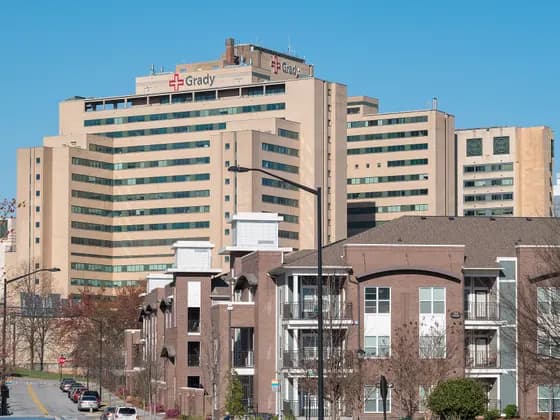


Photo: Thomson200 · CC0 · cropped
Photo: Marc Merlin · CC BY-SA 4.0 · Photo: Michael Barera · CC BY-SA 4.0 · Photo: atlexplorer from Atlanta, GA, United States · CC BY-SA 2.0
The Morehouse School of Medicine MD program at a glance (2027 entry)
Morehouse School of Medicine (MSM) in Atlanta, Georgia, offers a four-year Doctor of Medicine (MD) program. It began in 1975 as a two-year Medical Education Program at Morehouse College and became independent in 1981. MSM calls itself an independent, private historically Black medical school, and it belongs to the Atlanta University Center with Clark Atlanta University, Morehouse College and Spelman College. MSM's MD fact sheet lists entering classes of 125 in 2022, 110 in 2023, 105 in 2024 and 110 in 2025.
The first two years are the preclinical phase. Year 1 is an integrated curriculum called Molecules, Structures, Mechanisms. Its four units teach the sciences together, starting with basic principles and then moving through the organ systems, with gross anatomy lab built in. Year 2 turns to disease and ends with Step 1 of the United States Medical Licensing Examination (USMLE).
Community health and patients come early. In the first-year Community Health course, small groups work with community partner sites in Atlanta on local health needs. Fundamentals of Medicine, a course sequence running through Years 1 to 3, teaches clinical skills, ethics and behavior, and includes a clinical preceptorship in Year 1.
Years 3 and 4 are clinical. Most required clerkships, the core clinical rotations, take place at Grady Memorial Hospital, a safety-net hospital in Atlanta. Other rotations use the Atlanta VA Medical Center, Children's Healthcare of Atlanta and regional sites in Georgia, Tennessee and Washington.
The Liaison Committee on Medical Education (LCME) accredits MD programs in the United States. Its directory, updated October 14, 2026, lists Morehouse School of Medicine as Full, with 1978 as the initial year of accreditation and 2028-29 as the next survey date. The school's catalog gives its own history. Its first class, 24 students, entered the two-year program in September 1978 and completed their clinical training at other medical schools. The LCME approved plans to award the MD in 1982, and full accreditation followed in April 1985.
| Degree | MD (Doctor of Medicine) |
|---|---|
| Program length | 4 years; five on the MD/MBA or the Alternative Academic Track |
| Class size | Entering classes of 105 to 125 since 2022; 110 in 2025 |
| Year 1 curriculum | Molecules, Structures, Mechanisms: basic principles, then three organ-system units |
| Anatomy | Dissection in the gross anatomy lab, within the Organ Systems courses |
| First patient contact | Year 1 clinical preceptorship; ward patient assignments in Year 2 |
| Grading | Letter grades A to F; electives and a few courses pass/fail |
| Step 1 timing | June after Year 2; June 2029 for 2027 entrants, on the current schedule |
| Clinical sites | Grady in Atlanta for most clerkships; also Columbus, Albany, Chattanooga, Seattle |
| Accreditation | LCME (accreditor of MD programs): Full; next survey 2028-29 |
What makes the Morehouse School of Medicine MD program different
A first-year service-learning course in Atlanta communities
Community Health is a service-learning course, mixing community service with study. In the fall your group works with a community partner site in Atlanta. You assess local health needs by observing the area, running focus groups and interviewing people who know it well, then rank those needs with community representatives. In the spring the group designs, runs and evaluates a health promotion project for one or more of them.
Clerkships and sub-internships at Grady Memorial Hospital
Grady is a major Atlanta safety-net hospital, with large numbers of admissions and outpatient visits across many medical and surgical specialties. MSM faculty provide inpatient and outpatient care there. Several fourth-year sub-internships, where you take on much of a first-year resident's work, are based there as well.
Rotations from Columbus, Georgia, to Seattle
Some rotations take you beyond Atlanta: to Columbus, Georgia, an LCME-approved regional campus, and to Albany for rural-focused training with Phoebe Putney Health System. Through an alliance with CommonSpirit Health, students also rotate at CHI Memorial Hospital in Chattanooga and, in a hybrid program, in Seattle.
An option to spread the basic sciences over three years
The Alternative Academic Track lets you take the basic science curriculum over three years instead of two. Taken in Year 2, it spreads that year over two years: Fundamentals of Medicine II, microbiology and pharmacology first, then pathology and pathophysiology. You can choose it, and it is required if your first-year average is below 75 or your first-year National Board of Medical Examiners (NBME) exam average is below 50.
How Morehouse School of Medicine teaches medicine
Year 1 runs from July to May as one integrated curriculum. Its four units follow in sequence: Basic Principles of Human Biology from July to September, then Organ Systems I, II and III. Each Organ Systems unit teaches the anatomy, histology, embryology and physiology of a group of systems together, so you learn structure and function side by side.
The catalog lists lectures, gross anatomy lab, demonstrations, problem sessions, case-based teaching and self-directed study as the Organ Systems methods. The program mixes in-person skills sessions with live and self-paced online teaching, and the handbook expects you at in-person classes unless a course permits hybrid or virtual delivery.
Year 2 is organized as long courses: Pathophysiology, Pathology, Medical Microbiology and Immunology, and Medical Pharmacology and Toxicology. Fundamentals of Medicine runs beside the science in Years 1 to 3, covering clinical skills, communication, ethics, behavior and the health care system.
The ways you will learn
| Lectures | Lectures carry much of the science in Years 1 and 2. If you attend fewer than 80% of a course's classroom sessions, you lose eligibility for exam retakes, enrichment exams and remediation in that course. |
|---|---|
| Anatomy and pathology labs | Gross anatomy lab runs within the Organ Systems units. In Year 2, pathology labs use computer-simulated cases, fixed specimens and glass slides. Lab work is usually cooperative, so the handbook treats excessive absence as a serious breach of conduct. |
| Cases and small groups | Problem sessions and cases run through the Organ Systems units, Pathophysiology is case-based, and Pharmacology adds small-group problem solving and peer-assisted learning. Team-based learning sessions and small-group case studies are among the sessions you need an excused absence to miss. |
| Clinical skills and standardized patients | Fundamentals of Medicine II starts with large-group demonstrations of the physical examination, then moves to small groups led by clinical faculty for history taking, examination and presenting patients. Standardized patients, local people trained to portray patients, rate your interviewing and examination on a checklist for each case. |
| Clerkships | In Years 3 and 4 you learn on supervised clinical teams in hospitals and clinics. Duty hours are capped at 80 a week, averaged over four weeks, with in-house call no more often than every third night. |
How anatomy is taught at Morehouse School of Medicine
Anatomy is taught inside the first-year Organ Systems units, alongside histology, embryology and physiology. The 2026-27 catalog lists gross anatomy lab in Organ Systems I, which covers the back and upper limb, heart, lungs and gut. It also lists lab in Organ Systems II, which covers the kidneys, endocrine and reproductive systems, the pelvis and lower limb, and blood.
Organ Systems III, from March to May, covers the head, neck and nervous system. In its lab you study gross and microscopic sections of the brain and spinal cord, and the catalog says the head and neck are dissected. Teaching uses a dedicated gross anatomy laboratory; MSM opened a new lab in 2016, sized for nearly 115 students.
A fourth-year elective, Advanced Clinical Anatomy, takes you back to the lab. In the 2025-26 electives catalog, students spend at least five half-days a week dissecting and serving as teaching assistants in the Organ Systems courses.
When you first meet patients at Morehouse School of Medicine
Your first clinical experience comes through Fundamentals of Medicine I, a year-long first-year sequence. It combines a Clinical Preceptorship with Human Values, Human Behavior, and Epidemiology and Biostatistics, introducing primary care practice, core clinical skills and communication. Skills teaching comes before the preceptorship, which MSM's curriculum page places in physicians' offices and health clinics.
Human Behavior, taught by the psychiatry department, covers development across the lifespan, behavior change and motivational interviewing. It includes a smoking cessation clinical skills exercise and a communication skills field experience with older adults, both meant to build your interviewing.
In Year 2, Fundamentals of Medicine II adds individual patient assignments on the medical wards, backed by small-group sessions. Outside the curriculum, students volunteer with physicians at the student-run MSM H.E.A.L. (Health Equity for All Lives) Clinic. It offers free primary care on Saturday mornings at clinics on Howell Mill Road and Lee Street SW, plus a Wednesday evening telemedicine clinic.
The Morehouse School of Medicine curriculum, year by year
- Year 1
Molecules, Structures, Mechanisms
On the 2026-27 calendar, orientation is at the end of June, classes start July 1 and the year ends in late May. A White Coat and Pinning Ceremony comes at the fall convocation in September.
- Basic Principles of Human Biology (July to September): biochemistry, cell structure and biology, basic embryology, cellular physiology and basic tissue types.
- Organ Systems I to III (September to May): musculoskeletal, heart, lungs and gut; then kidneys, endocrine, reproductive and blood; then head, neck and nervous system.
- Community Health, taught on campus and at community sites: a fall health needs assessment with a partner site, then a spring health promotion project your group designs, runs and evaluates.
- Fundamentals of Medicine I: the Clinical Preceptorship, Human Values 1, Human Behavior, and Epidemiology and Biostatistics, plus learning community sessions (mentored groups you stay in for all four years).
- Exams include NBME exams built into the courses, and you must pass every first-year course before starting Year 2.
- Research Day in February and an MSM Day of Service in April.
- Year 2
Disease, treatment and Step 1
Year 2 runs from mid-August to late May, and the calendar sets June 30 as the Step 1 deadline. The focus moves to disease, infection and drugs, while Fundamentals of Medicine II builds bedside skills. All preclinical coursework must be complete, and readiness shown, before you sit Step 1.
- Pathophysiology (October to May): a two-semester, case-based course that works as a year-long board review, with board-style multiple-choice exams.
- Pathology: general disease processes first, then disease organ by organ, including how to use the clinical laboratory in diagnosis.
- Medical Microbiology and Immunology, and Medical Pharmacology and Toxicology, both running August to May.
- Fundamentals of Medicine II: Introduction to Patient Care, Physical Diagnosis, Human Values 2 and Psychopathology. The obstetrics and gynecology and pediatrics departments help teach its clinical skills.
- Step 1 readiness: for example, a passing score of at least 55% on the April Comprehensive Basic Science Exam, or an average of at least 70% across the year's NBME exams.
- Year 3
Core clerkships
Year 3 runs from early July to mid-June, opening with orientation and a Student Clinician Ceremony. Before rotations start you must complete the Clinical Passport course, with onboarding modules, assessments and certifications, and have sat Step 1. Schedules are set by lottery by June 1, in six eight-week slots.
- Internal medicine, surgery, pediatrics, and obstetrics and gynecology: eight weeks each.
- Family medicine and rural health, and psychiatry: six weeks each. Each shares an eight-week slot with two weeks of the Career Exploration Elective, a pass/fail mentorship in a field you choose; the plan of study counts four weeks in all.
- Fundamentals of Medicine III: regular seminars through the year on topics such as diagnostic imaging, medical decision-making, evidence-based medicine, ethics, career planning and exam preparation.
- An NBME subject (shelf) exam, a national end-of-rotation test, in each clerkship, plus OSCEs (objective structured clinical examinations, timed exams with standardized patients) through the year.
- The End of Year OSCE, which you must pass to graduate.
- Year 4
Senior Selective, electives and residency applications
Year 4 runs from July to May in four-week blocks. Your schedule, signed by your faculty advisor, is due by April 19 of Year 3. Residency interviews run from late October to January, and Match Day comes in March.
- Senior Selective: a required four-week clinical experience at Grady or another MSM affiliate. The 2025-26 options include sub-internships in ward medicine, surgery, pediatrics, obstetrics and gynecology and family medicine, plus intensive care, rural health and ambulatory rotations.
- Six four-week electives, at least four of them clinical under the 2025-26 catalog.
- USMLE Step 2 CK (Clinical Knowledge), the next licensing exam, by December 31; a recorded pass is required to take part in the May commencement.
- Optional residency preparation: Fundamentals of Medicine 4, a virtual course on choosing a specialty, interviewing and skills such as breaking bad news; Transition to Residency in April; and a Surgery Boot Camp.
How you are assessed at Morehouse School of Medicine
Required courses carry letter grades rather than pass/fail. The handbook scale runs from A (90 to 100) through B and C to D (60 to 69) and F (below 60). A D is a failing grade: you must remediate it, and the remediated grade can only rise to a C.
The 2025-26 electives catalog gives letter grades for required clinical rotations and senior selectives but pass/fail for electives. MSM does not rank students for external purposes. In the clinical years, grades come with written comments, which the Associate Dean of Student Affairs uses to summarize your performance for residency programs.
The USMLE is the exam series state medical boards use in licensing decisions, and you must pass Step 1 and Step 2 CK to graduate. Step 1 has been reported only as pass or fail since January 26, 2022. For MD students, enrollment in an LCME-accredited program is what makes you eligible to sit the USMLE. Students and graduates of osteopathic (DO) schools accredited by the Commission on Osteopathic College Accreditation, and of international schools that meet Educational Commission for Foreign Medical Graduates requirements, qualify through other routes.
First-time takers without academic deficiencies sit Step 1 between June 1 and June 30 after Year 2, once they have shown readiness. You cannot start clerkships until you have sat it, and if you test after June 30 you need a recorded pass before starting a rotation. Step 2 CK opens after the third-year core clerkships and must be sat by December 31 of Year 4.
You must pass Step 1 within 12 months of finishing Year 2 and Step 2 CK within four months of finishing Year 4, with no more than three attempts at each. On the current schedule, a student entering in July 2027 would sit Step 1 in June 2029, and Step 2 CK between late June and December 31, 2030. This uses the 2026-27 calendar, the latest posted.
In August 2026 the USMLE program announced a move to designated testing dates from January 2029, with Step exams offered less often each year. Its June 2026 notice had named 2028. Both of a 2027 entrant's exams would fall after the change, and the handbook lets MSM's promotions committee modify its USMLE policies as circumstances change.
- Each clerkship sets a minimum passing score on its NBME subject (shelf) exam at or above the national 5th percentile, and you must pass the exam to pass the clerkship.
- In Year 3, OSCEs in obstetrics and gynecology and surgery are summative, while those in internal medicine, family medicine and psychiatry are formative, for feedback.
- The End of Year OSCE has 9 to 12 cases, one or two from each specialty, usually completed within eight hours. Clerkship faculty grade the patient note you write after each case, and students below the cut-off complete tailored remediation before graduating.
- Formal feedback comes at least at the midpoint of each course and clerkship, and on rotations you log every patient you see for a mid-cycle review.
- Faculty may also file a Scholastic Non-Cognitive Evaluation, rating professional qualities such as responsibility, ethics, communication and teamwork as outstanding, adequate or inadequate.
- The Student Academic Progress and Promotions (SAPP) Committee monitors every student's progress and assesses readiness for promotion and graduation. You have six years to finish the MD, excluding approved leave.
Morehouse School of Medicine clinical rotations: where you will actually train
Third-year students complete most required clerkships at Grady Memorial Hospital in Atlanta, a major safety-net hospital serving a diverse, largely underserved population. The other core teaching affiliates are the Atlanta Veterans Affairs Medical Center and Children's Healthcare of Atlanta, at its Hughes Spalding and Scottish Rite hospitals.
Psychiatry rotations use Grady's outpatient mental health services, Ridgeview Institute, Georgia Regional Hospital, the Atlanta VA and New Horizons in Columbus. Family medicine trains through Morehouse Healthcare, MSM's faculty practice, with the Comprehensive Family Healthcare Center in East Point as a central site. The family medicine clerkship splits its clinical weeks between urban and rural settings, and MSM partners with Georgia's Area Health Education Centers (AHEC) on rural training.
Pediatrics centers on an ambulatory rotation in a private office, managed care office or hospital primary care clinic, including sites in Columbus, Georgia, Troy, Alabama, and Chattanooga, Tennessee. You also spend two inpatient weeks at a Children's Healthcare of Atlanta hospital or Studer Children's Hospital in Pensacola, Florida.
The 2026-27 handbook says students may be assigned to campuses outside metro Atlanta, by their choice when possible. Sometimes the only options are to accept the distant site or miss that cycle. Some experiences, such as neonatal intensive care unit (NICU) time in pediatrics in Albany, exist only there. The Columbus and Albany campuses offer dedicated student housing.
Through the More in Common Alliance (MiCA), a partnership between MSM and CommonSpirit Health, MD students also train at CommonSpirit sites in Chattanooga and the Seattle area. The 2025-26 electives catalog reaches further, with a family medicine sub-internship at Dominican Hospital in Santa Cruz, California, whose flights and lodging are covered.
Two hospitals are planned but not yet open. In August 2026, MSM and Atrium Health announced approval to move forward with plans for a teaching hospital at 675 Metropolitan Parkway SW. It is planned to open with about 50 beds, and the plans still depend on agreements with Fulton County. In March 2026, Fulton County commissioners approved a Grady hospital in Union City, with an amendment confirming that MSM students will train there. A media report reposted by MSM expects it to be fully operational in 2031 or 2032.
The base for most rotations.
- Grady Memorial Hospital
- Atlanta VA Medical Center
- Children's Healthcare of Atlanta: Hughes Spalding and Scottish Rite
- Georgia Regional Hospital, Atlanta
- Ridgeview Institute, Smyrna
- Morehouse Healthcare clinics: Howell Mill Road, Lee Street, Princeton Lakes and East Point
The LCME approved it as a regional campus on October 31, 2023. Core rotations include obstetrics and gynecology, internal medicine, family medicine, pediatrics and psychiatry.
- Piedmont Columbus Regional
- St. Francis-Emory Healthcare
- Valley Healthcare System
- New Horizons (psychiatry)
- Private practices in the Columbus area
The 2026-27 handbook describes a rural-focused Albany Regional Campus, with housing in the hospital's Living and Learning Center.
- Phoebe Putney Memorial Hospital
- Phoebe Putney Health System sites in southwest Georgia
A MiCA site led by a regional dean, developing inpatient and outpatient experiences, including the third-year core rotations. A February 2024 media report said MSM hoped to make it a regional medical campus.
- CHI Memorial Hospital
A MiCA site where students currently alternate four-week rotations between Atlanta and Seattle, in internal medicine and general surgery. A regional campus here is the long-term aim.
- Virginia Mason Medical Center (Virginia Mason Franciscan Health)
Pensacola takes a limited number of students for inpatient pediatrics.
- Studer Children's Hospital, Pensacola, Florida
- Pediatric sites in Troy, Alabama
Electives, selectives and away rotations at Morehouse School of Medicine
Electives start in Year 3 with the Career Exploration Elective. Before Year 3 ends you may take only one fourth-year elective for credit, a non-clinical one, though a longitudinal elective such as research can begin early.
Year 4 combines one Senior Selective with six electives, chosen with a clinical advisor, ideally an MSM faculty member in your intended field. A sub-internship, also called an acting internship, gives you much of the work of an intern, a first-year resident, under supervision. On the ward medicine sub-internship at Grady, you admit and take primary responsibility for three to five patients a week.
Electives can be at MSM, Emory University School of Medicine or any other LCME-accredited US medical school. The handbook allows up to two Emory electives, arranged by MSM rather than through the national Visiting Student Learning Opportunities (VSLO) system. It allows up to five away electives, only one of them in person. MSM offers no two-week electives, but two related two-week electives elsewhere are allowed.
The 2025-26 electives catalog, the latest posted, spans every department. Examples include Health Equity Leadership Development, Law and Medicine with Georgia State University's health law partnership, forensic pathology in Cobb, DeKalb and Fulton counties, and Business of Medicine. Neurology and emergency medicine are offered as fourth-year electives, such as MEDI 838 Clinical Neurology and MEDI 887 Emergency Medicine.
International electives are possible in the senior year. Credit requires an experience affiliated with or sponsored by an LCME-accredited US school, or a four- or eight-week program with Child Family Health International (CFHI). The handbook advises going before March, and the 2025-26 catalog lists an integrative medicine elective in Chennai, India.
MEDI 881 Service Learning is a four-week, non-clinical elective built around a community service project with a faculty mentor. A committee of three, including your mentor, must approve your proposal at least a month ahead. For each month of credit, up to two, you log at least 100 hours, write a scholarly paper of 10 pages or more, present for at least 15 minutes and critique a related paper.
Dual degrees and research years at Morehouse School of Medicine
The MD-PhD, MSM's Medical Scientist Training Program (MSM-MSTP), aims to develop leaders in academic medicine and biomedical research who can advance health equity. You complete Years 1 and 2, start the PhD once you pass Step 1, then return for Years 3 and 4. Your preclinical MD courses count toward the PhD's core coursework, and tuition and a stipend are provided during the PhD.
You can apply at any point from acceptance to the MD through Year 3. MSM also works with the University of Washington in Seattle for a PhD there; candidates ideally apply before or during their first year and spend a summer at the site as part of applying.
The MD/MSCR adds a Master of Science in Clinical Research, open to MD students who have completed Year 2, with the MD program's approval. The master's requires 36 credit hours, 12 of them for a mentored research project that you propose with your mentor and present orally at the end.
The MD/MBA with Georgia Tech's Scheller College of Business takes five years. After Years 1 to 3 at MSM, you take 39 credit hours of MBA courses at Scheller in the fourth year, then return to MSM for the final MD year. Fifteen MD credit hours count toward the 54-credit MBA. You apply before the end of Year 3, ideally in its fall.
Within the MD, MEDI 886 Research is a fourth-year elective of at least four weeks that any faculty member in any department can sponsor. A month before it starts, you and your mentor submit a proposal for approval by a committee of three. Research Day each February and a Neurology Research elective add further options.
MSM's Department of Community Health and Preventive Medicine describes an Honors in Community Health and Service program, created in 2001, for faculty-recommended rising second-years with A grades in Community Health. Candidates spend three years on a community project overseen by MSM faculty and community representatives. Required service hours are 32 in Year 2, five in Year 3 and 100 in Year 4 linked to the service-learning elective. After an oral defense, those who complete the program are recognized at Class Day, in the Dean's letters to residency programs and at graduation.
Facilities and support at Morehouse School of Medicine
Where you will learn
Most preclinical teaching happens in the Hugh M. Gloster Basic Medical Sciences Building, a 91,000-square-foot building from 1982 with lecture halls for about 100 students, two multidisciplinary teaching labs and the gross anatomy lab. A 2018 to 2023 renovation added flexible classrooms, small-group rooms and carrel rooms for active and team-based learning.
The Clinical Skills and Simulation Center, in the National Center for Primary Care, covers more than 4,800 square feet. It has 11 examination rooms with audio and video recording, simulation rooms with high-fidelity mannequins, and equipment for practicing procedures such as IV access, lumbar puncture and suturing.
The Billye Suber Aaron Pavilion, added in 2017, provides over 10,000 square feet of study, group and recreation space. The M. Delmar Edwards, M.D. Library, in the Medical Education Building, is open 24 hours a day, seven days a week. The Calvin Smyre Education Conference Center opened in 2025.
Support while you study
MSM started MD learning communities in 2011 as its classes grew. Each entering class is divided into 12 communities named for values such as Knowledge, Service, Equity and Discovery. You stay in yours for all four years, and its sessions are a required part of each year's Fundamentals of Medicine course.
Students lead the discussions, with two faculty mentors facilitating. Topics include ethics, health literacy, leadership, health reform, communication, implicit bias and conflict management.
The Office of Student Learning and Educational Resources (OSLER) offers peer tutoring, one-on-one learning specialists and workshop series, including Step 1 Prep. Weekly tutor-led Supplemental Instruction Sessions review pathology, pathophysiology and pharmacology for all second-year students. If you struggle, the Academic Coaching and Enrichment (ACE) program can provide a coach, an individual learning plan and NBME-style question practice.
The Office of Student Success handles preclinical advising and supports students at the regional campuses. Counseling Services offers confidential mental health support. Primary and behavioral health care comes from the Atlanta University Center Consortium Student Health and Wellness Center, on the third floor of MSM's Community Health and Wellness Center.
Is the Morehouse School of Medicine program right for you?
This program may suit you if
- You want most of your third-year clerkships in a major Atlanta safety-net hospital, Grady Memorial Hospital.
- You are drawn to community and population health. In the first-year Community Health course, your group assesses an Atlanta community's health needs with local partners, then designs, runs and evaluates a health promotion project.
- You would welcome rotations outside Atlanta, in Columbus, Albany, Chattanooga or Seattle, through MSM's regional campuses and its alliance with CommonSpirit Health.
- You want the option of more time, since the basic sciences can be spread over three years on the Alternative Academic Track.
- You are weighing a business or research career alongside medicine, with a five-year MD/MBA at Georgia Tech, an MD-PhD and an MD/MSCR on offer.
Things to think about
- Required courses carry letter grades from A to F rather than pass/fail, and a D counts as a fail that must be remediated.
- Some rotations may be at distance sites: when choice is not possible, you may have to accept the assigned site or miss that cycle, and pediatric NICU time is only in Albany.
- Step 1 timing is fixed: first-time takers sit it in June after Year 2, and on the current schedule a 2027 entrant would test under the USMLE's new designated testing dates.
- Attendance is tracked, and attending fewer than 80% of a course's classroom sessions costs you exam retakes and remediation in that course.
- Neurology and emergency medicine come as fourth-year electives, so plan them into your schedule if those fields interest you.
Morehouse School of Medicine MD program — frequently asked questions
Applying to Morehouse School of Medicine?
How to get into Morehouse School of Medicine
Prerequisites, MCAT, AMCAS personal statement, secondaries and interview, step by step.
Open the guide →Morehouse School of Medicine admissions profile
MCAT and GPA profile, acceptance rate, interview format and key dates.
See the profile →Compare Morehouse School of Medicine with other schools
Put the teaching style, anatomy teaching and clinical sites next to another school.
Open the comparison →Prepare for the Morehouse School of Medicine interview
Format breakdown, school-specific sample questions and prep tips from tutors who interviewed here.
Read the guide →Where this Morehouse School of Medicine program guide came from
This guide was written from 49 official sources — Morehouse School of Medicine's own program pages and curriculum documents, plus the accreditor and the hospitals and health systems the school trains students in where they publish detail — read on 2026-10-19, then checked claim by claim against those sources.
- MSM 2026-2027 Academic Catalog: Doctor of Medicine plan of study
- MSM 2026-2027 Academic Catalog: MEDI course descriptions
- MSM Academic Catalog 2021-2023 (earlier PDF edition, used to cross-check course descriptions)
- MSM 2026-2027 Academic Catalog: Facilities and Affiliations
- MSM 2026-2027 Academic Catalog: Departments
- MSM 2026-2027 Academic Catalog: Accreditation at MSM
- MSM 2026-2027 Academic Catalog: History
- MSM 2026-2027 Student Handbook: Educational Requirements and Student Progress
- MSM 2026-2027 Student Handbook: MD Academic Calendar 2026-2027
- MSM 2026-2027 Student Handbook: Undergraduate Medical Education
- MSM 2026-2027 Student Handbook: MD Policies, Procedures and Code of Conduct
- MSM 2026-2027 Student Handbook: Student Academic Progress and Promotion Committee
- MSM 2026-2027 Student Handbook: Scholastic Non-Cognitive Evaluation
- MSM 2026-2027 Student Handbook: MD-PhD Program (MSM-MSTP)
- MSM 2026-2027 Student Handbook: MD/MBA Program
- MSM 2026-2027 Student Handbook: Master of Science in Clinical Research
- MSM 2026-2027 Student Handbook: Office of Student Learning and Educational Resources
- MSM 2026-2027 Student Handbook: Office of Student Success
- MSM 2026-2027 Student Handbook: Counseling
- MSM 2026-2027 Student Handbook: AUCC Student Health and Wellness Center
- MSM 2026-2027 Student Handbook: Library
- MSM 2026-2027 Student Handbook: General Information, educational affiliates
- MSM MD4 Electives and Selectives Catalog, 2025-2026
- MSM MD Program: Curriculum
- MSM Doctor of Medicine Admissions FAQ (class start date)
- MSM Doctor of Medicine Degree Fact Sheet (entering class sizes)
- MSM Dual Degree Programs
- MSM Doctor of Medicine Learning Communities
- MSM Standardized Patient Program
- MSM Family Medicine: Medical Student Education (Family Medicine and Rural Health Clerkship)
- MSM Psychiatry: Undergraduate Medical Education Programs
- MSM Pediatrics: Undergraduate Medical Education
- MSM Community Health and Preventive Medicine: Undergraduate Medical Education
- MSM Columbus Regional Campus
- MSM news, February 2025: Phoebe Putney Health System and MSM sign agreement
- MSM news, February 2024: MSM eyes potential Chattanooga campus (media report)
- MSM news, August 2022: Virginia Mason Franciscan Health activates partnership with MSM
- MSM news release, August 21, 2026: Atrium Health and MSM plan a new teaching hospital
- MSM news, April 2026: statement after Fulton County approves funding for a new hospital
- MSM news, April 2026: Fulton County approves hospital in Union City (media report)
- MSM H.E.A.L. student-run clinic
- MSM news, April 2019: H.E.A.L. mobile clinic
- MSM news, September 2016: new gross anatomy lab
- LCME: Accredited Programs directory (updated October 14, 2026)
- USMLE: Designated Testing Dates Information Hub
- USMLE, August 6, 2026: designated testing dates transition will take place in January 2029
- USMLE, June 23, 2026: transition to limited testing dates starting in 2028 (since updated)
- USMLE: Step 1 transition to pass/fail only score reporting
- USMLE Bulletin of Information: Eligibility
Curricula are restructured between cycles. Anything here that decides your application — how anatomy is taught, a clinical campus assignment, a required research year — should be confirmed against the official page for your entry year.
Applying to Morehouse School of Medicine?
We help US applicants with MCAT strategy, the AMCAS personal statement, secondary essays and interview prep — everything you need for a competitive Morehouse School of Medicine application.