
The Mercer University School of Medicine MD program
What you actually study, and where you will be
Mercer University School of Medicine's MD is a 4-year program taught through problem-based learning, with patient contact from Year 1 and clinical rotations in Macon, Savannah, Columbus, Valdosta, Carrollton and rural Georgia (2027 entry). Mercer's MD is built to train doctors for rural and medically underserved Georgia. In Years 1 and 2 you learn the sciences through patient cases in small problem-based learning groups, with standardized patients from the first weeks and a rotation in a rural community. Years 3 and 4 bring clerkships and electives in Macon, Savannah, Columbus, Valdosta or Carrollton, and two three-year tracks lead into primary care or psychiatry residencies.
- Degree
- MD
- Length
- 4 years
- Teaching
- Problem-based learning
- Clinical contact
- Year 1

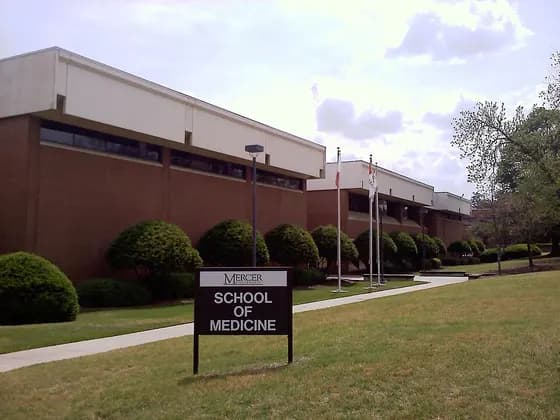
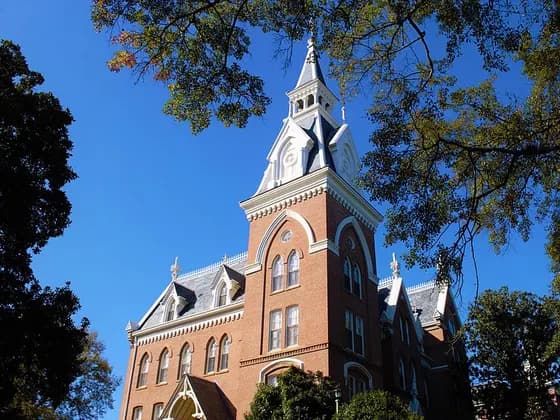
Photo: Korea2006 · CC BY-SA 3.0 · cropped
Photo: Korea2006 · CC BY-SA 3.0 · Photo: Brandon Dolley from Duluth, GA, United States · CC0 · Photo: NPS · Public domain
The Mercer University School of Medicine MD program at a glance (2027 entry)
Mercer University School of Medicine (MUSM), often called Mercer School of Medicine, offers a four-year Doctor of Medicine (MD) program run from its original campus in Macon, Georgia. The school opened in 1982 and graduated its first class of doctors in 1986. Its stated mission is to educate doctors for the primary care and health care needs of rural, medically underserved Georgia.
Years 1 and 2 are taught through problem-based learning (PBL). Instead of learning mainly from lectures, small groups of students work through patient cases, decide what they need to learn and research it, with team-based sessions and a clinical skills course alongside. Mercer's 2026-27 catalog calls this preclinical phase the Patient-Based Learning (PBL) Curriculum.
You study at one of three campuses that teach all four years: Macon, Savannah or Columbus. For Years 3 and 4, some students move to clinical campuses inside partner hospitals: South Georgia Medical Center (SGMC Health) in Valdosta, in south Georgia, and Tanner Medical Center in Carrollton, in west Georgia.
Patients come early, and rural Georgia runs through the program. You practice on standardized patients, people trained to portray patients, from your first few weeks. Year 1 ends with a population health rotation in a rural community that you return to in Year 4.
Year 3 is a 48-week year built around core clerkships, the required clinical rotations, and you must first pass Step 1 of the United States Medical Licensing Examination (USMLE). Year 4 mixes required rotations with 20 weeks of electives, rotations you choose yourself. Two three-year tracks, the Primary Care Accelerated Track (PC-ACT) and the Rural Critical Need Accelerated Track (RCN-ACT) in psychiatry, lead early into residency, the specialty training after medical school.
| Degree | MD (Doctor of Medicine) |
|---|---|
| Program length | 4 years; three-year PC-ACT and RCN-ACT tracks for some students |
| Four-year campuses | Macon, Savannah and Columbus, Georgia |
| Clinical campuses (Years 3 and 4) | Valdosta (SGMC Health) and Carrollton (Tanner Health) |
| Curriculum | Patient-Based Learning (PBL) Curriculum in Years 1 and 2: small-group cases |
| Anatomy | Taught by body region in Block 1; gross anatomy lab on each four-year campus |
| First patient contact | Standardized patients in the first weeks; rural rotation at the end of Year 1 |
| Grading | Satisfactory/unsatisfactory; core clerkships honors, high pass, satisfactory or unsatisfactory |
| Step 1 timing | After Year 2, before clerkships; mid-2029 for 2027 entrants, on current schedule |
| Accreditation | LCME (accreditor of MD programs), full; next survey 2028-29 |
What makes the Mercer University School of Medicine MD program different
Problem-based learning since 1982
Mercer has taught the basic sciences through small-group PBL since it opened. Your work in the group is itself assessed: participation, interpersonal relationships, problem-solving and how you gather information all count.
A rural community you return to in Year 4
At the end of Year 1, the Population Health rotation (POH 600) places you in a rural, medically underserved community. You see how a physician there works, assess the community's health needs with research and epidemiology methods, and plan a population health initiative. In Year 4 the four-week POH 900 rotation takes you back to the same site to complete it.
Three full campuses and two hospital clinical campuses
Macon, Savannah and Columbus each teach all four years, with their own gross anatomy lab, simulation center and standardized-patient exam rooms. Years 3 and 4 are also taught inside partner hospitals in Valdosta, since 2024, and Carrollton, since 2026, both serving largely rural regions.
Two three-year routes into residency
Students set on primary care can apply in Year 1 to PC-ACT, in family medicine, internal medicine or pediatrics; RCN-ACT does the same for psychiatry, at Columbus only. Both keep the standard first two years and finish the MD in three years.
Selective rural scholarships with leadership training
Two scholarships go to selected four-year MD students: Nathan Deal Scholars, since 2017, and Children's Rural Pediatric Scholars, since 2023 with Children's Healthcare of Atlanta. In return, scholars commit to four years of full-time practice in a medically underserved rural Georgia county after residency. Nathan Deal Scholars receive leadership training, and both join Mercer's rural health research and leadership development activities. Children's scholars also join a Scholars Summer Program.
How Mercer University School of Medicine teaches medicine
Years 1 and 2 form the preclinical phase. Each semester pairs a PBL block, which carries the basic sciences, with a Medical Practice course in clinical skills. The four blocks last 16 to 17 weeks and are divided into modules of four to six weeks.
Foundations of Medicine, the first block, emphasizes anatomy and clinical skills. The other three take the organ systems in turn, from normal function to disease, diagnosis and treatment.
Within each block, subjects such as anatomy, physiology, pathology and pharmacology are studied together through the cases rather than as separate courses. Ethics, population health and research methods, including statistics, run through the same blocks, with a focus on the needs of rural and other underserved communities.
The curriculum's objectives and assessment tools are identical on every campus, and distance-learning classrooms link Macon, Savannah and Columbus. Interprofessional education, where you learn with students of other health professions, and simulation-based clinical skills activities run through both preclinical years.
From Year 3 the teaching moves into clerkships, where you learn by caring for patients on wards and in clinics under supervision, with seminars in radiology and ethics built in.
The ways you will learn
| Problem-based learning groups | Eight or nine students and one faculty facilitator work through a clinical case. Each of you identifies learning issues and gathers information, then the group pulls the basic and clinical science together. The facilitator keeps the discussion relevant and at the right depth. |
|---|---|
| Large-group active learning | Whole-class sessions, such as team-based learning (TBL), build knowledge, tie the content together and practice teamwork. In TBL, teams apply what they have prepared beforehand to problems in class. |
| Medical Practice and standardized patients | You interview and examine standardized patients in exam rooms on your campus. They score you on checklists and give written feedback, and faculty can watch live or review recordings. |
| Point-of-care ultrasound | Bedside ultrasound is taught in Medical Practice 3 and 4, matched to the organ-system blocks: heart, lungs and kidneys, then the gastrointestinal, blood, hormone and reproductive systems. |
| Simulation | Every campus has a simulation lab with procedural task trainers and computerized manikins that respond to treatment. You practice skills such as IV catheter placement and lumbar puncture, run emergencies like cardiac arrest as a team and debrief afterwards. The labs are also open for self-directed practice. |
| Ethics and medical humanities | The Department of Bioethics and Medical Humanities, with faculty in Savannah, Columbus, Valdosta and Carrollton, teaches ethics and professionalism with a focus on rural and underserved care. |
How anatomy is taught at Mercer University School of Medicine
Anatomy is concentrated in your first semester. Foundations of Medicine (FOM 600) takes the body region by region over its four modules: the upper limb, the lower limb, the thorax and abdomen, then the pelvis. Histology, the study of tissue under the microscope, and embryology are taught in the same modules.
Macon, Savannah and Columbus each have a gross anatomy lab. The organ-system blocks of Years 1 and 2 return to the normal structure of each system before its diseases.
When you first meet patients at Mercer University School of Medicine
Clinical skills start within your first few weeks. In Medical Practice 1 you learn to take a full history and do a complete physical exam, from vital signs to the eyes, head and neck, heart, lungs and abdomen. You also learn to write a detailed clinical note.
Skills build each semester: neurological and musculoskeletal exams in Medical Practice 2, focused heart and lung exams in Medical Practice 3, then gastrointestinal and genitourinary exams and breaking bad news in Medical Practice 4. The emphasis moves from a complete exam to a focused one guided by clinical reasoning.
Real patients come in the POH 600 rotation at the end of Year 1, in a rural, medically underserved community, where you take part in clinical practice. Full-time clinical work starts with the Year 3 clerkships in late July, after Step 1.
The Mercer University School of Medicine curriculum, year by year
- Year 1
Foundations, then the nervous system and behavior
Year 1 opens with orientation on your home campus in early August and the White Coat Ceremony in Macon in September. Foundations of Medicine fills the fall and the first organ-system block the spring, and the year ends with the Population Health rotation in a rural community.
- Foundations of Medicine (FOM 600, 17 credits) has four modules. They pair upper limb anatomy with biochemistry, histology and cell biology; lower limb with embryology, genetics and cancer biology; thorax and abdomen with immunology, bacteria and parasites; pelvis with nutrition, ethics, viruses and fungi.
- Population health, statistics, rural health care needs and epidemiology are built into those four modules.
- Organ Systems Block 2 (ORG 610, 18 credits): the nervous system and special senses; behavioral health, family systems and the research process; then skin and the musculoskeletal system.
- Medical Practice 1 and 2 (MPRA 600 and 601) run alongside the two blocks.
- Population Health rotation (POH 600, 3 credits). The catalog's program outline calls it four weeks and its course listing three. On the 2026-27 calendar, each of its two sessions lasts about three weeks: May 17 to June 4, or June 1 to 18, 2027.
- Year 2
The remaining organ systems, then Step 1
Year 2 runs from early August to late May and completes the organ systems in two blocks. It closes with a three-week course that consolidates the preclinical sciences, followed by a study window for Step 1.
- Organ Systems Block 3 (ORG 700): cardiovascular (6 weeks), pulmonology (5 weeks), and renal with healthcare systems and the business of medicine (6 weeks). It includes a one-week interprofessional education block.
- Organ Systems Block 4 (ORG 710): gastroenterology, hematology and endocrinology, each paired with statistics, then reproduction.
- Medical Practice 3 and 4 (MPRA 700 and 701): focused exams, point-of-care ultrasound and breaking bad news.
- Emergency Medical Responders (EMR 600): after team simulations in your first three semesters, you learn to manage cardiac arrest, heart attack, stroke and other emergencies, practicing intubation and defibrillation. It ends with the Advanced Cardiac Life Support (ACLS) Megacode exam, a hands-on test of managing a simulated cardiac emergency.
- Application of Preclinical Science (APS 700; May 10 to 28 in 2027): clinical scenario questions, self-paced teaching sessions, coaching and a personal study plan. Students with borderline results, or a failed Block 3 or 4, take the more structured APS 701.
- Year 3
Six core clerkships
Year 3 runs for 48 weeks from late July. Clerkships fill two semesters, A and B, which can come in either order and blend hospital and outpatient care. A six-week summer term closes the year.
- Semester A: surgery (7 weeks) in clinics, the operating and recovery rooms, intensive care and the wards. Family medicine (7 weeks) mixes outpatient and inpatient care, and pediatrics (7 weeks) covers newborns to adolescents in clinic, ward and emergency settings.
- Semester B: internal medicine (10 weeks), with growing responsibility on wards and in primary care and specialty clinics. Psychiatry (5 weeks) includes mental illness in primary care and emergency settings, and obstetrics and gynecology lasts 5 weeks.
- Healthcare Systems (MED 800), one week in Semester B: clinical reasoning, the US health care system, patient safety, quality improvement, teamwork, leadership and the economics of chronic disease.
- MPRA Clinical Years and Telehealth Experience (MPRA 810): two weeks polishing history-taking, exam, clinical reasoning, presentation and telehealth skills, including the MPRA assessment. MPRA stands for Medical Practice Reasoning Assessment.
- A four-week patient care experience: a sub-internship, the required elective or another patient care elective, with a chance to meet residency programs at Mercer-affiliated sites. In a sub-internship you take on much of a first-year resident's work under supervision.
- Year 4
Required rotations, electives and the move to residency
Year 4 runs from July to late April, with commencement in early May. It opens with a one-week wellness course and ends with a Capstone course, leaving six weeks of unscheduled time for interviews and vacation.
- Population Health (POH 900): four weeks back at your Year 1 community site, completing your population health initiative and working alongside your preceptor, the community physician who supervises you, in the office and community.
- A four-week sub-internship and a four-week required elective in critical care, emergency medicine, or geriatrics and palliative care. Either can be done at another institution if it meets the equivalent Mercer course's requirements.
- At least 20 weeks of electives.
- Bioethics II (BIE 900) and a medical ethics paper, which the 2026-27 catalog requires of every Year 4 student. The school's Year 4 page, last updated in February 2025, describes the paper as a reflection on a single case from an ethical perspective.
- Capstone (MED 999), or a comparable one-week clinical skills boot camp, to prepare you for internship.
- Three-year tracks
PC-ACT and RCN-ACT Psychiatry
Two accelerated tracks compress the four-year objectives into three years and lead early into residency. You apply during Year 1, take the standard Year 1 and 2 courses, including Step 1, and add summer ACT blocks and longitudinal rotations.
- PC-ACT runs family medicine and internal medicine in Macon, Savannah and Columbus, and pediatrics in Macon and Savannah. The 2026-27 catalog compresses it into 135 weeks of instruction; the track's web page says 130.
- You apply after your first fall semester; the residency program you choose interviews applicants, and offers come in April. The plan is for graduates to complete residency at that host site.
- ACT 1, six summer weeks after Year 1 in your specialty department, reviews Year 1 and introduces your faculty mentors. In Year 2 you attend 18 half-day continuity clinics at your ACT site.
- ACT 2, a six-week modified clerkship after Year 2, counts as the whole pediatrics or family medicine clerkship, or part of internal medicine. A 49-week third year covers the other clerkships, some shortened, and a sub-internship.
- A PC-ACT student who fails Step 1 or a final clerkship shelf exam at the first attempt returns to the four-year program, as does one who becomes unsatisfactory anywhere in the curriculum. Shelf exams are national end-of-clerkship subject exams from the National Board of Medical Examiners (NBME).
- RCN-ACT Psychiatry, at Columbus only, starts with six summer weeks after Year 1 with St. Francis Hospital's psychiatry residency program. ACT 2 counts as the whole psychiatry clerkship. RCN-ACT students also take elective coursework in addiction medicine and emergency medicine, and a Transition to Residency course.
- Both tracks commit graduates to three years of full-time practice in a medically underserved rural Georgia county after residency.
How you are assessed at Mercer University School of Medicine
Everything except the Year 3 core clerkships is graded satisfactory or unsatisfactory on your transcript: Years 1 and 2, the other Year 3 courses and all of Year 4. The six core clerkships are graded honors, high pass, satisfactory or unsatisfactory. You need at least a satisfactory grade in every required course to graduate.
Grades rest on the program's six competencies: patient care and procedural skills, medical knowledge, interpersonal and communication skills, professionalism, practice-based learning and improvement, and systems-based practice. Every course of four weeks or more gives formative evaluations, feedback meant to help you improve rather than to grade you. Classroom exams run on your own laptop using ExamSoft testing software.
During the two-week MPRA 810 course at the end of Year 3, you take the MPRA: you see a series of standardized patients and write notes. You then present and discuss the cases one-on-one with clinical faculty, who give you feedback on your presentation, clinical reasoning and notes. The school reviews each student's performance and decides whether any remediation, extra work to fix a weakness, is needed. The catalog's accelerated-track rules also refer to final NBME shelf exams in clerkships.
The USMLE is the national exam series for medical licensure in the United States. Step 1 tests the sciences basic to medicine and has been reported only as pass or fail since January 26, 2022. Step 2 CK, for Clinical Knowledge, tests the clinical science you need to care for patients under supervision.
To sit Step 1 you must complete all of Year 2, including APS 700 or 701, and you must pass it to start Year 3. The catalog says a student who has not attempted it by the end of the first Year 3 term after becoming eligible, or passed it by the end of the second, is dismissed.
You must pass Step 2 CK to graduate. You become eligible with at least a satisfactory grade in five of the six core clerkships, including internal medicine, and no incomplete or unsatisfactory clerkship. You cannot sit it during a core clerkship.
- Mercer's latest posted calendar is for 2026-27; in 2025-26, late May to late July was set aside for Step 1.
- On the current schedule, a 2027 entrant would sit Step 1 between late May and late July 2029, before Year 3. Step 2 CK would follow the clerkships, which end in spring 2030, before graduation in spring 2031.
- In August 2026 the USMLE program announced a move to designated testing dates from January 2029, with Step exams offered less often each year. Its June 2026 notice had named 2028. Both exams for a 2027 entrant would fall after the change.
- The USMLE program has encouraged schools to review rules that restrict when students must test.
- Mercer has full accreditation from the Liaison Committee on Medical Education (LCME), which accredits MD programs in the United States. The LCME directory, updated October 14, 2026, lists 1982 as its first year of accreditation and 2028-29 for its next survey. All campuses come under that one accreditation.
- For MD students, enrollment in an LCME-accredited program is what makes you eligible for Step 1 and Step 2 CK. Osteopathic (DO) students and graduates of schools outside the United States qualify through other routes.
- Accelerated-track students sit Step 1 and Step 2 CK at times set by the Office of Academic Affairs.
Mercer University School of Medicine clinical rotations: where you will actually train
After acceptance you return a Campus Preference Request Form. Places at Macon, Savannah and Columbus are assigned first come, first served and cannot be guaranteed; if you miss your first and second choices you can join a wait list. You find your own housing, using online listings.
Each four-year campus has its own clinical partners, listed by city below. Clerkships also use other sites around Georgia, and a statewide network of community physician preceptors teaches students.
Valdosta and Carrollton are clinical campuses where students live and train for Years 3 and 4, in dedicated medical education units inside the partner hospitals. Each offers all the Year 3 core clerkships and electives, plus the Year 4 sub-internship, required elective and electives, with local clerkship directors and a simulation center for standardized-patient work. Students also rotate at other regional facilities.
Valdosta opened with SGMC Health in July 2024, when 17 third-year students moved there from Columbus, Macon and Savannah. Carrollton opened with Tanner Health in July 2026; its first seven third-year students, also from the three four-year campuses, began rotations in early August.
Rural training continues in the clinical years. In February 2025, Mercer announced a rural clerkship experience: at least two weeks of a core clerkship at a rural clinical site, rising to four weeks for the Class of 2028. It then listed 17 rural medical centers across Georgia as sites.
The school's original campus and administrative hub, on Mercer University's main campus. A four-year campus.
- Atrium Health Navicent
- Piedmont Macon Medical Center
A four-year campus since 2008, on the grounds of Memorial Health, a clinical partner since 1996.
- Memorial Health University Medical Center
A clinical campus from 2012 and a four-year campus since 2021, when its first class of 30 arrived. The only base for the RCN-ACT psychiatry track.
- Piedmont Columbus Regional
- St. Francis–Emory Healthcare
A Year 3 and 4 clinical campus inside the main SGMC Health hospital. SGMC's 15-county service area is largely rural.
- South Georgia Medical Center (SGMC Health)
A Year 3 and 4 clinical campus inside Tanner Medical Center. Tanner Health has hosted Mercer students for population health rotations since 1992, and for rural clerkships in Carrollton and Villa Rica.
- Tanner Medical Center
Population health rotations in rural, medically underserved communities in Years 1 and 4, and rural clerkship experiences during Year 3.
Electives, selectives and away rotations at Mercer University School of Medicine
Your first elective choice comes at the end of Year 3, in the four-week patient care experience. If you use it for the sub-internship or the required elective, you take an extra four-week patient care elective in Year 4 instead of repeating it.
Year 4, meant for rounding out your training and exploring specialties, needs at least 20 weeks of electives. At least 12 weeks must be patient care majority (PCR) electives, with half or more of the time spent caring directly for patients, and at least four of those weeks must be Mercer-sponsored. No more than 12 weeks in one sub-specialty count toward the 20.
You choose from Mercer's Senior Catalog or from courses at other medical schools and clinical sites. These away rotations, also called visiting student or audition rotations, need approval from the Year 4 director and a Year 4 subcommittee of the curriculum committee. If nothing fits, you can propose a Student Generated Elective with a sponsoring faculty member.
Dual degrees and research years at Mercer University School of Medicine
Every student completes a population health project. The PBL blocks teach the methods it needs, from the research process to statistics and epidemiology, and you plan the project in POH 600 and finish it in POH 900.
Beyond that, research is open to any student. Summer Scholars offers six weeks of faculty-mentored research, plus a week of vacation, in the summer after Year 1 on any campus. Projects range from bench science and community health to clinical studies, case reports and medical education, with weekly professional development sessions and a final presentation.
The Landings Cancer Research Scholars program follows the same summer pattern but is limited to cancer bench research on the Savannah campus, ending with a talk at the Mercer Joint Research Conference. A six-week Maternal Health Observership at the Georgia Rural Health Innovation Center lets rising second-year students shadow providers in rural maternal health, with a journal club and publication work.
At other times you can volunteer on a faculty project or arrange outside research, such as opportunities identified by the Association of American Medical Colleges (AAMC) or the Grady STaR Program. Year 3 and 4 students can research during clinical rotations and electives. Each four-year campus has a director of student research, and students present at the Summer Research Enrichment Symposium, MU BEAR Day and the Joint Research Conference.
Mercer's undergraduate admissions site describes two routes into this MD for students who start college at Mercer. Mercer Medical Scholars complete a four-year bachelor's degree in an eligible major, then the four-year MD: eight years in all. Accelerated Mercer Medical Scholars finish their undergraduate requirements in three years, so the two degrees take seven years in all. Their Bachelor of Science in Biomedical Sciences is awarded after the first year of the MD.
Facilities and support at Mercer University School of Medicine
Where you will learn
Each four-year campus has small-group tutorial rooms for PBL, distance-learning classrooms, a simulation center, a clinical skills wing and a gross anatomy lab. Its Skelton Medical Library branch is open around the clock with your Mercer ID. The clinical skills wings have 16 exam rooms in Macon, 13 in Savannah and 12 in Columbus.
Macon's Simulation Center covers 4,300 square feet. Columbus's 77,000-square-foot building, on a six-acre site by the Chattahoochee River, was completed in December 2021, and classes began there in January 2022. Its research labs are on the second floor. In Savannah the campus sits on the grounds of Memorial Health University Medical Center, steps from the hospital.
The libraries offer more than 17,000 online journals, 300,000 online books and 140 databases, point-of-care tools such as DynaMed and the Cochrane Library, and National Board study resources.
Mercer's simulation team, working with engineering faculty and students, designed low-cost 3D-printed trainers for cricothyrotomy, an emergency airway through the front of the neck, and for chest tube insertion. They are used at the Savannah and Valdosta campuses, and medical students in the Summer Scholars program helped develop them.
A new building is planned in downtown Macon. At the November 2025 groundbreaking, Mercer said the school would move from its 126,000-square-foot main-campus building into a 150,000-square-foot one, with three- and five-story wings around a courtyard, expected to open in fall 2028. It also said Macon's MD enrollment had grown from 96 to 240 since 1982.
Support while you study
Student Affairs has an associate dean on each four-year campus, led by a senior associate dean for all campuses. The deans hold individual career counseling and academic advising sessions and guide you through residency applications. That includes the Medical Student Performance Evaluation (MSPE), a summary of your record sent to programs, which you can review before it goes out.
Bear Buddies groups provide near-peer mentoring, with at least six sessions across the semesters of Years 1 to 3, as older students mentor younger ones. Bears Prepare sessions in the same semesters cover academic advising, ethics and professionalism, career counseling, financial planning and wellness. Career planning follows the AAMC's Careers in Medicine program.
Academic Success Counselors see any student one-on-one about study skills, organization, time management and Step preparation, and run group sessions on USMLE study. In 2023 the school created an associate dean role for academic achievement, to monitor every MD student's progress, direct mentoring by trained faculty advisors and run Step 1 and Step 2 preparation programs.
A Director of Wellness serves all campuses, and wellness teaching at orientation and Bears Prepare half days covers physical, emotional, spiritual, professional and financial health. Students have a 24-hour crisis support line, an anonymous line for reporting mistreatment, and named health and counseling services for the Macon, Savannah, Columbus and Valdosta campuses.
Aid for the Impaired Medical Student (AIMSS), run by a council that includes two peer-elected students from each MD class, supports students struggling with stress or substance use and helps them find treatment. If you ask for help with a substance use problem yourself, or discuss it with a personal therapist inside or outside Mercer, that information is kept confidential. It is not used in decisions about whether you stay in the program or move up a year.
Is the Mercer University School of Medicine program right for you?
This program may suit you if
- You learn best by working through cases in a small group and researching your own learning issues, as PBL groups of eight or nine do in Years 1 and 2.
- You want to practice in rural or underserved Georgia and would value a rural community rotation in Year 1 that you return to in Year 4.
- You want a choice of three campuses that each teach all four years, and would be open to clinical years at a hospital campus in Valdosta or Carrollton.
- You are sure about family medicine, internal medicine, pediatrics or psychiatry and want to finish the MD in three years through PC-ACT or RCN-ACT.
- You want hands-on skills early: standardized patients in your first weeks, point-of-care ultrasound and an ACLS Megacode exam before clerkships.
Things to think about
- Step 1 is a firm gate: you must pass it to begin Year 3, and the catalog sets dismissal deadlines for attempting and passing it.
- Campus places are assigned first come, first served from a preference form and cannot be guaranteed, so you may not get your first choice.
- PBL asks you to direct much of your own study. If you prefer lectures to lead, the first two years will feel different.
- If you join a three-year track or accept a rural scholarship, you commit to three or four years of full-time practice in a medically underserved rural Georgia county after residency.
- Clinical years in Valdosta or Carrollton mean moving partway through the program, and you arrange your own housing wherever you study.
Mercer University School of Medicine MD program — frequently asked questions
Applying to Mercer University School of Medicine?
How to get into Mercer University School of Medicine
Prerequisites, MCAT, AMCAS personal statement, secondaries and interview, step by step.
Open the guide →Mercer University School of Medicine admissions profile
MCAT and GPA profile, acceptance rate, interview format and key dates.
See the profile →Compare Mercer University School of Medicine with other schools
Put the teaching style, anatomy teaching and clinical sites next to another school.
Open the comparison →Prepare for the Mercer University School of Medicine interview
Format breakdown, school-specific sample questions and prep tips from tutors who interviewed here.
Read the guide →Where this Mercer University School of Medicine program guide came from
This guide was written from 63 official sources — Mercer University School of Medicine's own program pages and curriculum documents, plus the accreditor and the hospitals and health systems the school trains students in where they publish detail — read on 2026-10-19, then checked claim by claim against those sources.
- Mercer School of Medicine: Doctor of Medicine (MD program page)
- Mercer School of Medicine: Year I and II, PBL
- Mercer School of Medicine: Year IV, Clinical (page modified February 2025; used only for the ethics paper description)
- Mercer School of Medicine: Medical Practice
- Mercer School of Medicine: Clinical Skills Practice
- Mercer University 2026-2027 Graduate Catalog: Doctor of Medicine
- Mercer University 2026-2027 Graduate Catalog: Primary Care Accelerated Track (PC-ACT)
- 2026-2027 Graduate Catalog: FOM 600, Foundations of Medicine, Block 1
- 2026-2027 Graduate Catalog: ORG 610, Organ Systems, Block 2
- 2026-2027 Graduate Catalog: POH 600, Population Health
- 2026-2027 Graduate Catalog: POH 900, Population Health
- 2026-2027 Graduate Catalog: MPRA 810, MPRA Clinical Years and Telehealth Experience
- 2026-2027 Graduate Catalog: School of Medicine, message from the dean
- Mercer School of Medicine: Registrar's Office, 2026-27 academic calendar
- Mercer School of Medicine: 2025-2026 MD and PC-ACT academic calendars (PDF)
- Mercer School of Medicine: Standardized Patient Program
- Mercer School of Medicine: Simulation Lab
- Mercer School of Medicine: Campus Locations
- Mercer School of Medicine: Macon Campus
- Mercer School of Medicine: Macon Campus facilities
- Mercer School of Medicine: Savannah Campus
- Mercer School of Medicine: Savannah Campus Facilities
- Mercer School of Medicine: Columbus Campus
- Mercer School of Medicine: Columbus Campus Facilities
- Mercer School of Medicine: Columbus Expansion and construction updates
- Mercer School of Medicine: Academic Clinical Partners
- Mercer School of Medicine: LCME Accreditation
- Mercer School of Medicine: Message from the Dean
- Mercer School of Medicine: Vision, Mission and Values
- Mercer School of Medicine: Accepted Students (campus preference, orientation, housing)
- Mercer School of Medicine: Rural Health Scholarships and accelerated tracks
- Mercer School of Medicine: Primary Care Accelerated Track Program
- Mercer School of Medicine: Rural Critical Need Accelerated Track Program, Psychiatry
- Mercer School of Medicine: Nathan Deal Scholars Program
- Mercer School of Medicine: Children's Rural Pediatric Scholarship
- Mercer University Admissions: Mercer Medical Scholars Program (Mercer Medical Scholars and Accelerated Mercer Medical Scholars)
- Mercer School of Medicine: Bioethics and Medical Humanities
- Mercer School of Medicine: Technology Requirements (ExamSoft testing)
- Mercer School of Medicine: Student Research
- Mercer School of Medicine: Student Research FAQ
- Mercer School of Medicine: Student Affairs and Services
- Mercer School of Medicine: Academic Advising (Bear Buddies, Bears Prepare)
- Mercer School of Medicine: Career Counseling and Residency Planning Program
- Mercer School of Medicine: Student Wellness
- Mercer School of Medicine: Aid for the Impaired Medical Student (AIMSS)
- Mercer School of Medicine: Events and Ceremonies
- Mercer news, July 2024: Valdosta Clinical Campus and Simulation Lab open
- Mercer news, July 2026: Carrollton Clinical Campus and Simulation Lab open
- Mercer news, August 2025: partnership with Tanner Health for a Carrollton clinical campus
- Mercer news, February 2025: population health rotation and rural clerkship experience
- Mercer news, August 2023: new roles in Academic Affairs
- Mercer news, February 2026: low-cost simulation devices for rural training
- Mercer news, November 2025: groundbreaking for a new medical school building in downtown Macon
- Mercer University Profile 2025-2026 (PDF)
- LCME: Accredited Programs directory (updated October 14, 2026)
- LCME: About the School Directory
- USMLE: Updated Timeline for Designated Testing Dates, transition in January 2029 (August 6, 2026)
- USMLE: Designated Testing Dates Information Hub (dates the January 2029 announcement August 6, 2026)
- USMLE: Transition to Limited Testing Dates Each Year Starting in 2028 (June 23, 2026, since updated)
- USMLE: Step 1 Transition to Pass/Fail Only Score Reporting
- USMLE: Step 1 overview
- USMLE: Step 2 CK overview
- NBME: Clinical Science Subject Exams (end-of-clerkship shelf exams)
Curricula are restructured between cycles. Anything here that decides your application — how anatomy is taught, a clinical campus assignment, a required research year — should be confirmed against the official page for your entry year.
Applying to Mercer University School of Medicine?
We help US applicants with MCAT strategy, the AMCAS personal statement, secondary essays and interview prep — everything you need for a competitive Mercer University School of Medicine application.